The Particle Physics Opera

Posted in Opera, The Universe and Stuff on March 26, 2025 by telescoper

I thought I’d use the excuse that I’m teaching particle physics again to revive an old idea linking that subject to Mozart’s Opera The Magic Flute (Die Zauberflöte, K. 620).

I can’t remember how many times I have seen this opera performed nor in how many different productions. It’s a wonderful creation because it manages to combine being utterly daft with being somehow immensely profound. The plot makes no sense at all, the settings are ridiculous (e.g. “rocks with water and a cavern of fire”), and the whole thing appears to be little more than a pantomime. Since it’s Mozart, though, there is one ingredient you can’t quibble with: a seemingly unending sequence of gorgeous music.

When I first saw The Magic Flute I thought it was just a silly but sublime piece of entertainment not worth digging into too deeply. I wondered why so many pompous people seemed to take it so terribly seriously. Real life doesn’t really make much sense, so why would anyone demand that an opera be any less ridiculous? Nevertheless, there is a vast industry devoted to unravelling the supposed “mystery” of this opera, with all its references to magic and freemasonry.

But now I can unveil the true solution of problem contained within the riddle encoded in the conundrum that surrounds the enigma that has puzzled so many Opera fans for so long. I have definitive proof that The Magic Flute is not about freemasons or magic or revolutionary politics. It is actually about particle physics.

To see how I arrived at this conclusion note the following figure which shows the principal elementary particles contained within the standard model of particle physics:

To the left of this picture are the fermions, divided into two sets of particles labelled “quarks” and “leptons”. Each of these consists of three pairs (“doublets”), each pair defining a “generation”. This structure of twos and threes is perfectly represented in the cast The Magic Flute.

Let’s consider the leptons first. These can be clearly identified with the three ladies who lust after the hero Tamino in Act 1. This emotional charge is clearly analogous to the electromagnetic charge carried by the massive leptons (the electron, muon and tauon, lying along the bottom of the diagram). The other components in the leptonic sector must be the three boys who pop up every now and again to help Papageno with useful advice about when to jangle his magic bells. These must therefore be the neutrinos, which are less massive than the ladies, and are also neutral (although I hesitate to suggest that this means they should be castrati). They don’t play a very big part in the show because they participate only in weak interactions.

Next we have the quarks, also arrayed in three generations of pairs. These interact more strongly than the leptons and are also more colourful. The first generation is easy to identify, from the phenomenology of the Opera, as consisting of the hero Tamino (d for down) and his beloved Pamina (u for up); her voice is higher than his, hence the identification. The second generation must comprise the crazy birdcatcher Papageno (s for strange) and his alluring madchen who is called Papagena (c for charmed). That just leaves the final pairing which clearly is the basso profundo and fount of all wisdom Sarastro (b for bass bottom) and my favourite character and role model the Queen of the Night (t for top).

To provide corroboration of the identification of the Queen of the Night with the “top” quark, here is a clip from Youtube of a bevy of famous operatic sopranos having a go at the immensely different coloratura passage from the Act 1 aria “O Zittre Nicht, mein leiber Sohn” culminating in a spectacular top F that lies beyond the range of most particle accelerators, never mind singers.

There’s some splendid frocks in there too.

The Queen of the Night isn’t actually in the Opera very much. After this aria in Act 1 she disappears until the middle of Act 2, probably because she needs to have a lie down. When she comes back on she sings another glass-shattering aria (Der Hölle Rache kocht in meinem Herzen), which I like to listen to when I’m writing referee reports. The first line translates as “The rage of hell is boiling in my heart”.

The remaining members of the cast – The Speaker and Monostatos, as well as sundry priests, slaves, enchanted animals and the chorus – must make up the so-called Force carriers at the left of the table, which are bosons, but I haven’t had time to go through the identifications in detail. They’re just the supporting cast anyway. And there is one particle missing from the picture, the Higgs boson. This accounts for the masses of other particles by exerting a kind of drag on them so it clearly must be the Dragon from Act 1.

In the Good Books

Posted in Biographical, Literature with tags , , , , on March 25, 2025 by telescoper

It seems like eternity since I was on sabbatical and had enough time to get stuck in to some reading not related to work. Since I got back from Barcelona last September I’ve lapsed and haven’t read many books since then. I keep reading reviews in the Times Literary Supplement but that’s as close as I generally get.

It’s been in my mind for a while to rejuvenate my interest in literature but last week I had two specific triggers. One was the news that Amazon has opened a dedicated website in Ireland. I view that as a trigger not in a positive way but because it will make life even harder for our excellent local bookshop in Maynooth so I felt I should do more to support them. The other trigger was that the Irish Times published a list of the “best” 100 Irish novels of the 21st Century. When I saw I had only read a few of them, and feel I should read more contemporary literary fiction emanating from Ireland, I decided I should use the list as a guide to help me get back into a reading habit. Anyway, I went to the bookshop last week and bought these six to start with:

These aren’t the top six, by the way. They’re just the ones that caught my fancy while I was browsing in the store.

I’m going to start with Claire Keegan’s novella Foster, as it was this work that inspired the beautiful Irish language film An Cailín Ciúin which I blogged about here. It’s quite short, so it should provide me with a relatively gentle re-introduction to reading. I have’t decided in what sequence I will read the others. It remains to be seen when I can get another six let alone how long it will take for me to read all the books on the list!

Any comments on these books, or indeed any others either on the top 100 list or not would be welcome!

Not in Leiden…

Posted in Biographical, The Universe and Stuff with tags , , on March 24, 2025 by telescoper

It’s been a very busy day back to teaching after last week’s study break. This week there’s a big meeting in Leiden (Netherlands) which I would like to have attended as it combines the annual Euclid Consortium meeting with the 56th ESLAB Symposium. No doubt there’ll be a lot of discussion of the Euclid Q1 results announced last week. I can’t go, however, because of teaching commitments. The Euclid meetings are quite often scheduled in the summer, so I have a chance to attend, but not this time.

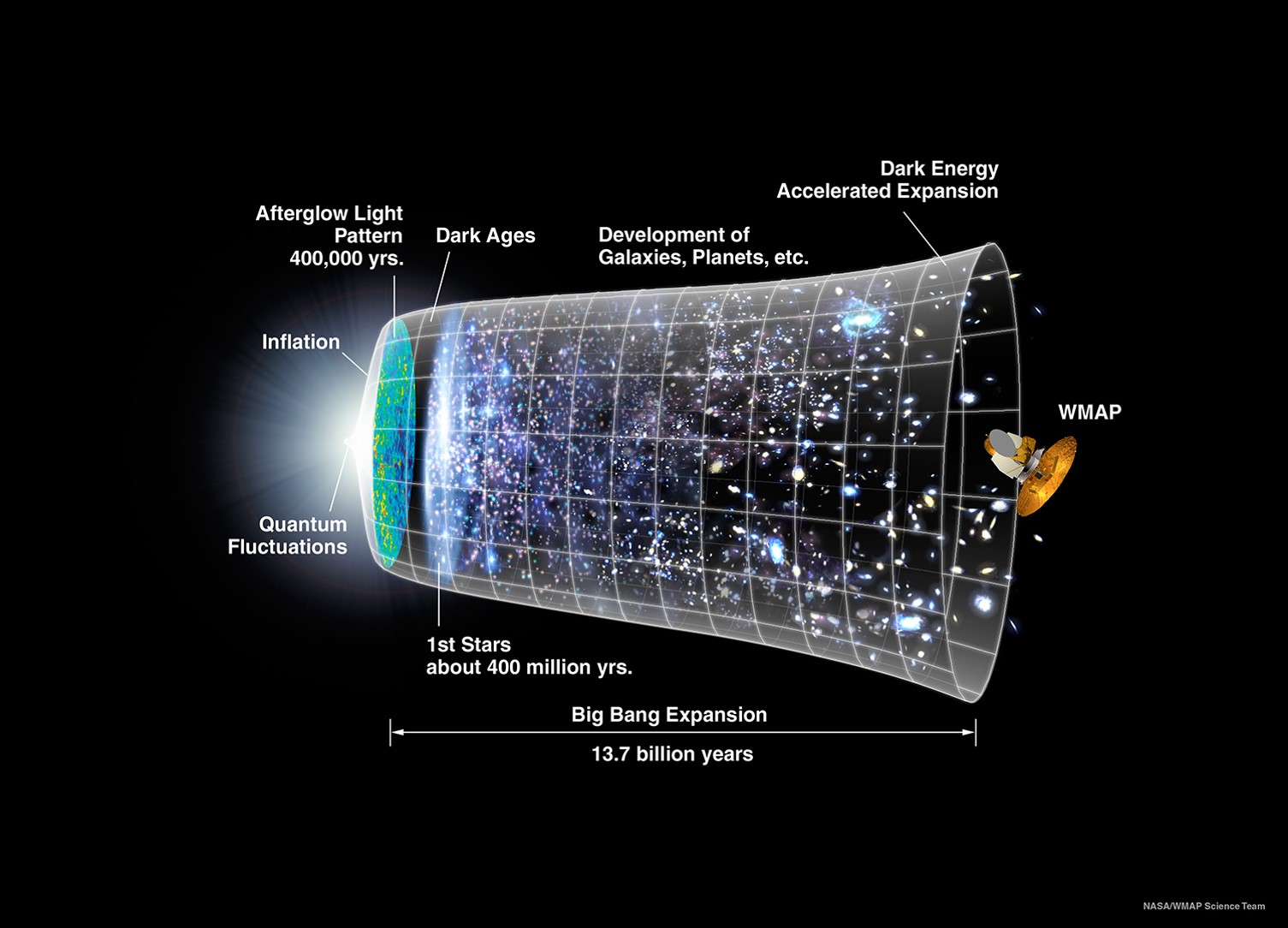
Anyway, I thought I would post a relevant memory from a previous trip to Leiden, about 30 years ago. which was taken at a conference in Leiden (Netherlands) in 1995. Was that really 30 years ago? Various shady characters masquerading as “experts” were asked by the audience of graduate students at a summer school to give their favoured values for the cosmological parameters (from top to bottom: the Hubble constant, density parameter, cosmological constant, curvature parameter and age of the Universe):

From left to right we have Alain Blanchard (AB), Bernard Jones (BJ, standing), John Peacock (JP), me (yes, with a beard and a pony tail – the shame of it), Vincent Icke (VI), Rien van de Weygaert (RW) and Peter Katgert (PK, standing). You can see on the blackboard that the only one to get anywhere close to correctly predicting the parameters of what would become the standard cosmological model was, in fact, Rien van de Weygaert…

INO The Flying Dutchman

Posted in Opera with tags , , , , on March 23, 2025 by telescoper

And so it came to pass that this afternoon I took the bus into Dublin to catch the first performance of Irish National Opera’s new production of Richard Wagner‘s The Flying Dutchman (or Der fliegende Holländer to give its proper title) at the romantically named Bord Gáis (Gas Board) Energy Theatre. It wasn’t exactly the first night, as the performance started at 5pm, but it did have a first night feel to it, with a smattering of media types in the full house.

The event took a bizarre twist at the interval, which was after Act 1. I’d only just collected my glass of wine when the fire alarm went off and we were told to leave the building. Amusingly, some of the cast joined us outside too, in costume. It was a false alarm, but the precautionary exodus extended the interval by about 15 minutes or so. When we were making our way back in, I overheard a nearby wit say “Never mind: worse things happen at sea”. Given the plot of the opera, that seemed a very apt comment.

The Flying Dutchman is an early composition by Wagner, first performed in 1843 when Wagner was only 30 years old. It’s much more of a conventional opera than his later music dramas. At least to my ears there are passages that sound a lot like Verdi, especially those featuring the chorus. It’s also quite short: it’s often performed without an interval, but even with one (and a fire alarm to boot) it’s only about three hours. On the other hand, there are some manifestations of things to come, especially the frequent use of a leitmotif whenever the eponymous Dutchman appears or is mentioned.

The story is set somewhere on the coast of Norway. This production has an intriguing preamble while the famous overture is playing. While the menfolk are away at sea, the women of a coastal village are going about their business. Among them is a little girl in a striking red coat. Shades of Schindler’s List, I thought. The little girl turns out to be “Little Senta”, a representation of the innocence of Senta, the leading female character.

The opera proper begings on a ship captained by a man called Daland which has been driven off course by a storm and is sheltering at anchor. While the crew are taking some rest, another ship appears beside and The Dutchman climbs onto Daland’s ship to have a look around. He meets Daland, explains that he is exiled from Holland, is fed up with travelling the seas all alone. He showers Daland with gifts and asks if he can marry Daland’s daughter, Senta. Daland is very keen to have a rich son-in-law and speedily gives his consent.

Meanwhile, back onshore, we’re in Act II. Senta is revealed to be obsessed with a portrait of the Flying Dutchman, a man cursed to wander the oceans until he finds a woman prepared to be completely faithful to him. She has known about this legendary figure since she was a child and wants to be the person who saves him from his fate. One person not happy about this is Erik, an impoverished hunter who himself wants to marry Senta. Eventually Daland’s and the Dutchman’s ships come home. Senta is overwhelmed to meet the Dutchman in person and consents to marry him.

Act III begins with a big party at which the sailor’s on Daland’s ship get drunk and try to get the crew of the Dutchman’s ship to reveal themselves, initially to no avail because they are ghosts. When they do appear it’s not a pretty sight. Erik comes back and tries to convince Senta to stay with him instead of mmarrying the Dutchman. The Dutchman overhears them and interprets their discussion as a betrayal in progress. He tells Senta to forget the whole thing and jumps on board his ship which descends into the sea. Heartbroken, Senta throws herself into the water after him, and drowns.

In the closing stages, Senta has changed is wearing a striking red coat just like Little Senta wore at the beginning. When Senta dies, Little Senta’s lifeless body appears suspended from a rope in the middle of the stage, symbolising her sacrifice and shattered dreams.

In a very strong cast, James Cresswell (bass) was an outstanding Daland, but others were fine too: Gavan Ring (tenor) was The Steersman, Jordan Shanahan (baritone) The Dutchman, Carolyn Dobbin (mezzo) Mary, Giselle Allen (soprano) Senta, Toby Spence (tenor) Erik and the non-singing part of Little Senta was engagingly played by Caroline Wheeler. The Orchestra and Chorus of Irish National Opera were also in fine form.

The set design by Francis O’Connor was relatively simple but highly effective: the only significant change after Act I (see picture above) was the wheelhouse to the right was removed and a lighthouse placed further towards the rear, from which Senta took her plunge at the end. There was some dramatic use of animated back-projections too.

This is the first time I’ve seen this opera. I was very impressed with the performance, both musically and dramatically. If anyone is thinking of trying their first taste of Wagner then they could do much worse than this production, but they’ll have to hurry – there are just three more performances in Dublin (Tuesday 25th, Thursday 27th and Saturday 29th March).

P.S. I usually go by train into Dublin for concerts and other performances, but there are two buses that go all the way from Maynooth to the Grand Canal Quay, which is where the Bord Gáis Energy Theatre is located so I thought I’d try them out. I took a C4 in and a C3 home, both journeys being pleasantly uneventful.

Crossword Solution and Problem

Posted in Crosswords, mathematics with tags , , , , on March 22, 2025 by telescoper

I got an email last week pointing out that I had won another prize in the Times Literary Supplement crossword competition 1565. They have modernised at the TLS, so instead of sending a cheque for the winnings, they pay by bank transfer and wanted to check whether my details had changed since last time. You can submit by email nowadays too, which saves a bit in postage.

Anyway, I checked this week’s online edition and found this for proof:

I checked when I last won this competition, which I enter just about every week, and found that it was number 1514, almost exactly a year ago. There are 50 competitions per year rather than 52, because there are double issues at Christmas and in August, so it’s actually just over a year (51 puzzles) since I last won. I’ve won the crossword prize quite a few times but haven’t been very careful at keeping track of the dates. I think it’s been about once a year since I started entering.

All this suggested to me a little problem I devised when I was teaching probability and statistics many years ago:

Let’s assume that  the same number of correct entries, N, is submitted for each competition. The winner each time is drawn randomly from among these N. If there are 50 competitions in a year and I submit a correct answer each time, winning once in these 50 submissions, then what can I infer about N?

Answers on a postcard, via email, or, preferably, via the Comments!

Weekly Update at the Open Journal of Astrophysics – 22/03/2025

Posted in OJAp Papers, Open Access, The Universe and Stuff with tags , , , , , , , , , , , , on March 22, 2025 by telescoper

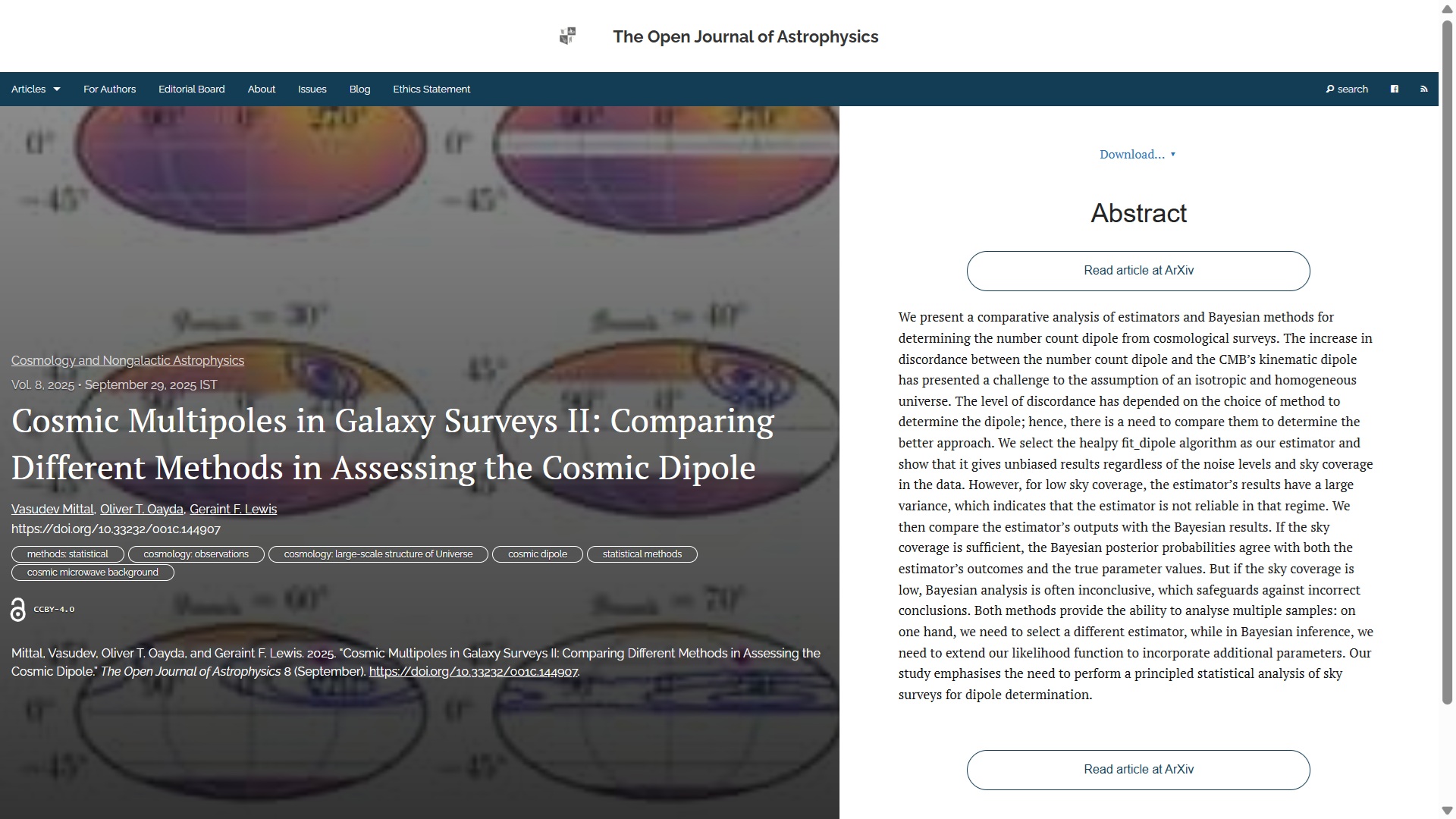
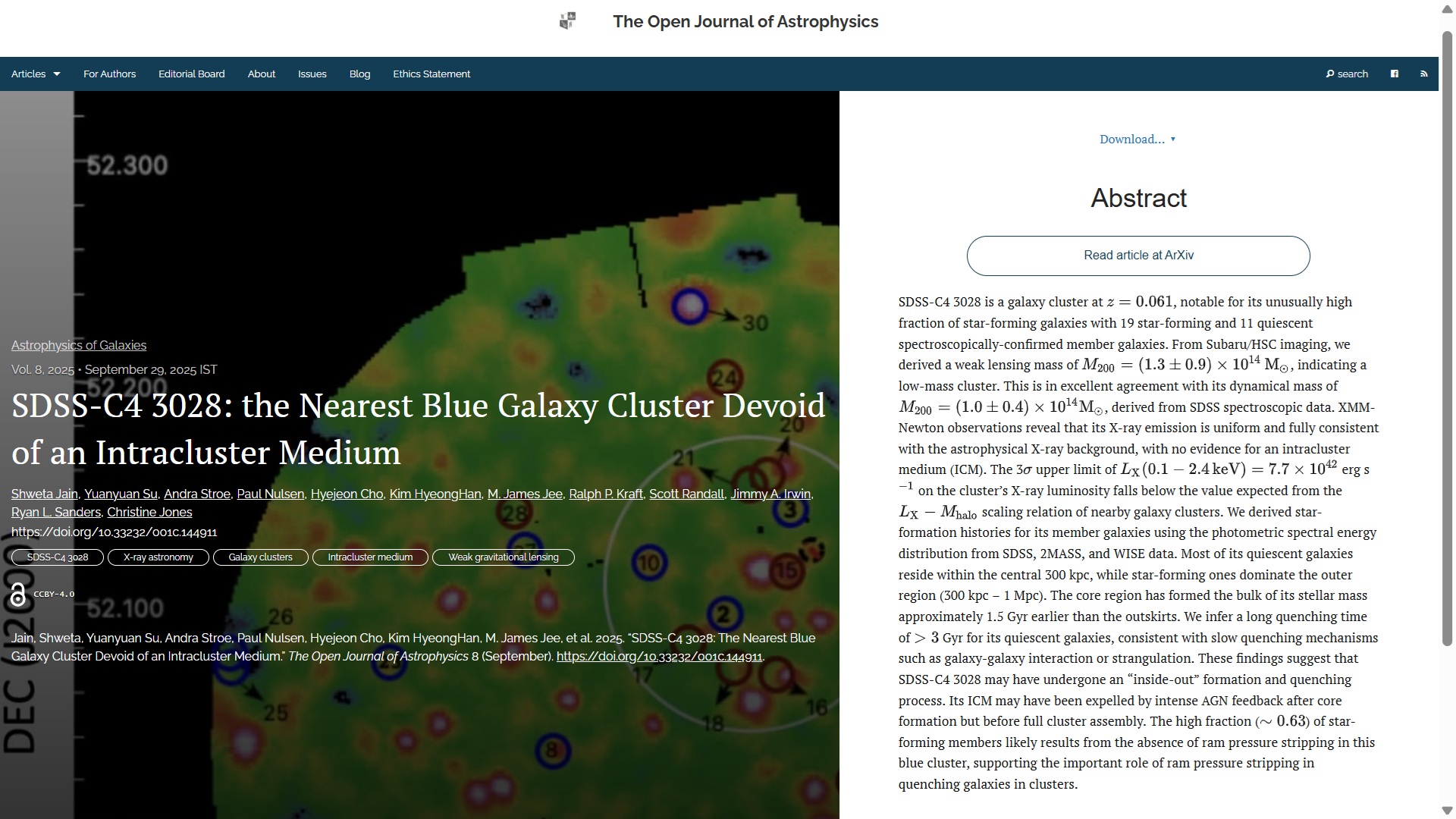
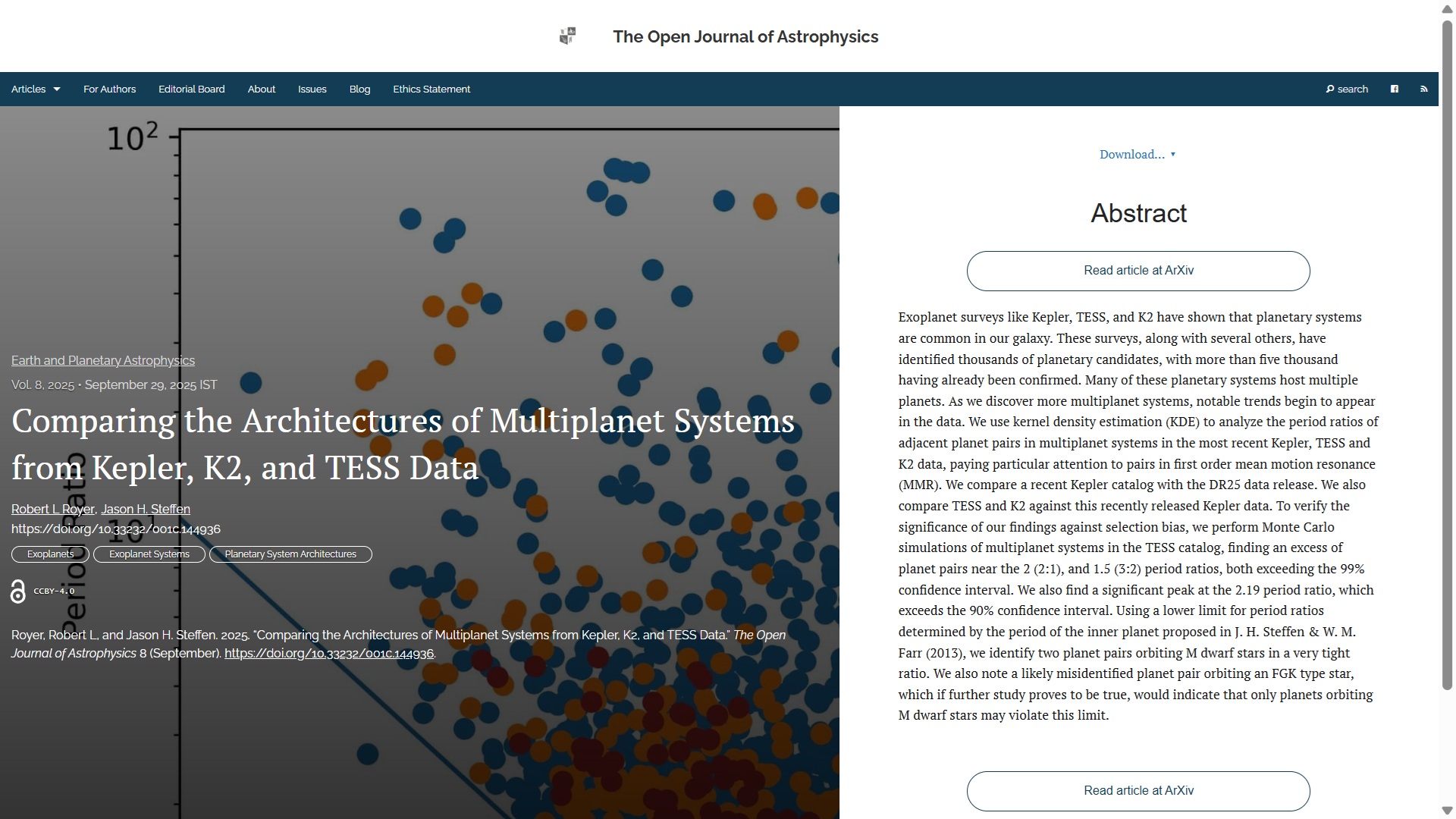
It’s Satuday morning once again, and time for another update of papers published at the Open Journal of Astrophysics. Since the last update we have published two papers, which brings the number in Volume 8 (2025) up to 29 and the total so far published by OJAp up to 264.

The papers we have published this week are connected by the theme of black holes and their role in galaxy formation, which is a very hot topic nowadays!

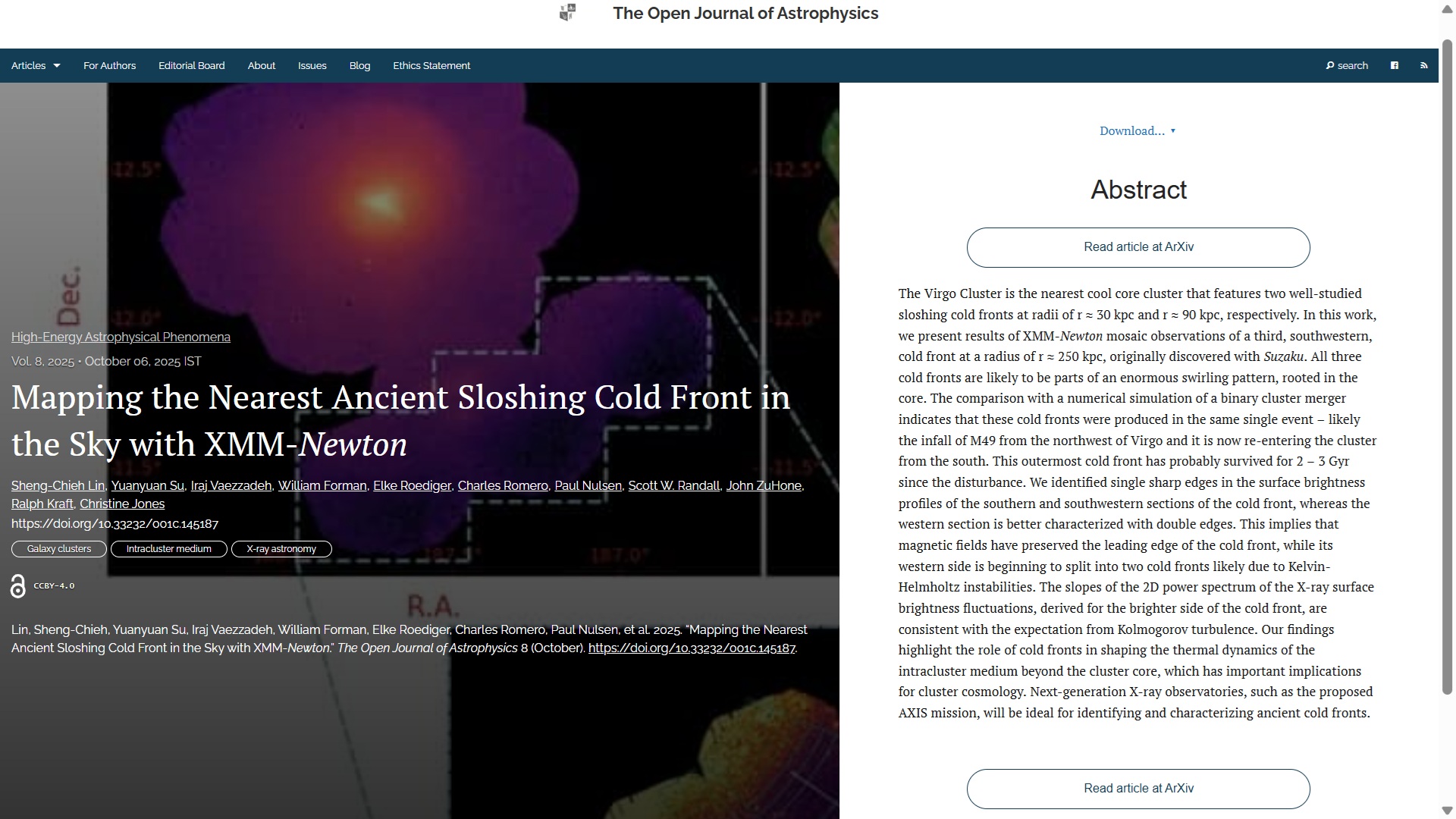
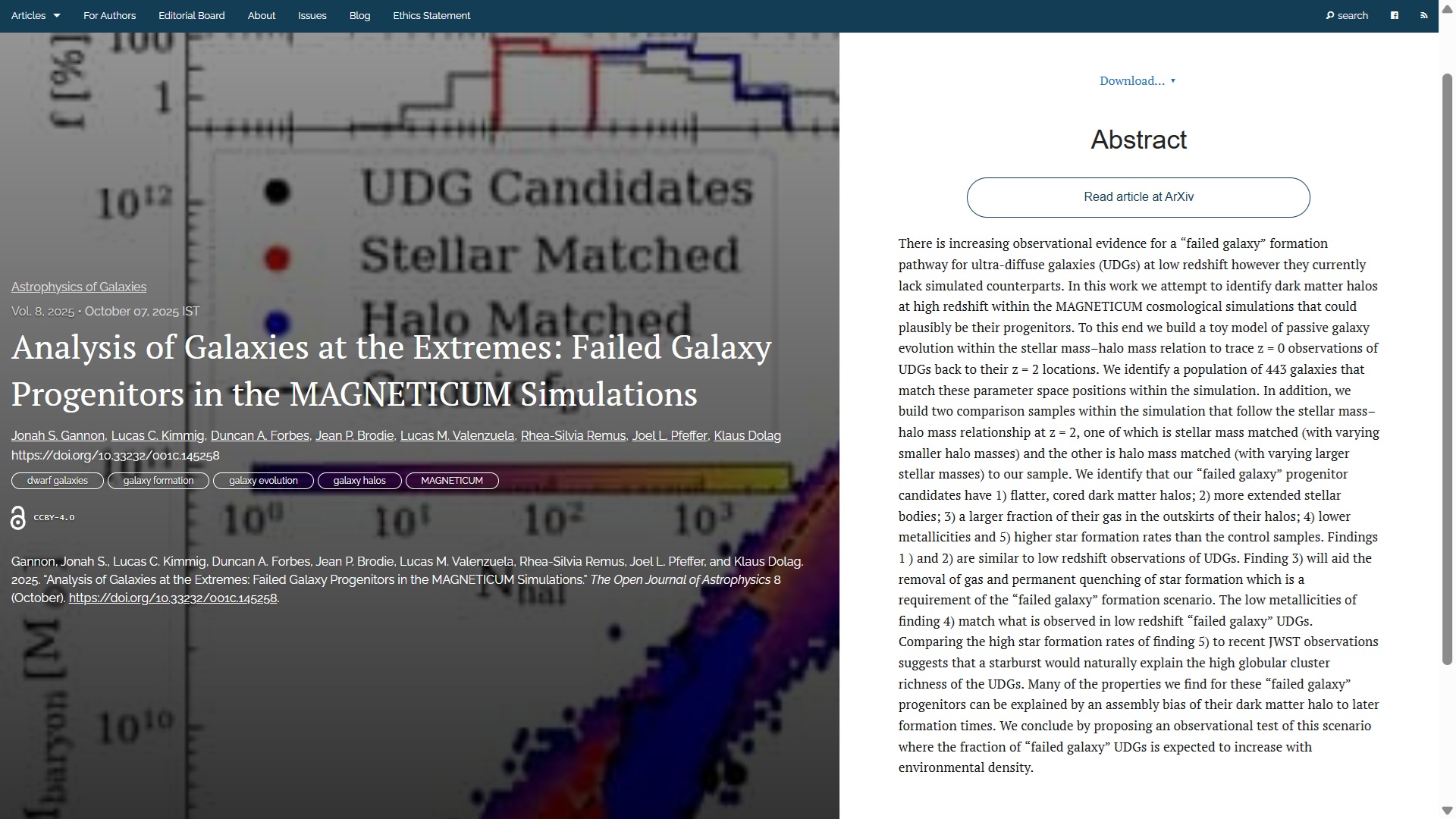
The first paper to report is “Hawking Radiation from non-evaporating primordial black holes cannot enable the formation of direct collapse black holes” by Jonathan Regan, Marios Kalomenopoulos and Kelly Kosmo O’Neil of the University of Nevada, USA. This paper, which is based on an undergraduate thesis, is a study of the irradiating effects of primordial black holes and a discussion of whether these might influence the subsequent formation of supermassive black holes. It is in the section marked Astrophysics of Galaxies, and was published on Tuesday  18th March.

The overlay is here:

and you can find the final accepted version on arXiv here.

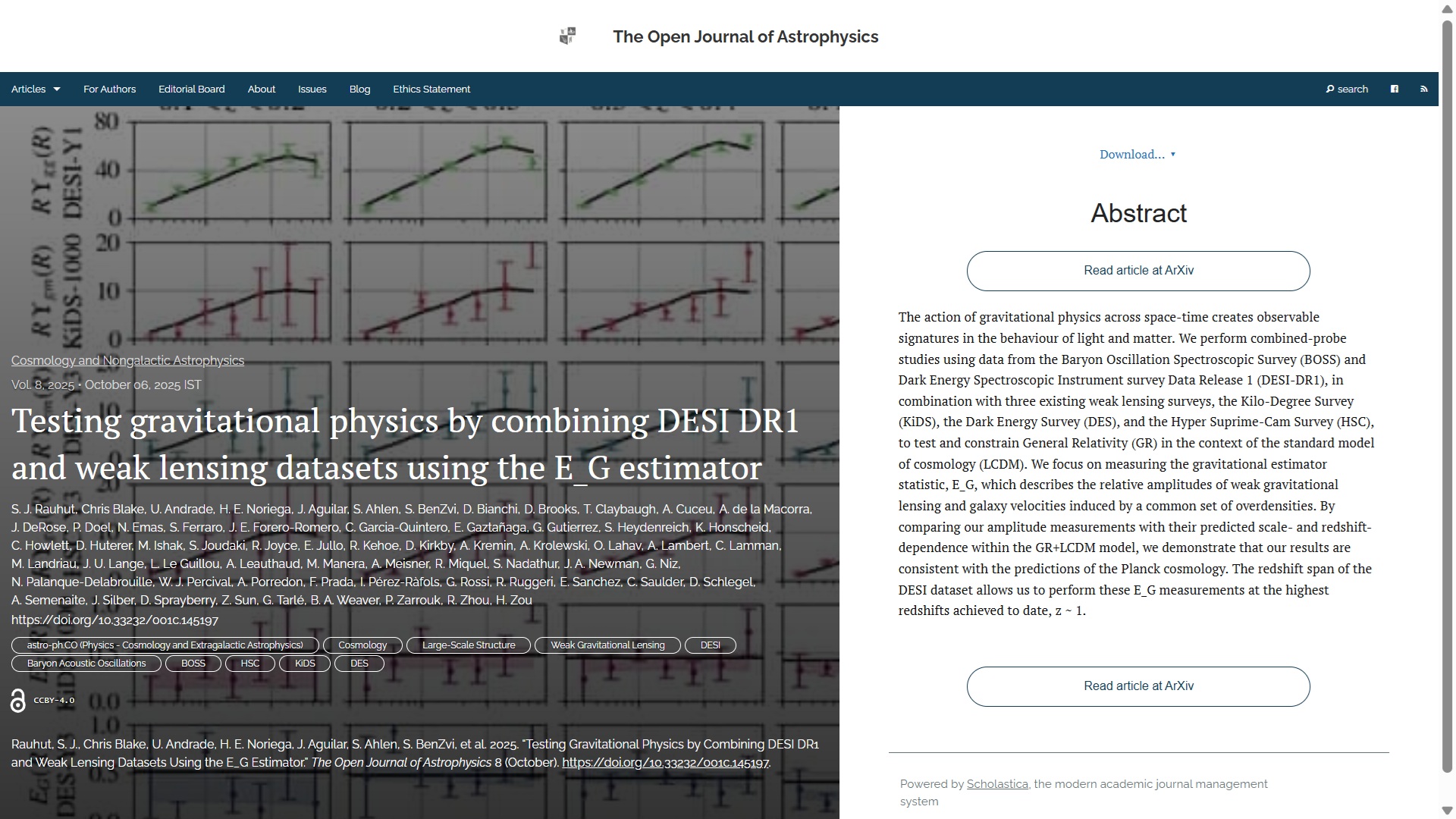
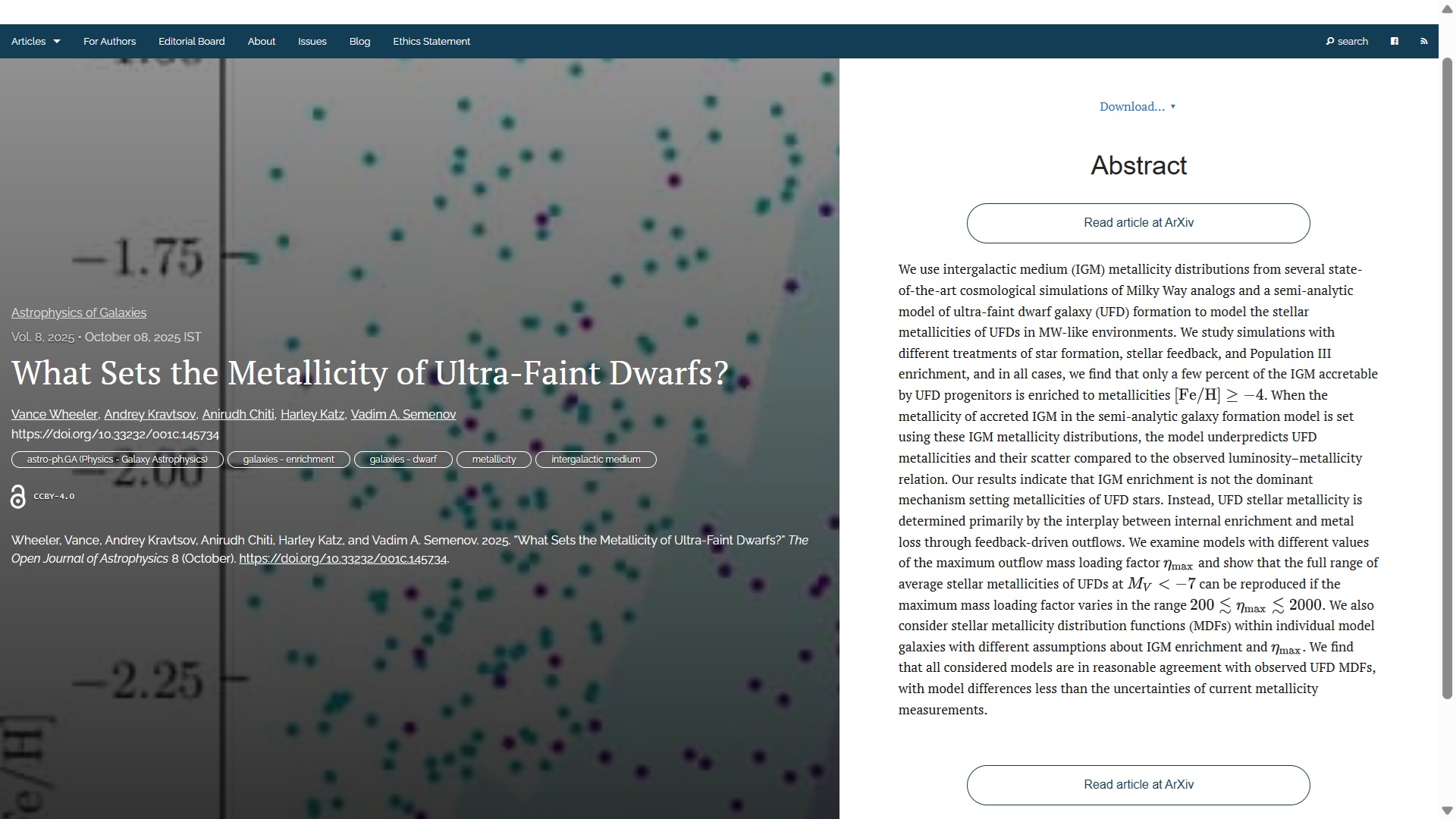
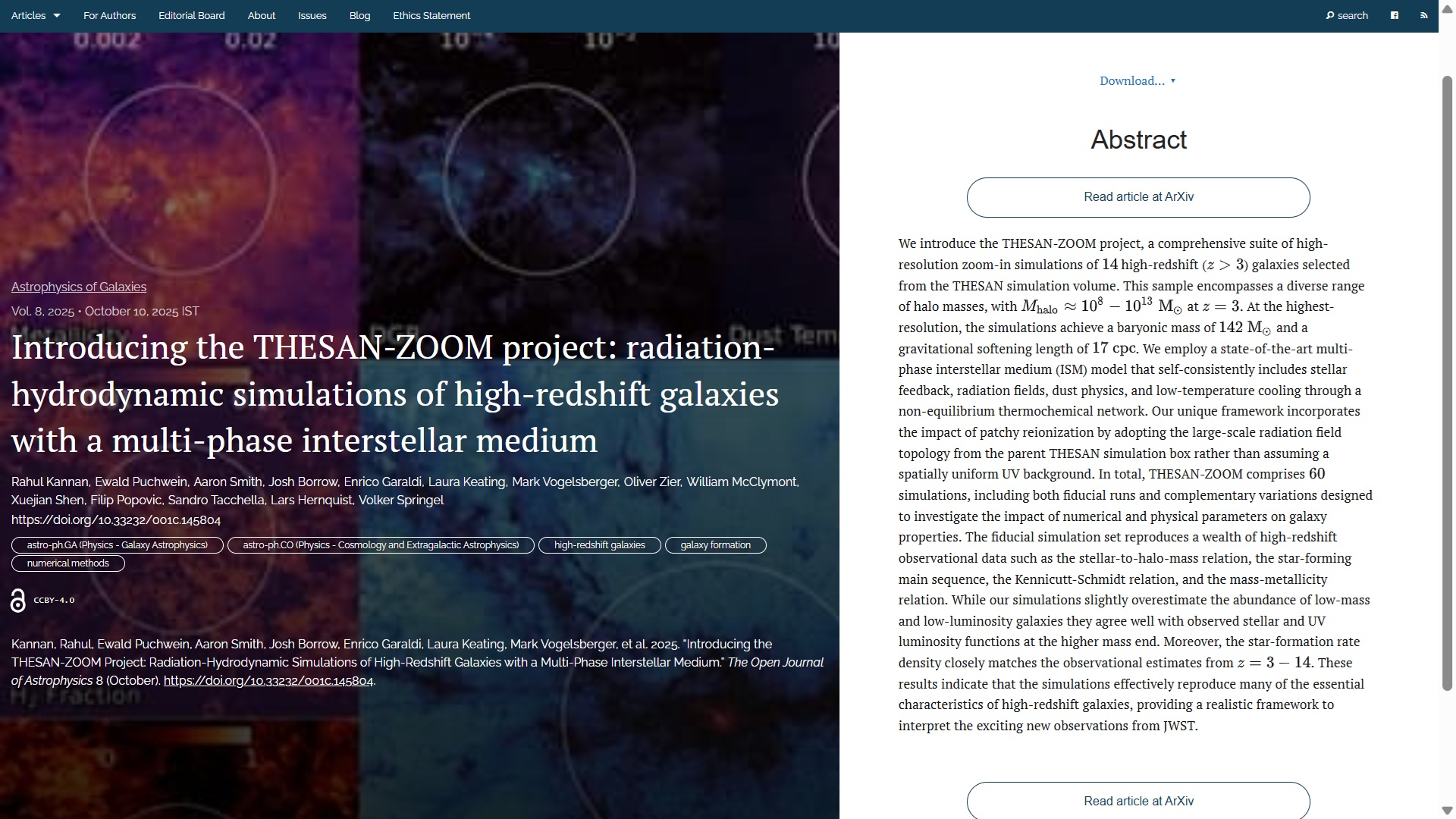
The second paper, which was published on Wednesday 19th March and is also in the folder Astrophysics of Galaxies, is “First Light and Reionization Epoch Simulations (FLARES) – XV: The physical properties of super-massive black holes and their impact on galaxies in the early universe” by Stephen Wilkins & Jussi K. Kuusisto (U. Sussex, UK), Dimitrios Irodotou (Institute of Cancer Research, UK), Shihong Liao (Beijing, China) Christopher C. Lovell (Portsmouth, UK), Sonja Soininen (Insitute of Cancer Research), Sabrina C. Berger (Melbourne, Australia), Sophie L. Newman (Portsmouth, UK), William J. Roper (Sussex), Louise T. C. Seeyave (Sussex), Peter A. Thomas (Sussex) and Aswin P. Vijayan Sussex). This paper uses cosmological hydrodynamical zoom simulations to study the formation of supermassive black holes and their impact on star formation in the early Universe.

Here is the overlay, which you can click on to make larger if you wish:


You can read the officially accepted version of this paper on arXiv here.

That’s all for this week. It’s been a bit frustrating for me as Managing Ediutor, because we have built up a backlog of several papers that were accepted for publication some time ago, but are still waiting for the authors to place the final version on arXiv. I hope these won’t take too long to appear, not least because I would like to clear my workflow on the Scholastica platform!

Meta Theft

Posted in Art, Books, Television with tags , , , , , , on March 21, 2025 by telescoper

Beware, all thieves and imitators of other people’s labour and talents, of laying your audacious hands upon our work.

Albrecht Dürer, 1511

I’ve remembered that quotation since it was uttered by Inspector Morse in the episode Who Killed Harry Field? Albrecht Dürer wasn’t referring to Artificial Intelligence when he said it, but it does seem pertitent to what’s going on today.

There’s an article in The Atlantic about a huge database of pirated work called LibGen that has been used by Mark Zuckerberg’s corporation Meta to train its artificial intelligence system. Instead of acquiring such materials from publishers – or, Heaven forbid, authors! – they decided simply to steal it. That’s theft on a grand scale: 7.5 million books and 81 million research papers.

The piece provides a link to LibGen so you can search for your own work there. I searched it yesterday and found 137 works by “Peter Coles”. Not all of them are by me, as there are other authors with the same name, but all my books are there, as well as numerous research articles, reviews and other pieces:

I suppose many think I should be flattered that my works are deemed to be of sufficiently high quality to be used to train a large language model, but I’m afraid I don’t see it that way at all. I think, at least for the books, this is simply theft. I understand that there may be a class action in the USA against Meta for this larceny, which I hope succeeds.

I think I should make a few points about copyright and authorship. I am a firm advocate of open access to the scientific literature, so I don’t think research articles should be under copyright. Meta can access them along with everyone else on the planet. It’s not really piracy if it’s free anyways. Although it would be courteous of Meta to acknowledge its sources, lack of courtesy is not the worst of Meta’s areas of misconduct.

In a similar vein, when I started writing this blog back in 2008 I did wonder about copyright. Over the years, quite a lot of my ramblings here have been lifted by journalists, etc. Again a bit of courtesy would have been nice. I did make the decision, however, not to bother about this as (a) it would be too much hassle to chase down every plagiarist and (b) I don’t make money from this site anyway. As far as I’m concerned as soon as I put anything on here it is in the public domain. I haven’t changed that opinion with the advent of ChatGPT etc. Indeed, I am pretty sure that all 7000+ articles from this blog were systematically scraped last year.

Books are, however, in a different category. I have never made a living from writing books, but it is dangerous to the livelihood of those that do to have their work systematically stolen in this way. I understand that there may be a class action in the USA against Meta for this blatant larceny, which I hope succeeds.

Cosmology Results from DESI

Posted in Astrohype, The Universe and Stuff with tags , , , , , , on March 20, 2025 by telescoper

Yesterday evening (10pm Irish Time) saw the release of new results from the Dark Energy Spectroscopic Instrument (DESI), completing a trio of major announcements of cosmological results in the space of two days (the Atacama Cosmology Telescope and the Euclid Q1 release being the others). I didn’t see the DESI press conference but you can read the press release here.

There were no fewer than eight DESI papers on the astro-ph section of the arXiv this morning. Here are the titles with links:

You can see from the titles that the first seven of these relate to the second data release (DR2; three years of data) from DESI; the last one listed here is a description of the first data release (DR1), which is now publicly available.

Obviously there is a lot of information to digest in these papers so here are two members of the DESI collaboration talking with Shaun Hotchkiss on Cosmology Talks about the key messages from the analysis of Baryon Acoustic Oscillations (the BAO in the titles of the new papers):

A lot has been made in the press coverage of these results about the evidence that the standard cosmological model is incomplete; see, e.g., here. Here are a few comments.

As I see it, taken on their own, the DESI BAO results are broadly consistent with the ΛCDM model as specified by the parameters determined by the Cosmic Microwave Background (CMB) inferred from Planck. Issues do emerge, however, when these results are combined with other data sets. The most intriguing of these arises with the dark energy contribution. The simplest interpretation of dark energy is that it is a cosmological constant (usually called Λ) which – as explained here – corresponds to a perfect fluid with an equation-of-state p=wρc2 with w=-1. In this case the effective mass density of the dark energy ρ remains constant as the universe expands. To parametrise departures from this constant behaviour, cosmologists have replaced this form with the form w(a)=w0+wa(1-a) where a(t) is the cosmic scale factor. A cosmological constant Λ would correspond to a point (w0=-1, wa=0) in the plane defined by these parameters, but the only requirement for dark energy to result in cosmic acceleration is that w<-1/3, not that w=-1.

The DESI team allow (w0, wa) to act as free parameters and let the DESI data constrain them, either alone or in combinations with other data sets, finding evidence for departures from the “standard values”. Here’s an example plot:

The DESI data don’t include the standard point (at the intersection of the two dashed lines) but the discrepancy gets worse when other data (such as supernovae and CMB) are folded in, as in this picture. The weight of evidence suggests a dark energy contribution which is decreasing with time.

These results are certainly intriguing, and a lot of credit is due to the DESI collaboration for working so hard to identify and remove possible systematics in the analysis (see the papers above) but what do they tell us about ΛCDM?

My view is that we’ve never known what the dark energy actually is or why it is so large that it represents 70% of the overall energy density of the Universe. The Λ in ΛCDM is really just a place-holder, not there for any compelling physical reason but because it is the simplest way of accounting for the observations. In other words, it’s what it is because of Occam’s Razor and nothing more. As with any working hypothesis, the standard cosmological model will get updated whenever new information comes to light (as it is doing now) and/or if we get new physical insights into the origin of dark energy.

Do the latest observations cast doubt on the standard model? I’d say no. We’re seeing an evolutionary change from “We have no idea what the dark energy is but we think it might be a cosmological constant” to “We still have no idea what the dark energy is but we think it might not be a cosmological constant”.

The Vernal Equinox 2025

Posted in Biographical, Maynooth, The Universe and Stuff with tags , , on March 20, 2025 by telescoper
Loughcrew Cairn: for a few days on and around the vernal equinox the rays of the rising Sun penetrate the passage and illuminate the back stone.

Just a quick note to mention that the Vernal Equinox (Spring Equinox) in the Northern hemisphere happens this morning, Thursday 20th March 2025, at 9.01 UTC (which is 9.01am local time here in Ireland, i.e. in about half an hour). Many people in the Northern hemisphere regard the Vernal Equinox as the first day of spring; of course in the Southern hemisphere, this is the Autumnal Equinox.

The date of the Vernal Equinox is often given as 21st March, but in fact it has only been on 21st March twice this century so far (2003 and 2007); it was on 20th March in 2008, has been on 20th March every spring from then until now, and will be until 2044 (when it will be on March 19th).

Anyway, people sometimes ask me how one can define the `equinox’ so precisely when surely it just refers to a day on which day and night are of equal length, implying that it’s a day not a specific time? The answer is that the equinox is defined by a specific event, the event in question being when the plane defined by Earth’s equator passes through the centre of the Sun’s disk (or, if you prefer, when the centre of the Sun passes through the plane defined by Earth’s equator). Day and night are not necessarily exactly equal on the equinox, but they’re the closest they get. From now until the Autumnal Equinox, days in the Northern hemisphere will be longer than nights, and the days will continue get longer until the Summer Solstice before beginning to shorten again.

P.S. This time last year I was in Barcelona. Time passes.

Q1 Day – Euclid’s First ‘Quick’ Data Release

Posted in Euclid, The Universe and Stuff with tags , , , on March 19, 2025 by telescoper

Today is Q1 Day! This means the first public release of data from the full Euclid Survey. It’s only a very small portion (0.4%) of the survey – just 63 square degrees on the sky, while the full survey will be over 14,000 square degrees – but in contrast to earlier data releases, this has been passed through the full Euclid Ground Segment so it represents the true quality of the data we can expect for the rest of the mission. There are no actual cosmology results yet – there isn’t enough data to address the key science goals of Euclid – but there are some great illustrations of the many byproducts of a survey of this type.

Update: here’s one of the Cosmology Talks video by Shaun Hotchkiss with two members of the Euclid Consortium commenting on today’s data release:

As well as the splash of press coverage likely to follow the lifting of today’s embargo, there will be a deluge of Q1-related papers hit the arXiv on 20th March. You can find details here.

Here’s a gallery of pretty pictures released today. These are low resolution versions; try opening the image in a new tab to see it without the caption. You can find and explore higher resolution images on ESASky (see below). Picture credits are: ESA/Euclid/Euclid Consortium/NASA, image processing by J.-C. Cuillandre, E. Bertin, G. Anselmi for the first six images, then ESA/Euclid/Euclid Consortium/NASA, image processing by M. Walmsley, M. Huertas-Company, J.-C. Cuillandre for the next two (bottom row); and ESA/Euclid/Euclid Consortium/NASA; ESA/Gaia/DPAC; ESA/Planck Collaboration for the last one.

I’m taking the liberty to append the official ESA Press Release, which follows:

–o–

On 19 March 2025, the European Space Agency’s Euclid mission released its first batch of survey data, including a preview of its deep fields. Here, hundreds of thousands of galaxies in different shapes and sizes take centre stage and show a glimpse of their large-scale organisation in the cosmic web.

Covering a huge area of the sky in three mosaics, the data release also includes numerous galaxy clusters, active galactic nuclei and transient phenomena, as well as the first classification survey of more than 380,000 galaxies and 500 gravitational lens candidates compiled through combined artificial intelligence and citizen science efforts. All of this sets the scene for the broad range of topics that the dark Universe detective Euclid is set to address with its rich dataset.

“Euclid shows itself once again to be the ultimate discovery machine. It is surveying galaxies on the grandest scale, enabling us to explore our cosmic history and the invisible forces shaping our Universe,” says ESA’s Director of Science, Prof. Carole Mundell.

“With the release of the first data from Euclid’s survey, we are unlocking a treasure trove of information for scientists to dive into and tackle some of the most intriguing questions in modern science. With this, ESA is delivering on its commitment to enable scientific progress for generations to come.”

Tracing out the cosmic web in Euclid’s deep fields

Euclid has scouted out the three areas in the sky where it will eventually provide the deepest observations of its mission. In just one week of observations, with one scan of each region so far, Euclid already spotted 26 million galaxies. The farthest of those are up to 10.5 billion light-years away. The fields also contain a small population of bright quasars that can be seen much farther away. In the coming years, Euclid will pass over these three regions tens of times, capturing many more faraway galaxies, making these fields truly ‘deep’ by the end of the nominal mission in 2030. 

But the first glimpse of 63 square degrees of the sky, the equivalent area of more than 300 times the full Moon, already gives an impressive preview of the scale of Euclid’s grand cosmic atlas when the mission is complete. This atlas will cover one-third of the entire sky – 14 000 square degrees – in this high-quality detail.

“It’s impressive how one observation of the deep field areas has already given us a wealth of data that can be used for a variety of purposes in astronomy: from galaxy shapes, to strong lenses, clusters, and star formation, among others,” says Valeria Pettorino, ESA’s Euclid project scientist. “We will observe each deep field between 30 and 52 times over Euclid’s six year mission, each time improving the resolution of how we see those areas, and the number of objects we manage to observe. Just think of the discoveries that await us.”

To answer the mysteries it is designed for, Euclid measures the huge variety of shapes and the distribution of billions of galaxies very precisely with its high-resolution imaging visible instrument (VIS), while its near-infrared instrument (NISP) is essential for unravelling galaxy distances and masses. The new images already showcase this capability for hundreds of thousands of galaxies, and start to hint at the large-scale organisation of these galaxies in the cosmic web. These filaments of ordinary matter and dark matter weave through the cosmos, and from these, galaxies formed and evolved. This is an essential piece in the puzzle towards understanding the mysterious nature of dark matter and dark energy, which together appear to make up 95% of the Universe.

“The full potential of Euclid to learn more about dark matter and dark energy from the large-scale structure of the cosmic web will be reached only when it has completed its entire survey. Yet the volume of this first data release already offers us a unique first glance at the large-scale organisation of galaxies, which we can use to learn more about galaxy formation over time,” says Clotilde Laigle, Euclid Consortium scientist and data processing expert based at the Institut d’Astrophysique de Paris, France.

Humans and AI classify more than 380 000 galaxies

Euclid is expected to capture images of more than 1.5 billion galaxies over six years, sending back around 100 GB of data every day. Such an impressively large dataset creates incredible discovery opportunities, but huge challenges when it comes to searching for, analysing and cataloguing galaxies. The advancement of artificial intelligence (AI) algorithms, in combination with thousands of human citizen science volunteers and experts, is playing a critical role.

“We’re at a pivotal moment in terms of how we tackle large-scale surveys in astronomy. AI is a fundamental and necessary part of our process in order to fully exploit Euclid’s vast dataset,” says Mike Walmsley, Euclid Consortium scientist based at the University of Toronto, Canada, who has been heavily involved in astronomical deep learning algorithms for the last decade.

“We’re building the tools as well as providing the measurements. In this way we can deliver cutting-edge science in a matter of weeks, compared with the years-long process of analysing big surveys like these in the past,” he adds.

A major milestone in this effort is the first detailed catalogue of more than 380 000 galaxies, which have been classified according to features such as spiral arms, central bars, and tidal tails that infer merging galaxies. The catalogue is created by the ‘Zoobot’ AI algorithm. During an intensive one-month campaign on Galaxy Zoo last year, 9976 human volunteers worked together to teach Zoobot to recognise galaxy features by classifying Euclid images. 

This first catalogue released today represents just 0.4% of the total number of galaxies of similar resolution expected to be imaged over Euclid’s lifetime. The final catalogue will present the detailed morphology of at least an order of magnitude more galaxies than ever measured before, helping scientists answer questions like how spiral arms form and how supermassive black holes grow.

“We’re looking at galaxies from inside to out, from how their internal structures govern their evolution to how the external environment shapes their transformation over time,” adds Clotilde.

“Euclid is a goldmine of data and its impact will be far-reaching, from galaxy evolution to the bigger-picture cosmology goals of the mission.”

Gravitational lensing discovery engine
Light travelling towards us from distant galaxies is bent and distorted by normal and dark matter in the foreground. This effect is called gravitational lensing and it is one of the tools that Euclid uses to reveal how dark matter is distributed through the Universe.

When the distortions are very apparent, it is known as ‘strong lensing’, which can result in features such as Einstein rings, arcs, and multiple imaged lenses.

Using an initial sweep by AI models, followed by citizen science inspection, expert vetting and modelling, a first catalogue of 500 galaxy-galaxy strong lens candidates is released today, almost all of which were previously unknown. This type of lensing happens when a foreground galaxy and its halo of dark matter act as a lens, distorting the image of a background galaxy along the line of sight towards Euclid

With the help of these models, Euclid will capture some 7000 candidates in the major cosmology data release planned for the end of 2026, and in the order of 100 000 galaxy-galaxy strong lenses by the end of the mission, around 100 times more than currently known.

Euclid will also be able to measure ‘weak’ lensing, when the distortions of background sources are much smaller. Such subtle distortions can only be detected by analysing large numbers of galaxies in a statistical way. In the coming years, Euclid will measure the distorted shapes of billions of galaxies over 10 billion years of cosmic history, thus providing a 3D view of the distribution of dark matter in our Universe.

“Euclid is very quickly covering larger and larger areas of the sky thanks to its unprecedented surveying capabilities,” says Pierre Ferruit, ESA’s Euclid mission manager, who is based at ESA’s European Space Astronomy Centre (ESAC) in Spain, home of the Astronomy Science Archive where Euclid’s data will be made available.

“This data release highlights the incredible potential we have by combining the strengths of Euclid, AI, citizen science and experts into a single discovery engine that will be essential in tackling the vast volume of data returned by Euclid.”

Notes to editors

As of 19 March 2025, Euclid has observed about 2000 square degrees, approximately 14% of the total survey area (14 000 square degrees). The three deep fields together comprise 63.1 square degrees. 

Euclid ‘quick’ releases, such as the one of 19 March, are of selected areas, intended to demonstrate the data products to be expected in the major data releases that follow, and to allow scientists to sharpen their data analysis tools in preparation. The mission’s first cosmology data will be released to the community in October 2026. Data accumulated over additional, multiple passes of the deep field locations will be included in the 2026 release.

The three deep field previews can now be explored in ESASky from 19 March 12:00 CET onwards:

The data release of 19 March 2025 is described in multiple scientific papers which have not yet been through the peer-review process, but which will be submitted to the journal Astronomy & Astrophysics. A preprint of the papers is available here from 19 March 12:00 CET.  

Find more detailed information about the data release here. 

About Euclid 

Euclid was launched in July 2023 and started its routine science observations on 14 February 2024. In November 2023 and May 2024, the world got its first glimpses of the quality of Euclid’s images, and in October 2024 the first piece of its great map of the Universe was released.

Euclid is a European mission, built and operated by ESA, with contributions from its Member States and NASA. The Euclid Consortium – consisting of more than 2000 scientists from 300 institutes in 15 European countries, the USA, Canada and Japan – is responsible for providing the scientific instruments and scientific data analysis. ESA selected Thales Alenia Space as prime contractor for the construction of the satellite and its service module, with Airbus Defence and Space chosen to develop the payload module, including the telescope. NASA provided the detectors of the Near-Infrared Spectrometer and Photometer, NISP. Euclid is a medium-class mission in ESA’s Cosmic Vision Programme.

Contact: ESA Media relations (media@esa.int)