The Day of St Patrick

Posted in History, Maynooth with tags , , , on March 17, 2025 by telescoper

Well, it’s St Patrick’s Day, which is a public holiday here in Ireland, so Lá Fhéile Pádraig sona daoibh go léir!
This morning I watched the Parade in Maynooth. It didn’t rain, but it was a strangely subdued affair notable for the lack of music. The isn’t much of an atmosphere if the participants are walking along in silence! You can’t have Craic agus Ceol if there’s no Ceol. I only counted two tractors too; usually there are many more than that. Fortunately, I have a calendar that offers a tractor for every month to make up for this disappointment. Still, it was good to see the kids enjoing themselves. The highlight for me this year was the Coakley Septic Tank Cleaning Truck, which just outdid the Thornton’s Refuse Collection Vehicle for sheer splendour.

Anyway, I should take the opportunity to write something about St Patrick. Not much is known for certain but it seems he was born in Britain, probably in the late 4th Century AD, probably somewhere around the Severn Estuary, and probably in Wales. It also appears that he didn’t know any Latin. When a young man, it seems he was captured by Celtic marauders coming up the River Severn and taken as a slave to Ireland. He eventually escaped back to Britain, but returned to Ireland as a missionary and succeeded somehow in converting the Irish people to Christianity.


Or did he? This interesting piece suggests his role was of lesser importance than many think.

However it happened, Ireland was the first country to be converted to Christianity that had never been part of the Roman Empire. That made a big difference to the form of the early Church here. The local Celtic culture was very loose and decentralized. There were no cities, large buildings, roads or other infrastructure. Life revolved around small settlements and farms. When wars were fought they were generally over livestock or grazing land. The early Irish Church that grew in this environment was quite different from that of continental Europe. It was not centralized, revolved around small churches and monasteries, and lacked the hierarchical structure of the Roman Church. Despite these differences, Ireland was quite well connected with the rest of the Christian world.Irish monks – and the wonderful illuminated manuscripts they created – spread across the continent, starting with Scotland and Britain. Thanks to the attentions of the Vikings few of these works survive but the wonderful Lindisfarne Gospels, dating from somewhere in the 8th Century were almost certainly created by Irish monks. The Book of Kells was probably created in Scotland by Irish Monks.

The traffic wasn’t entirely one-way however. A few years ago I saw a fascinating documentary about the Fadden More Psalter. This is a leather-bound book of Psalms found in a peat bog in 2006, which is of similar age to the Lindisfarne Gospels. It took years of painstaking restoration work to recover at least part of the text (much of which was badly degraded), but the leather binding turned out to hold a particularly fascinating secret: it was lined with papyrus. The only other books from the same period with the same structure that are known are from the Coptic Church in Egypt. That doesn’t mean that whoever owned the Fadden More Psalter had actually been to Egypt, of course. It is much more this book made its way to Ireland via a sort of relay race. On the other hand, it does demonstrate that international connections were probably more extensive than you might have thought.

Anyway, back to St Patrick’s Day. Saint Patrick’s Day is celebrated on March 17th, the reputed date of his death in 461 AD. Nobody really knows where St Patrick was born, though, so it would be surprising if the when were any better known. In any case, it wasn’t until the 17th Century that Saint Patrick’s feast day was placed on the universal liturgical calendar in the Catholic Church. Indeed, St Patrick has never been formally canonized. In the thousand years that passed any memory of the actual date of his birth was probably lost, so the choice of date was probably influenced by other factors, specifically the proximity of the Spring Equinox (which is this year on Thursday March 20th).

The early Christian church in Ireland incorporated many pre-Christian traditions that survived until roughly the 12th century, including the ancient festival of Ēostre (or Ostara), the goddess of spring associated with the spring equinox after whom Easter is named. During this festival, eggs were used a symbol of rebirth and the beginning of new life and a hare or rabbit was the symbol of the goddess and fertility. In turn the Celtic people of Ireland probably adapted their own beliefs to absorb much older influences dating back to the stone age. St Patrick’s Day and Easter therefore probably both have their roots in prehistoric traditions around the Spring Equinox, although the direct connection has long been lost.

Carabao Cup Winners!

Posted in Biographical, Football with tags , , on March 16, 2025 by telescoper

I’m old enough to remember when the Carabao Cup was called the League Cup, and I’m (just) old enough to remember Newcastle United winning the Fairs Cup in 1969.  I’m also old enough to remember countless cup final defeats, but I’m not old enough to remember the last time The Toon won a domestic trophy (the FA Cup in 1955), so today’s victory against Liverpool presents a unique opportunity to celebrate a Cup success. Even if it isn’t the most important piece of silverware, such an event is something I’d taken for granted I’d never be able to blog about!

As the late President Jimmy Carter put it, Howay the Lads!

Six Nations Rugby

Posted in Rugby with tags , , , , , , , , on March 16, 2025 by telescoper

Yesterday I watched the last round of matches in this years Six Nations rugby Championship so, as I did last year, I thought I would do a quick summary of the games and the competition as a whole.

In the first game yesterday, thanks largely to their own errors, Ireland struggled to beat a spirited Italian side in Rome 17-22. That put them briefly top of the table, but with fewer bonus points and a worse points difference than either England or France so needed both those teams to lose in order to win the Championship. Hope of that happening vanished quickly when England scored a try about 2 minutes into their game against Wales in Cardiff, quickly followed by another. England thereafter ran riot and won 68-14 taking them to the top. England did play well, but Wales were very poor. To be honest, I found the game a bit painful to watch. If it had been boxing the referee would have stopped the fight. Memories of the great Welsh teams of the past are very distant nowadays. It’s hard to see where they go from here, with their second successive Wooden Spoon.

Then it was time for the finale, France versus Scotland. I did think that France would win easily but Scotland gave it a good go, and were unlucky not to take a lead into half-time. They wilted in the second half, however, and France duly picked up a bonus point win and the Championship. They are worthy winners, and all credit to them.

(The atmosphere at the Stade de France last night was so raucous that I had difficulty hearing the commentators over the crowd noise. I find commentators rarely add much to the experience, so this isn’t a complaint. In fact, I think it would be good if TV broadcasts allowed the viewer to turn off the commentary but keep the sounds from the stadium.)

The only game France lost was against England on a rainy day at Twickenham on 8th February, a game I watched. France should really have won that game but made a ludicrous number of mistakes and lost by a single point at the death. But for that Les Bleus would have had a Grand Slam. Fair play to England for hanging on and showing great resilience. After an unconvincing start as the competition went on they got better and better, though they needed a slice of luck to beat Scotland 16-15 as Finn Russell missed a conversion that would have won the game.

Up until last week the only team able to do a Grand Slam was Ireland, but they were outplayed in Dublin by France who won 42-27. Sports journalists have a habit of seeing everything as either a triumph or a disaster, and the Irish media portrayed that as the latter. The way I see it is that Ireland’s rugby team reached a high-water mark with their Grand Slam two years ago since when a number of important players have retired. It’s been a time for reconstruction and rebuilding. This is the way of things. I remember Ireland beating France comfortably last season, but France came back strongly this year. At least Ireland collected another Triple Crown, beating England, Wales and Scotland.

After last night’s game I was reflecting on why I enjoy the Six Nations so much. I think it’s mainly because there are relatively few games so each one takes on a significance, either in the context of the Championship or because it represents a longstanding rivalry (e.g. the Calcutta Cup). The point is that there is real jeopardy attached to many of the games. Contrast this with the United Rugby Championship. The games featuring the Irish teams in this competition (Leinster, Munster, Connacht and Ulster) are broadcast free-to-air on television here and I watch quite a few of them. There are 16 teams in this competition, divided into four pools of four: each side plays the 15 others once, and an additional game against the other three in their pool, meaning 18 games per team. After 18 rounds, all that happens is that the bottom eight in the league table are eliminated and the top eight go into the knockout stage. Eighteen games is a long slog when all it does is eliminate half the teams, and it means that there’s much less at stake in individual matches. Still, now the Six Nations is over I’ll be watching the URC for the rest of the season, starting next weekend.

Ravel plays Ravel

Posted in Music with tags , , on March 15, 2025 by telescoper

Not to labour the point about the correct pace for a Pavane which I made here and here, here’s a piano roll of Maurice Ravel playing a solo version the piece of which I heard the orchestral version last week, Pavane pour une infante défunte. Piano rolls are still being made, by the way. One feature that distinguishes them from other recording formats is that you can vary the tempo without changing the pitch. If you play a vinyl record faster then the pitch goes up. On a piano roll you always get the right notes. To be sure that this is the original tempo you would need to establish that it’s being played at the same speed as it was recorded. If that is the case, it’s definitely a bit faster than most versions I’ve heard – and (in my opinion) none the worse for that. Aside from the tempo, it’s interesting how he approaches the piece, emphasizing the harmony far more than the melody.

Weekly Update at the Open Journal of Astrophysics – 15/03/2025

Posted in OJAp Papers, Open Access, The Universe and Stuff with tags , , , , , , , , , , , , , on March 15, 2025 by telescoper

The Ideas of March are come, so it’s time for another update of papers published at the Open Journal of Astrophysics. Since the last update we have published two papers, which brings the number in Volume 8 (2025) up to 27 and the total so far published by OJAp up to 262.

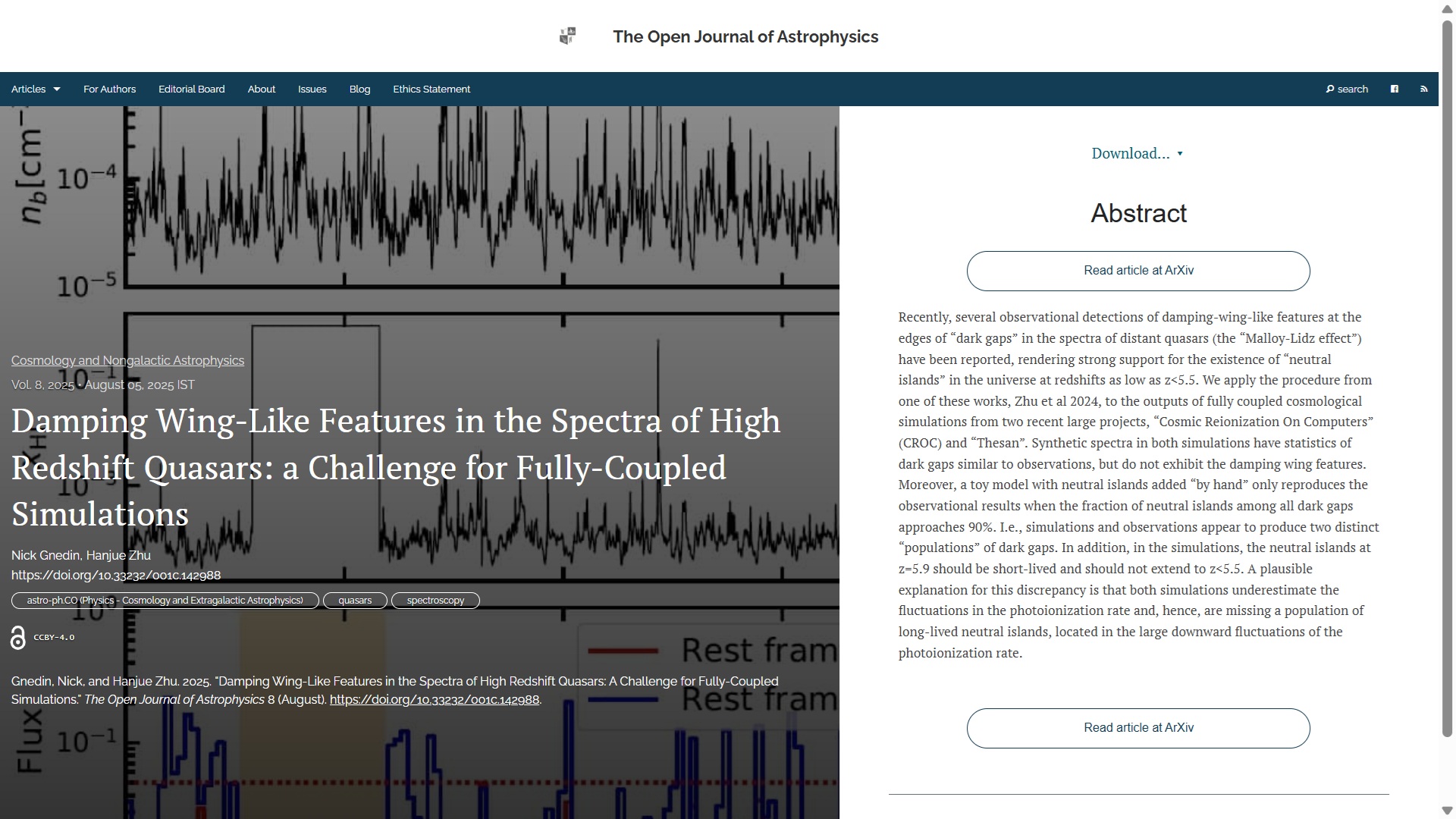
The first paper to report is “Dark Energy Survey Year 6 Results: Point-Spread Function Modeling” by Theo Schutt and 59 others distributed around the world, on behalf of the DES Collaboration. It was published on Wednesday March 12th 2025 in the folder Cosmology and NonGalactic Astrophysics. It discusses the improvements made in modelling the Point Spread Function (PSF) for weak lensing measurements in the latest Dark Energy Survey (6-year) data and prospects for the future.

Here is the overlay, which you can click on to make larger if you wish:


You can read the officially accepted version of this paper on arXiv here.

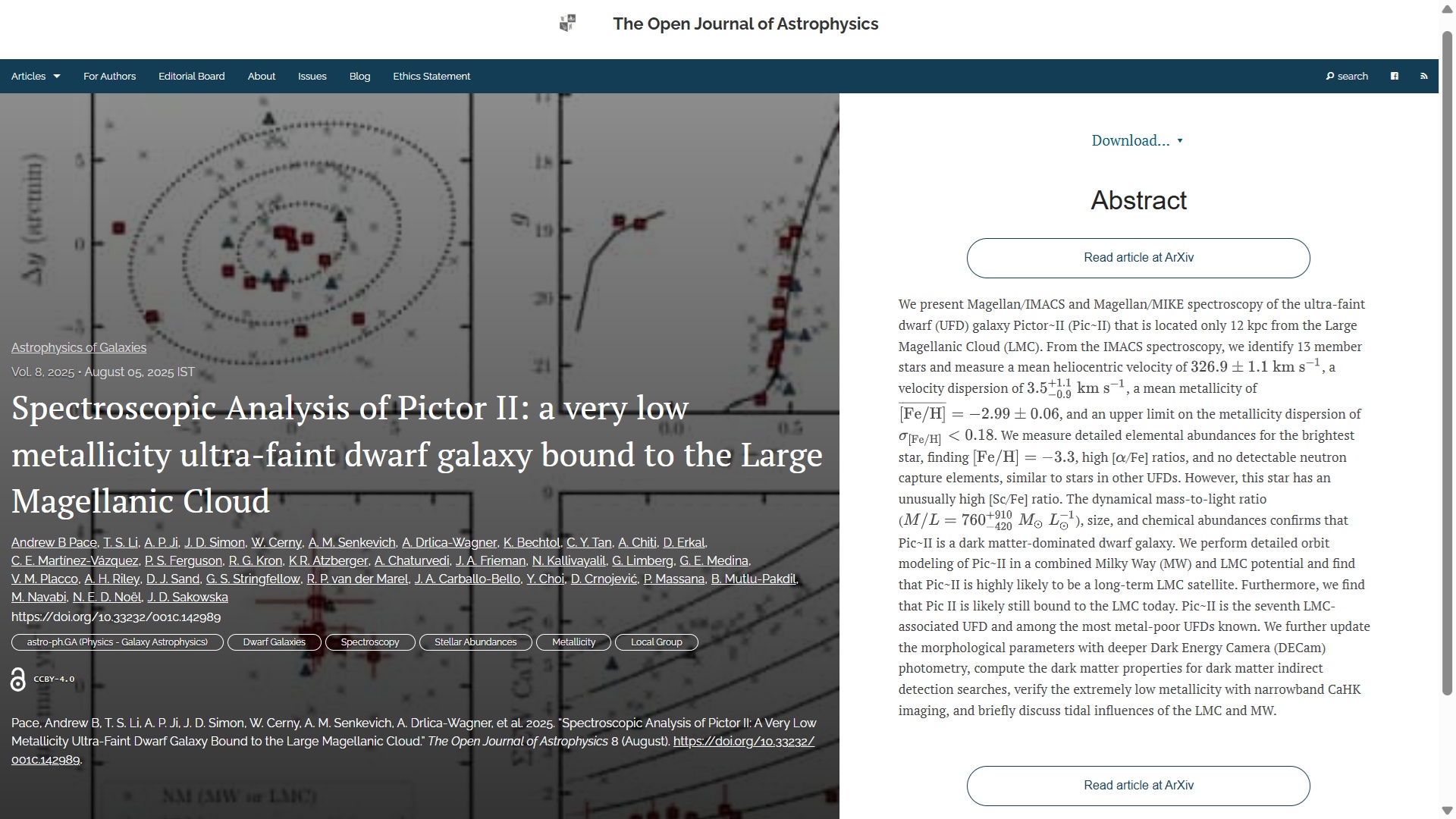
The other paper published this week is “Exploring Symbolic Regression and Genetic Algorithms for Astronomical Object Classification” by Fabio Ricardo Llorella (Universidad Internacional de la Rioja, Spain) & José Antonio Cebrian (Universidad Laboral de Córdoba, Spain), which came out on Thursday 13th March. This one is in the folder marked Astrophysics of Galaxies and it discusses the classification of astronomical objects in the Sloan Digital Sky Survey SDSS-17 dataset using a combination of Symbolic Regressiion and Genetic Algorithms.

The overlay can be seen here:

You can find the “final” version on arXiv here.

That’s it for this week. I’ll have more papers to report next Saturday.

Half-term Time!

Posted in Biographical, Education, Maynooth with tags , , , , on March 14, 2025 by telescoper

After a Departmental meeting this afternoon being the last item on the agenda for this week, at last we’ve reached the Mid-Semester Half-Term Study-Week Break. Six weeks down, six weeks to go (not including an extra week off for Easter). This coming Monday is St Patrick’s Day, a national holiday here in Ireland, and the rest of the week is free from lectures, labs and tutorials. I have two batches of computational physics tests and a particle physics assignment to grade, four examination papers to write and a graduation ceremony to attend before we return, so it’s not exactly a holiday. I plan to try to make the most of the time freed up by not having to teach to finishing writing up at least one, and possibly two, papers.

I’m glad of the arrival of this break, as I’ve been running on empty for the last several days, the general sense of fatigue exacerbated by a flare-up of the arthritis in my knees. Doctors say that there’s no reliable evidence that arthritis pain correlates with the weather, but in my case it does seem to come on when the weather changes, especially when it suddenly becomes cold or damp as it has done over the past few days. I’ll be due for another steroid shot soon, which should help, and hopefully the weather will improve over the next few weeks. Possibly. It seems to be a tradition for St Patrick’s Day to take place during inclement weather so, while I plan to go and watch the parade in Maynooth on Monday, I won’t linger outside if it’s cold. I will be taking the whole day off though.

The second half of term should be a bit easier than the first. For one thing, we have another break coming up four weeks after the resumption. Good Friday is on April 18th, so that is a holiday, as is the following week. The second 6 weeks of the Semester is therefore split 4-2 with a week off in between. Moreover, I usually only give lectures in Computational Physics for 9 or 10of the 12 teaching weeks in the Semester, after which the students will be working on the mini-projects which form part of the assessment for this module.

Anyway, it’s time to head home via the shops and buy something to eat while I watch St Pat’s versus Bohemians on the telly box. I haven’t got the energy for anything else!

Pandemic Memories, Five Years On

Posted in Biographical, Covid-19, Education, Maynooth with tags , , , on March 13, 2025 by telescoper

At the start of my Computational Physics lecture at 9am this morning I suddenly remembered that it was the corresponding day five years ago that Covid-19 pandemic restrictions were introduced in Ireland. The date for that was Thursday March 12th 2020, while today is Thursday March 13th 2025, but it was the same stage of of the semester, the Thursday before St Patrick’s Day and the mid-term Study Break.

One thing I remember quite well from that day five years ago was that I told my Computational Physics class to keep an eye on their email during the day as I thought an announcement would be made. When it came – around lunchtime, if memory serves – it was much stricter than I had anticipated: from 6pm that day, all schools, colleges and cultural institutions were to close until 29th March. Few people believed that would be the end of it, and we were right!

I had a computing laboratory session that afternoon, which went ahead, but some students understandably left early as they had to find their way home. The next time I interacted with any students it was online, and remote working carried on for many months, not just the two weeks originally planned. I did not envisage it would last so long. Nor did I imagine how little support teaching staff would receive from management. Indeed, the University saw the opportunity to build up large surpluses during the lockdown, all generated by the huge amount of extra, unacknowledged and unrenumerated, work put in by academics and support staff. That’s all money that should have been spent on the education of students. It was never going to be easy to teach during lockdown, but deliberately withholding resources made it far harder than it had to be.

Among other things, the Covid-19 pandemic restrictions played havoc with my perception of the passage of time and messed with my memory. I remember some things very clearly, such the lecture and lab on the day the restrictions were announced, which seem like they happened a few weeks ago never mind five years. Other things are like ancient history. Several major life events took place during the Covid-19 period period that I find it hard place in chronological order without looking at written records (including this blog).

I am not an expert on such matters but it seems to me that the isolation, disruption of social interaction, and the loss of familiar routines imposed by work are among the things responsible for distorting one’s perception of the passage of time and powers of recall.

It was not just the disruption to routine of course. There was also a genuine fear of becoming infected. From time to time after my last in-person class on March 12th 2020, I wondered if I would ever see those students again. I also made arrangements to write a will. For a time it looked likely that intensive care facilities in Ireland might be overwhelmed so I felt it important to make contingencies of that sort. Fortunately they weren’t needed. As far as I know the Coronavirus never reached me, though I think even those of us who were never infected by Covid-19 were definitely affected by it.

The Hume Scholarship Scheme Returns…

Posted in Maynooth with tags , , , , on March 12, 2025 by telescoper

You may recall that I posted about the decision by the Management of Maynooth University to scrap the John and Pat Hume Doctoral Scholarships and followed this up with another post suggesting the decision might be reversed and another pointing out that it hadn’t been and then another at the start of this month (March) pointing out that the scheme was still “paused” for a “review” which was actually completed in January…

Well, all of a sudden there was an announcement yesterday from On High to the effect that the Hume Doctoral Scholarships are back. When I say “back”, it’s not really accurate as the scheme has changed. In the past it was entirely applicant driven: prospective students had to apply with their own project proposals (usually developed with the help of a prospective supervisor). The new scheme is quite the opposite: prospective supervisors have to submit Expressions of Interest (EoIs), outlining possible PhD projects which are then advertised. Students then have to apply.

You can find details of the new scheme here, where it says:

Established in honour of John Hume, an alumnus of Maynooth University, and in recognition of his important contribution to Ireland, the John & Pat Hume Doctoral Awards are offered across all disciplines at Maynooth University. 

No honour to Pat Hume, then.

The investigator-led approach is probably OK for science and engineering disciplines, but does not reflect how postgraduate research happens in the arts and humanities. There will be considerable resentment in some quarters about the way this change has been effected.

It is also worth mentioning that there are only 15 Hume Scholarships for the whole University; that’s just five per faculty. In the case of Science & Engineering that’s about 0.5 per Department. It will be a very competitive!

Having sat on this issue for the best part of two months, the deadline given to supervisors to submit EoIs is next Wednesday, 19th March. The EOI submission form went live today, giving just a week’s notice (Monday 17th is a national holiday and the rest of next week is a Study Break at Maynooth). The management of this whole issue has been very poor indeed, but at least we have some PhD opportunities to advertise. Prospective students can apply from March 20th until April 17th. It’s still too late, of course, as many students will already have accepted places elsewhere. I don’t know what’s been going on behind the scenes, but this is no way to run a University.

Fauré plays Fauré

Posted in Music with tags , , , on March 11, 2025 by telescoper

In my post on Saturday I raised the question of the tempo for the orchestral version of Pavane pour une infante défunte by Maurice Ravel. A pavane is a stately dance, which is to be played quite slow but it’s not a funeral dirge. As Ravel himself is reported to have said “It’s the Princess (infante) who is sup[posed to be dead (defunte), not the Pavane”. There is a temptation when playing a lovely tune to wallow in it a bit too much, I think. In this light I now share a recording of a different Pavane, Opus 50 by Gabriel Fauré which is also quite well known. Here is the composer himself playing it in 1913 on his very own piano at a tempo which I find very pleasing and not too slow…

Beard of Ireland 2025

Posted in Beards, Biographical with tags , , on March 10, 2025 by telescoper

Regular readers of this blog will know that, way back in 2020, apparently as the result of some form of administrative error, I was voted St Patrick’s Day Beard of Ireland. Five years have passed and it is now time for Beard of Ireland 2025 and I am among the contenders. The voting is mainly on X/Twitter, on which I have no presence, so I don’t hold out much hope, but if you do want to vote for me please do so there, or elsewhere following the instructions in the attached post from Keith Flett in which he volunteers to be bombarded with direct messages…

P.S. For reference, here is a picture of my beard and I