Small Business letter to the Telegraph; an attempt to defraud the electorate?

Posted in Uncategorized on April 27, 2015 by telescoper

This unravelling story shows that the Conservative Party’s campaign is both inept and dishonest. Initially I though it was hilarious but now it’s getting very serious indeed.

sturdyblog's avatarsturdyblog

How the letter from small business owners to the Telegraph in support of the Tories fell apart

There is a lot, so I’ll be brief.

Huge thanks to the many people on Twitter who sent me discrepancies all day, as they discovered them.

The day started with the Conservatives and the Prime Minister claiming a major victory.

20150427-161316.jpg

Things soon began to unravel, when it emerged that this wasn’t the unsolicited, spontaneous combustion of love from small business to the Tories, which had been presented. In fact the Conservative Party had generated the letter and asked its members to sign it.

20150427-161016.jpg

Things got much more tangled up when it was discovered that the background document, containing the names and signatures of the “small business owners” on the Telegraph website, still bore the metadata tags of Conservative Campaign Headquarters.

20150427-161329.jpg

Say what you want, claimed a Tory councillor to me. The source is not important. What is…

View original post 922 more words

Astronomy and Forensic Science – The Herschel Connection

Posted in History, The Universe and Stuff with tags , , , , , , on April 27, 2015 by telescoper

When I was in Bath on Friday evening I made a point of visiting the Herschel Museum, which is located in the house in which Sir William Herschel lived for a time, before moving to Slough.
image

Unfortunately I got there too late to go inside. It did remind me however of an interesting connection between astronomy and forensic science, through a certain William Herschel..

When I give popular talks about Cosmology,  I sometimes look for appropriate analogies or metaphors in detective fiction or television programmes about forensic science. I think cosmology is methodologically similar to forensic science because it is generally necessary in both these fields to proceed by observation and inference, rather than experiment and deduction: cosmologists have only one Universe;  forensic scientists have only one scene of the crime. They can collect trace evidence, look for fingerprints, establish or falsify alibis, and so on. But they can’t do what a laboratory physicist or chemist would typically try to do: perform a series of similar experimental crimes under slightly different physical conditions. What we have to do in cosmology is the same as what detectives do when pursuing an investigation: make inferences and deductions within the framework of a hypothesis that we continually subject to empirical test. This process carries on until reasonable doubt is exhausted, if that ever happens.

Of course there is much more pressure on detectives to prove guilt than there is on cosmologists to establish the truth about our Cosmos. That’s just as well, because there is still a very great deal we do not know about how the Universe works. I have a feeling that I’ve stretched this analogy to breaking point but at least it provides some kind of excuse for mentioning the Herschel connection.

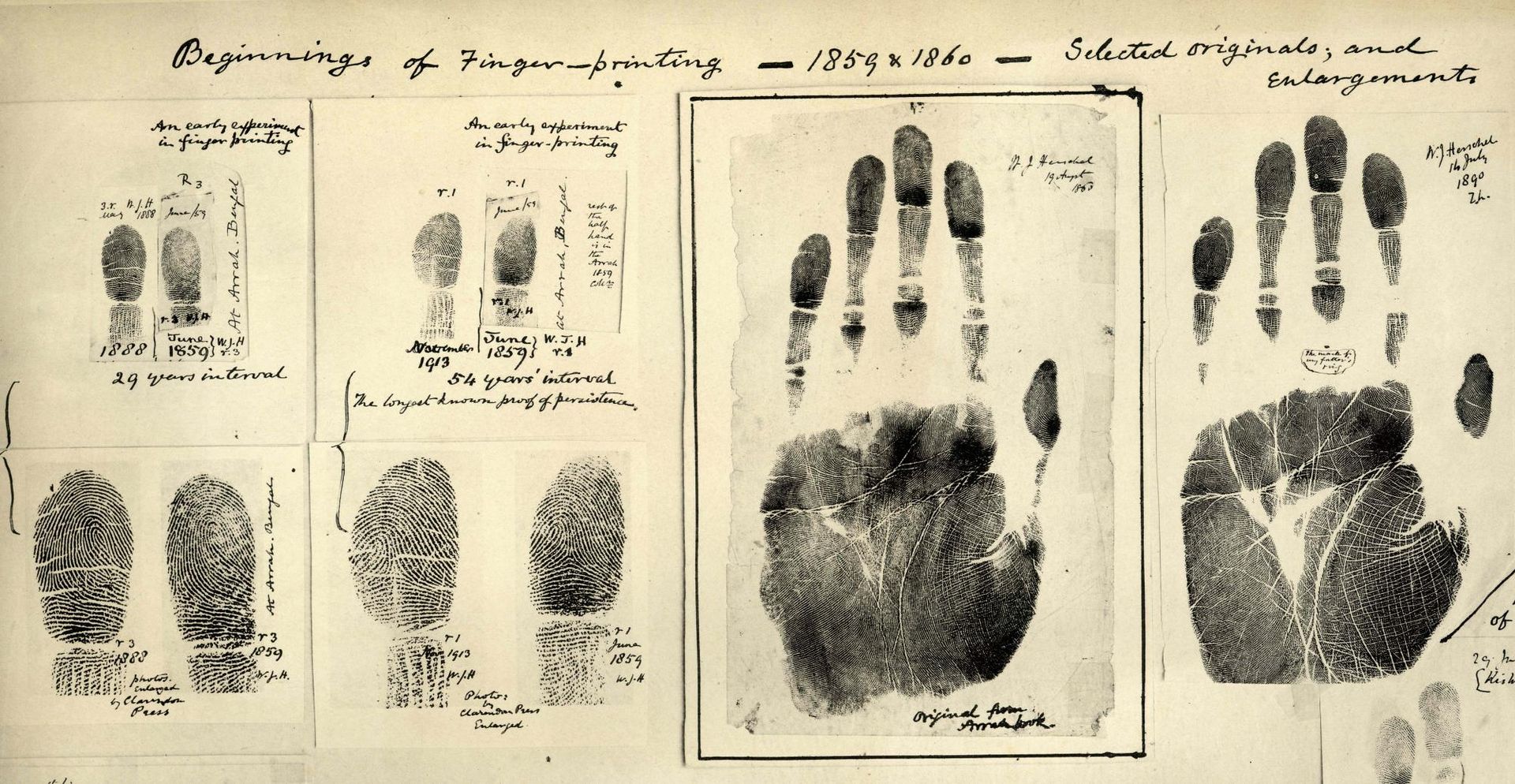
In fact the Herschel connection comes through William James Herschel, the grandson of William Herschel and the eldest son of John Herschel, both of whom were eminent astronomers. William James Herschel was not an astronomer, but an important figure in the colonial establishment in India. In the context relevant to this post, however, his claim to fame is that he is credited with being the first European to have recognized the importance of fingerprints for the purposes of identifying individuals. William James Herschel started using fingerprints in this way in India in 1858; some examples are shown below (taken from the wikipedia page).

Fingerprints_taken_by_William_James_Herschel_1859-1860

Later,  in 1877 at Hooghly (near Calcutta) he instituted the use of fingerprints on contracts and deeds to prevent the then-rampant repudiation of signatures and he registered government pensioners’ fingerprints to prevent the collection of money by relatives after a pensioner’s death. Herschel also fingerprinted prisoners upon sentencing to prevent various frauds that were attempted in order to avoid serving a prison sentence.

The use of fingerprints in solving crimes was to come much later, but there’s no doubt that Herschel’s work on this was an important step.

We have a Beautiful Cosmos

Posted in Music, Poetry with tags , , on April 27, 2015 by telescoper

On the bus coming up to campus just now, I was looking through the Brighton Festival (which starts on 2nd May) and found that there is a show called The Beautiful Cosmos of Ivor Cutler, which is on at the Theatre Royal. As a devout fan of Ivor Cutler I’ll definitely be going, but in the mean time here is the title track (set to video…)

And here be the lyrics:

You are the centre of your little world
and I am of mine.
No one again we meet for tea
we’re two of a kind.

This is our universe…
cups of tea.
We have a beautiful cosmos,
you and me.
We have a beautiful cosmos.

What do we talk of whenever we meet:
nothing at all.
You sit with a sandwich,
I look at a roll.
Sometimes I open my mouth,
then shut it.

We have a beautiful cosmos,
you and me.
We have a beautiful cosmos.

You are the centre of your little world
and I am of mine.
No one again we meet for tea
we’re two of a kind.

This is our universe…
cups of tea.
We have a beautiful cosmos,
you and me.
We have a beautiful cosmos.

Could the SNP block a Labour Budget? No.

Posted in Politics with tags , , , on April 26, 2015 by telescoper

Interesting post about the constitutional limits on the ability of the SNP to influence UK budget setting.

Prof. Colin R Talbot's avatarColin Talbot - my blog

The SNP are claiming they can ‘block Labour budgets’, ‘end austerity’ and ‘stop Trident’. Their problem however is simple – most of what they say is based on assuming that Westminster works the same way as Holyrood does for budgeting – and it doesn’t. There are huge ‘constitutional’ and practical obstacles to implementing the sort of radical challenges to Government tax and spend decisions that the SNP and others seem to be mooting. The first set of problems is that in the Westminster parliament only the Government can propose taxation or spending measures. These can be defeated, or amended, but only by cutting spending or lowering or removing taxes – not by increasing either.

View original post 1,076 more words

A Happy Hubble Coincidence

Posted in Biographical, Books, The Universe and Stuff with tags , , , on April 25, 2015 by telescoper

image

Preoccupied with getting ready for my talk in Bath  I forgot t post an item pointing out that yesterday was the 25th anniversary of the launch of the Hubble Space Telescope. Can it really be so long?

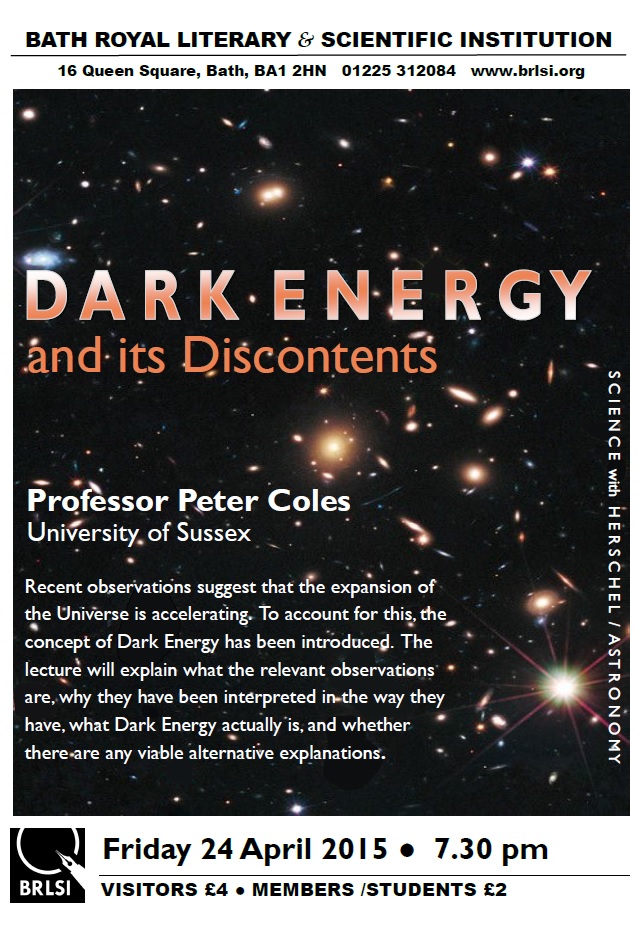
Anyway, many happy returns to Hubble. I did manage to preempt the celebrations however by choosing the above picture of the Hubble Ultra Deep Field as the background fo the poster advertising the talk.

Anyway it went reasonably well. There was a full house and questions went on quite a while. Thanks to Bath Royal Literary and Scientific Institution for the invitation!

Dark Energy and its Discontents

Posted in Biographical, Books, The Universe and Stuff with tags , on April 24, 2015 by telescoper

Just time for a spot of gratuitous self-promotion. I shall be giving a public lecture tonight, Friday 24th April 2015, entitled Dark Energy and its Discontents, at the very posh-sounding Bath Royal Literary and Scientific Institution.
I am just finishing the slides for the talk, and packing some dark energy in my bag to use as a demonstration.
Here is the poster for tonight’s event, which explains all…

Bath_lecture

Perhaps I’ll see the odd reader of this blog there?

Another Awayday..

Posted in Uncategorized on April 23, 2015 by telescoper

Just a quick post to say that I spent today in London with the other Heads of School at Sussex University (or most of them). We met in the British Library Conference Centre, which is next door to St Pancras station. It wasn’t in the library itself, so I wasn’t able to try out the famous echo in the British Library Reading Room…

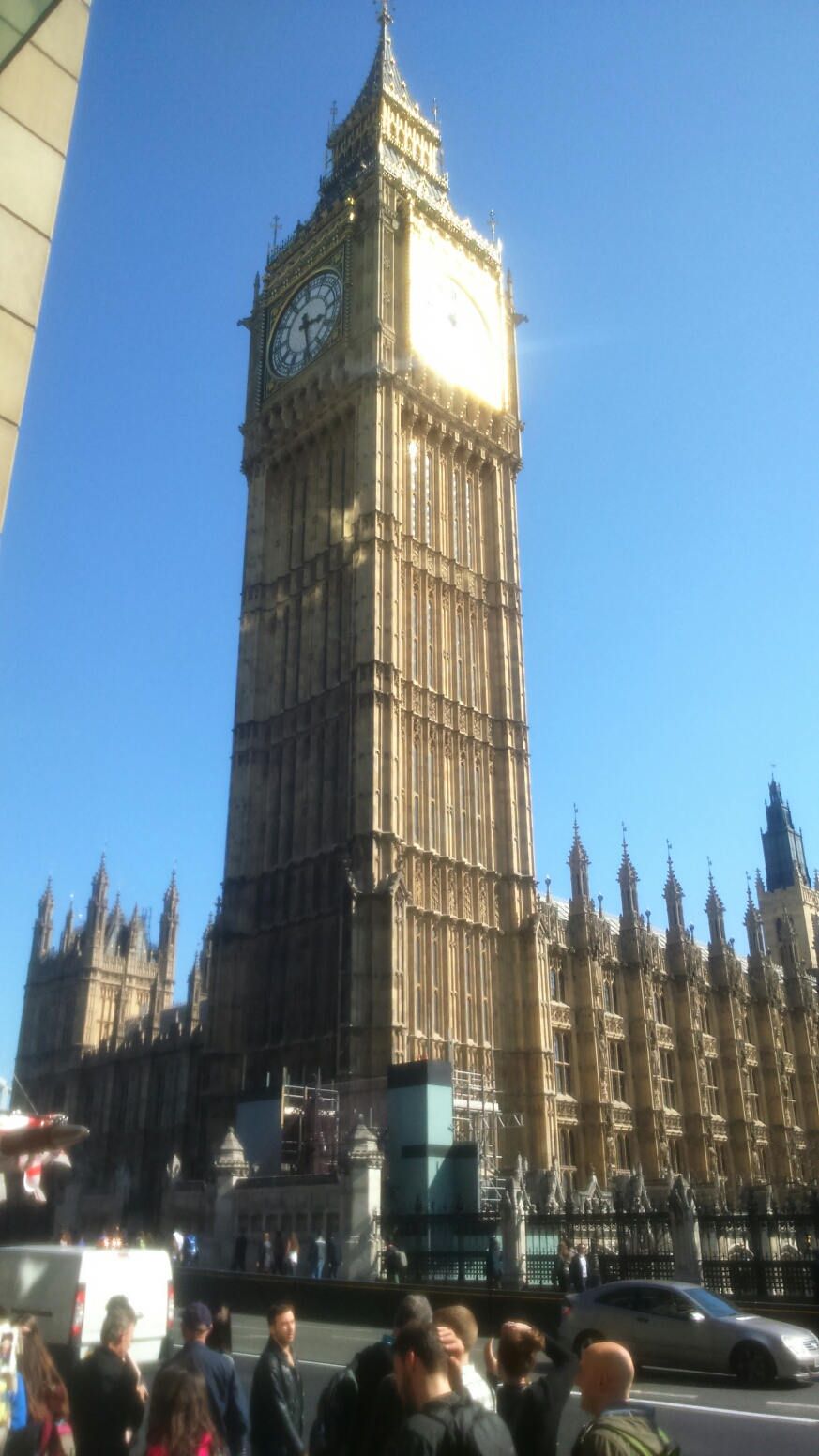
After leaving that meeting at ten-mile I had another appointment, near this relatively well-known landmark..

image

I won’t divulge the purpose or location of Meeting B as it’s a bit hush-hush, though not in a bad way…

Spring Giddiness

Posted in Poetry with tags , , on April 22, 2015 by telescoper

Today, like every other day, we wake up empty
and frightened. Don’t open the door to the study
and begin reading. Take down a musical instrument.
Let the beauty we love be what we do.
There are hundreds of ways to kneel and kiss the ground.

The breeze at dawn has secrets to tell you.
Don’t go back to sleep.
You must ask for what you really want.
Don’t go back to sleep.
People are going back and forth across the doorsill
where the two worlds touch.
The door is round and open.
Don’t go back to sleep.

I would love to kiss you.
The price of kissing is your life.
Now my loving is running toward my life shouting,
What a bargain, let’s buy it.

Daylight, full of small dancing particles
and the one great turning, our souls
are dancing with you, without feet, they dance.
Can you see them when I whisper in your ear?

All day and night, music,
a quiet, bright
reedsong. If it
fades, we fade.

by Jalāl ad-Dīn Muhammad Rūmī (1207-1273)


The Supervoid and the Cold Spot

Posted in Astrohype, Cosmic Anomalies, The Universe and Stuff with tags , , , , , on April 21, 2015 by telescoper

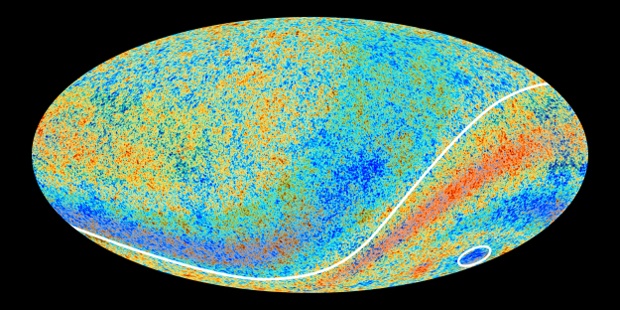
While I was away at the SEPnet meeting yesterday a story broke in the press broke about the discovery of a large underdensity in the distribution of galaxies. The discovery is described in a paper by Szapudi et al. in the journal Monthly Notices of the Royal Astronomical Society. The claim is that this structure in the galaxy distribution can account for the apresence of a mysterious cold spot in the cosmic microwave background, shown here (circled) in the map generated by Planck:
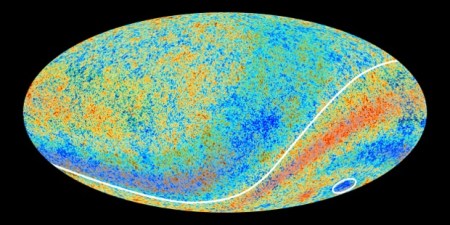
Planck_coldspot

I’ve posted about this feature myself here in the category Cosmic Anomalies.

The abstract of the latest paper is here:

We use the WISE-2MASS infrared galaxy catalogue matched with Pan-STARRS1 (PS1) galaxies to search for a supervoid in the direction of the cosmic microwave background (CMB) cold spot (CS). Our imaging catalogue has median redshift z ≃ 0.14, and we obtain photometric redshifts from PS1 optical colours to create a tomographic map of the galaxy distribution. The radial profile centred on the CS shows a large low-density region, extending over tens of degrees. Motivated by previous CMB results, we test for underdensities within two angular radii, 5°, and 15°. The counts in photometric redshift bins show significantly low densities at high detection significance, ≳5σ and ≳6σ, respectively, for the two fiducial radii. The line-of-sight position of the deepest region of the void is z ≃ 0.15–0.25. Our data, combined with an earlier measurement by Granett, Szapudi & Neyrinck, are consistent with a large Rvoid = (220 ± 50) h−1 Mpc supervoid with δm ≃ −0.14 ± 0.04 centred at z = 0.22 ± 0.03. Such a supervoid, constituting at least a ≃3.3σ fluctuation in a Gaussian distribution of the Λ cold dark matter model, is a plausible cause for the CS.

The result is not entirely new: it has been discussed at various conferences over the past year or so (e.g this one) but this is the first refereed paper showing details of the discovery.

This gives me the excuse to post this wonderful cartoon, the context of which is described here. Was that really in 1992? That was twenty years ago!
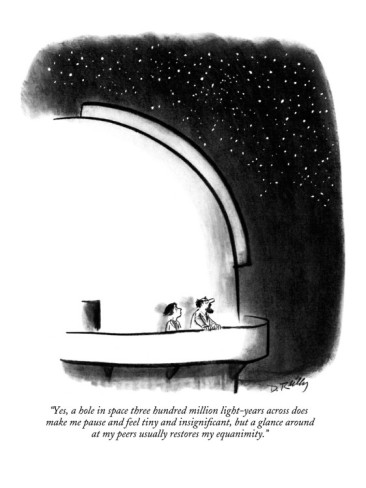
Anyway, I just wanted to make a few points about this because some of the press coverage has been rather misleading. I’ve therefore filed this one in the category Astrophype.

First, the “supervoid” structure that has been discovered is not a “void”, which would be a region completely empty of galaxies. As the paper makes clear it is less dramatic than that: it’s basically an underdensity of around 14% in the density of galaxies. It is (perhaps) the largest underdensity yet found on such a large scale – though that depends very much on how you define a void – but it is not in itself inconsistent with the standard cosmological framework. Such large underdensities are expected to be rare, but rare things do occur if you survey a large enough volume of the universe. Large overdensities also arise as statistical fluctuations in large volumes.

Second, and probably most importantly, although this “supervoid” is in the direction of the CMB Cold Spot it cannot on its own explain the Cold Spot; the claim in the abstract that it provides a plausible explanation of the cold spot is simply incorrect. A void can affect the measured temperature of the CMB through the Integrated Sachs-Wolfe effect: photons travelling through such a structure are redshifted as they travel through the underdense region, so the CMB looks cooler in the direction of the void. However, even optimistic calculations of the magnitude of the effect suggest that this particular “void” can only account for about 10% of the signal associated with the Cold Spot. This is a reasonably significant contribution but it does not account for the signal on its own.

This is not to say however that it is irrelevant. It could well be that the supervoid actually sits in front of a region of the CMB sky that was already cold, as a result of a primordial fluctuation rather than a line-of-sight effect. Such an effect could well arise by chance, at least with some probability. If the original perturbation were a “3σ” temperature fluctuation then the additional effect of the supervoid would turn it into a 3.3σ effect. Since this pushes the event further out into the tail of the probability distribution it makes a reasonably uncommon feature look  less probable. Because the tail of a Gaussian distribution drops off very quickly this has quite a large effect on the probability. For example, a fluctuation of 3.3σ or greater has a probability of 0.00048 whereas one of 3.0σ has a probability of 0.00135, about a factor of 2.8 larger. That’s an effect, but not a large one.

In summary, I think the discovery of this large underdensity is indeed interesting but it is not a plausible explanation for the CMB Cold Spot. Not, that is, unless there’s some new physical process involved in the propagation of light that we don’t yet understand.

Now that would be interesting…

SEPnet Awayday

Posted in Education with tags , , , on April 20, 2015 by telescoper

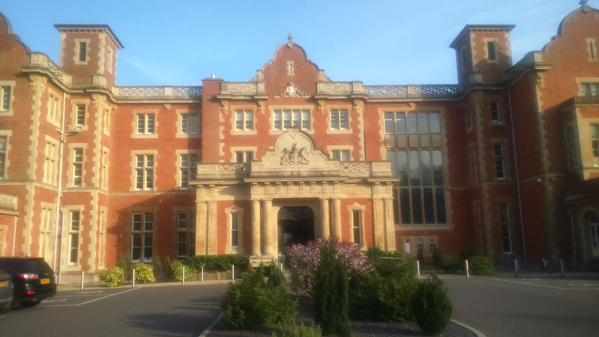
Here I am in Easthampstead Park Conference Centre after a hard day being away at an awayday. In fact we’ve been so busy that I’ve only just checked into my room (actually it’s a suite) and shall very soon be attempting to find the bar so I can have a drink. I’m parched.

The place is very nice. Here’s a picture from outside:

Eastham

I’m told it is very close to Broadmoor, the famous high-security psychiatric hospital, although I’m sure that wasn’t one of the reasons for choice of venue.

I have to attend quite a few of these things for one reason or another. This one is on the Future and Sustainability of the South East Physics Network, known as SEPnet for short, which is a consortium of physics departments across the South East of England working together to deliver excellence in both teaching and research. I am here deputising for a Pro Vice Chancellor who can’t be here. I’ve enjoyed pretending to be important, but I’m sure nobody has been taken in.

Although it’s been quite tiring, it has been an interesting day. Lots of ideas and discussion, but we do have to distil all  that down into some more specific detail over dinner tonight and during the course of tomorrow morning.  Anyway, better begin the search for the bar so I can refresh the old brain cells.