This week’s Private Eye cover is spot-on about the hypocrisy of certain political leaders whose professed support free speech in France differs markedly from what goes on in their own country…

This week’s Private Eye cover is spot-on about the hypocrisy of certain political leaders whose professed support free speech in France differs markedly from what goes on in their own country…
This afternoon I gave three hours of lectures on the trot, so I’m now feeling more than a little knackered. Before I head home for an early night, though, I thought I’d share this amazing video produced by the Panchromatic Hubble Andromeda Survey (or PHAT, for short), which is a Hubble Space Telescope (HST) Multi-cycle program to map roughly a third of the star-forming disk of the Andromeda Nebula (M31), using 6 filters covering from the ultraviolet through the near infrared. With HST’s resolution and sensitivity, the disk of M31 is resolved into more than 100 million stars. The combination of scale and detail is simply jaw-dropping. Hat’s off to the PHAT team!
Follow @telescoper“She can’t be unhappy,” you said,
“The smiles are like stars in her eyes,
And her laughter is thistledown
Around her low replies.”
“Is she unhappy?” you said–
But who has ever known
Another’s heartbreak–
All he can know is his own;
And she seems hushed to me,
As hushed as though
Her heart were a hunter’s fire
Smothered in snow.
by Sara Teasdale (1885-1933)
Follow @telescoperI’ve already posted the picture below, which was taken at a conference in Leiden (Netherlands) in 1995. Various shady characters masquerading as “experts” were asked by the audience of graduate students at a summer school to give their favoured values for the cosmological parameters (from top to bottom: the Hubble constant, density parameter, cosmological constant, curvature parameter and age of the Universe).
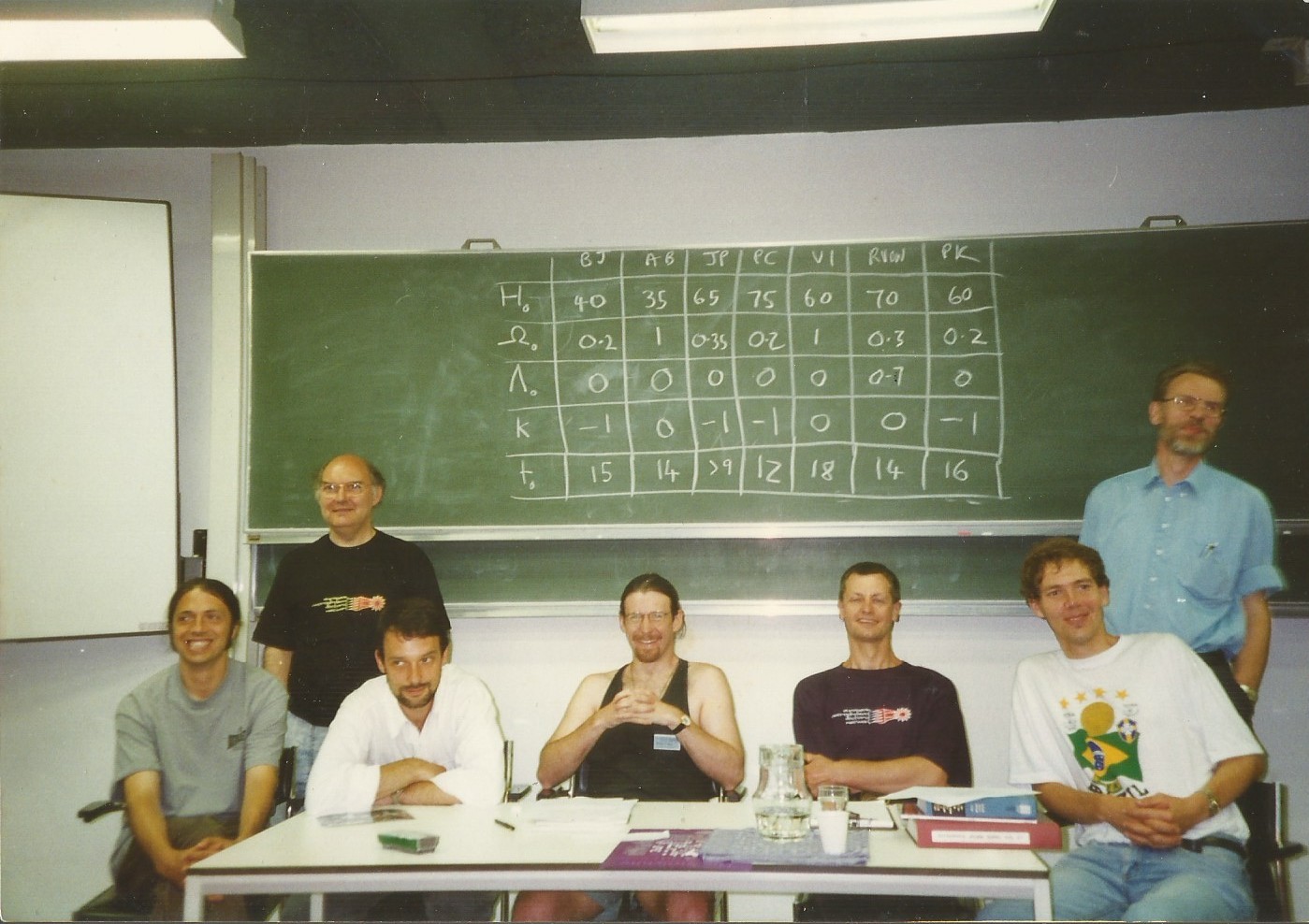
From left to right we have Alain Blanchard (AB), Bernard Jones (BJ, standing), John Peacock (JP), me (yes, with a beard and a pony tail – the shame of it), Vincent Icke (VI), Rien van de Weygaert (RW) and Peter Katgert (PK, standing). You can see on the blackboard that the only one to get anywhere close to correctly predicting the parameters of what would become the standard cosmological model was, in fact, Rien van de Weygaert.
Well, my excuse for posting this again is the fact that a similar discussion was held at a meeting in Oslo (Norway) at which a panel of experts and Alan Heavens did a similar thing. I wasn’t there myself but grabbed the evidence from facebook:
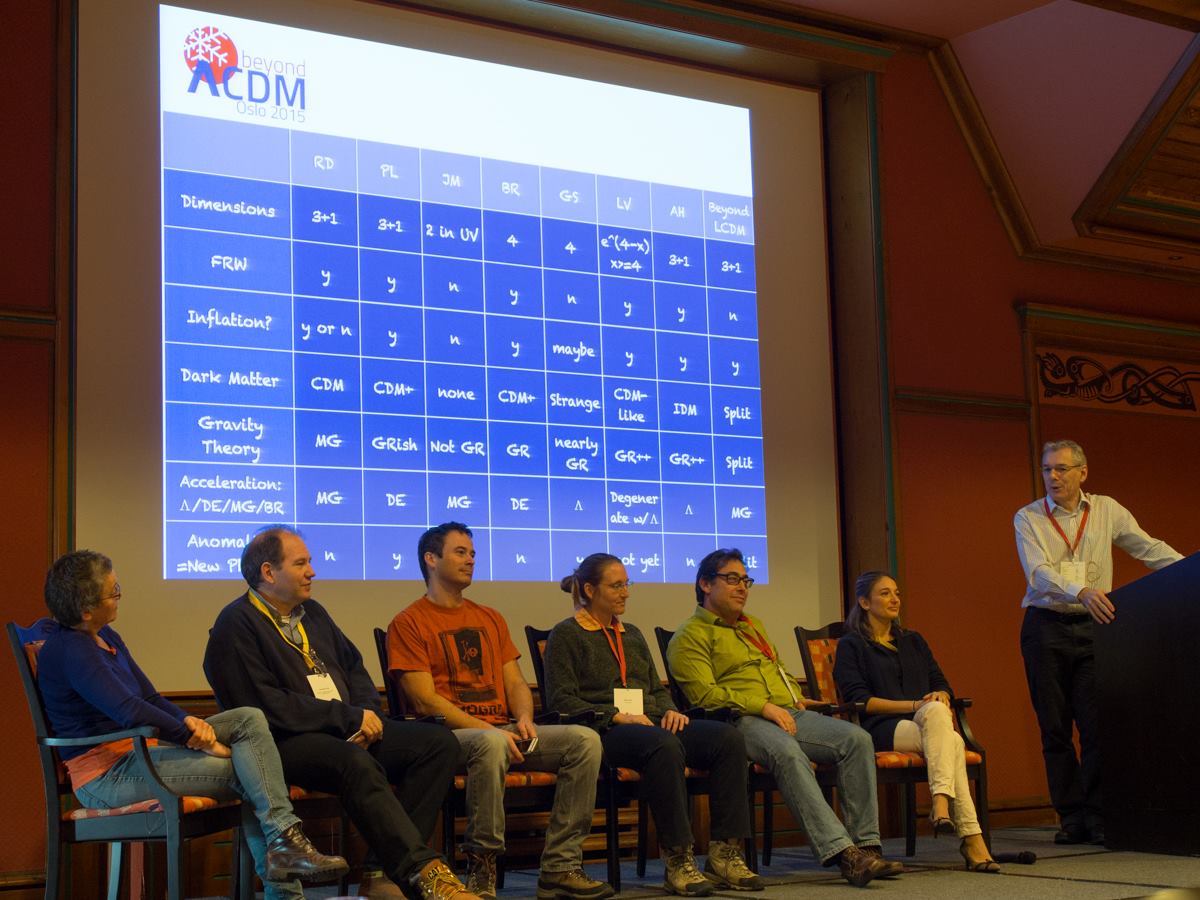
I’ll leave it as an exercise for the reader to identify the contributors. The 2015 version of the results is considerably more high-tech than the 1995 one, but in case you can’t read what is on the screen here are the responses:
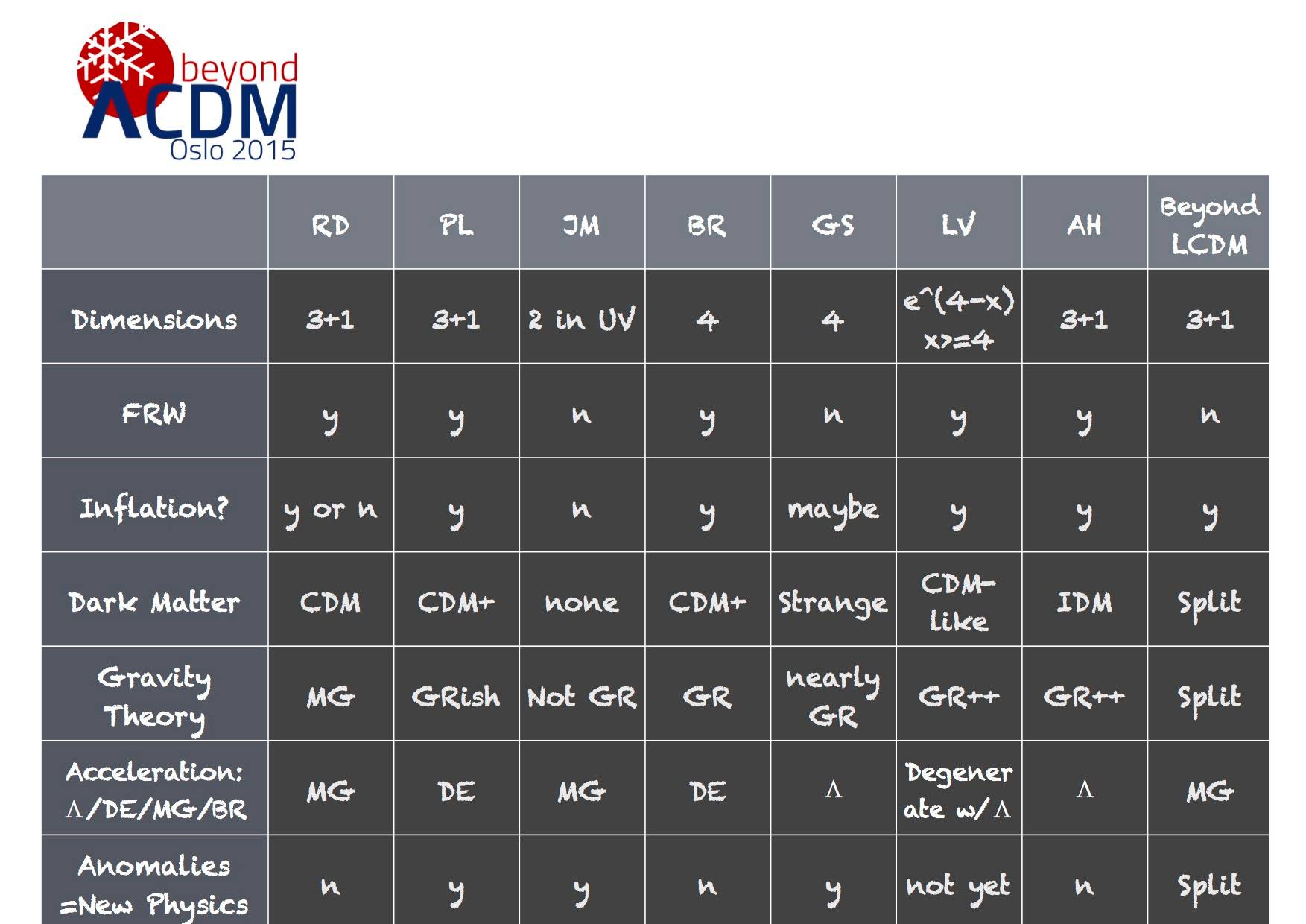
The emphasis here is on possible departures from the standard model, whereas in 1995 the standard model hadn’t yet been established. I’m not sure exactly what questions were asked but I think my answers would have been: 3+1; maybe; maybe; don’t know but (probably) not CDM; something indistinguishable from GR given current experiments; Lambda; and maybe. I’ve clearly become a skeptic in my old age.
Anyway, this “progress” reminded me of a quote I used to have on my office door when I was a graduate student in the Astronomy Centre at the University of Sussex many years ago:
We have not succeeded in answering all our problems. The answers we have found only serve to raise a whole set of new questions. In some ways we feel we are as confused as ever, but we believe we are confused on a higher level and about more important things.
The attribution of that quote is far from certain, but I was told that it was posted outside the mathematics reading room, Tromsø University. Which is in Norway. Apt, or what?
Follow @telescoperI imagine that a great many people have been thinking hard recently about democracy, free speech and religious belief in the wake of the Charlie Hebdo murders in Paris. There’s also been a great deal of stuff in the print media covering these issues. I just want to mention one thing that I have decided to do, namely to join the National Secular Society an organization that campaigns against religious privilege.
Let me reproduce a statement from their webpage here:
The National Secular Society works towards a society in which all citizens, regardless of religious belief, or lack of religious belief, can live together fairly and cohesively. We campaign for a secular democracy with a separation of religion and state, where everyone’s Human Rights are respected equally.
We work in the UK and Europe to challenge the disproportionate influence of religion on governments and in public life. We provide a secular voice in the media, defending freedom and equality as a counterbalance to the powerful religious lobby and some of the more destructive religious impulses that can threaten human rights worldwide.
The National Secular Society is a non-party-political organisation with members from across the social and political spectrum. Our Honorary Associates include MPs and peers, as well as leading figures from politics, journalism, law and the arts.
The NSS is a democratic and independent non-profit organisation which receives no funding from government or other public bodies. Our campaigning is wholly supported by our members and supporters, people like you who share our belief in the urgent need to keep religion and politics separate.
One of the National Secular Society’s very active current campaings is against the egregious Local Government (Religious etc Observances) Bill, which includes a provision that would require local councillors to attend sessions that involve prayers. This bill is wholly unacceptable to me, as it is perfectly possible for councillors of a religious persuasion to pray whenever they like, either before during or after a meeting, without requiring non-believers to be present.
I respect the right of others to whatever religious belief they choose and would not interrupt or disrupt an act of religious observance, but imposing such actions on others is simply unacceptable. I don’t think religious services should be imposed in schools and colleges, and I don’t see why this is any different.
Anyway, the general point is that I firmly believe that the only way we will ever develop a society that allows people of all cultures and beliefs to live in peace with each other and in atmosphere of mutual respect is to remove any reference to religion from our political and legal establishment. It’s a ridiculous anachronism that Bishops of the Church of England sit in the House of Lords, for example.
You’ll all no doubt be glad to know that I’m not going to “preach” about this at length here, although I may from time to time post on matters related to the National Secular Society (NSS), though hopefully in such a way as it doesn’t get confused with that other NSS the National Student Survey. I will however include a little story as a kind of postscript.
When I tweeted about the National Secular Society recently a friend of mine pointed out a curious connection between it, astronomy, and my former employer, Cardiff University. The first ever Professor of Mathematics and Astronomy at the University College of South Wales and Monmouthsire (which eventually became Cardiff University) was a distinguished chap by the name of Henry William Lloyd Tanner, who was appointed to his position in 1883. In November 1883 there was a vigorous campaign by religious types to have him removed because of his connections with the National Secular Society (which was founded way back in 1866); you can read about it here. The campagign did not succeed, and H.W. Lloyd Tanner remained in post until 1909.
We have at least made some progress since 1883, in that nowadays a Professor would not be threatened with the sack on the basis of his religious beliefs or lack of them, but there’s a long way to go before our nation is a truly secular society.
Follow @telescoperThe inestimable Dorothy Lamb has yet again been doing her bit for our outreach effort here in the School of Mathematical and Physical Sciences at the University of Sussex. Charged with the task of coming up with some props to explain Zeno’s Paradox to schoolchildren. One famous version of this paradox features in the form of a story about Achilles and the Tortoise:
Achilles, the fleet-footed hero of the Trojan War, is engaged in a race with a lowly tortoise, which has been granted a head start. Achilles’ task initially seems easy, but he has a problem. Before he can overtake the tortoise, he must first catch up with it. While Achilles is covering the gap between himself and the tortoise that existed at the start of the race, however, the tortoise creates a new gap. The new gap is smaller than the first, but it is still a finite distance that Achilles must cover to catch up with the animal. Achilles then races across the new gap. To Achilles’ frustration, while he was scampering across the second gap, the tortoise was establishing a third. The upshot is that Achilles can never overtake the tortoise. No matter how quickly Achilles closes each gap, the slow-but-steady tortoise will always open new, smaller ones and remain just ahead of the Greek hero.
Anyway, we now have a splendid knitted Achilles along with not one but three lovely tortoises…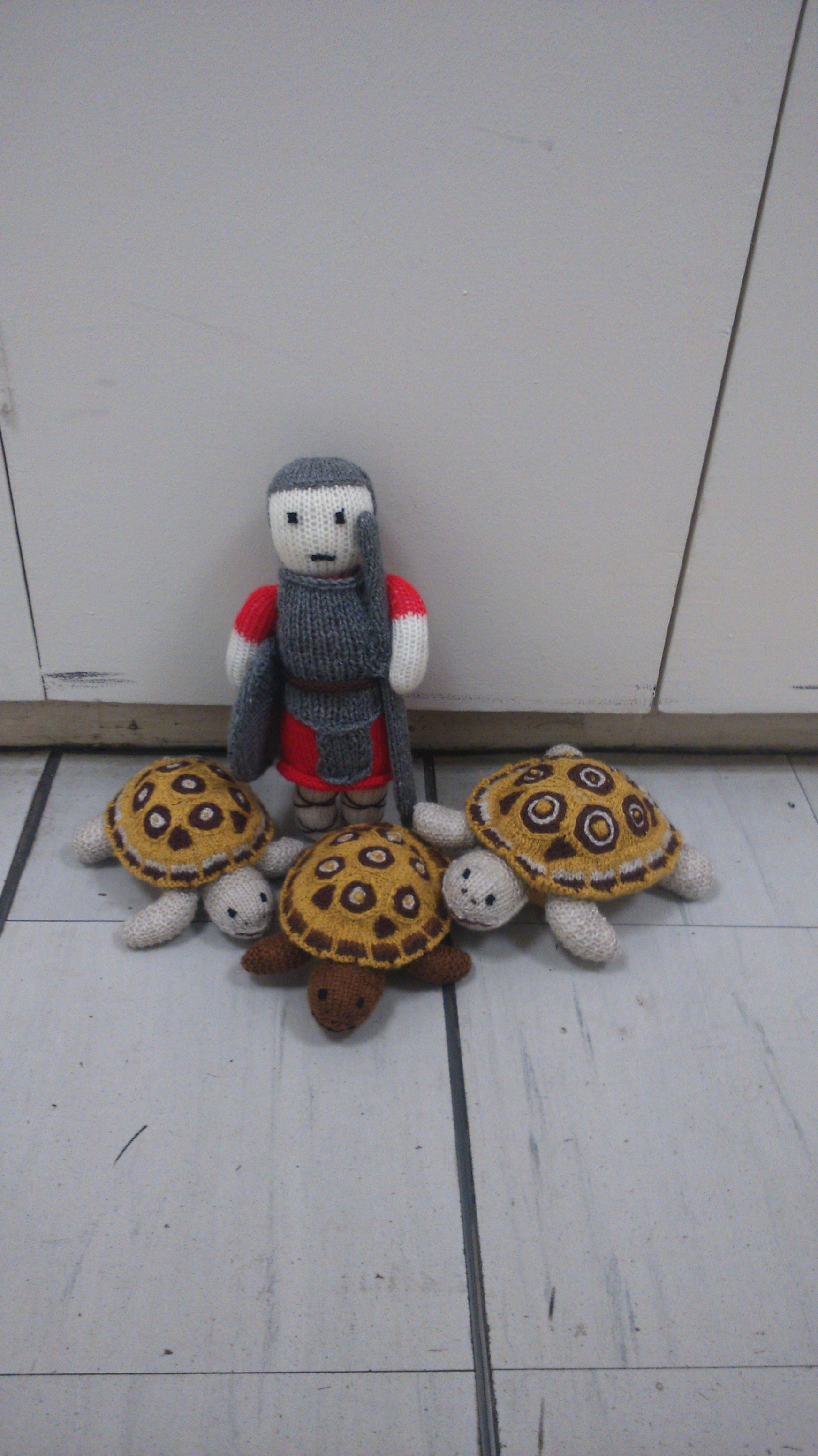
Achilles is a bit short in the leg, although I suppose that doesn’t necessarily mean that he can’t be fleet of foot, and we had to prop him up against the wall lest he should heel over, but nevertheless I think these are great. Could this be the next big thing in toys for mathematically inclined students?
Follow @telescoperS’io credesse che mia risposta fosse
A persona che mai tornasse al mondo,
Questa fiamma staria senza piu scosse.
Ma perciocche giammai di questo fondo
Non torno vivo alcun, s’i’odo il vero,
Senza tema d’infamia ti rispondo.
Let us go then, you and I,
When the evening is spread out against the sky
Like a patient etherized upon a table;
Let us go, through certain half-deserted streets,
The muttering retreats
Of restless nights in one-night cheap hotels
And sawdust restaurants with oyster-shells:
Streets that follow like a tedious argument
Of insidious intent
To lead you to an overwhelming question…
Oh, do not ask, “What is it?”
Let us go and make our visit.
In the room the women come and go
Talking of Michelangelo.
The yellow fog that rubs its back upon the window-panes,
The yellow smoke that rubs its muzzle on the window-panes
Licked its tongue into the corners of the evening,
Lingered upon the pools that stand in drains,
Let fall upon its back the soot that falls from chimneys,
Slipped by the terrace, made a sudden leap,
And seeing that it was a soft October night,
Curled once about the house, and fell asleep.
And indeed there will be time
For the yellow smoke that slides along the street,
Rubbing its back upon the window-panes;
There will be time, there will be time
To prepare a face to meet the faces that you meet;
There will be time to murder and create,
And time for all the works and days of hands
That lift and drop a question on your plate;
Time for you and time for me,
And time yet for a hundred indecisions,
And for a hundred visions and revisions,
Before the taking of a toast and tea.
In the room the women come and go
Talking of Michelangelo.
And indeed there will be time
To wonder, “Do I dare?” and, “Do I dare?”
Time to turn back and descend the stair,
With a bald spot in the middle of my hair—
[They will say: “How his hair is growing thin!”]
My morning coat, my collar mounting firmly to the chin,
My necktie rich and modest, but asserted by a simple pin—
[They will say: “But how his arms and legs are thin!”]
Do I dare
Disturb the universe?
In a minute there is time
For decisions and revisions which a minute will reverse.
For I have known them all already, known them all—
Have known the evenings, mornings, afternoons,
I have measured out my life with coffee spoons;
I know the voices dying with a dying fall
Beneath the music from a farther room.
So how should I presume?
And I have known the eyes already, known them all—
The eyes that fix you in a formulated phrase,
And when I am formulated, sprawling on a pin,
When I am pinned and wriggling on the wall,
Then how should I begin
To spit out all the butt-ends of my days and ways?
And how should I presume?
And I have known the arms already, known them all—
Arms that are braceleted and white and bare
[But in the lamplight, downed with light brown hair!]
Is it perfume from a dress
That makes me so digress?
Arms that lie along a table, or wrap about a shawl.
And should I then presume?
And how should I begin?
. . . . .
Shall I say, I have gone at dusk through narrow streets
And watched the smoke that rises from the pipes
Of lonely men in shirt-sleeves, leaning out of windows? …
I should have been a pair of ragged claws
Scuttling across the floors of silent seas.
. . . . .
And the afternoon, the evening, sleeps so peacefully!
Smoothed by long fingers,
Asleep… tired… or it malingers,
Stretched on the floor, here beside you and me.
Should I, after tea and cakes and ices,
Have the strength to force the moment to its crisis?
But though I have wept and fasted, wept and prayed,
Though I have seen my head [grown slightly bald] brought in upon a platter,
I am no prophet—and here’s no great matter;
I have seen the moment of my greatness flicker,
And I have seen the eternal Footman hold my coat, and snicker,
And in short, I was afraid.
And would it have been worth it, after all,
After the cups, the marmalade, the tea,
Among the porcelain, among some talk of you and me,
Would it have been worth while,
To have bitten off the matter with a smile,
To have squeezed the universe into a ball
To roll it toward some overwhelming question,
To say: “I am Lazarus, come from the dead,
Come back to tell you all, I shall tell you all”—
If one, settling a pillow by her head,
Should say: “That is not what I meant at all.
That is not it, at all.”
And would it have been worth it, after all,
Would it have been worth while,
After the sunsets and the dooryards and the sprinkled streets,
After the novels, after the teacups, after the skirts that trail along the floor—
And this, and so much more?—
It is impossible to say just what I mean!
But as if a magic lantern threw the nerves in patterns on a screen:
Would it have been worth while
If one, settling a pillow or throwing off a shawl,
And turning toward the window, should say:
“That is not it at all,
That is not what I meant, at all.”
. . . . .
No! I am not Prince Hamlet, nor was meant to be;
Am an attendant lord, one that will do
To swell a progress, start a scene or two,
Advise the prince; no doubt, an easy tool,
Deferential, glad to be of use,
Politic, cautious, and meticulous;
Full of high sentence, but a bit obtuse;
At times, indeed, almost ridiculous—
Almost, at times, the Fool.
I grow old… I grow old…
I shall wear the bottoms of my trousers rolled.
Shall I part my hair behind? Do I dare to eat a peach?
I shall wear white flannel trousers, and walk upon the beach.
I have heard the mermaids singing, each to each.
I do not think that they will sing to me.
I have seen them riding seaward on the waves
Combing the white hair of the waves blown back
When the wind blows the water white and black.
We have lingered in the chambers of the sea
By sea-girls wreathed with seaweed red and brown
Till human voices wake us, and we drown.
by T.S. Eliot (1888-1965)
Follow @telescoper
I was looking up the reference for an old paper of mine on ADS yesterday and was surprised to find that it is continuing to attract citations. Thinking about the paper reminds me off the fun time I had in Copenhagen while it was written. I was invited there in 1990 by Bernard Jones, who used to work at the Niels Bohr Institute. I stayed there several weeks over the May/June period which is the best time of year for Denmark; it’s sufficiently far North (about the same latitude as Aberdeen) that the summer days are very long, and when it’s light until almost midnight it’s very tempting to spend a lot of time out late at night..
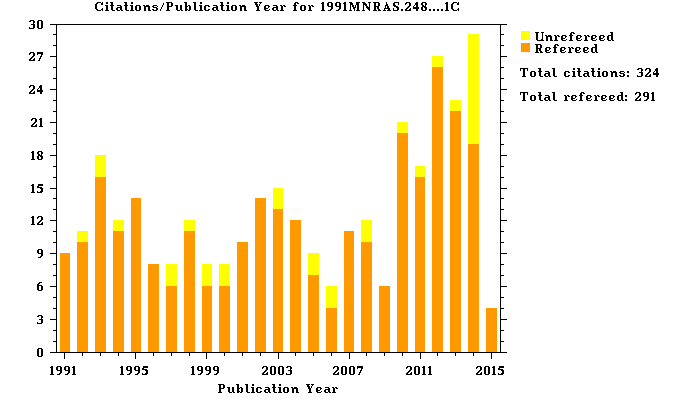
As well as being great fun, that little visit also produced what has turned out to be my most-cited paper. In fact the whole project was conceived, work done, written up and submitted in the space of a couple of months. I’ve never been very good at grabbing citations – I’m more likely to fall off bandwagons rather than jump onto them – but this little paper seems to keep getting citations. It hasn’t got that many by the standards of some papers, but it’s carried on being referred to for almost twenty years, which I’m quite proud of; you can see the citations-per-year statistics even seen to be have increased recently. The model we proposed turned out to be extremely useful in a range of situations, which I suppose accounts for the citation longevity:
I don’t think this is my best paper, but it’s definitely the one I had most fun working on. I remember we had the idea of doing something with lognormal distributions over coffee one day, and just a few weeks later the paper was finished. In some ways it’s the most simple-minded paper I’ve ever written – and that’s up against some pretty stiff competition – but there you go.
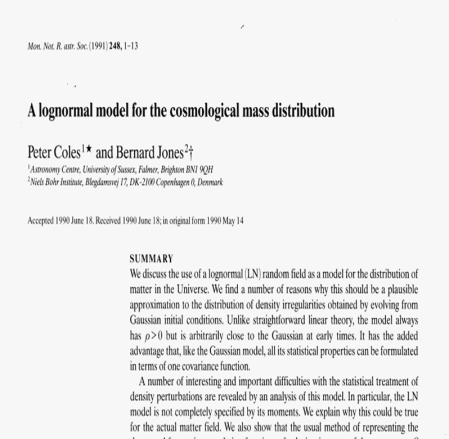
The lognormal seemed an interesting idea to explore because it applies to non-linear processes in much the same way as the normal distribution does to linear ones. What I mean is that if you have a quantity Y which is the sum of n independent effects, Y=X1+X2+…+Xn, then the distribution of Y tends to be normal by virtue of the Central Limit Theorem regardless of what the distribution of the Xi is If, however, the process is multiplicative so Y=X1×X2×…×Xn then since log Y = log X1 + log X2 + …+log Xn then the Central Limit Theorem tends to make log Y normal, which is what the lognormal distribution means.
The lognormal is a good distribution for things produced by multiplicative processes, such as hierarchical fragmentation or coagulation processes: the distribution of sizes of the pebbles on Brighton beach is quite a good example. It also crops up quite often in the theory of turbulence.
I’ll mention one other thing about this distribution, just because it’s fun. The lognormal distribution is an example of a distribution that’s not completely determined by knowledge of its moments. Most people assume that if you know all the moments of a distribution then that has to specify the distribution uniquely, but it ain’t necessarily so.
If you’re wondering why I mentioned citations, it’s because it looks like they’re going to play a big part in the Research Excellence Framework, yet another new bureaucratical exercise to attempt to measure the quality of research done in UK universities. Unfortunately, using citations isn’t straightforward. Different disciplines have hugely different citation rates, for one thing. Should one count self-citations?. Also how do you aportion citations to multi-author papers? Suppose a paper with a thousand citations has 25 authors. Does each of them get the thousand citations, or should each get 1000/25? Or, put it another way, how does a single-author paper with 100 citations compare to a 50 author paper with 101?
Or perhaps the REF panels should use the logarithm of the number of citations instead?
Follow @telescoper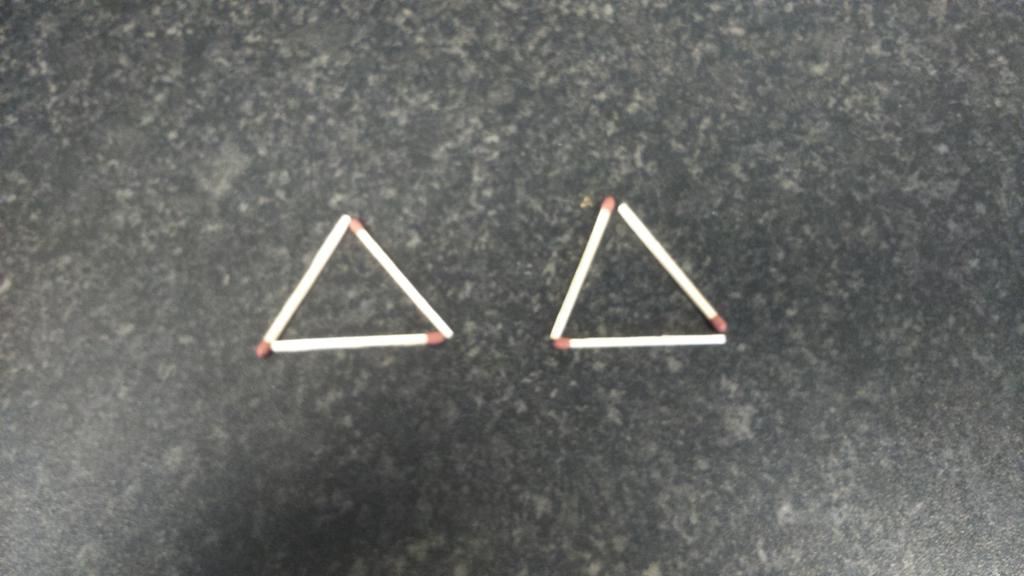 Puzzle time! Move three (and only three) matches and position them to create just four, i.e four and only four, (identical) triangles. No cutting the matches, either!
Click on to see the answer…

 In the Dark