Polling Day Memories

Posted in Biographical, Politics with tags , , , , on May 7, 2015 by telescoper

At last we’ve reached General Election day and I’ve just been to cast my vote in the crypt of St George’s Church in Kemptown, very close to my Brighton residence.  It was quite busy this morning when I got there, and I had to queue to get my ballot paper. I don’t know what the turnout is like this time, but I hope it’s good. I don’t think there’s really any excuse for not voting, although some people seem to prefer to whinge than to vote.

I doubt if I’ll stay up late tonight to watch the results come in. Polls don’t close until 10pm and until then there’s a blackout of press coverage relating to the vote so there’s nothing to follow until quite late at night, when I’m usually tucked up in bed with my cocoa.  The latest opinion polls suggest that the Conservative Party may just get the biggest share of the vote, but it is highly unlikely they’ll win a majority of the seats. The likelihood therefore is abother hung parliament, at which point there’ll be some frantic negotiation behind the scenes. It will still be interesting to see how the horse-trading works out over the next few days, but after three weeks of phoney war we’ll soon have to face up to reality. I’m not really looking forward to that.

On the corresponding Polling Day eighteen years ago in 1997 I was actually in Lawrence, Kansas. Don’t ask me why. I’d arranged a postal vote, but had to watch the proceedings from afar on the TV. Some expat British friends of mine decided to hold a party that night in their house and I went along to drink beer while the results came in. Watching a British election from the midwest USA is a bit strange, but it’s improved by the fact that the polls close in the UK at what is early evening Kansas-time and it’s all pretty much over by midnight.

That election I was swept up in the euphoria generated by the prospect of a New Labour government with its slogan “Things can only get better”. When they won a landslide majority we celebrated in grand style, singing Jerusalem in the back garden and then tottered not-too-soberly to a tattoo parlour to have a red rose put on my arm.

We had a great time that night, and the good vibes continued after I returned to London from my short stay at the University of Kansas. It didn’t take long, however, for my enthusiasm to wane. Instead of doing the really radical things their large majority would have allowed, they didn’t seem to have the gumption to tackle the really important issues. Then of course Blair took us into Iraq and, despite having voted Labour all my life before then, I vowed never again to vote for the Labour Party while it was led by the people that made that decision.

But I’ve still got the red rose tattoo and this time I returned to the fold by voting for Nancy Platts in Brighton Kemptown. I wasn’t initially very impressed with Ed Miliband but I have changed my mind over the last few weeks. I think during this campaign he has behaved with great dignity and strength of character in the face of some pretty nasty personal attacks from his political opponents. Now I really hope that Ed Miliband leads the next Goverment of the United Kingdom, although it will probably only be able to do so in some sort of coalition with the Scottish Nationalist Party and possibly the Liberal Democrats.

For what it’s worth, my predictions for the consituencies in Brighton is that Labour will win both Kemptown and Hove, whereas in Pavilion Caroline Lucas of the Green Pary will hold the seat for the Conservatives.

But whether or not you agree with my political opinions, please get out there and vote. Tomorrow, VE Day, is the 70th Anniversary of the end of the Second World War in Europe. Remember that as you cast your vote, and have faith in the democracy so many gave their lives to defend.

The Lads in their Hundreds

Posted in Music, Poetry with tags , , , , on May 6, 2015 by telescoper

So last night I had my first experience of this year’s Brighton Festival when I went to the Theatre Royal in Brighton to see a show called The Lads in the Hundreds, performed by a group from Comédie de Picardie which is situated in Amiens, capital of the Somme region of France. The cast for yesterday’s performance consisted of just four people: Tchéky Karyo (actor); Edmund Hastings (tenor); Michael Foyle (violin); and Edward Liddall (piano). The performance consisted of dramatic recitations by Karyo (mostly in French) interspersed with music, mostly settings of English poems by English composers such as Ivor Gurney and George Butterworth, as well as a couple of instrumental numbers including a beautiful pared-down version for piano and violin of The Lark Ascending by Vaughan Williams which  was, apparently, how it was first performed. The title The Lads in their Hundreds is taken from a poem by A.E. Housman which was among those set to music and included in this show.  Young Edmund Hastings performed this and the other songs with a bright clear and very English tenor voice, dressed in the uniform of a British soldier of the period. Overall the poetry and music create a very poignant blend that brings together moving expressions of loss and remembrance for the fallen of the First World War with stark descriptions of the horror and brutality of conflict.

I particularly wanted to see this show because I had studied (and much admired) the British poets of the First World War when I was at school, especially Wilfred Owen, but knew nothing of French war poetry of the same era and was very keen to find out more. Although I haven’t studied French since O-level, I am glad these verses were performed in their original language. Poetry can be translated, of course, but it rarely gains anything in the process and often loses a lot. Despite being at pains to drink French wine before the performance to assist my powers of recall, I did struggle a bit to follow some of the poems with my schoolboy knowledge of French, but that difficulty was far outweighed by the expressive sound of verse that can only be achieved when spoken in the language in which it was conceived. A couple of the poems were performed in English, including one with a musical accompaniment in the form of an arrangement of the beautiful Andante movement from Beethoven’s Seventh Symphony for violin and piano. That combination took me completely by surprise and had me at the brink of tears.

It’s interesting that the poems echo the savagery and futility of war in much the same way as the poems of Wilfred Owen or Siegfried Sassoon, but the music chosen is quite different in that it draws greatly on English folk music and is consequently quite nostalgic in character. Perhaps the “English Pastoral” style particularly associated with Vaughan Williams was an attempt to cope with the trauma of the First World War by evoking an idyllic representation of the English countryside as a world apart from the horrific realities of the Somme. French poetry and English music together created a whole that was much more than the sum of its parts. It was an evening that was both fascinating and deeply moving and I’m glad I made time during a busy week to attend it.

To end with I thought I’d include the poem I mentioned earlier that was performed to music by Beethoven. The poem is called The Andante and is by Albert-Paul Granier, an officer in the French artillery, whose name was completely unknown to me until yesterday but who wrote poetry which bears comparison with that of any other poet of the Great War. He was killed in action in 1917. To prove that there are exceptions to every rule, this poem is exquisite even in translation (by Ian Higgins):

The rain, endlessly unravelling;
the rain, shovelling at the mud the whole sullen day;
the rain, unendingly sobbing its toneless chords;
and the whispering wind, crumbling the cloud into drizzle . . .

Why, this evening, am I haunted so
by that majestic andante
from the Seventh Symphony?

Its chords, as magnificently simple
as the triumphal arches of the ancients,
hold me in a vast enchantment.

Its harmony is velvet to my soul,
its murmur a caress that soothes
the melancholy as we pick our way
along the bank of this canal.

The rain has never stopped . . .

The mud is all long, snaking rivulets of agate
and clouded onyx, chopped into splashes
with every drawn-out hoof-fall of my horse.

The rain has never stopped, the whole lead-blue day.

The andante
gently eases my resentment
with its divine serenity . . .

Ah, those Sundays, not two years ago —
the Sunday afternoons,
the lamp-lit hall,
the huge orchestra a single mind and spirit
in every flying bow-tip:

The miraculous fluid
a fountain spreading up to the galleries, then
falling like snowflakes onto souls laid bare,
like springtime sunlight through stained glass
on a girl’s communion veil.

The andante,
the andante is gentle, with a touch of sadness,
like an autumn evening over ponds,
or the voix céleste of an organ;
and my chrysalid soul
weaves itself a wonderful cocoon
from this aching blessedness,
on the purple silk weft of the rain.

Loans for PhD Fees?

Posted in Education, Finance with tags , , , on May 5, 2015 by telescoper

Just a short post to remind (or perhaps just tell) interested parties that the Department of Business, Innovation and Skills (BIS) is running a consultation on issues connected with postgraduate education. According to the BIS website:

We’re seeking views on proposals to introduce loans for postgraduate taught master’s degrees and to improve support for research students.

The consultation closes on May 29th 2015. The Institute of Physics and the Royal Astronomical Society are putting together collective responses for Physics and Astronomy respectively, but anyone can submit an opinion.

The scope of the consultation seems carefully worded as not to suggest explicitly  that loans might be extended to postgraduate research (i.e. PhD) students, but the implication is there. If the system of providing research council scholarships to PhD students were to be scrapped in favour of loans I think that would have a devastating effect on the future of UK science, as another sizeable loan on top of the debts accumulated as an undergraduate would put most potential research students completely off the idea of doing a PhD.

I wonder though if there might be actually be a limited role for loans in funding PhD students that might actually have a positive effect. I’ve stated before on this blog that I’m not opposed to the principle that students who can afford to make a contribution to the cost of their education should be required to do so, as this releases funding to support students who can’t afford to make such a contribution. I’ve never agreed with transferring the entire burden onto the student – which the current system effectively does – but I think it is reasonable for students to chip in a few grand when they can. It is true that having a better educated population benefits the country as a whole, which is why the taxpayer should support university students, but there is no question that the students themselves do benefit financially so they should share some of the cost too. Offering susbsidised loans to enable them to do this makes it quite a reasonable proposition.

One advantage of students having to contribute to their fees emanates from the fact that people tend to value things more if they have to pay for them. It seems quite clear to me that students, generally speaking, show far greater levels of engagement with their courses now that they are investing their own money in them.

Universities charge fees for posgraduate courses too, including the PhD, though these are much lower than for undergraduates. At my institution, the University of Sussex, for example, fees for a PhD in a science subject are about £4K per annum. Students funded by a research council bursary get this fee paid on their behalf on top of a stipend of around £14k per annum, and most are probably not even aware that the fee even exists. Students not in receipt of external funding usually have either have to pay their fee by working for it (possibly by teaching) or have to convince the institution to waive it, in which case the Department concerned does not cover its costs. If a student has a bursary that covers a fee plus a stipend for up to 4 years there isn’t much of an incentive for a PhD student to take a shorter time to complete.

So my suggestion is that it might be worth thinking about moving to a system wherein PhD students would be able to access loans to cover their fees rather than having them funded by a research council bursary or by having to work to earn the money. Such a scheme would save the cash-strapped research councils part of what they currently contribute and it would actually help students finance their own PhD if they had no access to such contributions. Having to borrow the money to pay the fee might deter some potential PhD applicants, but it might also improve completion rates by giving an incentive to finish promptly rather than hanging about. Note that a student with a PhD can expect to earn, on average, about 23 per cent more over a lifetime than someone only holding a Bachelors degree so it seems to me to be reasonable to ask a student to stump up part of the cost of doing a research degree through a loan which need only be paid back when the salary reaches a certain level.

I think this suggestion does have a positive side, but it is by no means a complete solution to the problem that, at least in the UK, we produce many more people with PhDs than are needed to sustain academic research and we need to think much more carefully about whether this route provides the correct career development for scientists in the wider world.

R.I.P. Ruth Rendell (1930-2015)

Posted in Literature with tags , , on May 5, 2015 by telescoper

I was saddened at the weekend to hear of the death at the age 85 of novelist Ruth Rendell; she had suffered a stroke in January this year and passed away on 2nd May 2015.

Ruth Rendell

Ruth Rendell, photographed by Felix Clay.

Ruth Rendell is often compared and contrasted with the other great crime writer P.D. James, who died in November last year; for an appreciation of her see here. They certainly both managed to transcend the narrow confines of the detective story to produce work that stands as literature in its own right, but other than that they were very different in style and approach. Ruth Rendell wrote more than 60 novels in her career, so was far more prolific than P.D. James. Although some were written in the classic mode of a detective story, she also wrote many books that were more psychological thriller than whodunnit. Like P.D. James and other writers of detective stories Ruth Rendell’s work in that genre usually featured the same fictional detective, in her case Chief Inspector Wexford; these were made into a successfull series of television adaptations, with George Baker as Wexford.

But she also wrote books that departed very far from the conventional structure of a mystery novel, some of them written under the pseudonym Barbara Vine. P.D. James was definitely “old school” in the classic tradition of Dorothy L. Sayers, whereas Ruth Rendell had a more modern voice and greater interest in contemporary social issues. It’s not surprising that Rendell was politically to the left of P.D. James, either; she was made a Labour peer in 1997.

Ruth Rendell certainly had a flair for ingenious plot twists, and understood how to pace a story to make it compulsive reading. But many crime writers can do that. What was special about Ruth Rendell was that she created characters that were not only credible but also genuinely fascinating – even the people who do terrible things are portrayed as real people, not caricatures. She realised that crime fiction could hold up a mirror to society in a particularly effective way, and her novels also tackled politically sensitive issues such as immigration and the environment.

I have probably only read about 60% of the books Ruth Rendell wrote in her long career as an author, but that’s quite still a few and not one single book among them was of poor quality. She was a writer who found a distinctive voice and used it over and over again to say interesting things through her chosen medium. She’s one of the few crime novelists whose books I have regularly read all the way through in a single sitting and for many years has been my favoured author of that last-minute purchase to read on a plane.

Rest in peace, Ruth Rendell (1930-2015).

Campaigners say ‘dirty beards’ research has whiff of pogonophobia

Posted in Beards on May 4, 2015 by telescoper

For the record I’d like to make it clear that there is no poo in my beard, not even sham poo. Geddit?

kmflett's avatarKmflett's Blog

Beard Liberation Front

PRESS RELEASE 4th May

Contact Keith Flett 07803 167266

CAMPAIGNERS SAY ‘DIRTY BEARDS’ RESEARCH HAS WHIFF OF POGONOPHOBIA

The Beard Liberation Front, the informal network of beard wearers, has said that research by John Golobic of Quest in New Mexico, widely publicised over the weekend, which purports to demonstrate that beards contain ‘poo’ has a whiff of pogonphobia about it.

The research took swabs from people’s beards which analysis showed contained faecal matter

The campaigners say it is unclear why Mr Golobic carried out the research or what his sample was. It is also unclear why he did not take swabs from people’s hair and their hands which in some cases might also have traces of dirt.

BLF Organiser Keith Flett said of course people should keep their beards shampooed, washed and clean and there are numerous beard health preparations on the market. However the ‘dirty…

View original post 28 more words

All Purpose Opinion Poll Blog Post

Posted in Uncategorized on May 3, 2015 by telescoper

 A dramatic new (insert name of polling organization, e.g. GALLUP) opinion poll has revealed that the (insert name of political party) lead over (insert name of political party) has WIDENED/SHRUNK/NOT CHANGED dramatically. This almost certainly means a (insert name of political party) victory or a hung parliament. This contrasts with a recent (insert name of polling organization, e.g. YOUGOV) poll which showed that the (insert name of political party) lead had WIDENED/SHRUNK/NOT CHANGED which almost certainly meant a (insert name of political party) victory or a hung parliament.

Political observers were quick to point out that we shouldn’t read too much into this poll, as tomorrow’s (insert name of polling organization e.g. COMRES) poll shows the (insert name of political party) lead over (insert name of political party) has WIDENED/SHRUNK/NOT CHANGED dramatically, almost certainly meaning a (insert name of political party) victory or a hung parliament.

Meanwhile, Lord Ashcroft.. (continued, page 94)

Smoke Gets in Your Eyes

Posted in Jazz with tags , , on May 2, 2015 by telescoper

Over thirty years ago I wandered into Windows shop in Newcastle and found an LP called Blues Pour Flirter. It was recorded in Paris in 1962 and features Don Byas on tenor saxophone. I didn’t care much for the title, especially when I looked at the listing to find that there wasn’t a single blues among the tracks – they’re all ballads. I bought the album anyway and am glad I did because Don Byas plays beautifully throughout, and one of the tracks has been a particular favourite of mine ever since.

Some of the tracks involve a big studio orchestra including strings and woodwinds but my favourite has Don Byas on tenor saxophone accompanied by a rhythm section of Christian Garros on drums, Pierre Sim on bass and George Arvanitas on piano. They play a ravishing version of the Jerome Kern standard  Smoke Gets InYour Eyes, which someone has had the good grace to put on YouTube. It seems this and some of the other tracks on the album I bought way back when have been reissued on another album.

I love the huge sound Don Byas produces as he plays this tune,  like a lion playing with a cub. At one point it seems like he’s going to tear it apart but it all ends peacefully. How I wish I could play like this!

The Critical Shortage of UK Physics Teachers

Posted in Education with tags , , on May 1, 2015 by telescoper

I came across this little video at the Gatsby Charitable Foundation website and thought I would share it here.

The video (or “motion graphic”) makes the point that the impact of innovative thinking and interventions resulted in an increase in the supply of physics teachers until 2012 but since then it has subsequently declined, with serious implications not only for physics but for the country as a whole.

I quote:

Modelling by the Department for Education (DfE) and the Institute of Physics (IoP) suggests that we need to recruit around 1,000 new physics teachers every year for at least the next decade in order to meet demand. This year, just 661 teachers started physics teacher training, down from a peak of 900 in 2012. The stark reality is that, if we are to meet the demand for physics teachers and ensure that all pupils have access to well-qualified, specialist teachers, we must look at new ways to recruit, train and retain physics teachers.

Indeed. We’re planning a bit initiative here in the Department of Physics & Astronomy at the University of Sussex, of which more anon..

It seems to me that the basic problem is threefold: (a) that there aren’t enough physics students at University in the first place; (b) that good physics graduates are very employable and get snapped up quickly by employers; (c) that teaching doesn’t seem an attractive career option compared to the many others available. Many efforts focus on (c) but the root cause of the problem is actually (a)…

..nevertheless, I will use this opportunity to point out that bursaries of £25K are available to excellent physics graduates wanting to become physics teachers, courtesy of the Institute of Physics. The deadline for the latest round of applications is this Monday (4th May). Here’s a promotional video:

Annual Appraisal Training

Posted in Television with tags , , on April 30, 2015 by telescoper

Teaching is over and the students are writing dissertations and revising for the summer examinations, so naturally the thoughts of staff here in the School of Mathematical and Physical Sciences at the University of Sussex are turning towards the annual round of staff appraisals. Naturally, as the Supreme Leader Head of School I shall myself be appraising a number of staff and in so doing I will be putting into practice the useful tips passed on to me by the following training video.

Ned Wright’s Dark Energy Piston

Posted in The Universe and Stuff with tags , , , , on April 29, 2015 by telescoper

Since Ned Wright picked up on the fact that I borrowed his famous Dark Energy Piston for my talk I thought I’d include it here in all its animated glory to explain a little bit better why I think it was worth taking the piston.

The two important things about dark energy that enable it to reconcile apparently contradictory observations within the framework of general relativity are: (i) that its energy-density does not decrease with the expansion of the Universe (as do other forms of energy, such as radiation); and (ii) that it has negative pressure which, among other things, means that it causes the expansion of the universe to accelerate.

piston-animThe Dark Energy Piston (above) shows how these two aspects are related. Suppose the chamber of the piston is filled with “stuff” that has the attributes described above. As the piston moves out the energy density of dark energy does not decrease, but its volume does, so the total amount of energy in the chamber must increase. Since the system depicted here consists only of the piston and the chamber, this extra energy must have been supplied as work done by the piston on the contents of the chamber. For this to have happened the stuff inside must have resisted being expanded, i.e. it must be in tension. In other words it has to have negative pressure.

Compare the case of “ordinary” matter, in the form of an ideal gas. In such a case the stuff inside the piston does work pushing it out, and the energy density inside the chamber would therefore decrease.

If it seems strange to you that something that is often called “vacuum energy” has the property that its density does not decrease when it subjected to expansion, then just consider that a pretty good definition of a vacuum is something that, when you do dilute it, you don’t any less!

So how does this dark vacuum energy stuff with negative pressure cause the expansion of the Universe to accelerate?

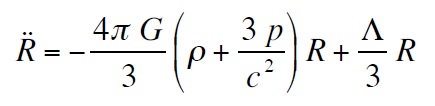
Well, here’s the equation that governs the dynamical evolution of the Universe:

DecelerationI’ve included a cosmological constant term (Λ) but ignore this for now. Note that if the pressure p is small (e.g. how it would be for cold dark matter) and the energy density ρ is positive (which it is for all forms of energy we know of) then in the absence of Λ the acceleration is always negative, i.e. the universe decelerates. This is in accord with intuition: because gravity always pulls we expect the expansion to slow down by the mutual attraction of all the matter. However, if the pressure is negative, the combination in brackets can be negative so can imply accelerated expansion.

In fact if dark energy stuff has an equation of state of the form p=-ρc2 then the combination in brackets leads to a fluid with precisely the same effect that a cosmological constant would have, so this is the simplest kind of dark energy.

When Einstein introduced the cosmological constant in 1915/6 he did it by modifying the left hand side of his field equations, essentially modifying the law of gravitation. This discussion shows that he could instead have modified the right hand side by introducing a vacuum energy with an equation of state p=-ρc2. A more detailed discussion of this can be found here.

Anyway, which way you like to think of dark energy the fact of the matter is that we don’t know how to explain it from a fundamental point of view. The only thing I can be sure of is that whatever it is in itself, dark energy is a truly terrible name for it.

I’d go for “persistent tension”…