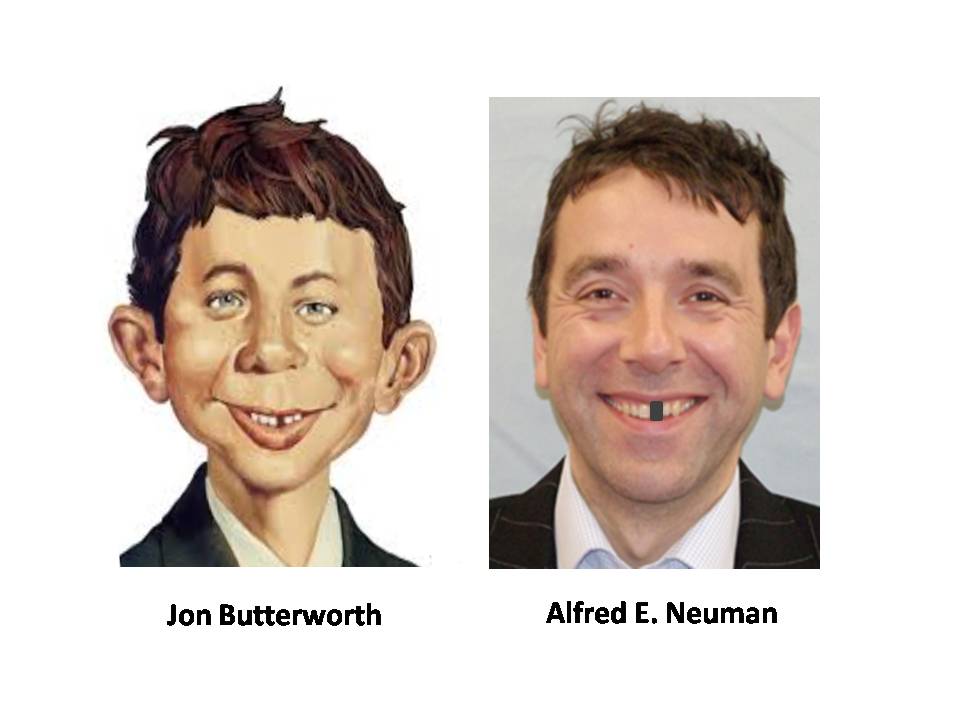
Although it’s not strictly an astronomical observation, I am struck by the resemblance between the distinguished particle physicist and blogger Professor Alfred E. Neuman, of University College London, and the iconic cover boy of Mad Magazine, Jon Butterworth. This could explain a lot about the Large Hadron Collider.
Follow @telescoperAstronomy (and Particle Physics) Look-alikes, No. 92
Posted in Astronomy Lookalikes with tags Alfred E. Neuman, Jon Butterworth, Mad Magazine on April 24, 2014 by telescoperWhy Graduate Teaching Assistantships Should Be Scrapped
Posted in Education with tags funding, Graduate Teaching Assistants, Pay, postgraduate, research student, Universities, University of Sussex on April 24, 2014 by telescoperThere’s an interesting piece in today’s Times Higher about the variability in pay and working conditions for Graduate Teaching Assistants across the UK Higher Education sector. For those of you not up with the lingo, Graduate Teaching Assistants (GTAs) are (usually) PhD students who fund their doctoral studies by doing some teaching for the department in which they are studying. As the piece makes clear, the use of GTAs varies widely between one university and another across the country and indeed between one department and another within the same university. The use of such positions is higher in arts and humanities departments than in science and engineering, because the latter general have more opportunity to fund scholarships for PhD students, either from one of the Research Councils or elsewhere. Such scholarships pay a stipend (tax-free) as well as the fee for studying as a PhD student.
When I arrived at the University of Sussex last year I found that the School of Mathematical and Physical Sciences operated a GTA scheme in parallel with Research Council bursaries. Students funded by a research council scholarship received a stipend paid at a national rate of about £13,600 per annum, but were able to top this up by undertaking a limited amount of teaching in the School (e.g. marking coursework, helping with workshops, or demonstrating in the teaching laboratories). Externally funded students did teaching on a voluntary basis. The GTAs on the other hand were required to undertake a fixed amount of teaching without remuneration in order to cover their fees.
I found this two-tier system unfair and divisive, with students funded as GTAs clearly treated as second-class citizens. One of the first major decisions I made as Head of School was to phase out the GTA scheme and replace it with bursaries on exactly the same terms as externally-funded ones with the same opportunity to top up the stipend with some teaching income. I announced this at a School meeting recently and it was met with broad approval, the only reservation being that it would be difficult if too few students opted to do extra teaching to cover the demand. I think that’s unlikely, actually, because although the stipend is not taxable so is equivalent to a somewhat higher amount in salary terms, Brighton is quite an expensive part of the country and most students would opt for a bit of extra dosh. Also, it is actually very good for a PhD student to have teaching experience on their CV when it comes to looking for a job.
Existing GTA schemes make it too easy for departments engage in exploitative behaviour, by dumping a huge amount of their teaching duties on underpaid and unqualified PhD students. It’s also unfair for the undergraduate students, nowadays paying enormously high fees, to be fobbed off onto PhD students instead of being taught by full-time, experienced and properly trained staff. Of course the system I’m advocating will be difficult to implement in departments that lack external funding for PhD students. Having to pay a full-stipend for each student will be more expensive and will consequently lead to a reduction in the number of PhD students that can be funded, but that’s not necessarily a bad thing. Indeed, the whole structure of undergraduate teaching will have to change in many departments. From what I’ve seen in the National Student Survey, that isn’t necessarily a bad thing either…
As I’ve argued a number of times on this blog, the current system drastically overproduces PhD students. The argument, a matter of simple arithmetic, is that on average in a steady state each potential PhD supervisor in the university system will, over their entire career, produce just one PhD student who will get a job in academia. In many fields the vast majority of PhDs have absolutely no chance of getting a permanent job in academia. Some know this, of course, and take their skills elsewhere when they’ve completed, which is absolutely fine. But I get the strong feeling that many bright students are lured into GTAs by the prospect that an illustrious career as an academic awaits them when really they’re just being hired as cheap labour. The result is a growing pool of disillusioned and disaffected people with PhDs who feel they’ve been duped by the system.
The British system of postgraduate research study is that it basically takes three years to do a degree. In the United States it usually takes much longer, so the employment of students as GTAs has less of an impact on their ability to complete their thesis on schedule. Although there are faults with the UK’s fast-track system, there is also much to recommend it. Not, however, if the student is encumbered with a heavy teaching load for the duration. The GTA scheme (which incidentally didn’t exist when I did my PhD nearly thirty years ago) is a damaging American import. In much of continental Europe there are far fewer PhD students and in many countries, especially in Scandinavia, PhD students are actually paid a decent wage. I think that’s the way we should go.
Follow @telescoperElsevier journals — some facts
Posted in Open Access with tags academic publishing, Elsevier, Rapacious Bastards on April 24, 2014 by telescoperRead this, and weep as you learn that Elsevier’s ruthless profiteering continues unabated…
A little over two years ago, the Cost of Knowledge boycott of Elsevier journals began. Initially, it seemed to be highly successful, with the number of signatories rapidly reaching 10,000 and including some very high-profile researchers, and Elsevier making a number of concessions, such as dropping support for the Research Works Act and making papers over four years old from several mathematics journals freely available online. It has also contributed to an increased awareness of the issues related to high journal prices and the locking up of articles behind paywalls.
However, it is possible to take a more pessimistic view. There were rumblings from the editorial boards of some Elsevier journals, but in the end, while a few individual members of those boards resigned, no board took the more radical step of resigning en masse and setting up with a different publisher under a new name (as some journals have…
View original post 10,674 more words
A Note to the Physics REF Panel
Posted in Education, Finance, Science Politics with tags 2008, 2014, Research Assessment Exercise, Research Excellence Framework on April 23, 2014 by telescoperI’ve just been skimming through an interesting report about the strength of UK physics research. One of the conclusions of said document is that UK physics research is the best in the world in terms of quality.
I couldn’t resist a brief post to point this out to any members of the Physics panel involved in the 2014 Research Excellence Framework. My motivation for doing this is that the Physics panel of the 2008 Research Assessment Exercise evidently came to the conclusion that UK physics research wasn’t very good at all, awarding a very much lower fraction of 4* (world-leading) grades than many other disciplines, including chemistry. I’ve never understood why the Panel arrived at such a low opinion of its own discipline, but there you go..
Physics departments across the country have fought very hard to recover from the financial and reputational damage inflicted by the 2008 RAE panel’s judgement. Let’s just hope there isn’t another unwarranted slap in the face in store when the 2014 results are announced later this year…
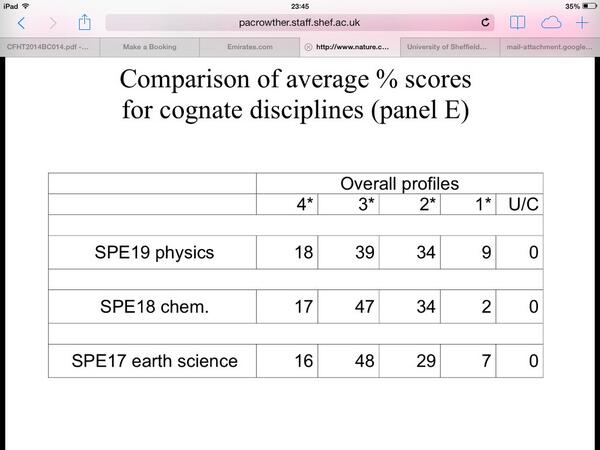
UPDATE: I’m grateful to Paul Crowther for pointing out a surprising fact based on a talk given by the Chairman of the Physics RAE Panel in 2008, Sir John Pendry. Here are the slides in full, but the pertinent fact is the distribution of 4*, 3* and 2* grades across disciplines shown in this table:
You can see that they are in fact broadly, similar across disciplines. However, what is clear is that the highest scoring departments in Chemistry did much better than the highest-scoring in Physics; for example top of the table for Physics was Lancaster with 25% of its outputs graded 4* while top in Chemistry was Cambridge with 40%. Is it really justifiable that the top physics departments were so much worse than the top chemistry departments? Suspicion remains that the Physics scores were downgraded systematically to produce the uncannily similar profiles shown in the table. Since all the RAE documents have been shredded, we’ll never know whether that happened or not…
Follow @telescoperSonnet No. 30
Posted in Poetry on April 23, 2014 by telescoperThe exact date of Shakespeare’s birth is not known but, by tradition, it is celebrated on 23rd April, St George’s Day. Today therefore marks the 450th anniversary of his birth.
This sonnet is clearly closely related to the one preceding it, No. 29, and is thought to have been written to the Earl of Southampton. I picked it for today not just because it’s beautiful, but also because it provides an example of how deeply embedded in our language certain phrases from Shakespeare have become; the standard English translation of Marcel Proust’s A la recherche du temps perdu is entitled The Remembrance of Things Past, though I have never felt it was a very apt rendering. English oneupmanship, perhaps?
When to the sessions of sweet silent thought
I summon up remembrance of things past,
I sigh the lack of many a thing I sought,
And with old woes new wail my dear time’s waste:
Then can I drown an eye, unused to flow,
For precious friends hid in death’s dateless night,
And weep afresh love’s long since cancelled woe,
And moan the expense of many a vanished sight:
Then can I grieve at grievances foregone,
And heavily from woe to woe tell o’er
The sad account of fore-bemoanèd moan,
Which I new pay as if not paid before.
But if the while I think on thee, dear friend,
All losses are restored and sorrows end.
by William Shakespeare (1564-1616).
Yeh Yeh
Posted in Music, Television with tags Bob Downe, Yeh Yeh on April 22, 2014 by telescoperBy way of celebrating the end of my holiday I thought I’d post this bit of musical entertainment by the legendary Bob Downe singing a medley of the Georgie Fame hit, Yeh Yeh. If only all Australian men were as butch as Bob Downe…
Follow @telescoper
The Stifling Effect of REF Impact
Posted in Education, Politics with tags impact, REF, Research Excellence Framework, SEPNET on April 22, 2014 by telescoperWell, I’m back to civilization (more or less) and with my plan to watch a day of cricket at Sophia Gardens thwarted by the rain I decided to pop into an internet café and do a quick post about one of the rants that has been simmering on the back burner while I’ve been taking a break.
Just before the Easter vacation I had lunch with some colleagues from the Department of Physics & Astronomy at the University of Sussex. One of the things that came up was the changing fortunes of the department. After years of under-investment from the University administration, it was at one time at such a low ebb that it was in real danger of being closed down (despite its undoubted strengths in research and teaching). Fortunately help came in the form of SEPnet, which provided funds to support new initiatives in Physics not only in Sussex but across the South East. Moreover, the University administration had belatedly realized that a huge part of the institutional standing in tables of international research rankings was being generated by the Department of Physics & Astronomy. In the nick of time, the necessary resources were invested and the tide was turned and there has been steady growth in staff and student numbers since.
As Head of the School of Mathematical and Physical Sciences I have had to deal with the budget for the Department of Physics & Astronomy. Just a decade ago very few physics departments in the UK were financially solvent and most had to rely on generous subsidies from University funds to stay open. Those that did not receive such support were closed down, a fate which Sussex narrowly avoided but which befell, for example, the physics departments at Reading and Newcastle.
As I blogged about previously, the renaissance of Sussex physics seems not to be unique. Admissions to physics departments across the country are growing at a healthy rate, to the extent that new departments are being formed at, e.g. Lincoln and Portsmouth. None of this could have been imagined just ten years ago.
So will this new-found optimism be reflected in the founding of even more new physics departments? One would hope so, as I think it’s a scandal that there are only around 40 UK universities with physics departments. Call me old-fashioned but I think a university without a physics department is not a university at all. Thinking about this over the weekend however I realized that any new physics department is going to have grave problems under the system of allocating research funding known as the Research Excellence Framework.
A large slice (20%) of the funding allocated by the 2014 REF will be based on “Impact” which, roughly speaking, means the effect the research can be demonstrated to have had outside the world of academic research. This isn’t the largest component – 65% is allocated on the basic of the quality of “Outputs” (research papers etc) – but is a big chunk and will probably be very important in determining league table positions. It is probably going to be even larger in future versions of the REF.
Now here’s the rub. When an academic changes institution (as I have recently done, for example) he/she can take his/her outputs to the new institution. Thus, papers I wrote while at Cardiff could be submitted to the REF from Sussex. This is not the case with “impact”. The official guidance on submissions states:
Impact: The sub-panels will assess the ‘reach and significance’ of impacts on the economy, society and/or culture that were underpinned by excellent research conducted in the submitted unit, as well as the submitted unit’s approach to enabling impact from its research. This element will carry a weighting of 20 per cent.
The emphasis is mine.
The period during which the underpinning research must have been published is quite generous in length: 1 January 1993 to 31 December 2013. This is clearly intended to recognize the fact that some research take a long time to generate measurable impact. The problem is that the underpinning research must have been done within the submitting unit; it can’t be brought in from elsewhere. If the unit is new and did not exist for most of this period,then it is much harder to generate impact no matter how brilliant the staff it recruits. Any new departments in physics, or any other subject for that matter, will have to focus on research that can generate impact very rapidly indeed if it is to compete in the next REF, expected in 2018 or thereabouts. That is a powerful disincentive for universities to invest in research that may take many years to come to fruition. Five years is a particularly short time in experimental physics.
Follow @telescoper
Interlude
Posted in Uncategorized on April 16, 2014 by telescoperI’m taking a short holiday over the Easter break and probably won’t be blogging until I get back, primarily because I won’t have an internet connection where I’m going. That’s a deliberate decision, by the way. So, as the saying goes, there will now follow a short intermission….
Follow @telescoper
Magnetic River
Posted in Education, The Universe and Stuff with tags Eric Laithwaite, magnetism, Magnets on April 15, 2014 by telescoperI stumbled across this yesterday as a result of an email from a friend who shall remain nameless (i.e. Anton). I remember seeing Prof. Eric Laithwaite on the television quite a few times when I was a kid. What I found so interesting about watching this so many years later is that it’s still so watchable and compelling. No frills, no gimmicks, just very clear explanation and demonstrations, reinforced by an aura of authoritativeness that makes you want to listen to him. If only more modern science communication were as direct as this. I suppose part of the appeal is that he speaks with an immediately identifiable no-nonsense accent, from the part of the Midlands known as Lancashire….
Follow @telescoper
Bearded Bishop Brentwood welcomed but too late for Beard of Spring poll
Posted in Beards, Biographical, Football, Politics on April 15, 2014 by telescoperI’m still way behind John Brayford (who he?), but there’s definitely signs of a bounce! The Deadline is 19th April. Vote for me!
Beard Liberation Front
PRESS RELEASE 14th April
Contact Keith Flett 07803 167266
Bearded Bishop Brentwood welcomed but too late for Spring Beard poll
The Beard Liberation Front, the informal network of beard wearers that campaigns against beardism, has welcomed the news that the Pope on Monday appointed Fr Alan Williams FM as the Bishop of Brentwood but say that his appointment is too late for inclusion on the Beard of Spring 2014 poll which concludes on Friday.
The campaigners say that they are certain that the distinguished Bishop will feature in future
The big issue in the days left for voting is whether current leader Sheffield United footballer John Brayford did enough in his team’s defeat to Hull in Sunday’s FA Cup semi-final to take the title or whether challengers such as cosmologist Peter Coles and Editor of the I Paper Olly Duff can catch him
The Beard of Spring…
View original post 136 more words