Beard Liberation Front PRESS RELEASE 14th April Contact Keith Flett 07803 167266 Bearded Bishop Brentwood welcomed but too late for Spring Beard poll
The Beard Liberation Front, the informal network of beard wearers that campaigns against beardism, has welcomed the news that the Pope on Monday appointed Fr Alan Williams FM as the Bishop of Brentwood but say that his appointment is too late for inclusion on the Beard of Spring 2014 poll which concludes on Friday.
The campaigners say that they are certain that the distinguished Bishop will feature in future
The big issue in the days left for voting is whether current leader Sheffield United footballer John Brayford did enough in his team’s defeat to Hull in Sunday’s FA Cup semi-final to take the title or whether challengers such as cosmologist Peter Coles and Editor of the I Paper Olly Duff can catch him
This evening sees the start of the Jewish Festival of the Passover (Pesach) which made me think of posting this piece of inspired silliness by the legendary Slim Gaillard to wish you all a Chag Sameach.
Slim Gaillard was a talented musician in his own right, but also a wonderful comedian and storyteller. He’s most famous for the novelty jazz acts he formed with musicians such as Slam Stewart and, later, Bam Brown; their stream of consciousness vocals ranged far afield from the original lyrics along with wild interpolations of nonsense syllables such as MacVoutie and O-reeney; one such performance figures in the 1957 novel On the Road by Jack Kerouac.
In later life Slim Gaillard travelled a lot in Europe – he could speak 8 languages in addition to English – and spent long periods living in London. He died there, in fact, in 1991, aged 75. I saw him a few times myself when I used to go regularly to Ronnie Scott’s Club. A tall, gangly man with a straggly white beard and wonderful gleam in his eye, he cut an unmistakeable figure in the bars and streets of Soho. He rarely had to buy himself a drink as he was so well known and such an entertaining fellow that a group always formed around him in order to enjoy his company whenever he went into a pub. You never quite knew what he was going to do next, in fact. I once saw him sit down and play a piano with his palms facing upwards, striking the notes with the backs of his fingers. Other random things worth mentioning are that Slim Gaillard’s daughter was married to Marvin Gaye and it is generally accepted that the word “groovy” was coined by him (Slim). I know it’s a cliché, but he really was a larger-than-life character and a truly remarkable human being.
They don’t make ’em like Slim any more, but you can get a good idea of what a blast he was by listening to this record, which is bound to bring a smile even to the most crabbed of faces….
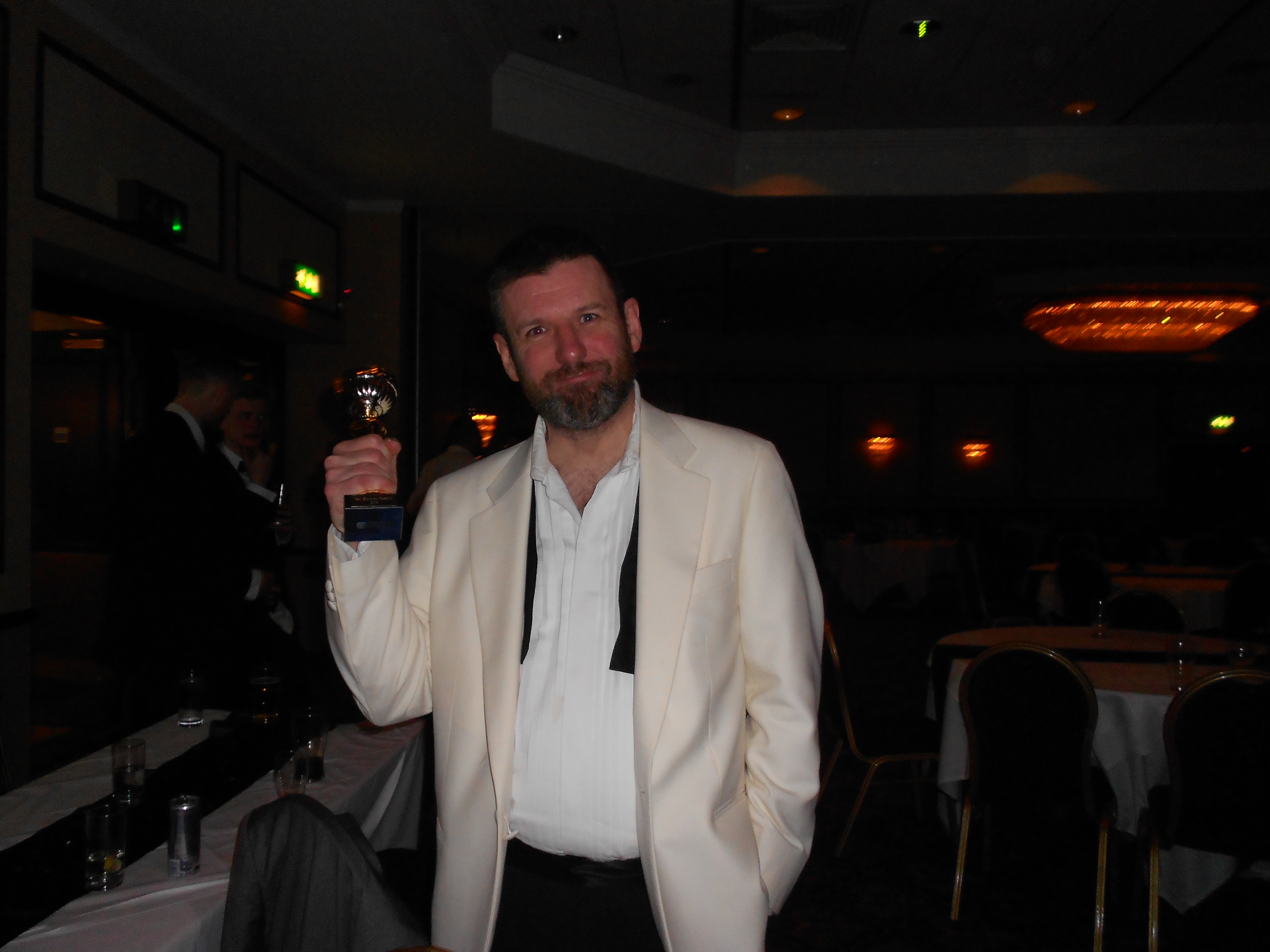
Fortunately, however my disappointment at fading into oblivion in one competition has been more than adequately offset by joy at being awarded a Prize by students from the Department of Physics & Astronomy at the University of Sussex. You could have knocked me down with a feather (had I not been seated) when they announced my name as winner of the award for Best Expressed Research. Here’s the trophy:
I’m assuming that it’s solid gold, although it’s surprisingly light to carry. I’m not sure where I should store it until next year when presumably it will be handed onto someone else. It did occur to me to send it up to Newcastle United. At least that way they will have something to put in their trophy cabinet…
Anyway, I’d like to thank everyone who voted for me, although I’m still not at all sure what “Best Expressed Research” actually means nor do I know what I did in particular to deserve the award. Not that any of that really matters. It’s honour enough to be working in a Department that’s part of a School where there’s such a wonderful friendly and cooperative atmosphere between staff and students. I’ve worked in some good physics departments in my time, but the Department of Sussex is completely unique both for the level of support it offers students and the fact that so many of the undergraduates are so highly motivated. Maybe that’s at least partly because there is such a close link between our teaching and research across the Department. Some people think – and some universities would have them think – that research-led teaching only happens in Russell Group institutions. In reality there’s plenty of evidence that, at least in Physics, Sussex does research-led teaching better than any of the Russell group.
Amid all the administrative jobs I have to do these days the opportunity to do a bit of teaching every now and then is the only chance I have of staying even approximately sane. I’m not sure how many other Heads of School at Sussex University do teaching – I’m told my predecessor in the School of Mathematical and Physical Sciences didn’t do any – but the day I have to stop teaching is the day I’ll retire. Teaching students who want to learn is much more than mere waged labour – it’s one of the most rewarding ways there is of spending your time.
Part of the entertainment at last night’s Physics & Astronomy Ball was a marvellously entertaining and informative after-dinner speech by particle physicist David Wark. David had to leave before the evening ended in order to get a taxi to Heathrow and thence a flight to Japan, so he missed out on the dancing and general merriment. I may get time tomorrow to write a bit more about the Ball itself, including the fact that I received an award from the students! For the time being, though, I’ll just pass on a fascinating snippet that David Wark, an expert on neutrinos, mentioned in his speech.
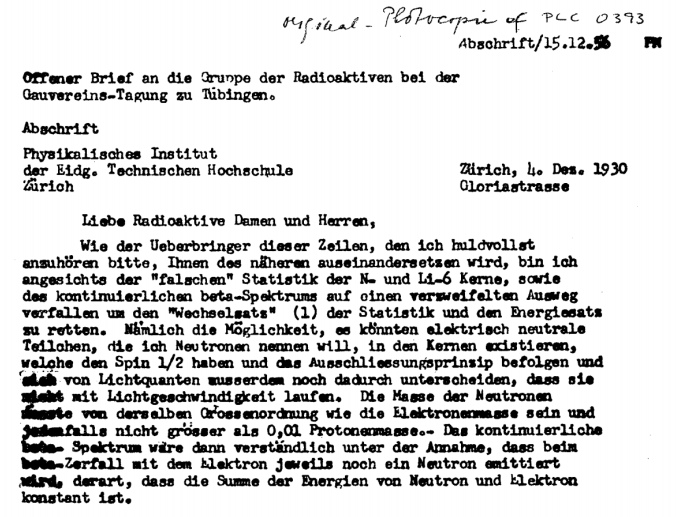
It is well known that the neutrino was first postulated by Wolfgang Pauli in 1930 to account measurements that suggested that energy and momentum were not conserved in beta decay. What is perhaps less well known – it was certainly new to me until I heard about it last night – is that Pauli’s proposal is described in famous letter, addressed rather charmingly to “Radioactive Ladies and Gentlemen” of Tübingen from his base the ETH in Zürich. Part of the letter is reproduced here:
The opening phrases of the letter “Wie der überbringer dieser Zeilen den ich huldvollst anzuhören bitte…” is a polite request that the recipient(s) listen to the “bearer of these lines”. Presumably, Pauli being unable to visit Tübingen himself, he sent someone else along with the letter and that person gave some sort of seminar or informal presentation of the idea.
The mystery is that despite the obvious importance of this episode for the history of physics, nobody seems to know who the “bearer of the lines” from Pauli actually was. In his speech David Wark said he had been trying for 15 years to identify the individual, without success.
Term has ended at last. These 12-week teaching terms we have at Sussex are quite exhausting, but we got there in the end. In fact, I much prefer doing all the teaching in one block like that instead of having to split it in order to accommodate the Easter holiday which happens when Easter is earlier in the year. It’s tiring, but worth it.
Teaching actually finished yesterday, but today we had yet another UCAS Applicant Visit Day on the Sussex University campus, with both Departments in my School (i.e. Mathematics and Physics & Astronomy) in action. It’s been quite a nice day actually, which is no doubt part of the reason why today has been very busy. There’s only one more such visit day left – at the very end of April – and then we can sit back and wait until August, when the A-level results come out, to find out how many students we will be welcoming into the first year next year.
I’ve had other reasons for being especially tired over the last couple of days. On Thursday night we had the Sussex University Mathematics Society Annual staff-student ball, a very pleasant affair held in the splendid Hilton Metropole Hotel on Brighton’s seafront. I had planned to leave at a respectable hour as I had to work on Friday (yesterday), but ended up getting home well after 2am.
On Friday afternoon I went up to London for the regular Monthly Open Meeting of the Royal Astronomical Society followed by dinner with the RAS Club, which was very pleasant but I didn’t get back to Brighton until after eleven. I was quite pleased that a bus arrived at the Station almost as soon as I reached the stop. About half-way home a lady got on the bus who was clearly in a tired and emotional state. As often seems to happen this person sat next to me. She proceeded to ask me if I’d like her to sing. I politely declined but she started anyway so I had an unwanted “musical” accompaniment for the rest of my journey. I wouldn’t have minded so much, but she had a terrible voice.
Then this morning I had to get up pretty early to get up to campus for our Applicant Visit Day – not that it was much of a chore to do so because I always enjoy these occasions and it was a lovely morning anyway.
It’s not quite over, though, because tonight is the Annual Physics & Astronomy Ball. It is quite disconcerting to have two Balls squeezed together in such close proximity, but when I took over as Head of School last year I decided that I should either go to both Balls, or neither. Naturally I chose the first option. It’s a tough job but somebody has to do it. I think I’ll need to give my liver a rest for a few days afterwards, though.
Now the plan is to have an afternoon nap before tonight’s event. There’s a football match kicking off at the Amex stadium at 3pm, though, so traffic is likely to be heavy until then so I’m killing time writing this meandering blog post until getting the bus back to my flat.
I’ve just got a few more days at work until I take a break for ~10 days. I haven’t decided yet, but I think I might take a break from blogging then too. But I’ll be back tomorrow on campus to try to make sure I finish all the things I’m supposed to do before I take my holiday.
Just time for a short lunchtime post in between loads of end-of-term business and travelling up to London for this afternoon’s meeting of the Royal Astronomical Society. I’m a bit tired, to be honest, largely owing to a late night last night at the Sussex University Mathematics Society Ball, but this is an excellent pick-me-up. You can dip into the classic “Hot Five” recordings at any point and come up with something wonderful, but I think this is one of the very best. Recorded in Chicago on February 26, 1926, Cornet Chop Suey was written by Louis Armstrong and features him on trumpet, at the centre of the amazing front line that also included Kid Ory on trombone and Johnny Dodds on clarinet. Johnny St. Cyr plays banjo and on piano is the superb Lil Armstrong (née Hardin), Louis’ first wife, who plays a very fine solo on this track. Above all, though, it’s a vehicle for Louis Armstrong himself who is on absolutely superlative form, especially in the stop-time choruses from about 1:47 onwards. The ending’s pretty good too…
Just so you know that our education system is safe in the hands of Michael Gove I thought I would pass on a couple of examples from the latest official guidance on subject content for GCSE Combined Science. These are both from Appendix 1, entitled Equations in Physics.
Example one:
kinetic energy = 0.5 x mass x (acceleration)2
Example two:
(final velocity)2 – (initial velocity)2 = 2 x acceleration x time
Neither of these is even dimensionally correct!
Such sloppiness from the Department of Education is really unforgivable. Has anyone else spotted any similar howlers elsewhere in the document? If so please let me know via the comments box…
UPDATE: Monday 14th April. Apparently these errors in the document have now been corrected, but still…
Frederick Delius is by no means my favourite composer, but when I heard yesterday of the death of the fine English baritone John Shirley-Quirk, I immediately decided to post this piece as a tribute. It’s a sumptuous setting, by Delius, of Ernest Dowson‘s sensual and languid poem Non Sum Qualis Eram Bonae Sub Regno Cynarae which is named after a phrase from Horace but is actually, obviously, about the poet’s obsession with a lost love. I probably shouldn’t mention that the lost love in question was an eleven year old girl and he was 24. Dowson pursued her unsuccessfully for eight years. When eventually, at the age of 19, she married someone else he drank himself to death at the age of 32. Oscar Wilde said of Dowson:
Poor wounded wonderful fellow that he was, a tragic reproduction of all tragic poetry, like a symbol, or a scene. I hope bay leaves will be laid on his tomb and rue and myrtle too for he knew what love was.
Anyway, the music and words are beautifully woven together and also beautifully sung. RIP John Shirley-Quirk.
Here’s the text of the poem
Last night, ah, yesternight, betwixt her lips and mine There fell thy shadow, Cynara! thy breath was shed Upon my soul between the kisses and the wine; And I was desolate and sick of an old passion, Yea, I was desolate and bowed my head: I have been faithful to thee, Cynara! in my fashion.
All night upon mine heart I felt her warm heart beat, Night-long within mine arms in love and sleep she lay; Surely the kisses of her bought red mouth were sweet; But I was desolate and sick of an old passion, When I awoke and found the dawn was grey: I have been faithful to thee, Cynara! in my fashion.
I have forgot much, Cynara! gone with the wind, Flung roses, roses riotously with the throng, Dancing, to put thy pale, lost lilies out of mind, But I was desolate and sick of an old passion, Yea, all the time, because the dance was long: I have been faithful to thee, Cynara! in my fashion.
I cried for madder music and for stronger wine, But when the feast is finished and the lamps expire, Then falls thy shadow, Cynara! the night is thine; And I am desolate and sick of an old passion, Yea, hungry for the lips of my desire: I have been faithful to thee, Cynara! in my fashion.
We investigate possible imprints of galactic foreground structures such as the `radio loops’ in the derived maps of the cosmic microwave background. Surprisingly there is evidence for these not only at radio frequencies through their synchrotron radiation, but also at microwave frequencies where emission by dust dominates. This suggests the mechanism is magnetic dipole radiation from dust grains enriched by metallic iron, or ferrimagnetic molecules. This new foreground we have identified is present at high galactic latitudes, and potentially dominates over the expected B-mode polarisation signal due to primordial gravitational waves from inflation.
The authors argue that foreground emission from our own Galaxy has not been fully subtracted from maps of the cosmic microwave background. This emission could result in significant contamination of the CMB polarization if it is associated with dust grains aligned with the Galaxy’s magnetic field.
I’m grateful to one of the authors of the paper, Philip Mertsch, for sending me this map of the Galactic Loops with the BICEP2 region superimposed on it, demonstrating that there is potential for a contribution…
This paper is likely to provoke quite a discussion, so I thought I’d suggest one possible way of testing it, namely by updating the analysis presented by myself and Patrick Dineen in 2003 with new data. Here’s the abstract of our old paper:
We present a diagnostic test of possible Galactic contamination of cosmic microwave background sky maps designed to provide an independent check on the methods used to compile these maps. The method involves a non-parametric measurement of cross-correlation between the Faraday rotation measure (RM) of extragalactic sources and the measured microwave signal at the same angular position. We argue that statistical properties of the observed distribution of rotation measures are consistent with a Galactic origin, an argument reinforced by a direct measurement of cross-correlation between dust, free-free and synchrotron foreground maps and RM values with the strongest correlation being for dust and free-free. We do not find any statistically compelling evidence for correlations between the RM values and the COBE DMR maps at any frequency, so there is no evidence of residual contamination in these CMB maps. On the other hand, there is a statistically significant correlation of RM with the preliminary WMAP individual frequency maps which remains significant in the Tegmark et al. Wiener-filtered map but not in the Internal Linear Combination map produced by the WMAP team.
The idea is that cross-correlating the CMB pattern with Faraday rotation measures should provide an independent diagnostic of the effect of magnetic fields. Our analysis was based on old CMB data, so there’s an interesting project to be done updating it with, e.g., Planck CMB data and a larger set of rotation measures. See the comment below for a reference to more recent work along these lines, but still not including Planck.
Anyway, this all goes to show that there’s one question you can always ask about an astrophysics result: have you considered the possible role of magnetic fields?
The views presented here are personal and not necessarily those of my employer (or anyone else for that matter).
Feel free to comment on any of the posts on this blog but comments may be moderated; anonymous comments and any considered by me to be vexatious and/or abusive and/or defamatory will not be accepted. I do not necessarily endorse, support, sanction, encourage, verify or agree with the opinions or statements of any information or other content in the comments on this site and do not in any way guarantee their accuracy or reliability.