Countdown to GAIA

Posted in The Universe and Stuff with tags , , , on December 18, 2013 by telescoper

Just a quick post to point out that tomorrow morning at 9.12am GMT will see the launch of the European Space Agency’s Gaia mission.  You can watch the launch live here from about 8.50 GMT. I’ll be in a meeting at 9am tomorrow morning, so I’m probably going to miss it.

Gaia arrives on the Launchpad at Kourou, French Guyana, on 13th December

Gaia arrives on the Launchpad at Kourou, French Guyana, on 13th December

I remember first hearing about Gaia about 15 years ago when I was on a PPARC advisory panel and was simultaneously amazed  by the ambition of its objectives and sceptical that it would ever get off the ground. Now its almost ready to go, so fingers crossed for a successful launch tomorrow.

Coincidentally, Gaia is among the various telescopes and observatories featured in the STFC Roadshow we put on  viewfor an Astronomy Master Class we have been putting on for local schools over the last couple of days here at the University of Sussex:

IMG-20131218-00248

Gaia is a global space astrometry mission, which will make the largest, most precise three-dimensional map of our Galaxy by surveying more than a thousand million stars. In some sense it is the descendant of the Hipparcos mission launched in 1989, but it’s very much more than that. Gaia will monitor each of its target stars about 70 times over a five-year period. It is expected to discover hundreds of thousands of new celestial objects, such as extra-solar planets and brown dwarfs, and observe hundreds of thousands of asteroids within our own Solar System. The mission is also expected to yield a wide variety of other benefits, including new tests of the  General Theory of Relativity.

Gaia will create an extraordinarily precise three-dimensional map of more than a thousand million stars throughout our Galaxy (The Milky Way) and beyond, mapping their motion, luminosity, temperature and chemical composition as well as any changes in such properties. This huge stellar census will provide the data needed to tackle an enormous range of important problems related to the origin, structure and evolutionary history of our Galaxy. Gaia will do all this by repeatedly measuring the positions of all objects down to an apparent magnitude of 20. A thousand million stars is about 1% of the entire stellar population of the Milky Way.

For the brighter objects, i.e. those brighter than magnitude 15, Gaia will measure their positions to an accuracy of 24 microarcseconds, comparable to measuring the diameter of a human hair at a distance of 1000 km. Distances of relatively nearby stars will be measured to an accuracy of 0.001%. Even stars near the Galactic Centre, some 30 000 light-years away, will have their distances measured to within an accuracy of 20%.

It’s an astonishing mission that will leave an unbelievably rich legacy not only for the astronomers working on the front-line operations of Gaia but for generations to come. I have a feeling that there might be  a few sleepless nights tonight waiting for the launch, but I suppose astronomers should be used to that!

UPDATE: 19/12/2013 Success! Launch went smoothly, separation of the Gaia spacecraft achieved. Now we have to wait for a month or so for it to get to L2, settle itself down, and then start doing science. The first data release isn’t due for 22 months…Bon Voyage!

Viva Elsewhere…

Posted in Biographical, Education with tags , , on December 18, 2013 by telescoper

I just came back from a meeting of the Heads of  the science Schools here at the University of Sussex where, among other things, we discussed PhD completion rates across the University. I sat there smugly because ours in the School of Mathematical and Physical Sciences are pretty good. The meeting started at 10am which also happens to have been the starting time for a PhD examination in at Cardiff University involving my (former) student Ian Harrison. I would have liked to have been there, but unfortunately I have several appointments today in Sussex so couldn’t make it.

It’s not normal practice for the supervisor of a PhD to be present at the examination of the candidate. The rules allow for it – usually at the request of the student – but the supervisor must remain silent unless and until invited to comment by the examiners. I think it’s a very bad idea for both student and supervisor, and the one example that I can recall of a supervisor attending the PhD examination of his student was a very uncomfortable experience.

I always feel nervous when a student of mine is having their viva voce examination, probably because I’m a bit protective and such an occasion always brings back painful memories of the similar ordeal I went through twenty-odd years ago. Although I have every confidence in Ian, I can’t help  sitting in my office wondering how it is going. However, this is something a PhD candidate has to go through on their own, a sort of rite of passage during which the supervisor has to stand aside and let them stand up for their own work. Usually, of course, I would be there for the event (if not actually present in the examination room), but now I’m a considerable distance away it feels a bit strange.

I’ve actually blogged about a paper of Ian’s already. He finished his thesis well within the usual three-year limit and has moved to the Midlands (Manchester, to be precise) to take up a postdoctoral research position there.  He’s not technically allowed to call himself Doctor Harrison yet, but I’m sure it’s just a matter of time. In the words of Miss Jean Brodie, my students are, without doubt, la crème de la crème.

It’s now 11.45. Fingers crossed for some news soon…

UPDATE: 13.00. Still no news…

UPDATE: 13.07. Congratulations, Dr Harrison!


The Gambler’s Puzzle

Posted in Cute Problems, Literature with tags , , , on December 17, 2013 by telescoper

The following is a quotation from the short novel The Gambler by Fyodor Dostoyevsky:

I was a gambler myself; I realized it at that moment. My arms and legs were trembling and my head throbbed. It was, of course, a rare happening for zero to come up three times out of some ten or so; but there was nothing particularly astonishing about it. I had myself seen zero turn up three times running two days before, and on that occasion one of the players, zealously recording all the coups on a piece of paper, had remarked aloud that no earlier than the previous day that same zero had come out exactly once in twenty four hours.

The probability of obtaining a zero on a (fair) Roulette wheel of the European variety is 1/37. Assuming  that such a wheel is spun exactly 370 times in a day, determine the probability of obtaining at most one zero in twenty four hours as described in the quotation. Give your answer to three significant figures.

Answers through the comments box please!

An Ashes Lament..

Posted in Cricket with tags , on December 17, 2013 by telescoper

It seems like yesterday that I was celebrating a famous England victory in an Ashes series in Australia. In fact it was a little under three years ago. In that series the difference between the two teams was primarily in the batting, with opener Alastair Cook having a particularly brilliant series. Now England captain, Cook has struggled with the bat on this tour. Yesterday’s dismissal, first ball, more-or-less sums up his team’s weaknesses. The batting has been fragile, their bowling ineffective and their fielding unreliable. A bit more resolve in the batting, a few more opportunities taken in the field and things might have been different. The truth is, however, that since the opening Test in Brisbane England have been playing like a side expecting to be beaten. Once you’ve lost confidence like that it’s difficult to get it back, especially with Test matches coming up in such quick succession. Australia took the initiative early on, and have been ruthless in exploiting it. In the early  hours of this morning, Australia won the Third Test in Perth to lead 3-0, and so take the Ashes having an unassailable lead in the 5 match series..

England had a good run of luck during this summer’s Ashes series in England – the weather getting them out of a couple of rather deep holes – but the Australian summer rarely shows such mercy on visiting teams, and England’s weaknesses have been cruelly exposed. I always thought England would have a tough time trying to retain the Ashes down under, but didn’t expect them to be so thoroughly outplayed.  I wouldn’t bet against a 5-0 whitewash the way things are going. Shades of 2006/7.

But enough of England. I would be churlish not to congratulate the Australians on their deserved victory. They have had a lean time for many years and I’m sure will enjoy the celebrations. There’s no doubt that the better side has won; they have trounced England in all departments. Well played the Aussies!

On Monsieur’s Departure

Posted in History, Poetry with tags , on December 16, 2013 by telescoper

I grieve and dare not show my discontent,
I love and yet am forced to seem to hate,
I do, yet dare not say I ever meant,
I seem stark mute but inwardly to prate.
I am and not, I freeze and yet am burned.
Since from myself another self I turned.

My care is like my shadow in the sun,
Follows me flying, flies when I pursue it,
Stands and lies by me, doth what I have done.
His too familiar care doth make me rue it.
No means I find to rid him from my breast,
Till by the end of things it be supprest.

Some gentler passion slide into my mind,
For I am soft and made of melting snow;
Or be more cruel, love, and so be kind.
Let me or float or sink, be high or low.
Or let me live with some more sweet content,
Or die and so forget what love ere meant.

by Elizabeth I (1533-1603)

A picture from the past!

Posted in Biographical with tags , on December 12, 2013 by telescoper

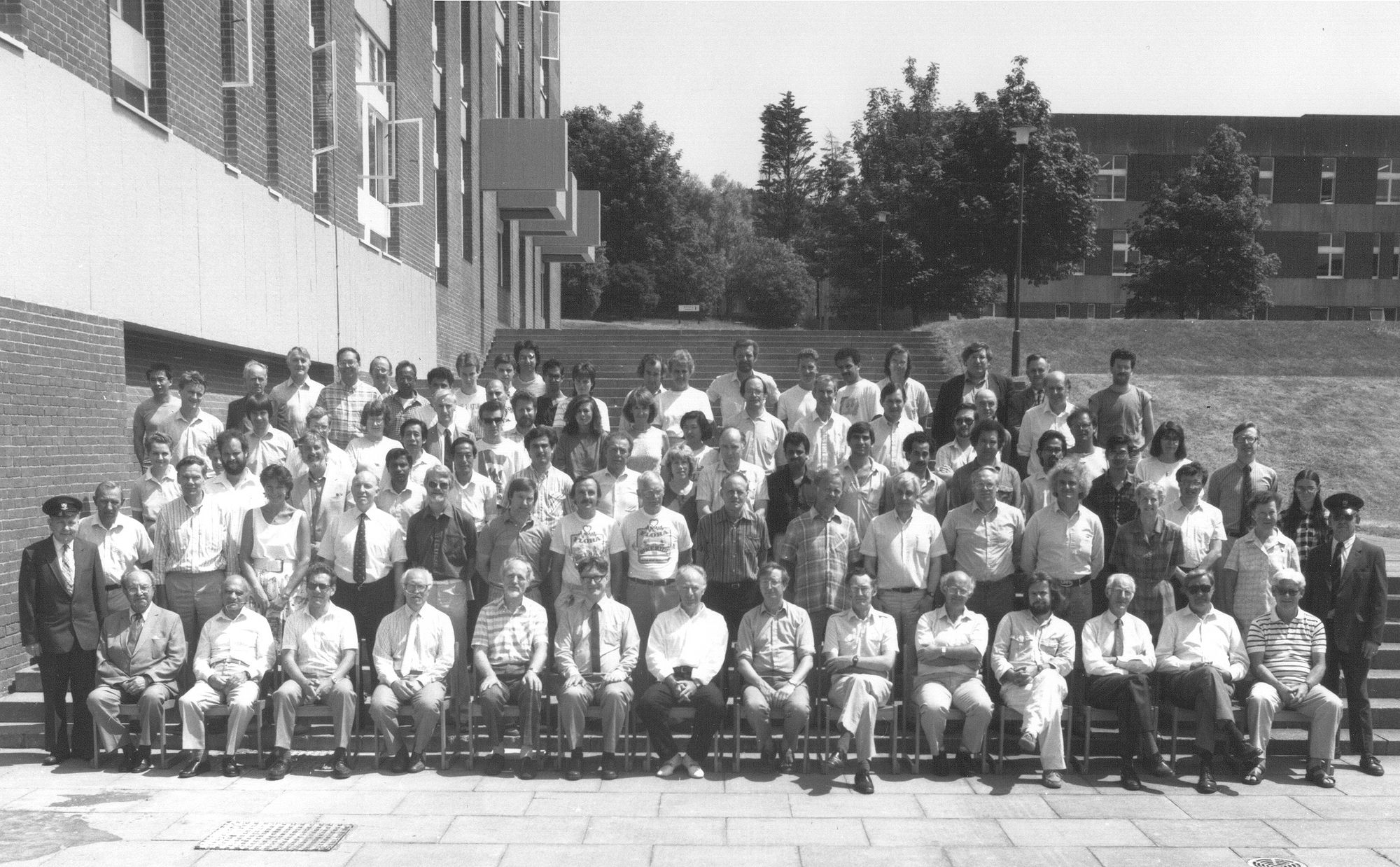
Well, here’s a blast from the past! This is the School Photograph for the School of Mathematical and Physical Sciences at the University of Sussex, vintage 1989. The School was called MAPS in those days; over the years we’ve lost an A and are now called MPS. Anyway, see if you can spot yours truly in this picture; you can click on the picture to make it larger. I did my PhD (actually DPhil) there from 1985-88 and then stayed on for a two-year postdoctoral position until 1990; so if you can spot me that’s what I looked like as a PDRA!

2000px-MAPS_photo_1989_BW

Elsevier is taking down papers from Academia.edu

Posted in Open Access with tags , on December 12, 2013 by telescoper

Yet another example of an academic publisher (Elsevier) acting in a manner clearly detrimental to research.

Mike Taylor's avatarSauropod Vertebra Picture of the Week

Lots of researchers post PDFs of their own papers on their own web-sites. It’s always been so, because even though technically it’s in breach of the copyright transfer agreements that we blithely sign, everyone knows it’s right and proper. Preventing people from making their own work available would be insane, and the publisher that did it would be committing a PR gaffe of huge proportions.

Enter Elsevier, stage left. Bioinformatician Guy Leonard is just one of several people to have mentioned on Twitter this morning that Academia.edu took down their papers in response to a notice from Elsevier. Here’s a screengrab of the notification:

oLI5n9w

And here is the text (largely so search-engines can index it):

Hi Guy

Unfortunately, we had to remove your paper, Resolving the question of trypanosome monophyly: a comparative genomics approach using whole genome data sets with low taxon sampling, due to a take-down notice from…

View original post 403 more words

Boycott Nature and Science!

Posted in Open Access, Science Politics with tags , , , , on December 11, 2013 by telescoper

On Tuesday Randy Schekman, joint winner of the 2013 Nobel Prize for Physiology or Medicine hit out at academic publishers for the way the most “prestigious” journals (specifically Cell, Nature and Science) publish only the “flashiest” research.  I see his announcement as part of a groundswell of opinion that scientists are being increasingly pressured to worry more about the impact factors of the journals they publish in than about the actual science that they do. Cynics have been quick to point out that his statements have emerged only after he received the Nobel Prize, and that it’s difficult for younger researchers who have to build their careers in a world to break free from the metrics that are strangling many disciplines. I feel, as do some of my colleagues (such as Garret Cotter of Oxford University), that it’s time for established researchers to make a stand and turn away from those publishers that we feel are having a negative impact on science and instead go for alternative modes of publication that are in better keeping with the spirit of open science.

In future, therefore, I’ll be boycotting Nature and Science (I don’t publish in Cell anyway) and I call upon my colleagues to do likewise. Here’s a nice logo (courtesy of Garrett Cotter) that you might find useful should you wish to support the boycott.

CNS

ps. For the record I should point out that during my career I have published four papers in Nature and one in Science.

The Cosmic Web at Sussex

Posted in Books, Talks and Reviews, The Universe and Stuff with tags , on December 10, 2013 by telescoper

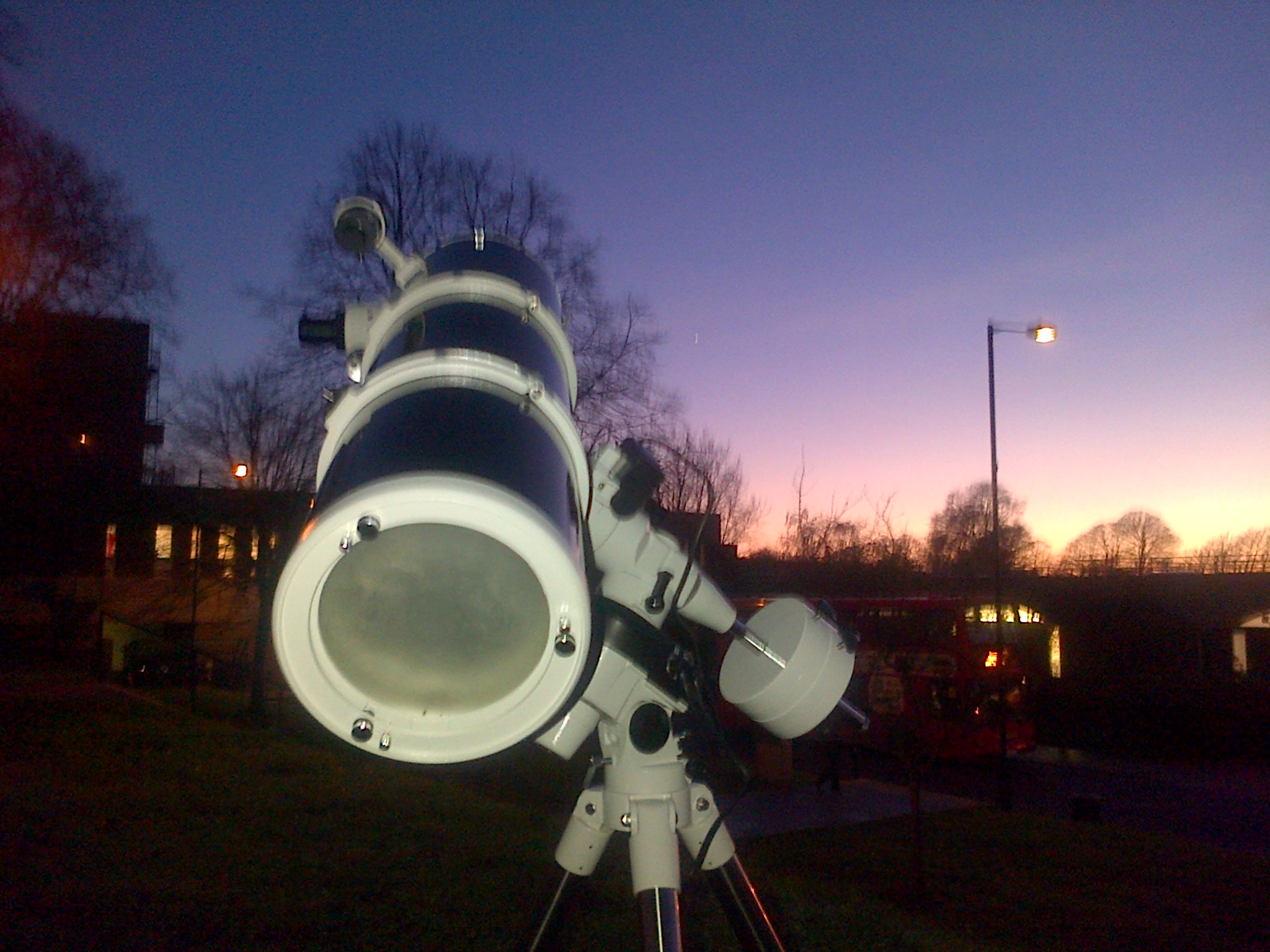
Yesterday I had the honour of giving an evening lecture for staff and students at the School of Mathematical and Physical Sciences at the University of Sussex. The event was preceded by a bit of impromptu twilight stargazing with the new telescope our students have just purchased:

IMG-20131209-00241 IMG-20131209-00243

You can just about see Venus in the second picture, just to the left of the street light.

Anyway, after briefly pretending to be a proper astronomer it was down to my regular business as a cosmologist and my talk entitled The Cosmic Web. Here is the abstract:

The lecture will focus on the large-scale structure of the Universe and the ideas that physicists are weaving together to explain how it came to be the way it is. Over the last few decades, astronomers have revealed that our cosmos is not only vast in scale – at least 14 billion light years in radius – but also exceedingly complex, with galaxies and clusters of galaxies linked together in immense chains and sheets, surrounding giant voids of (apparently) empty space. Cosmologists have developed theoretical explanations for its origin that involve such exotic concepts as ‘dark matter’ and ‘cosmic inflation’, producing a cosmic web of ideas that is, in some ways, as rich and fascinating as the Universe itself.

And for those of you interested, here are the slides I used for your perusal:

It was quite a large (and  very mixed) audience; it’s always difficult to pitch a talk at the right level in those circumstances so that it’s not too boring for the people who know something already but not too challenging for those who don’t know anything at all. A couple of people walked out about five minutes into the talk, which doesn’t exactly inspire a speaker with confidence, but overall it seemed to go down quite well.

Most of all, thank you to the organizers for the very nice reward of a bottle of wine!

Quantum Technology – a Sussex Strength

Posted in Finance, Politics, Science Politics, The Universe and Stuff with tags , , on December 9, 2013 by telescoper

Amid all the doom and gloom in the Chancellor’s Autumn Statement delivered last week there’s a ray of sunshine for research in Physics in the form of an injection of around £270 million in Quantum Technology. According to the Financial Times,

The money will support a national network of five research centres, covering quantum computing, secure communications, sensors, measurement and simulation.

Details of the scheme are yet to be released, but it seems the network will consist of “regional centres” although how evenly it will be spread across the regions remains to be seen. How many will be in the Midlands, for example?

We’re very happy here with this announcement here in the School of Physics & Astronomy at the University of Sussex as we have a well-established and expanding major research activity in Quantum Technology and an MSc Course called Frontiers of Quantum Technology. Moreover, as members of the South East Physics Network (SEPNet) we seem to be in a good position to be for funds as a truly regional centre. Assuming, that is, that the scheme hasn’t already been divvied up behind closed doors before it was even announced!

The investment announced by the government mirrors a growing realization of the potential for economic exploitation of, e.g., quantum computing which is bound to lead to a new range of career opportunities for budding physics graduates.

I’d welcome any comments from people who know any more information about the details of the new investment, as I’m too lazy to search for it myself…