Why the Universe is (probably) not rotating

Posted in Cosmic Anomalies, The Universe and Stuff with tags , , , , , on October 1, 2013 by telescoper

Just a quick post to point you towards a nice blog post by Jason McEwen entitled Is the Universe rotating? It’s a general rule that if  an article has a question for a title then the answer to that question is probably “no”, and “probably no” is indeed the answer in this case.

The item relates to a paper by McEwen et al whose abstract is given here:

We perform a definitive analysis of Bianchi VII_h cosmologies with WMAP observations of the cosmic microwave background (CMB) temperature anisotropies. Bayesian analysis techniques are developed to study anisotropic cosmologies using full-sky and partial-sky, masked CMB temperature data. We apply these techniques to analyse the full-sky internal linear combination (ILC) map and a partial-sky, masked W-band map of WMAP 9-year observations. In addition to the physically motivated Bianchi VII_h model, we examine phenomenological models considered in previous studies, in which the Bianchi VII_h parameters are decoupled from the standard cosmological parameters. In the two phenomenological models considered, Bayes factors of 1.7 and 1.1 units of log-evidence favouring a Bianchi component are found in full-sky ILC data. The corresponding best-fit Bianchi maps recovered are similar for both phenomenological models and are very close to those found in previous studies using earlier WMAP data releases. However, no evidence for a phenomenological Bianchi component is found in the partial-sky W-band data. In the physical Bianchi VII_h model we find no evidence for a Bianchi component: WMAP data thus do not favour Bianchi VII_h cosmologies over the standard Lambda Cold Dark Matter (LCDM) cosmology. It is not possible to discount Bianchi VII_h cosmologies in favour of LCDM completely, but we are able to constrain the vorticity of physical Bianchi VII_h cosmologies at $(\omega/H)_0 < 8.6 \times 10^{-10}$ with 95% confidence.

For non-experts the Bianchi cosmologies are based on exact solutions of Einstein’s equations for general relativity which obey the condition that they are spatially homogeneous but not necessarily isotropic. If you find that concept hard to understand, imagine a universe which looks the same everywhere but which is pervaded by a uniform magnetic field: that would be homogeneous (because every place is identical) but anisotropic (because there is a preferred direction – along the magnetic field lines). Another example of would be s a universe which is, for reasons known only to itself, rotating; the preferred direction here is the axis of rotation. The complete classification of all Bianchi space-times is discussed here. I also mentioned them and showed some pictures on this blog here.

As Jason’s post explains, observations of the cosmic microwave background by the Wilkinson Microwave Anisotropy Probe (WMAP) suggest  that there is something a little bit fishy about it: it seems to be have an anomalous large-scale asymmetry not expected in the standard cosmology. These suggestions seem to be confirmed by Planck, though the type of analysis done for WMAP has not yet been performed for Planck. The paper mentioned above investigates whether the WMAP asymmetry could be accounted for by one particular Bianchi cosmology, i.e. Bianchi VII_h. This is quite a complicated model which has negative spatial curvature, rotation (vorticity) and shear; formally speaking, it is the most general Bianchi model of any type that includes the standard Friedmann cosmology as a special case.

The question whether such a complicated model actually provides a better fit to the data than the much simpler standard model is one naturally answered by Bayesian techniques that trade off the increased complexity of a more sophisticated model  against the improvement in goodness-of-fit achieved by having more free parameters.  Using this approach McEwen et al. showed that, in simple  terms, while a slight improvement in fit is indeed gained by adding a Bianchi VII_h component to the model,  the penalty paid in terms of increased complexity means that the alternative model is not significantly more probable than the simple one. Ockham’s Razor strikes again! Although this argument does not definitively exclude the possibility that the Universe is rotating, it does put limits on how much rotation there can be. It also excludes one possible explanation of the  peculiar pattern  of the temperature fluctuations seen by WMAP.

So what does cause the anomalous behaviour of the cosmic microwave background?

I have no idea.

Return of the Bad Penny Blues

Posted in Jazz, Music with tags , , , on October 1, 2013 by telescoper

So, it’s October again. What happened to September? Anyway, looking back through my archive this morning I discovered that exactly five years ago today I posted a tribute to the legendary Humphrey Lyttelton. I still miss Humph greatly so thought I’d indulge myself by posting the piece again with a few small updates. Well, they say a Bad Penny always comes back….

–0–

I knew I could’t blog for long without writing something about a great hero of mine, the inimitable Humphrey Lyttelton, better known to his many fans as “Humph”. He died earlier this year (on April 25 2008, at the age of 86) of complications following a heart operation. News of his death came as a massive shock to me, as it had never really occured to me that one day he would be no more. Tributes to him in the media were unsurprisingly glowing in their admiration.

In later years, Humph was best known as the chairman of the long-running radio comedy show I’m Sorry I Haven’t a Clue, subtitled “The Antidote to Panel Games” in which his gravelly but perfectly elocuted voice, schoolmasterish manner and impeccable comic timing proved the perfect foil to the antics of Barry Cryer, Tim Brooke-Taylor, Graeme Garden and many other contributors. I hope I get the chance to say a bit more about this programme in due course, as I treasure my collection of recordings of shows that still make me laugh at the umpteenth listening.

But Humph had many other strings to his bow. He was a talented cartoonist and a gifted writer, and also hosted the BBC Radio programme “The Best of Jazz” on Radio 2 for forty years, counting the great John Peel among his legions of listeners. I owe a special debt to Humph for this programme as I listened to it religiously every monday night at 9pm during my teenage years. He would open the show with “This his Humphrey Lyttelton here, with the best part of an hour of jazz between now and five to ten”. His theme tune then was Wanderlust, recorded by a subset of Duke Ellington’s orchestra with the great saxophonist Coleman Hawkins appearing as a guest and contributing a truly magnificent tenor solo near the end of the piece.

Through Humph I discovered most of the music I still listen to on a daily basis, jazz from the classic era of Louis Armstrong and Jelly Roll Morton, through the swing era of Duke Ellington, Benny Goodman and Count Basie, the postwar bebop period of Charlie Parker, Dizzy Gillespie and Thelonious Monk, Miles Davis and John Coltrane, then modernists like Ornette Coleman, Sam Rivers, Archie Shepp and onto the avant-garde of the time. Humph loved all kinds of jazz, and he communicated his encyclopedic knowledge a style flavoured by a dry sense of humour. I never met him in person, but I would have loved the chance to thank him for helping nurture in me a passion for all that wonderful music.

Humph was also a fine Jazz trumpeter and bandleader in his own right. When my father was at school in the 1950s, the Lyttelton band was the leading “traditional Jazz” band in Britain. Humph had played with many of the greats, including Louis Armstrong and Sidney Bechet, and won their admiration for his trumpet-playing.

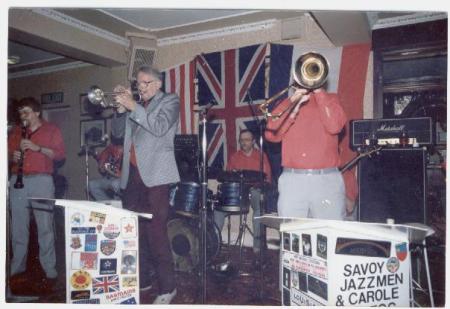
My dad had become a Lyttelton fan at School and it was this that persuaded him to take up playing the drums. He joined the RAF for his national service, and he had the opportunity to play with various bands then and later on when he went back into civvy street. He was a life long admirer of Humph and eventually got to play with him at the Corner House in Newcastle but not until the 1990s. He told me it was one of the proudest moments of his life, although he had been so nervous he didn’t really play very well. Here’s a photograph of this occasion:

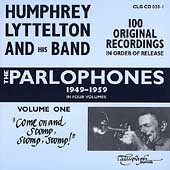
In the late 1940s Humph’s band had started to record a series of 78rpm records for the Parlophone label, starting with a lovely version of “Maple Leaf Rag” and stretching to over a hundred titles. Among these tracks was one record that actually made it into the Top 20 of the British pop charts in 1956, admittedly at Number 19, but nevertheless that’s no mean feat for a Jazz record. I should point out that this was long before my birth, but I remember hearing the track many times around the house when I was young.

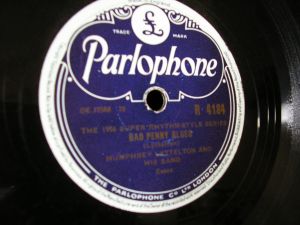
The Bad Penny Blues was written by Humphrey Lyttelton and the hit recording features a quartet drawn from his band which, by the mid-1950s, had gravitated to a more mainstream jazz style, away from the “traddy” sound favoured by most contemporary jazz outfits. Indeed, he had incurred the wrath of many conservative fans by daring to include a saxophonist, the brilliant but eccentric Bruce Turner, in his outfit. Bad Penny Blues, though, featured only Humph on trumpet, Johhny Parker on piano, Stan Greig on drums and Jim Bray on bass. It was only recorded as an afterthought because it went down well at live gigs at Humph’s Jazz Club the HL Club (which later became the 100 Club, at 100 Oxford Street.)

But the real key to the success of this record was a young man by the name of Joe Meek. Starting out as a sound engineer at the Parlophone studios, Meek had quickly established an excellent reputation and in this case he was asked to take over the whole production of the record. According to Humph, they were slightly concerned at what he was doing with the microphones before they made the take but after it was done they all went home and left Meek to do some tinkering with the sound before cutting the disk. In those days, recording techniques were relatively crude and there generally wasn’t much in the way of post production, especially in jazz.

When he heard the final record, Humph was shocked. For one thing, Meek had close-miked all the instruments, including the drums – something which wasn’t generally done with jazz records for fear of (a) drowning out the rest of the band and (b) exposing the clumsiness of the drummer, the latter being a particularly problem. As Humph said, his band always sounded like the rhythm section was wearing diving boots. For this reason the drums were usually recorded with a distant mike and generally hidden in the ensemble playing. But in this case it worked out very well. Stan Greig used brushes on this track and his playing served beautifully both to propel and to punctuate the performances of the other musicians.

But it wasn’t the drums that so disturbed Humph. Meek had also fiddled with the double bass and with the left hand boogie-woogie figures of Johnny Parker’s piano, fattening them out and changing the balance to bring them right up in the final mix. He also compressed the overall sound so that the bass lines seem to press in on both the piano’s right hand and the growling muted trumpet lead, tying them closer to Greig’s insistent drum patterns and creating an unusually dense sound. The result is an intense, driving feel, with a dark undertone that is quite unlike any other jazz record of its period and redolent with the atmosphere of a smoky jazz club. I love it, especially the moment when Humph’s trumpet takes over from the piano solo. With a timely kick from the drums and against the backdrop of those bluesy thumping bass lines the band finds another gear and they build up a fine head of steam before riffing their way into the fade.

Here is the original 78rpm single:

Humph didn’t like the way the record had been put together, but it was an instant hit. He later joked that he hated it all the way to the bank.

Joe Meek went on to produce several classic pop records, generating many ideas that were later used by Phil Spector, but ultimately he became a tragic figure. Such commercial success as he achieved didn’t really last and he sank into debt, depression and paranoia. A gay man in an era in which homosexuality was still illegal, he became a victim of blackmail and was questioned by the police for alleged encounters with rent boys. He committed suicide in 1967 at the age of 37.

The Bad Penny Blues went on to be the “inspiration” behind Paul Macartney’s Lady Madonna, a Beatles track which has a lot of the same notes in it and also borrows the same overall feel. I can’t put it more subtly than that. George Martin, who produced the Beatles’ track, was actually in charge of the Parlophone studio at the time Bad Penny Blues was recorded…

And Humph went on to live another 52 years, bringing music and laughter to millions.

To end with, here’s a link to a later version of the tune recorded by a more recent manifestation of Humph’s band, probably in the 1980s. Note the way his technique involved the use of his eyebrows! I may be wrong, but I think the pianist on this performance is Mick Pyne and the bass is played by Dave Green. I can’t really make out the drummer.

Unchained Melody

Posted in Film, Music with tags , , , , on September 30, 2013 by telescoper

You pick up a lot of interesting snippets listening to BBC Radio 3. Last night I was listening to a programme about  Alex North, a prolific composer of music scores, including one of my favourite films A Streetcar Named Desire.  Alex North also wrote a complete soundtrack for Kubrick’s 2001: A Space Odyssey and must have been mortified when he turned up for the Premiere and found that not a single note of the music he’d written was used in the final version. Anyway, one thing I learnt that I didn’t know before was that Alex North also wrote the tune Unchained Melody for a relatively unknown prison movie called, appropriately enough, Unchained. The song was a massive hit in the 60s for the Righteous Brothers, and gained popularity again as a consequence of the 1990 film Ghost.  It’s also been murdered by countless karaoke singers since then…

Anyway, here is the original version of Unchained Melody as it appears in the 1955 film. Knowing the background to the song (i.e. that the enforced separation of the singer and his sweetheart is because the former is in prison) makes it all the more poignant, and Todd Duncan (whose style clearly owes a debt to Paul Robeson) gives it a bluesy feel present in none of the cover versions I’ve heard…

A Cranefly in September

Posted in Poetry with tags , , on September 29, 2013 by telescoper

She is struggling through grass-mesh – not flying,
Her wide-winged, stiff, weightless basket-work of limbs
Rocking, like an antique wain, a top-heavy ceremonial cart
Across mountain summits
(Not planing over water, dipping her tail)
But blundering with long strides, long reachings, reelings
And ginger-glistening wings
From collision to collision.
Aimless in no particular direction,
Just exerting her last to escape out of the overwhelming
Of whatever it is, legs, grass,
The garden, the county, the country, the world –

Sometimes she rests long minutes in the grass forest
Like a fairytale hero, only a marvel can help her.
She cannot fathom the mystery of this forest
In which, for instance, this giant watches –
The giant who knows she cannot be helped in any way.

Her jointed bamboo fuselage,
Her lobster shoulders, and her face
Like a pinhead dragon, with its tender moustache,
And the simple colourless church windows of her wings
Will come to an end, in mid-search, quite soon.
Everything about her, every perfected vestment
Is already superfluous.
The monstrous excess of her legs and curly feet
Are a problem beyond her.
The calculus of glucose and chitin inadequate
To plot her through the infinities of the stems.

The frayed apple leaves, the grunting raven, the defunct tractor
Sunk in nettles, wait with their multiplications
Like other galaxies.
The sky’s Northward September procession, the vast
soft armistice,
Like an Empire on the move,
Abandons her, tinily embattled
With her cumbering limbs and cumbered brain.

by Ted Hughes (1930-1998)

Better learning means less assessment and more feedback

Posted in Education with tags , , on September 28, 2013 by telescoper

Yesterday I took part in a meeting that discussed, among other things, how to improve the feedback on student assessments in order to help them learn better. It was an interesting meeting, involving academics, administrative staff and a representative of the Students Union, that generated quite a few ideas which I hope will be implemented pretty soon.

Positive though the discussion was, it didn’t do anything to dissuade me from a long-held view that the entire education system holds back the students’ ability to learn by assessing them far too much. The combination of the introduction of modular programmes and the increase of continuously assessed coursework has led to a cycle of partial digestion and regurgitation that involves little in the way of real learning.

I’m not going to argue for turning the clock back entirely, but for the record my undergraduate degree involved no continuous assessment at all (apart from a theory project I opted for in my final year. Having my entire degree result based on the results of six three-hour unseen examinations in the space of three days is not an arrangement I can defend, but note that despite the lack of continuous assessment I still spent less time in the examination hall than present-day students.

That’s not to say I didn’t have coursework. I did, but it was formative rather than summative; in other words it was for the student to learn about the subject, rather for the staff to learn about the student. I handed in my stuff every week, it was marked and annotated by a supervisor, then returned and discussed at a supervision.

People often tell me that if a piece of coursework “doesn’t count” then the students won’t do it. There is an element of truth in that, of course. But I had it drummed into me that the only way really to learn my subject (Physics) was by doing it. I did all the coursework I was given because I wanted to learn and I knew that was the only way to do it.

The very fact that coursework didn’t count for assessment made the feedback written on it all the more useful when it came back because if I’d done badly I could learn from my mistakes without losing marks. This also encouraged me to experiment a little, such as using a method different from that suggested in the question. That’s a dangerous strategy nowadays, but surely we should be encouraging students to exercise their creativity rather than simply follow the instructions? The other side of this is that more challenging assignments can be set, without worrying about what the average mark will be or what specific learning outcome they address.

I suppose what I’m saying is that the idea of Learning for Learning’s Sake, which is what in my view defines what a university should strive for, is getting lost in a wilderness of modules, metrics, percentages and degree classifications. We’re focussing too much on those few aspects of the educational experience that can be measured, ignoring the immeasurable benefit (and pleasure) that exists for all humans in exploring new ways to think about the world around us.

The Amplituhedron and Other Excellently Silly Words

Posted in The Universe and Stuff with tags , on September 27, 2013 by telescoper

No time for a proper post between meetings, so I thought I’d take the opportunity to reblog one of many interesting posts I’ve seen recently about the Amplituhedron. “The what?” I hear you say. Well, read on. And, better still, perhaps you can pass an opinion on whether it is more than hype…

4gravitons's avatar4 gravitons

Nima Arkani-Hamed recently gave a talk at the Simons Center on the topic of what he and Jaroslav Trnka are calling the Amplituhedron.

There’s an article on it in Quanta Magazine. The article starts out a bit hype-y for my taste (too much language of importance, essentially), but it has several very solid descriptions of the history of the situation. I particularly like how the author concisely describes the Feynman diagram picture in the space of a single paragraph, and I would recommend reading that part even if you don’t have time to read the whole article. In general it’s worth it to get a picture of what’s going on.

That said, I obviously think I can clear a few things up, otherwise I wouldn’t be writing about it, so here I go!

“The” Amplituhedron

Nima’s new construction, the Amplituhedron, encodes amplitudes (building blocks of probabilities in particle…

View original post 997 more words

Ignorance + Fear = Prejudice

Posted in Biographical with tags , , on September 26, 2013 by telescoper

george-mental-patient-1-522x293

The charming costume displayed above was advertised by Asda as part of their Halloween “Fancy Dress” range, along with this explanatory text:

Every one (sic) will be running away from you in fear in this mental patient fancy dress costume.

In fact in response to a deluge of critical comments, Asda has now withdrawn the offensive article but one still wonders who could have thought this was a good idea in the first place.

Years ago when I lived in London I served on the Governing Body of a residential home in Hackney for people with a range of mental health issues. Doing this opened my eyes to the level of prejudice that exists about mental health. I remember one example very vividly. After months of training to try to help one of the residents live a little more independently, she finally plucked up courage to take a trip on the bus. She bought her ticket and sat upstairs. Unfortunately, she got a bit confused and missed her stop. She then started to panic and burst into tears. The reaction of the people on the bus was at first to ignore her distress and then when got worse to forcible restrain her. The bus was stopped and eventually the police were called. She was eventually found by staff from the home in a police cell in a state of complete disarray. Months of good work had been undone.

So why had the other passengers behaved in such a way? I think the answer to that is that many people are very frightened by mental illness because they don’t understand it. Fear is often born of ignorance in other situations too, but it’s particularly striking in public settings, such as on a bus or train. In modern life we have to cope with complete strangers in many places and I think we rely on behavioural conventions to deal with the proximity of other individuals that we might otherwise suppose to be hostile. When people start violating these conventions – as one may do if suffering a mental illness – then we often respond in a way that reflects our prejudice that they might be dangerous, even though that is extremely unlikely. It’s the sane that we have to fear most.

That was way back in the 1980s. We like to think that times have changed in so many respects, but the appearance of that Asda `Mental Patient’ demonstrates that our attitudes towards mental illness are firmly rooted in the days when thousands were kept at a safe distance by being incarcerated in lunatic asylums. The stereotypical straitjacket `costume’ panders to ignorance, promotes fear, and encourages prejudice. It is truly offensive. It is Time to Change our attitudes.

For the record, here’s a picture of me taken late last summer in my own Mental Patient Costume:

me

The Argus Intrigues…

Posted in Brighton with tags on September 25, 2013 by telescoper

IMG-20130924-00174

Another Indian Summer

Posted in Jazz with tags , , , on September 25, 2013 by telescoper

I posted this a couple of years ago in response to a discussion concerning the origin of the phrase Indian Summer (which, contrary to popular belief, has nothing to do with India). Looking back over my five years of blog entries for this time of year it’s quite surprising how often I’ve mentioned a late September heatwave. Now we’re having another one. In Welsh, such a period of warm weather at the end of September is known as Haf Bach Mihangel or “Michael’s Little Summer”, as it occurs around Michaelmas Day ( 29th of September).

Anyway, I’m not sure our little summer will last until Sunday 29th September so I’ll take the opprtunity to have a cup of tea outside in the sunshine and post this lovely old recording by the late great Sidney Bechet. So since we’re currently experiencing an Indian Summer, why not bask in its glow?

“You gotta be in the Sun to feel the Sun” – Sidney Bechet.

Whither The Sky at Night?

Posted in Television, The Universe and Stuff with tags , , on September 24, 2013 by telescoper

According to rumours flying around on Twitter, the BBC has decided to axe the long-running astronomy programme The Sky at Night.  There’s been a predictable outcry from fans of the show and a petition has been organized.  What I’ve heard is that the series will end in December, but that a new astronomy programme will be launched in April next year.

I’ve long felt it was inevitable that The Sky at Night would cease to be when Patrick Moore died. The programme was so much Patrick’s programme that it would be very difficult to find another presenter to fill the role in the unique way that he did. Moreover, although there’s no doubt that it is an important vehicle for UK astronomy, many feel that the format has become very tired and uninspiring. As for myself, I can’t really comment. I don’t watch television very much at all and in any case, The Sky at Night is on way past my bedtime.

Way back in 1996 I was involved with a show at the NEC in Birmingham called Tomorrow’s World Live. This involved all the regular presenters of Tomorrow’s World, but wasn’t broadcast, but performed in a small theatre with a live audience. My contribution was to talk a little bit about the Hubble Space Telescope and then answer questions from the audience.  We did four such shows a day for three days. It was tiring and a bit nerve-wracking, but a lot of fun.

Typically for the BBC the contributors such as myself were paid a negligible fee, but we did get our meals paid for. At dinner one evening I chatted to a well-known TV Producer who was involved with the live event. After a while the conversation turned to The Sky at Night. The person concerned explained that he thought the show was well past its prime and was actually holding back astronomy programming on TV: it was too old-fashioned and had a tiny audience yet while it existed it was impossible to make the case to the Beeb to commission other astro-related shows. On the other hand, while Patrick was still around, and undoubtedly a National Institution, the outcry would be so intense if they cancelled The Sky at Night that nobody had the nerve to do it. Impasse.

Of course now, 17 years later, Patrick Moore has passed away and there’s now a chance to change things. It is promising that that the BBC seems to be going to launch a new programme next year. But any new show will have to tread very carefully. The Sky at Night was followed by thousands of dedicated amateur astronomers who know a great deal about their subject and would not be interested in the simple-minded gee-whizzery that plagues so many so-called Science Programme (e.g. Horizon). These people are very important for UK astronomy, because without them UK astronomy would not have the unique role that it has in our scientific and cultural landscape. We professional astronomers would be funded anything like as well as we are either.  On the other hand, there is at least the possibility of coming up with a format that reaches a new audience as well as retaining the interest of those already enthused about astronomy.

But how to ensure that this happens? Answers on a postcard, or through the comments box!

Meanwhile here’s a little poll to gauge the strength of opinion: