Science, Religion and Henry Gee

Posted in Bad Statistics, Books, Talks and Reviews, Science Politics, The Universe and Stuff with tags , , , , , , , , , on September 23, 2013 by telescoper

Last week a piece appeared on the Grauniad website by Henry Gee who is a Senior Editor at the magazine Nature.  I was prepared to get a bit snarky about the article when I saw the title, as it reminded me of an old  rant about science being just a kind of religion by Simon Jenkins that got me quite annoyed a few years ago. Henry Gee’s article, however, is actually rather more coherent than that and  not really deserving of some of the invective being flung at it.

For example, here’s an excerpt that I almost agree with:

One thing that never gets emphasised enough in science, or in schools, or anywhere else, is that no matter how fancy-schmancy your statistical technique, the output is always a probability level (a P-value), the “significance” of which is left for you to judge – based on nothing more concrete or substantive than a feeling, based on the imponderables of personal or shared experience. Statistics, and therefore science, can only advise on probability – they cannot determine The Truth. And Truth, with a capital T, is forever just beyond one’s grasp.

I’ve made the point on this blog many times that, although statistical reasoning lies at the heart of the scientific method, we don’t do anywhere near enough  to teach students how to use probability properly; nor do scientists do enough to explain the uncertainties in their results to decision makers and the general public.  I also agree with the concluding thought, that science isn’t about absolute truths. Unfortunately, Gee undermines his credibility by equating statistical reasoning with p-values which, in my opinion, are a frequentist aberration that contributes greatly to the public misunderstanding of science. Worse, he even gets the wrong statistics wrong…

But the main thing that bothers me about Gee’s article is that he blames scientists for promulgating the myth of “science-as-religion”. I don’t think that’s fair at all. Most scientists I know are perfectly well aware of the limitations of what they do. It’s really the media that want to portray everything in simple black and white terms. Some scientists play along, of course, as I comment upon below, but most of us are not priests but pragmatatists.

Anyway, this episode gives me the excuse to point out  that I ended a book I wrote in 1998 with a discussion of the image of science as a kind of priesthood which it seems apt to repeat here. The book was about the famous eclipse expedition of 1919 that provided some degree of experimental confirmation of Einstein’s general theory of relativity and which I blogged about at some length last year, on its 90th anniversary.

I decided to post the last few paragraphs here to show that I do think there is a valuable point to be made out of the scientist-as-priest idea. It’s to do with the responsibility scientists have to be honest about the limitations of their research and the uncertainties that surround any new discovery. Science has done great things for humanity, but it is fallible. Too many scientists are too certain about things that are far from proven. This can be damaging to science itself, as well as to the public perception of it. Bandwagons proliferate, stifling original ideas and leading to the construction of self-serving cartels. This is a fertile environment for conspiracy theories to flourish.

To my mind the thing  that really separates science from religion is that science is an investigative process, not a collection of truths. Each answer simply opens up more questions.  The public tends to see science as a collection of “facts” rather than a process of investigation. The scientific method has taught us a great deal about the way our Universe works, not through the exercise of blind faith but through the painstaking interplay of theory, experiment and observation.

This is what I wrote in 1998:

Science does not deal with ‘rights’ and ‘wrongs’. It deals instead with descriptions of reality that are either ‘useful’ or ‘not useful’. Newton’s theory of gravity was not shown to be ‘wrong’ by the eclipse expedition. It was merely shown that there were some phenomena it could not describe, and for which a more sophisticated theory was required. But Newton’s theory still yields perfectly reliable predictions in many situations, including, for example, the timing of total solar eclipses. When a theory is shown to be useful in a wide range of situations, it becomes part of our standard model of the world. But this doesn’t make it true, because we will never know whether future experiments may supersede it. It may well be the case that physical situations will be found where general relativity is supplanted by another theory of gravity. Indeed, physicists already know that Einstein’s theory breaks down when matter is so dense that quantum effects become important. Einstein himself realised that this would probably happen to his theory.

Putting together the material for this book, I was struck by the many parallels between the events of 1919 and coverage of similar topics in the newspapers of 1999. One of the hot topics for the media in January 1999, for example, has been the discovery by an international team of astronomers that distant exploding stars called supernovae are much fainter than had been predicted. To cut a long story short, this means that these objects are thought to be much further away than expected. The inference then is that not only is the Universe expanding, but it is doing so at a faster and faster rate as time passes. In other words, the Universe is accelerating. The only way that modern theories can account for this acceleration is to suggest that there is an additional source of energy pervading the very vacuum of space. These observations therefore hold profound implications for fundamental physics.

As always seems to be the case, the press present these observations as bald facts. As an astrophysicist, I know very well that they are far from unchallenged by the astronomical community. Lively debates about these results occur regularly at scientific meetings, and their status is far from established. In fact, only a year or two ago, precisely the same team was arguing for exactly the opposite conclusion based on their earlier data. But the media don’t seem to like representing science the way it actually is, as an arena in which ideas are vigorously debated and each result is presented with caveats and careful analysis of possible error. They prefer instead to portray scientists as priests, laying down the law without equivocation. The more esoteric the theory, the further it is beyond the grasp of the non-specialist, the more exalted is the priest. It is not that the public want to know – they want not to know but to believe.

Things seem to have been the same in 1919. Although the results from Sobral and Principe had then not received independent confirmation from other experiments, just as the new supernova experiments have not, they were still presented to the public at large as being definitive proof of something very profound. That the eclipse measurements later received confirmation is not the point. This kind of reporting can elevate scientists, at least temporarily, to the priesthood, but does nothing to bridge the ever-widening gap between what scientists do and what the public think they do.

As we enter a new Millennium, science continues to expand into areas still further beyond the comprehension of the general public. Particle physicists want to understand the structure of matter on tinier and tinier scales of length and time. Astronomers want to know how stars, galaxies  and life itself came into being. But not only is the theoretical ambition of science getting bigger. Experimental tests of modern particle theories require methods capable of probing objects a tiny fraction of the size of the nucleus of an atom. With devices such as the Hubble Space Telescope, astronomers can gather light that comes from sources so distant that it has taken most of the age of the Universe to reach us from them. But extending these experimental methods still further will require yet more money to be spent. At the same time that science reaches further and further beyond the general public, the more it relies on their taxes.

Many modern scientists themselves play a dangerous game with the truth, pushing their results one-sidedly into the media as part of the cut-throat battle for a share of scarce research funding. There may be short-term rewards, in grants and TV appearances, but in the long run the impact on the relationship between science and society can only be bad. The public responded to Einstein with unqualified admiration, but Big Science later gave the world nuclear weapons. The distorted image of scientist-as-priest is likely to lead only to alienation and further loss of public respect. Science is not a religion, and should not pretend to be one.

PS. You will note that I was voicing doubts about the interpretation of the early results from supernovae  in 1998 that suggested the universe might be accelerating and that dark energy might be the reason for its behaviour. Although more evidence supporting this interpretation has since emerged from WMAP and other sources, I remain sceptical that we cosmologists are on the right track about this. Don’t get me wrong – I think the standard cosmological model is the best working hypothesis we have _ I just think we’re probably missing some important pieces of the puzzle. I don’t apologise for that. I think sceptical is what a scientist should be.

When’s a Sonnet not a Sonnet? When it’s No. 126..

Posted in Poetry with tags , , on September 22, 2013 by telescoper

Every now and then I like to post one of Shakespeare’s Sonnets. Of the entire collection of 154 this one, No. 126, is undoubtedly the strangest. It marks the end of the series of poems addressed to an unknown young man and is thought to have been given to the fair youth on his 27th birthday, marking the end of a relationship that lasted nine years. The following sonnets are addressed to another unknown person, but of the opposite Experts generally regard it as a kind of envoi, which is normally a short stanza at the end of a long poem, but in this case it is a poem in itself occurring at the end of a sequence. What’s strange about it is that it isn’t actually a sonnet at all. It consists of twelve lines rather than the usual fourteen, but the missing two lines are presented in most editions as two pairs of parentheses as shown below. Moreover, the rhyme scheme (consisting of six couplets) doesn’t fit with the pattern of the rest of the Sonnets, so even if he had filled in the two blanks at the end it would still have been an oddity.

So what was the reason for this curious verse? Perhaps Shakespeare deleted the final couplet because he felt the lines were somehow inappropriate? Perhaps he meant the fair youth to finish it himself, or issue an invitation to others to do likewise? Perhaps the poem is simply unfinished? Perhaps the poet wanted to demonstrate that the relationship with his beloved ended prematurely.

More likely than any of these interpretations, in my opinion, is that furnished by looking at the typical structure of a Shakespearean Sonnet. The last two lines usually express the poet’s consolation in the face of what has come before. Here there is none. It’s over. Read it in this light and I think it becomes even more moving to anyone who has experienced any kind of love and has had to face the fact that it is finally over.

O thou, my lovely boy, who in thy power
Dost hold Time’s fickle glass, his sickle, hour;
Who hast by waning grown, and therein show’st
Thy lovers withering, as thy sweet self grow’st.
If Nature, sovereign mistress over wrack,
As thou goest onwards, still will pluck thee back,
She keeps thee to this purpose, that her skill
May time disgrace and wretched minutes kill.
Yet fear her, O thou minion of her pleasure!
She may detain, but not still keep, her treasure:
Her audit (though delayed) answered must be,
And her quietus is to render thee.
(        )
(        )

Another Equinox

Posted in Biographical, Education on September 22, 2013 by telescoper

Well, that’s the end of Freshers Week at the University of Sussex. Hopefully new and returning students are settling into their courses now. Today is also the Autumnal Equinox, which gives me the excuse to post an edited and updated version of an item from the corresponding day five years ago. Although I’ve since moved from Cardiff to Brighton, not much has changed except me being five years older. Even the weather is similar:

The weather is unsettling. It’s warm, but somehow the warmth doesn’t quite fill the air; somewhere inside it there’s a chill that reminds you that autumn is not far away.

I find this kind of weather a bit spooky because it always takes me back to the time when I left home to go to University, as thousands of fledgling students are about to do this year in their turn. I did it 31 years ago, getting on a train at Newcastle Central station with my bags of books and clothes. I said goodbye to my parents there. There was never any question of them taking me in the car all the way to Cambridge. It wasn’t practical and I wouldn’t have wanted them to do it anyway. After changing from the Inter City at Peterborough onto a local train, we trundled through the flatness of East Anglia until it reached Cambridge. The weather, at least in my memory, was exactly like today.

I don’t remember much about the actual journey, but I must have felt a mixture of fear and excitement. Nobody in my family had ever been to University before, let alone to Cambridge. Come to think of it, nobody from my family has done so since either.

I was a bit worried about whether the course I would take in Natural Sciences would turn out to be difficult, but I think my main concern was how I would fit in generally.

I had been working between leaving school and starting my undergraduate course, so I had some money in the bank and I was also to receive a full grant. I wasn’t really worried about cash. But I hadn’t come from a posh family and didn’t really know the form. I didn’t have much experience of life outside the North East either. I’d been to London only once before going to Cambridge, and had never been abroad.

I didn’t have any posh clothes, a deficiency I thought would mark me as an outsider. I had always been grateful for having to wear a school uniform (which was bought with vouchers from the Council) because it meant that I dressed the same as the other kids at School, most of whom came from much wealthier families. But this turned out not to matter at all. Regardless of their family background, students were generally a mixture of shabby and fashionable, like they are today. Physics students in particular didn’t even bother with the fashionable bit. Although I didn’t have a proper dinner jacket for the Matriculation Dinner, held for all the new undergraduates, nobody said anything about my dark suit which I was told would be acceptable as long as it was a “lounge suit”. Whatever that is.

Taking a taxi from the station, I finally arrived at Magdalene College. I waited outside, a bundle of nerves, before entering the Porter’s Lodge and starting my life as a student. My name was found and ticked off and a key issued for my room in the Lutyen’s building. It turned out to be a large room, with a kind of screen that could be pulled across to divide the room into two, although I never actually used this contraption. There was a single bed and a kind of cupboard containing a sink and a mirror in the bit that could be hidden by the screen. The rest of the room contained a sofa, a table, a desk, and various chairs, all of them quite old but solidly made. Outside my  room, on the landing, was the gyp room, a kind of small kitchen, where I was to make countless cups of tea over the following months, although I never actually cooked anything there.

I struggled in with my bags and sat on the bed. It wasn’t at all like I had imagined. I realised that no amount of imagining would ever really have prepared me for what was going to happen at University.

I  stared at my luggage. I suddenly felt like I had landed on a strange island where I didn’t know anyone, and couldn’t remember why I had gone there or what I was supposed to be doing.

After 31 years you get used to that feeling.

Cherokee, by Clifford Brown

Posted in Jazz with tags , , on September 21, 2013 by telescoper

The blog’s been quite busy this week, so I’ll take it easy today and just indulge my love of 1950s jazz. This version of Ray Noble’s standard Cherokee is a vehicle for the virtuosity and creativity of the trumpeter Clifford Brown. The changes of this tune are notoriously difficult to improvise on, 64 bars of harmonic twists and turns that have led countless musicians onto the rocks, but Clifford Brown navigates them at full pelt with amazingly agility. Enjoy!

Of the Terrible Doubt of Appearances

Posted in Poetry with tags , , on September 20, 2013 by telescoper

Of the terrible doubt of appearances,
Of the uncertainty after all, that we may be deluded,
That may-be reliance and hope are but speculations after all,
That may-be identity beyond the grave is a beautiful fable only,
May-be the things I perceive, the animals, plants, men, hills,
shining and flowing waters,
The skies of day and night, colors, densities, forms, may-be these
are (as doubtless they are) only apparitions, and the real
something has yet to be known,
(How often they dart out of themselves as if to confound me and mock me!
How often I think neither I know, nor any man knows, aught of them,)
May-be seeming to me what they are (as doubtless they indeed but seem)
as from my present point of view, and might prove (as of course they
would) nought of what they appear, or nought anyhow, from entirely
changed points of view;
To me these and the like of these are curiously answer’d by my
lovers, my dear friends,
When he whom I love travels with me or sits a long while holding me
by the hand,
When the subtle air, the impalpable, the sense that words and reason
hold not, surround us and pervade us,
Then I am charged with untold and untellable wisdom, I am silent, I
require nothing further,
I cannot answer the question of appearances or that of identity
beyond the grave,
But I walk or sit indifferent, I am satisfied,
He ahold of my hand has completely satisfied me.

by Walt Whitman (1819-92)

A New Theory of Electromagnetism?

Posted in Cute Problems, Education, The Universe and Stuff with tags , , on September 19, 2013 by telescoper

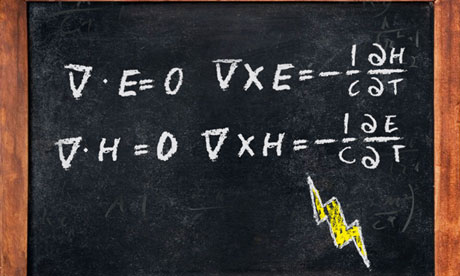
I was delighted to see an article by Alok Jha in the Observer on Sunday discussing Maxwell’s Equations, but my rapture was rapidly modified when I saw the image that accompanied the piece:

Maxwell's Equations

Since our new students are just settling into their courses in the Department of Physics & Astronomy here at the University of Sussex, I thought it would be fun to post this here and invite my readers (some of whom are students) to spot the deliberate mistake(s). More amusingly, how about offering suggestions as to what the Universe would be like if electromagnetism did indeed behave the way described by the alternative theory outlined in the Observer article.

Answers through the comment box please!

Open Access Repositories should be based on Subject, not Institution

Posted in Open Access with tags , , , , on September 18, 2013 by telescoper

Just when we thought that the powers that be might be starting to see the light on Open Access, round comes another circular from the Higher Education Funding Council for England (HEFCE) that shows that policymakers have an unlimited ability to get things wrong at the most basic level.

The document concerned opens a “Consultation on open access in the post-2014 Research Excellence Framework” by putting forward a number of proposals.

Now it’s depressing enough that the entire document is predicated on the assumption that there will be another Research Excellence Framework, perhaps in 2020. The current REF is such a disaster that one might have hoped somebody up there would have decided that enough is enough. But then we thought that about Research Assessment Exercise in 2008. Even the most pessimistic of us hope that the REF would have a “lighter touch” than the RAE, but as it has turned out it’s many times worse both in the time it has taken to prepare submissions and the ridiculous game-playing and dodgy employment practices that it has encouraged among participation institutions.

I hope there’s still time to drive a stake through the heart of the runaway bureaucracy that keeps imposing this idiocies on us. After all, a new Chief Executive about to take over at HEFCE. Perhaps a new broom will be wielded? I hope against hope.

However, setting all that to one side, I had a look at the proposals for Open Access after 2014 contained in the document. Here is the summary of the proposals:

HEFCE

Aarrgh!

Why on Earth should the proposals favour national institutional repositories over international subject-based ones? A shining example of the latter is the arXiv which has, for Physics and Astronomy, become the basic resource for researchers around the world; it’s a one-stop shop at which one can access research from all around the world. By contrast, having work in the same field stored over a plethora of institutional repositories will serve no useful purpose at all, because UK research will not  treated in the same way as work from other countries and in any case individual repositoes will lead to an absurd level of duplication of infrastructure and other resources. This requirement is particularly indefensible in Physics and Astronomy, as it would require us to duplicate in (probably inferior) institutional repositories what we already do with the arXiv.

The UK Funding Councils need realize that the solution to many of the challenges of Open Access has already been found. In fact, the European Research Council seems to have acknowledged this and is now directly funding the arXiv. The UK Research Councils should be required to construct similar archives for their disciplines. That shouldn’t be difficult, because all the hard work has already been done. There is a working model.

I’ll be responding to the consultation document in no uncertain terms. The Royal Astronomical Society is also collating responses for a collective submission. We have to resist these, and other proposals such as another REF, which are being foisted on us by people who have no idea what they’re doing and no idea what damage they’re causing.

Any resemblance is purely coincidental..

Posted in Brighton with tags on September 18, 2013 by telescoper

They are my initials, but…

BUbgpziCYAAjD72

Coronal Rain

Posted in The Universe and Stuff with tags , , , on September 17, 2013 by telescoper

Well it’s dark and gloomy and pouring with rain on the day on which I’m required to do the most running about on campus. I think we could all do with another look at the Sun – which might otherwise fade into a distant memory. This is no ordinary look at the Sun, though, it’s a spectacular video taken by NASA’s Solar Dynamics Observatory. According to the description on Youtube,

Eruptive events on the Sun can be wildly different. Some come just with a solar flare, some with an additional ejection of solar material called a coronal mass ejection (CME), and some with complex moving structures in association with changes in magnetic field lines that loop up into the Sun’s atmosphere, the corona.

On July 19, 2012, an eruption occurred on the sun that produced all three. A moderately powerful solar flare exploded on the Sun’s lower right hand limb, sending out light and radiation. Next came a CME, which shot off to the right out into space. And then, the Sun treated viewers to one of its dazzling magnetic displays — a phenomenon known as coronal rain.

Over the course of the next day, hot plasma in the corona cooled and condensed along strong magnetic fields in the region. Magnetic fields, themselves, are invisible, but the charged plasma is forced to move along the lines, showing up brightly in the extreme ultraviolet wavelength of 304 Angstroms, which highlights material at a temperature of about 50,000 Kelvin. This plasma acts as a tracer, helping scientists watch the dance of magnetic fields on the Sun, outlining the fields as it slowly falls back to the solar surface.

The footage in this video was collected by the Solar Dynamics Observatory’s AIA instrument. SDO collected one frame every 12 seconds, and the movie plays at 30 frames per second, so each second in this video corresponds to 6 minutes of real time. The video covers 12:30 a.m. EDT to 10:00 p.m. EDT on July 19, 2012.

Those are the facts, and here is the video, which is simply stunning:

Five Years in the Dark

Posted in Biographical on September 16, 2013 by telescoper

I came in this morning to find a little message from WordPress pointing out that it’s five years ago today that I first registered on their website and started this blog. They even gave me a logo with a laurel. At least I think that’s what it is.

My first post on September 16th 2008 actually came out second because, with characteristic incompetence, I forgot to press the “publish” button on it before writing another one later the same day. D’Oh!

birthday-five

I’d like to take this opportunity to send my best wishes to everyone, and to thank everyone, who reads this blog, however occasionally. According to the WordPress stats, I’ve got readers from all round the world, including one in the Vatican! If you’re interested in statistics then, as of 9.15 this morning, I have published 2107 blog posts in all, and have received 1,592,554 hits altogether (I get about 1300 per day, but this varies very erratically). There have been 17,650 comments published on here and 356,694 rejected as spam or abuse; a lot goes on behind the scenes that you don’t want to know about!

Anyway, the numbers don’t really matter but it does mean a lot to know that there are people who find my ramblings interesting enough to look at, and sometimes even to come back for more! I’m read by a number of powerful and influential people too, and John Womersley….

Do keep the comments coming. I don’t always have time to respond when a thread gets busy, but I do find it fascinating how the discussion tends to go off in random directions.

It’s the start of Fresher’s Week here at Sussex University, so I’m going to be quite busy today, but I may just have a quiet drink this evening to celebrate!

Toodle-pip!