It’s LGBTQIA+ STEM Day!

Posted in LGBTQ+, Maynooth with tags , , , , on November 18, 2024 by telescoper

Just a quick post to point out that today is LGBTQIA+ STEM Day, which aims to celebrate  to celebrate the work of LGBTQIA+ people in science, technology, engineering, and maths (STEM), but also to highlight the barriers still facing us.

For more information see here.

This also provides an opportunity for me to send my best wishes to all LGBTQIA+ staff and students at Maynooth and around the world!

P.S. I’m reminded that it was 21 years ago today that Section 28 was finally repealed in England and Wales.

The Future of Diamond Open Access in Astrophysics

Posted in Biographical, Open Access with tags , , , , , , on November 17, 2024 by telescoper

The Open Journal of Astrophysics is now reasonably well established as a Diamond Open Access journal for the astrophysics community. We have published over a hundred articles so far this year at such a low cost that we can make our publications free to read and to publish. Thanks for all this is due to the volunteers on our Editorial Board, the excellent team at Maynooth University library, who have supported this project for 6 years, to the arXiv, as well of course to the authors who have chosen to publish with us.

Although we have established a good base, we’re still much smaller than the mainstream journals publishing just a few percent of their output. There is no sign of a slowdown at OJAp. Indeed there are signs that pace will pick up. I heard last week, for example, that Oxford University Press (the publisher of Monthly Notices of the Royal Astronomical Society) has decided to cancel the ‘Read-and-Publish’ agreement that allowed authors from Australian institutions to avoid APCs. I imagine we’ll get quite a few more submissions from Down Under thanks to that decision.

Nevertheless, we’ve a long way to go to catch up with the likes of A&A, MNRAS and ApJ in terms of numbers. If activity continues to grow then we will incur greater costs – our provider, Scholastica, charges us per paper. Those costs will still be smaller than regular journals, but I think it’s unfair that the expense of running a journal that serves the global astrophysics community should fall entirely on one small University in Ireland.

Expense is only one issue. I never envisaged that OJAp would be unique. It was more intended to be a proof of concept. I would like to see a range of Diamond Open Access journals offering a choice for authors and serving different sub-disciplines. Most universities nowadays have publishing operations so there could be network of federated journals, some based on arXiv and some based on other repositories. Perhaps institutions are worried about the expense but, as we have shown the actual cost, is far less than they are wasting on Article Processing Charges. I rather think it’s not the money that is the issue, just the unimaginatively risk-averse thinking in what passes these days for university management.

There are two simple – but not mutually exclusive – possibilities.

One is that astrophysics institutions club together and donate funds not only to keep OJAp going, but also to allow us to invest in improvements. A donation equivalent to the cost of just one APC for a typical journal would help us enormously. We do actually get some donations already, but more would always be welcome. In the long run, an investment in Diamond Open Access would pay back many times in savings; OJAp has already saved the worldwide community over £500,000.

The other is that other members of the community follow the lead of OJAp and set up their own journals. I wouldn’t see others as much as competitors, more as allies with community-led federated system. In the light of the OUP decision mentioned above, why don’t Australian research institutions set up their own version of OJAp? I’d be happy to discuss how to start up such a journal with anyone interested.

If you would like to discuss either of these possibilities please use the comment box below or email me here.

P.S. There is another issue concerning the future of OJAp, which is that I will be retiring in a few years, but now isn’t the time to discuss that one!

Social Media Better than Meta

Posted in Biographical with tags , , , , , , on November 16, 2024 by telescoper

You may or may not know that these blog posts appear automatically on various social media platforms.

I have been posting content automatically on Meta platforms, Facebook and Threads. Recently, however, Meta’s AI algorithm has been randomly blocking posts. A couple of weeks ago it blocked this post (about the Edgeworth family) on the grounds that it violated rules concerning “sexually explicit content”. Today it blocked this post (the weekly update for OJAp) on the grounds that it was identified as spam. I can see the need for an automatic screening given the huge volume of posts, but the problem is that my facebook feed is full of actual spam that gets through these filters while innocent posts get blocked. In other words the algorithm is crap. If you ask for a review of the decision, all Meta does is run the algorithm again – with the same results, which is a waste of time.

I haven’t got time to waste on such stupidity so I will shortly be deactivating automatic posts to Facebook and Threads; these generate very little traffic for me anyway.

There are, however, plenty of alternative ways of following this blog. You can subscribe by email or by RSS feed for a start. On other social media platforms I recommend the federated version on Mastodon here:

https://telescoper.blog/@telescoper.blog

They also appear on my personal Mastodon account here:

https://mastodon.social/@telescoper

Posts also appear on LinkedIn here:

https://www.linkedin.com/in/peter-coles-911912216/

and on my BlueSky account:

https://bsky.app/profile/telescoper.bsky.social

WordPress has just set up an automatic integration with BlueSky, on which I now have over 3000 followers, which is nice, but any one of these is better than Meta!

Two New Publications at the Open Journal of Astrophysics

Posted in OJAp Papers, Open Access, The Universe and Stuff with tags , , , , , , , , on November 16, 2024 by telescoper

Once again it’s time for a Saturday morning update on activity at the  Open Journal of Astrophysics.  Since the last update we have published two more papers, taking  the count in Volume 7 (2024) up to 104 and the total published by OJAp up to 219.

The first paper of the most recent pair, published on November 13 2024,  in the folder Cosmology and NonGalactic Astrophysics, is “Stochastic Super-resolution of Cosmological Simulations with Denoising Diffusion Models” by Andreas Schanz, Florian List and Oliver Hahn (all based in the University of Vienna, Austria). It presents a  discussion of denoising diffusion in generative models for achieving super-resolution in simulations of cosmic large-scale structure.

Here is a screen grab of the overlay which includes the abstract:


You can click on the image of the overlay to make it larger should you wish to do so.  You can find the officially accepted version of this paper on the arXiv here.

The second paper to be published this week is also in the folder marked Cosmology and NonGalactic Astrophysics. It was published on November 14 and has the title “Halo mass functions at high redshift” by Hannah O’Brennan, John A. Regan, Chris Power (*), Saoirse Ward, John Brennan, and Joe McCaffrey. Five of the six authors are colleagues of mine from the National University of Ireland, Maynooth; Chris Power (marked with a *) is from the University of Western Australia.

Here is a screen grab of the overlay which includes the abstract:


You can click on the image of the overlay to make it larger should you wish to do so. You can find the officially accepted version of the paper on the arXiv here.

That concludes this week’s update. More  next week!

Letter in November – Sylvia Plath

Posted in Poetry with tags , , , , , on November 15, 2024 by telescoper
Love, the world
Suddenly turns, turns color. The streetlight
Splits through the rat's tail
Pods of the laburnum at nine in the morning.
It is the Arctic,

This little black
Circle, with its tawn silk grasses - babies hair.
There is a green in the air,
Soft, delectable.
It cushions me lovingly.

I am flushed and warm.
I think I may be enormous,
I am so stupidly happy,
My Wellingtons
Squelching and squelching through the beautiful red.

This is my property.
Two times a day
I pace it, sniffing
The barbarous holly with its viridian
Scallops, pure iron,

And the wall of the odd corpses.
I love them.
I love them like history.
The apples are golden,
Imagine it ----

My seventy trees
Holding their gold-ruddy balls
In a thick gray death-soup,
Their million
Gold leaves metal and breathless.

O love, O celibate.
Nobody but me
Walks the waist high wet.
The irreplaceable
Golds bleed and deepen, the mouths of Thermopylae.

by Silvia Plath (1932-1963)

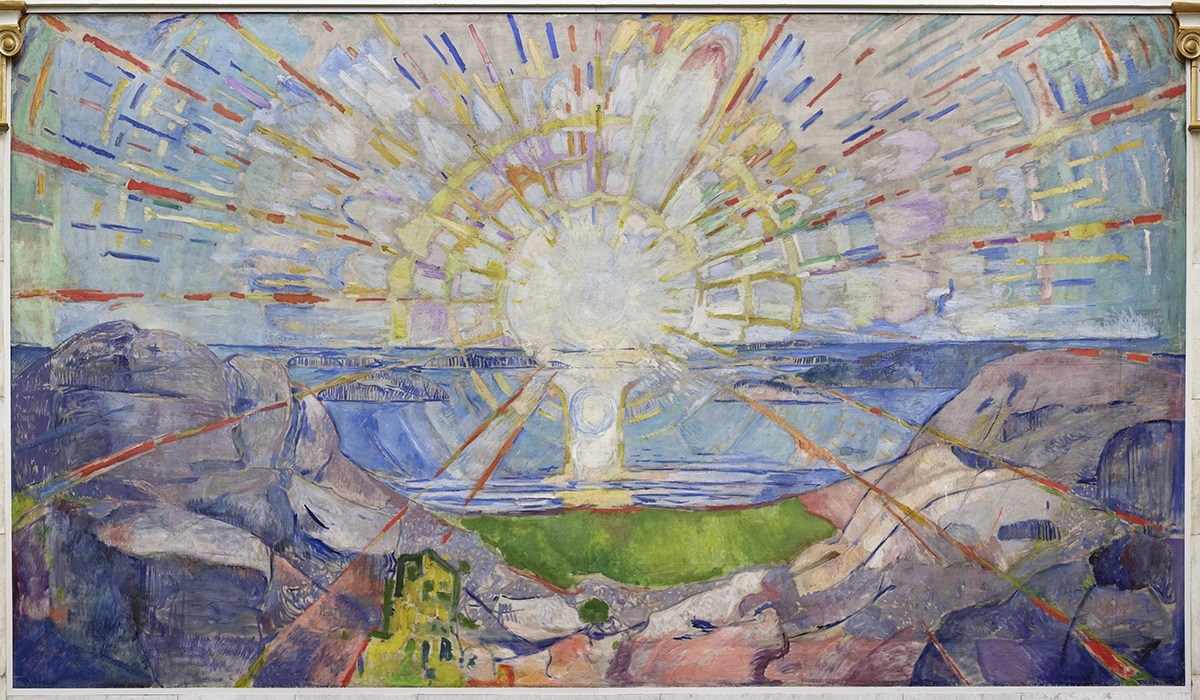
The Sun – Edvard Munch

Posted in Art with tags , , on November 14, 2024 by telescoper

by Edvard Munch (1911, 455 x 780 cm, oil on canvas, University of Oslo; this very large work hangs in the University Aula at the University of Oslo where it is flanked by ten other Munch paintings )

R.I.P. Roy Haynes (1925-2024)

Posted in Jazz, R.I.P. with tags , , , , , , , , , on November 13, 2024 by telescoper

I was very sad to hear of the death yesterday (12th November) at the age of 99 of legendary jazz drummer Roy Haynes, one of the last survivors of the bebop era of the 1940s. Roy Haynes had a career that was not only exceptionally long but also exceptionally prolific: just look at the discography on his Wikipedia page! If I can add a personal note, he features on the first ever Charlie Parker LP I bought when I was about 15 and which I still have. I bought it on impulse, not really knowing who Charlie Parker was, was this record that turned me onto his music and I’ve never turned off.

No information is provided on Youtube, but the sleeve note reveals that the track was recorded from a radio broadcast live from Birdland in New York City on March 31st 1951 using a primitive disc recording machine by an amateur recording buff called Boris Rose. The sound quality isn’t great, but he deserves much greater recognition for capturing this and so many other classic performances and preserving them for posterity.

The personnel consists of Charlie Parker (alto saxophone), Dizzy Gillespie (trumpet), Bud Powell (piano), Tommy Potter (bass) and Roy Haynes (drums).

Here’s what the sleevenote (written by Gary Giddens) says about this track:

“Anthropology is an “I Got Rhythm” variation which originally appeared, in a slightly different form, as “Thriving on a Riff” on Parker’s first session as leader. The tempo is insanely fast; the performance is stunning. Bird has plenty of ideas in his first chorus, but he builds the second and third around a succession of quotations: “Tenderly”, “High Society”, “Temptation.” Gillespie’s second chorus is especially fine – only Fats Navarro had comparable control among the trumpeters who worked with Bird. His blazing high notes tend to set his lyrical phrases in bold relief. Bud, the ultimate bop pianist (and much more), jumps in for two note-gobbling choruses: no quotes, though, it’s all Powell. The four bar exchanges that follow demonstrate Haynes’s precision.

It’s a very exciting track not least because of the contributions of Roy Haynes, not only in the chase sequence mentioned in that quote but throughout the track where he demonstrates tremendous energy and imagination as well as control at such a high tempo.

Rest in peace, Roy Haynes (1925-2024), one of the greatest of all jazz drummers.

Save the Hume Scholarships!

Posted in Maynooth, Politics with tags , , on November 12, 2024 by telescoper

You may recall that I recently posted about the terrible decision by the Management of Maynooth University to scrap the John and Pat Hume Doctoral Scholarships and followed this up with another post suggesting the decision might be reversed.

As it turns out, the decision has not been reversed but, in a truly bizarre step, the scheme is to be paused for a “review” with the possibility that applications would be opened in June 2025 for PhDs starting in October 2025. The vast majority of qualified students intending to do PhDs will have accepted offers elsewhere by then so effectively the scheme is cancelled for 2025. Only students not able to secure a place elsewhere will be around to apply in June. A sensible decision would be to keep the scheme going until the review is complete, but clearly the University bosses want to divert the funds elsewhere. Perhaps the money saved will go towards the €500k luxury limousine service for self-defined VIP managers currently out to tender. Who knows?

Anyway, the decision and the manner in which it has been imposed by the University Executive is highly objectionable (though I’m afraid typical of the regime at Maynooth). Along with the union to which I belong, IFUT, I am therefore happy to support the Postgraduate Workers’ Organization (PWO) in their campaign on this issue. Please consider signing the petition either using the QR code or by following the link here.

Midpoint at Maynooth

Posted in Biographical, Education, mathematics, Maynooth with tags , , , , on November 11, 2024 by telescoper

Amid all the excitement last week I forgot that it was the sixth teaching week of the Semester. That means that we’re now past the halfway point. Among other things that meant that examination papers were due in on Friday (8th November). That means two papers for each module I’m teaching, one to be sat in January and another for the repeat opportunity in August, so that’s four altogether.

I always find setting examination questions very difficult. In theoretical physics we want to stretch the stronger candidates at the same time as allowing the weaker ones to show what they can do. It’s a perennial problem how to make the questions neither too easy nor too difficult, but it is compounded this time by the fact that I’m teaching two modules for the very first time so judging the right level is tricky.

Another issue is that I’m once again in a situation in which I have to set examination papers without having taught all the material. At least I’ve covered the first half of the content so I have some idea of what the students found difficult, but that’s not the case for the second half. It should be a bit easier next year once I’ve experience of covering the whole syllabus. Assuming, of course, that I’m teaching the same modules again next year, which is by no means guaranteed…

I’m teaching a module on Differential Equations and Complex Analysis for 4th year students and just about ready to switch to the part that comes after the and. I taught a bit of Complex Analysis when I was at Sussex and I’m quite looking forward to it, although it does pose a particular challenge. Some of the class are doing a Double Major in Theoretical Physics and Mathematics, and have done quite a lot of Complex Analysis before, while others are doing a Single Major in Theoretical Physics and haven’t really done any. I have to somehow find a way to satisfy these two different groups. The only way I can think of to do that is to teach the subject as a physicist rather than a pure mathematician, with an emphasis on examples and real-world applications rather than in the abstract. We’ll see how this works out over the next few weeks.

P.S. On the subject of Complex Analysis, I just remembered this post from a few years ago.