The trouble with teaching particle physics is that students start out thinking that the standard model looks like this
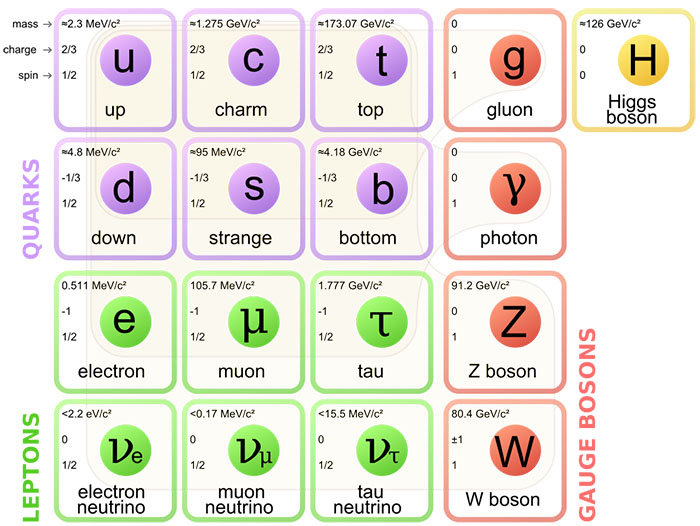
when it’s really more like this
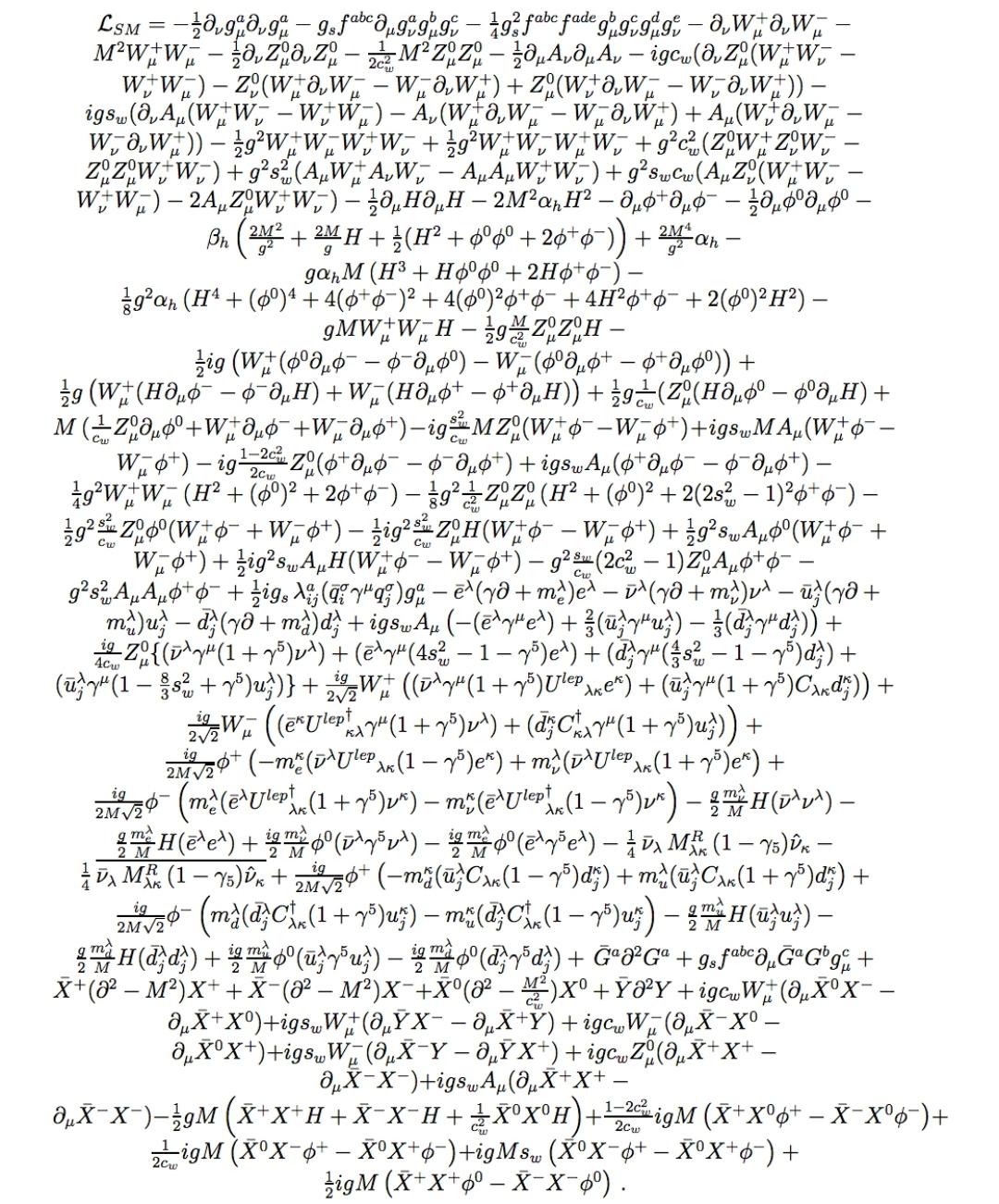
I hope this clarifies the situation.
The trouble with teaching particle physics is that students start out thinking that the standard model looks like this
when it’s really more like this
I hope this clarifies the situation.
This “shitty WordPress blog” (to use someone’s memorable phrase) has been going for over 17 years now. I have occasionally thought about breaking the habit but having gone this far I think I might as well keep going until I retire, by which time in it will have reached the grand old age of 20.
In recent years the traffic here has settled down to a level about 40% lower than it was in its heyday. There are about 2,000 people recceiving posts by email and a few hundred who read it on the fediverse; these are not counted in the web traffic statistics unless they click through to the website.
The most popular year ever for web traffic was 2012, in which In The Dark attracted 464k visitors, whereas for the last few years it has been more like 260k per annum. Part of the reason for the drop will have been my move to Ireland and not posting so much of relevance to people in the UK, which was my main audience. I prefer not to think that the decline is because I’m now older and my posts more boring, but that may well the case. Twitter used to be the source of a considerable number of clicks too, but the changes introduced by Elon Musk put a stop to that even before I left that platform. In any case the blog numbers are far higher than I thought I would attract when I started blogging way back in 2008.
Anyway, I have noticed that in recent weeks the levels of traffic have been closer to those of a decade or more ago, with several notifications like this popping up:

In the first two weeks of February, for example, there have been over 30k views, i.e. over 2000 per day. The drivers of this increase have been two posts about the STFC funding crisis, first mine at the end of January and then a Guest Post by George Efstathiou which has been shared very widely.
I suppose the recent increase in traffic is a new manifestation of the old adage that “bad news sells newspapers”…
It seems an appropriate evening for a romantic love song. Lyrics by Sammy Cahn, music by Jule Styne, vocals and trumpet by Chet Baker. Baker’s singing is quite unlike most jazz singers, and many jazz fans don’t like it very much, but I think his intimate, tender, and somewhat melancholic vocal performance together with his spare yet lyrical trumpet playing combine make this a classic.
It’s Saturday once more so time for another update of activity at the Open Journal of Astrophysics. Since the last update we have published a further six papers, bringing the number in Volume 9 (2026) to 30 and the total so far published by OJAp up to 478.
I will continue to include the posts made on our Mastodon account (on Fediscience) to encourage you to visit it. Mastodon is a really excellent service, and a more than adequate replacement for X/Twitter (which nobody should be using); these announcements also show the DOI for each paper.
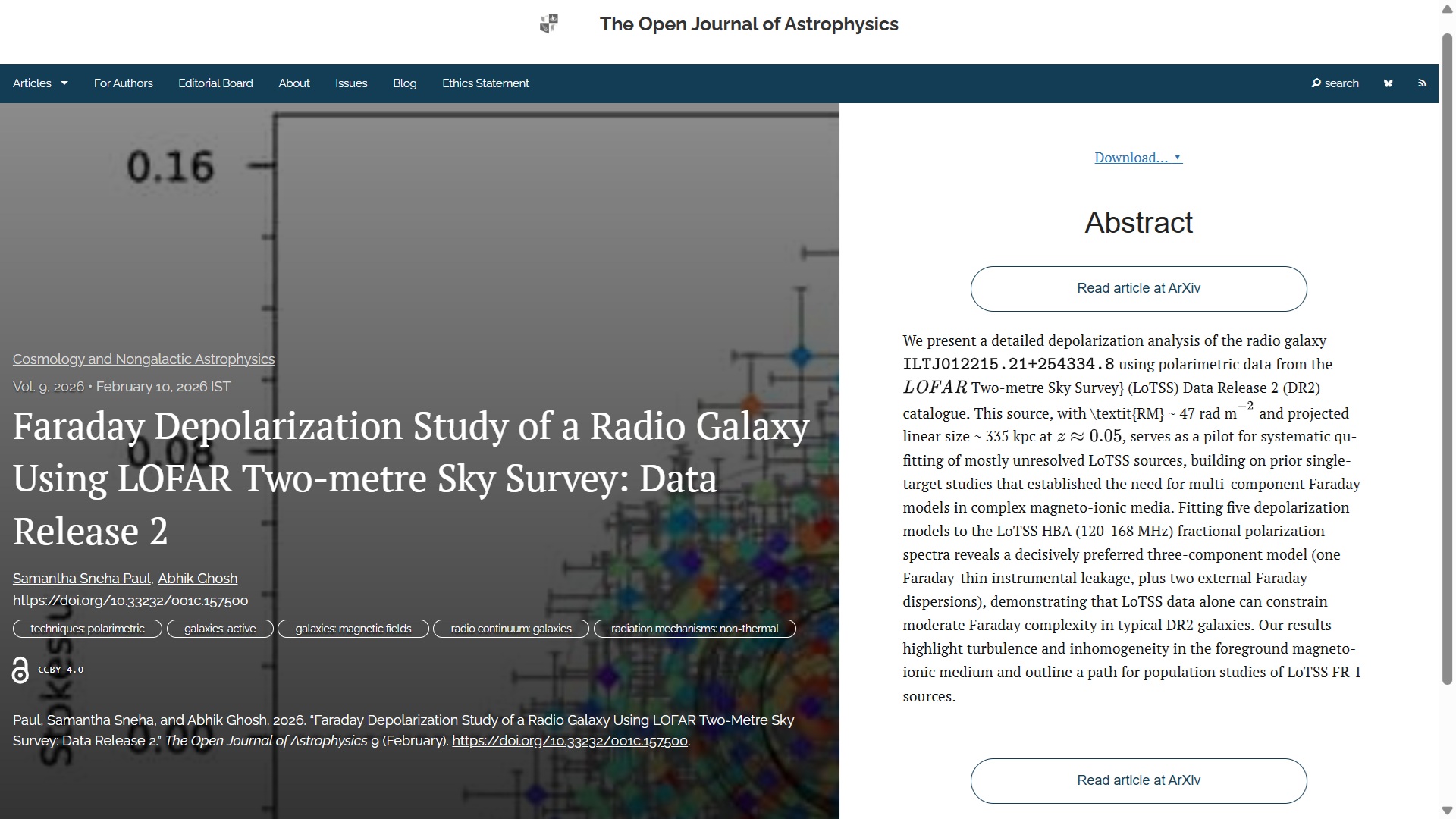
The first paper to report this week is “Faraday Depolarization Study of a Radio Galaxy Using LOFAR Two-metre Sky Survey: Data Release 2” by Samantha Sneha Paul and Abhik Ghosh (Banwarilal Bhalotia College, India). This was published on Tuesday February 10th in the folder Cosmology and Nongalactic Astrophysics. The paper analyzes the depolarization of radio galaxy ILTJ012215.21+254334.8 using LOFAR’s Sky Survey data, revealing a preferred three-component model and highlighting turbulence in the magneto-ionic medium.
The overlay is here:
You can find the officially accepted version on arXiv here and the announcement on Fediverse here:
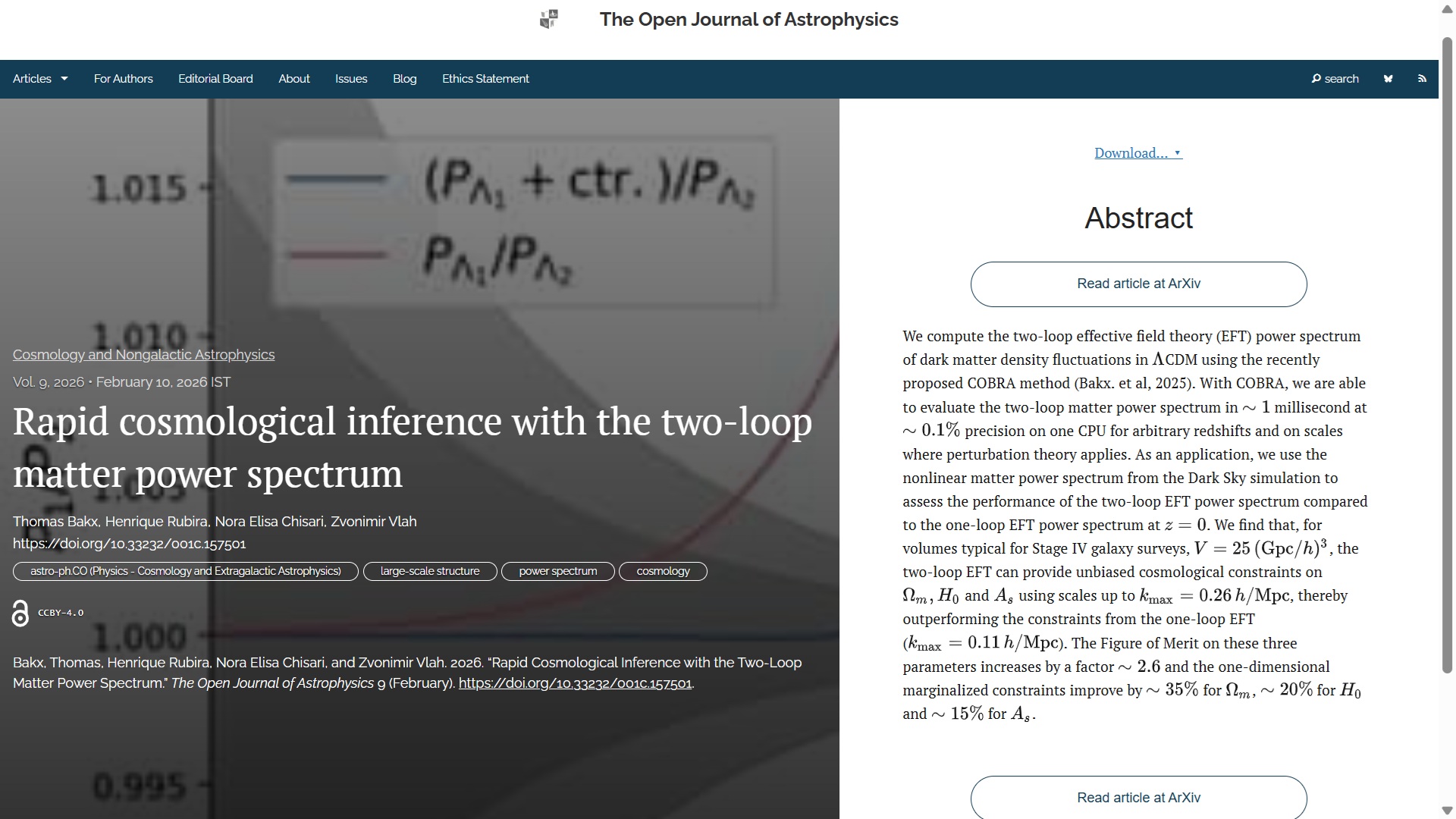
The second paper is “Rapid cosmological inference with the two-loop matter power spectrum” by Thomas Bakx (Utrecht U., NL), Henrique Rubira (Ludwig-Maximilians-Universität, DE), Nora Elisa Chisari (Utrecht) and Zvonimir Vlah (Ruđer Bošković Institute, Croatia). This was also published on Tuesday February 10th in the folder Cosmology and Nongalactic Astrophysics. This paper uses the COBRA method to compute the two-loop effective field theory power spectrum of dark matter density fluctuations, providing more precise cosmological constraints than the one-loop EFT.
The overlay for this one is here:
The official version of the paper can be found on arXiv here and the Fediverse announcement here:
Next, published on Wednesday 11th February in the folder Astrophysics of Galaxies, is “Interpreting nebular emission lines in the high-redshift Universe” by Aswin P. Vijayan (U. Sussex, UK) and 9 others based in the UK, Taiwan, China and The Netherlands. This article examines the reliability of diagnostics used to estimate star formation rate and gas-phase oxygen abundance in high-redshift galaxies. It finds that variations in stellar populations and star-dust geometry. The overlay is here:
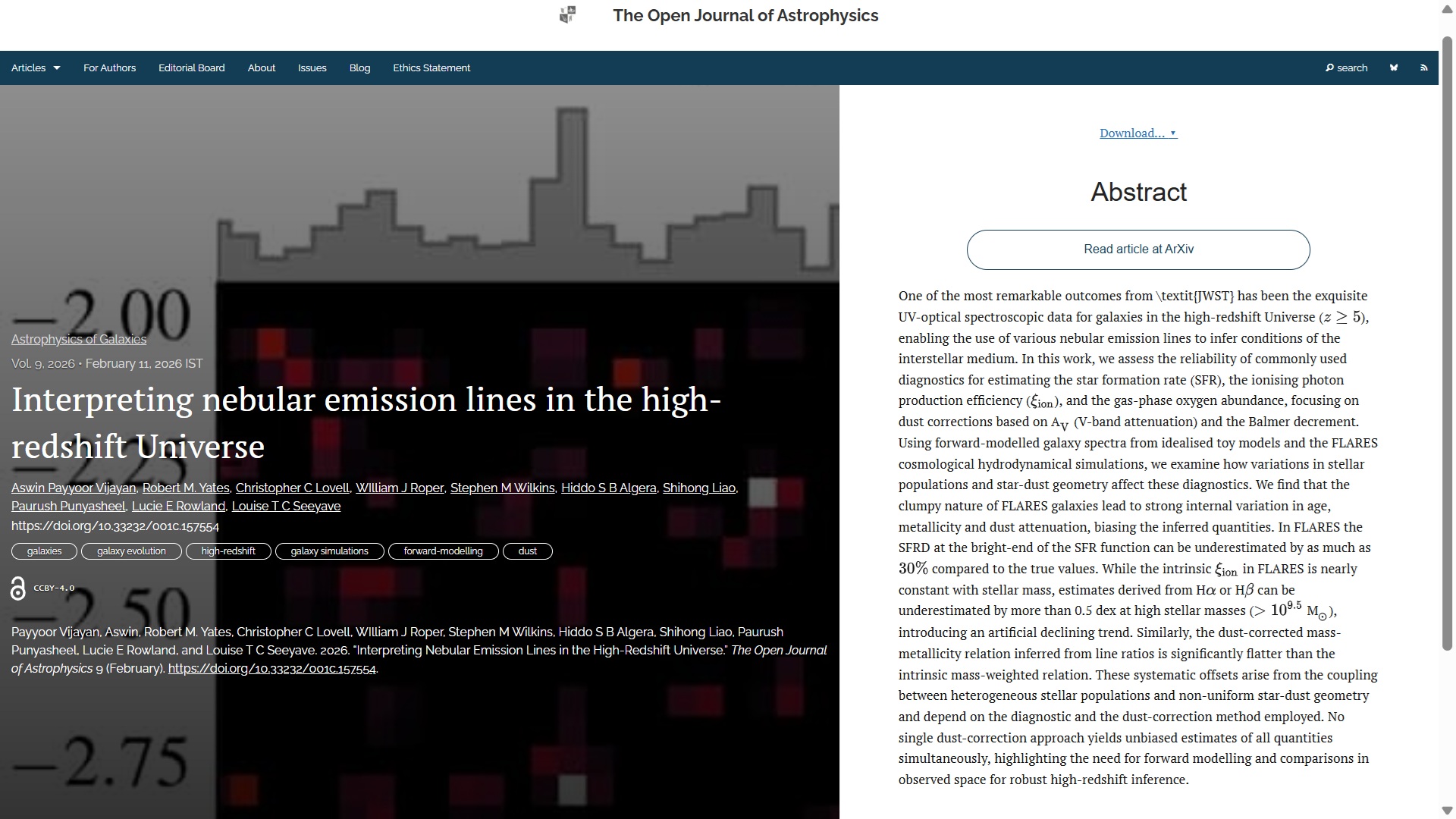
The official version can be found on arXiv here and the Fediverse announcement is here:
The fourth paper this week, also published on Wednesday 11th February, but in the folder Instrumentation and Methods for Astrophysics is “Derivative-Aligned Anticipation of Forbush Decreases from Entropy and Fractal Markers” by Juan D. Perez-Navarro & David Sierra Porta (Universidad Tecnológica de Bolívar, Colombia). The paper presents a feature-based framework for predicting Forbush decreases, i.e. rapid, temporary drops in galactic cosmic ray (GCR) intensity (up to tens of percent) caused by solar wind disturbances, typically Coronal Mass Ejections (CMEs) or high-speed streams from coronal holes, in neutron-monitor records using various computational methods. The approach is reproducible, operates on native station units, and is stable.
Here is the overlay:
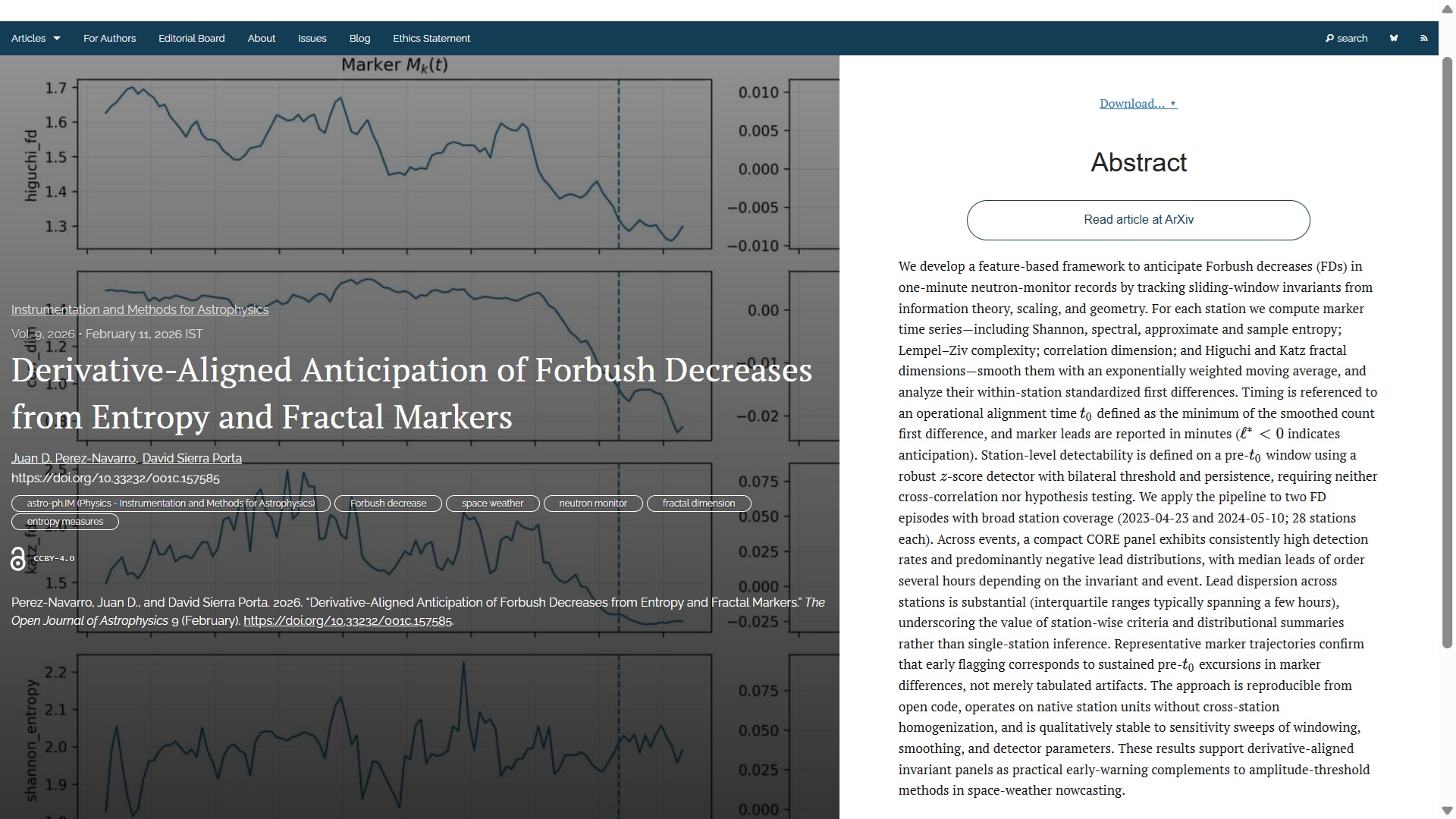
The official version can be found on arXiv here and the Fediverse announcement is here:
The fifth paper, the penultimate for this week, is “Supermassive black hole growth from stellar binary encounters” by Aubrey L Jones and Benjamin C Bromley (University of Utah, USA). This paper explores the growth of supermassive black holes (SMBHs) through stellar accretion via the Hill’s mechanism, predicting capture rates and identifying potential growth drivers in 91 galaxies. It was published on Thursday 11th February 2026 in the folder Astrophysics of Galaxies.
The overlay is here:
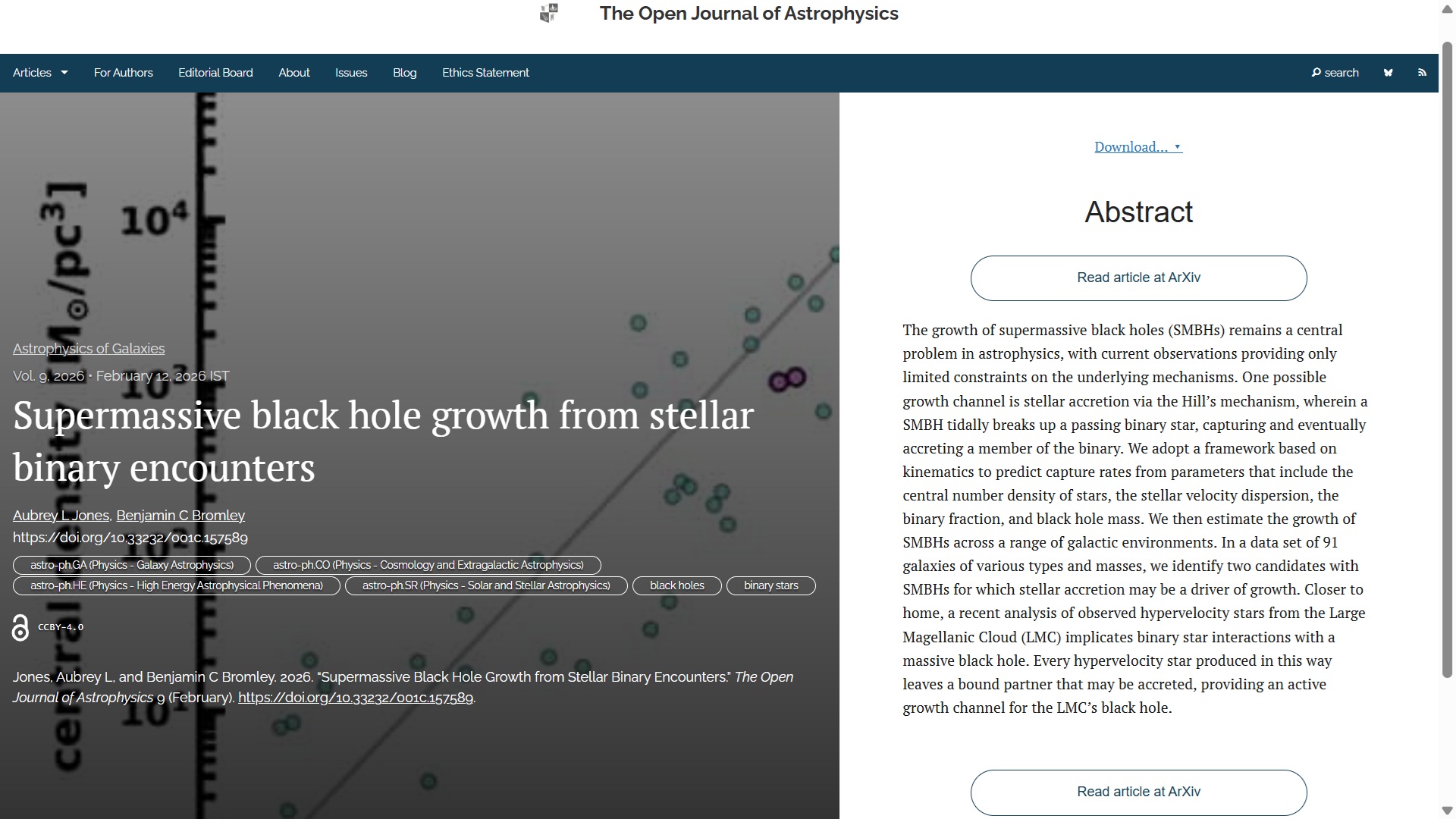
The accepted version can be found on arXiv here, and the fediverse announcement is here:
Finally for this week we have “Dynamics in the Cores of Self-Interacting Dark Matter Halos: Reduced Stalling and Accelerated Core Collapse” by Frank C. van den Bosch and Shashank Dattathri (Yale University, USA). This study uses simulations to explore core dynamics in self-interacting dark matter (SIDM) halos. Findings suggest strong self-interactions prevent core stalling and buoyancy, leading to accelerated core collapse. This was published yesterday, on Friday 13th February 2026, in the folder Astrophysics of Galaxies.
The overlay is here:
You can find the published version of the article here, and the Mastodon announcement is here:
And that concludes this week’s update. I will do another next Saturday.
The National Hurling League – not to be confused with the All-Ireland Senior Hurling Championship (which follows it and ends in the All-Ireland Final) – started a couple of weeks ago so inter-county hurling has been on the telly recently once more. The League is organized in 5 divisions (1a, 1b, 2, 3 and 4) and the TV coverage usually focusses on higher-division teams . Last week for example, there was a televised game between Cork and Tipperary, last year’s Championship finalists, in Div 1a. Cork won a feisty contest in front of a crowd of over 40,000 that exploded into a huge brawl near half-time . Anyway, I was looking through the lower divisions on the web and did a bit of a double-take when I reached Division 4 as I thought I’d got muddled up with the cricket!

Yes, there are two English counties in the Hurling League. There’s also a team from London in Division 3. None of them are doing very well, but if you want to see some live hurling in England you could check out Lancashire GAA, Warwickshire GAA or London GAA.
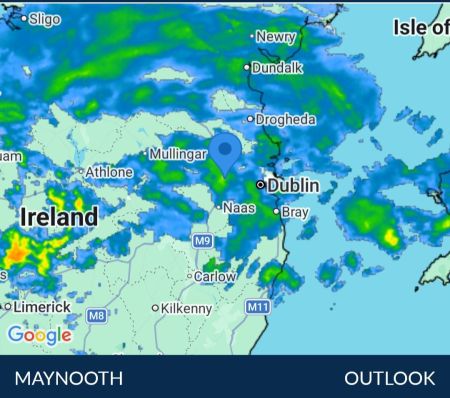
There’s been a lot of rain recently, combined with an unusual easterly wind; the usual prevailing wind in Ireland is from a westerly direction. I’ve managed to avoid the worst of the wet until today. On the way home from work this evening I got absolutely drenched. A lot of water had pooled on the paths and pavements on campus too; I hadn’t put sufficiently sturdy footwear on so my feet got wet too. It seems set to be similar weather tomorrow, so I’ll make sure I’m better prepared. Was it Billy Connolly who said that there’s not really such a thing as bad weather, just the wrong clothes?
We are approaching the end of Week 2 of Semester 2 at Maynooth. I’ve been busy with the usual start-of-term things as well as some other jobs of the sort that crop up from time to time. I started teaching Computational Physics again last week for the first time in a different computer lab, and there were numerous problems with logins, etc, which caused quite a lot of stress. The second cycle of labs started today and everything went much better. I hope this continues. My lecture course on Particle Physics seems to be going reasonably well too, although it’s early days. Hopefully things will settle down and I won’t feel so exhausted for the rest of term. Thursdays are busy for me this term, with a 9am lecture as well as a lab and, today, several other things in between. Combined with the drenching on the way home I feel in need of refreshment, so I think I’ll have a hot bath followed by a glass of brandy and an early night…
P.S. Anniversaries often give me ideas for blog posts but I forgot one yesterday, which was ten years to the day since the announcement of the discovery of gravitational waves. Here’s the blog I did on that day. Was it really a decade ago?
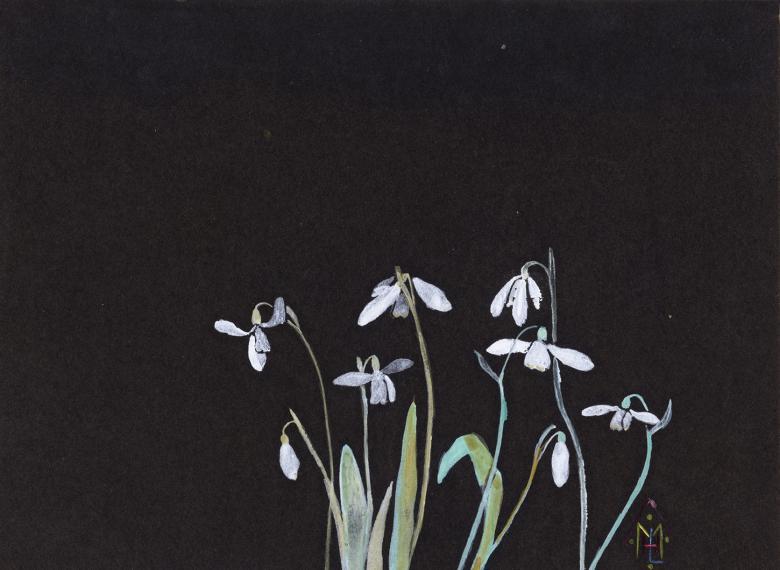
Snowdrops by Lillias Mitchell (1929, watercolour on paper, 29 x 34 cm, National Gallery of Ireland); painted when the artist, who lived from 1915 to 2000, was 14 years old.
I came across a recent article on the arXiv with the title Probabilistic inference in very large universes by Feraz Azhar, Alan H. Guth, Mohammad Hossein Namjoo.
The paper discusses a conceptually challenging issue in cosmology, which I’ll put simply as follows. Suppose we have two cosmological theories: A, which describes a very large universe in only a tiny part of which low-energy physics turns out like ours; and B in which we have a possibly much smaller universe in which low-energy physics is like ours with a high probability. Can we determine whether A or B is the “better” theory, and if so how?
The abstract of the paper is below:
Some cosmological theories propose that the observable universe is a small part of a much larger universe in which parameters describing the low-energy laws of physics vary from region to region. How can we reasonably assess a theory that describes such a mostly unobservable universe? We propose a Bayesian method based on theory-generated probability distributions for our observations. We focus on basic principles, leaving aside concerns about practicality. (We also leave aside the measure problem, to discuss other issues.) We argue that cosmological theories can be tested by standard Bayesian updating, but we need to use theoretical predictions for “first-person” probabilities — i.e., probabilities for our observations, accounting for all relevant selection effects. These selection effects can depend on the observer, and on time, so in principle first-person probabilities are defined for each observer-instant — an observer at an instant of time. First-person probabilities should take into account everything the observer believes about herself and her surroundings — i.e., her “subjective state”. We advocate a “Principle of Self-Locating Indifference” (PSLI), asserting that any real observer should make predictions as if she were chosen randomly from the theoretically predicted observer-instants that share her subjective state. We believe the PSLI is intuitively very reasonable, but also argue that it maximizes the expected fraction of observers who will make correct predictions. Cosmological theories will in general predict a set of possible universes, each with a probability. To calculate first-person probabilities, we argue that each possible universe should be weighted by the number of observer-instants in the specified subjective state that it contains. We also discuss Boltzmann brains, the humans/Jovians parable of Hartle and Srednicki, and the use of “old evidence”.
arXiv:2602.02667
I haven’t had time to read the paper in detail yet, and I don’t think I’m going to agree with all of it when I do, but I found it sufficiently stimulating to share here in the hope that others will find it interesting.
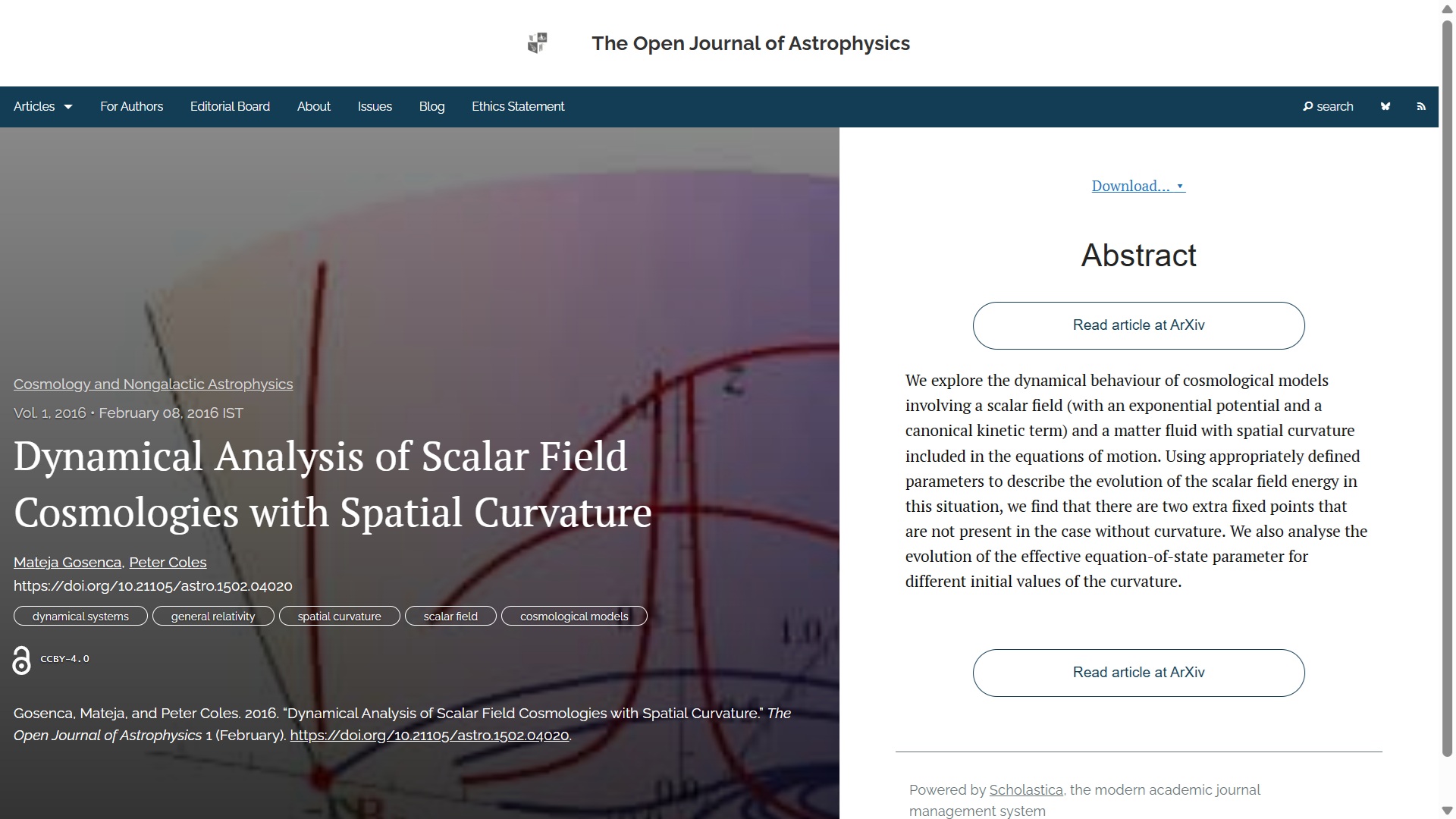
The visit of my former PhD student Mateja Gosenca to Maynooth last year reminded me that she was co-author of the very first paper published by the Open Journal of Astrophysics. The date of publication for that paper was 8th February 2016, i.e. excactly10 years ago today.
Here is the overlay:
In those days OJAp was very much an experiment, and we used a protoptype platform which I had paid a developer to set up but it never really progressed beyond a “beta” version owing to stability and other issues. I was a Head of School at Sussex then and had very little time to work on the project and it stalled. I came to Maynooth in late 2017 and discussed the idea of OJAp with staff at the Library who were enthusiastic about it. We abandoned the prototype and switched to the Scholastica platform, imported the papers we had previously published into the new site and restarted. It was slow going at first and then we had the Covid-19 lockdown tand I had to conted with a workload that went through the roof. Several times I thought it was never going to take off and wondered about closing it to new submissions. With a bit of pig-headed obstinacy and a refusal to look facts in the face, however, we carried on.
The journal has grown steadily since the end of the pandemuic: from just 17 papers in 2022, 50 in 2023, 120 in 2024, to 213 last year (including our first Supplement). I expect we’ll publish over 250 this year. I think a large part of the growth has been due to the decision of the Royal Astronomical Society to adopt a pay-to-publish model. I expected it to take a while to establish a reputation, but perhaps not as long as it did. We’re still quite small compared to other journals, but I’m pleased with the progress. I think in the long run the slow start helped, as it gave us more time to iron out various issues and recruit more editors.
This brings me to the fact that I will be retiring in a couple of years, if not sooner, and someone else will have to take over as Editor-in-Chief when that happens. At present, OJAp is published by Maynooth Academic Publishing and it’s not obvious that arrangement can continue when I am no longer employed at Maynooth. It would not be technically difficult to transfer everything to a new owner, but the handover would have to be planned to avoid disruption.
P.S. As I mentioned last month, we are always on the lookout for new Editors. Please contact me if you’re interesed!


 In the Dark