Election News

Posted in Politics with tags , , , , , on November 10, 2024 by telescoper

On Friday 8th November Taoiseach Simon Harris (left) inspired Ireland’s rugby team to a very disappointing home defeat by New Zealand. Earlier on that day he had visited the President to request a dissolution of the  33rd Dáil and to call a General Election on November 29th 2024.

The Saturday newspapers were full of nonsense about how the “General Election campaign starts now” when in fact I’ve had canvassers knocking at my door for at least a fortnight already. Two of them were for Fine GaeI – far scarier than trick-or-treat! I made it abundantly clear that I wouldn’t be voting for their party and hoped that they wouldn’t bother me again.

Fine Gael’s opening gambit was to announce that if elected they would reduce VAT on the hospitality sector to 11%. There was a budget just a few weeks ago in which they could have announced such a reduction had they really wanted it to happen. If re-elected no doubt they will find an excuse for not doing it. If you believe what they say I have a 340k bike shed to sell you.

Talking about the budget, Ireland’s government is in a very different position from the UK, with a large fiscal surplus thanks to buoyant tax receipts. This year presented a great opportunity to use that cash for much-needed investment in public housing, transport, education, the health service, etc. Instead the Government decided to tinker here and there with allowances and bung some cash to middle-income families in order to buy votes. Simon Harris has the air of a man who would sell his Grandmother if he could buy votes with the proceeds. The FG approach may well work but, if it does, we’re in for many years more of decaying public services, homelessness and high rents. As the Landlord Party in all but name, this will suit Fine Gael very well.

My constituency is Kildare North which in 2020 elected four TDs: 1 Social Democrat, 1 Fianna Fáil, 1 Fine Gael, and 1 Sinn Féin. This time, owing to population growth in the area, the seat will return five TDs. Fine Gael is standing three. I won’t say anything about Fianna Fáil. To all intents and purposes they are indistinguishable from Fine Gael and I won’t be voting for either of them. For me “more of the same” is not an option. I hope it goes without saying that I won’t be voting for any neofascists who get onto the ballot paper either.

Catherine Murphy (SD) is not standing and since she had a strong personal following the SDs will struggle to keep that seat. Angela Feeney, who is very active on the Local Council, is standing for Labour and Réada Cronin for Sinn Féin will be trying to hold onto her seat. Nominations of candidates continue for another week, so I don’t know the final list of candidates. I’ll wait until then before deciding on my order of preferences.

Not that long ago Sinn Féin were riding high in the polls, but a series of missteps have left them trailing Fine Gael. They also did poorly in the local and European elections earlier this year, seeming to have lost supporters of the more extreme nationalist type to overtly right-wing candidates.

The only prediction I am willing to make at this stage is that, owing to disaffection with the mainstream political parties, the number of independent TDs is likely to increase considerably from the 20 last time. This will make the task of forming a government even more complicated than before.

Four New Publications at the Open Journal of Astrophysics

Posted in OJAp Papers, Open Access, The Universe and Stuff with tags , , , , , , , , , , , , , , , , on November 9, 2024 by telescoper

Once again it’s time for a quick update of activity at the Open Journal of Astrophysics. Since the last update a week ago we have published  four papers, which takes the count in Volume 7 (2024) up to 102 and the total published altogether by OJAp up to 217.   This means not only that we have reached a century for the year but also that so far in 2024 we have published more than double the number of papers that we published in all of 2023. I blogged about the significance of the figure 217 here.

In chronological order, the four papers published this week, with their overlays, are as follows. You can click on the images of the overlays to make them larger should you wish to do so.

First one up is “A generative model for Gaia astrometric orbit catalogs: selection functions for binary stars, giant planets, and compact object companions” by Kareem El-Badry (Caltech, USA), Casey Lam (Carnegie Observatories), Berry Holl & Jean-Louis Halbwachs (U. Geneva), Hans-Walter Rix (MPA Heidelberg, Germany), Tsevi Mazeh (Tel Aviv, Israel) and Sahar Shahaf (Weizmann Institute of Science, Israel). This one is in the folder Solar and Stellar Astrophysics. The paper presents a forward method for estimating the selection function (i.e. the probability of a system with a given set of parameters being included in a catalog). It was published on November 4th 2024.

Here is a screen grab of the overlay, which includes the abstract:


You can find the officially accepted version of the paper on the arXiv here.

The second paper to announce, published on 5th November 2024. is “Primordial magnetogenesis in a bouncing model with dark energy” by Marcus V. Bomfim (Rio de Janeiro, Brazil), Emmanuel Frion (Western U. Canada), Nelson Pinto-Neto (Espírito Santo, Brazil), and Sandro D. P. Vitenti (Paraná, Brazil). This paper, in the section on Cosmology and NonGalactic Astrophysics, presents a discussion of the possible generation of magnetic fields on cosmological scales by in a model involving a scalar field coupled to electromagnetism

You can see the overlay here:


The accepted version of this paper can be found on the arXiv here.

The third paper, published on 6th November 2024 in the folder marked Astrophysics of Galaxies, is called  “Evidence for large scale compressible turbulence in the ISM of CSWA13, a star-Forming Lensed Galaxy at z = 1.87 with outflowing wind” by Itzhak Goldman (Tel Aviv, Israel). It presents a statistical analysis of the spatial distribution and kinematics of nebular gas with discussion of the nature of the turbulence present.

Here is the overlay


The final version accepted on arXiv is here.

Last in this batch is “Star formation in the high-extinction Planck cold clump PGCC G120.69+2.66” by Anlaug Amanda Djupvik (Aarhus, Denmark), João L. Yun (Lisbon, Portugal), and Fernando Comerón (ESO, Garching, Germany). It was published on 7th November 2024 in the folder marked Astrophysics of Galaxies. The paper uses imaging and spectroscopy  information to identify sites of star formation in a molecular cloud. This is the overlay:

You can find the official accepted version on the arXiv here.

That’s all for now. I will post another update in a week.

Developmental Review

Posted in Biographical, Maynooth with tags , , on November 8, 2024 by telescoper

Today I attended a (mandatory) training workshop relating to the Developmental Review, a process which is aims to “help to align the objectives of the Reviewee with the goals of the Unit* and with those of the University” and “to develop the capability of all staff, by focussing on the employee’s current role and their future career plans”. In other words, it’s a Staff Appraisal scheme.

Basically the reviewee discusses goals for the next couple of years with the reviewer and identify any training or other needs that would help achieve those goals. The two meet again at the end of the review period to see whether the goals have been reached and agree aims for the next couple of years. And so on.

I have, in a previous existence, been involved with conducting appraisals as a reviewer as well as participating as a reviewee, and found the experience reasonably positive because it is reviewee-led and focussed on career development rather than being tied to pay. This time round, however, the only career development goal on the horizon for me is retirement so I’m not sure I’ll get much out of it unless someone can suggest a way of bringing the date forward…

*Don’t ask me what “the goals of the Unit” are. I have no idea.

Saving Money via Diamond Open Access

Posted in Open Access with tags , , , , , on November 7, 2024 by telescoper

This morning I published a paper at the Open Journal of Astrophysics that brought the total number of publications there to 217. That may not seem a very significant number but I’ve had it in the back of my mind for some time. Some time ago Monthly Notices of the Royal Astronomical Society (MNRAS) decided to go Gold Open Access, charging a baseline APC of £2310 per article. I know that cost is not paid directly by authors from institutions with Read and Publish agreements with Oxford University Press (the publisher ofn MNRAS) but that doesn’t mean that it’s free: funds are still siphoned off from library budgets.

Anyway, taking the indicative cost of an APC to be the £2310 charged by MNRAS – some journals charge a lot more – the fact that we have published 217 papers means we have now saved the astronomical community around 217 × £2310 which is over £500k (€600k) in APCs. The cost to us is just a few percent of that figure.

The issue of University funding is a very live one in England, in Ireland and in The Netherlands. None of the financial crises can be solved completely by moving away from APCs but there is no justification at all for continuing to hand millions per year out of a shrinking pot over to greedy publishers. Surely this is an excellent time for Higher Education Institutions collectively to make a decisive move in the direction of Diamond Open Access?

The Morning After

Posted in Politics with tags , on November 6, 2024 by telescoper

Before anyone asks, no I didn’t stay up all night to see the US electoral disaster unfold. I was fairly sure what would happen and was not pleased to be proven right. I will never understand why anyone could vote for an individual so obviously unsuitable for high office as Donald Trump. I could say that about a number of other prominent national leaders too, but Trump is far worse. At least in 2016 there was an argument that he was an unknown quantity. Now everyone knows that he is a convicted felon – at least until he issues himself a pardon – and serial sexual predator whose outspoken bigotry appeals to the basest instincts of the electorate and who tried to stage an insurrection when he lost the last election. I don’t believe that Trump fans can’t see what a monster their idol is: they do see, but don’t care. It was the same in the UK with Boris Johnson.

However depressing it is to wake up and hear yet more evidence of the relentless march of fascism, there is no point in self-pity.  If you yield to despair, the bastards have won. In order to resist it is first necessary to endure. Brace yourselves. Things are going to get very nasty.

I’m just glad that I’m no longer young.

Maynooth University Library Cat Update

Posted in Maynooth with tags , on November 5, 2024 by telescoper

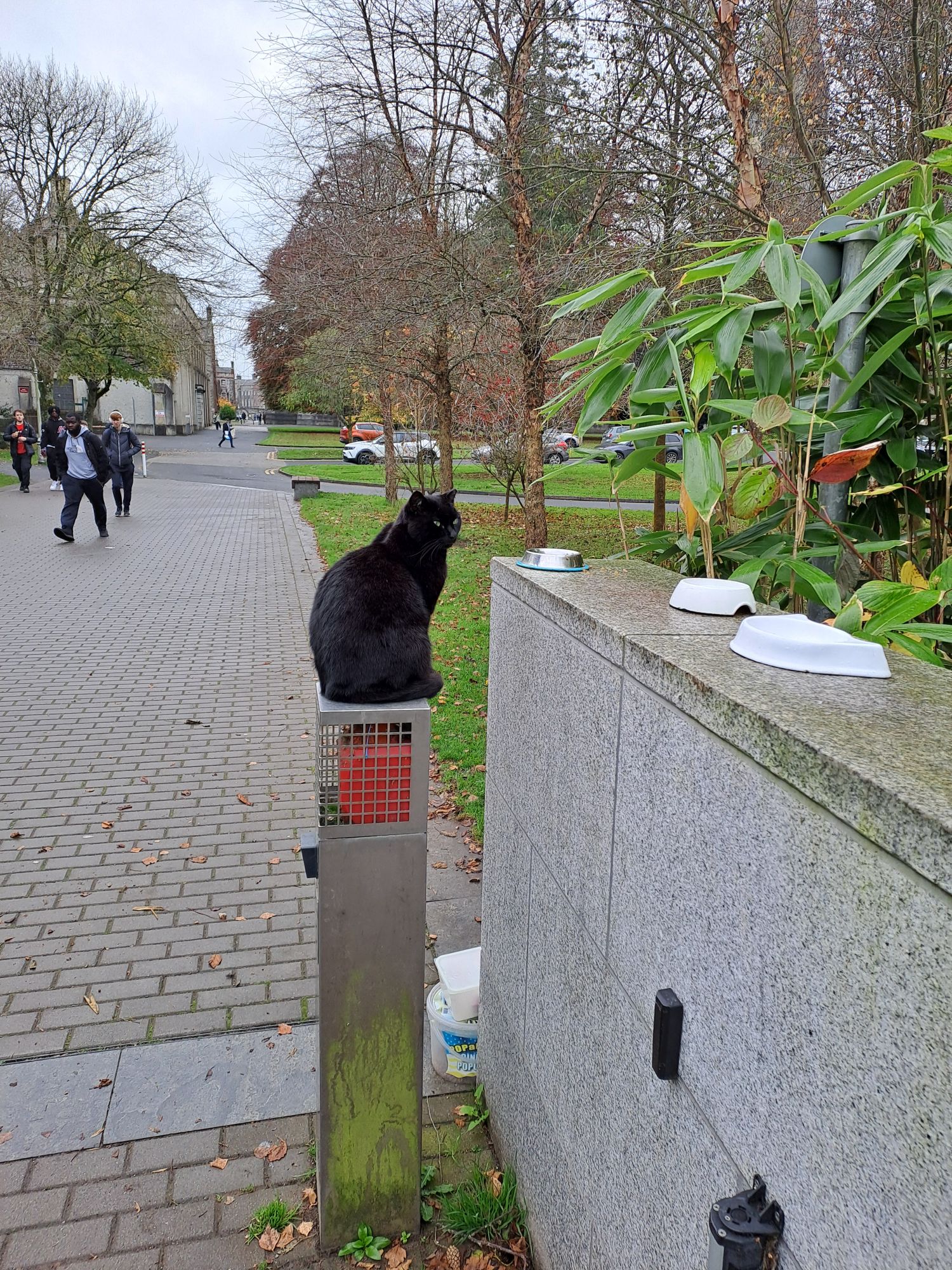
Maynooth University Library Cat was on post again today, staring at empty dishes to indicate that it was feeding time.

Blues Walk

Posted in Jazz with tags , , , , on November 4, 2024 by telescoper

I couldn’t resist sharing this piece I found on YouTube a while ago and have listened to many times. It’s amazing how many of my favourite jazz performances date from 1958, and here’s another. It’s the Dizzy Gillespie Quintet of that year featuring the great Sonny Stitt on tenor saxophone, given plenty of space by leader Dizzy Gillespie who takes the second solo on trumpet. The tune is called Blues Walk, although it is sometimes known by the alternative title Loose Walk and as such appeared on the classic film Jazz on a Summer’s Day which also featured Stitt on tenor, though with a quite different band. Note the presence of the great Ray Brown on bass and Lou Levy on piano. The drummer, Gus Johnson, is much less well known but plays very well on this.

If anyone could claim to be a direct musical descendant of Charlie Parker then it was Sonny Stitt, who demonstrates his amazing drive and technical ability in a tremendous solo on this tune, the last number performed at a concert in Belgium. Listen to the chorus that starts about 1:30. Wow! They don’t call this style “hard bop” for nothing!

Another Edgeworth Connection

Posted in History, The Universe and Stuff with tags , , , , , , , , , on November 3, 2024 by telescoper

A week or so ago I posted an item about the Edgeworth family that included a reference to Kenneth Edgeworth, an amateur astronomer of some note who first posited the existence of what is now known as the Kuiper belt. Here’s another interesting connection. Kenneth Edgeworth was born in 1880 in Daramona House in Street in County Westmeath. The owner of this house was Edgeworth’s uncle, another astronomer called William Edward Wilson who built an observatory next to Daramona House.

Here are pictures of (left) house and (right) the observatory, neither of look in particularly good condition!

After independence, many of the large houses owned by the rich Anglo-Irish families who had run Ireland until then fell into disrepair or were destroyed.

Anyway, on top of the two-storey observatory building there used to be a dome that housed a 24″ Grubb reflecting telescope. Here’s an old picture showing what it looked like in better times, around 1900:

The dome is no longer there, and neither is the telescope. The latter was donated to the University of London in 1925 eventually housed in the Observatory at Mill Hill, now run by University College London. Here is an excerpt from the history of the University of London Observatory:

W.E. Wilson established an observatory at Daramona, Street, County Westmeath, in 1871 and equipped it with a 12-inch equatorial reflector by Grubb. Wilson (born in 1851, elected FRS in 1896, an original member of the BAA, awarded an honorary DSc by the University of Dublin in 1901, High Sheriff of Co. Westmeath in 1894), observed the transit of Venus in 1882 and solar eclipses at Oran in 1870 and Spain in 1900, published many papers in Proc. R. Soc, Proc. R. Dublin Soc., Proc. R. Irish Acad., etc., and died in 1908) enlarged his observatory in 1881 and installed a 24-inch reflector by Grubb on the mounting previously used for the 12-inch reflector. Ten years later a new mounting was constructed. It is this mounting which was moved to Mill Hill in 1928. Dr. Wilson used his telescope to make some of the best photographs of his time of star clusters and nebulae, and he worked extensively on problems of solar physics and the solar constant. The telescope may be used in Newtonian and Cassegrain forms; the focal length of the mirror is 10 feet and the equivalent focal length at the Cassegrain focus is approximately 42 feet. The telescope was moved in 1928 from Ireland to University College, where minor modifications were made to the focussing arrangements and plate-holder, and an electric motor was added to rewind the driving clock automatically.

The Wilson telescope was retired from active service in 1974 and moved to the World Museum in Liverpool where, as far as I know, it remains on display to this day.

Tara Erraught at the National Concert Hall

Posted in Music with tags , , , , , , , , , , on November 2, 2024 by telescoper

Last night’s concert at the National Concert Hall featured star mezzo-soprano Tara Erraught (who is from Mullingar, in County Westmeath, and is artist-in-residence at the National Concert Hall for this season. She was accompanied by the National Symphony Orchestra directed by Laurence Cummings. You can tell how much I like Tara Erraught by the fact I went to the concert despite there being a harpsichord involved in some of the pieces; fortunately it was pointed away from the audience so we couldn’t hear it.

Before the concert, I was trying to remember when I heard her sing before. A look at my back catalogue revealed that it was this concert at which she sang a Mahler song-cycle. Last night’s performance comprised very different material, all from the 18th Century. There were three vocal pieces: a cantata in four sections by a name quite new to me, Marianna Martines, also known as Marianne von Martinez; a concert aria by Joseph Haydn; and by far the most exciting piece, Mozart’s wonderful Exsultate Jubilate. Tara Erraught was in fine voice throughout but I was particularly impressed with the precision of her articulation of the ornamented phrases in the last work. The audience loved it too.

The concert was all about Tara Erraught, however. The first half included Symphony No. 25 by Joseph Haydn, a funny little work only 13 minutes long and lacking the usual slow movement that seemed to me like it wasn’t really finished. It’s certainly not among Haydn’s best symphonies, anyway. It was a bit unfair on Haydn to have Mozart’s Symphony No. 41 “Jupiter” on the same menu as that it is one of the great symphonies by any composer. It did however demonstrate very powerfully how much the symphonic form had evolved in the twenty-odd years separating the two compositions (which incidentally are both in the same key of C Major). The Jupiter symphony is not only brim full of ideas, but the themes are woven into a much richer fabric. I might add that it was very well played by the NSO in a performance that was forceful and energetic without being too bombastic.

Three New Publications at the Open Journal of Astrophysics

Posted in OJAp Papers, Open Access, The Universe and Stuff with tags , , , , , , , , , , , on November 2, 2024 by telescoper

It’s Saturday, so it’s time once again for another summary of business at the  Open Journal of Astrophysics. This week I have three papers to announce, which brings the total we have published so far this year (Vol. 7) to 98 and the total published by OJAp to 213.

First one up, published on Tuesday 29th October 2024, is “Cosmology with shear ratios: a joint study of weak lensing and spectroscopic redshift datasets” by Ni Emas & Chris Blake (Swinburne U., Australia), Rossana Ruggeri (Queensland U, Australia) and Anna Porredon (Ruhr University, Bochum, Germany). This paper is in the folder marked Cosmology and NonGalactic Astrophysics. The paper investigates the use of shear ratios as a cosmological diagnostic, with applications to lensing surveys

Here is a screen grab of the overlay, which includes the abstract:

You can read the paper directly on arXiv here.

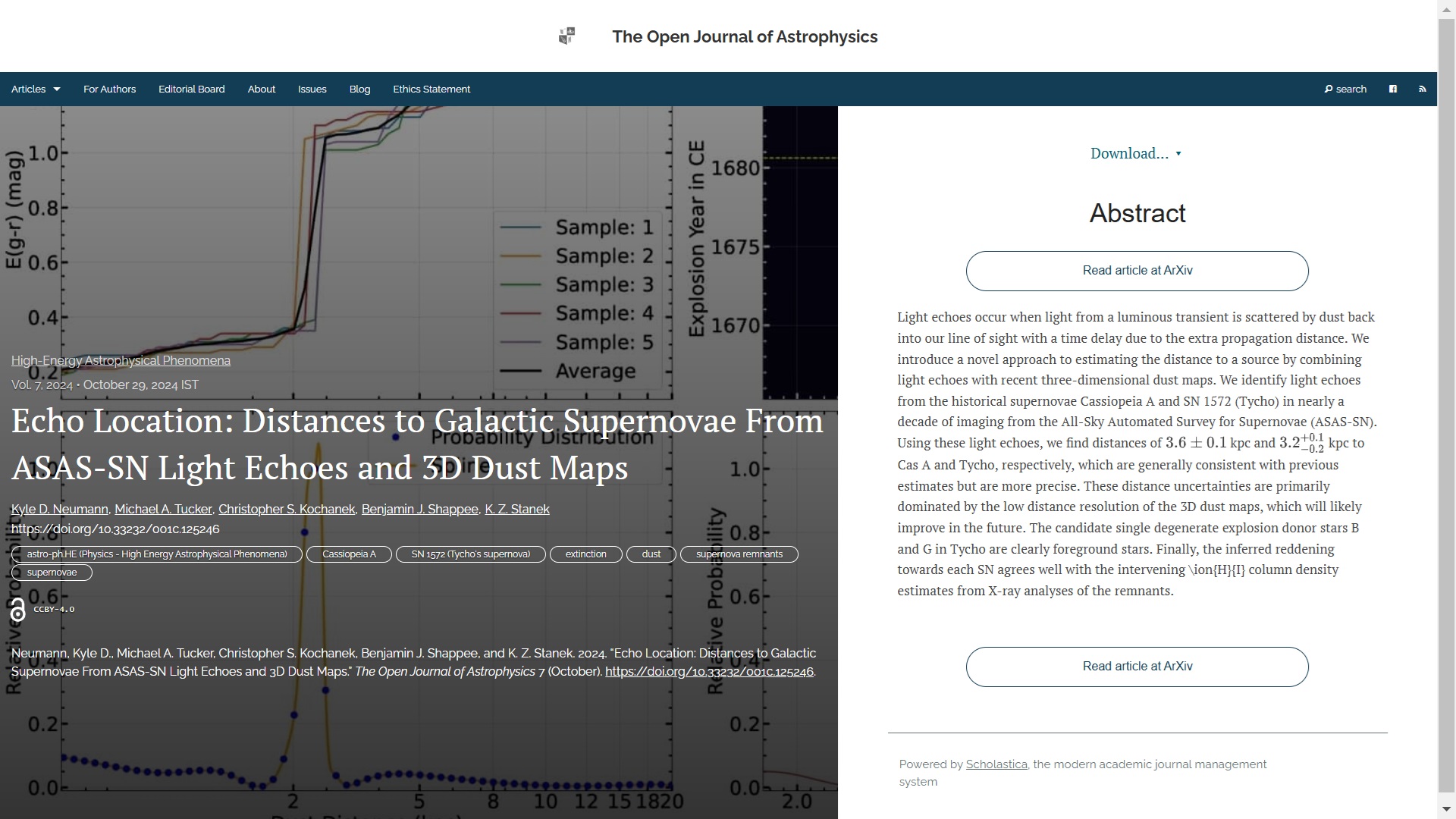
The second paper to present, also published on Tuesday 29th October 2024, is “Echo Location: Distances to Galactic Supernovae From ASAS-SN Light Echoes and 3D Dust Maps” by Kyle D. Neumann (Penn State), Michael A. Tucker & Christopher S. Kochanek (Ohio State), Benjamin J. Shappee (U. Hawaii), and K. Z. Stanek (Ohio State), all based in the USA. This paper is in the folder marked High-Energy Astrophysical Phenomena and it presents a new approach to estimating the distance to a source by combining light echoes with recent three-dimensional dust maps with application to supernova distances.

The overlay looks like this:


You can read this paper directly on the arXiv here.

Last, but by no means least, comes  “A deconstruction of methods to derive one-point lensing statistics” by Viviane Alfradique (Universidade Federal do Rio De Janeiro, Brazil), Tiago Castro (INAF Trieste, Italy), Valerio Marra (Trieste), Miguel Quartin (Rio de Janeiro), Carlo Giocoli (INAF Bologna, Italy), and Pierluigi Monaco (Trieste).  Published in the folder marked Cosmology and NonGalactic Astrophysics, it describes a comparative study of different methods of approximating the one-point probability density function (PDF) for use in the statistical analysis of gravitational lensing.

Here is a screengrab of the overlay:


To read the accepted version of this on the arXiv please go here.

That’s it for this week. I hope to post another update next weekend, by when we might well have reached a century for this year!