Pleurez mes yeux
Posted in Opera with tags Jules Massenet, Le Cid, Maria Callas, Pleurez mes Yeux on July 14, 2012 by telescoperOlafur Eliasson: Space, Art and Little Sun
Posted in Art with tags Little Sun, Olafur Eliasson, Tate Modern, TEDX on July 13, 2012 by telescoperI recently found a report about a new project by Olafur Eliasson at Tate Modern called Little Sun which seems very intriguing to me. Basically the Little Suns in question are solar-powered LED lamps, with a running time of about 5 hours. Similar, I suppose to the things some of us have in our gardens that charge up during the day and light up at night. Anyway, the idea is that on Saturday evenings from 28 July to 23 September the lights at Tate Modern will be switched off, and each visitor given a Little Sun so they can wander around and see the exhibits in the dark. I can imagine that this will a fascinating experience, changing as it will the usual relationship between the viewer and the viewed, and the space enclosing them both. During the day there will also be a gallery open on the building’s third floor, where visitors can learn about solar power, global energy problems, light and its importance to life, as well as create light graffiti, as demonstrated on the little video here:
I’m not sure I’ll the chance to see Little Sun but I hope this encourages at least a few of you to check it out.
I also found this talk by Olafur Eliasson at TEDX some time ago, called Playing with Space and Light. A while ago was invited one of the gatherings of artists and scientists he mentions at the beginning, and found it absolutely fascinating…
Follow @telescoperNevaeh ot Yawriats
Posted in Bad Statistics, Music, The Universe and Stuff with tags Led Zeppelin, Stairway to Heaven, suggestion, template matching on July 12, 2012 by telescoperI just remembered hearing this a while ago at a public talk given by Simon Singh. I guess many of you will have come across it before, but there’s no harm in repeating it. I don’t know why it popped into my head at this particular moment, but perhaps it’s because I’ve been reading some stuff about how my colleagues in gravitational wave research use templates to try to detect specific patterns in noisy data. The method involves cross-correlating a simulated signal against the data until a match is obtained; the problem is often how to assess the probability of a “chance” coincidence correctly and thus avoid spurious detections. The following might perhaps be a useful warning that unless you do this carefully, you only get out what you put in!
This is an excerpt from the classic track Stairway to Heaven, by the popular beat combo Led Zeppelin, played backwards. I suggest that you listen to it once without looking at the words on the video, and then again with the words in front of you. If you haven’t heard/seen it before, I think you’ll find it surprising…
Of course the proper way to interpret (or dismiss) matches like this is to use tools based on Bayesian inference….
Follow @telescoperSafe Mode
Posted in Biographical, Poetry on July 11, 2012 by telescoperIt’s broken down.
So what? Who cares?
Silence. Move on.
System restart.
Using safe mode.
(Without plug-ins).
Should do the trick.
Or perhaps not.
Who cares? Move on.
Claim a refund?
No warranty…
Take to the tip?
It was rather
Expensive. True,
but years ago.
Not worth the cost
Of repairing,
Things of that sort.
In the mean time,
Back in its box.
Leave it a while.
Switch the thing off
Then on again.
You know the drill.
Usually works.
If not, just get
Another one;
A different
Make this time, more
Reliable.
by Peter Coles (aged 49).
Follow @telescoper
Trouble in Mind
Posted in Jazz with tags Nina Simone, Trouble in Mind on July 10, 2012 by telescoperScience 2.0 and all that
Posted in Open Access, Science Politics with tags Open Access, open science, Science, Science 2.0 on July 9, 2012 by telescoperI cam across this on Twitter today and thought I’d share it. Although I have written at various times about open access and the virtues of sharing scientific data, I hadn’t realised that such things came under the umbrella of “Science 2.0“, a term which is quite new to me. This post contains some very interesting ideas and information on the subject.

We’re approaching the final stage of our study. So far, we have opened up our bibliography on our Mendeley group here; our notes through this very blog; our model for open science; and our draft policy recommendations for EU. And we’ve benefited from your comments and insight.
Now, we need your help to improve the evidence about the importance of Science 2.0, if we want policy-makers to take it seriously.
Therefore, we share the final presentation that we have presented to the European Commission, DG RTD here.
Help us improving it, by gathering more data and evidence, showing that Science 2.0 is important and disruptive, and that it’s happening already. In particular, we ask to share evidence and data on the take-up of Science 2.0: how many scientist are adopting it? With what benefits?

We ask all people interested in Science 2.0 to share the evidence at hand, by adding
View original post 15 more words
Munch at Tate Modern
Posted in Art, Biographical with tags Edvard Munch, Red Virginia Creeper, Self Portrait between Clock and Bed, Tate Modern, The Modern Eye, The Night Wanderer on July 8, 2012 by telescoperOn Friday I had the morning off from my stint at the Royal Society Summer Exhibition I mentioned a few days ago, so I took the short walk from my hotel to Tate Modern to see an exhibition of art by Edvard Munch called Edvard Munch: The Modern Eye. Before seeing the collection, which is housed on the second floor of Tate Modern, I took a picture of the view from the balcony looking across the Thames from Bankside towards St Paul’s.

Not inappropriate weather for this exhibition!
Everyone knows Munch by his famous work The Scream, which isn’t part of this exhibition. I don’t regret this omission it allows the visitor to focus on his lesser-known works, some of which I think are even more powerful than The Scream which, incidentally, I have seen when it was part of an exhibition of Munch’s work in Berlin in 1995. In fact I bought a poster of that exhibition, the design of which includes a copy of The Scream; it is hanging in my study as I write this.
The gallery’s booklet describes Munch’s paintings as
..profoundly introspective, unflinchingly depicting his experience of ageing, emotional turmoil, sickness and bodily decay.
Indeed. Some of the works are so powerful as to be almost unbearable to look at. I’ll just mention a few that struck me in particular.
One room is filled with a number of almost identical paintings entitled Weeping Woman, in which a naked female figure stands bowed and sobbing within a dreary claustrophobic room. The repetition of this theme across many canvases seems almost compulsive, and they’re painted with crude almost frantic strokes.
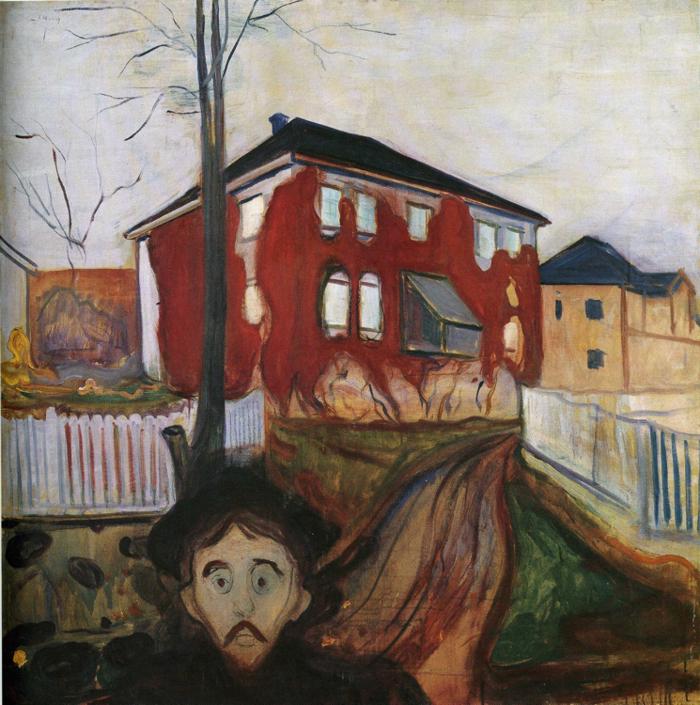
This is a painting called Red Virginia Creeper, a plant that grows on my house in fact, but which in this case has transformed into a dripping bloodstain behind the crudely drawn but obviously bewildered figure in the foreground.
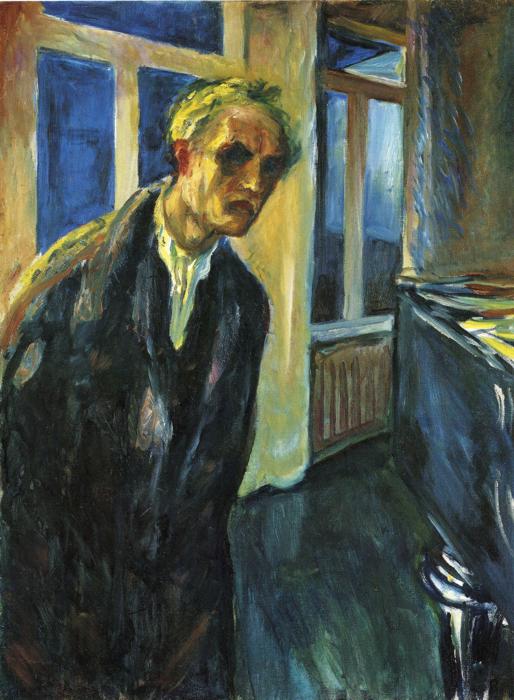
But the most powerful works by Munch were made later in his life. He was born in 1863 (100 years before me) and suffered a complete nervous breakdown in 1908. Here is a self-portrait called The Night Wanderer, showing himself as a gaunt insomniac figure wandering around a darkened house:
Then, right at the end of the exhibition, is his most moving work of all. Self Portrait between Clock and Bed, painted near the end of his life – he died in 1944 – shows a lonely old man standing between the clock, symbolising the remorseless passage of time, and the bed in which he no doubt expected to die.

This exhibition is not exactly a comfortable experience, filled as it is with images of alienation, despair and inner torment, but it was a “must-see” for me as Munch is such an important artist. Groups of schoolchildren were being led around the exhibition while I was there. Most of them giggled. I wonder how long it will be before they understand that the world really can be exactly as Munch painted it?
Anyway, I headed back across the river to the Royal Society to do the afternoon shift at the Herschel Telescope stand, which included playing with an infra-red camera to show the visitors young and old how it detects body heat, and taking pictures of them in the near infra-red as souvenirs. To show that the Munch collection hadn’t affected me too much, I took one of myself.

Intermission
Posted in Uncategorized on July 5, 2012 by telescoperOwing to a combination of circumstances, I’ve decided to take a break from blogging for a while. Normal services will be resumed as soon as possible but, for the time being, there will now follow a short intermission.
Follow @telescoper

