Bad News for Astrophysics from ESA

Posted in Science Politics, The Universe and Stuff with tags , , , , , , , , on April 18, 2012 by telescoper

Just a quick post to pass on the news (which I got from Steinn Sigurdsson’s blog) that the ESA Executive (see correction in comments below) Space Science Advisory Committee (SSAC) of the European Space Agency (ESA) has made a recommendation as to the next large mission to be flown. The short list consisted of a mission to Jupiter’s moons (JUICE), an X-ray observatory (ATHENA), and a gravitational wave observatory (NGO). The last two of these are severely de-scoped versions of missions (IXO and LISA respectively) that had to be re-designed in the aftermath of decisions made in the US decadal review not to get involved in them.

Not unexpectedly, the winner is JUICE. Barring a rejection of this recommendation by the ESA Science Programme Committee (SPC) this will be the next big thing for ESA space science.

The School of Physics and Astronomy at Cardiff University has a considerable involvement in gravitational wave physics, so the decision is disappointing for us but not entirely surprising. It’s not such a big blow either, as we are mainly involved in ground-based searches such as LIGO.

The biggest local worry will be for the sizeable community of X-ray astronomers in the UK. With no big new facilities likely for well over a decade one wonders how the expertise in this area can be sustained into the future, even if LOFT is selected as one of the next medium-sized missions. Or, given that STFC funding is already spread extremely thin, perhaps this is time for the UK to organize a strategic withdrawal from X-ray astronomy?

Welcome to Britain

Posted in Biographical with tags , , , , on April 17, 2012 by telescoper

Well then. Back to Blighty. Not the  best journey home, though.

For a start, the 11-hour flight from Cape Town became a 12-hour  flight because of an hour spent circling around in a holding pattern over South London. One expects that at Heathrow. Air traffic delays are the rule rather than the exception, and you learn to get used to it. Kind of. Although since it always happens you would think the airlines might include it in their timetables and other advertising, for the sake of honest and accuracy. Just saying. Nevertheless, this didn’t particularly annoy me.  Despite  getting no more than an hour’s sleep last night I was in a fairly good mood when I got off the plane.

At least until I got into the terminal building, Terminal 5 at Heathrow. For those of you not familiar with this terminal, it’s a gleaming and apparently spacious affair only a few years old. The problem is that when it gets busy, like this morning, you discover that this glitzy exterior masks a design that’s completely idiotic.

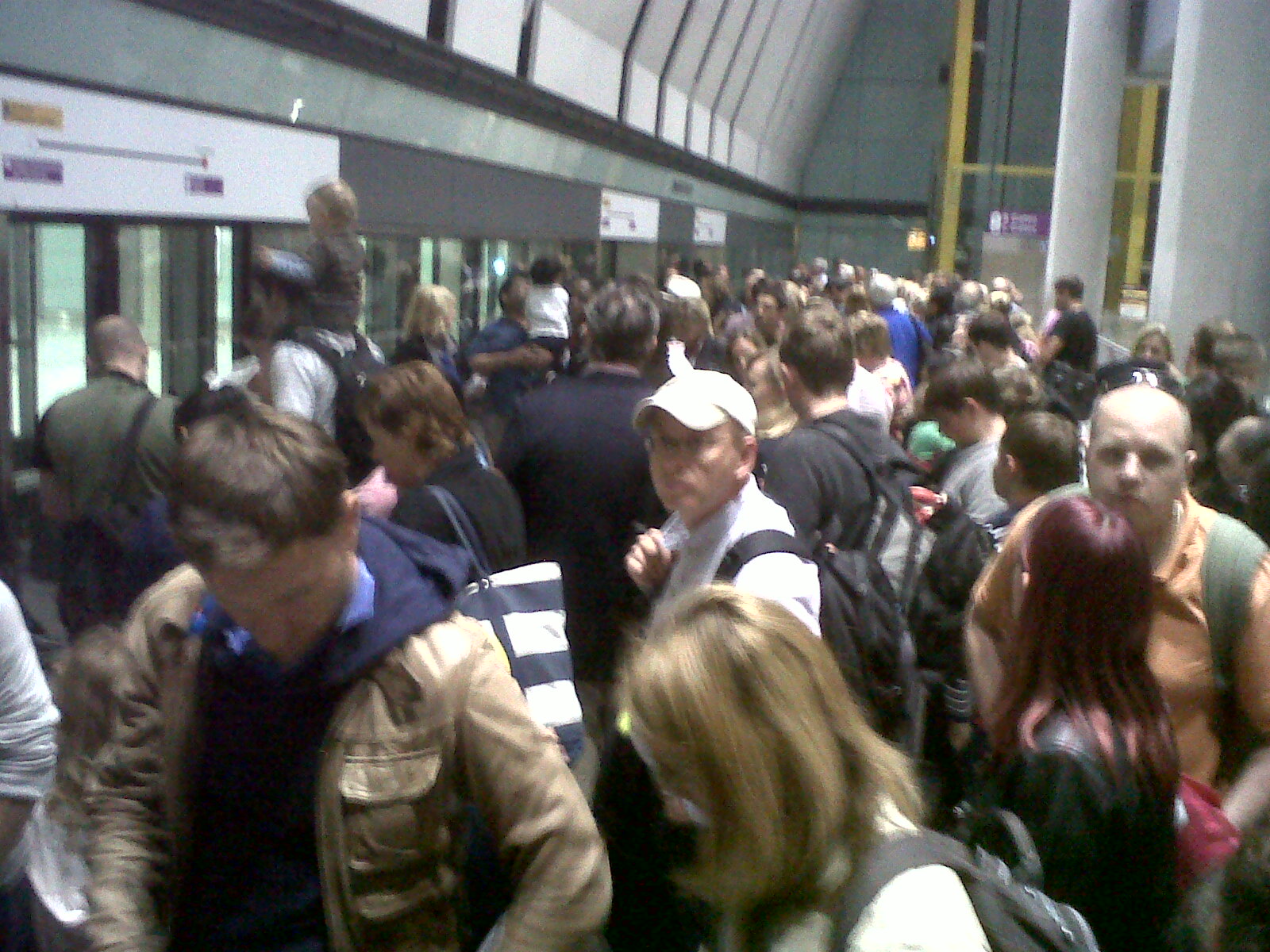
We landed at a `B’ gate on a satellite building connected to the main terminal via a `transit’, i.e. a small train. A very small train. When passengers from my flight got to the concourse from which the transit departs, it was crammed full of people who had to squeeze onto the the little train when it eventually arrived:

All this for a journey of about 2 minutes. It would have been much simpler to have constructed a walkway to the main terminal. In fact there is one. For staff only. But not for the passengers. There had to be a transit. Transits are the thing. Of course having a transit means having an extra subterranean level to the building, with lifts going down to it at one end and up from it at another. But lifts are the thing also. There are lots of lifts at Terminal 5. Going forward we’ll all be going up and down.

I wonder if the architect had shares in a company that makes lifts and transit trains?

Anyway on arrival at Terminal 5 there was a similar scrum at the lifts up to passport control. No escalators were working, so I had to wait in the crowd of disgruntled passengers, gradually inching forwards while the 3 operating lifts came and went. As we went up it dawned on me that there might be a delay at passport control..

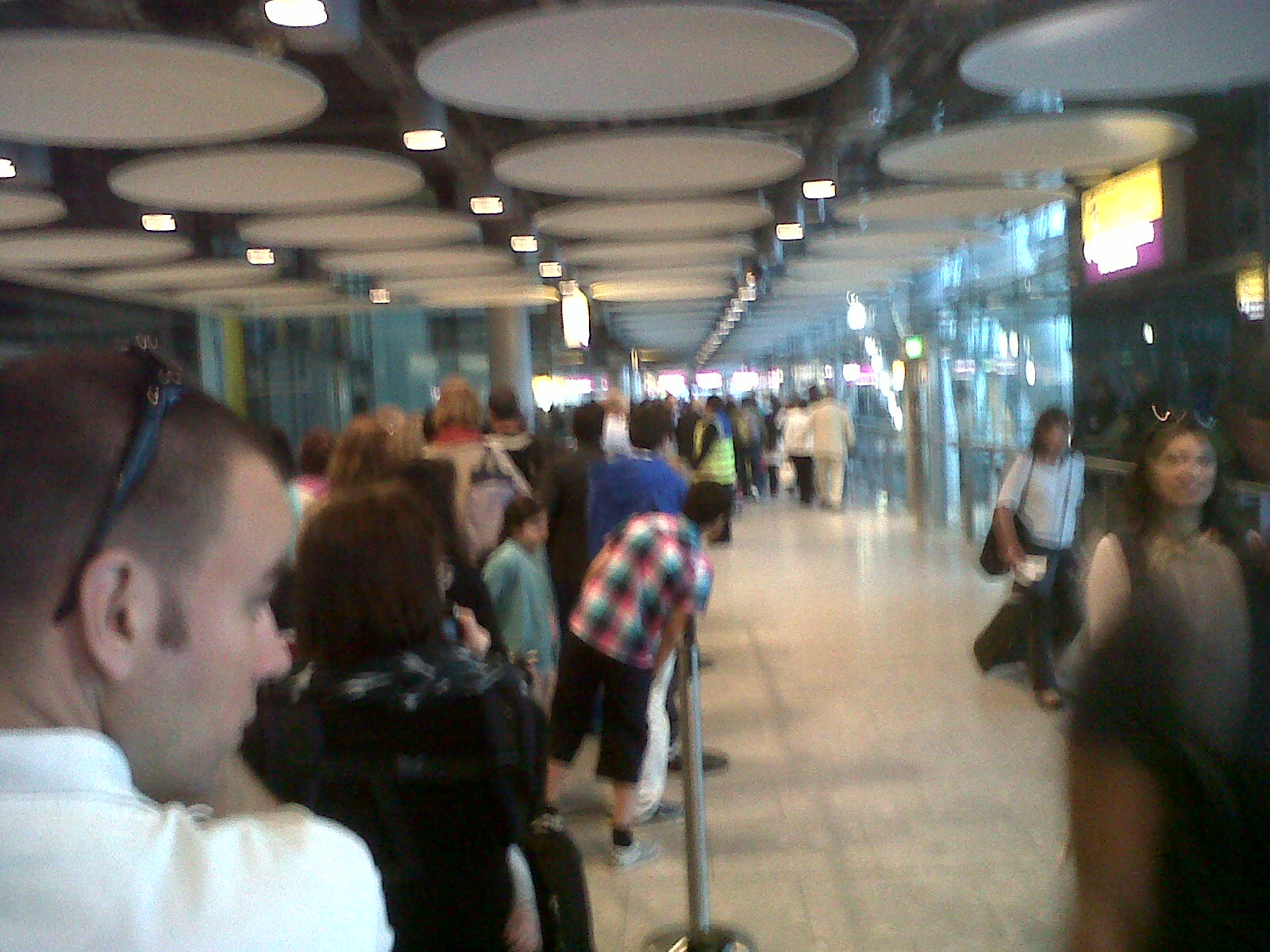
In fact there were delays before we even got there. The immigration hall was so full that we had to form three separate queues along a corridor just to get into the main queue.

When I finally got into the immigration hall, it was pandemonium. The capacity in this area is clearly far too small and there are far too few people checking passports. The system just can’t cope with the traffic being sent through it. It’s a basic management problem that apparently nobody is prepared to do anything about. Improving it would cost money, of course, but why bother? Passengers are hardly going to turn around and go home at that point, so who cares?

At least the queue for UK/EU passport holders was moving. As I inched forward through the rat’s maze towards a desk I looked from time to time at the “Other passports” line, which barely budged. I felt a sense of anger mixed with shame. What sort of message does this send to visitors to our shores? What kind of country is it that makes showy new buildings like Terminal 5 and then runs them like Fawlty Towers?

They don’t allow photography in the passport control area, by the way. The ban is no doubt an attempt to conceal the evidence of what a shambles it is.

Anyway, at least the long delay at Immigration meant that my bag had arrived at the Baggage Reclaim by the time I got through. I picked it up and made for the Heathrow Express connection to Paddington. The time was just after 8.30; one hour and three quarters after we’d landed.

Still at least I was on my way. Or was I? The train departed and then stopped at a signal. We waited. Eventually the driver explained that there was a major points and signal failure so only one line was operating. We got to Paddington, but it took 35 minutes rather than the usual 15.

There is an alternative way of getting back to Cardiff from Heathrow, which involves taking a bus to Reading and getting the train from there. Although that route is cheaper, there is a risk of severe traffic delays at rush-hour periods, so opted for the Heathrow Express in the belief it was more reliable. More fool me.

When I arrived at Paddington, it too was a mass of disgruntled people. The reason? No trains.

The same signalling problem was disrupting trains into and out of Paddington. All departing trains were simply marked as “delayed” on the boards. Eventually, I got the 9.15, which departed at 9.38. Not too bad in the end. Except that it had to navigate a crowded route westwards. We arrived at Reading after 50 minutes instead of the usual 25.

Then things seem to settle down. We started to move at full speed. I even had a short nap. I was woken by an announcement from the guard. It had been decided that the train I was on would not, after all, be going to Cardiff but would terminate at Newport. First Great Western like to make the most of any possible inconvenience. It’s only 15 minutes from Newport to Cardiff, but it was too much trouble to take us that short distance. We were turfed off and had to wait for local commuter train. Not surprisingly, it was packed so I had to stand all the way.

I’ll be expecting a refund from First Great Western, but that’s not the point. It’s their contemptuous attitude to the travelling public that’s the point. Their prices are so high one might expect them to treat passengers with some respect. But no.

Anyway, I got home exhausted, stressed and frustrated. Given how badly things had gone I half-expected my house to have fallen down while I was away, but thankfully all was well back at the ranch. I decided to cool off a bit before writing this account of the journey, otherwise it would have been even more intemperate! I had been planning to go into work this afternoon but was in no fit state.

Still, it’s good to be home. Kind of.
Going Virial

Posted in The Universe and Stuff with tags , , , on April 16, 2012 by telescoper

Here’s something a bit different. I was talking the other day with some folks here about the use of the Virial Theorem to measure masses of galaxy clusters. In case you’ve forgotten,  an important consequence of the virial theorem is that the average potential energy of an isolated system in gravitational equilibrium is equal to minus twice the average kinetic energy, i.e.

\langle \Phi \rangle = -2 \langle T \rangle

Being mathematicians they wanted to  have a precise definition of when this theorem holds, i.e. what it means for a system to be in virial equilibrium. I have to admit I was a bit stumped.

The problem is that the proof of the theorem (which you can find on the wikipedia page) involves assuming that the time-average of a scalar quantity (the virial), derived from the positions and momenta of the particles in the system, is zero. That’s fine, but the average is taken over an infinite time and most cosmic objects we apply it too are rather younger than the age of the Universe. So how accurately does it apply to, e.g., galaxy clusters? How large are the fluctuations about the mean?

Another problem is that clusters aren’t really isolated either. According to prevailing wisdom clusters sit at the intersections of filaments and sheets of dark matter from which matter continually accretes onto them, increasing their mass.

Clusters also contain a sizeable amount of substructure. Does this cast further doubt on how well actual clusters are described by the virial theorem?

I’ve heard a number of lectures and seminars about virial mass estimates of clusters but never have I heard a precise, testable definition of when it is expected to apply and how large the deviations from it are in realistic situations. I’ve taught courses in which the theorem is applied to a variety of situations, but I never looked too deeply into its foundations – which is, of course, very sloppy of me.  I tried asking a few people, and posted a question of Twitter, but didn’t get a really convincing response. Naturally, therefore, I decided to try it out on the readership of this blog….

So, please, would anyone out there please give me a precise  testable definition of what is meant by a “virialised system”  and explain how how well the virial theorem is supposed to apply to real clusters? Pointers to convincing discussions in the literature would be welcome!


Left Alone

Posted in Jazz with tags , , on April 15, 2012 by telescoper

Here’s a lovely little duet by saxophonist Archie Shepp and Abdullah Ibrahim, who was born in South Africa and formerly  known as Dollar Brand. A good time to post it, as it’s called Left Alone and  I’m spending the day on my own finishing a few things off before returning to Blighty tomorrow…

The Birth of Shaka

Posted in Poetry with tags , , on April 14, 2012 by telescoper

His baby cry
was of a cub
tearing the neck
of the lioness
because he was fatherless.

The gods
boiled his blood
in a clay pot of passion
to course in his veins.

His heart was shaped into an ox shield
to foil every foe.

Ancestors forged
his muscles into
thongs as tough
as water bark
and nerves
as sharp as
syringa thorns.

His eyes were lanterns
that shone from the dark valleys of Zululand
to see white swallows
coming across the sea.
His cry to two assassin brothers:

“Lo! you can kill me
but you’ll never rule this land!”

by Oswald Mtshali (b. 1940)

Shaka was a Zulu chief of the 19th Century who built such a  giant empire in what is now South Africa that he became known in Europe as the Black Napoleon. He was eventually killed by his half brothers, but the Zulu empire crumbled soon after when the British Army took it on.

It ain’t half hot…

Posted in Biographical on April 13, 2012 by telescoper

Just to point out that it’s over 30 degrees today. I realised it was going to be a scorcher, at least by my standards, when I emerged from the underpass on my way to the department and felt the full heat of the Sun. And that was at 9am.

I’m not very well adapted for high temperatures, unlike the people who live here. The other day I heard a student complaining about how cold it was, only 24 degrees. When I said that it wasn’t really that cold in Cape Town, as London was only 12 degrees on that day, he said he couldn’t understand how people could live in a place where there was only half as much heat….

I do hope it wasn’t a physics student.

On the Buses

Posted in Politics with tags , , , on April 13, 2012 by telescoper

It seems that while I’m away there’s been a to-do and a hoo-ha about advertisements on London buses. It all started with this rather innocuous advertisement placed by the campaigning organization Stonewall…

Apparently this upset a couple of minority religious sects, the overtly homophobic Anglican Mainstream and Core Issues which apparently has a mission to convert happy homosexual people into miserable heterosexual ones by a mixture of coercion, brainwashing and quack psychology. It’s strange that Christian groups like this have such an obsession with homosexuality. Aren’t there more important things for a Christian to be doing, like being kind to the poor and loving your neighbour? Anyway, these folks responded with a bus advert of their own:

Following a number of complaints about the latter, and an intervention by the Mayor Boris Johnson, Transport for London decided to remove the second set of advertisements on the grounds that

We don’t believe these ads reflect TfL’s commitment to a tolerant and inclusive London.

Actually, I think it’s a shame that the Anglican Mainstream adverts were removed. For a start, it’s one of the prices of living in a free society that you have to put up with views you don’t like. More importantly, however, the clumsy and childish nature of the tit-for-tat response from the “religious” fringe to Stoenwall’s pithy original reveals them as the mean-spirited dullards that they are. Their implicit reference to voodoo therapies as “gay cures” will hopefully now receive wider scrutiny in the media, and be exposed for what it is i.e. dogma-inspired pseudoscience. These folk would be more honest if they just took out adverts saying “We hate gay people”, but the disguise is so transparent that’s the message they carry anyway. I am confident publicity campaigns like this are counter-productive in the long run, so let them stand up and be counted. By their slogans shall ye know them.

The Advertising Standards Agency – correctly, in my view – deemed both sets of advertisements acceptable. It was a decision by Transport for London to ban the second set. I don’t think that’s contrary to the spirit of free speech. Anglican Mainstream or any other group has the right to print and distribute literature, organize demonstrations and what have you. It is however, up to newspapers, television companies and radio stations to decide whether they feel comfortable carrying advertisements by organizations promoting messages that run counter to their own code of conduct.

Fifty Years of the UK in Space

Posted in The Universe and Stuff with tags , , on April 12, 2012 by telescoper

I got an email just now advertising this event which I hadn’t heard about before today, so I thought I’d put my community service hat on and spread the word via the medium of this blog by passing on the content of the email with a minimum of edits. Unfortunately I won’t be going to the thing myself as I’ll be teaching on 26th April…

On 26 April 1962, Britain became the third space-faring nation with the launch of Ariel-1, the first satellite to be developed and operated by the UK. Fifty years on, the UK space sector is a world leader in space science, innovative technology and applications development helping Planet Earth.

To commemorate the launch of Ariel-1 and to celebrate the continued excellence of UK space activities, on the anniversary of the launch, 26 April 2012, the UK Space Agency and the Science Museum are co-hosting a two-day conference celebrating 50 years of the UK in space. It will bring together those who started the UK on the road to being a world-renowned centre for space technology and research with the scientists and engineers of the next fifty years. The Director of Science and Robotic Exploration at the European Space Agency will make the keynote speech and there will exciting announcements and memorable moments to enjoy at the evening reception hosted by the UK Space Agency on the 26th April. Come along, mingle with friends old and new and look forward to the next chapter of the UK in space. Admission is free.

More information can be found here, and at the conference website here. You can download a PDF of the conference programme here.

Bayes, Bridge and the Brain

Posted in Books, Talks and Reviews, The Universe and Stuff with tags , , , on April 12, 2012 by telescoper

I was having a chat over coffee yesterday with some members of the Mathematics Department here at the University of Cape Town, one of whom happens to be an expert at Bridge, actually representing South Africa in international competitions. That’s a much higher level than I could ever aspire to so I was a bit nervous about mentioning my interest in the game, but in the end I explained that I have in the past used Bridge (and other card games) to describe how Bayesian probability works; see this rather lengthy post for more details. The point is that as cards are played, one’s calculation of the probabilities of where the important cards lie changes in the light of information revealed. It makes much more sense to play Bridge according to a Bayesian interpretation, in which probability represents one’s state of knowledge, rather than what would happen over an ensemble of “random” realisations.

This particular topic – and Bayesian inference in general – is also discussed in my book From Cosmos to Chaos (which is, incidentally, now available in paperback). On my arrival in Cape Town I gave a copy of this book to my genial host, George Ellis, and our discussion of Bridge prompted him to say that he thought I had missed a trick in the book by not mentioning the connections between Bayesian probability and neuroscience. I hadn’t written about this because I didn’t know anything about it, so George happily enlightened me by sending a few review articles, such as this:

I can’t post it all, for fear of copyright infringement, but you get the idea. Here’s another one:

And another…

Nature Reviews Neuroscience 11, 605 (August 2010) | doi:10.1038/nrn2787-c1

A neurocentric approach to Bayesian inference    Christopher D. Fiorillo

Abstract A primary function of the brain is to infer the state of the world in order to determine which motor behaviours will best promote adaptive fitness. Bayesian probability theory formally describes how rational inferences ought to be made, and it has been used with great success in recent years to explain a range of perceptual and sensorimotor phenomena.

As a non-expert in neuroscience, I find these very interesting. I’ve long been convinced that from the point of view of formal reasoning, the Bayesian approach to probability is the only way that makes sense, but until reading these I’ve not been aware that there was serious work being done on the possibility that it also describes how the brain works in situations where there is insufficient information to be sure what is the correct approach. Except, of course, for players of Bridge who know it very well.

There’s just a chance that I may have readers out there who know more about this Bayes-Brain connection. If so, please enlighten me further through the comments box!

Academic Spring Time

Posted in Open Access with tags , , , , on April 11, 2012 by telescoper

Catching up on the last few days’ activity on the Twittersphere I realise that at last the Academic Journal Racket has made it into the mainstream media. The Guardian ran an article on Monday reporting that the Wellcome Trust had weighed in on the side of open access to academic journals, and followed this up with an editorial this morning. Here are the first two paragraphs.

Some very clever people have put up with a very silly system for far too long. That is the upshot of our reporting on scholarly journals this week. Academics not only provide the raw material, but also do the graft of the editing. What’s more, they typically do so without extra pay or even recognition – thanks to blind peer review. The publishers then bill the universities, to the tune of 10% of their block grants, for the privilege of accessing the fruits of their researchers’ toil. The individual academic is denied any hope of reaching an audience beyond university walls, and can even be barred from looking over their own published paper if their university does not stump up for the particular subscription in question.

This extraordinary racket is, at root, about the bewitching power of high-brow brands. Journals that published great research in the past are assumed to publish it still, and – to an extent – this expectation fulfils itself. To climb the career ladder academics must get into big-name publications, where their work will get cited more and be deemed to have more value in the philistine research evaluations which determine the flow of public funds. Thus they keep submitting to these pricey but mightily glorified magazines, and the system rolls on.

These are the points many academics, including myself, have been making for several years apparently with little success. What seems to be giving the campaign against the racketeers some focus is the boycott of rapacious publishing giant Elsevier I blogged about earlier this year, which was kicked off by mathematician and blogger Tim Gowers; the petition now has over 9300 signatures. Elsevier is one of the worst of the racketeers, which is deeply ironic. When Galileo, having been forced to recant by the Inquisition, wrote the Dialogues concerning Two New Sciences and got them published in non-Catholic Leiden, by Elsevier…

Elsevier has since withdrawn its support for the infamous Research Works Act, but I hope that doesn’t mean the campaign will dissipate. For the sake of the future of science, the whole system needs to be systematically dismantled and rebuilt free of parasites.

Today I see there’s a related piece in the Financial Times (although it’s blocked by a paywall) and I gather there has also been coverage on BBC Radio over the last few days, although I didn’t hear any of it because of my current location.

The fact that this issue  has garnered coverage  from the mainstream media is a very good thing. Academics have put up with being ripped off for far too long, and it’s to our shame that we haven’t done anything about it until now. Now I think the public will be asking how we could possibly have accepted the status quo and sheer embarrassment might force a change.

Another thing that we need to realise is the extent to which the Academic Journal Racket is feeding off the monster that is Research Assessment, specifically the upcoming Research Excellence Framework. The main beneficiaries of such exercises are not the researchers, but  the academic publishers who rake in the profits generated by the mountains of papers submitted to them in the hope that they’ll be judged “internationally leading” (whatever that means).  If the government is serious about Open Access then only papers that are freely available should be accepted by the REF. If that doesn’t shake up the system, nothing will!