A Little Bit of Bayes

Posted in Bad Statistics, The Universe and Stuff with tags , , , , , , on November 21, 2010 by telescoper

I thought I’d start a series of occasional posts about Bayesian probability. This is something I’ve touched on from time to time but its perhaps worth covering this relatively controversial topic in a slightly more systematic fashion especially with regard to how it works in cosmology.

I’ll start with Bayes’ theorem which for three logical propositions (such as statements about the values of parameters in theory) A, B and C can be written in the form

P(B|AC) = K^{-1}P(B|C)P(A|BC) = K^{-1} P(AB|C)

where

K=P(A|C).

This is (or should be!)  uncontroversial as it is simply a result of the sum and product rules for combining probabilities. Notice, however, that I’ve not restricted it to two propositions A and B as is often done, but carried throughout an extra one (C). This is to emphasize the fact that, to a Bayesian, all probabilities are conditional on something; usually, in the context of data analysis this is a background theory that furnishes the framework within which measurements are interpreted. If you say this makes everything model-dependent, then I’d agree. But every interpretation of data in terms of parameters of a model is dependent on the model. It has to be. If you think it can be otherwise then I think you’re misguided.

In the equation,  P(B|C) is the probability of B being true, given that C is true . The information C need not be definitely known, but perhaps assumed for the sake of argument. The left-hand side of Bayes’ theorem denotes the probability of B given both A and C, and so on. The presence of C has not changed anything, but is just there as a reminder that it all depends on what is being assumed in the background. The equation states  a theorem that can be proved to be mathematically correct so it is – or should be – uncontroversial.

Now comes the controversy. In the “frequentist” interpretation of probability, the entities A, B and C would be interpreted as “events” (e.g. the coin is heads) or “random variables” (e.g. the score on a dice, a number from 1 to 6) attached to which is their probability, indicating their propensity to occur in an imagined ensemble. These things are quite complicated mathematical objects: they don’t have specific numerical values, but are represented by a measure over the space of possibilities. They are sort of “blurred-out” in some way, the fuzziness representing the uncertainty in the precise value.

To a Bayesian, the entities A, B and C have a completely different character to what they represent for a frequentist. They are not “events” but  logical propositions which can only be either true or false. The entities themselves are not blurred out, but we may have insufficient information to decide which of the two possibilities is correct. In this interpretation, P(A|C) represents the degree of belief that it is consistent to hold in the truth of A given the information C. Probability is therefore a generalization of the “normal” deductive logic expressed by Boolean algebra: the value “0” is associated with a proposition which is false and “1” denotes one that is true. Probability theory extends  this logic to the intermediate case where there is insufficient information to be certain about the status of the proposition.

A common objection to Bayesian probability is that it is somehow arbitrary or ill-defined. “Subjective” is the word that is often bandied about. This is only fair to the extent that different individuals may have access to different information and therefore assign different probabilities. Given different information C and C′ the probabilities P(A|C) and P(A|C′) will be different. On the other hand, the same precise rules for assigning and manipulating probabilities apply as before. Identical results should therefore be obtained whether these are applied by any person, or even a robot, so that part isn’t subjective at all.

In fact I’d go further. I think one of the great strengths of the Bayesian interpretation is precisely that it does depend on what information is assumed. This means that such information has to be stated explicitly. The essential assumptions behind a result can be – and, regrettably, often are – hidden in frequentist analyses. Being a Bayesian forces you to put all your cards on the table.

To a Bayesian, probabilities are always conditional on other assumed truths. There is no such thing as an absolute probability, hence my alteration of the form of Bayes’s theorem to represent this. A probability such as P(A) has no meaning to a Bayesian: there is always conditioning information. For example, if  I blithely assign a probability of 1/6 to each face of a dice, that assignment is actually conditional on me having no information to discriminate between the appearance of the faces, and no knowledge of the rolling trajectory that would allow me to make a prediction of its eventual resting position.

In tbe Bayesian framework, probability theory  becomes not a branch of experimental science but a branch of logic. Like any branch of mathematics it cannot be tested by experiment but only by the requirement that it be internally self-consistent. This brings me to what I think is one of the most important results of twentieth century mathematics, but which is unfortunately almost unknown in the scientific community. In 1946, Richard Cox derived the unique generalization of Boolean algebra under the assumption that such a logic must involve associated a single number with any logical proposition. The result he got is beautiful and anyone with any interest in science should make a point of reading his elegant argument. It turns out that the only way to construct a consistent logic of uncertainty incorporating this principle is by using the standard laws of probability. There is no other way to reason consistently in the face of uncertainty than probability theory. Accordingly, probability theory always applies when there is insufficient knowledge for deductive certainty. Probability is inductive logic.

This is not just a nice mathematical property. This kind of probability lies at the foundations of a consistent methodological framework that not only encapsulates many common-sense notions about how science works, but also puts at least some aspects of scientific reasoning on a rigorous quantitative footing. This is an important weapon that should be used more often in the battle against the creeping irrationalism one finds in society at large.

I posted some time ago about an alternative way of deriving the laws of probability from consistency arguments.

To see how the Bayesian approach works, let us consider a simple example. Suppose we have a hypothesis H (some theoretical idea that we think might explain some experiment or observation). We also have access to some data D, and we also adopt some prior information I (which might be the results of other experiments or simply working assumptions). What we want to know is how strongly the data D supports the hypothesis H given my background assumptions I. To keep it easy, we assume that the choice is between whether H is true or H is false. In the latter case, “not-H” or H′ (for short) is true. If our experiment is at all useful we can construct P(D|HI), the probability that the experiment would produce the data set D if both our hypothesis and the conditional information are true.

The probability P(D|HI) is called the likelihood; to construct it we need to have   some knowledge of the statistical errors produced by our measurement. Using Bayes’ theorem we can “invert” this likelihood to give P(H|DI), the probability that our hypothesis is true given the data and our assumptions. The result looks just like we had in the first two equations:

P(H|DI) = K^{-1}P(H|I)P(D|HI) .

Now we can expand the “normalising constant” K because we know that either H or H′ must be true. Thus

K=P(D|I)=P(H|I)P(D|HI)+P(H^{\prime}|I) P(D|H^{\prime}I)

The P(H|DI) on the left-hand side of the first expression is called the posterior probability; the right-hand side involves P(H|I), which is called the prior probability and the likelihood P(D|HI). The principal controversy surrounding Bayesian inductive reasoning involves the prior and how to define it, which is something I’ll comment on in a future post.

The Bayesian recipe for testing a hypothesis assigns a large posterior probability to a hypothesis for which the product of the prior probability and the likelihood is large. It can be generalized to the case where we want to pick the best of a set of competing hypothesis, say H1 …. Hn. Note that this need not be the set of all possible hypotheses, just those that we have thought about. We can only choose from what is available. The hypothesis may be relatively simple, such as that some particular parameter takes the value x, or they may be composite involving many parameters and/or assumptions. For instance, the Big Bang model of our universe is a very complicated hypothesis, or in fact a combination of hypotheses joined together,  involving at least a dozen parameters which can’t be predicted a priori but which have to be estimated from observations.

The required result for multiple hypotheses is pretty straightforward: the sum of the two alternatives involved in K above simply becomes a sum over all possible hypotheses, so that

P(H_i|DI) = K^{-1}P(H_i|I)P(D|H_iI),

and

K=P(D|I)=\sum P(H_j|I)P(D|H_jI)

If the hypothesis concerns the value of a parameter – in cosmology this might be, e.g., the mean density of the Universe expressed by the density parameter Ω0 – then the allowed space of possibilities is continuous. The sum in the denominator should then be replaced by an integral, but conceptually nothing changes. Our “best” hypothesis is the one that has the greatest posterior probability.

From a frequentist stance the procedure is often instead to just maximize the likelihood. According to this approach the best theory is the one that makes the data most probable. This can be the same as the most probable theory, but only if the prior probability is constant, but the probability of a model given the data is generally not the same as the probability of the data given the model. I’m amazed how many practising scientists make this error on a regular basis.

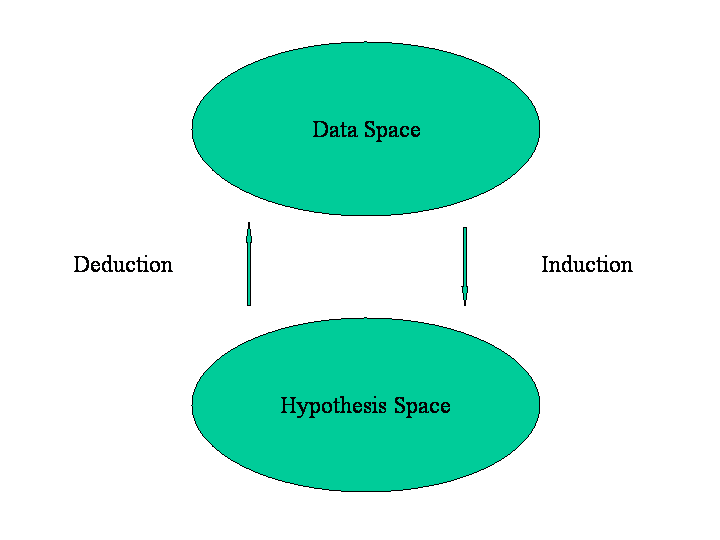
The following figure might serve to illustrate the difference between the frequentist and Bayesian approaches. In the former case, everything is done in “data space” using likelihoods, and in the other we work throughout with probabilities of hypotheses, i.e. we think in hypothesis space. I find it interesting to note that most theorists that I know who work in cosmology are Bayesians and most observers are frequentists!

As I mentioned above, it is the presence of the prior probability in the general formula that is the most controversial aspect of the Bayesian approach. The attitude of frequentists is often that this prior information is completely arbitrary or at least “model-dependent”. Being empirically-minded people, by and large, they prefer to think that measurements can be made and interpreted without reference to theory at all.

Assuming we can assign the prior probabilities in an appropriate way what emerges from the Bayesian framework is a consistent methodology for scientific progress. The scheme starts with the hardest part – theory creation. This requires human intervention, since we have no automatic procedure for dreaming up hypothesis from thin air. Once we have a set of hypotheses, we need data against which theories can be compared using their relative probabilities. The experimental testing of a theory can happen in many stages: the posterior probability obtained after one experiment can be fed in, as prior, into the next. The order of experiments does not matter. This all happens in an endless loop, as models are tested and refined by confrontation with experimental discoveries, and are forced to compete with new theoretical ideas. Often one particular theory emerges as most probable for a while, such as in particle physics where a “standard model” has been in existence for many years. But this does not make it absolutely right; it is just the best bet amongst the alternatives. Likewise, the Big Bang model does not represent the absolute truth, but is just the best available model in the face of the manifold relevant observations we now have concerning the Universe’s origin and evolution. The crucial point about this methodology is that it is inherently inductive: all the reasoning is carried out in “hypothesis space” rather than “observation space”.  The primary form of logic involved is not deduction but induction. Science is all about inverse reasoning.

For comments on induction versus deduction in another context, see here.

So what are the main differences between the Bayesian and frequentist views?

First, I think it is fair to say that the Bayesian framework is enormously more general than is allowed by the frequentist notion that probabilities must be regarded as relative frequencies in some ensemble, whether that is real or imaginary. In the latter interpretation, a proposition is at once true in some elements of the ensemble and false in others. It seems to me to be a source of great confusion to substitute a logical AND for what is really a logical OR. The Bayesian stance is also free from problems associated with the failure to incorporate in the analysis any information that can’t be expressed as a frequency. Would you really trust a doctor who said that 75% of the people she saw with your symptoms required an operation, but who did not bother to look at your own medical files?

As I mentioned above, frequentists tend to talk about “random variables”. This takes us into another semantic minefield. What does “random” mean? To a Bayesian there are no random variables, only variables whose values we do not know. A random process is simply one about which we only have sufficient information to specify probability distributions rather than definite values.

More fundamentally, it is clear from the fact that the combination rules for probabilities were derived by Cox uniquely from the requirement of logical consistency, that any departure from these rules will generally speaking involve logical inconsistency. Many of the standard statistical data analysis techniques – including the simple “unbiased estimator” mentioned briefly above – used when the data consist of repeated samples of a variable having a definite but unknown value, are not equivalent to Bayesian reasoning. These methods can, of course, give good answers, but they can all be made to look completely silly by suitable choice of dataset.

By contrast, I am not aware of any example of a paradox or contradiction that has ever been found using the correct application of Bayesian methods, although method can be applied incorrectly. Furthermore, in order to deal with unique events like the weather, frequentists are forced to introduce the notion of an ensemble, a perhaps infinite collection of imaginary possibilities, to allow them to retain the notion that probability is a proportion. Provided the calculations are done correctly, the results of these calculations should agree with the Bayesian answers. On the other hand, frequentists often talk about the ensemble as if it were real, and I think that is very dangerous…

Share/Bookmark

Come White Van Man to Bute Park Now…

Posted in Bute Park, Politics with tags , on November 20, 2010 by telescoper

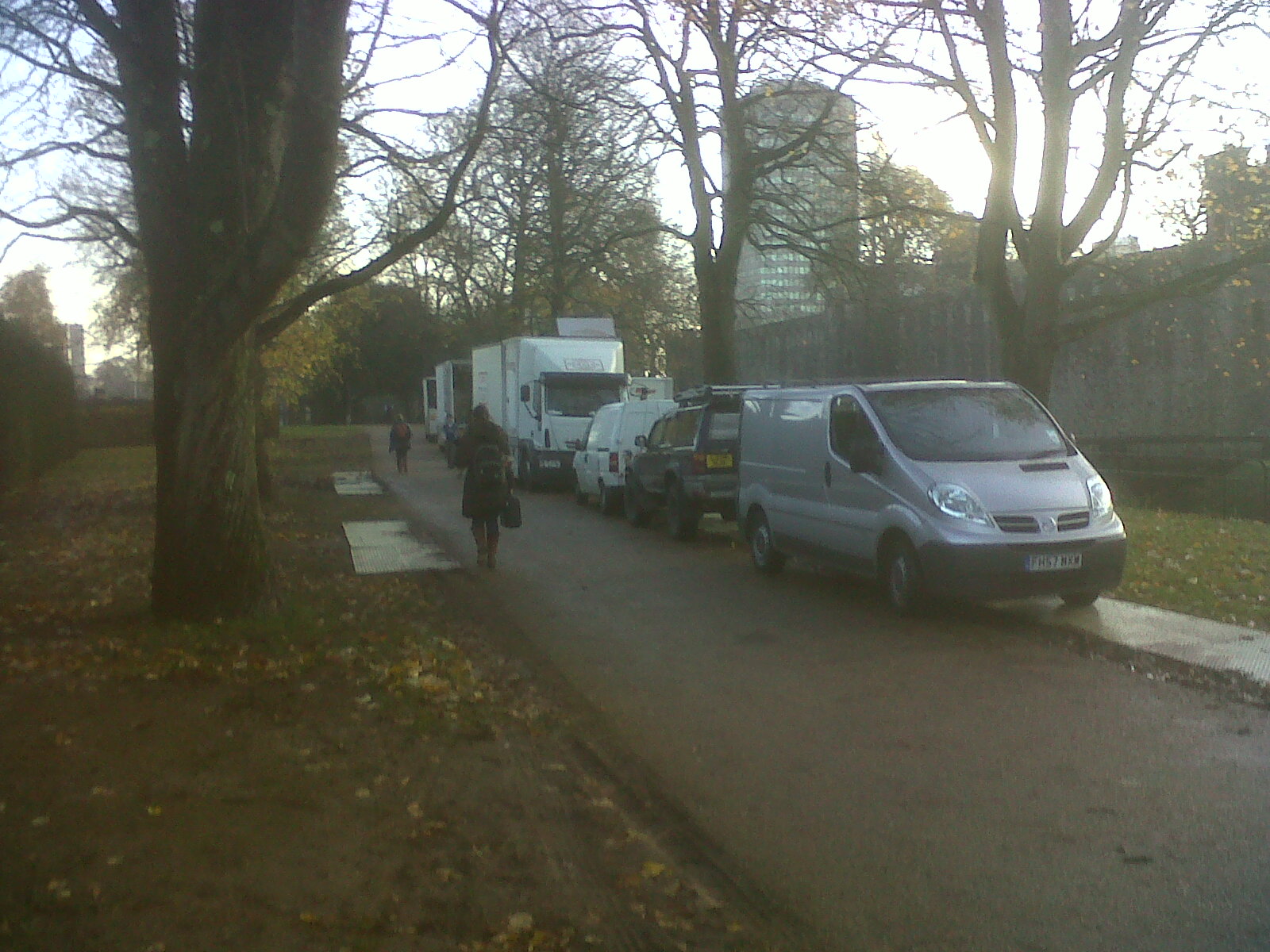
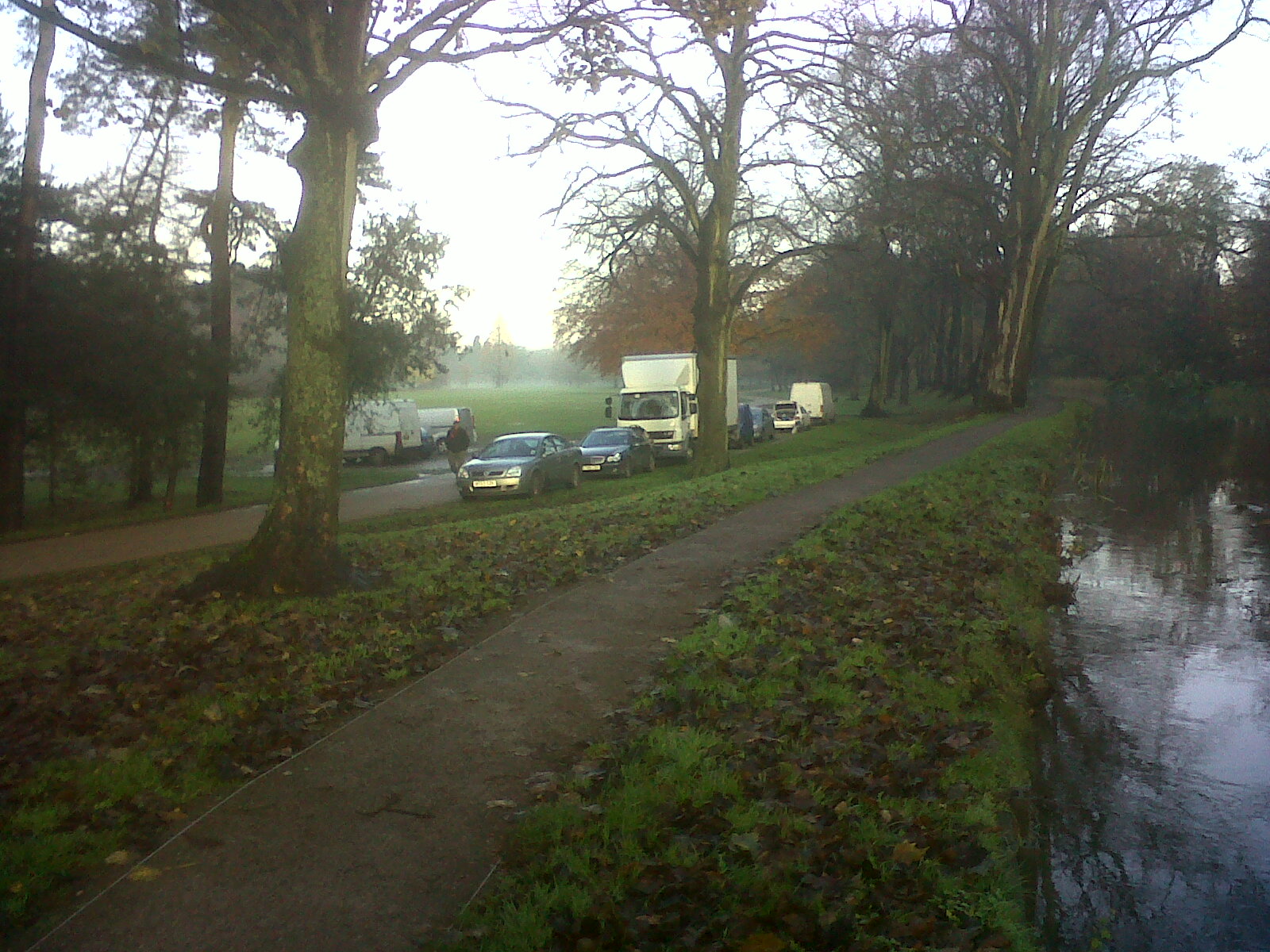
If you needed any proof of Cardiff City Council’s dishonesty about the likely effects of their new road into Bute Park then just take a look at these examples of private vehicles littering this once beautiful site. I should also say that there used to be signs proclaiming a 5mph speed limit on the public footpaths, but these have all been taken away, giving the dreaded White Van Man a licence to drive at high speed around the Park. I’ve stopped walking through it, in fact, on my way to work in the mornings as it has become too unpleasant battling my way through the traffic. Much more of this and I’m afraid Bute Park just won’t be fit for humans…


Share/Bookmark

The Trouble with Columbo

Posted in Columbo with tags , , , on November 20, 2010 by telescoper

So far it’s been a busy and extremely frustrating Saturday all on account of my old moggy, Columbo…

Today I took him to the vets for his six-monthly check-up. All went well, even to the extent that he didn’t try to take the vets arm off when they took a blood sample for the fructosamine test that checks whether his diabetes has been under control since the last visit. He’s even lost a bit of weight, which won’t do him any harm, although at 6.8 kg he’s still not exactly slim. His only indiscretion was to have a wee in his carrying box on the way there, but that’s nothing particularly unusual and was easily dealt with.

However, when I went to pick up his supplies (food, medication, syringes, and insulin) the vet informed me that the manufacturer of the kind of insulin he normally gets is no longer supplying it. This particular type is of a flavour called “Protamine Zinc”, although I don’t know really know what’s so special about that. Anyway, given that I’m running low the vet wrote me out a private prescription for human insulin, which apparently they are allowed to do if the supply of veterinary products runs out.

So I took Columbo home with the other stuff, left him in the house and, prescription in hand, romped off to the nearest pharmacy, which turned out to be the first of many I visited this morning. The problem is that human persons who are diabetic generally don’t use the old-fashioned vial-and-syringes approach to administering insulin, but get their dose from preloaded gadgets that look a bit like pens. These won’t do for cats which have skin that’s too thick. So one after the other various pharmacists explained that they would have to order the stuff I needed, and that it might take a while to arrive since there’s not much demand for it these days. None of them had a supplier that was open on saturdays either..

Eventually I gave up trying to find the insulin today and left the chit with a pharmacist to order on monday when their supplier is open. That is, if they’re able to supply it at all.

I’m not sure what I’m going to do if I can’t get the supply Columbo needs. Probably we’ll have to switch to another type of insulin, but the problem with that is that we’ll have to establish the right dose. He’s been stable on his current dose of his normal insulin for a long time now, but it did take a long time to sort how much he needs. If I have to start again on a different type, it will probably require several tests to see how he responds.

Anyway, having hoped to get the business of his insulin supply sorted out today, I’m now forced to wait until monday to see if I can get the necessary from the pharmacist. If not, I’ll have to talk to the vet when the fructosamine results come back to see what to do about starting on a new type. It’s all a bit of a pain, and I’m knackered after traipsing around half the chemists in Cardiff on a wild goose chase.

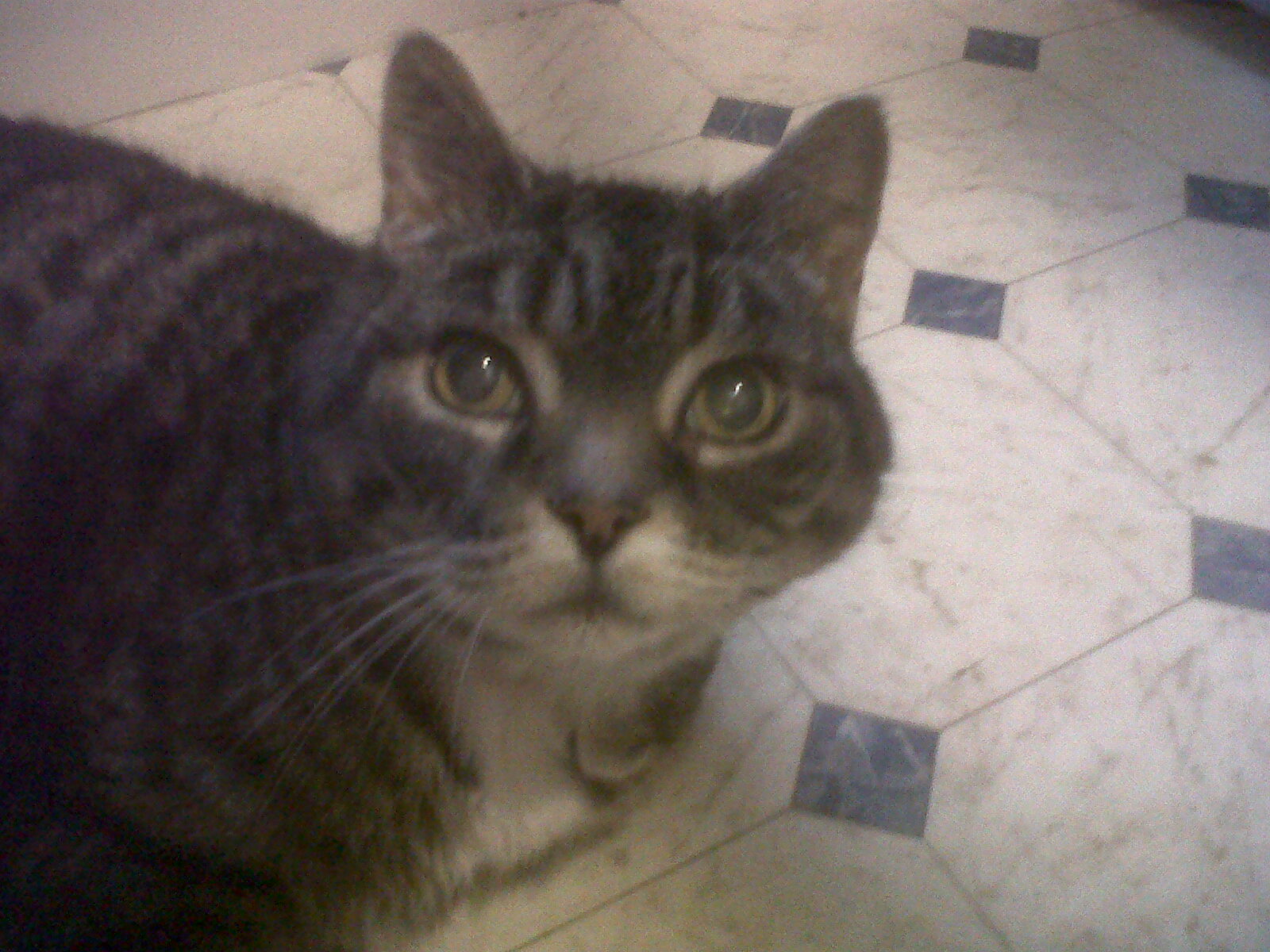
Columbo, however, is oblivious to all this and is doing pretty well. While I’ve been running around on his behalf he has been sleeping as is his wont, this time in the bathroom. He’s a picture of him taken after he’d just woken up.

Now it’s time to do a bit of relaxation of my own, in the form of the Guardian Prize crossword.


Share/Bookmark

The Inconceivable Nature of Nature

Posted in The Universe and Stuff with tags , , on November 19, 2010 by telescoper

I had a couple of requests to post yet another Feynman clip. This one – about electromagnetic waves and swimming pools – is one that I vividly remember watching on BBC when it was first broadcast donkeys’ years ago. I think it’s totally wonderful.


Share/Bookmark

At It

Posted in Poetry, The Universe and Stuff with tags , , on November 18, 2010 by telescoper

Apologies for my posts being a bit thin on original content recently. There’s a lot going on at the moment and it has not been easy to find the time to write at any length. Before too long I hope to be able to get back into the swing of things and maybe even blog about science. Or even do some! In the meantime, however, I couldn’t resist passing on this poem called, At It, by R.S. Thomas. I’ve posted some of his verse on previous occasions, but I only found this one a few days ago and couldn’t resist sharing it, not least because it mentions Sir Arthur Eddington (probably in a reference to one of his popular science books).

I think he sits at that strange table
of Eddington’s. That is not a table
at all, but nodes and molecules
pushing against molecules
and nodes; and he writes there
in invisible handwriting the instructions
the genes follow. I imagine his
face that is more the face
of a clock, and the time told by it
is now, though Greece is referred
to and Egypt and empires
not yet begun.
+++++++++ And I would have
things to say to this God
at the judgement, storming at him,
as Job stormed with the eloquence
of the abused heart. But there will
be no judgement other than the verdict
of his calculations, that abstruse
geometry that proceeds eternally
in the silence beyond right and wrong.


Share/Bookmark

A Sign of the Times

Posted in Education, Finance with tags , , on November 18, 2010 by telescoper

Given yesterday’s announcement of cuts to the Higher Education budget in Wales, and the likely outcome in terms of increased costs to students, this picture of a sign I found the other day at the entrance to Bute Park seems particularly apt…


Share/Bookmark

Higher Education Spending in Wales

Posted in Education, Politics with tags , , , on November 17, 2010 by telescoper

Just a quick post to pass on the news that the Welsh Assembly has now published its draft budget for 2011/12 (and following years). You can find the documents related to this here, the most useful one of which is this.

I haven’t got time to comment in detail but, being a university employee, I skipped directly to the section about Higher Education and found the following:

In order to direct funding to schools and skills, the majority of budget reductions have been focused on specific budgets. Higher Education will receive a reduction over the next 3 years of £51m. This amounts to some 11.8%, compared to the severe reductions proposed in England. The planned reductions will facilitate the statutory commitment to provide financial support for Higher Education students, numbers of which have increased significantly over the past two years. This does not predetermine the Welsh Assembly Government’s response to the Browne Review. The reductions include the efficiency savings we expect to be delivered through the implementation of our Higher Education strategy, For our Future. The commitment to the development of the University of the Heads of The Valleys (UHoVI) and Coleg Cymraeg Cenedlaethol (formerly Coleg Federal) will, however, remain a priority to
be funded from this budget.

In other words, Higher Education is to bear the brunt of protecting the budgets for Schools (which remains roughly level in cash terms) and  Further Education (which is cut by about 2%). Clearly the WAG must either think that  maintaining funding for Higher Education  is a low priority or that money saved from HE can be recouped some other way (i.e. through increasing fees or cutting student support).

An 12% cut in cash terms is much worse in real terms, of course, but the draft budget doesn’t give any details of how this is going to be broken down in terms of research and teaching allocations. Moreover, the Welsh Assembly has yet to formulate a response to the Browne Review which has resulted in proposals for tuition fees up to £9000 per annum in England. Since the Welsh Assembly elections are to be held next May, it is highly unlikely that a new tuition fee system for Wales  will be in place before then. Moreover, the fact that funding is being diverted into the new institutions described above suggests that even less money than this will be available for established universities.

We also don’t know the extent to which research will be protected. In England, a cut of 40% has been applied to teaching budgets from next year, with research funding largely preserved. It appears something similar is going to happen in Scotland, but with a much smaller overall cut to the universities budget there. Will Wales follow the same pattern, or will it sacrifice any chance of having high quality research-led universities by single-mindedly pursuing its “regional agenda”?


Share/Bookmark

Farewell to the Haldane Principle?

Posted in Science Politics with tags , , , , on November 17, 2010 by telescoper

Many scientists – myself included – were so relieved at the outcome of the recent Comprehensive Spending Review that we thought the government had accepted the argument that Science is Vital more-or-less completely. Most of us have stopped worrying about whether we’re going to have to go about to carry on doing science and just got on with doing it for the past few weeks.

However, today I came across some worrying news about planned changes to the way the science budget is administered in the UK. In particular, the post currently occupied by Adrian Smith Director General for Science and Research – is to be phased out. The position will be merged with what are currently other separate positions within the Department of Business Innovation and Skills (BIS) to form a single Director General covering science, universities, research and innovation.

There’s nothing intrinsically sinister about administrative reorganisation, of course, and one can understand that a certain amount of streamlining might well be justified in order to save costs at a time of economic challenge. However, there are worrying signs about this particular change.

One thing is that the new post has only been advertised to civil servants. Apparently there will no longer be a scientist in a position to speak up for science among the higher management of BIS. Adrian Smith is not only an effective manager – as demonstrated by his past success as Principal of Queen Mary, University of London – but is also a respected figure in the field of mathematical statistics. I suspect this combination of skills and gravitas played a big role in securing a reasonably satisfactory outcome for science in the CSR.

Another worrying thing is that the planned reorganisation apparently hasn’t even been discussed with the government’s Chief Scientific Adviser, John Beddington. Former Chief Scientific Advisor Lord May has reacted angrily to the new proposals, calling them “stupid, ignorant and politically foolish”. Strong stuff.

On top of all this is the apparent ambivalence expressed by the Minister for Universities and Science, David Willetts, about the Haldane Principle, which has underpinned British science policy for decades. Roughly speaking, this principle states that it should be researchers rather than politicians who should decide where research funds should be spent.

Willetts recently responded to a question about the Haldane Principle in the form of a Parliamentary written answer:

The Haldane principle is an important cornerstone for the protection of the scientific independence and excellence. We all benefit from its application in the UK.

The principle that decisions on individual research proposals are best taken by researchers through peer review is strongly supported by the coalition Government. Prioritisation of an individual research council’s spending within its allocation is not a decision for Ministers. Such decisions are rightly left to those best placed to evaluate the scientific quality, excellence and likely impact of scientific programmes.

The Government do, however, need to take a view on the overall level of funding to science and research and they have decided to protect and to ring fence the science and research budget for the next four years. This decision has been made in the context of the current economic status of the UK and the strategic importance of research funding, while recognising the value of science to our future growth, prosperity and cultural heritage.

Over the years there has been some uncertainty over the interpretation of the Haldane principle. I intend to clarify this is a statement which will be released alongside the science and research budget allocations towards the end of this year. In order that this statement has the consent of the research community, I intend to consult with senior figures in the UK science and research community to develop a robust statement of the Haldane principle.

A superficial reading of this does start out by giving the impression that it strongly supports the  principle. However, I’m not aware of what  “uncertainty” there is over its application that requires such clarification. I rather think this is being put up as  an excuse to limit its scope, i.e. that the uncertainty is more about how the political establishment can get around it rather than what it actually means.

The fact that the  “robust statement” of a Revised Version of the  Haldane Principle is going to be wheeled out just when the allocations to the research councils are announced makes me very nervous that its prime function will be to justify big cuts in fundamental science in favour of applied research.

This all seems to add up to  a systematic attempt to sideline the scientists currently involved in the development of UK science policy development and its implementation. If nothing else, it seems rather strange from a political point of view to try to bring about this change in a way that is bound to alienate large sections of the scientific community, just when the government seemed to be recognizing the importance of science for the UK.

But then, perhaps I’m reading too much into it. Maybe we just have a new government that’s trying to do too much too quickly, and happens to have made a botch of this particular job…

You can find other blog posts on this issue, e.g.  here and here.


Share/Bookmark

Autumn

Posted in Poetry with tags , on November 16, 2010 by telescoper

Walking to work through the cold fog of a Cardiff November morning, a vague recollection of this poem popped into my head from somwhere or other only to disappear when I made it into the office. It was foggy again on the way home, so I remembered the half-memory I had earlier on. I had a look around and found the poem that had been in and out of my head.

An autumn melancholy seems to have taken grip of many folk in the department, probably because it seems like there’s long dark tunnel until Christmas, never mind next Spring. I have to say I rather like the autumn, actually…

I SAW old Autumn in the misty morn
Stand shadowless like Silence, listening
To silence, for no lonely bird would sing
Into his hollow ear from woods forlorn,
Nor lowly hedge nor solitary thorn;–
Shaking his languid locks all dewy bright
With tangled gossamer that fell by night,
Pearling his coronet of golden corn.

Where are the songs of Summer?–With the sun,
Oping the dusky eyelids of the south,
Till shade and silence waken up as one,
And Morning sings with a warm odorous mouth.
Where are the merry birds?–Away, away,
On panting wings through the inclement skies,
Lest owls should prey
Undazzled at noonday,
And tear with horny beak their lustrous eyes.

Where are the blooms of Summer?–In the west,
Blushing their last to the last sunny hours,
When the mild Eve by sudden Night is prest
Like tearful Proserpine, snatch’d from her flow’rs
To a most gloomy breast.
Where is the pride of Summer,–the green prime,–
The many, many leaves all twinkling?–Three
On the moss’d elm; three on the naked lime
Trembling,–and one upon the old oak-tree!
Where is the Dryad’s immortality?–
Gone into mournful cypress and dark yew,
Or wearing the long gloomy Winter through
In the smooth holly’s green eternity.

The squirrel gloats on his accomplish’d hoard,
The ants have brimm’d their garners with ripe grain,
And honey bees have stored
The sweets of Summer in their luscious cells;
The swallows all have wing’d across the main;
But here the Autumn melancholy dwells,
And sighs her tearful spells
Amongst the sunless shadows of the plain.
Alone, alone,
Upon a mossy stone,
She sits and reckons up the dead and gone
With the last leaves for a love-rosary,
Whilst all the wither’d world looks drearily,
Like a dim picture of the drowned past
In the hush’d mind’s mysterious far away,
Doubtful what ghostly thing will steal the last
Into that distance, gray upon the gray.

O go and sit with her, and be o’ershaded
Under the languid downfall of her hair:
She wears a coronal of flowers faded
Upon her forehead, and a face of care;–
There is enough of wither’d everywhere
To make her bower,–and enough of gloom;
There is enough of sadness to invite,
If only for the rose that died, whose doom
Is Beauty’s,–she that with the living bloom
Of conscious cheeks most beautifies the light:
There is enough of sorrowing, and quite
Enough of bitter fruits the earth doth bear,–
Enough of chilly droppings for her bowl;
Enough of fear and shadowy despair,
To frame her cloudy prison for the soul!

by Thomas Hood (1799-1845)


Share/Bookmark

RIP Allan Sandage (1926-2010)

Posted in The Universe and Stuff with tags , , on November 15, 2010 by telescoper

More sad news. Allan Sandage, one of the founding fathers of observational cosmology, passed away on 13th November, aged 84, of pancreatic cancer.

You can read a fuller appreciation of Allan Sandage’s contributions to astronomy and cosmology by Julianne Dalcanton over at Cosmic Variance.


Share/Bookmark