The Feynman Reaction

Posted in The Universe and Stuff with tags , , on November 5, 2010 by telescoper

I came across this clip of the great physicist Richard Feynman sort-of explaining magnetism, but was taken aback by some of the comments posted on Youtube in reaction to it. Some people appear to have found his response extremely arrogant, while others think he was just being honest (and trying his very best not to be patronising). I know what I think, but doubt if everyone agrees with my reaction.

I know the readership of this blog isn’t a fair sample, but I’d be very interested to see the general opinion on his comments. So please study the clip and complete the poll at the bottom.


Share/Bookmark

Finding Gravitational Lenses, the Herschel Way…

Posted in The Universe and Stuff with tags , , , , , , on November 4, 2010 by telescoper

It’s nice to have the chance to blog for once about some exciting astrophysics rather than doom and gloom about budget cuts. Tomorrow (5th November) sees the publication of a long-awaited article (by Negrello et al.)  in the journal Science (abstract here) that presents evidence of discovery of a number of new gravitational lens systems using the Herschel Space Observatory.

There is a press release accompanying this paper on the  Cardiff University website, and a longer article on the Herschel Outreach website, from which I nicked the following nice graphic (click on it for a bigger version).

This shows rather nicely how a gravitational lens works: it’s basically a concentration of matter (in this case a galaxy) along the line of sight from the observer to a background source (in this case another galaxy). Light from the background object gets bent by the foreground object, forming multiple  images which are usually both magnified and distorted. Gravitational lensing itself is not a new discovery but what is especially interesting about the new results are that they suggest a much more efficient way of finding lensed systems than we have previously had.

In the past they have usually been found by laboriously scouring optical (or sometimes radio) images of very faint galaxies. A candidate lens (perhaps a close-set group of images with similar colours), then this candidate is followed up with detailed spectroscopy to establish whether the images are actually all at the same redshift, which they should be if they are part of a lens system. Unfortunately, only about one-in-ten of candidate lens systems found this way turn out to be actual lenses, so this isn’t a very efficient way of finding them. Even multiple needles are hard to find in a haystack.

The new results have emerged from a large survey, called H-ATLAS, of galaxies detected in the far-infrared/submillimetre part of the spectrum. Even the preliminary stages of this survey covered a sufficiently large part of the sky – and sufficiently many galaxies within the region studied – to suggest  the presence of a significant population of galaxies that bear all the hallmarks of being lensed.

The new Science article discusses five surprisingly bright objects found early on during the course of the H-ATLAS survey. The galaxies found with optical telescopes in the directions of these sources would not normally be expected to be bright at the far-infrared wavelengths observed by Herschel. This suggested that the galaxies seen in visible light might be gravitational lenses magnifying much more distant background galaxies seen by Herschel. With the relatively poor resolution that comes from working at long wavelengths, Herschel can’t resolve the individual images produced by the lens, but does collect more photons from a lensed galaxy than an unlensed one, so it appears much brighter in the detectors.


Detailed spectroscopic follow-up using ground-based radio and sub-millimetre telescopes confirmed these ideas :  the galaxies seen by the optical telescopes are much closer, each ideally positioned to create gravitational lenses.

These results demonstrate that gravitational lensing is probably at work in all the distant and bright galaxies seen by Herschel. This in turn, suggests that in the full H-ATLAS survey might provide huge numbers of gravitational lens systems, enough to perform a number of powerful statistical tests of theories of galaxy formation and evolution. It’s a bit of a cliché to say so, but it looks like Herschel will indeed open up a new window on the distant Universe.

P.S. For the record, although I’m technically a member of the H-ATLAS consortium, I was not directly involved in this work and am not among the authors.

P.P.S. This announcement also gives me the opportunity to pass on the information that all the data arising from the H-ATLAS science demonstration phase is now available online for you to play with!


Share/Bookmark

The Waiting Game

Posted in Science Politics with tags , , on November 4, 2010 by telescoper

I thought I’d briefly don my “community service” hat and send a message to any astronomers reading this who have “responsive mode” grant applications currently under review by the Science and Technology Facilities Council (STFC).

Obviously I can’t discuss any details here (or anywhere else for that matter), but I’ve had a few email enquiries about when the results are likely to be known. I’m sure the chair of the Astronomy Grants Panel, Andy Lawrence (aka the e-astronomer) has had even more. It seems worth posting a brief message to make the situation as clear as possible to anyone waiting for news.

The current situation is that all the rolling grant specialist panel presentations have now finished, but the full AGP has to reconvene later in November to complete the process of assigning a final ranking to all the applications.

The process is, therefore, ongoing. It would be even if it were not for the fact that the Comprehensive Spending Review results were only announced on 20th October. It will therefore still be some time before STFC knows its budget for the next few years, and only when it knows that can it produce a delivery plan that stipulates how much of its funding will be available for research grants. And only after that is done will the Astronomy Grants Panel be able to determine its final proritisation, after which STFC will decide precisely which proposals will be funded and which don’t make the cut. In an ideal world this process would be finished by the end of this calendar year, but I’m afraid there’s quite a lot of evidence that we don’t live in an ideal world, especially as science funding is concerned.

So there you have the situation as clear as I can make it, which isn’t very clear at all. You’ll all just have to wait. The most important thing is not to assume that it’s going to be bad news if you hear nothing quickly…

Diem noctis exspectatione perdunt, noctem lucis metu.

(Seneca, De Brevitate Vitae)


Share/Bookmark

A for Aphorisms?

Posted in Literature with tags , on November 3, 2010 by telescoper

I’m back again in Cardiff from a long day in Swindon, too tired to post anything substantial and indeed too tired to do anything much at all except make something to eat and slump in front of the football with a glass of wine (or two).

However, on the train coming home this evening I remembered something I’d promised to do last week, but which had slipped my mind. You may recall that I gave a talk in London last Wednesday evening. Well, before that, I had a glass of wine and a natter with one of the organisers of that event, a writer by the name of Robert Eddison. During the course of the conversation it emerged that he’s a prolific compiler of original aphorisms. In fact he has coined over 26,000 of these. The ones I saw were only a small part of the collection, but included such gems as

Things are best brought into the open behind closed doors

History, like photography, is all about perspective

You can’t have bare facts without the naked truth

and, my favourite because it’s a bit risqué,

It is during their salad days that most young matadors get tossed

It seemed to me that there was probably a ready market for a collection of pithy pensées, including speech writers, journalists, etc., but Robert explained that he was finding it difficult to find a publisher for them. I suggested setting up a sort of online repository for them. That’s been done already for famous examples, but surely there’s a demand for originally crafted ones?

Anyway, not being a publishing expert myself I hit on the idea of enlisting the help of my readers (both of them). If anyone has any suggestions about possible markets for 26,000 brand new sayings covering a huge range of topics in a witty and concise style or, better still, if you’re a publisher and you’re interested in them yourself, please let me have suggestions through the comments box and I’ll pass them onto to Robert on your behalf.


Share/Bookmark

Shadows in the Water

Posted in Poetry with tags , on November 2, 2010 by telescoper

Just back from a long day in Swindon, exhausted by the days STFC deliberations, and in need of an early night ahead of another 5am start tomorrow. Apologies then for not having a proper blog post. Here instead is another from my reserve collection of bits and bobs that I’ve been storing for a while. This poem is probably the most famous one by Thomas Traherne, who I’ve posted about before. I think Shadows in the Water is a marvellous mixture of childlike curiosity and deep philosophical reflection. I hope you like it.

In unexperienced infancy
Many a sweet mistake doth lie:
Mistake though false, intending true;
A seeming somewhat more than view;
That doth instruct the mind
In things that lie behind,
And many secrets to us show
Which afterwards we come to know.

Thus did I by the water’s brink
Another world beneath me think;
And while the lofty spacious skies
Reversèd there, abused mine eyes,
I fancied other feet
Came mine to touch or meet;
As by some puddle I did play
Another world within it lay.

Beneath the water people drowned,
Yet with another heaven crowned,
In spacious regions seemed to go
As freely moving to and fro:
In bright and open space
I saw their very face;
Eyes, hands, and feet they had like mine;
Another sun did with them shine.

‘Twas strange that people there should walk,
And yet I could not hear them talk:
That through a little watery chink,
Which one dry ox or horse might drink,
We other worlds should see,
Yet not admitted be;
And other confines there behold
Of light and darkness, heat and cold.

I called them oft, but called in vain;
No speeches we could entertain:
Yet did I there expect to find
Some other world, to please my mind.
I plainly saw by these
A new antipodes,
Whom, though they were so plainly seen,
A film kept off that stood between.

By walking men’s reversèd feet
I chanced another world to meet;
Though it did not to view exceed
A phantom, ’tis a world indeed;
Where skies beneath us shine,
And earth by art divine
Another face presents below,
Where people’s feet against ours go.

Within the regions of the air,
Compassed about with heavens fair,
Great tracts of land there may be found
Enriched with fields and fertile ground;
Where many numerous hosts
In those far distant coasts,
For other great and glorious ends
Inhabit, my yet unknown friends.

O ye that stand upon the brink,
Whom I so near me through the chink
With wonder see: what faces there,
Whose feet, whose bodies, do ye wear?
I my companions see
In you another me.
They seemèd others, but are we;
Our second selves these shadows be.

Look how far off those lower skies
Extend themselves! scarce with mine eyes
I can them reach. O ye my friends,
What secret borders on those ends?
Are lofty heavens hurled
‘Bout your inferior world?
Are yet the representatives
Of other peoples’ distant lives?

Of all the playmates which I knew
That here I do the image view
In other selves, what can it mean?
But that below the purling stream
Some unknown joys there be
Laid up in store for me;
To which I shall, when that thin skin
Is broken, be admitted in.


Share/Bookmark

Poisoned Chalice, Anyone?

Posted in Science Politics with tags , on November 1, 2010 by telescoper

In the July instalment of news from STFC Council, among the items discussed  were the arrangements for selecting a successor to the current Chief Executive Officer, Professor Keith Mason. Apparently a sub-group of the Council has been established to work out how to proceed; its terms of reference are also given. Among the latter you can find the following statement:

Keith Mason comes to the end of his second and final term as a Research Council CEO in March 2012 having served as PPARC CEO and then as founding CEO of STFC. Council believes it to be important that in the context of the selection of a new chief executive that a clear understanding is reached with STFC’s various stakeholders as to the role and responsibilities of the STFC chief executive in leading a complex and diverse organisation through what will undoubtedly be times of further change, uncertainty and financial pressure. Council also believes it will be important to understand as we move forward any lessons that should be learnt from the circumstances behind the communication recently received by the chairman from individuals within STFC’s academic communities expressing concern about STFC’s leadership.

The italics are mine. The communication referred to in the above extract must be the petition, signed by over nine hundred scientists, expressing no confidence in the current executive and discussed here recently in a guest post by Professor George Efstathiou.

The fear is that the Science and Technology Facilities Council will decide to appoint a Chief Executive, perhaps from the world of commerce or industry, who has even less sympathy for the fundamental sciences, such as astronomy and particle physics than the current one.

The latest (October) News from Council contains a report from the sub-Group advising on the appointment of the new CEO which makes interesting reading.  For example, the mandatory requirements for candidates for the post include that he/she should

  • Have a strong and respected STEM background and qualification (at least to PhD level), or similar (e.g. in the biomedical sector) provided candidates can demonstrate an appreciation and understanding of the scale and complexity of STFC science and research;
  • Command the respect of the academic communities and be seen as champion of STFC’s research base;
  • Be recognised as having previously and successfully led and managed (with total accountability) an organisation or organisational unit of an appropriate and relevant degree of complexity;
  • Demonstrate a very high intellectual calibre;
  • Have experience of working within an international context;

This suggests that they will be looking for someone with a background in academic research although not specifically in physics or astronomy. This will come as a relief to many working in areas covered by STFC’s remit, and even might inspire a few people I know to start writing updating their CVs. However, I think it  will be extremely difficult for STFC to persuade anyone of sufficient calibre to take up a post which has,  for the entire duration of the existence of the organisation,  involved responding  to a calamitous series of financial crises and restructurings with very little scope for implementing a coherent science programme. In fact, three years since its inception, the STFC still hasn’t produced any document that represents a science strategy of any real substance.

I hope that STFC has better times ahead of it, but I wonder how many qualified candidates would just see this job as a poisoned chalice?


Share/Bookmark

Rapture

Posted in Art, The Universe and Stuff with tags , , on November 1, 2010 by telescoper

Glorious video of timelapse photography by, Tom Lowe, the winner of the 2010 Astronomy Photographer of the Year award.


Share/Bookmark

Tomorrow, and tomorrow, and tomorrow..

Posted in Biographical, Literature with tags , on November 1, 2010 by telescoper

Gearing up for another stint in Swindon for the STFC Astronomy Grants Panel this week, I was trying to think of an appropriate theme for a blog post. The following short soliloquy from Macbeth somehow came up in a conversation in the pub last week, so I thought I’d post it here.

We actually “did” Macbeth at school and I was lucky enough to be cast in the best part, Lady Macbeth. No jokes please. I went to an all-boys school and, anyway, in Shakespeare’s time all the female roles were actually played by boys. I still remember quite a lot of the speeches I learned then, including all of Lady Macbeth’s famous Act I soliloquy The raven himself is hoarse. I’ll keep that for another post, so that no compunctious visitings of nature distract me from reading grant applications.

The speech below is remarkable for two things, I think. One is that it’s where one of the central themes of the play is laid bare: the numbing of the moral sense. Lady Macbeth has just died, but Macbeth himself seems no longer to care. He’s indifferent to everything around him, as the events that his ambitions have set in motion carry him to his ultimate doom. The incessant, mechanical rhythm of the verse accentuates this sense of inevitability.

The other thing is that, with the exception of some passages from Hamlet, this short excerpt has a higher density of familiar phrases than just about anything else in Shakespeare. Titles of novels and TV programmes figure prominently throughout the text but somehow it has survived all that borrowing without any diminution of its dramatic effect.

To-morrow, and to-morrow, and to-morrow,
Creeps in this petty pace from day to day,
To the last syllable of recorded time;
And all our yesterdays have lighted fools
The way to dusty death. Out, out, brief candle!
Life’s but a walking shadow, a poor player,
That struts and frets his hour upon the stage,
And then is heard no more. It is a tale
Told by an idiot, full of sound and fury,
Signifying nothing.

It’s almost as if the immortal bard himself knew what it was like to have to travel to Swindon over and over again…


Share/Bookmark

After Piero

Posted in Art, Education, Politics, The Universe and Stuff with tags , , , on October 31, 2010 by telescoper

I don’t often blog about things inspired from TV programmes. I don’t watch that many, and those I do see are rarely inspirational. However, last night, I caught the last of the series Renaissance Revolution, presented by Matthew Collings. It was on the subject of a major obsession of mine, the art of Piero della Francesca, and I thought it was wonderful. I regret having missed the previous programmes in the series, but I’m sure I’ll get a chance to see them sometime.

Collings focused on one particular painting by Piero, The Baptism of Christ, which hangs in the National Gallery in London, and which is illustrated below:

The political and religious backround to this painting are almost as fascinating as its composition, based on the offset superposition of a circle (representing heaven) and a square (representing the Earth). The use of perspective was very new around 1450 when this painting was finished, but that’s not the only geometrical aspect to note. There’s a striking use of symmetry (e.g. in the angles of John the Baptist’s arm and leg), and the central vertical axis defined by the dove, John’s hand and Christ’s hands.

Given the mathematical rigour of his compositional techniques, it should come as no surprise to learn that in his lifetime Piero was just as famous as a mathematician as he was as an artist. In other words he was the archetypal renaissance man. Unfortunately, most of his art doesn’t survive; the vast majority of his works were frescoes in various churches, few of which have withstood the test of time. Regrettably, little also is known about Piero the man, except that he lived into his 80s.

A while ago I mentioned another work by Piero which is the origin of my obsession with his paintings. The Flagellation of Christ is a work that has burrowed so far into my psyche that I quite often dream that I’m in the strange building depicted therein:
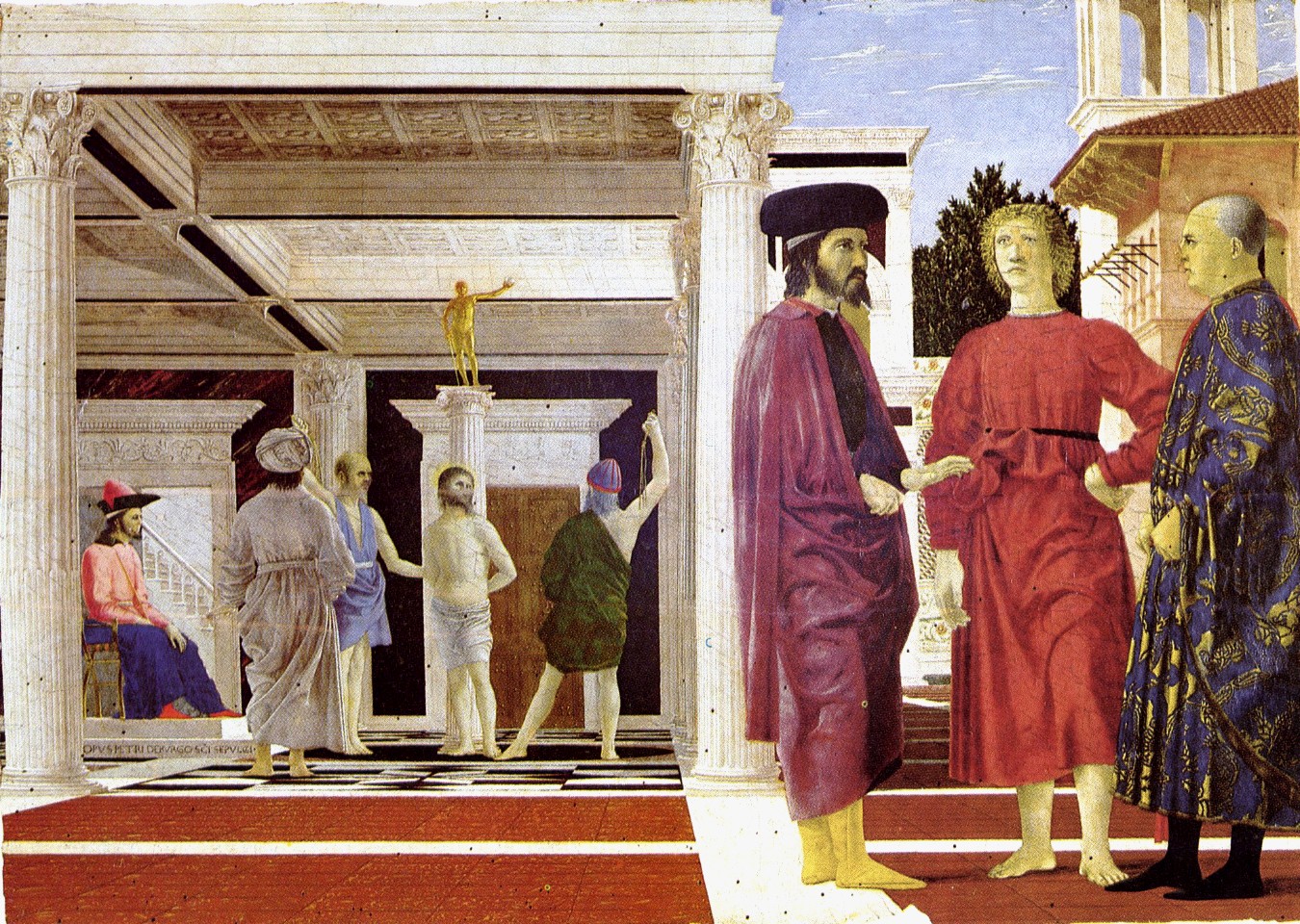
In fact I also use this painting in talks about science – I did so in my talk on Wednesday, in fact. The reason I use it in that context is that it is a bit like the standard model of cosmology. On one level it makes sense: the flat Euclidean geometry mapped out by the precise linear perspective allows us to understand the properties of the space extremely well, including the scale (the vanishing point indicates a front-to-back distance of about 250 ft). This is what our standard cosmology says too:- the universe also has a flat geometry. On the other hand, the more you think about the contents, the more confusing the picture gets. The main subject matter of the painting is to the left, in the background, playing an apparently minor part in the whole thing. Who are the characters surrounding the Christ figure? And who are the three figures in the foreground, dominating the whole composition, but seemingly indifferent to what is going on behind? Do they represent dark energy? Do the other characters represent the dark matter?

That’s not meant to be taken seriously, of course, and nobody actually knows what is really going on in this painting. It’s undoubtedly beautiful, but also an enigma, and that combination is what makes it a great work of art. It’s not easy to understand. It makes you wonder.That’s what science is like too. We have our theories, we have data, but there always remains a great deal we don’t understand. And sometimes the more we think about it, the more confused we get. Just as it is with that painting.

As Mark Collings put it brilliantly in the programme last night

When you’re looking at the picture, analysis isn’t exactly what is going on. You’re seeing and you’re getting pleasure from seeing. Partly the picture is telling you how pleasure is constructed, how it’s created, and partly you’re just lost in it. So when you’re lost in the light of Piero, you’re experiencing when you’ve forgotten how to experience. And you’re suddenly curious when you’ve forgotten how to be curious. And what you’re experiencing and being curious about is .. the world.

It doesn’t matter whether you’re a scientist or an artist (or a poet or a philosopher or a historian or whatever). The need to be curious about the world – or some aspect of it – is surely what it’s all about. During the Renaissance it wasn’t unusual for great minds to embrace science, mathematics and art – just think of Leonardo da Vinci. However, over the centuries we’ve become increasingly specialised and compartmentalised and more focused on making money than on making ideas. We’re losing what above all else is what makes us human, our curiosity.

Our society increasingly sees education simply as a means to develop skilled workers, smart enough to do technically complicated jobs, but not clever enough to ask too many questions about the materialistic treadmill they will spend their life upon. The UK government’s plan to withdraw funding for arts and humanities departments in universities is just another step along this path.

It shouldn’t be like this. Universities should be about learning for learning’s sake; not about teaching facts or skills, but about teaching people to ask questions and figure out their own answers. In other words, they should be about curiosity.


Share/Bookmark

Did HE fall, or was it pushed?

Posted in Education, Politics with tags , , , , , , on October 30, 2010 by telescoper

One of the other scary bits of news to emerge last week concerns proposed changes to the arrangements for tuition fees in English universities. According to the Times Higher, the Minister responsible for universities, David Willetts, has admitted that the cuts to university budgets announced in the Comprehensive Spending Review, will occur before any new money flows into universities from whatever new fee arrangements emerge from the government’s deliberations following the Browne Report.

One of the recommendations of the Browne Report was that central government funding for arts, humanities and social sciences be scrapped entirely. Although I’m a scientist and I do think Science is Vital this is a very bad move, as I think other forms of scholarship and learning are vital too, for a wide range of reasons including cultural ones. It was never clear whether arts & humanities departments would be able to recoup the money lost as a result of cuts to central funding, but now it appears they will have to survive for an indeterminate time without any prospect of extra income to offset the shortfall.

The upshot of all this will be a huge and immediate cut in the budgets of many university departments, a  state of affairs about which Willetts commented only thus:

You have to expect that there will be pressure on universities to save money, and we don’t think they should be exempt from the pursuit of efficiencies.

Can an immediate 40% cut in teaching income be made by efficiency savings? I don’t think so, Mr Willetts. Even making large-scale redundancies won’t help there, as that costs a lot of money up front.

So why is the government pushing through cuts to university funding before ensuring that the new fee arrangements are in place? A variety of answers are possible. One would be incompetence, always a possibility when politicians are involved. However, although this government has tried to rush things through very quickly, I do not believe that this is something that hasn’t been considered very carefully. I think it’s deliberate.  I believe that this government wants some universities to fail, and has found an opportunity to push them over the edge.

It’s not about efficiency savings, it’s about survival of the fattest. Only those places able to dig into their reserves for several years will be able to weather the storm. Some will cope, some won’t. That’s the point.

It’s well known that several universities, most of them post-1992 institutions, have been struggling financially for a considerable time. In the past, special procedures have always been implemented to protect organizations of this type that have been close to insolvency. This government has said that will do things differently, and that universities that go bust will now be allowed to fail. This may involve them closing altogether, or being taken over by private companies. If I were working in a university heavily dependent on income from arts, humanities and social science teaching, I would be extremely nervous about the future. I mean, more nervous than I am anyway, working as a scientist in an institution which is financially sound. And that  is already very nervous indeed.

The other side of this particularly nasty coin, is that more “prestigious” institutions specialising in non-STEM areas, such as the London School of Economics, are already considering the option of going private. If the government gives them no support directly, yet insists – as seems likely – in capping the fee students pay at a figure around £7K per annum as well as strangling them with yards of red tape as HEFCE is wont to do, then why not just withdraw from the system and set fees at whatever level they like? It’s unlikely that an institution with a strong science base will go down this road, as the taxpayer is going to continue supporting STEM subjects, but it seems to me that it would make sense for the LSE to opt out of a system whether the costs of membership exceed the benefits received.

In the longer term, the squeeze is set of continue. According again to the Times Higher, the net revenue from fees will only replace part of the funding withdrawn over the CSR period. It looks like five years of struggle during which many departments may go under. The more you think about it, the worse it looks.

However, perhaps a better question than the one I asked a couple of paragraphs ago is the following. Why is the government intent on slashing the budgets of HE institutions, when it appears to have  let Vodafone off without paying a bill for £6 billion tax?

That amount would have been more than enough to tide the HE sector over until the new fee stream came online…


Share/Bookmark