Follow My Leader

Posted in Education, Science Politics with tags , , , on February 2, 2011 by telescoper

News broke today about  the dreaded “Letter from HEFCE” to heads of English higher education institutions informing them of their funding allocations for the near future. The cuts outlined in the funding letter were not entirely unexpected, but have nevertheless generated quite a lot of reaction – see, e.g., here. For those of you who can’t be bothered to read the Circular Letter, it is of the form:

Dear Vice-Chancellor or Principal,

You’re screwed.

Yours Sincerely,

HEFCE

One of the ramifications of the decisions made by the Higher Education Funding Council for England (for that is HEFCE) is that funding will be further cut for research rated a “mere” 2* in the 2008 Research Assessment Exercise. For those of you who prefer meaningless words to meaningless numbers-with-asterisks, 2* is translated in the HEFCE dictionary as “internationally recognised”. Obviously a waste of money then. By 2013 the only research that will be funded at all under the QR formula will be 3* (“internationally excellent) and 4* (world leading). Of course “world leading” won’t include “nationally leading”, as by then there won’t be anyone in England left to follow the survivors; everyone left after the cull will be doing their best to be a  “leader” in order to avoid being labelled a “follower”,  a crime for which the punishment is, apparently, death.

I only hope that this mad policy dismantling the Great Pyramind of Research from the bottom upwards isn’t pursued here in Wales too, otherwise I’ll soon be sitting next to the radiator in the local Wetherspoons drinking cheap beer with the rest of the prematurely terminated. For the time being, until HEFCW decides what do do, we in Wales have a stay of execution.

All this reminds me of a story I heard at a conference dinner years ago. I happened to be sitting next to someone Mrs X – the spouse of a physicist who shall remain nameless – who had for a time worked on undergraduate admissions for a Humanities Department of a  big American Ivy League university. One application for a place had been accompanied by a lukewarm recommendation from a high school teacher, containing a statement along the lines of John is definitely a follower rather than a leader. On this slim evidence of potential, my dining companion Mrs X decided to offer little Johnny a place.

Bewildered to hear that John had been admitted, the aforementioned teacher telephoned the Department and was put through to Mrs X. “But I thought I made it clear in my reference what I thought! Was the decision to let him in some sort of administrative error?”

“No,” said Mrs X.

“Let me explain. Every year this Department takes in about 500 undergraduate students. Virtually every  recommendation letter says this student is a leader rather than a follower. In the light of this huge number of leaders, I feel it is my duty every year to ensure that the Department contains at least one follower.”


Share/Bookmark

EPSRC : a capital affair (via The e-Astronomer)

Posted in Finance, Science Politics with tags , , , on February 2, 2011 by telescoper

If you think the grass is greener on the EPSRC side of the fence than on the STFC one, then you should read this post by the genial e-Astronomer. Times are tough…

I just came back from an EPSRC roadshow presentation to our University. Interesting to compare this to the STFC one we got a week or so back. Possibly the most striking thing, given that EPSRC is the biggest research council (budget 760M), is that the attendance was smaller than for the STFC show, and there was a much larger fraction of finance and admin people as opposed to scientists. I think this shows that despite all the troubles of the last … Read More

via The e-Astronomer

Mole Apocalypse

Posted in Bute Park, Uncategorized with tags , , on February 1, 2011 by telescoper

I recently mentioned in passing that the rodent control executive whose services I had cause to call on told me that most of his time these days is taken up with controlling an epidemic of moles whose activities are annoying the hell out of local people, especially those with lawns. On the way to work the other day I took a couple of pictures near the River Taff in Bute Park which show how severe the problem is…


If all this is the work of one critter he or she’s been very busy indeed!

Now, what was that line again?

“The houses are blind as moles (though moles see fine to-night in the snouting, velvet dingles)..”


Share/Bookmark

The Black Stars

Posted in Poetry, The Universe and Stuff with tags , , on February 1, 2011 by telescoper

Let no one sing again of love or war.

The order from which the cosmos took its name has been dissolved;
The heavenly legions are a tangle of monsters,
The universe – blind, violent, strange – assails us.
The sky is strewn with horrible dead suns,
Dense sediments of mangled atoms.
Only desperate heaviness emanates from them,
Not energy, not messages, not particles, not light.
Light itself falls back down, broken by its own weight,
And all of us human seed, we live and die for nothing,
The skies perpetually revolve in vain.

by Primo Levi (1919-1987), translated by Ruth Feldman and Brian Swann.


Share/Bookmark

Scale

Posted in The Universe and Stuff with tags , , , , , on January 31, 2011 by telescoper

A number of people drew my attention to this today. It’s definitely worth passing on to those of you who haven’t seen it already. Have a look at this  blog post too!


Share/Bookmark

Certain Scientists aren’t Good Scientists

Posted in Science Politics, The Universe and Stuff with tags , , , , , on January 30, 2011 by telescoper

Just time for a quickie today because tomorrow is the first day of teaching (in what we optimistically call the “Spring Semester”) and I’ve decided to head into the department this afternoon to prepare some handouts and concoct some appropriately fiendish examples for my first problem set.

I thought I’d take the opportunity to add a little postscript to some comments I made in a post earlier this week on the subject of misguided criticisms of science. Where I (sometimes) tend to agree with some such attacks is when they are aimed at scientists who have exaggerated levels of confidence in the certainty of their results. The point is that scientific results are always conditional, which is to say that they are of the form “IF we assume this theoretical framework and have accounted for all sources of error THEN we can say this”.

To give an example from my own field of cosmology we could say “IF we assume the general theory of relativity applies and the Universe is homogeneous and isotropic on large scales and we have dealt with all the instrumental uncertainties involved etc etc THEN 74% of the energy density in the Universe is in a form we don’t understand (i.e. dark energy).” We don’t know for sure that dark energy exists, although it’s a pretty solid inference, because it’s by no means certain that our assumptions – and there are a lot of them – are all correct.

Similar statements are made in the literature across the entire spectrum of science. We don’t deal with absolute truths, but always work within a given theoretical framework which we should always be aware might be wrong. Uncertainty also derives from measurement error and statistical noise. A scientist’s job is to deal with all these ifs buts and don’t-knows in as hard-nosed a way as possible.

The big problem is that, for a variety of reasons, many people out there don’t understand that this is the way science works. They think of science in terms of a collection of yes or no answers to well-posed questions, not the difficult and gradual process of gathering understanding from partial clues and (occasionally inspired) guesswork.

Why is this? There are several reasons. One is that our system of science education does not place sufficient emphasis on science-as-method as opposed to science-as-facts. Another is that the media don’t have time for scientists to explain the uncertainties. With only a two-minute slot on the news to explain cosmology to a viewer waiting for the football results all you can do is deliver a soundbite.
This is what I wrote in my book From Cosmos to Chaos:

Very few journalists or television producers know enough about science to report sensibly on the latest discoveries or controversies. As a result, important matters that the public needs to know about do not appear at all in the media, or if they do it is in such a garbled fashion that they do more harm than good. I have listened many times to radio interviews with scientists on the Today programme on BBC Radio 4. I even did such an interview once. It is a deeply frustrating experience. The scientist usually starts by explaining what the discovery is about in the way a scientist should, with careful statements of what is assumed, how the data is interpreted, and what other possible interpretations might be. The interviewer then loses patience and asks for a yes or no answer. The scientist tries to continue, but is badgered. Either the interview ends as a row, or the scientist ends up stating a grossly oversimplified version of the story.

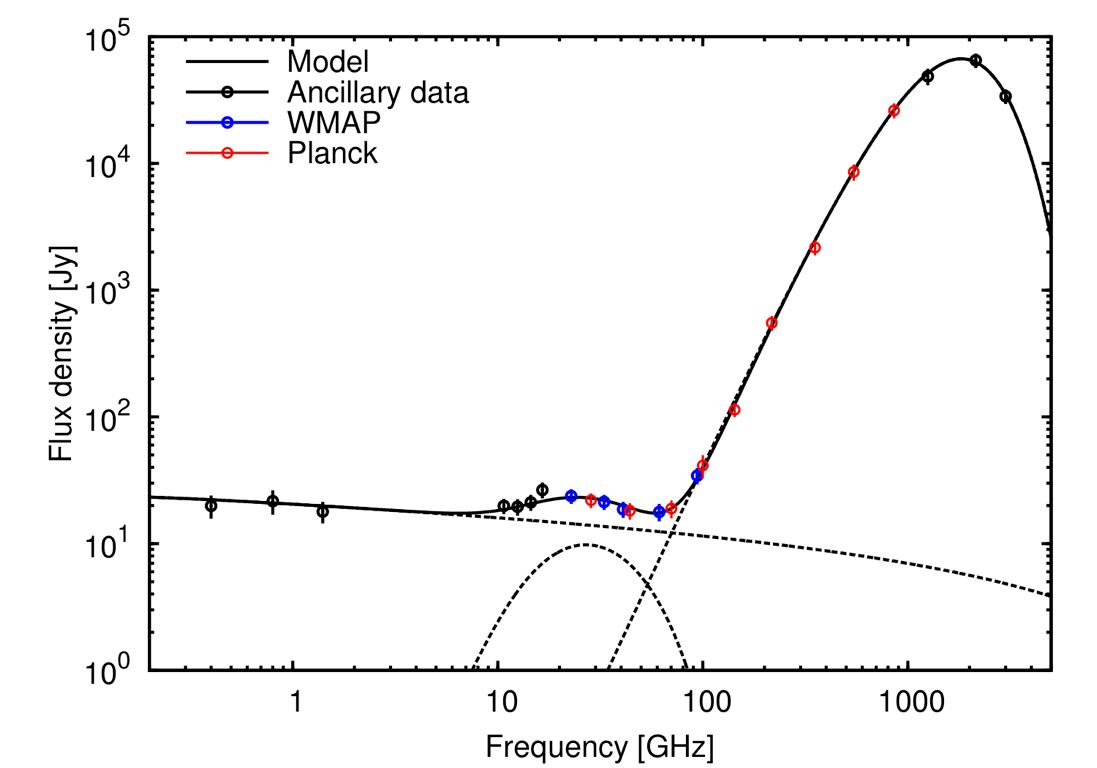
Here’s another, more recent, example. A couple of weeks ago, a clutch of early release papers from the Planck satellite came out; I blogged about them here. Among these results were some interesting new insights concerning the nature of the Anomalous Microwave Emission (AME) from the Milky Way; the subject of an excellent presentation by Clive Dickinson at the conference where the results were announced.

The title of a story in National Geographic is typical of the coverage this result received:

Fastest Spinning Dust Found; Solves Cosmic “Fog” Puzzle

Now look at the actual result. The little bump in the middle is the contribution from the anomalous emission, and the curve underneath it shows the corresponding “spinning dust” model:

There’s certainly evidence that supports this interpretation, but it’s clearly nowhere near the level of “proof”. In fact, in Clive’s talk he stated the result as follows:

Plausible physical models appear to fit the data

OK, so that would never do for a headline in a popular magazine, but I hope I’ve made my point. There’s a big difference between what this particular scientist said and what was presented through the media.

I hope you’re not thinking that I’m criticising this bit of work. Having read the papers I think it’s excellent science.

But it’s not just the fault of the educationalists and the media. Certain scientists play this dangerous game themselves. Some enjoy their 15 minutes – or, more likely, two minutes – of fame so much that they will happily give the journalists what they want regardless of the consequences. Worse still, even in the refereed scientific literature you can find examples of scientists clearly overstating the confidence that should be placed in their results. We’re all human, of course, but my point is that a proper statement of the caveats is at least as much a part of good science as theoretical calculation, clever instrument design or accurate observation and experiment.

We can complain all we like about non-scientists making ill-informed criticisms of science, but we need to do a much better job at being honest about what little we really know and resist the temptation to be too certain.


Share/Bookmark

Never mind the Brahms, hear the Adams.

Posted in Music with tags , , , , , on January 29, 2011 by telescoper

People keep telling me how wonderful the music of Johannes Brahms is and, although he’s never been a favourite of mine, I’ve always been willing to accept that this was basically down to my ignorance and that I should persevere.

Yesterday I had an opportunity to have another go at Brahms, in the form of a concert by the BBC National Orchestra of Wales at St David’s Hall which comprised two pieces completely new to me, one of which was Brahms’ Piano Concerto No. 2 in B flat major, featuring Lars Vogt. Not knowing anything about the piece beforehand, other than that quite a few people I know told me it was brilliant, I went with as few preconceptions as possible.

This is a much larger work than the typical piano concerto.  Spread over four meaty movements rather than the more usual three, it lasts about 45 minutes and in places it feels more like a symphony which happens to a have a piano part than a piano concerto per se. I think I was expecting something more overtly virtuosic too, and this work isn’t really like that, although it must be hard to play because it requires quite a lot of muscle from time to time. There are passages of great beauty, especially in the elegaic slow (3rd) movement, wherein there is a beautiful singing cello part, and in the swelling orchestral climaxes of the first two movements. The intricate and very artful last movement involves so many different themes coming in an playing off against each other that it’s difficult to keep track.

Conducted by Thierry Fischer, the Orchestra was a bit slow to get into the swing of it and I felt some of the playing early on was a bit flat where it is clearly supposed to be full of heroic grandeur. Perhaps this was partly because of the disappointing attendance – St David’s Hall couldn’t have been half full despite a price of only £20 for stalls seats.

Apart from the slightly disappointing opening, I enjoyed this first part of the concert. A lot, in fact. I certainly found the music impressive in its craftsmanship and vision. But if you ask me if it moved me, I’d have to say no. It left me a bit cold, I’m afraid. I guess Brahms doesn’t really speak my language. On the other hand, this is a piece which probably should be heard more than once to appreciate it fully, as it is rather a lot to take in one go. I’m keen to get a good recording of it so I can do that at home. I’d welcome recommendations through the comments box, in fact, as my personal jury is still out as far as Brahms is concerned.

The second half of the concert was quite a different matter. John Adams wrote  Harmonielehre in 1985, about a hundred years after Brahms composed his second Piano Concerto. The title is taken from a book on musical composition by Arnold Schoenberg. The link between this and the Brahms work is not as tenuous as you might imagine, however, as Schoenberg started his compositional career writing in a late romantic style not so far removed from Brahms. It was only later that he turned to atonalism and, eventually, serialism.

Although its harmonic structure is  complex, and some of the structures Adams uses are similar to those you might find in Schoenberg, at least relatively early on while he was still experimenting,  Harmonielehre is  not really an atonal work. In each sequence the music does hover around a  tonal centre although it times the music strains against its own centre of gravity.

And although he deploys some devices associated with minimalism – insistent, percussive repetition, recurrent motifs, a quasi-static chordal framework and very gradual development and transformation – this isn’t really a minimalist work either.

It’s the fact that it’s so hard to categorize this work that makes it so fascinating and exciting. Other passages seem to echo other composers, especially Gustav Mahler (who died in 1911, the same year that Schoenberg wrote the book Harmonielehre). It’s as if Adams decided to take the end of the romantic period as a starting point but map out a very different route from there to that pioneered by Schoenberg.

If all this sounds very academic then I’m doing a great disservice to the piece. It’s actually a complete blast to listen to, from start to finish. It begins in exhilirating fashion with a thunderous breakneck sequence like a rollercoaster ride that eventually dissolves into a lyrical string theme. The second movement is where the strong echoes of Mahler can be found – there’s also a passage where a solo trumpet plays a lonely theme over disjointed chords which reminded me greatly of Miles Davies and Gil Evans. The last movement is in perfect contrast – fully of energy and exuberance, it ends with thrilling waves of sound crashing and reforming and crashing again. Nothing short of ecstatic.

I went to this concert almost completely preoccupied with the question of whether I would “get” Brahms’ Piano Concerto, but after the finale of Harmonielehre I had almost forgotten Brahms entirely. You could easily tell which piece the musicians enjoyed most too, as there were broad grins and mutual applause all across the stage as they took their bows. This was especially true of the percussionists, who were outnumbered by their instruments – bells, marimbas, xylophones, drums, you name it, so had to run backwards and forwards whenever needed to man the barricades.

The audience loved it too. Bravo.

P.S. The concert was recorded for broadcast on BBC Radio 3 at a future date.


Share/Bookmark

Why can’t Cardiff be like Copenhagen?

Posted in Bute Park, Cardiff, Uncategorized with tags , , , , , , on January 28, 2011 by telescoper

Walking into work this morning I was almost run over three different times by three different vehicles. The first was near the car park in Sophia Gardens, where there are signs and road marking clearly indicating that there is a speed limit of 5 mph but where the normal speed of cars is probably more like 35; the guy who nearly killed me was doing about 60.

Next, in Bute Park, a heavy lorry belonging to the Council, engaged in some sort of “tree-management” business, thundered along the footpath past me. These paths used to be marked 5mph too, but the Council removed all the signs when it decided to build a huge road into the Park and encourage more vehicles to drive around inside. The lorry wasn’t going as fast as the Boy Racer of Sophia Gardens, but the size of the truck made it just as scary.

Finally, using a green light at the pedestrian crossing at Park Place I was narrowly missed by another car who had clearly jumped a red light to get onto the dual carriageway (Dumfries Place) leading to Newport Road.

I have to say things like this aren’t at all unusual, but it is the first time I’ve had three close encounters in one day! Although most car drivers behave responsibly, there seems to be a strong concentration of idiots in Cardiff whose antics are exacerbated by the hare-brained Highways Department of the local council. There are many things to enjoy about living in Cardiff, and the quality of life here is very good for a wide range of reasons, but of all the cities I’ve lived in it is by a long way the least friendly to pedestrians and cyclists.

If only Cardiff were like Copenhagen, one of the loveliest and most liveable cities I’ve ever experienced, partly because of traffic policies.

PS. In the interest of balance I should also point out that I was once actually hit on a pedestrian crossing in Cardiff by a bicycle steered by a maniac who went through a red light. In this case, however, I did manage to push him off his bike as he tried to get away, so he ended up more seriously hurt than I was. I was hoping that a friendly car would run over his bike, which was lying in the road, but sadly that didn’t happen.


Share/Bookmark

Invictus

Posted in Poetry with tags , , on January 27, 2011 by telescoper

I’ve been thinking of sharing this poem – and especially the superb reading of it by Alan Bates – with you for quite a while. There’s no compelling personal reason for choosing today to so, in fact. I’m not myself labouring in the “fell clutch of circumstance”; neither have the “bludgeonings of chance” fallen particularly hard on my head recently. Nevertheless, this poem has been on my mind for quite a while and, anyway, we all need a bit of inspiration from time to time. This certainly does that job for me, as I hope it will for those who are having a tough time of it these days.

Invictus was written by Victorian poet W.E. Henley as a response to having much of his left leg amputated. I’m not a particular fan of Henley’s verse in general – some of it is unpleasantly jingoistic – but I love this poem’s dignified yet forceful expression of resolute defiance in the face of adversity and injustice. It may be a bit “stiff upper lip” for some of you, but there you go.

Among those who have found solace or inspiration in this poem is Nelson Mandela, who kept it close by during the long years of his incarceration in the dreadful prison on Robben Island, a place I visited on a trip to Cape Town a few years ago; I can tell you that it’s every bit as grim as you might imagine. I’m sure he could teach all of us a thing or two about dignified defiance.

Out of the night that covers me,
Black as the Pit from pole to pole,
I thank whatever gods may be
For my unconquerable soul.

In the fell clutch of circumstance
I have not winced nor cried aloud.
Under the bludgeonings of chance
My head is bloody, but unbowed.

Beyond this place of wrath and tears
Looms but the Horror of the shade,
And yet the menace of the years
Finds, and shall find, me unafraid.

It matters not how strait the gate,
How charged with punishments the scroll.
I am the master of my fate:
I am the captain of my soul.

And here’s the magnificent reading of the piece by the late Alan Bates.


Share/Bookmark

“Astrology is rubbish”, but… (via Whewell’s Ghost)

Posted in The Universe and Stuff with tags , on January 26, 2011 by telescoper

Here’s a very nicely reasoned and invective-free blog post, on the subject of the decision by the Astrological Association of Great Britain to petition the BBC in complaint about its “unfair representation of astrology”.

"Astrology is rubbish", but... Over the past week or two I've seen a steady trickle of tweets from astronomers, science writers and journalists having a good laugh about astrology. Fair enough, perhaps, except that this all began with a story on NBC News (and video here), reporting on the comments of one Parke Kunkle, an astronomy instructor linked with the Minnesota Planetarium Society and Minnesota Community and Technical College (where, it appears from Rate My Professor, he … Read More

via Whewell's Ghost


Share/Bookmark