In a Mood

Posted in Jazz with tags , , , on January 9, 2011 by telescoper

Back to work tomorrow, and I’ve got quite a lot to sort out before we start back so I’ll be in the office this afternoon. No time for anything of any great consequence, therefore, so I thought I’d post this bit of music which some of you might find amusing and/or enjoyable.

I think I’ve written on this blog before that mathematical theorems and physical laws often have the wrong name associated with them. So it is with famous tunes. I’m in the mood to point this one out. The following track, called Tar Paper Stomp, was recorded by Wingy Manone and his Orchestra in 1930. The tune features a well-known riff that formed the basis of a much more famous and commercially successful recording made in 1939. In fact Glen Miller‘s hit was a second-order copy; he got the theme from a tune called Hot and Anxious recorded by Fletcher Henderson‘s Orchestra in 1931. There’s some debate who actually wrote it first – Fletcher Henderson’s brother Horace claimed to have done so – but Wingy Manone did receive an out-of-court cash settlement in return for not pursuing a copyright claim.

Anyway, in case you were wondering “Wingy” Manone’s nickname derived from the fact that he lost his right arm when he was run over by a streetcar as a child. Thereafter he wore a prosthetic limb, hence the name. It sounds a bit cruel, but he didn’t seem to object. In fact he was an extrovert showman, singer, comedian and all-round entertainer as well as a fine trumpeter. It can’t be that easy to play the trumpet with only one working hand – he seems to have used his prosthetic arm just for support, fingering the valves and holding the horn with his left. His style was firmly rooted in Dixieland; it may be a bit rough around the edges, occasionally downright raucous, but he certainly could play with a lot of gusto – his solo on this track is hugely enjoyable. In fact, I think this track makes Glen Miller’s In the Mood sound like a wet weekend in Stevenage.

I don’t have a personnel listing for this recording, but the tenor saxophonist sounds to me a lot like Bud Freeman. Although Benny Goodman played with Manone’s band around 1930 the clarinettist doesn’t sound like him to me. Could it have been Frank Teschmacher?


Share/Bookmark

Mock Examination

Posted in Bute Park on January 8, 2011 by telescoper

Regular readers (both of them) will know I’m Professor of Theoretical Astrophysics at Cardiff University. With the undergraduate mid-year exam period coming up shortly, I was thinking of posting something to help the students with their revision of my specialist topic. Based on an appropriate syllabus for this subject inferred from rigorous study of the content of this blog, a friend of mine (who should remain nameless, but is called Anton) suggested the following examination questions.

Feel free to suggest others through the comments box!

CARDIFF UNIVERSITY FINAL YEAR EXAMINATION IN PHYSICS

Option: Theoretical Astrophysics.

Time allowed: 2 hours.

Answer all questions, in full. No credit will be given for partial answers, numerical or grammatical errors, spelling mistakes or any other variety of underachievement.

1. “England’s victorious Ashes series in 2005 was more meritorious than retaining the Ashes in 2010/11.” Discuss.

2. Was Charlie Parker a greater saxophonist than Miles Davis was a trumpeter?

3. Compose a 15 × 15 cryptic crossword using only astrophysical terms.

4. You hear that Bute Park is to be turned into an airport. Write a model letter of complaint to Cardiff City Council.

5. Discuss the influence of Mahler’s awareness of his own mortality on his later Lieder.

6. You have 10 minutes on Google to find a US TV soap star lookalike for Prof. Coles. (Marks will be awarded automatically by a Bayesian image comparison routine.)

7. Compose a Pindarian ode protesting about governmental priorities in science funding.


Share/Bookmark

Ashes Victory

Posted in Cricket, Poetry with tags , , , , , on January 7, 2011 by telescoper

Well, there you have it. England’s cricketers finally won the final Test of the Ashes series in Sydney by an innings and 83 runs, to win the series outright. It has been a wonderful performance by the England team down under which has warmed the cold English (and Welsh) winter.

Commiserations to Australian cricket fans. Their team just wasn’t as good as England, with bat or ball. They have a lot of rebuilding to do, but you can be sure they’ll be back challenging for the Ashes again before long.

I thought I’d put up a poem to celebrate. This one is called The Game and was written by John Groves. It represents an idyllic view of what many English crickets fans surely regard as the match of any season – the Lord’s Test – which we can now look forward to with relish in the summer. However, I chose this poem for this occasion primarily because of the final couplet which takes us far beyond the boundaries of St John’s Wood.

A painter’s sky over Lord’s.
A gentle zephyr, blowing without brace,
The crowd engaged in all that joy affords
And England batting with admired grace.
The sun ablaze, an unforgiving pitch,
A bowler with a patriotic itch,
A ticking scoreboard and a close-run thing,
A resolute gull, high on a drowsy wing.

Though one team triumph, victory’s all the same:
The winner is the beauty of the game.


Share/Bookmark

Epiphany

Posted in Cricket, Football, Literature with tags , , , on January 6, 2011 by telescoper

So here we are then, it’s “officially” the last day of Christmas.

Last night was Twelfth Night, traditionally marked by an evening of festive merrymaking. And so it came to pass, as I sat with a cup of Ovaltine watching TV highlight’s of the third day’s play in the final Ashes Test in Sydney followed by Match of the Day, featuring coverage of Newcastle’s 5-0 thrashing of West Ham.

Today, 6th January, is Epiphany which traditionally marks the arrival of the three Magi and the presentation of their gifts to the baby Jesus. As far as I’m aware there’s no actual evidence that this actually happened on January 6th, but there you go. It’s a tradition nevertheless. In fact, I seem to remember that the Magi only appear in one of the four gospels (Matthew) and it doesn’t even specify that there were three of them..

Here in the United Kingdom, January 6th is when the holiday season really finishes, when Christmas trees and decorations come down, and when we’re allowed at last to stop eating Turkey curries. Some years ago I discovered that in other countries Epiphany is actually observed rather differently and is in fact one of the main events of the Christmas period. I only discovered this when I tried to arrange a meeting with Spanish and Italian representatives of an EU Network I was involved with on January 6th, only to be greeted with howls of protest. It actually makes sense, though, as presumably the exchanging of gifts at Christmas is supposed to commemorate the visit of the Magi. Why not, therefore, do it at Epiphany?

All this reminded me of the following (very famous) poem, called The Journey of the Magi , by T.S Eliot. I’m all out of gold, frankenstein and myrrh (whatever that is) – and I’m not a particularly wise man anyway – so I’ll offer this in lieu of a gift.

‘A cold coming we had of it,
Just the worst time of the year
For a journey, and such a journey:
The ways deep and the weather sharp,
The very dead of winter.’
And the camels galled, sore-footed, refractory,
Lying down in the melting snow.
There were times we regretted
The summer palaces on slopes, the terraces,
And the silken girls bringing sherbet.

Then the camel men cursing and grumbling
And running away, and wanting their liquor and women,
And the night-fires going out, and the lack of shelters,
And the cities hostile and the towns unfriendly
And the villages dirty and charging high prices:
A hard time we had of it.
At the end we preferred to travel all night,
Sleeping in snatches,
With the voices singing in our ears, saying
That this was all folly.

Then at dawn we came down to a temperate valley,
Wet, below the snow line, smelling of vegetation;
With a running stream and a water-mill beating the darkness,
And three trees on the low sky,
And an old white horse galloped in away in the meadow.
Then we came to a tavern with vine-leaves over the lintel,
Six hands at an open door dicing for pieces of silver,
And feet kicking the empty wine-skins.
But there was no imformation, and so we continued
And arrived at evening, not a moment too soon
Finding the place; it was (you may say) satisfactory.

All this was a long time ago, I remember,
And I would do it again, but set down
This set down
This: were we led all that way for
Birth or Death? There was a Birth, certainly,
We had evidence and no doubt. I had seen birth and death,
But had thought they were different; this Birth was
Hard and bitter agony for us, like Death, our death.
We returned to our places, these Kingdoms,
But no longer at ease here, in the old dispensation,
With an alien people clutching their gods.
I should be glad of another death.


Share/Bookmark

Herschel Views Andromeda (via The Herschel Space Observatory)

Posted in The Universe and Stuff with tags , , , , on January 6, 2011 by telescoper

An amazing composite image of M31 in Andromeda using both infra-red and X-rays was recently obtained using Herschel and XMM space observatories. It featured in the BBC Stargazing Live programme earlier this week and I’m told that, typically for astronomy, the inspiration behind it was … beer.

Herschel Views Andromeda We've been sitting on this image since just before Christmas so that it could be unveiled during the BBC Stargazing Live show last night, but I've been aching to get this onto the blog ever since I saw it. This is a Herschel image of our nearest neighbour galaxy, the Andromeda galaxy, also known as M31, along with comparison images at other wavelengths. [/captio … Read More

via The Herschel Space Observatory


Share/Bookmark

My Fellow Pagans …

Posted in The Universe and Stuff with tags , , on January 5, 2011 by telescoper

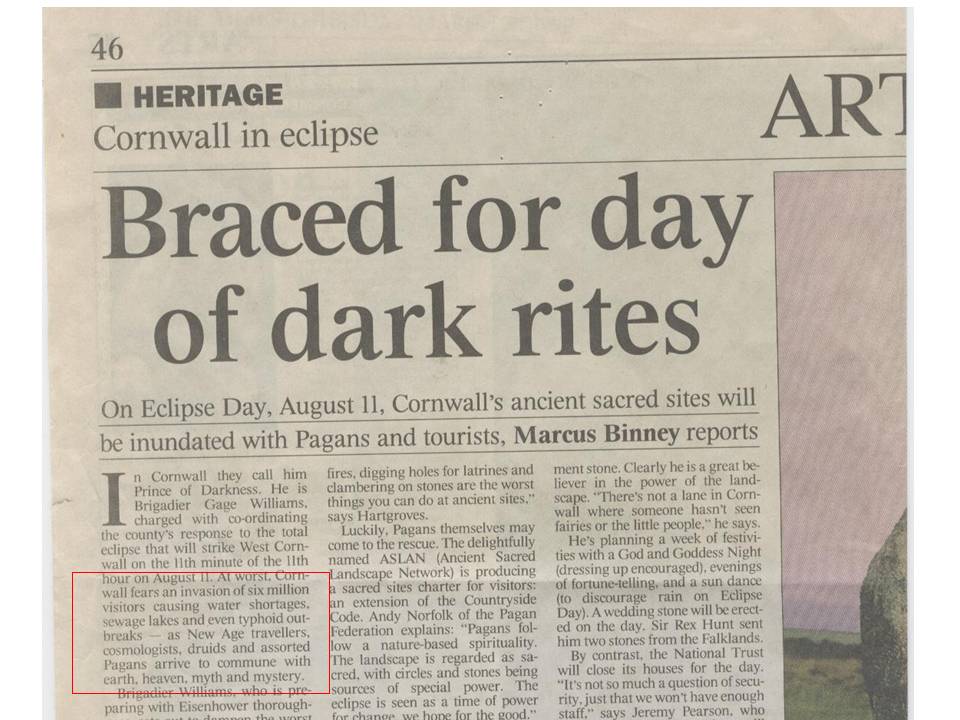
I was reminded yesterday of the following clipping, which I found in The Times, in 1999, just before the total eclipse that was visible from parts of the United Kingdom in that year. It was a feature about the concerns raised by certain residents of Cornwall about the possible effects of the sudden influx of visitors on the local community. Here is a scan  of a big chunk of the story, which you probably can’t read…

.and here is a blow-up of the section shown in the red box, which places cosmologists in rather strange company:

This makes it clear what journalists on this rag think about cosmology! In protest, I wrote a letter to the The Times saying that, as a cosmologist, I thought this piece was very insulting … to Druids.

They didn’t publish it.


Share/Bookmark

Einstein and the Eclipse

Posted in Biographical, The Universe and Stuff with tags , , , , , , , on January 4, 2011 by telescoper

Following on from my previous post, I thought you might be interested in this. It’s the last programme in a series called Six Experiments that Changed the World which was presented by the late Ken Campbell. It was made for Channel 4 and first broadcast in 2000. It’s in two parts. If you watch the second one, you might see someone you recognize…


Share/Bookmark

Insignificance

Posted in The Universe and Stuff with tags , , , , , , , on January 4, 2011 by telescoper

I’m told that there was a partial eclipse of the Sun visible from the UK this morning, although it was so cloudy here in Cardiff that I wouldn’t have seen anything even if I had bothered to get up in time to observe it. For more details of the event and pictures from people who managed to see it, see here. There’s also a nice article on the BBC website. The BBC are coordinating three days of programmes alongside a host of other events called Stargazing Live presumably timed to coincide with this morning’s eclipse. It’s taking a chance to do live broadcasts about astronomy given the British weather, but I hope they are successful in generating interest especially among the young.

As a spectacle a partial solar eclipse is pretty exciting – as long as it’s not cloudy – but even a full view of one can’t really be compared with the awesome event that is a total eclipse. I’m lucky enough to have observed one and I can tell you it was truly awe-inspiring.

If you think about it, though, it’s a very strange thing that such a thing is possible at all. In a total eclipse, the Moon passes between the Earth and the Sun in such a way that it exactly covers the Solar disk. In order for this to happen the apparent angular size of the Moon (as seen from Earth) has to be almost exactly the same as that of the Sun (as seen from Earth). This involves a strange coincidence: the Moon is small (about 1740 km in radius) but very close to the Earth in astronomical terms (about 400,000 km away). The Sun, on the other hand, is both enormously large (radius 700,000 km) and enormously distant (approx. 150,000,000 km).  The ratio of radius to distance from Earth of these objects is almost identical at the point of a a total eclipse, so the apparent disk of the Moon almost exactly fits over that of the Sun. Why is this so?

The simple answer is that it is just a coincidence. There seems no particular physical reason why the geometry of the Earth-Moon-Sun system should have turned out this way. Moreover, the system is not static. The tides raised by the Moon on the Earth lead to frictional heating and a loss of orbital energy. The Moon’s orbit  is therefore moving slowly outwards from the Earth. I’m not going to tell you exactly how quickly this happens, as it is one of the questions I set my students in the module Astrophysical Concepts I’ll be starting in a few weeks, but eventually the Earth-Moon distance will be too large for total eclipses of the Sun by the Moon to be possible on Earth, although partial and annular eclipses may still be possible.

It seems therefore that we just happen to be living at the right place at the right time to see total eclipses. Perhaps there are other inhabited moonless planets whose inhabitants will never see one. Future inhabitants of Earth will have to content themselves with watching eclipse clips on Youtube.

Things may be more complicated than this though. I’ve heard it argued that the existence of a moon reasonably close to the Earth may have helped the evolution of terrestrial life. The argument – as far as I understand it – is that life presumably began in the oceans, then amphibious forms evolved in tidal margins of some sort wherein conditions favoured both aquatic and land-dwelling creatures. Only then did life fully emerge from the seas and begin to live on land. If it is the case that the existence of significant tides is necessary for life to complete the transition from oceans to solid ground, then maybe the Moon played a key role in the evolution of dinosaurs, mammals, and even ourselves.

I’m not sure I’m convinced of this argument because, although the Moon is the dominant source of the Earth’s tides, it is not overwhelmingly so. The effect of the Sun is also considerable, only a factor of three smaller than the Moon. So maybe the Sun could have done the job on its own. I don’t know.

That’s not really the point of this post, however. What I wanted to comment on is that astronomers basically don’t question the interpretation of the occurence of total eclipses as simply a coincidence. Eclipses just are. There are no doubt many other planets where they aren’t. We’re special in that we live somewhere where something apparently unlikely happens. But this isn’t important because eclipses aren’t really all that significant in cosmic terms, other than that the law of physics allow them.

On the other hand astronomers (and many other people) do make a big deal of the fact that life exists in the Universe. Given what  we know about fundamental physics and biology – which admittedly isn’t very much – this also seems unlikely. Perhaps there are many other worlds without life, so the Earth is special once again. Others argue that the existence of life is so unlikely that special provision must have been made to make it possible.

Before I find myself falling into the black hole marked “Anthropic Principle” let me just say that I don’t see the existence of life (including human life) as being of any greater significance than that of a total eclipse. Both phenomena are (subjectively) interesting to humans, both are contingent on particular circumstances, and both will no doubt cease to occur at some point in perhaps not-too-distant the future. Neither tells us much about the true nature of the Universe.

Let’s face it. We’re just not significant.


Share/Bookmark

Ich bin der Welt abhanden gekommen

Posted in Music with tags , , , on January 3, 2011 by telescoper

The last day of the winter break has arrived, in the form of a bank holiday Monday in lieu of New Year’s Day which this year happened on a Saturday. It has also started snowing again. I’m determined to get all the rest and recuperation I can get before starting back at work so instead of posting anything strenuous I thought I’d put up this wonderful piece of music.

This is the third and undoubtedly the most famous song in Gustav Mahler‘s cycle of five Rückert Lieder, settings of poems by Friedrich Rückert. Perhaps the best known version of this is the marvellous recording mezzo Dame Janet Baker made in the 1960s with Sir John Barbirolli and the Hallé Orchestra, which I listen to over and over again. It is also to be heard in a version with piano rather than orchestral accompaniment, and sometimes with male rather than female vocalist. I firmly prefer the orchestral setting, however.

The German text of this poem reads

Ich bin der Welt abhanden gekommen,
Mit der ich sonst viele Zeit verdorben,
Sie hat so lange nichts von mir vernommen,
Sie mag wohl glauben, ich sei gestorben!

Es ist mir auch gar nichts daran gelegen,
Ob sie mich für gestorben hält,
Ich kann auch gar nichts sagen dagegen,
Denn wirklich bin ich gestorben der Welt.

Ich bin gestorben dem Weltgetümmel,
Und ruh’ in einem stillen Gebiet!
Ich leb’ allein in meinem Himmel,
In meinem Lieben, in meinem Lied!

As always with poetry, it’s not easy to translate, but a reasonable English version is

I am lost to the world
with which I used to waste so much time,
It has heard nothing from me for so long
that it may very well believe that I am dead!

It is of no consequence to me
Whether it thinks me dead;
I cannot deny it,
for I really am dead to the world.

I am dead to the world’s tumult,
And I rest in a quiet realm!
I live alone in my heaven,
In my love and in my song!

Although I only did one year of German at school, I think “I have become a stranger to the world” is a better version of the first line; it scans better, at least. Nevertheless, the gist of it is that the poet is celebrating his escape from the hustle and bustle of everyday life. Because it’s about solitude  people tend to assume that it’s a sad song. I don’t think of it like that at all. I’m sure artists, musicians, poets, and even – dare I say it – scientists, all experience times when they’re so focussed on what they’re doing that nothing else seems to matter. Solitude is then not to do with loneliness or sadness, but with self-fulfilment.

This is what Mahler’s music seems to me to convey anyway. For me it’s one of the most joyful pieces of music he ever wrote, although, as is inevitable with Mahler, whenever there’s radiance you know that darkness is never far away. He seems to know exactly how to trigger the deepest emotional response, by introducing those shadowy undercurrents. Gets me every time.

This performance, which I chanced upon on Youtube,  has  a strong local connection. I don’t know where the performance took place, but the conductor is Carlo Rizzi who was conductor of the Orchestra of Welsh National Opera until 2007, and the mezzo soprano vocalist is Katarina Karnéus, who won the Cardiff Singer of the World competition in 1995 and  performed in Mahler’s Third Symphony in Cardiff last year. There’s just a chance, therefore, that this recording was made in St David’s Hall. Wherever it was, I think this is a lovely performance,  to see as well as hear.

If there is a more beautiful piece of music than this, I’d really love to hear it.


Share/Bookmark

2010 in review

Posted in Uncategorized on January 2, 2011 by telescoper

The stats helper monkeys at WordPress.com mulled over how this blog did in 2010, and here’s a high level summary of its overall blog health:

Healthy blog!

The Blog-Health-o-Meter™ reads Wow.

Crunchy numbers

Featured image

The Louvre Museum has 8.5 million visitors per year. This blog was viewed about 280,000 times in 2010. If it were an exhibit at The Louvre Museum, it would take 12 days for that many people to see it.

In 2010, there were 408 new posts, growing the total archive of this blog to 790 posts. There were 99 pictures uploaded, taking up a total of 30mb. That’s about 2 pictures per week.

The busiest day of the year was December 8th with 2078 views. The most popular post that day was (Guest Post) The GREAT10 Challenge.

Where did they come from?

The top referring sites in 2010 were reddit.com, twitter.com, andyxl.wordpress.com, facebook.com, and Google Reader.

Some visitors came searching, mostly for telescoper, flaming june, peter coles blog, in the dark, and logo.

Attractions in 2010

These are the posts and pages that got the most views in 2010.

1

(Guest Post) The GREAT10 Challenge December 2010
5 comments

2

Flaming June June 2009
13 comments

3

Doubts about the Evidence for Penrose’s Cyclic Universe November 2010
51 comments

4

Unravelling Cable September 2010
54 comments and 2 Likes on WordPress.com

5

The Joy of Natural Units March 2010
18 comments