In the Dark on Social Media

Posted in Biographical, Politics with tags , , , , , , on August 12, 2024 by telescoper

It’s almost a year since I deactivated my Twitter account. Or should I call it X? Anyway, it doesn’t matter because I don’t use it any more. Over the past few weeks it seems quite a few more – especially in the UK – have had enough of the antics of Elon Musk (aka Space Karen), especially with his attempts to fan the flames of the recent Farage riots by spreading misinformation. The first thing I noticed was that my BlueSky account was suddenly getting quite a lot of new followers. I now have about 850, still a long way short of the over 7000 I used to have on Twitter, but the level of engagement is far higher. That’s because the algorithm Space Karen introduced on X makes it difficult for your own followers. let alone anyone else, to see your tweets. The one disadvantage of BlueSky is that it doesn’t have an API that allows me to post directly from this blog when I publish a post, so I have to copy the URL by hand.

I also have an account on Mastodon where I have over 1200 followers and similarly good engagement. When I first started there a couple of years ago it didn’t have a WordPress API but it does now, so everything I write here gets posted automatically on my feed. Not only that, this blog is now also now fully federated which means that there is an autonomous feed for the blog posts. Not just a link to each post, as the API produces, but the whole post. This is a nice feature because if I change a post on this WordPress platform it automatically gets changed on the Mastodon feed.

I also have a Facebook Page on which these

And now there’s Threads, which is like a version of Twitter bolted onto Instagram. When this first came out last year it wasn’t available in the EU for data protection issues so I didn’t bother with it. I only just found out at the weekend that has been available since December 2023 but I wasn’t paying much attention to social media then so didn’t catch the news. Anyway, since I already have a (very quiet) Instagram account so I set up a Threads account which you can find here if you like that sort of thing. My first impressions of Threads are not very favourable, but let’s see how it goes. At least it’s not as bad as Twitter. I still think it is indefensible that my employer, along with most other universities, has decided to maintain a presence on that site.

The Mechanics of the Pole Vault

Posted in Sport, The Universe and Stuff with tags , , , on August 11, 2024 by telescoper

One of the many highlights of the 2024 Olympics was the amazing achievement of Armand Duplantis in winning the Gold Medal in Pole Vault and in the process breaking his own world record at a height of 6.25m. Here he is

He seemed to clear that height quite comfortably, actually, so I dare say he’ll break quite a few more records in his time. On the other hand, when I first wrote about this back in 2011 the world record for the pole vault was held by the legendary Ukrainian athlete Sergey Bubka at a height of 6.14m which he achieved in 1994. That record stood for almost 20 years but has since been broken several times since. The fact that the world record has only increased by 11 cm in 30 years tells you that the elite pole vaulters are working at the limits of what the human body can achieve. A little bit of first-year mechanics will convince you why, as I have pointed out in previous posts (e.g. here).

What a pole-vaulter does is rather complicated and requires a lot of strength, flexibility and skill, but as in many physics problems one can bypass the complications and just look at the beginning and the end and use an energy conservation argument. Basically, the pole is a device that converts the horizontal kinetic energy of the vaulter \frac{1}{2} m v^2,  as he/she runs in, to the gravitational potential energy m g h acquired at the apex of his/her  vertical motion, i.e. at the top of the vault.

Now assume that the approach is at the speed of a sprinter, i.e. about 10 ms^{-1}, and work out the height h = v^2/2g that the vaulter can gain if the kinetic energy is converted with 100% efficiency. Since g = 9.8 \, ms^{-2} the answer to that little sum turns out to be about 5 metres.

This suggests that  6.25 metres should not just be at, but beyond, the limit of a human vaulter,  unless the pole were super-elastic. However, there are two things that help. The first is that the centre of mass of the combined vaulter-plus-pole does not start at ground level; it is at a height of a bit less than 1m for an an average-sized person.  Note also that the centre of mass of pole (which weighs about 15 kg and is about 5 m long) only ends up about 2.5 m off the ground when it is vertical, so there’s a significant effect there.  Note also that the centre of mass of the vaulter does not actually pass over the bar after letting go of the pole.  That  doesn’t happen in the high jump, either. Owing to the flexibility of the athlete’s back, the arc is such that the centre of mass remains under the bar while the different parts of the athlete’s body go over it.

Moreover, it’s not just the kinetic energy related to the horizontal motion of the vaulter that’s involved. A human can jump vertically from a standing position using elastic energy stored in muscles. In fact the world record for the standing high jump is an astonishing 1.9m. In the context of the pole vault it seems likely to me that this accounts for at least a few tens of centimetres.

Despite these complications, it is clear that pole vaulters are remarkably efficient athletes. And not a little brave either – as someone who is scared of heights I can tell you that I’d be absolutely terrified being shot up to 6.25 metres on the end of  a bendy stick, even with something soft to land on!

Wine in a Can – Marcel Lucont

Posted in Poetry with tags , , on August 10, 2024 by telescoper

And now, some poetry…

Three New Publications at the Open Journal of Astrophysics

Posted in OJAp Papers, Open Access, The Universe and Stuff with tags , , , , , , , , , , , , , , on August 10, 2024 by telescoper

It’s Saturday so it’s time once again for another roundup of business at the  Open Journal of Astrophysics. After last week’s summer lull, this week I have three papers to announce, which brings the total we have published so far this year (Vol. 7) to 67 and the total published by OJAp to 182.

First one up, published on 7th August 2024, is “Brightest Cluster Galaxy Offsets in Cold Dark Matter” by Jonathan Katz of Washington University (St Louis, Missouri, USA),  a simulation-based study of the distribution of the position of brightest cluster galaxies relative to the dark matter distribution and its possible use as a cosmological probe.  The authors are Cian Roche (MIT), Michael McDonald (MIT), Josh Borrow (MIT), Mark Vogelsberger (MIT), Xuejian Shen (MIT), Volker Springel (MPA Garching), Lars Hernquist (Harvard), Ruediger Pakmor (Harvard), Sownak Bose (Durham, UK) and Rahul Kannan (York U., Canada). This paper is in the folder marked Astrophysics of Galaxies.

Here is a screen grab of the overlay, which includes the abstract:


You can read the paper directly on arXiv here.

The second paper to present is “LAMOST J1010+2358 is not a Pair-Instability Supernova Relic” by five authors based in the USA: Pierre Thibodeaux (Chicago), Alexander P. Ji (Chicago), William Cerny (Yale), Evan N. Kirby (Notre Dame) and Joshua D. Simon (Carnegie Observatories) .  As the title makes clear, the paper presents arguments against previous claims that a particular star is not a pair-instability supernova relic. This paper is in the folder marked Solar and Stellar Astrophysics. It was published on Friday August 9th 2024.

The overlay looks like this:


You can read this paper directly on the arXiv here.

Last, but by no means least, comes  “A Pilot Search for Gravitational Self-Lensing Binaries with the Zwicky Transient Facility“, results of a trial search for signals of gravitational lensing of one component in a binary system by a compact companion, with a discussion of future prospects for larger surveys. This one, which was also published on 9th August, is in the folder marked High-Energy Astrophysical Phenomena. The authors are Allison Crossland & Eric C Bellm (U. Washington), Courtney Klein (UC Irvine), James R. A. Davenport (U. Washington), Thomas Kupfer (Hamburg Observatory) and Steven L. Groom, Russ R. Laher & Reed Riddle (Caltech).

Here is a screengrab of the overlay:

To read the accepted version of this on the arXiv please go here.

That’s it for this week. I hope to post another update next weekend.

Have you never contracted Covid-19?

Posted in Biographical, Covid-19 with tags , on August 9, 2024 by telescoper

I’ve taken the liberty of reblogging this post from a blog that I follow, as it is a question that interests me. As far as I know I have never contracted Covid-19, but I think I’m a rare case. I know many people who have had it multiple times. The most I think is five. There was an outbreak at the Euclid Meeting in Rome too, which affected over sixty people. I am hearing through the grapevine that case numbers are rather high at the moment, both in Europe and the USA, but in the absence of any systematic testing it is difficult to know the precise situation.

A couple of months ago I had a nasty cough which I thought might have been Covid-19 but repeated tests came back negative.

In the interest of full disclosure, I am fully vaccinated and boosted. I suppose another booster will be available in the autumn and I’ll take that too.

Anyway, I’d be interested to hear through the comments from anyone who has never had Covid-19 if you feel like divulging such information.

The Woke Olympics

Posted in Film, Sport with tags , , , , on August 9, 2024 by telescoper

I have seen many comments on social media to the effect that the 2024 Paris Olympics have gone “woke”. I agree. Many sports are now mere shadows of what they were a few decades ago let alone the original Greek ideals. Gymnastics for example, the name of which is derived from the Greek gymnós meaning “naked”, nowadays involves competitors with their naughty bits covered up. How woke is that? And the boxers even wear gloves! They’ve all gone soft!

Another example is the fencing. I’m not an expert on this but I did watch quite a lot when I was younger – admittedly not on live TV, but in the form of film recordings. The modern Olympic version of fencing is boring compared with how it used to be. Here are two photographs that illustrate how fencing has gone woke.

For a start, just look at all the protective gear worn by the namby-pamby competitors on the left! And they don’t even use proper swords! It’s health and safety gone mad!

Also, where are the fancy costumes, the stone staircases to run up and down, the chandeliers to swing from, the elaborate hanging tapestries to climb, or the long banqueting tables covered in expensive items there to be trashed? Pathetic!

(P.S. Basil Rathbone (in the still on the right) was actually a seriously good fencer, twice British Army champion in fact, unlike his opponent in the picture Errol Flynn who was so useless that he was a danger to other members of the cast, including Rathbone.)

A Physics Question

Posted in Literature, The Universe and Stuff on August 8, 2024 by telescoper
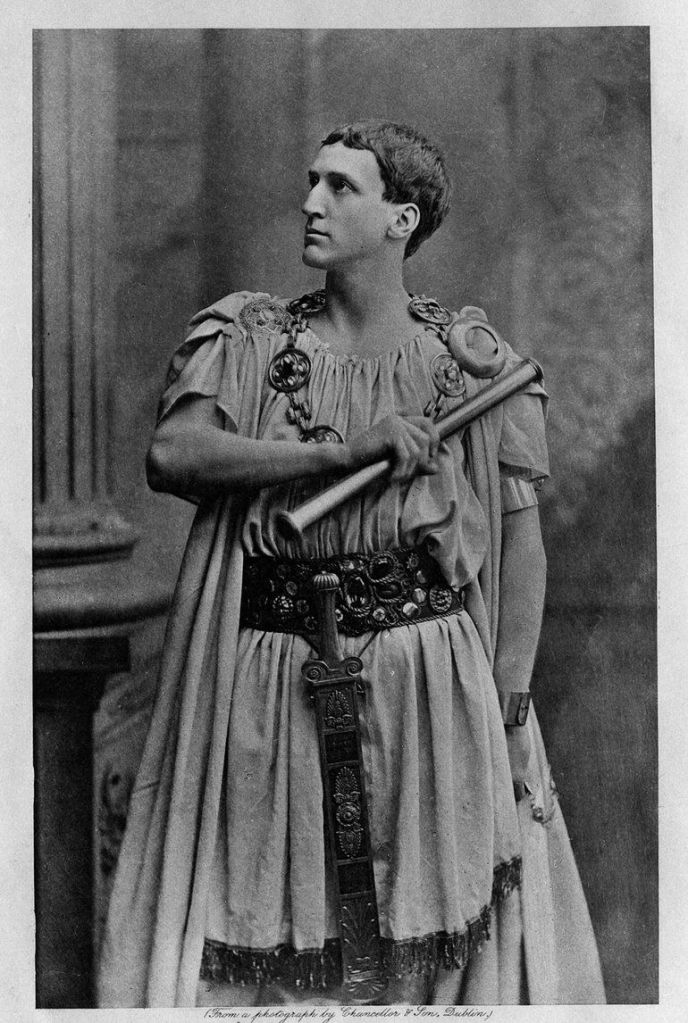
Frank Benson in the role of Coriolanus (1893)

Is Shakespeare’s play Coriolanus different when performed in the Southern Hemisphere?

Open Access Encounters: The Good, The Bad and the Ugly

Posted in Open Access with tags , , , on August 7, 2024 by telescoper

As it was foretold on Saturday, this afternoon I gave a talk at the 32nd General Assembly of the International Astronomical Union currently taking place in Cape Town, or rather at a side event thereof called Open Access Encounters: The Good, The Bad and the Ugly. I actually gave the last talk in the session, which may or may not mean that I was representing The Ugly

About 50 people attended online plus an unknown number in person, so it was quite a decent size of audiance.

I’m not sure if Slideshare is still working on WordPress, but if not here is a PDF of the slides.

Lessons from Physics and Biology

Posted in Sport, The Universe and Stuff with tags , , , on August 6, 2024 by telescoper

As I’ve mentioned before on this blog, one of my English teachers at school would occasionally give us exercises in creative writing inspired by `Only Connect’ – the epigraph of the novel Howard’s End by E.M. Forster. We were given two apparently disconnected things (usually news items), asked to think of a possible connection between them and write an story joining them together. From time to time when trying to think of something to write about I’ve resorted to playing the same game and am going to do it today.

This time, I thought I would connect two of my own recent blog posts, one about the case of female boxer Imane Khelife and the other about about the death of theoretical physicist TD Lee. What could the connection be?

Tsung-Dao Lee’s most famous work – for which he won the 1957 Nobel Prize with was on parity violation, which was detected experimentally by Chien-Shiung Wu in 1956. Parity is a conserved quantity in classical physics (e.g. in electromagnetism and gravity) and it was believed until the mid-20th century that it would be conserved in the quantum theory of nuclear interactions too. Wolfgang Pauli, for example, criticized Hermann Weyl’s suggestion of a two-component weakly interacting massless particle because it implied parity violation.

The experimental proof of parity violation in some weak interactions led to a much deeper understanding of fundamental physics, including the the idea of chiral gauge interactions, and the development of the standard model of particle physics. Parity is violated in some strong interactions too. Our simple-minded view of how things are changed as a result of an exception to a widely-held assumption. That’s how progress happens.

You might think now that I’m going to write about the fact that double-helix structure of DNA is right-handed, i.e. that it exhibits a form of parity violation, but that’s not it. Or only a little bit. You see, not all DNA is right-handed…

What does this have to do with Olympic boxing? Well, much of the furore about about Imane Khelif is about the (unproven) assertion that she has XY chromosome and is therefore male and should not be allowed to box in the women’s competition. A ‘biological’ female would have XX chromosomes.

It is true in the vast majority of cases that men have XY chromosomes and women have XX chromosomes, but if you read any reasonably modern book on human biology, the statement that ‘females have XX chromosomes’ is preceded by a “usually” or “in most cases”. But there exceptions: some women have XY chromosomes and some men have XX chromosomes; there are also individuals who have an extra chromosome and are XXY.

How can a person be said to be female if they have XY chromosomes? Well, that is because there is a very long journey between the information encoded in genetic material and the expression of that information in form and function. That entire process determines whether an athlete may nor not have an advantage over another. In a rare, sensible article about the Imane Khelif case I found this

Alun Williams, professor of sports and exercise genomics at Manchester Metropolitan University, said that when considering if a person had an unfair advantage it was necessary to look at chromosomes, levels of testosterone and other hormones, as well as the body’s response to testosterone.

“That then is a clinical assessment, which is really very invasive,” Williams said. “Simply looking at someone’s sex chromosomes … is incomplete.”

In most cases individuals with XY chromosomes develop “male” characteristics and those with XX chromosomes develop “female” but there are exceptions. For example, there are women – with ovaries, a uterus and no male sex organs – who have XY chromosomes. These are biologically female, even if their karyotype indicates otherwise. There is much more to biology than genetics, just as there is much more to physics than electromagnetism and gravity.

I don’t know whether Imane Khelif has XY chromosomes or not, and frankly I don’t care. The fact is that she was assigned female gender at birth, has been raised as female, and her gender is female as on her passport. She is a woman. I won’t use the phrase biological woman, because it is silly: every human being is biological. Caster Semenya is female too.

You might not care about this case and prefer top stick to the rigid definition that XX=male and XY=female. I don’t think that’s appropriate in sports: chromosomes don’t compete in sports, people do. I’ve also been accused of being ‘unscientific’ for accepting that the exceptions to a rule. On the contrary, I think such exceptions are how our understanding improves, not only in scientific terms but also in our respect for our fellow human beings.

R.I.P. Tsung-Dao Lee (1926-2024)

Posted in R.I.P., The Universe and Stuff with tags , , , on August 5, 2024 by telescoper

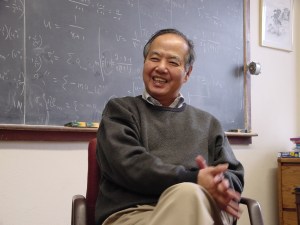
T.D.1.jpg_copyI’ve just heard the sad news of the death at the age of 97 of TD Lee (shown left) who, together with CN Yang, won the Nobel Prize for Physics in 1957 for his work on parity violation in particle physics. I always find it difficult on occasions like this to find ways of describing the work of people of such eminence in fields other than my own, but in this case it turns out I have a personal connection of a sort. Way back in 2006 when I was at Nottingham, the University decided to award Prof. Lee an honorary degree and I was chosen to deliver the oration at the graduation ceremony before spending some time chatting to him with some students. I remember that it was a very hot day and I was wilting under the graduation robes, but he took it all in his stride despite being 80 years old. Anyway, here is the text that I prepared for that occasion, which I hope will serve as a fitting obituary.


PROFESSOR TSUNG-DAO LEE

ORATION DELIVERED BY PROFESSOR PETER COLES

ON MONDAY 17 JULY 2006

Chancellor, Vice-Chancellor, Ladies and Gentlemen, it is both a pleasure and a privilege to present Professor Tsung-Dao Lee for the award of an honorary degree.  Professor Lee is a distinguished theoretical physicist whose work over many years has been characterized, in the words of Dr J Robert Oppenheimer, by “a remarkable freshness, versatility and style.”

Tsung-Dao Lee was born in Shanghai and educated at Suzhou University Middle School in Shanghai.  Fleeing the Japanese invasion, he left Shanghai in 1941.  His education was interrupted by war.  In 1945 he entered the National Southwest University in Kunming as a sophomore.  He was soon recognized as an outstanding young scientist and in 1946 was awarded a Chinese Government Scholarship enabling him to start a PhD in Physics under Professor Enrico Fermi at the University of Chicago.  He gained his doctorate in physics in 1950 with a thesis on the Hydrogen Content of White Dwarf Stars, and subsequently served as a research associate at the Yerkes Astronomical Observatory of the University of Chicago in Williams Bay, Wisconsin.

Astronomy is a science that concerns the very large, but it was in the physics of the very small that Professor Lee was to do his most famous work.  After one year as a research associate and lecturer at the University of California in Berkeley, he became a fellow of the Institute of Advanced Study in Princeton and, in 1953, he accepted an assistant professorship position at Columbia University in New York.  Two and a half years later, he became the youngest full professor in the history of Columbia University.  During this time he often collaborated with Chen Ning Yang whom he had known as a fellow student in Chicago.  In 1956 they co-authored a paper whose impact was both immediate and profound.  Only a year later, Lee and Yang were jointly awarded the Nobel Prize in Physics.  Professor Lee was thirty-one at the time and was the second youngest scientist ever to receive this distinction.  (The youngest was Sir Lawrence Bragg who shared the Physics Prize with his father in 1915, at the age of twenty-five; Werner Heisenberg was 31 when his Nobel Prize was announced, in 1932, but he did not receive the prize until the following year.)

It is usually difficult to explain the ideas of theoretical physics to non-experts.  The mathematical language is inaccessible to those without specialist training.  But some of the greatest achievements in this field are so bold and so original that they appear, at least with hindsight, to be astonishingly simple.  The work of Lee and Yang on parity violation in elementary particle interactions is an outstanding example.

Subatomic particles interact with each other in very complicated ways.  In high energy collisions, particles can be scattered, destroyed or transformed into other particles.  But governing these changes are universal rules involving things that never change.  The existence of these conservation laws is a manifestation of the symmetries possessed by the mathematical theory of particle interactions.

Lee and Yang focussed on a particular attribute called parity, which relates to the “handedness” of a particle and symmetry with respect to mirror reflections.  Physicists had previously assumed that the laws of nature do not distinguish between left- and right-handed states: a left-handed object when seen in a mirror should be indistinguishable from a right-handed one.  This symmetry suggests that parity should be conserved in particle interactions, as it is in many other physical processes.  Unfortunately this chain of thought led to a puzzling deadlock in our understanding of the so-called weak nuclear interaction.  Lee and Yang made the revolutionary suggestion that parity is not conserved in weak interactions and consequently that the laws of nature must have a built-in handedness.  A year later their theory was tested experimentally and found to be correct.  Their penetrating insight led to a radical overhaul of the theory of weak interactions and to many further discoveries.  Physicists around the world said “Of course!  Why didn’t I think of that?”

This classic “Eureka moment” happened half a century ago, but Professor Lee has since made a host of equally distinguished contributions to fields as diverse as astrophysics, statistical mechanics, field theory and turbulence.  He was made Enrico Fermi Professor at Columbia in 1964 and University Professor there in 1984.  With typical energy and enthusiasm he took up the post of director of the RIKEN Research Center at Brookhaven National Laboratories in 1998.  He has played a prominent role in the advancement of science in China, including roles as director of physics institutes in Beijing and Zhejiang.

Professor Lee has received numerous awards and honours from around the world, including the Albert Einstein Award in Science, the Bude Medal, the Galileo Galilei Medal, the Order of Merit, Grande Ufficiale of Italy, the Science for Peace Prize, the China National-International Cooperation Award, the New York City Science Award, the Pope Joannes Paulis Medal, Il Ministero dell’Interno Medal of the Government of Italy and the New York Academy of Sciences Award.  His recognition even extends beyond this world, for in 1997 Small Planet 3443 was named in his honour.

Chancellor, Vice-Chancellor, to you and to the whole congregation I present Professor Tsung-Dao Lee as eminently worthy to receive the degree of Doctor of Science, honoris causa.