Lecture Recordings Again

Posted in Cardiff, Covid-19, Education, Maynooth with tags , , , , , on March 5, 2025 by telescoper

Long before the pandemic restrictions – was it really five years ago that all that started? – I posted an item about an innovation I encountered when I moved to Sussex in 2013, namely lecture capture facilities which

…allow lecturers to record videos of their own lectures which are then made available for students to view online. This is of course very beneficial for students with special learning requirements, but in the spirit of inclusive teaching I think it’s good that all students can access such material. Some faculty were apparently a little nervous that having recordings of lectures available online would result in falling attendances at lectures, but in fact the evidence indicates precisely the opposite effect. Students find the recorded version adds quite a lot of value to the “live” event by allowing them to clarify things they might not have not noted down clearly.

A few years later, when I did some teaching back in Cardiff, I discovered that lecture recording had become normal practice there too. The main difference was that Sussex had a proper policy on important matters such as who could see the recordings, and what they could be used for, which allayed some staff fears about snooping and the inhibition of academic freedon; the policy at Cardiff had not been fully developed in advance of the rollout of lecture capture, which I think was a big mistake.

Anyway, before the pandemic we didn’t really have any facilities at Maynooth University for recording lectures so it certainly wasn’t normal practice. With the onset of Covid-19 lecture recordings and live streams became the only way to carry out teaching and we lecturers made the best of what we had at home. A couple of years ago, after restrictions were lifted, I posted about a meeting between student representatives and staff in the (then) Department of Theoretical Physics during which students criticized, among other examples of inadequate teaching resources. Part of the reason for this is the drastic shortage of student accommodation which means many students have to commute long distances to campus and have difficulty doing that every day for lectures.

I – and I’m speaking personally here – wish we could offer lecture recordings as routine. Unfortunately, however, and much to my disappointment, Senior Management at Maynooth University has discouraged lecture recording as a matter of policy and has not invested in the technology required to enable it, so it is not practicable anyway.

In my view the benefits of lecture capture far outweigh the disadvantages, and we should incorporate recordings of lectures as part of our standard teaching provision, as a supplement to learning rather than to replace face-to-face sessions. Every student learns in a different way and we should therefore be doing as much as we possibly can to provide a diverse range of teaching resources so that each can find the combination that suits them best. Technology allows us to do this far better now than in the past.

Some really enjoy live in-person lecture sessions, especially the ability to interact with the lecturer and the shared experience with other students, but others don’t like them as much. Others have reasons (such as disability) for not being able to attend in-person lectures, so providing recordings can help them. Others still have difficulty attending all lectures because of a dratic shortage of student accommodation. Why not in any case provide recordings for everyone? That seems to me to be a more inclusive approach.

The problem with lecture capture in Maynooth is that we will need to improve the cameras and recording equipment in the large lecture rooms to make it possible for lectures with a significant mathematical content. The existing setups in teaching rooms do not easily allow the lecturer to record material on a whiteboard or blackboard. In Cardiff, for example, the larger rooms had more than one camera, usually one on the lectern and one on the screen or whiteboard (which has to be placed further away and therefore needs to be of higher resolution). In Maynooth we only have small low-resolution cameras in the teaching rooms. In fact I have far better facilities in my study at home – provided at my own expense – than my employer is prepared to provide on campus.

Anyway, the reason for mentioning all this is that I saw an article today in the University Times (a student newspaper based at Trinity College, Dublin). I can only infer that someone at Trinity has floated the idea of mandatory lecture recordings, because the piece argues against them even with

…established guidelines for their use, re-use, storage, and dissemination, and a ban of their use during industrial action.

I think a properly negotiated agreement with the Trade Union representing staff (e.g. IFUT, of which I am a member) covering these points would allow me to accept mandatory lecture recordings. Worries about covert monitoring or unauthorized dissemination on social media would hopefully be assuaged by such an agreement. A particular issue in the UK, given the current meltdown of its higher education sector, Senior Management may sack lecturers to save money but keep using their recordings. That would be unconscionable, but that doesn’t mean it won’t be tried.

FRS: Failure at the Royal Society

Posted in Politics with tags , on March 4, 2025 by telescoper

A while ago I posted an item about the Royal Society’s failure to take proper action against Elon Musk. The petition I linked to then gained almost 4,000 signatures – including quite a number of people I know. Well, yesterday evening that venerable institution held a meeting attended by over 150 of its Fellows. The meeting was behind closed doors but it seems to have been rather fractious. It also seems that Elon Musk remains a Fellow.

Here is the resulting statement in all its bland uselessness:

At a meeting this evening of the Royal Society, Fellows agreed on the need to stand up for science and for scientists around the world in the face of the growing challenges science faces.

Concern was expressed, in particular, about the fate of colleagues in the US who are reportedly facing the prospect of losing their jobs amid threats of radical cutbacks in research funding.

Fellows, over 150 of whom attended tonight’s meeting, were united in the need for the Society to step up its efforts to advocate for science and scientists at a time when these are under threat as never before and yet at the same time have never been more necessary for humanity at large.

The Society agreed to look at potential further actions that might help make the case for science and scientific research and counter the misinformation and ideologically motivated attacks on both science and scientists.

Is that the best they could come up with?

Fat Tuesday again…

Posted in Jazz with tags , , , on March 4, 2025 by telescoper

Well, it’s Shrove Tuesday, Pancake Day, Mardi Gras and Fat Tuesday which gives me four excuses to post this lovely old record made by Humphey Lyttelton’s Paseo Jazz Band in the early Fifties. That’s the band that featured Humph’s regular crew alongside a number of London’s marvellous West Indian musicians of the time, hence the abundance of percussion and the resulting infectious calypso beat. I’ve posted this before but the link died, so here it is again. Enjoy!

If Oscar Wilde were a Torus

Posted in mathematics with tags , , , , on March 3, 2025 by telescoper

Term goes on…

Posted in Biographical, Education, Maynooth with tags , , , , , on March 2, 2025 by telescoper

Here we are, about to start the fifth week of the Spring semester at Maynooth University. Teaching isn’t going too badly, but I have come to realize that I have a lot of continuous assessment marking to do – classs tests and mini-projects for Computational Physics and assignments for Particle Physics. The numbers of students involved are 32 in the first case and 23 in the second, but I have to do all the corrections myself. Ho hum. Still, I’m enjoying teaching particle physics again after a gap of 15 years or so so I can’t complain about that.

Last week saw some important achievements by research students. Two students in the Department of Physics – one of them supervised by me – submitted their PhD theses last week. Nominations of examiners have to be approved by Faculty and Academic Council but that should be a formality and we then have the viva voce examinations, so the process is not over yet, but the submission of a thesis is a landmark in itself and is to be celebrated.

Something less worthy of celebration is the ongoing chaos at Maynooth over funding for future research students. You may recall that I posted about the terrible decision by the Management of Maynooth University to scrap the John and Pat Hume Doctoral Scholarships and followed this up with another post suggesting the decision might be reversed and another pointing out that it hadn’t been. The Hume scheme has been paused for a “review”. That review was actually completed in January. It is now March and academic staff have still had no word about the status of the Hume Scholarships. Someone is stalling.

I have received a number of enquiries in recent weeks from prospective students about when applications would open as I’m sure is also the case for several of my colleagues. It has been very depressing to have to reply saying that I have no idea. As far as I know the scheme is suspended indefinitely. It’s now effectively too late for this year anyway, as most prospective students will already have lined up offers elsewhere. Only students not able to secure a place elsewhere will be available to apply if and when the scheme does open.

The timing of this is especially sad for the new Department of Physics. Our final-year Theoretical Physics class sizes are larger than ever but the Maynooth is sending them a very clear signal that it doesn’t want any of them to stay here for their PhDs.

A Poem for St David’s Day

Posted in Poetry with tags , , , , on March 1, 2025 by telescoper
Daffodils photographed yesterday at Maynooth University

It’s St David’s Day so, notwithstanding the fact that I’ve just watched Leinster beat Cardiff 42-24 at Rugby,

Dydd Gŵyl Dewi Hapus!

On this day I usually post a poem by a Welsh poet. This, by Dylan Thomas, which was published in 1936 and seems to me to be rather topical, featured in the concert I went to about a month ago.

The hand that signed the paper felled a city;
Five sovereign fingers taxed the breath,
Doubled the globe of dead and halved a country;
These five kings did a king to death.

The mighty hand leads to a sloping shoulder,
The finger joints are cramped with chalk;
A goose's quill has put an end to murder
That put an end to talk.

The hand that signed the treaty bred a fever,
And famine grew, and locusts came;
Great is the hand that holds dominion over
Man by a scribbled name.

The five kings count the dead but do not soften
The crusted wound nor pat the brow;
A hand rules pity as a hand rules heaven;
Hands have no tears to flow.

The Universe Keeper

Posted in Maynooth, The Universe and Stuff with tags , , , , , , on February 28, 2025 by telescoper

Interested in learning a little bit about the ideas behind string theory? Here’s a short video that tries to explain the basics in a thought-provoking way. It features three main characters: The Universe Keeper Renata, inspired by Russian-American physicist Renata Kallosh, the quizzical Wolfie, inspired by the Austrian Nobel laureate Wolfgang Pauli, and the inquisitive Albie, inspired by Albert Einstein.

See what you make of it…

(One of the creators of this video is my PhD student Kay Lehnert, who has just given a departmental seminar in which he mentioned the video.)

Roger Penrose: Discoverer of Black Holes?

Posted in History, The Universe and Stuff with tags , , , , , , , , , on February 27, 2025 by telescoper

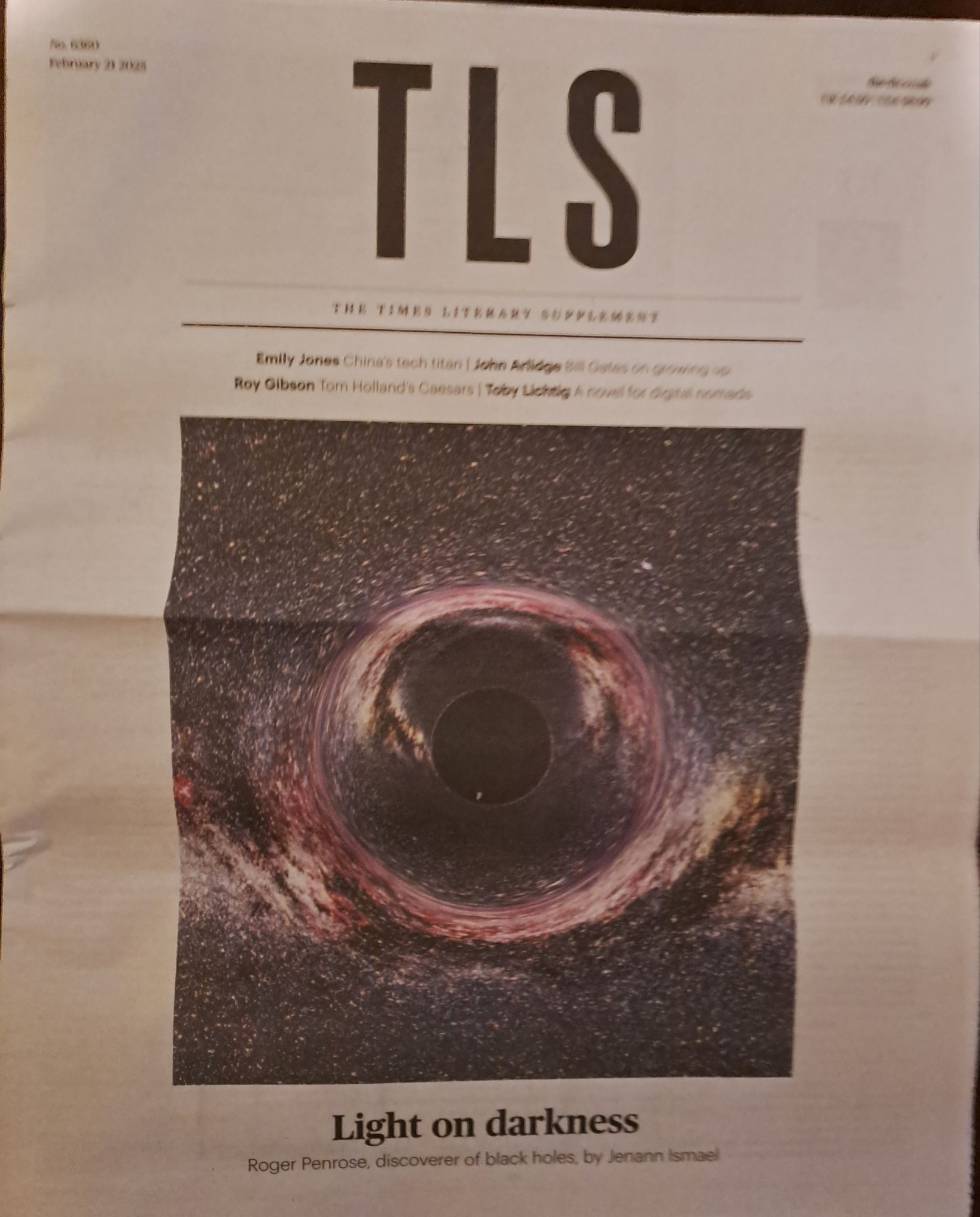
I got home from a busy day on campus to find the 21st February issue of the Times Literary Supplement had landed on my doormat having arrived today, 27th February. It used to take a couple of weeks for my subscription copy to reach Ireland but recently the service has improved. Intriguingly, the envelope it comes in is postmarked Bratislava…

But I digress. This is the cover:

The text below the title “Light on darkness” under the graphic reads “Roger Penrose, discoverer of black holes, by Jennan Ismael”. Nice though it is to see science featured in the Times Literary Supplement for a change and much as I admire Roger Penrose, it is unreasonable to describe him as “the discoverer of black holes”.

A black hole represents a region of space-time where the action of gravity is sufficiently strong that light cannot escape. The idea that such a phenomenon might exist dates back to John Michell, an English clergyman, in 1783, and later by Pierre-Simon Laplace but black holes are most commonly associated with Einstein’s theory of general relativity.  Indeed, one of the first exact solutions of Einstein’s equations to be found describes such an object. The famous Schwarzschild solution was obtained in 1915 by Karl Schwarzschild, who died soon after on the Eastern front in the First World War. The solution corresponds to a spherically-symmetric distribution of matter, and it was originally intended that it could form the basis of a mathematical model for a star. It was soon realised, however that for an object of any mass M there is a critical radius (Rs, the Schwarzschild radius) such that if all the mass is squashed inside Rs then no light can escape.  In terms of the mass M, velocity of light c, and Newton’s constant G, the critical radius is given by Rs = 2GM/c2 . For the mass of the Earth, the critical radius is only 1cm, whereas for the Sun it is about 3km.

Since the pioneering work of Schwarzschild, research on black holes has been intense and other kinds of mathematical solutions have been obtained. For example, the Kerr solution describes a rotating black hole and  the Reissner -Nordstrom solution corresponds to  a black hole with an electric charge.  Various theorems have also been demonstrated relating to the so-called `no-hair’ conjecture: that black holes give very little outward sign of what is inside.

Some people felt that the Schwarzschild solution was physically unrealistic as it required a completely spherical object, but Roger Penrose showed mathematically that the existence of a trapped surface was a generic consequence of gravitational collapse, the result that won him the Nobel Prize in 2020. His work did much to convince scientists of the physical reality of black holes, and he deserved his Nobel Prize, but I don’t think it is fair to say he “discovered” them.

I would say that, as is the case for discoveries in many branches of science, there isn’t just one “discoverer” of black holes: there were important contributions by many people along the way.

P.S. If you want to limit the application of the word “discovery” to observations then I think that the discovery of black holes is down to Paul Murdin and Louise Webster who identified the first really plausible candidate for a black hole in Cygnus X-1, way back in 1971…

P.P.S. The term “Black Hole” was, as far as I know, coined by John Wheeler in 1967.

Roger Penrose is 93.

The University of Edinburgh in Crisis

Posted in Education, Finance with tags , , , , on February 26, 2025 by telescoper

It seems that financial emergencies are spreading around the United Kingdom like a contagion. About a month ago I posted about the crisis at Cardiff University, but now there’s a bombshell about the University of Edinburgh which, according to the Times Higher is planning to make cuts of around £140 million in recurrent expenditure, about 10% of its annual operating budget. This level of cuts is greater than those previously listed at other universities, including Cardiff, the largest of which are measured in tens of millions. The piece goes on to explain that target can’t be reached by voluntary redundancies, which presumably means compulsory redundancies are looming.

I don’t know which particular academic units are under threat, but I’m sure this episode is causing a great deal of stress to a great many people. The only advice I can offer to anyone at Edinburgh worrying about the future is, if they haven’t done so already, to JOIN A UNION!

Talking of which, the University of Edinburgh UCU has pointed out that the University revealed a budget surplus last year and has huge reserves measured in the billions. It accuses managers of manufacturing a crisis in order to cut staff and bring about even more centralisation – thus achieving an even greater level of corporate control over teaching and research activities. The subordination of academia to management is the aim. I don’t doubt that university managers around the world believe that teaching will be largely done by AI anyway which will allow even more lecturing staff to be cut.

I believe that universities need less centralisation not more. The Principal of the University of Edinburgh, Peter Mathieson, is quoted in the Times Higher piece as saying:

We can no longer afford to run duplicative services across the university, often with inconsistent practices which create inefficiencies, increase staff workload and impact our student experience..

This is fair enough, but it is quite wrong to assume that greater centralisation is the solution. In my experience it is “The Centre” that creates inefficiencies, increases staff workload and impacts student experience. That is because it knows far less than Schools and Departments about what is needed to achieve their academic objectives. Universities need a flatter and more responsive structure, not the ever-increasing management bloat that has been imposed on them for decades and which is now causing them to capsize.