
A Little Bit of Chaos
Posted in The Universe and Stuff with tags astronomy, Carl Heiles, Chaos, Laplace, Michel Henon, phase space, Physics, Sir Isaac Newton, Sir William Hamilton on November 21, 2009 by telescoperThe era of modern physics could be said to have begun in 1687 with the publication by Sir Isaac Newton of his great Philosophiae Naturalis Principia Mathematica, (Principia for short). In this magnificent volume, Newton presented a mathematical theory of all known forms of motion and, for the first time, gave clear definitions of the concepts of force and momentum. Within this general framework he derived a new theory of Universal Gravitation and used it to explain the properties of planetary orbits previously discovered but unexplained by Johannes Kepler. The classical laws of motion and his famous “inverse square law” of gravity have been superseded by more complete theories when dealing with very high speeds or very strong gravity, but they nevertheless continue supply a very accurate description of our everyday physical world.
Newton’s laws have a rigidly deterministic structure. What I mean by this is that, given precise information about the state of a system at some time then one can use Newtonian mechanics to calculate the precise state of the system at any later time. The orbits of the planets, the positions of stars in the sky, and the occurrence of eclipses can all be predicted to very high accuracy using this theory.
At this point it is useful to mention that most physicists do not use Newton’s laws in the form presented in the Principia, but in a more elegant language named after Sir William Rowan Hamilton. The point about Newton’s laws of motion is that they are expressed mathematically as differential equations: they are expressed in terms of rates of changes of things. For instance, the force on a body gives the rate of change of the momentum of the body. Generally speaking, differential equations are very nasty things to solve which is a shame because most a great deal of theoretical physics involves them. Hamilton realised that it was possible to express Newton’s laws in a way that did not involve clumsy mathematics of this type. His formalism was equivalent, in the sense that one could obtain the basic differential equations from it, but easier to use in general situations. The key concept he introduced – now called the Hamiltonian – is a single mathematical function that depends on both the positions q and momenta p of the particles in a system, say H(q,p). This function is constructed from the different forms of energy (kinetic and potential) in the system, and how they depend on the p’s and q’s, but the details of how this works out don’t matter. Suffice to say that knowing the Hamiltonian for a system is tantamount to a full classical description of its behaviour.
Hamilton was a very interesting character. He was born in Dublin in 1805 and showed an astonishing early flair for languages, speaking 13 of them by the time he was 13. He graduated from Trinity College aged 22, at which point he was clearly a whiz-kid at mathematics as well as languages. He was immediately made professor of astronomy at Dublin and Astronomer Royal for Ireland. However, he turned out to be hopeless at the practicalities of observational work. Despite employing three of his sisters to help him in the observatory he never produced much of astronomical interest. Mathematics and alcohol seem to have been the two real loves of his life.
It is a fascinating historical fact that the development of probability theory during the late 17th and early 18th century coincided almost exactly with the rise of Newtonian Mechanics. It may seem strange in retrospect that there was no great philosophical conflict between these two great intellectual achievements since they have mutually incompatible views of prediction. Probability applies in unpredictable situations; Newtonian Mechanics says that everything is predictable. The resolution of this conundrum may owe a great deal to Laplace, who contributed greatly to both fields. Laplace, more than any other individual, was responsible to elevated the deterministic world-view of Newton to a scientific principle in its own right. To quote:
We ought then to regard the present state of the Universe as the effect of its preceding state and as the cause of its succeeding state.
According to Laplace’s view, knowledge of the initial conditions pertaining at the instant of creation would be sufficient in order to predict everything that subsequently happened. For him, a probabilistic treatment of phenomena did not conflict with classical theory, but was simply a convenient approach to be taken when the equations of motion were too difficult to be solved exactly. The required probabilities could be derived from the underlying theory, perhaps using some kind of symmetry argument.
The s-called “randomizing” devices used in all traditional gambling games – roulette wheels, dice, coins, bingo machines, and so on – are in fact well described by Newtonian mechanics. We call them “random” because the motions involved are just too complicated to make accurate prediction possible. Nevertheless it is clear that they are just straightforward mechanical devices which are essentially deterministic. On the other hand, we like to think the weather is predictable, at least in principle, but with much less evidence that it is so!
But it is not only systems with large numbers of interacting particles (like the Earth’s atmosphere) that pose problems for predictability. Some deceptively simple systems display extremely erratic behaviour. The theory of these systems is less than fifty years old or so, and it goes under the general title of nonlinear dynamics. One of the most important landmarks in this field was a study by two astronomers, Michel Hénon and Carl Heiles in 1964. They were interested in what would happens if you take a system with a known analytical solutions and modify it.
In the language of Hamiltonians, let us assume that H0 describes a system whose evolution we know exactly and H1 is some perturbation to it. The Hamiltonian of the modified system is thus

What Hénon and Heiles did was to study a system whose unmodified form is very familiar to physicists: the simple harmonic oscillator. This is a system which, when displaced from its equilibrium, experiences a restoring force proportional to the displacement. The Hamiltonian description for a single simple harmonic oscillator system involves a function that is quadratic in both p and q:

The solution of this system is well known: the general form is a sinusoidal motion and it is used in the description of all kinds of wave phenomena, swinging pendulums and so on.
The case Henon and Heiles looked at had two degrees of freedom, so that the Hamiltonian depends on q1, q2, p1 and p2:

However, in this example, the two degrees of freedom are independent, meaning that there is uncoupled motion in the two directions. The amplitude of the oscillations is governed by the total energy of the system, which is a constant of the motion. Other than this, the type of behaviour displayed by this system is very rich, as exemplified by the various Lissajous figures shown in the diagram below. Note that all these figures are produced by the same type of dynamical system of equations: the different shapes are consequences of different initial conditions and different coefficients (which I set to unity in the form above).
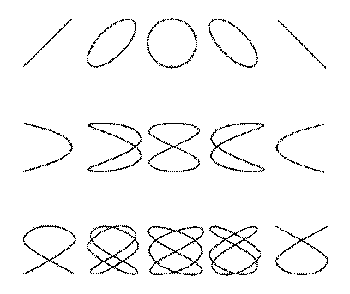
If the oscillations in each direction have the same frequency then one can get an orbit which is a line or an ellipse. If the frequencies differ then the orbits can be much more complicated, but still pretty. Note that in all these cases the orbit is just a line, i.e. a one-dimensional part of the two-dimensional space drawn on the paper.
More generally, one can think of this system as a point moving in a four-dimensional phase space defined by the coordinates q1, q2, p1 and p2; taking slices through this space reveals qualitatively similar types of orbit for, say, p2 and q2 as for p1 and p2. The motion of the system is confined to a lower-dimensional part of the phase space rather than filling up all the available phase space. In this particular case, because each degree of freedom moves in only one of its two available dimensions, the system as a whole moves in a two-dimensional part of the four-dimensional space.
This all applies to the original, unperturbed system. Hénon and Heiles took this simple model and modified by adding a term to the Hamiltonian that was cubic rather than quadratic and which coupled the two degrees of freedom together. For those of you interested in the details their Hamiltonian was of the form

The first set of terms in the brackets is the unmodified form, describing a simple harmonic oscillator; the other two terms are new. The result of this simple alteration is really quite surprising. They found that, for low energies, the system continued to behave like two uncoupled oscillators; the orbits were smooth and well-behaved. This is not surprising because the cubic modifications are smaller than the original quadratic terms if the amplitude is small. For higher energies the motion becomes a bit more complicated, but the phase space behaviour is still characterized by continuous lines, as shown in the left hand part of the following figure.
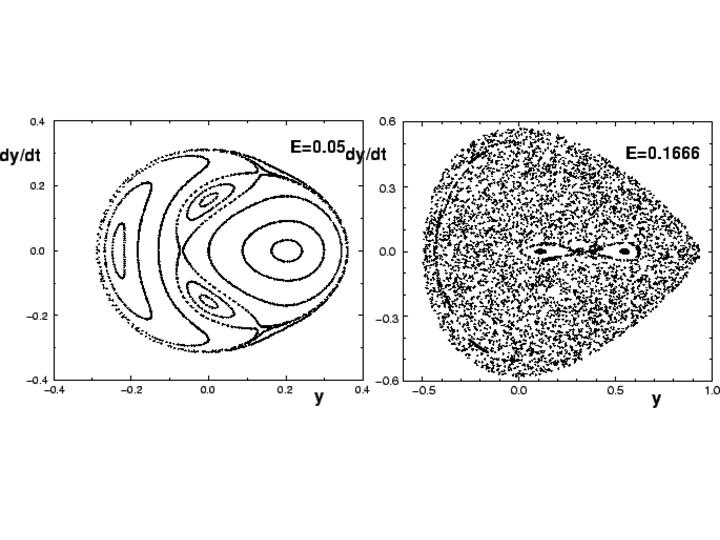
However, at higher values of the energy (right), the cubic terms become more important, and something very striking happens. A two-dimensional slice through the phase space no longer shows the continuous curves that typify the original system, but a seemingly disorganized scattering of dots. It is not possible to discern any pattern in the phase space structure of this system: it appear to be random.
Nowadays we describe the transition from these two types of behaviour as being accompanied by the onset of chaos. It is important to note that this system is entirely deterministic, but it generates a phase space pattern that is quite different from what one would naively expect from the behaviour usually associated with classical Hamiltonian systems. To understand how this comes about it is perhaps helpful to think about predictability in classical systems. It is true that precise knowledge of the state of a system allows one to predict its state at some future time. For a single particle this means that precise knowledge of its position and momentum, and knowledge of the relevant H, will allow one to calculate the position and momentum at all future times.
But think a moment about what this means. What do we mean by precise knowledge of the particle’s position? How precise? How many decimal places? If one has to give the position exactly then that could require an infinite amount of information. Clearly we never have that much information. Everything we know about the physical world has to be coarse-grained to some extent, even if it is only limited by measurement error. Strict determinism in the form advocated by Laplace is clearly a fantasy. Determinism is not the same as predictability.
In “simple” Hamiltonian systems what happens is that two neighbouring phase-space paths separate from each other in a very controlled way as the system evolves. In fact the separation between paths usually grows proportionally to time. The coarse-graining with which the input conditions are specified thus leads to a similar level of coarse-graining in the output state. Effectively the system is predictable, since the uncertainty in the output is not much larger than in the input.
In the chaotic system things are very different. What happens here is that the non-linear interactions represented in the Hamiltonian play havoc with the initial coarse-graining. Phase-space orbits that start out close to each other separate extremely violently (typically exponentially) and in a way that varies from one part of the phase space to another. What happens then is that particle paths become hopelessly scrambled and the mapping between initial and final states becomes too complex to handle. What comes out the end is practically impossible to predict.

Talked Out
Posted in Books, Talks and Reviews, Cosmic Anomalies with tags Bath, Bath Royal Literary and Scientific Institution, Imperial College, William Herschel Society on November 20, 2009 by telescoperMy trip to Bath yesterday turned out to be very enjoyable and entirely free of aqueous complications. The train ran on time from Cardiff to Bath Spa, although it was hideously overcrowded. About an hour later I was met at the station by Gary Mathlin and taken to the University campus in his car. I didn’t get to see much of the city because it was already dark, but parts of it are very beautiful in a very Jane-Austen type of way. The University of Bath campus is a very different kettle of fish, a 1960s modernist construction in which I would have got completely lost had I not had a guide. Quite smart though. Better than most of its ilk.
The talk itself was in quite a large and swish lecture theatre. I’m not sure how many turned up but it might have been close to a hundred or so. Very mixed too, with quite a few students and some much older types.
I thought it went down quite well, but you’ll really have to ask the audience about that! I answered a few questions at the end and then there was a very generous vote of thanks and I was given a gift of a very interesting book published by Bath Royal Literary and Scientific Institution. Thereafter I was whisked off to dinner, which I hadn’t realised was going to happen. I had the chance to chat to various people, including students and members of the William Herschel Society, all of whom were very friendly and convivial after a few glasses of wine. Fortunately, Gary Mathlin lives in Cardiff so he gave me a lift home afterwards so I didn’t get back too late.
This morning I had to head straight to London without going into work in order to get to Imperial College to give a lunchtime seminar at the Theoretical Physics group, which is based in the Huxley building. I think it is named after T.H. rather than Aldous, because I wasn’t offered any Mescalin. Of course seminars like this have a much smaller audience and are much more technical than public lectures, but I still found myself having flashbacks to the previous evening’s lecture. I talked about various bits and pieces arising from work I’ve been doing with various people about the cosmic anomalies I’ve blogged about from time to time.
After this we went to a local pizzeria for a late lunch (and a couple of glasses of wine). I would have liked to stay longer to chat with the folks there, but I wanted to get back to Cardiff at a reasonable hour so I left in time for the 4.15 train.
Walking back home from Cardiff station along the side of the River Taff I was struck by its rather sinister appearance. Still high after the recent rains, and lit only by the lights of the city, it glistened like thick black oil as it flowed very quickly down towards the Bay. I felt more than a hint of menace in the sheer volume of water streaming past in the darkness.
So far we’ve escaped the worst of the season’s bad weather. The fells of Cumbria, in the far north-west of England, have had 14 inches of rain in 2 days, which is a record. If that happened in South Wales I’m not sure even Cardiff’s formidable flood defences would cope! The forecast for this weekend is terrible so I don’t think I’ll be doing anything very much outdoors. That suits me, in fact, as all this travelling about has left me well and truly knackered. Time for an early night, I think!
Aquae Sulis
Posted in Books, Talks and Reviews, The Universe and Stuff with tags Annual Herschel Lecture, Cosmology, Minerva, Sulis, University of Bath, William Herschel Society on November 19, 2009 by telescoperJust time for a quick post this lunchtime, in between a whole day of meetings with students about projects and other things. This afternoon I have to whizz off to the fine city of Bath where this evening I am giving a public lecture jointly organized by the University of Bath and the William Herschel Society (which is based in Bath).
The title of my talk is The Cosmic Web, and a brief outline is as follows.
The lecture will focus on the large scale structure of the Universe and the ideas that physicists are weaving together to explain how it came to be the way it is.
Over the last few decades astronomers have revealed that our cosmos is not only vast in scale – at least 14 billion light years in radius – but also exceedingly complex in texture, with galaxies and clusters of galaxies linked together in immense chains and sheets tracing out an immense network of structures we call the Cosmic Web.
Cosmologists have developed theoretical explanations for its origin that involve such exotic concepts as ‘dark matter’ and ‘cosmic inflation’, producing a cosmic web of ideas that is in many ways as rich and fascinating as the Universe itself.
The University of Bath website has more details of the talk, and I think they are going to do a podcast too. I’ll actually be doing a recap in a couple of weeks’ time in Bristol at an event for the Institute of Physics, of which more anon.
Bath is only about an hour from Cardiff by train and I’m very much looking forward to this trip as I have never been to the University of Bath before.I remember from my schooldays that the Romans named the place Aquae Sulis (or, as my Latin teacher Mr Keating who couldn’t pronounce his esses would say, Aquae Thulith). The local waters were famous for their healing powers even before the Romans got to England, and the Celtic inhabitants attributed this to a deity they called Sulis. The Romans kept the name, although they decided that Sulis was actually their goddess Minerva in disguise. The Romans were good at appropriating local traditions like that.
The only potential fly in the ointment is the British weather, which has been terrible over the last week or so and further deluges are forecast this afternoon and evening. As I write, though, it’s actually fine and sunny and the weather map suggests the worst of the current band of rain has passed to the north of here. I hope I’m not tempting providence, and that there won’t be too much of the aquae heading in my direction!
The Academic Journal Racket
Posted in Open Access, Science Politics with tags Academic Journals, arXiv, astronomy, Institute of Physics, Physics, Publishing on November 18, 2009 by telescoperI’ve had this potential rant simmering away at the back of my mind for a while now, since our last staff meeting to be precise. In common, I suspect, with many other physics and astronomy departments, here at Cardiff we’re bracing ourselves for an extended period of budget cuts to help pay for our government’s charitable donations of taxpayer’s money to the banking sector.
English universities are currently making preparations for a minimum 10% reduction in core funding, and many are already making significant numbers of redundancies. We don’t know what’s going to happen to us here in Wales yet, but I suspect it will be very bad indeed.
Anyway, one of the items of expenditure that has been identified as a source of savings as we try to tighten our collective belts is the cost of academic journals. I nearly choked when the Head of School revealed how much we spend per annum on some of the journal subscriptions for physics and astronomy. In fact, I think university and departmental libraries are being taken to the cleaners by the academic publishing industry and it’s time to make a stand.
Let me single out one example. Like many learned societies, the Institute of Physics (the professional organisation for British physicists) basically operates like a charity. It does, however, have an independent publishing company that is run as a profit-making enterprise. And how.
In 2009 we paid almost £30K (yes, THIRTY THOUSAND POUNDS) for a year’s subscription to the IOP Physics package, a bundled collection of mainstream physics journals. This does not include Classical and Quantum Gravity or the Astrophysical Journal (both of which I have published in occasionally) which require additional payments running into thousands of pounds.
The IOP is not the only learned society to play this game. The Royal Astronomical Society also has a journal universally known as MNRAS (Monthly Notices of the Royal Astronomical Society) which earns it a considerable amount of revenue from its annual subscription of over £4K per department. Indeed, I don’t think it is inaccurate to say that without the income from MNRAS the RAS itself would face financial oblivion. I dare say MNRAS also earns a tidy sum for its publisher Wiley…
If you’re not already shocked by the cost of these subscriptions, let me outline the way academic journal business works, at least in the fields of physics and astronomy. I hope then you’ll agree that we’re being taken to the cleaners.
First, there is the content. This consists of scientific papers submitted to the journal by researchers, usually (though not exclusively) university employees. If the paper is accepted for publication the author receives no fee whatsoever and in some cases even has to pay “page charges” for the privilege of seeing the paper in print. In return for no fee, the author also has to sign over the copyright for the manuscript to the publisher. This is entirely different from the commercial magazine market, where contributors are usually paid a fee for writing a piece, or book publishing, where authors get a royalty on sales (and sometimes an advance).
Next there is the editorial process. The purpose of an academic journal – if there is one – is to ensure that only high quality papers are published. To this end it engages a Board of Editors to oversee this aspect of its work. The Editors are again usually academics and, with a few exceptions, they undertake the work on an unpaid basis. When a paper arrives at the journal which lies within the area of expertise of a particular editor, he or she identifies one or more suitable referees drawn from the academic community to provide advice on whether to publish it. The referees are expected to read the paper and provide comments as well as detailed suggestions for changes. The fee for referees? You guess it. Zilch. Nada.
The final part of the business plan is to sell the content (supplied for free), suitably edited (for free) and refereed (for free) back to the universities paying the wages of the people who so generously donated their labour. Not just sell, of course, but sell at a grossly inflated price.
Just to summarise, then: academics write the papers, do the refereeing and provide the editorial oversight for free and we then buy back the product of our labours at an astronomical price. Why do we participate in this ridiculous system? Am I the only one who detects the whiff of rip-off? Isn’t it obvious that we (I mean academics in universities) are spending a huge amout of time and money achieving nothing apart from lining the pockets of these exploitative publishers?
And if it wasn’t bad enough, there’s also the matter of inflation. There used to be a myth that advances in technology should lead to cheaper publishing.Nowadays authors submit their manuscripts electronically, they are sent electronically to referees and they are typset automatically if and when accepted. Most academics now access journals online rather than through paper copies; in fact some publications are only published electronically these days. All this may well lead to cheaper publishing but it doesn’t lead to cheaper subscriptions. The forecast inflation rate for physics journals over this year is about 8.5%, way above the Retail Price Index, which is currently negative.
Where is all the money going? Right into the pockets of the journal publishers. Times are tough enough in the university sector without us giving tens of thousands of pounds per year, plus free editoral advice and the rest, to these rapacious companies. Enough is enough.
It seems to me that it would be a very easy matter to get rid of academic journals entirely (at least from the areas of physics and astronomy that I work in). For a start, we have an excellent free repository (the arXiv) where virtually every new research paper is submitted. There is simply no reason why we should have to pay for journal subscriptions when papers are publically available there. In the old days, the journal industry had to exist in order for far flung corners of the world to have access to the latest research. Now everyone with an internet connection can get it all. Journals are redundant.
The one thing the arXiv does not do is provide editorial control, which some people argue is why we have to carry on being fleeced in the way I have described. If there is no quality imprint from an established journal how else would researchers know which papers to read? There is a lot of dross out there.
For one thing, not all referees put much effort into their work so there’s a lot of dross in refereed journals anyway. And, frustratingly, many referees sit on papers for months on end before sending in a report that’s only a couple of sentences. Far better, I would say, to put the paper on the arXiv and let others comment on it, either in private with the authors or perhaps each arXiv entry should have a comments facility, like a blog, so that the paper could be discussed interactively. The internet is pushing us in a direction in which the research literature should be discussed much more openly than it is at present, and in which it evolves much more as a result of criticisms and debate.
Finally, the yardstick by which research output is now being measured – or at least one of the metrics – is not so much a count of the number of refereed papers, but the number of citations the papers have attracted. Papers begin to attract citations – through the arXiv – long before they appear in a refereed journal and good papers get cited regardless of where they are eventually published.
If you look at citation statistics for refereed journals you will find it very instructive. A sizeable fraction of papers published in the professional literature receive no citations at all in their lifetime. So we end up paying over the odds for papers that nobody even bothers to read. Madness.
It could be possible for the arXiv (or some future version of it) to have its own editorial system, with referees asked to vet papers voluntarily. I’d be much happier giving my time in this way for a non-profit making system than I am knowing that I’m aiding and abetting racketeers. However, I think I probably prefer the more libertarian solution. Put it all on the net with minimal editorial control and the good stuff will float to the top regardless of how much crud there is.
Anyway, to get back to the starting point of this post, we have decided to cancel a large chunk of our journal subscriptions, including the IOP Physics package which is costing us an amount close to the annual salary of a lecturer. As more and more departments decide not to participate in this racket, no doubt the publishers will respond by hiking the price for the remaining customers. But it seems to me that this lunacy will eventually have to come to an end.
And if the UK university sector has to choose over the next few years between sacking hundreds of academic staff and ditching its voluntary subsidy to the publishing industry, I know what I would pick…
Follow @telescoperPlanet Wave
Posted in Jazz, Poetry, The Universe and Stuff with tags Edwin Morgan, Planet Wave, Tommy Smith on November 17, 2009 by telescoperRegular readers of this blog (both of you) will know that from time to time I like to post little bits of poetry. The verses are usually related to astronomy (or science generally) and they’re usually things I come across pretty much by accident when I’m browsing through the books of poetry I occasionally buy. This evening I was leafing through a collection called A Book of Lives, by the popular and highly respected Scottish national poet Edwin Morgan. In the middle of this set is a long sequence of poems called Planet Wave, each of which is to do with a specific historical episode or important character, such as Copernicus or Darwin. The first poem in the cycle is about the Big Bang so I thought it would be a good choice.
However, regular readers will also know that I like to post bits of jazz on here too – although the blog statistics suggest that these are much less popular than the poetry! I read in the Book of Lives that the first half the sequence of poems making up Planet Wave was commissioned by the Cheltenham International Jazz Festival and set to music by the excellent Tommy Smith. The poetry and music combination was first performed in Cheltenham Town Hall on 4 April 1997.
Great, I thought. Here’s a chance to combine jazz and poetry (for what would only be the second time on here, the first being this post). Unfortunately, though, I’ve been unable to locate any recording of a performance of this work. I found an interview with Tommy Smith on the net which suggests a recording was made but never released. I’d certainly love to hear it and I hope that there might be a jazz fan out there somewhere who knows what happened to it.
Anyway, in the absence of the music here’s just the first verse of the first poem of the cycle. As you will see, Morgan’s style is very inventive, often extremely funny, and always extremely Scottish.
In the Beginning
(20 Billion BC)
Don’t ask me and don’t tell me. I was there.
It was a bang and it was big. I don’t know
what went before, I came out with it.
Think about that if you want my credentials.
Think about that, me, it, imagine it
as I recall it now, swinging in my spacetime hammock,
nibbling a moon or two, watching you.
What am I? You don’t know. It doesn’t matter.
I am the witness, I am not in the dock.
I love matter and I love anti-matter.
Listen to me, listen to my patter.
(Reproduced by kind permission of Carcanet Press.)
If you want to read the rest you’ll have to buy the book! And if anyone out there knows what happened to the recording of Planet Wave please let me know. I’d love to hear it!
Les Feuilles Mortes
Posted in Biographical, Columbo with tags Autumn, Cardiff, Columbo, Weather on November 16, 2009 by telescoperAfter the strain of writing a long post about something halfway interesting yesterday, as well as spending most of today at work composing and sending out umpteen letters of recommendation for various people’s job applications, I haven’t got the energy to write very much today. However, I was reminded at the weekend that it’s been a while since I posted anything about Columbo.
It’s almost two months in fact since I took the moggy to the vets to have another blood sample extracted, although I think he extracted more from the vet and her assistant than they got from him. They phoned me a day or two later to say that his blood sugar levels were fine and he didn’t need to go back for six months or so.
We’ve settled back into normality, except that I’m keeping a specially close eye on his food intake since the vet declared him officially obese. He’s lost about 350g since he’s been on the current diet, so it’s working. He’s more affectionate too, at least when it’s time for the grub. Cupboard love, I think it’s called.
After a couple of generally fine and temperate months in September and October, we’ve suddenly hit a patch of decidedly inclement weather this November. Over the weekend a fairly intense storm passed over the UK, heavy rainfall causing floods here and there and high winds causing problems in a number of areas. Cardiff is fairly sheltered so the winds didn’t do much serious damage here – at least not that I noticed – apart from bringing down what was left of the leaves on the trees in the surrounding streets and in the park. The effect of the pouring rain on the fallen leaves has been to produce an unpleasant slippy brown sludge on the paths and pavements.
Columbo has a bit of a thing about windy days and leaves. He always seems to enjoy going out into the garden when it’s blowing a gale. He gets very skittish and chases things about as if he were a youngster again. Well, for a few minutes at least. The recent storms have curtailed this fun a bit. I don’t think there’s much excitement in playing with a pile of soggy leaves stuck to the ground compared to nice dry ones floating in the air.
Columbo isn’t spending so much time outside these days because when he does venture forth he’s as likely as not to come back soaking. Then he usually comes straight to me, leaving a trail of muddy footprints and jumps up covering me with mud and twigs. Once he was so filthy when he came in I had to put him in the shower, although I just sponged him off rather than turning it full on. He’d probably have a heart attack if I did that.
Although the weather has reduced his options, Columbo’s life still seems to present many challenges for him. The main one these days is where to sleep. In the summer he’d quite often snooze outside on the lawn, on the decking or under a bush in the garden. Now these are no longer viable, he still has important decisions as to where to take his repose.
Columbo has four main places to sleep inside the house, and he seems to visit them in the same order each day like a drowsy student moving from one lecture theatre to another. At night he sleeps in a basket in the dining room. After breakfast, and the brief period of wakefulness that follows it, he moves into the sitting room (I think because it catches the sun in the mornings). In the afternoons he likes the space under the window in the spare bedroom and then in the evenings he likes the mat next to the bath.
He sometimes interrupts his busy schedule of napping to climb onto the sofa, usually when I’m trying to read or do the crossword, to snuggle up and to sleep again always in what looks like an impossibly uncomfortable position.
That’s just about all there is to report for now. Soon, if I can be bothered, I’ll be putting up a Christmas tree. That usually produces a generous batch of hilarious moments because he likes to play with the decorations, especially if they’re reflective, batting them about to the point of destruction. But I’ll leave that for next time.

By the way, he often sleeps on his back like this. It’s quite strange for a cat, I think.
The Monkey Complex
Posted in Bad Statistics, The Universe and Stuff with tags complexity, Cosmology, ergodic hypothesis, Kolmogorov, multiverse, randomness on November 15, 2009 by telescoperThere’s an old story that if you leave a set of monkeys hammering on typewriters for a sufficiently long time then they will eventually reproduce the entire text of Shakespeare’s play Hamlet. It comes up in a variety of contexts, but the particular generalisation of this parable in cosmology is to argue that if we live in an enormously big universe (or “multiverse“), in which the laws of nature (as specified by the relevant fundamental constants) vary “sort of randomly” from place to place, then there will be a domain in which they have the right properties for life to evolve. This is one way of explaining away the apparent fine-tuning of the laws of physics: they’re not finely tuned, but we just live in a place where they allowed us to evolve. Although it may seem an easy step from monkeys to the multiverse, it always seemed to me a very shaky one.
For a start, let’s go back to the monkeys. The supposition that given an infinite time the monkeys must produce everything that’s possible in a finite sequence, is not necessarily true even if one does allow an infinite time. It depends on how they type. If the monkeys were always to hit two adjoining keys at the same time then they would never produce a script for Hamlet, no matter how long they typed for, as the combinations QW or ZX do not appear anywhere in that play. To guarantee what we need the kind their typing has to be ergodic, a very specific requirement not possessed by all “random” sequences.
A more fundamental problem is what is meant by randomness in the first place. I’ve actually commented on this before, in a post that still seems to be collecting readers so I thought I’d develop one or two of the ideas a little.
It is surprisingly easy to generate perfectly deterministic mathematical sequences that behave in the way we usually take to characterize indeterministic processes. As a very simple example, consider the following “iteration” scheme:

If you are not familiar with the notation, the term mod(1) just means “drop the integer part”. To illustrate how this works, let us start with a (positive) number, say 0.37. To calculate the next value I double it (getting 0.74) and drop the integer part. Well, 0.74 does not have an integer part so that’s fine. This value (0.74) becomes my first iterate. The next one is obtained by putting 0.74 in the formula, i.e. doubling it (1.48) and dropping the integer part: result 0.48. Next one is 0.96, and so on. You can carry on this process as long as you like, using each output number as the input state for the following step of the iteration.
Now to simplify things a little bit, notice that, because we drop the integer part each time, all iterates must lie in the range between 0 and 1. Suppose I divide this range into two bins, labelled “heads” for X less than ½ and “tails” for X greater than or equal to ½. In my example above the first value of X is 0.37 which is “heads”. Next is 0.74 (tails); then 0.48 (heads), 0.96(heads), and so on.
This sequence now mimics quite accurately the tossing of a fair coin. It produces a pattern of heads and tails with roughly 50% frequency in a long run. It is also difficult to predict the next term in the series given only the classification as “heads” or “tails”.
However, given the seed number which starts off the process, and of course the algorithm, one could reproduce the entire sequence. It is not random, but in some respects looks like it is.
One can think of “heads” or “tails” in more general terms, as indicating the “0” or “1” states in the binary representation of a number. This method can therefore be used to generate the any sequence of digits. In fact algorithms like this one are used in computers for generating what are called pseudorandom numbers. They are not precisely random because computers can only do arithmetic to a finite number of decimal places. This means that only a finite number of possible sequences can be computed, so some repetition is inevitable, but these limitations are not always important in practice.
The ability to generate random numbers accurately and rapidly in a computer has led to an entirely new way of doing science. Instead of doing real experiments with measuring equipment and the inevitable errors, one can now do numerical experiments with pseudorandom numbers in order to investigate how an experiment might work if we could do it. If we think we know what the result would be, and what kind of noise might arise, we can do a random simulation to discover the likelihood of success with a particular measurement strategy. This is called the “Monte Carlo” approach, and it is extraordinarily powerful. Observational astronomers and particle physicists use it a great deal in order to plan complex observing programmes and convince the powers that be that their proposal is sufficiently feasible to be allocated time on expensive facilities. In the end there is no substitute for real experiments, but in the meantime the Monte Carlo method can help avoid wasting time on flawed projects:
…in real life mistakes are likely to be irrevocable. Computer simulation, however, makes it economically practical to make mistakes on purpose.
(John McLeod and John Osborne, in Natural Automata and Useful Simulations).
So is there a way to tell whether a set of numbers is really random? Consider the following sequence:
1415926535897932384626433832795028841971
Is this a random string of numbers? There doesn’t seem to be a discernible pattern, and each possible digit seems to occur with roughly the same frequency. It doesn’t look like anyone’s phone number or bank account. Is that enough to make you think it is random?
Actually this is not at all random. If I had started it with a three and a decimal place you might have cottoned on straight away. “3.1415926..” is the first few digits in the decimal representation of p. The full representation goes on forever without repeating. This is a sequence that satisfies most naïve definitions of randomness. It does, however, provide something of a hint as to how we might construct an operational definition, i.e. one that we can apply in practice to a finite set of numbers.
The key idea originates from the Russian mathematician Andrei Kolmogorov, who wrote the first truly rigorous mathematical work on probability theory in 1933. Kolmogorov’s approach was considerably ahead of its time, because it used many concepts that belong to the era of computers. In essence, what he did was to provide a definition of the complexity of an N-digit sequence in terms of the smallest amount of computer memory it would take to store a program capable of generating the sequence. Obviously one can always store the sequence itself, which means that there is always a program that occupies about as many bytes of memory as the sequence itself, but some numbers can be generated by codes much shorter than the numbers themselves. For example the sequence
111111111111111111111111111111111111
can be generated by the instruction to “print 1 35 times”, which can be stored in much less memory than the original string of digits. Such a sequence is therefore said to be algorithmically compressible.
There are many ways of calculating the digits of π numerically also, so although it may look superficially like a random string it is most definitely not random. It is algorithmically compressible.
I’m not sure how compressible Hamlet is, but it’s certainly not entirely random. When I studied it at school I certainly wished it were a little shorter…
The complexity of a sequence can be defined to be the length of the shortest program capable of generating it. If no algorithm can be found that compresses the sequence into a program shorter than itself then it is maximally complex and can suitably be defined as random. This is a very elegant description, and has good intuitive appeal.
I’m not sure how compressible Hamlet is, but it’s certainly not entirely random. At any rate, when I studied it at school, I certainly wished it were a little shorter…
However, this still does not provide us with a way of testing rigorously whether a given finite sequence has been produced “randomly” or not.
If an algorithmic compression can be found then that means we declare the given sequence not to be random. However we can never be sure if the next term in the sequence would fit with what our algorithm would predict. We have to argue, inferentially, that if we have fit a long sequence with a simple algorithm then it is improbable that the sequence was generated randomly.
On the other hand, if we fail to find a suitable compression that doesn’t mean it is random either. It may just mean we didn’t look hard enough or weren’t clever enough.
Human brains are good at finding patterns. When we can’t see one we usually take the easy way out and declare that none exists. We often model a complicated system as a random process because it is too difficult to predict its behaviour accurately even if we know the relevant laws and have powerful computers at our disposal. That’s a very reasonable thing to do when there is no practical alternative.
It’s quite another matter, however, to embrace randomness as a first principle to avoid looking for an explanation in the first place. For one thing, it’s lazy, taking the easy way out like that. And for another it’s a bit arrogant. Just because we can’t find an explanation within the framework of our current theories doesn’t mean more intelligent creatures than us won’t do so. We’re only monkeys, after all.
Lev Kofman
Posted in The Universe and Stuff with tags Cosmology, Lev Kofman on November 14, 2009 by telescoperJune 17, 1957 – November 12, 2009
 I heard yesterday from Andrew Jaffe of the death a few days ago of Lev Kofman (left), from cancer. Lev was a wonderfully spontaneous and generous character as well as a very fine physicist. I hadn’t known that he was ill, which made the news of his death all the more shocking and the sense of loss even deeper. My thoughts and those of my colleagues who were lucky enough to know Lev are with his family and friends at what must be difficult time for them.
I first met Lev about twenty years ago and we bumped into each other fairly frequently over the following years. Then I went on sabbatical to Toronto, where Lev was based, and therefore spent a quite a bit of time with him talking cosmology, drinking and failing to play football. It’s hard to believe that now, just a few years later, the wonderful light he cast on those around him has actually gone out. He was such a hive of activity all the time I once joked that I thought the Lev should be a unit of energy (like Gev).
I’m sure there will be very many formal tributes paid to Lev by people who knew him far better than me – there is an item on cosmic variance which is worth reading if you didn’t know much about him. For my part, I’ll just say that I liked and admired him enormously and the field of cosmology will be much poorer for his passing.
An email letter was sent out by Lev’s family and friends, which I hope they will not mind me reproducing here, as I think it perfectly conveys the deep affection which Lev inspired in all who had the opportunity to meet and work with him.
We are deeply saddened to inform you that the fabulous Lev Kofman, husband of Anna, father of Sergei 13 and Maria 15, brother of Svetlana, and our great friend, died in the early morning of November 12 from cancer. Many of you were able to commune with Lev as the situation deteriorated over the past weeks, by visits, phone calls, and emails read to him. We are deeply grateful for that: and it provided some solace for Lev to know the tremendous impact he has had on the lives of so many of you.
He bravely kept the physics going strong throughout his illness, characteristic of Lev. His scientific outpourings and influence will transcend this passage. As you know, he made fundamental contributions to Lambda cosmology and dark energy, structure in the cosmic web, inflationary theory, its Gaussian and non-Gaussian aspects, and gravitational waves. He initiated and developed the theory of preheating, showing how all matter could arise from a coherent vacuum energy at the end of inflation, his cosmic baby. And much more besides. He was the quintessential leader, for CITA and CIFAR as a whole, and for the vibrant early universe group he established, providing inspirational guidance to a generation of young researchers.
He felt the physics to his very core. Beyond this, it is the indomitable, fun-loving, deeply philosophical spirit, a gourmand of life in all its manifestations, that we will miss so much.
With our best wishes in these sad times,
Anna Chandarina (Kofman)
Svetlana Kofman
Dick Bond
Andrei Linde
Renata Kallosh
And if you never had the chance to see the man in action you can find some videos of lectures he gave at the Perimeter Institute here.
For Your Listening Pleasure…
Posted in The Universe and Stuff with tags astronomy, BBC Radio 4, Cardiff University, Herschel on November 12, 2009 by telescoperWell, this is blogging made easy. I’ve just cut-and-pasted the following item directly from the School’s news page with very few alterations, but it’s all done for a good reason, so please read on:
A leading member of the School of Physics and Astronomy at Cardiff University, whose research helped create one of the most powerful and ambitious astronomical satellites ever made will feature in a two-part Radio 4 programme.
The Herschel Space Telescope is a two-part series to be aired on Radio 4 on Wednesday 18th November, 11:00-11:30am and Wednesday 25th November, 11:00-11:30am. BBC science reporter Jonathan Amos follows the engineers and scientists working on the SPIRE instrument for the European Space Agency’s Herschel satellite. Herschel is one of the most important missions in the history of European spaceflight and was launched successfully on May 14 this year.
The SPIRE instrument was built by an international team led by Professor Matt Griffin, School of Physics and Astronomy. The programme tells the story of the UK SPIRE team, including several members from Cardiff, as they prepared for the launch of Herschel and as the first results came in.
As well as Professor Griffin, other members of staff in the School of Physics and Astronomy who contributed to the project are also featured. They include: Professor Steve Eales, Dr Jon Davies, Dr Kate Isaak, and Dr Pete Hargrave as well as post-doctoral researchers Dr Jason Kirk, Dr Michael Pohlen, and Dr Luca Cortese.

Professor Matt Griffin
Herschel carries the biggest mirror ever sent to space and is already giving astronomers their best view yet of the Universe at far-infrared and sub-millimetre wavelengths. It can peer through obscuring clouds of dust to look at the early stages of star birth and galaxy formation; it can examine the composition and chemistry of comets and planetary atmospheres in the Solar System; and it is able to study the star-dust ejected by dying stars into interstellar space which forms the raw material for planets like the Earth.
Professor Griffin said: “With its big telescope and sophisticated and sensitive instruments, including SPIRE, Herschel is a very powerful observatory for many studies from our own solar system to the most distant galaxies. Already we can see that its results will reveal how stars like the Sun are forming in our own galaxy today, how planetary systems can develop from the dust and gas around young stars, and how the galaxies grew and evolved over cosmic time.
“Astronomers from Cardiff are at the forefront in making these exciting scientific discoveries – we are delighted that the work of Cardiff scientists will be featured in such an important radio programme.”
I should also point out that BBC Radio 4 programmes can be listened to online, and are available to download for a week after the broadcast from the BBC website (even to foreigners).
PS. I should also mention that today’s “Material World” (another Radio 4 programme) was a special edition from Cardiff University and also featured an astronomy item. If you missed it, or if you want to hear it again, you can listen to it here.

 In the Dark