Planet Wave

Posted in Jazz, Poetry, The Universe and Stuff with tags , , on November 17, 2009 by telescoper

Regular readers of this blog (both of you) will know that from time to time I like to post little bits of poetry. The verses are usually related to astronomy (or science generally)  and they’re usually things I come across pretty much by accident when I’m browsing through the books of poetry I occasionally buy. This evening I was leafing through a collection called A Book of Lives, by the popular and highly respected Scottish national poet Edwin Morgan.  In the middle of this set is a long sequence of poems called Planet Wave, each of which is to do with a specific historical episode or important character, such as Copernicus or Darwin. The first poem in the cycle is about the Big Bang so I thought it would be a good choice.

However, regular readers will also know that I like to post bits of jazz on here too – although the blog statistics suggest that these are much less popular than the poetry!  I read in the Book of Lives that the first half the sequence of poems making up Planet Wave was commissioned by the Cheltenham International Jazz Festival and set to music by the excellent Tommy Smith. The poetry and music combination was first performed in Cheltenham Town Hall on 4 April 1997.

Great, I thought. Here’s a chance to combine jazz and poetry (for what would only be the second time on here, the first being this post). Unfortunately, though, I’ve been unable to locate any recording of a performance of this work. I found an interview with Tommy Smith on the net which suggests a recording was made but never released. I’d certainly love to hear it and I hope that there might be a jazz fan out there somewhere who knows what happened to it.

Anyway, in the absence of the music here’s just the first verse of the first poem of the cycle.  As you will see, Morgan’s style is very inventive, often extremely funny, and always extremely Scottish.

In the Beginning
(20 Billion BC)

Don’t ask me and don’t tell me. I was there.
It was a bang and it was big. I don’t know
what went before, I came out with it.
Think about that if you want my credentials.
Think about that, me, it, imagine it
as I recall it now, swinging in my spacetime hammock,
nibbling a moon or two, watching you.
What am I? You don’t know. It doesn’t matter.
I am the witness, I am not in the dock.
I love matter and I love anti-matter.
Listen to me, listen to my patter.

(Reproduced by kind permission of Carcanet Press.)

If you want to read the rest you’ll have to buy the book! And if anyone out there knows what happened to the recording of Planet Wave please let me know. I’d love to hear it!

Les Feuilles Mortes

Posted in Biographical, Columbo with tags , , , on November 16, 2009 by telescoper

After the strain of writing a long post about something halfway interesting yesterday, as well as spending most of today at work composing and sending out  umpteen letters of recommendation for various people’s job applications, I haven’t got the energy to write very much today. However, I was reminded at the weekend that it’s been a while since I posted anything about Columbo.

It’s almost two months in fact since I took the moggy to the vets to have another blood sample extracted, although I think he extracted more from the vet and her assistant than they got from him. They phoned me a day or two later to say that his blood sugar levels were fine and he didn’t need to go back for six months or so.

We’ve settled back into normality, except that I’m keeping a specially close eye on his food intake since the vet declared him officially obese. He’s lost about 350g since he’s been on the current diet, so it’s working. He’s more affectionate too, at least when it’s time for the grub. Cupboard love, I think it’s called.

After a couple of generally fine and temperate months in September and October, we’ve suddenly hit a patch of decidedly inclement weather this November. Over the weekend a fairly intense storm passed over the UK, heavy rainfall causing floods here and there and high winds causing problems in a number of areas. Cardiff is fairly sheltered so the winds didn’t do much serious damage here – at least not that I noticed – apart from bringing down what was left of the leaves on the trees in the surrounding streets and in the park. The effect of the pouring rain on the fallen leaves has been to produce an unpleasant slippy  brown sludge on the paths and pavements.

Columbo has a bit of a thing about windy days and leaves. He always seems to enjoy going out into the garden when it’s blowing a gale. He gets very skittish and chases things about as if he were a youngster again. Well, for a few minutes at least. The recent storms have curtailed this fun a bit. I don’t think there’s much excitement in playing with a pile of soggy leaves stuck to the ground compared to nice dry ones floating in the air.

Columbo isn’t spending so much time outside these days because when he does venture forth he’s as likely as not to come back soaking. Then he usually comes straight to me, leaving a trail of muddy footprints and jumps up covering me with mud and twigs. Once he was so filthy when he came in I had to put him in the shower, although I just sponged him off rather than turning it full on. He’d probably have a heart attack if I did that.

Although the weather has reduced his options, Columbo’s life still seems to present many challenges for him. The main one these days is where to sleep. In the summer he’d quite often snooze outside on the lawn, on the decking or under a bush in the garden. Now these are no longer viable, he still has important decisions as to where to take his repose.

Columbo has four main places to sleep inside the house, and he seems to visit them in the same order each day like a drowsy student moving from one lecture theatre to another. At night he sleeps in a basket in the dining room. After breakfast, and the brief period of wakefulness that follows it, he moves into the sitting room (I think because it catches the sun in the mornings).  In the afternoons he likes the space under the window in the spare bedroom and then in the evenings he likes the mat next to the bath.

He sometimes interrupts his busy schedule of napping to climb onto the sofa, usually when I’m trying to read or do the crossword, to snuggle up and to sleep again always in what looks like an impossibly uncomfortable position.

That’s just about all there is to report for now. Soon, if I can be bothered, I’ll be putting up a Christmas tree. That usually produces a generous batch of  hilarious moments because he likes to play with the decorations, especially if they’re reflective, batting them about to the point of destruction. But I’ll leave that for next time.

By the way, he often sleeps on his back like this. It’s quite strange for a cat, I think.

The Monkey Complex

Posted in Bad Statistics, The Universe and Stuff with tags , , , , , on November 15, 2009 by telescoper

There’s an old story that if you leave a set of monkeys hammering on typewriters for a sufficiently long time then they will eventually reproduce the entire text of Shakespeare’s play Hamlet. It comes up in a variety of contexts, but the particular generalisation of this parable in cosmology is to argue that if we live in an enormously big universe (or “multiverse“), in which the laws of nature (as specified by the relevant fundamental constants) vary “sort of randomly” from place to place, then there will be a domain in which they have the right properties for life to evolve. This is one way of explaining away the apparent fine-tuning of the laws of physics: they’re not finely tuned, but we just live in a place where they allowed us to evolve. Although it may seem an easy step from monkeys to the multiverse, it always seemed to me a very shaky one.

For a start, let’s go back to the monkeys. The supposition that given an infinite time the monkeys must produce everything that’s possible in a finite sequence, is not necessarily true even if one does allow an infinite time. It depends on how they type. If the monkeys were always to hit two adjoining keys at the same time then they would never produce a script for Hamlet, no matter how long they typed for, as the combinations QW or ZX do not appear anywhere in that play. To guarantee what we need the kind their typing has to be ergodic, a very specific requirement not possessed by all “random” sequences.

A more fundamental problem is what is meant by randomness in the first place. I’ve actually commented on this before, in a post that still seems to be collecting readers so I thought I’d develop one or two of the ideas a little.

 It is surprisingly easy to generate perfectly deterministic mathematical sequences that behave in the way we usually take to characterize indeterministic processes. As a very simple example, consider the following “iteration” scheme:

 X_{j+1}= 2 X_{j} \mod(1)

If you are not familiar with the notation, the term mod(1) just means “drop the integer part”.  To illustrate how this works, let us start with a (positive) number, say 0.37. To calculate the next value I double it (getting 0.74) and drop the integer part. Well, 0.74 does not have an integer part so that’s fine. This value (0.74) becomes my first iterate. The next one is obtained by putting 0.74 in the formula, i.e. doubling it (1.48) and dropping  the integer part: result 0.48. Next one is 0.96, and so on. You can carry on this process as long as you like, using each output number as the input state for the following step of the iteration.

Now to simplify things a little bit, notice that, because we drop the integer part each time, all iterates must lie in the range between 0 and 1. Suppose I divide this range into two bins, labelled “heads” for X less than ½ and “tails” for X greater than or equal to ½. In my example above the first value of X is 0.37 which is “heads”. Next is 0.74 (tails); then 0.48 (heads), 0.96(heads), and so on.

This sequence now mimics quite accurately the tossing of a fair coin. It produces a pattern of heads and tails with roughly 50% frequency in a long run. It is also difficult to predict the next term in the series given only the classification as “heads” or “tails”.

However, given the seed number which starts off the process, and of course the algorithm, one could reproduce the entire sequence. It is not random, but in some respects  looks like it is.

One can think of “heads” or “tails” in more general terms, as indicating the “0” or “1” states in the binary representation of a number. This method can therefore be used to generate the any sequence of digits. In fact algorithms like this one are used in computers for generating what are called pseudorandom numbers. They are not precisely random because computers can only do arithmetic to a finite number of decimal places. This means that only a finite number of possible sequences can be computed, so some repetition is inevitable, but these limitations are not always important in practice.

The ability to generate  random numbers accurately and rapidly in a computer has led to an entirely new way of doing science. Instead of doing real experiments with measuring equipment and the inevitable errors, one can now do numerical experiments with pseudorandom numbers in order to investigate how an experiment might work if we could do it. If we think we know what the result would be, and what kind of noise might arise, we can do a random simulation to discover the likelihood of success with a particular measurement strategy. This is called the “Monte Carlo” approach, and it is extraordinarily powerful. Observational astronomers and particle physicists use it a great deal in order to plan complex observing programmes and convince the powers that be that their proposal is sufficiently feasible to be allocated time on expensive facilities. In the end there is no substitute for real experiments, but in the meantime the Monte Carlo method can help avoid wasting time on flawed projects:

…in real life mistakes are likely to be irrevocable. Computer simulation, however, makes it economically practical to make mistakes on purpose.

(John McLeod and John Osborne, in Natural Automata and Useful Simulations).

So is there a way to tell whether a set of numbers is really random? Consider the following sequence:

1415926535897932384626433832795028841971

Is this a random string of numbers? There doesn’t seem to be a discernible pattern, and each possible digit seems to occur with roughly the same frequency. It doesn’t look like anyone’s phone number or bank account. Is that enough to make you think it is random?

Actually this is not at all random. If I had started it with a three and a decimal place you might have cottoned on straight away. “3.1415926..” is the first few digits in the decimal representation of p. The full representation goes on forever without repeating. This is a sequence that satisfies most naïve definitions of randomness. It does, however, provide something of a hint as to how we might construct an operational definition, i.e. one that we can apply in practice to a finite set of numbers.

The key idea originates from the Russian mathematician Andrei Kolmogorov, who wrote the first truly rigorous mathematical work on probability theory in 1933. Kolmogorov’s approach was considerably ahead of its time, because it used many concepts that belong to the era of computers. In essence, what he did was to provide a definition of the complexity of an N-digit sequence in terms of the smallest amount of computer memory it would take to store a program capable of generating the sequence. Obviously one can always store the sequence itself, which means that there is always a program that occupies about as many bytes of memory as the sequence itself, but some numbers can be generated by codes much shorter than the numbers themselves. For example the sequence

111111111111111111111111111111111111

can be generated by the instruction to “print 1 35 times”, which can be stored in much less memory than the original string of digits. Such a sequence is therefore said to be algorithmically compressible.

There are many ways of calculating the digits of π numerically also, so although it may look superficially like a random string it is most definitely not random. It is algorithmically compressible.

I’m not sure how compressible Hamlet is, but it’s certainly not entirely random. When I studied it at school I certainly wished it were a little shorter…

The complexity of a sequence can be defined to be the length of the shortest program capable of generating it. If no algorithm can be found that compresses the sequence into a program shorter than itself then it is maximally complex and can suitably be defined as random. This is a very elegant description, and has good intuitive appeal.  

I’m not sure how compressible Hamlet is, but it’s certainly not entirely random. At any rate, when I studied it at school, I certainly wished it were a little shorter…

However, this still does not provide us with a way of testing rigorously whether a given finite sequence has been produced “randomly” or not.

If an algorithmic compression can be found then that means we declare the given sequence not to be  random. However we can never be sure if the next term in the sequence would fit with what our algorithm would predict. We have to argue, inferentially, that if we have fit a long sequence with a simple algorithm then it is improbable that the sequence was generated randomly.

On the other hand, if we fail to find a suitable compression that doesn’t mean it is random either. It may just mean we didn’t look hard enough or weren’t clever enough.

Human brains are good at finding patterns. When we can’t see one we usually take the easy way out and declare that none exists. We often model a complicated system as a random process because it is  too difficult to predict its behaviour accurately even if we know the relevant laws and have  powerful computers at our disposal. That’s a very reasonable thing to do when there is no practical alternative. 

It’s quite another matter, however,  to embrace randomness as a first principle to avoid looking for an explanation in the first place. For one thing, it’s lazy, taking the easy way out like that. And for another it’s a bit arrogant. Just because we can’t find an explanation within the framework of our current theories doesn’t mean more intelligent creatures than us won’t do so. We’re only monkeys, after all.

Lev Kofman

Posted in The Universe and Stuff with tags , on November 14, 2009 by telescoper

June 17, 1957 – November 12, 2009

DSC00517 copy___china_head_cut_LRI heard yesterday from Andrew Jaffe of the death a few days ago of Lev Kofman (left), from cancer. Lev was a wonderfully spontaneous  and generous character as well as a very fine physicist. I hadn’t known that he was ill, which made the news of his death all the more shocking and the sense of loss even deeper. My thoughts and those of my colleagues who were lucky enough to know Lev are with his family and friends at what must be difficult time for them.

I first met Lev about twenty years ago and we bumped into each other fairly frequently over the following years. Then I went on sabbatical to Toronto, where Lev was based, and therefore spent a quite a bit of  time with him talking cosmology, drinking and failing to play football.  It’s hard to believe that now, just a few years later, the wonderful light he cast on those around him has actually gone out. He was such a hive of activity all the time I once joked that I thought the Lev should be a unit of energy (like Gev).

I’m sure there will be very many formal tributes paid to Lev by people who knew him far better than me – there is an item on cosmic variance which is worth reading if you didn’t know much about him. For my part, I’ll just say that I liked and admired him enormously and the field of cosmology will be much poorer for his passing.

An email letter was sent out by Lev’s family and friends, which I hope they will not mind me reproducing here, as I think it perfectly conveys the deep affection which Lev inspired in all who had the opportunity to meet and work with him.

We are deeply saddened  to inform you that the fabulous Lev Kofman, husband of Anna, father of Sergei 13 and Maria 15, brother of Svetlana, and our great friend, died in the early morning of November 12 from cancer. Many of you were able to commune with Lev as the situation deteriorated over the past weeks, by visits, phone calls, and emails read to him. We are deeply grateful for that: and it provided some solace for Lev to know the tremendous impact he has had on the lives of so many of you.

He bravely kept the physics going strong throughout his illness, characteristic of Lev. His scientific outpourings and influence  will transcend this passage. As you know, he made fundamental contributions to Lambda cosmology and dark energy, structure in the cosmic web, inflationary theory, its Gaussian and non-Gaussian aspects, and gravitational waves. He initiated and developed the theory of preheating, showing how all matter could arise from a coherent vacuum energy at the end of inflation, his cosmic baby. And much more besides. He was the quintessential leader, for CITA and CIFAR as a whole, and for the vibrant early universe group he established, providing inspirational guidance to a generation of young researchers.

He felt the physics to his very core. Beyond this, it is the indomitable, fun-loving, deeply philosophical spirit, a gourmand of life in all its manifestations, that we will miss so much.

With our best wishes in these sad times,

Anna Chandarina (Kofman)
Svetlana Kofman
Dick Bond
Andrei Linde
Renata Kallosh

And if you never had the chance to see the man in action you can find some videos of lectures he gave at the Perimeter Institute here.

For Your Listening Pleasure…

Posted in The Universe and Stuff with tags , , , on November 12, 2009 by telescoper

Well, this is blogging made easy. I’ve just cut-and-pasted the following item directly from the School’s news page with very few alterations, but it’s all done for a good reason, so please read on:

A leading member of the School of Physics and Astronomy at Cardiff University, whose research helped create one of the most powerful and ambitious astronomical satellites ever made will feature in a two-part Radio 4 programme.

The Herschel Space Telescope is a two-part series to be aired on Radio 4 on Wednesday 18th November, 11:00-11:30am and Wednesday 25th November, 11:00-11:30am. BBC science reporter Jonathan Amos follows the engineers and scientists working on the SPIRE instrument for the European Space Agency’s Herschel satellite. Herschel is one of the most important missions in the history of European spaceflight and was launched successfully on May 14 this year.

The SPIRE instrument was built by an international team led by Professor Matt Griffin, School of Physics and Astronomy. The programme tells the story of the UK SPIRE team, including several members from Cardiff, as they prepared for the launch of Herschel and as the first results came in.

As well as Professor Griffin, other members of staff in the School of Physics and Astronomy who contributed to the project are also featured. They include: Professor Steve Eales, Dr Jon Davies, Dr Kate Isaak, and Dr Pete Hargrave as well as post-doctoral researchers Dr Jason Kirk, Dr Michael Pohlen, and Dr Luca Cortese.

Professor Matt Griffin

Herschel carries the biggest mirror ever sent to space and is already giving astronomers their best view yet of the Universe at far-infrared and sub-millimetre wavelengths. It can peer through obscuring clouds of dust to look at the early stages of star birth and galaxy formation; it can examine the composition and chemistry of comets and planetary atmospheres in the Solar System; and it is able to study the star-dust ejected by dying stars into interstellar space which forms the raw material for planets like the Earth.

Professor Griffin said: “With its big telescope and sophisticated and sensitive instruments, including SPIRE, Herschel is a very powerful observatory for many studies from our own solar system to the most distant galaxies. Already we can see that its results will reveal how stars like the Sun are forming in our own galaxy today, how planetary systems can develop from the dust and gas around young stars, and how the galaxies grew and evolved over cosmic time.

“Astronomers from Cardiff are at the forefront in making these exciting scientific discoveries – we are delighted that the work of Cardiff scientists will be featured in such an important radio programme.”

I should also point out that BBC Radio 4 programmes can be listened to online, and are available to download for a week after the broadcast from the BBC website (even to foreigners).

PS. I should also mention that today’s “Material World” (another Radio 4 programme) was a special edition from Cardiff University and also featured an astronomy item. If you missed it, or if you want to hear it again, you can listen to it here.


Viva Voce

Posted in Biographical, The Universe and Stuff with tags , on November 11, 2009 by telescoper

Just back from a flying visit to the beautiful city of Edinburgh, where I was involved in the examination of a PhD candidate at the Institute for Astronomy, which is housed on the site of the Royal Observatory.

For those of you not familiar with how this works, a PhD involves doing research into a particular topic and then writing up what you’ve done in a thesis. The thesis is a substantial piece of work, often in the region of 100,000 words (200 pages or so), which is then assessed by two examiners (one internal to the university at which the research was done, and one external). They read copies of the thesis and then the candidate has to defend it in an oral examination, which was what happened today, after which they make a recommendation to the university about whether the degree should be awarded.

At most universities the supervisor does not attend the oral examination, but is not normally required to go into hiding for the day, which is what seemed to happen in this case…

There aren’t many rules for how a viva voce examination should be conducted or how long it should last, but the can be as short as, say, 2 hours and can be as long as 5 hours or more. The examiners usually ask a mixture of questions, some about the details of the work presented and some about the general background. The unpredictable content of a viva voce examination makes it very difficult to prepare for, and it can be difficult and stressful for the candidate (as well as just tiring, as it can drag on for a long time). However, call me old-fashioned but I think if you’re going to get to call youself Doctor of Philosophy you should expect to have to work for it. Some might disagree.

As it happens, my own PhD examination 20 years ago was quite long (about 4hrs 30 minutes) and my external examiner was John Peacock, who happened to be the supervisor of today’s candidate Berian James. It wasn’t a deliberate consequence of me wanting to take vicarious revenge as external examiner on John’s student, but this turned out to be a long examination too. We did break twice (once, briefly, for the remembrance day silence and then for a longer period for lunch), but it was still a lengthy affair.

Obviously I can’t give details of what went on in the examination except that it was long primarily because the thesis was very interesting and gave us lots to discuss. In the end internal examiner Philip Best and I agreed to recommend the award of a PhD. Berian then went off to celebrate while we completed the necessary paperwork. At Edinburgh as in most UK universities, the examiners simply make a recommendation to a higher authority (e.g. Board of Graduate Studies) to formally award the degree, but in the overwhelming majority of cases they follow the recommendation.

After doing the paperwork I still had time to join the party for a glass or two of fizzy. At the do and at various points during the day I had the chance to say hello to some old friends, including Andy Taylor, Bob Mann, and Alan Heavens who all work at the ROE and Richard Nelson who was there for a meeting that I hadn’t known about when we arranged the date and time of the viva.

All in all, it was a very pleasant trip. Although I had to dash around to and from airports a bit getting to and from Scotland, all the planes went on time and since it’s less than an hour flying time from Cardiff to Edinburgh, it was all remarkably hassle-free.

Just before I left to get a taxi to the airport I had a quick chat with one of the PhD students, Alina Kiessling, who joked that I must be rushing off to write about the day on my blog. I never had time to read blogs when I was a PhD student (but  they hadn’t been invented then).

Perhaps I should start charging people to put their name in lights on In the Dark…

Planck’s Progress

Posted in The Universe and Stuff with tags , , on November 10, 2009 by telescoper

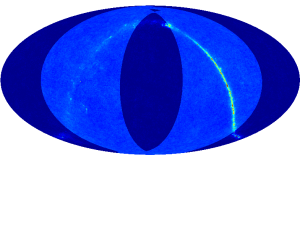
Only time for a very quick post today, so I thought I’d just pass on some news I got via Chris North about how Planck is doing. As it happens, the satellite has recently reached  the point where it has observed about half the sky. It spins on its axis in rather stately fashion (at about one revolution per minute) and, as it moves in its orbit, that sweeps the telescope across the celestial sphere. Each scan is almost a great circle, but  these gradually creep around over about a six month period to cover the whole sky.

The nice picture below, in ecliptic coordinates, shows how far it has got. You can also see the Galactic plane, arching across the sky and showing up clearly at the frequencies Planck is sensitive to.

Planck3NovSkyCoverage

The Planck Consortium had an official meeting last week in Bologna at which they drank lots of wine and ate lots of food, but other than that nobody who was there has told me anything.

It’s all very hush hush don’t you know.

Dulce et Decorum Est

Posted in Poetry with tags , on November 9, 2009 by telescoper

Folowing on from yesterday’s post, here’s probably the greatest poem by the greatest of all the poets of the First World War, Wilfred Owen. He captures the horror and brutality of war in language so potent that it still retains the ability to shock even now, 90 years later. Every image attacks the myth of war as a noble or glamorous thing and the cumulative effect of this onslaught is overwhelming. The title comes from a phrase in Horace, also quoted in the last lines of the verse: Dulce et decorum est pro patria mori (It is sweet and suitable to die for your country).

There is a nice short video clip featuring Jeremy Paxman that really says it all, but it’s just as powerful if you read the text yourself.

Bent double, like old beggars under sacks,
Knock-kneed, coughing like hags, we cursed through sludge,
Till on the haunting flares we turned our backs
And towards our distant rest began to trudge.
Men marched asleep. Many had lost their boots
But limped on, blood-shod. All went lame; all blind;
Drunk with fatigue; deaf even to the hoots
Of disappointed shells that dropped behind.

GAS! Gas! Quick, boys!– An ecstasy of fumbling,
Fitting the clumsy helmets just in time;
But someone still was yelling out and stumbling
And floundering like a man in fire or lime.–
Dim, through the misty panes and thick green light
As under a green sea, I saw him drowning.

In all my dreams, before my helpless sight,
He plunges at me, guttering, choking, drowning.

If in some smothering dreams you too could pace
Behind the wagon that we flung him in,
And watch the white eyes writhing in his face,
His hanging face, like a devil’s sick of sin;
If you could hear, at every jolt, the blood
Come gargling from the froth-corrupted lungs,
Obscene as cancer, bitter as the cud
Of vile, incurable sores on innocent tongues,–
My friend, you would not tell with such high zest
To children ardent for some desperate glory,
The old Lie: Dulce et decorum est
Pro patria mori
.

Acts of Remembrance

Posted in Uncategorized with tags , , , , on November 8, 2009 by telescoper

So here we are again. Once more it’s Remembrance Sunday, an occasion to remember those who have given their lives in conflicts past and present. This is always held on the second Sunday in November in the United Kingdom, so that it is close to the date of anniversary of the armistice that formally ended the First World War, on 11th November 1918. Another way to commemorate this  is the observance of two minutes’ silence at 11am on 11th November itself. I plan to do that, this Wednesday (which is the 11th November). In fact, I shall  be in the middle of a PhD examination in Edinburgh at that time, so I hope the candidate and the internal examiner don’t object! It is, however, one of the very few things that I’m not willing to compromise about.

Another is the wearing of a poppy. The poppy appeal raises money for veterans and their families, but the wearing of these little red paper flowers is something that not everyone feels comfortable with. Some people think that to wear a poppy is to celebrate militarism or even Britain’s imperialist past. I don’t see it that way at all. If someone asked me to wear a badge to support Britain’s participation in the invasion of Iraq, I’d certainly refuse, in fact.

I wrote about my reaction to the horror and futility of war about this time last year, so I’ll try not to repeat myself except to say that, to me, the poppy is not about celebrating war or military prowess, it’s simply about remembering those who died. In fact, one of the main reasons the paraphernalia of  Remembrance Day observances (the poppy, the cenotaph, the tomb of the unknown soldier, and all that) were set up in the first place was to remind not just people but also governments of the devastation caused byWorld War One. That’s why the Remembrance Day ceremonial laying of wreaths takes place in Whitehall, right at the heart of government. The ritual  was specifically intended to be a warning to the politicians who had brought the conflict about not to allow it to happen again.

As a young lefty student I grappled with the implications of the poppy appeal. The Peace Pledge Union produces white poppies, as an overtly anti-war symbol of remembrance. For a time I wore a white poppy but, although I am against war, I don’t think a policy of non-violence would have helped much against the Nazis and therefore can’t really call myself an out-and-out  pacifist. One year I wore both white and red poppies, but since then I’ve decided to stick with a red one.

Of course many in the Establishment would like the poppy to turn into a symbol of obedience, a kind of alternative national flag. Some people choose not to wear it precisely for that reason. The sight of some hypocritical warmongerers wearing the poppy at the Cenotaph on these occasions sickens me, but their betrayal does not make me want to stop wearing it myself. Neither does the fact that our politicians seem content to give away the freedoms that so many died to protect.

Some poppy sellers use the slogan  Wear Your Poppy With Pride, but the original meaning  is much better expressed by the original, Lest We Forget. I’m not sure I wear mine with pride at all, in fact. What I feel is really more like shame, at the wastefulness and stupidity of armed conflict. I count myself incredibly lucky that I have never had to live through anything like that, not only because I’ve had a peaceful and comfortable life, but also because I have never been tested in the way previous generations were. I wear the poppy to acknowledge their bravery and to recognize my own good fortune.

On Friday evening I went with a bunch of  Cardiff astronomers to a pub near the department for a couple of pints, as at the end of most weeks. For a while we talked about poppies and their meaning. Some of us were wearing  them, some weren’t. Various views were aired. One view was that it they saw the poppy as supporting the ongoing wars in Iraq and Afghanistan. Others expressed distaste for the fact that the poppy had become a kind of meaningless fashion accessory, or that wearing it had become compulsory, at least for newsreaders and other TV celebrities. Another pointed out that the last British veterans of the Great War, Harry Patch and Henry Allingham both died earlier this year, within a few days of each other, and that made the poppy irrelevant.

I respect these points of view, but don’t agree with them. I think the fact that there are no living survivors of the trenches makes it more, not less, important to remember those that died. It’s not just about the First World War anyway. Nor is it just about servicemen. When I stand for the two minutes silence I remember those all who fell fighting on all sides of all wars, and  fallen civilians too.

I didn’t support the invasions of Iraq or Afghanistan and I don’t understand what the continued presence of British soldiers in such places is supposed to be achieving other than more death. But why should the dead of Helmand 2009 deserve less respect than those of Flanders 1917? I wear the poppy for them, not for the fools that sent them there.

When the newsreader Jon Snow decided not to wear a poppy on TV a few years ago, there were angry complaints. I’m sure he didn’t mean disrespect to the cause but disliked the pressure being put on him to conform. I can see his point. It has to be voluntary if it is to mean anything at all. I would probably refuse to wear a poppy myself if someone tried to make it compulsory. But in the end I agree with Euan Ferguson’s piece in today’s Observer. The picture shows a bunch of the contestants from X-factor (which is, apparently, a popular television programme) all wearing poppies.

Ferguson writes

I recall a time, it seems just – just! – about 20 years ago, presumably around the time most of these X Factor contestants were crying their first (but by no means their last) tears, that anyone handing the stroppy younger me a poppy would be met with mystification and reluctance, as if they were offering me a cormorant. Although it’s possible the group in this photograph was suitably “advised” for their very public trip to the West End premiere of A Christmas Carol, the many under-20s stopping outside London’s King’s Cross to buy poppies last week from squaddies suggests a real change of attitude. Gone are the sulky, rebellious, anti-poppy teens of old, now seeming as distant as CND marches.

The young appear not only proud to wear them, but are almost using them as accessories: here, oversized, silky, something even of a statement. Elsewhere, there’s the tasteful option of those rather fine little enamel badges. I’ve seen people take out the little green paper foliage and opt for the simple scarlet. Sarah Brown managed to attract criticism for sporting an extra large one.

Is it all healthy? Well, I don’t like pressure being put on people to conform. Orthodoxy and fear are always to be regretted and today’s society is over-condemnatory, swift to its manufactured outrage. But this change seems to have come from below, not been ordered by bullies: the daily reports of life and death in the forces, of the danger other 20-year-olds daily find themselves facing. And is the symbolism of the poppy being degraded as it is customised? No. You can’t do much to the fabulous simplicity of this symbol. And the poppy doesn’t preach: it’s not about “right” or “wrong” wars, but about brave dead soldiers. And the message was, never, Remember in the way we tell you to remember. It is, simply, Lest We Forget.

Memphis Shake

Posted in Jazz with tags , on November 7, 2009 by telescoper

Today has been a very busy day, so I haven’t had time to put finger to keyboard at all. I always feel I’m letting the side down if I don’t post every day, but I’ve only got a few minutes before going for dinner. Fortunately I’ve got a list of little fillers for such occasions so I thought I’d try this one on you. Experience suggests you will either love it or hate it!

I’ve blogged before about the pioneering clarinettist Johnny Dodds, who appeared on an astonishingly high fraction of the greatest recordings of the era of classic jazz. But although he was a jazz age superstar he remained until his death in 1940 a modest and self-effacing man who never tried to hog the limelight.

One day in December 1926, Johnny Dodds happened to be in the Chicago studios of the Victor record company. The band that happened to be recording at that time was an obscure folk group from Louisville (Kentucky)with the unpromising sounding name of The Dixieland Jug Blowers. After some discussion, Johnny Dodds agreed to sit in with them while they recorded a tune called Memphis Shake. They weren’t really a jazz band and didn’t use the usual jazz instruments. There is what sounds like an alto sax on this record, but there is also a fiddle, banjo and, of course, the “jug”  (an earthenware whisky jar or some such item, played  by blowing across the top to produce a whimsical kind of bass). The idea of a jugband probably sound very hokey now, but were in fact extremely popular in the pre-jazz era and well into the 1920s. Other than the fact that they were led by a chap called Earl Macdonald and the fiddle is played by Clifford Hayes, I really don’t know anything else about the personnel.

As you’ll hear, Johnny Dodds takes quite a back seat, but his presence on this record turned it into a little  piece of jazz history and original 78s of this are much sought after among collectors. It is a bit of an oddity. It’s not really jazz and it’s not really folk, but what it is is one of the most joyously carefree pieces of music you will ever hear in your life. Even if it’s not your cup of tea, I hope it at least brings a smile to your face as it does to mine whenever I hear it.