The First Digit Phenomenon

Posted in Bad Statistics, The Universe and Stuff with tags , , on March 11, 2009 by telescoper

I thought it would be fun to put up this quirky example of how sometimes things that really ought to be random turn out not to be. It’s also an excuse to mention a strange connection between astronomy and statistics.

The astronomer Simon Newcomb (right) was born in 1835 in Nova Scotia picture2(Canada). He had no real formal education at all, but since there wasn’t much else to do in Nova Scotia, he taught himself mathematics and astronomy and became very adept at performing astronomical calculations with great diligence. He began work in a lowly position at the US Nautical Almanac Office in 1857, and by 1877 he was director. He became was professor of Mathematics and Astronomy and Johns Hopkins University from 1884 until 1893 and was made the first ever president of the American Astronomical Society in 1899; he died in 1909.

Newcomb was performing lengthy numerical calculations in an era long before the invention of the pocket calculator or desktop computer. In those days many such calculations, including virtually anything involving multiplication, had to be done using logarithms. The logarithm (to the base ten) of a number x is defined to be the number a such that x=10a. To multiply two numbers whose logarithms are a and b respectively involves simply adding the logarithms: 10a times 10b=10(a+b), which helps a lot because adding is a lot easier than multiplying if you have no calculator. The initial logarithms are simply looked up in a table; to find the answer you use different tables to find the “inverse” logarithm.

Newcomb was a heavy user of his book of mathematical tables for this type of calculation, and it became very grubby and worn. But he also noticed that the first pages of the logarithms seemed to have been used much more than the others. This puzzled him greatly. Logarithm tables are presented in order of the first digit of the number required: the first pages therefore contain logarithms for numbers beginning with the digit 1. Newcomb used the tables for a vast range of different calculations of different things. He expected the first digits of numbers that he had to look up to just be as likely to be anything. Shouldn’t they be randomly distributed? Shouldn’t all the pages be equally used?

Once raised, this puzzle faded away until it was re-discovered in 1938 and acquired the name of Benford’s law, or the first digit phenomenon. In virtually any list you can think of – street addresses, city populations, lengths of rivers, and so on – there are more entries beginning with the digit “1” than any other digit.

To give another example, although I admit this one is much harder to explain, in the American Physical Society’s list of fundamental constants, or at least the last version I happened to look at, no less than 40% begin with the digit 1. If you’ve been writing physics examination papers recently like I have, you will notice a similar behaviour. Out of the 16 physical constants listed in the rubric of a physics examination paper lying on my desk right now, 6 begin with the digit 1.

So what is going on?

There is a (relatively) simple answer, and a more complicated one. I’ll take the simple one first.

Consider street numbers in an address book as an example. Suppose Any street will be numbered from 1 to N. It doesn’t really matter what N is as long as it is finite (and nobody has ever built an infinitely long street). Now think about the first digits of the addresses. There are 9 possibilities, because we never start an address with 0. On the face of it, we might expect a fraction 1/9 (approximately 11%) of the addresses will start with 1. Suppose N is 200. What fraction actually starts with 1? The answer is more than 50%. Everything from 100 upwards, plus 1, and 11 to 19. Very few start with 9: only 9 itself, and 90-99 inclusive. If N is 300 then there are still more beginning with 1 than any other digit, and there are no more that start with 9. One only gets close to an equal fraction of each starting number if the value of N is an exact power of 10, e.g. 1000.

Now you can see why pulling numbers out of an address book leads to a distribution of first digits that is not at all uniform. As long as the numbers are being drawn from a collection of streets each of whom has a finite upper limit, then the result is bound to be biased towards low starting digits. Only if every street contained an exact power of ten addresses would the result be uniform. Every other possibility favours 1 at the start.

The more complicated version involves a scaling argument and is a more suitable explanation for the appearance of this phenomenon in measured physical quantities. Lengths, heights and weights of things are usually measured with respect to some reference quantity. In the absence of any other information, one might imagine that the distribution of whatever is being measured possesses some sort of invariance or symmetry with respect to the scale being chosen. In this case the prior distribution p(x) can be taken to have the so-called Jeffreys form, which is uniform in the logarithm, i.e. p(x) is proportional to 1/x. There obviously must be a cut-off at some point as this can’t be allowed to go on forever as it doesn’t converge for large x, but this doesn’t really matter for the sake of this argument. We can suppose anyway that there are many powers of ten involved before this upper limit is reached.

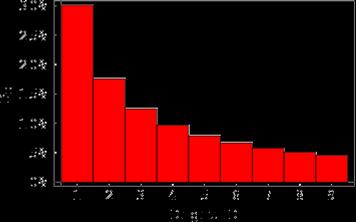
In this case the probability that the first digit is D is just given by the ratio of two terms: In the numerator we have the integral between D and D+1 of p(x) (that’s a measure of how much of the distribution represents numbers starting with the digit D) and on the denominator we have the integral between 1 and 10 of p(x) (the overall measure). The result, if we take p(x) to be proportional to 1/x, is just log (1+1/D).
picture1

The shape of this distribution is shown in the Figure. Note that about 30% of the first digits are expected to be 1. Of course I have made a number of simplifying assumptions that are unlikely to be exactly true, and the case of the physical constants is complicated by the fact that some are measured and some are defined, but I think this captures the essential reason for the curious behaviour of first digits.

If nothing else, it provides a valuable lesson that you should be careful in what variables you assume are uniformly distributed!

The Feline Condition

Posted in Columbo with tags , , , on March 9, 2009 by telescoper

It’s time for my regular update about Columbo, my famous diabetic cat.

I took said moggy to the vet today for a repeat fructosamine test. When I took him a couple of months ago his level was quite high (280), which surprised me because he’s actually been in fine fettle and there was no reason to think anything was going wrong on the health front. Nevertheless, the vet had suggested an increase in his regular insulin injection to 4 units (from three) and a repeat test a bit later. So I went back today.

The fructosamine test measures the level of blood sugar over a period of 1-3 weeks. Fructosamines are stable complexes of carbohydrates and proteins that are produced by an irreversible, nonenzymatic glycosylation of protein. Increased fructosamine values are due to higher quantities of glucose in the blood, resulting in increased glycosylation of proteins. This provides a more stable measurement of blood sugar concentration than a one-off glucose test because the latter can be heavily influenced by stress, such as is induced by visiting the vet….

Just as a check, they took a glucose reading today which came out at 18, much higher than the level he showed on his last visit to the vet (which was 7 on the same scale). I didn’t notice any real evidence that he was stressed out at all when they did this. In fact he was purring in the vet’s examination room. So the glucose result appears to be consistent with his previously high fructosamine test and probably indicates poorer control of his diabetes than we would have wished for.

So they took another, largerm blood sample from his neck (which he never enjoys) to find the fructosamine level. Today proved to be no exception to his displeasure at this procedure, and he’s been in a huff since we got home. They have to send the sample off to a lab for analysis so I’ll have to wait until Wednesday to find out the score and what to do about it.

His diabetes has been pretty stable for many years now, and I’m not sure why it the control doesn’t seem to be as good these days. It’s may be just because his metabolism is changing as he gets older. If the level of fructosamine remains high I’ll probably have to increase the dose again and have another test done to see if it succeeds in lowering his sugars.

Columbo will be 15 on March 31st, and he’s definitely showing signs of age and of his diabetes. He began to develop cataracts some time ago, giving his eyes a slightly cloudy appearance; these are apparently associated with diabetes, although they are a bit more common in dogs than in cats. He probably doesn’t see very well as a result of this but it doesn’t seem to bother him. He certainly still manages to play with moving toys alright so his close-up vision is good enough. The rest of his observable Universe isn’t so very large anyway, only consisting of my house and small garden.

He sleeps a lot, as most cats do, but he still has his playful moments and maintains a healthy interest in the little bits of wildlife that stray into my garden. While I’m a bit concerned about his condition, I’m not too worried while he still seems to be enjoying life.

Starless and Bible Black

Posted in Jazz, Literature, Poetry with tags , , , , , on March 7, 2009 by telescoper

A few weeks ago in my bit about the great jazz composer and pianist Thelonious Monk, I mentioned another great musician, Stan Tracey. He was Ronnie Scott’s house pianist for many years, as well as being a composer and leader of his own band. It’s only the fact that he stayed all his life in England that prevented him from gaining wider recognition. No less a musician than Sonny Rollins asked (of British Jazz fans)

Does anyone here realise how good he is?

Well, I think they do but he remains relatively unknown outside these shores.

Amongst the collection of old LPs that I am gradually making into CDs using the USB turntable I got for Christmas is one of the greatest British jazz albums, Under Milk Wood, which was written by Stan Tracey and recorded by his band in 1965.

Living in Wales, I’m somewhat ashamed that I didn’t do this one before because it is of course inspired by the “play for voices” with the same name by Dylan Thomas. The music is brilliant throughout, vividly evoking the atmosphere of various episodes in the play, but my favourite track is about the very first lines. Stan Tracey’s piano and Bobby Wellins‘ saxophone hauntingly evoke the atmosphere of the opening of Under Milk Wood which, if you’ll forgive me for quoting a rather lengthy extract, shows Dylan Thomas extraordinarily imaginative use of language, superb control of rhythm even in a prose setting. His poems are wonderful to listen to as well as to read, especially when read by the poet himself with his sonorous yet lilting voice; if you want a short example try this example, steeped in a sense of nocturnal melancholy

In My Craft or Sullen Art

In my craft or sullen art
Exercised in the still night
When only the moon rages
And the lovers lie abed
With all their griefs in their arms,
I labour by singing light
Not for ambition or bread
Or the strut and trade of charms
On the ivory stages
But for the common wages
Of their most secret heart.

Not for the proud man apart
From the raging moon I write
On these spindrift pages
Nor for the towering dead
With their nightingales and psalms
But for the lovers, their arms
Round the griefs of the ages,
Who pay no praise or wages
Nor heed my craft or art.

Anyway, the play Under Milk Wood‘s famous opening goes along these lines:

It is Spring, moonless night in the small town, starless and bible-black, the cobblestreets silent and the hunched, courter’s-and-rabbits’ wood limping invisible down to the sloeblack, slow, black, crowblack, fishingboat-bobbing sea. The houses are are blind as moles (though moles see fine tonight in the snouting, velvet dingles) or blind as Captain Cat there in the muffled middle by the pump and the town clock, the shops in mourning, the Welfare Hall in widows’
weeds. And all the people of the lulled and dumbfound town are sleeping now.

Hush, the babies are sleeping, the farmers, the fishers, the tradesmen and pensioners, cobbler, schoolteacher, postman and publican, the undertaker and the fancy woman, drunkard, dressmaker, preacher, policeman, the webfoot cocklewomen and the tidy wives. Young girls lie bedded soft or glide in their dreams, with rings and trousseaux, bridesmaided by glow-worms down the aisles of the organplaying wood. The boys are dreaming wicked of the bucking ranches of the night and the jollyrodgered sea. And the anthracite statues of the horses sleep in the fields, and the cows in the byres, and the dogs in the wet-nosed yard; and the cats nap in the slant corners or lope sly, streaking and needling, on the one cloud of the roofs.

You can hear the dew falling, and the hushed town breathing.

Only your eyes are unclosed to see the black and folded town fast, and slow, asleep.

And you alone can hear the invisible starfall, the darkest-before-dawn minutely dewgrazed stir of the black, dab-filled sea where the Arethusa, the Curlew and the Skylark, Zanzibar, Rhiannon, the Rover, the Cormorant, and the Star of Wales tilt and ride.

Listen. It is night in the chill, squat chapel, hymning in bonnet and brooch and bombazine black, butterfly choker and bootlace bow, coughing like nannygoats, sucking mintoes, fortywinking hallelujah; night in the four-ale, quiet as a domino; in Ocky Milkman’s lofts like a mouse with gloves; in Dai Bread’s bakery flying like black flour. It is tonight in Donkey Street, trotting silent, with seaweed on its hooves, along the cockled cobbles, past curtained fernpot, text and trinket, harmonium, holy dresser, watercolours done by hand, china dog and rosy tin teacaddy. It is night neddying among the snuggeries of babies.

Look. It is night, dumbly, royally winding through the Coronation cherry trees; going through the graveyard of Bethesda with winds gloved and folded, and dew doffed; tumbling by the Sailors Arms.

Time passes. Listen. Time passes.

Here are Stan Tracey and Bobby Wellins with Stan Tracey’s meditation on that piece, Starless and Bible Black, played in a way that’s as moving and ethereal as the sound of time passing….

The Atomic Mr Basie

Posted in Jazz with tags , , , on March 6, 2009 by telescoper

I’ve been lecturing and writing bumf all day and decided I could do with a bit of a break, but my fingers are so used to typing today that they insisted I should use this ten-minute hiatus to write a blog entry. And who am I to argue with my digits?

Anyway, I had an idea last night of something to put up so I’ll take it off the mental shelf on which I store silly blog ideas and present it now.

Last weekend I went to see the Opera Doctor Atomic in London, and last night I was tidying up my CDs which I usually leave lying around all over the place. In amongst the ones I found in my study and moved back to their rack was the brilliant album that my version calls The Atomic Mr Basie, but I think was originally issued in 1957 on LP with the name E=MC2. I doubt that there is that much musical fare with the word “Atomic” in the title so it struck me as a bit of a coincidence. Apart from anything else it’s a reminder of how far the language of atomic bombs had entered into popular circulation during the 1950s. I can’t think of any other Jazz albums with an equation as the title either.

I’m not sure why Count Basie became Mr Basie for the purposes of the later title, but there you are.

Jazz historians tend to distinguish quite sharply between two versions of the Count Basie Orchestra. According to the books, the first Basie Band was a rough-and-ready blues outfit that arrived in New York from Kansas City in 1936 and the second was a magnificently slick powerhouse machine that emerged after a short hiatus in 1951. Actually both bands were terrific, able to slip from laid back swing to full-throttle up-tempo rabble-rousing in barely the bat of an eye. Anyway, how “rough-and-ready” could a band be with the great Lester Young in the saxophone section? Another invariant between the two bands was the brilliance of the rhythm section which had a featherlight touch but was able to drive the band along like no other.

The late and very great Ella Fitzgerald described the Count Basie Orchestra as

They’re the swinginest band there ever was. They swing ya into bad health.”

Quite.

The real difference in the two bands wasn’t really the personnel (although that did change substantially over the years), but in the style of playing. The early Count Basie Orchestra didn’t have very sophisticated written arrangements so it relied a lot more on punchy riffs and call-and-answer exchanges between the brass and reeds, which were executed incredibly tightly considering that they were ad-libbed. The second manifestation drew on superb arrangers, particularly Neal Hefti who wrote most of the arrangements on The Atomic Mr Basie. The band still had an almost telepathic gift for synchronized riffing, especially playing behind a star soloist improvising in one of the many gaps left in the arrangements.

I had a quick shufti for hefti on Youtube and found one of the tracks from The Atomic Mr Basie, Whirlybird, performed in 1965 but with the same tenor sax soloist, Eddie “Lockjaw” Davis that plays on the album. I remember going to see him play in Newcastle once and was blown away by his enormous sound, the muscular leatheriness of his tone, and his uncanny ability to change up a gear just when you think he’s going flat out. Then in his sixties, he was an exhilirating musician to listen to and he was even better twenty years earlier with this great band punching out riffs behind him. I love this version nearly as much as the original, even if the drum solo (by the overrated Rufus Jones) does go on a bit, because the brass section is just awesome…

Turkeys and Angels

Posted in Uncategorized with tags , , , , , , , on March 4, 2009 by telescoper

Travelling to London on Saturday to see Doctor Atomic, I read an interesting piece in the Guardian review by Salman Rushdie. The general theme was inspired by the fact that a film director once told him that all movies made from novels were “rubbish”.

I was reminded of that piece today when I had a quick look at cosmic variance and found a post about the forthcoming film Angels and Demons by Dan Brown, author of The Da Vinci Code.  The post is mainly about the fact that Angels and Demons is based in the world of particle physics so some educational materials have been generated to cash in on it, so to speak. Nothing wrong with that as an idea. Every little helps.

The problem for me is that the film is  directed by Ron Howard and stars Tom Hanks. This is the same combination that took Brown’s enjoyably preposterous page-turner and made it into one of the worst pieces of cobbled-together garbage that I’ve ever seen in a cinema. The novel isn’t so bad for what it is, a formulaic but fairly well crafted thriller. The film is excruciating. The book of Angels and Demons is not as good as the book of the Da Vinci Code, so I shan’t be rushing to see the film when it is released in the UK, particle physics content notwithstanding.

This is only one example of a book being turned into a terrible film, but I can think of many counter-examples to the assertion that they’re all rubbish. Of course it helps if the book you start with isn’t rubbish itself.  As a recent example I  think of Atonement by Ian McEwan, a great book  turned into a pretty good film.

But the example that for me really refutes the argument is Death in Venice, by Thomas Mann:  a brilliant and disturbing novella about  physical and spiritual decay turned into a stunning visual masterpiece of a film by Luchino Visconti. The story is about the growing obsession of ageing writer Gustav von Aschenbach with a young Polish boy, Tadzio, in a city beset by a cholera epidemic. It’s not a story about paedophilia (nor even, in fact, particularly about homosexuality) although it doesn’t shrink from either of those themes. As the critic Lawrence J.  Quirk put it

Some shots of Björn Andrésen, the Tadzio of the film, could be extracted from the frame and hung on the walls of the Louvre or the Vatican in Rome. For this is not a pretty youngster who is supposed to represent an object of perverted lust; that was neither novelist Mann’s nor director-screen writer Visconti’s intention. Rather, this is a symbol of a beauty allied to those which inspired Michelangelo‘s David and Da Vinci‘s Mona Lisa, and which moved Dante to seek ultimate aesthetic catharsis in the distant figure of Beatrice.

In other words Tadzio symbolises beauty in a primarily aesthetic sense rather than a sexual one. Or maybe I protest too much.

The film is beautiful to look at and is held together by a riveting central performance by the late Dirk Bogarde in probably his greatest acting role. Here is the closing scene of the film, La Morte del Professore sulla Spiaggia, languidly paced but emotionally and erotically charged. Aschenbach, wearing make-up and with the  hair dye used to disguise his age melting in the heat, suffers a heart attack and dies while Tadzio stands in the sea, like an angel beckoning him  to a better world.

The music is the 4th movement (Adagietto) from Mahler‘s 5th Symphony. If ever there was music to die for, this is it.

And if this is a bit morbid for your taste, maybe you can suggest other great novels made into great movies?

Doctor Atomic

Posted in Opera with tags , , , , on March 1, 2009 by telescoper

It’s not often that my interest in Opera overlaps significantly with my career in Physics, but this Saturday night (28th March) was a definite example, with English National Opera‘s production of Doctor Atomic by John Adams providing the opportunity. I even went with a group of six physicists to see it.

The piece is, of course, centred around the personality of J Robert Oppenheimer “The Father of the Atomic Bomb” and is set in Los Alamos in the runup to the first “Trinity” test detonation of an atomic bomb in July 1945. Other physicists feature in the story, especially Edward Teller and Robert Wilson, and images of many more taken from their security passes are projected onto the set at the opening of Scene 1.

According to what I was told, John Adams originally engaged a librettist to write the text for the Opera but this didn’t work out, and a libretto was instead stitched together by Peter Sellars from a variety of sources, including the poetry of John Donne, the Bhagavad Gita, scientific documents, and assorted memoranda from Los Alamos.

This means that the work doesn’t really have a real narrative trajectory, and there is very little in the way of character development, but instead it resolves itself into a series of impressionist tableaux. Rather than attempting to provide the coherence that the libretto lacks through the music, Adams chose to work with what he had and not try to impose a larger structure on it via the score.

The result is fascinating but it’s not without its problems. I greatly admire John Adams’ music, which manages to be both innovative and accessible. There certainly are many places in Doctor Atomic where the music, words and drama come together to make wonderful Opera. Frankly, though, there are also some passages where it gets becalmed, especially in the domestic scenes between Oppenheimer and his wife which didn’t seem to me to add any special insight into the character of either. The Opera ends with the countdown to the detonation of the Trinity Test, but I thought this was also too long, robbing the event of some of its power, although the last moments and the explosion itself were brilliantly done.

This is a new Opera, first performed as recently as 2005 in San Francisco. This production is only the second, as it has moved directly to London from a successful run at the Metropolitan Opera in New York. Many of the great operas which we now regard as standards went through several iterations before they arrived at their final version. This may happen to Doctor Atomic too. The running time of around three hours is by no means excessive by opera standards, but I do think it would work even better on stage if it were shortened quite a bit and tightened up to remove the longueurs from both acts and focus on building the tension as the test approaches.

I hope all this doesn’t sound too negative. It really is a fascinating and compelling piece. The ending, involving an empty stage and a tape recording of the words of a dying Japanese woman asking for water, moved at least one of our little group to tears.

And of course there’s that aria. At the end of Act 1, just before the interval, Oppenheimer is alone on stage while the prototype bomb is suspended behind him. His thoughts are expressed by the words of a Sonnet Batter my Heart, by John Donne:

Batter my heart, three-person’d God, for you
As yet but knock, breathe, shine, and seek to mend;
That I may rise and stand, o’erthrow me, and bend
Your force to break, blow, burn, and make me new.
I, like an usurp’d town to’another due,
Labor to’admit you, but oh, to no end;
Reason, your viceroy in me, me should defend,
But is captiv’d, and proves weak or untrue.
Yet dearly’I love you, and would be lov’d fain,
But am betroth’d unto your enemy;
Divorce me,’untie or break that knot again,
Take me to you, imprison me, for I,
Except you’enthrall me, never shall be free,
Nor ever chaste, except you ravish me.

Coming back to Cardiff on the train this morning I read a glowing review of Doctor Atomic in the Observer by Fiona Maddocks which referred to this aria as the greatest written since Puccini. I’m not sure I’d go as far as that, but it is truly wonderful, especially when sung as it was last night by the flawless Gerald Finley. It also struck me that it has many parallels with, and is as at least as good as, the aria When the Great Bear and Pleiades in Peter Grimes by Benjamin Britten. Whether Doctor Atomic eventually comes to be regarded as a great Opera in the way Peter Grimes has remains to be seen, but I would bet my bottom dollar that this aria will anyway be performed many many times as a concert piece.

Fortunately, though, you don’t have to take my word for how good  it is. Since the Met version of this production has been released on video, I can end with Batter my Heart just as we saw and heard it last night, with John Adams great music stuttering uneasily at the start but taking on a radiant quality as the aria develops. Superb.

False Positives

Posted in Bad Statistics with tags , , on February 27, 2009 by telescoper

There was an interesting article on the BBC website this week that, for once, contains an example of a reasonable discussion of statistics in the mass media. I’m indebted to my friend Anton for pointing it out to me. I’ve filed it along with examples of Bad Statistics because the issue is usually poorly explained. I don’t think the article itself is bad. In fact, it’s rather good.

The question is all about cancer screening, specifically for breast cancer, but the lesson could apply to a host of other situations. In the original context, the question goes as follows:

Say that routine screening is 90% accurate. Say you have a positive test. What’s the chance that your positive test is accurate and you really have cancer?

Presumably there will be many of you that think the answer is 90%. Hands up if you think this!

If you don’t think it’s 90% then what do you think it is?

The correct answer is that you have no idea. I haven’t given you enough information.

To see why, imagine that the prevalence of cancer in the population is such that 1% of a randomly selected sample will have it. Out of a thousand people one would expect that, on average, ten would have cancer. If the test is 90% accurate then 9 of these will show positive signs and only one won’t.

However, 990 people out of the original thousand don’t have cancer. If the test is only 90% accurate then 10%, i.e. 99 of these will show a false positive.

Thus the total number of positive tests is 108 and only 9 of the individuals concerned actually have cancer. The odds are therefore 9/108. That’s only about a 1-in-12 chance that you have cancer.

But that depends on my assumption about the overall rate in the population. If that number is different it changes the odds. Without this information, the problem is ill-posed.

The more general way of looking at this is in terms of conditional probabilities. What you are given is that P(positive test| cancer)=P(+|C)=0.9 and P(negative test|no cancer)=0.9, while P(negative test|cancer)= 0.1 and P(positive test|no cancer)=P(+|N)=0.1. What you want to know is P(cancer|positive test)=P(C|+). This can be obtained from Bayes’ Theorem but only if you know P(cancer)=P(C)=1-P(N), since people either have cancer or they don’t.

The answer is given by P(C|+)=P(C)P(+|C)/[P(C)P(+|C)+P(N)P(+|N)], which for the numbers I gave above= 0.01 x 0.9/[0.01 x 0.9 + 0.99 x 0.1]=0.009/[0.009+0.099], which gives the same answer as before.

So the moral is that you shouldn’t panic if you get a positive test from a screening test of this type. As long as the condition being tested is relatively rarer than the likelihood of an error in the test result then the chances are high that you’ve got nothing to worry about. But of course, you should take more detailed tests.

The Bayesian way is the easy way!

A Welsh Affair

Posted in Science Politics with tags , , , , on February 26, 2009 by telescoper

Today I had the “pleasure” of attending a day-long conference called Funding, Risk and Innovation: Wales’s Engagement with Science Policy organized by the Institute of Welsh Affairs and sponsored by, amongst other organizations, the Institute of Physics. I had hoped that this would give me an insight into the landscape of Welsh science politics which might bear fruit in the future. As if.

Unfortunately, but alas predictably, there wasn’t much of interest. I think the first presentation of the day perfectly  illustrated the whole problem. Opening the batting was Ieuan Wyn Jones, Deputy First Minister and Minister for Economic Development, from the Welsh Assembly Government or WAG.  He gave a motherhood-and-apple-pie talk about how important science was to the future of Wales, took a few questions and then left. Those of us scientists who had gone to the meeting hoping for engagement between  politicians and scientists were left to discuss things between ourselves. Hardly the point.

Next was Phil Gummett, Chief Executive of HEFCW who gave the results of the latest Research Assessment Exercise (which I’ve blogged about here, there and everywhere). To my dismay he announced that HEFCW are indeed going to use the 0:1:3:7 weighting formula adopted by HEFCE, but has found a bit more cash which it will add to the pot of money allocated to 4*. However, unlike in the case of English universities, HEFCW is not going to apply any protection to STEM subjects (Science, Technology & Medicine). In the case of my own department at Cardiff University, which got a very low assessment  of 4* research, this is very bad news.

When I got home this evening I read the same news in the Times Higher. I could have found this out without wasting a day sitting  in a ghastly conference room in the soulless Cardiff Novotel. Still, the lunch wasn’t bad.

Phil Gummett struck me as quite a reasonable chap who is trying to do the right thing, but whose hands are tied by the Welsh Assembly which has decided that Higher Education in Wales is not as high a priority as Further Education, with the result that the funds available to HEFCW for research is less than it would be for English universities. University STEM departments in Wales altogether receive about £10M less from HEFCW than they would get from HEFCE if they were in England. For physics, this will probably get worse after the 2008 RAE.

The reason for this pessimism is that, as I’ve noted before, Physics did rather badly in the RAE compared to other discplines, with a significantly lower fraction of work assessed at 4* (world-leading). Since the funding formula is heavily weighted by the 4* element, physics will suffer relative to other disciplines. HEFCW will not attempt to correct this. I think the Chair of the Physics panel, Sir John Pendry, must shoulder at least some of the blame for the gross anomaly that this represents.

It remains to be seen what happens to physics nationally, but I fear the RAE may undo a decade of very effective positive campaigning about the importance of physics. I’ve already heard from various Heads of Physics departments around the country (even those who have done well in the RAE)  who have been asked by their Vice-Chancellors why they have done so much worse than other disciplines.

The final thing he said was that HEFCW would make its allocations as block grants to the Universities concerned and that they should make their own decisions as to how to allocate the funds to the departments. This sort of thing always annoys me. It’s admitting that the formula is probably stupid, so passing the buck to the institutions to sort out the mess themselves.

I spoke to a nice lady from Cardiff University’s planning department in the afternoon who said that they weren’t sure how they were going to allocate funds to Schools after the HEFCW grant was announced, and that the University as a whole was probably going to lose out in research funds, despite having 54% of all the 4* research in Wales.

The big problem is the funding gap caused by the WAG’s policy. Devolution has had a negative effect in science funding in Wales, while in Scotland it has had the opposite effect. The Scottish parliament seems much more interested in science than does the Welsh Assembly. Indeed, per capita, Scottish Universities have a much heavier level of research investment even than those in England, which in turn are much higher than in Wales.

EPSRC‘ recently allocated £82M to UK universities to fund  doctoral training centres. In all, it allocated grants to 45 universities. Wales has 5% of the UK population, but not a single grant went to a Welsh university. Of the 1200 or so students these centres will train, not a single one will be in Wales.  I can’t believe the Scottish assembly would have let such an outcome happen in Scotland.

Further strangulation of research funds is inevitable unless the WAG is persuaded to change its mind about the importance of science. But if the politicians don’t stay to listen to the arguments, how will this happen?

Over lunch I chatted to various physicists from Swansea University. Several of them had come to the meeting, but I was the only representative from Cardiff. There was a strong steer from the RAE panel for physics in terms of closer collaboration so we chatted a bit about possibilities for that. I think the consensus was that we’re probably going to be bounced down the road anyway so the best way forward would be to come up with a plan of our own instead of having someone else’s.

I promise not to mention the RAE again, until the final allocations are published in April!

Blackbird has Spoken

Posted in Biographical, Poetry with tags , , , on February 25, 2009 by telescoper

Over the last few days we’ve been having something approximating springtime here in Cardiff. It has been sunny and quite warm, my garden has started to come to life, and the crocuses have appeared in Bute Park. It’s also getting to the time when I won’t feel guilty for walking home in daylight. Soon I’ll even be able to walk home through Bute Park, which closes when it gets dark, currently at 5.15.

I hope this all continues into a pleasant spring and summer, without the heavy continuous rain we had last year. I’m not betting on it though.

However, the clement weather has given me one headache recently. With sunrise happening a bit earlier and the good weather giving the local wildlife something to shout about, the dawn chorus has been waking me up around 4am.

Or, actually, it’s not so much a chorus as a solo. A very loud blackbird has taken to sitting right next to my bedroom window and singing at the top of its voice.

I’m very fond of blackbirds. Once while I was in the garden in my old house in Beeston, a blackbird flew onto a fence post about a yard away from me and sat there looking at me as I stood with a spade in my hand. I looked back. We looked at each other for ages, the blackbird turning its head every now and again so as to peer at me with a different eye. I slowly raised my arm and extended a palm. To my absolute delight the bird hopped onto my open hand. It stayed there only a minute or so, probably until it realised my fingers weren’t actually big fat worms like it thought. For that moment, though, I felt a bit like a latter-day St Francis of Assisi.

Blackbirds have a very attractive song, but this one seems particularly loud and he certainly does go on a bit. For about a week now I’ve been unable to get back to sleep after being woken by this critter, and instead got up and had a cup of tea while he says what he has to say. Columbo finds his song quite interesting too, although the bird is always out of reach…

Years ago, I used to suffer very badly from insomnia so being awake at 4am is not an unfamiliar experience to me, although it’s much nicer to be woken by birdsong than to be unable to sleep in the first place. This all reminded me of a devastatingly brilliant poem called Aubade and written by Philip Larkin that was published in the Times Literary Supplement in 1977. This is one of the last poems written by Larkin, and is undoubtedly one of the greatest.

Written by a jazz-loving bachelor who drank too much, someone not unlike myself in some respects, I found it uncanningly accurate in its depiction of the bleak thoughts that tend to engulf you when you’re alone and awake in the silence before dawn. But I can assure you the mood is a whole lot lighter when you have a blackbird (and a cat) for company!

I work all day, and get half drunk at night.
Waking at four to soundless dark, I stare.
In time the curtain edges will grow light.
Till then I see what’s really always there:
Unresting death, a whole day nearer now,
Making all thought impossible but how
And where and when I shall myself die.
Arid interrogation: yet the dread
Of dying, and being dead,
Flashes afresh to hold and horrify.

The mind blanks at the glare. Not in remorse
– The good not used, the love not given, time
Torn off unused – nor wretchedly because
An only life can take so long to climb
Clear of its wrong beginnings, and may never:
But at the total emptiness forever,
The sure extinction that we travel to
And shall be lost in always. Not to be here,
Not to be anywhere,
And soon; nothing more terrible, nothing more true.

This is a special way of being afraid
No trick dispels. Religion used to try,
That vast moth-eaten musical brocade
Created to pretend we never die,
And specious stuff that says no rational being
Can fear a thing it cannot feel, not seeing
that this is what we fear – no sight, no sound,
No touch or taste or smell, nothing to think with,
Nothing to love or link with,
The anaesthetic from which none come round.

And so it stays just on the edge of vision,
A small unfocused blur, a standing chill
That slows each impulse down to indecision
Most things may never happen: this one will,
And realisation of it rages out
In furnace fear when we are caught without
People or drink. Courage is no good:
It means not scaring others. Being brave
Lets no-one off the grave.
Death is no different whined at than withstood.

Slowly light strengthens, and the room takes shape.
It stands plain as a wardrobe, what we know,
Have always known, know that we can’t escape
Yet can’t accept. One side will have to go.
Meanwhile telephones crouch, getting ready to ring
In locked-up offices, and all the uncaring
Intricate rented world begins to rouse.
The sky is white as clay, with no sun.
Work has to be done.
Postmen like doctors go from house to house.

Fat Tuesday

Posted in Jazz with tags , on February 24, 2009 by telescoper

Today’s  the day we call in England  Shrove Tuesday. We’re apparently all supposed to get shriven by doing a pennance before Lent . Another name for the occasion is Pancake Day, although I’m not sure what sort of pennance it is to be forced to eat pancakes.

Further afield the name for this day is a bit more glamorous. Mardi Gras, which I translated for the title using my schoolboy French, doesn’t make me think of pancakes but of carnivals. And being brought up in a house surrounded by Jazz, it makes me think of New Orleans and the wonderful marching bands that played not just during the Mardi Gras parades but at  just about every occasion for which they could find an excuse, including funerals.

The Mardi Gras parades gave rise to many of the great tunes of New Orleans Jazz, many of them named after the streets through which the parade would travel, mainly in  the famous French Quarter. Basin Street, South Rampart Street, and Bourbon Street are among the names redolent with history for Jazz fans and musicians around the world. I also remember a record by Humphrey Lyttelton‘s 1950s band called Fat Tuesday.

The New Orleans Mardi Gras has on recent occasions sometimes got a bit out of hand, and you probably wouldn’t want to take kids into the French Quarter for fear they would see things they shouldn’t. Personally, though, I’d love the chance to savour the atmosphere and watch the parades.

The  clip I’ve chosen is of Bourbon Street Parade. The one and only time I went to New Orleans I felt a real thrill walking along this street, just because I’ve heard the tune so many times on old records.  I didn’t go in Mardi Gras time, however, but in the middle of summer. The heat was sweltering and the humidity almost unbearable, but the air was filled with music as well as moisture. It was impossible to sleep in the heat, so I stayed up moving from bar to bar, drinking and listening to music until I was completely exhausted.

The tune was written by the late Paul Barbarin, who died in 1969 during a street parade in New Orleans. What a way to go. He also plays on the clip I included here.

I picked this particular clip because it features a much underrated British musician, Sammy Rimmington (although the notes on Youtube have muddled it up; he plays saxophone on this, not clarinet). My dad once played with Sammy Rimmington and I remember the unqualified admiration with which he (my dad) spoke of his (Sammy’s) playing.