The Eightsome Reels

Posted in Crosswords, Literature with tags , on March 24, 2009 by telescoper

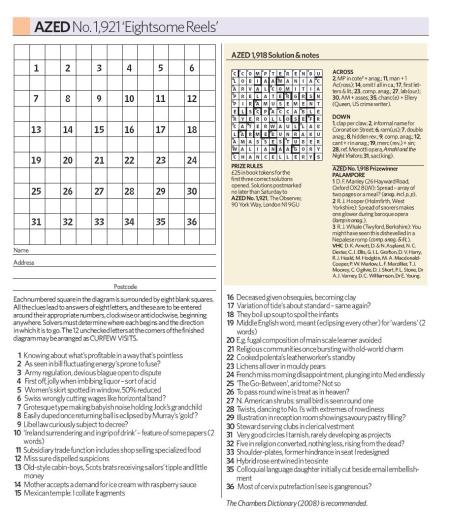
As an ardent cruciverbalist, I couldn’t resist posting this week’s Observer Crossword just to show you one of the interesting variations that Azed comes up with from time to time:

azed

It’s probably a bit small to read  the clues, or even the instructions, but the point to grasp is that the answers are all 8 letters long and they have to be fitted in the squares surrounding the corresponding number. The trouble is that you’re not told which square to start from, or whether the letters are to be entered clockwise or anticlockwise.

Hmmm.

The only way I know to start one of these puzzles is to solve several adjacent clues before entering them in the diagram and then see if I can find a way to fit them together on a bit of scrap paper. The structure of the diagram guarantees many checked letters (i.e. overlaps) between neighbouring answers so once you have a few then the subsequent ones get easier to fit in. These puzzles are usually difficult to start though.

Fortunately, however, in this one  I managed to get four  answers quite quickly:

2. As seen in bill fluctuating energy’s prone to fuse?

This is “liquable”, from “qua” meaning “as” in anagram of “bill”+e for energy, meaning able to melt.

3. Army regulation, devious blague open to dispute

Is clearly “arguable” (army regulation=ar+anagram of blague, “open to dispute” is the definition).

8. Easily duped once returning ball is eclipsed by Murray’s `gold’?

A little harder, but the word “once” suggests an obsolete spelling so the answer is “gullable” (“ball” backwards in “gule”, a Scottish form of “gold”, hence the reference to Murray).

9. Libel law curiously subject to decree?

Is “willable” (anagram of “libel law”; “subject to decree” being the definition).

With those four answers to fit in the squares around 2,  3, 8 and 9 I had plenty of checked letters and could find only one way to make it work. The remaining clues fell into place eventually, although it took me well over an hour to finish it on Sunday afternoon.

Nice puzzle though.

In the ongoing Azed competition for budding crossword cluers, I’m not doing so well. I did pick up a “highly commended” for my last clue, in competition No. 1918,  for the word PALAMPORE (a kind of Nepalese bedcover, don’t you know), but From the dizzying heights of 28th place, I’ve slipped down the table to 33rd.  Still, the winning clue for PALAMPORE was a real beauty:

Spread – array of two pages or a meal?

This involves an anagram of “pp+or a meal” with two different definitions of spread in the cryptic part. Very ingenious, and certainly better than my attempt (which I’m ashamed to include). Esteem to D.F. Manley, who wrote this clue and who is heading the Azed Honours Table for this year after 9 competitions.

Social Physics and Astronomy

Posted in The Universe and Stuff with tags , , , , , on March 23, 2009 by telescoper

When I give popular talks about Cosmology,  I sometimes look for appropriate analogies or metaphors in television programmes about forensic science, such as CSI: Crime Scene Investigation which I used to watch quite regularly (to the disdain of many of my colleagues and friends). Cosmology is methodologically similar to forensic science because it is generally necessary in both these fields to proceed by observation and inference, rather than experiment and deduction: cosmologists have only one Universe;  forensic scientists have only one scene of the crime. They can collect trace evidence, look for fingerprints, establish or falsify alibis, and so on. But they can’t do what a laboratory physicist or chemist would typically try to do: perform a series of similar experimental crimes under slightly different physical conditions. What we have to do in cosmology is the same as what detectives do when pursuing an investigation: make inferences and deductions within the framework of a hypothesis that we continually subject to empirical test. This process carries on until reasonable doubt is exhausted, if that ever happens.

Of course there is much more pressure on detectives to prove guilt than there is on cosmologists to establish the truth about our Cosmos. That’s just as well, because there is still a very great deal we do not know about how the Universe works.I have a feeling that I’ve stretched this analogy to breaking point but at least it provides some kind of excuse for writing about an interesting historical connection between astronomy and forensic science by way of the social sciences.

The gentleman shown in the picture on the left is Lambert Adolphe Jacques Quételet, a Belgian astronomer who lived from 1796 to 1874. His principal research interest was in the field of celestial mechanics. He was also an expert in statistics. In Quételet’s  time it was by no means unusual for astronomers to well-versed in statistics, but he  was exceptionally distinguished in that field. Indeed, Quételet has been called “the father of modern statistics”. and, amongst other things he was responsible for organizing the first ever international conference on statistics in Paris in 1853.


His fame as a statistician owed less to its applications to astronomy, however, than the fact that in 1835 he had written a very influential book which, in English, was titled A Treatise on Man but whose somewhat more verbose original French title included the phrase physique sociale (“social physics”).

Apparently the philosopher Auguste Comte was annoyed that Quételet appropriated the phrase “social physics” because he did not approve of the quantitative statistical-based  approach that it had come to represent. For that reason Comte  ditched the term from his own work and invented the subject of  sociology…

Quételet had been struck not only by the regular motions performed by the planets across the sky, but also by the existence of strong patterns in social phenomena, such as suicides and crime. If statistics was essential for understanding the former, should it not be deployed in the study of the latter? Quételet’s first book was an attempt to apply statistical methods to the development of man’s physical and intellectual faculties. His follow-up book Anthropometry, or the Measurement of Different Faculties in Man (1871) carried these ideas further, at the expense of a much clumsier title.

This foray into “social physics” was controversial at the time, for good reason. It also made Quételet extremely famous in his lifetime and his influence became widespread. For example, Francis Galton wrote about the deep impact Quételet had on a certain British lady:

Her statistics were more than a study, they were indeed her religion. For her Quételet was the hero as scientist, and the presentation copy of his “Social Physics” is annotated on every page. Florence Nightingale believed – and in all the actions of her life acted on that belief – that the administrator could only be successful if he were guided by statistical knowledge. The legislator – to say nothing of the politician – too often failed for want of this knowledge. Nay, she went further; she held that the universe – including human communities – was evolving in accordance with a divine plan; that it was man’s business to endeavour to understand this plan and guide his actions in sympathy with it. But to understand God’s thoughts, she held we must study statistics, for these are the measure of His purpose. Thus the study of statistics was for her a religious duty.

The name of the lady in question was Florence Nightingale. Not many people know that she was an adept statistician who was an early advocate of the use of pie charts to represent data graphically; she apparently found them useful when dealing with dim-witted army officers and dimmer-witted politicians.

The type of thinking described in the quote  also spawned a number of highly unsavoury developments in pseudoscience, such as the eugenics movement (in which Galton himself was involved), and some of the vile activities related to it that were carried out in Nazi Germany. But an idea is not responsible for the people who believe in it, and Quételet’s work did lead to many good things, such as the beginnings of forensic science.

A young medical student by the name of Louis-Adolphe Bertillon was excited by the whole idea of “social physics”, to the extent that he found himself imprisoned for his dangerous ideas during the revolution of 1848, along with one of his Professors, Achile Guillard, who later invented the subject of demography, the study of racial groups and regional populations. When they were both released, Bertillon became a close confidante of Guillard and eventually married his daughter Zoé. Their second son, Adolphe Bertillon, turned out to be a prodigy.

Young Adolphe was so inspired by Quételet’s work, which had no doubt been introduced to him by his father, that he hit upon a novel way to solve crimes. He would create a database of measured physical characteristics of convicted criminals. He chose 11 basic measurements, including length and width of head, right ear, forearm, middle and ring fingers, left foot, height, length of trunk, and so on. On their own none of these individual characteristics could be probative, but it ought to be possible to use a large number of different measurements to establish identity with a very high probability. Indeed, after two years’ study, Bertillon reckoned that the chances of two individuals having all 11 measurements in common were about four million to one. He further improved the system by adding photographs, in portrait and from the side, and a note of any special marks, like scars or moles.

Bertillonage, as this system became known, was rather cumbersome but proved highly successful in a number of high-profile criminal cases in Paris. By 1892, Bertillon was exceedingly famous but nowadays the word bertillonage only appears in places like the Observer’s Azed crossword.

The main reason why Bertillon’s fame subsided and his system fell into disuse was the development of an alternative and much simpler method of criminal identification: fingerprints. The first systematic use of fingerprints on a large scale was implemented in India in 1858 in an attempt to stamp out electoral fraud.

The name of the British civil servant who had the idea of using fingerprinting in this way was William Herschel, although I don’t think he was related to the astronomer of the same name.

That would be too much of a coincidence.

Endgames

Posted in Biographical, Uncategorized with tags , , , , on March 22, 2009 by telescoper

I haven’t blogged for a few days largely because I’ve been too busy doing other things like teaching and writing grant applications. This is because we have a deadline for the Astronomy group‘s STFC rolling grant application coming up in early April. This is a complicated thing to put together and I’m glad I don’t have the responsibility to assemble the whole thing. I have been charged with the responsibility of putting together the section on cosmology, which should have been easier than it proved owing to the reluctance of some of my colleages to get their fingers out and provide their contributions.

We’re also reaching the end of the term, with the holidays starting on Friday 27th March. I can’t wait. This term seems to have gone on for ages. It’s certainly much longer than last year owing to the late arrival of Easter in 2009. For the second half of this semester I have to give some lectures on particle physics to the third years, which I enjoy doing, but preparing and delivering lectures does take up a lot of time and energy, even if it doesn’t appear that way to the students!

I don’t usually take holidays other than a few days here and there tacked onto the end of a conference, a long weekend here and there, or a few days off at home in the summer to do a spot of gardening. I don’t think I’ll go anywhere at Easter either but I’m definitely going to take some time off to do some things that need doing around the house.

Anyway, on Thursday night I have to fly to Ireland to give a talk on Friday at a meeting at Trinity College, Dublin, so my term finishes on Thursday afternoon. I can’t wait.

Speaking of Ireland, I must mention yesterday’s extraordinary scenes in Cardiff as the RBS Six Nations Rugby came to a close with a dramatic match between Ireland and Wales. Ireland had won all four of its previous matches against England, Scotland, France and Italy so was on the brink of a Grand Slam in this tournament for only the second time, the previous occasion being way back in 1948 when it was called the Five Nations; Italy joined in relatively recently (in 2000). Wales, on the other hand, had only lost one game this year (to France) so if they beat Ireland they stood a chance of winning the competition, although not with a Grand Slam of course. If two teams are level on the basis of games won, then the points tally is taken into consideration to decide the competition winner. Wales would have to beat Ireland by 13 clear points to take the Championship.

The importance of this sporting occasion, along with the glorious sunny weather, brought unbelievably huge crowds into Cardiff yesterday. The capacity of the magnificent Millennium Stadium is about 80,000 but I’m told that there were 3-4 Irish people without tickets for the match for every one that made it inside the ground. I think Dublin must have been a ghost town for the day. The streets of Cardiff were alive with red (Welsh) and green (Irish) colours, so much so that it was difficult to move around the City Centre all day yesterday, and well nigh impossible to get a drink in the heaving bars.

Because many Irish fans hadn’t booked hotels, there were rugby fans camping out on Pontcanna fields near my home, which is only about 15 minutes from the stadium. There’s a good number of pubs near where I live (no coincidence, I assure you) including one, The Half Way, which is a favourite haunt for sports fans. Yesterday it was packed out from 11am onwards, although the Wales-Ireland match didn’t start until 5.30pm.

After watching France thrash Italy in the first match of three on Saturday on my TV, I had been hoping to pop into the pub and have a pint while watching England play Scotland in the penultimate Six Nations match (for the Calcutta Cup) on the big screen, but there was no chance of getting a drink so I watched that one at home too. I don’t think a lone Englishman would have been a good thing to be in that crowd anyway! England managed to beat Scotland after putting in a good first-half performance, which meant that they would be second in the competition if Ireland won the Grand Slam. So then it was all set up nicely for the decider.

As it turned out, I think the pressure got to both sets of players and the match was a hectic scrappy affair riddled with errors by both teams. Unusually for rugby, half an hour passed before any points were scored as attack after attack ended with some form of breakdown, such as a knock-on or a penalty. By half time it was Wales who had inched ahead with two penalties to leave the score 6-0. However, after the break Ireland scored two converted tries in quick succession to make it 14-6. Then they seemed to lose their composure a bit and gave away a string of penalties, three of which were kicked for points by Welshman Stephen Jones. Suddenly Wales were ahead 15-14. With the clock running down, a quick drop goal from O’gara after smart work from the Irish pack left them in front 17-15.

But that wasn’t quite it. With no time left on the clock, Wales had a penalty in the centre of the field, so the last kick of the game could win it for them at 17-18. Stephen Jones, who had kicked all of Wales’ points in the game, gave it a big hoof but it was too far out and the ball fell short. Victory (17-15) and the Grand Slam went to Ireland.

The celebrating Irish fans flocked into Cardiff to enjoy their victory. Much drunkenness and out-of-tune singing followed up and down my street for the rest of the evening, but it had been a fine occasion and it was all in very good humour. The high spirits carried on until the early hours: I was woken up at 3.30am by the sound of a couple shagging on the bonnet of a car in front of my house. I peeped out through the blinds of my bedroom window to see what was going on. I can tell you it wasn’t a pretty sight, but it was certainly very funny. If I’d had a camcorder I would have posted the video..

Anyway, the end of the Six Nations together with the accompanying nocturnal fertility ritual, is yet another indication that Spring is here. The good weather has continued into today, but looks like we might be in for a bit of a change over the next few days.

It being Mothering Sunday (which is its proper name, not Mother’s Day) I was talking to my Mum (in Newcastle) on the phone today after her flowers arrived, and she told me that the weather there has already turned much colder.

We have now passed the Vernal Equinox, which actually happened on Friday 20th March this year. This makes it officially Spring, I guess, and the only remaining formality of this transition is that we switch to British Summer Time from Greenwich Mean Time next weekend.

Finally, in this embarrassingly rambling post, caused no doubt by the fact I didn’t sleep well last night owing to things going bump in the night, I remembered that one of my first blog posts was inspired by the Autumnal Equinox last September, which also happened during a period of clement weather.

This tale of two Equinoxes tells me I have now been blogging for over 6 months. I didn’t think I’d spend as much time doing this as has turned out to be the case, but I have to admit I’ve found it quite addictive. I also didn’t imagine when I started that I’d get so many readers.

So for the time being it’s cheerio, and thanks for all the hits!
Hard Cash

Posted in Science Politics, Uncategorized with tags , , on March 19, 2009 by telescoper

The Higher Education Funding Council for Wales (HEFCW) has finally announced its cash allocations for Welsh Universities over the period 2009-10. The settlement of English Universities (produced by HEFCE) has been public for quite a while already.

On the back of a poor showing in the Research Assessment Exercise (RAE) by Cardiff University we were all braced for a cut in our recurrent grant, which has indeed turned out to be the case. Our total grant for teaching and research has been cut in cash terms by about 1.3% with most of the hit coming in the QR money that was allocated according to the RAE. This cut amounts to losing about £2M from the University’s budget and, including inflation, is more like a 3% cut in real terms.

That sounds bad enough (even the fact that there is a minus sign is pretty poor), but there are exacerbating factors on top. First, the National Pay Agreement has given University staff large pay rises over the past year or so. Given the large fraction of a University’s budget that goes on salaries, this means that a positive change in the grant would have been required to keep pace with the increased cost of staff wages. I’m ignoring other sources of income, of course, such as external research grants and endowments but the latter are less important to us in Cardiff than they are, for example, in Oxbridge. Moreover, the recent dire performance of the various University pension schemes has led to the proposal – virtually certain to be agreed – that the employers’ contributions should rise by 2%. This also has a big effect on the University’s budget.

The particular implications of all this for the School of Physics & Astronomy are yet to be worked out in detail, but a safe working assumption is an effective cut in our own budget of about 10%. Unless we can drastically increase our external income then some of our planned activity will have to be curtailed. With STFC having a budget crisis of its own, there seems little prospect of increasing our income from that source so it looks like we’re in for a challenging time.

There were winners in Wales, notably Swansea which has enjoyed a cash increase of about 10%, and some even bigger losers than Cardiff such as Lampeter, already a struggling institution, which has to endure a cut of 9% in its HEFCW grant.

The funding allocations for English Universities have been handled a bit differently to Wales, partly by the introduction of transitional relief to assuage the pain of some large Universities who would have suffered large drops in grant. HEFCE also ring-fenced funding for Science Technology and Medicine (STEM) subjects which helped out places like Imperial College, who would otherwise have had a cut; as it is, their allocation is up by 0.1% in cash. There was no attempt by HEFCW to implement this type of damage limitation, although it did put some extra money into STEM subjects from “other resources”.

It’s interesting to note that Cardiff’s share of the QR funds is actually steady at about 50% which is roughly where as a result of the previous exercise. Application of the English formula in 2001 would have given Cardiff 75% of the QR funding in Wales, which was decided to be politically unacceptable so it was capped at 50%. I think HEFCW used the English formula this time because it kept Cardiff at the level HEFCW wanted it at…

Furthermore the settlement for England as a whole is a tad more generous than Wales. The overall cash settlement for Welsh Universities is up by about 1.66% over last year, whereas that for England is up by 4.1%. The origin of the difference is in the QR funds which in England are up by 7.7% in cash terms but rise by a much lower amount in Wales. This isn’t HEFCW’s fault of course: it has to work with the funds allocated to it by the Welsh Assembly.

Among the English Universities to have done well overall are two that I used to work at. The University of Nottingham has a total grant that has increased by about 9.6% and Queen Mary has trumped that with 10.4%. However, another of my previous haunts, the University of Sussex is one of the few English institutions to have a cash cut like Cardiff’s. Their total grant is cut by 1.4%, which is a tough deal for them. I think the ring-fencing of STEM subjects probably hasn’t helped Sussex as much as some other institutions, as its traditional research strengths are in Arts and Humanities. The biggest loser in England is the troubled Thames Valley University, which has a cash cut of 11.7%. Ouch!

I think I’ve made it clear (here, here, here, here and here) that I think the RAE was a bit of a botch generally and that Physics was particularly badly done by. The outcome has certainly hit Cardiff School of Physics & Astronomy hard. I still can’t understand why our research was rated so poorly. Nature papers with over a thousand citations were not graded 4* by the panel, or at least not when submitted from Cardiff.

When I moved here, I had dreams of building up a nice little cosmology group but it looks like there’s not much chance of this happening, unless we find some way of getting some more money into Welsh physics. Welsh University Physics Alliance anyone?

But the cards have now been dealt. At least we know what sort of hand we’ve got. Now we have to get on playing it as best we can.

Spring is Here

Posted in Bute Park, Jazz with tags on March 17, 2009 by telescoper

All of a sudden it seems like Spring. We had a little foretaste a few weeks ago, but this was followed by a return into chilly miserable weather for a while. That even seemed to dampen the spirits of the blackbird that was waking me up and he’s left me alone for a while.

Now, though, it’s sunny and warm and the forecast is set fair until the weekend. My walk through Bute Park takes me past hosts of daffodils, appropriately enough for Wales. The trees are covered once more in green leaves. It’s just a pity there’s another week or so before the Easter holiday so I can’t spend more time outside or make use of the weather to get some necessary house repairs done, such as new window frames and repointing the chimney.

Still, I shouldn’t get too depressed. Spring has come early anyway. The clocks don’t go forward for another couple of weeks.

And if the weather wasn’t enough, my weekly veggie box arrived this morning with further evidence of springtime. After a steady supply of winter vegetables (such as swedes and parsnips), things have suddenly changed. The selection of seasonal vegetables I got today includes lettuce and tomatoes (for the first time in months), as well as Red Russian Kale and Cauliflower.

Oh, and the blackbird was back this morning too.

I haven’t put any music up for a while, so I hope you enjoy the following clip from Youtube which seems to fit the season. Errol Garner was a brilliant musician who invented a very distinctive style of Jazz piano entirely of his own. Many attempted to copy him, but nobody managed to get it quite right. He perfected a style of playing that involved using his left hand to keep a solid rhythm while his right hand usually played behind the beat created by his left. In other hands this lagging effect would probably have made the music drag, but in his it produced a wonderful sense of tension that he always somehow managed to resolve.

On slower numbers, such as most famous hit, Misty,
he tended to be elaborately decorative, something which I don’t like at all. But on the faster ones he could rattle along producing wonderful ad-libbed melodies like no other Jazz pianist, putting in little musical jokes here and there at the same time.

His other trademark was to play lengthy disguised out-of-tempo introductions that kept the audience guessing as to what tune was coming next and what speed it would be played at. I always thought his bass player and drummer were probably in the dark too, until he broke into tempo and played the melody, usually to spontaneous applause and broad grins all round. You can see that happening on this clip, around 2 minutes in, when at last he plays the theme of It Might as Well be Spring, a tune which was a big hit for Stan Getz and Astrud Gilberto in the 1960s.

If you’re interested in hearing Errol Garner at his absolute best, you have to get the classic Concert By the Sea, recorded live in Carmel, California in 1955, which is a joy to listen to over and over again. But in the meantime, here is in 1964.

Factoid-based Learning

Posted in Books, Talks and Reviews, The Universe and Stuff with tags , on March 16, 2009 by telescoper

There’s a post over on cosmic variance that asks the question What is Scientific Literacy? Some of the comments reminded me of a book review I did for Nature a while ago, so I thought I’d put it on here.

My point is that teaching science isn’t about teaching facts, it’s about trying to develop critical thinking and problem-solving skills.
At least that’s what it should be, if only the dumbers-down would stop meddling.

BOOK REVIEWED Heavenly Errors: Misconceptions about the Real Nature of the Universe

by Neil F. Comins

Columbia University Press: 2001. 288 pp. $27.95, £18.95

Astronomy is a curious subject to teach. Even the most unpromising fledgling scientist has probably, at some stage, looked at the night sky and wondered about the meaning of it all. Students usually therefore enter the classroom with some preconceived notions about astronomical matters. These notions are often naïve, sometimes inaccurate, and occasionally downright bogus. The teaching of astronomy does not, therefore, begin with a blank piece of paper, as it does with other topics in physical science, but with the correction of misconceptions that may be deeply held.

In Heavenly Errors, Neil F. Comins illustrates the ambivalent consequences of astronomy’s peculiar allure with a series of commonly held misconceptions, misunderstandings and errors of logic. It is a promising idea for a book, particularly when the author has enlisted the willing help of thousands of undergraduate students to compile a list of frequently held wrong ideas about the Solar System and beyond. It is interesting to read of the origins of these misconceptions: Hollywood movies, astrology, the Internet and bad reporting of science all share some of the blame. But it’s even more interesting to look at the different kinds of misconception and what they tell us about the chasm that often lies between scientific thinking and the ‘common-sense’ reasoning they represent.

Ask why the weather is colder in the winter and you may well get the reply that, because its orbit is elliptical, the Earth is further from the Sun during winter than it is during summer and therefore receives less of the Sun’s power at that time of year. This explanation fails to explain why the Southern Hemisphere experiences summer at the same time as the Northern Hemisphere experiences winter, that is, at the same stage of the Earth’s orbit around the Sun. Talking through the logic of this example with students not only corrects the misconception, but also illustrates the scientific method by examining other necessary consequences of a given explanation before settling on the correct one. In this case, it is to do with the varying length of day and angle of the Sun in the sky.

Many of the examples presented by Comins are simple errors of fact. For example, “Polaris is the brightest star in the night sky”, comes in at number 8 in the top 50 Cosmic Clangers (it is Sirius). Many others do not justify being called misconceptions at all. Time travel, which Comins takes to be self-evidently impossible, is not, as he claims, excluded by the general theory of relativity. On the other hand, he states that black holes are definitely not black because they give off Hawking radiation — this despite the fact that Hawking radiation has not yet been observed in an astronomical object.

And what is a misconception anyway? Contrary to popular belief, planetary orbits are not circular, and yet circles provide a useful approximate description for many purposes. We are told that they are actually elliptical, but this is itself an approximation that ignores perturbations from other bodies and relativistic effects. Most scientific explanations are misconceptions if you view them like this.

Much of the early part of Heavenly Errors is excellent, particularly its explanations of the basic astronomical properties of the Sun, planets and comets. But further on, the book goes badly off the rails. Through its conflation of fact and theory, and its blurring of the distinction between truth and approximation, it turns into a misguided crusade that encourages the rote learning of factoids as a means to “acquire a sound scientific foundation for understanding nature”. I think this does more harm than good. T. H. Huxley, who knew a thing or two about science, put it best: “irrationally held truths may be more harmful than reasoned errors.”

The Forces of History

Posted in Uncategorized with tags , , , , on March 15, 2009 by telescoper

Sorting through my old books yesterday, I picked up my copy of Das Kapital, and had a quick browse through it for old times’ sake because I found the following passage on the BBC website:

Owners of capital will stimulate the working class to buy more and more expensive goods, houses and technology, pushing them to take more and more expensive credits, until their debt becomes unbearable. The unpaid debt will lead to bankruptcy of banks, which will have to be nationalised, and the state will have to take the road which will lead eventually to communism.

How’s that for a prediction of the Credit Crunch?


The words were written in London by Karl Marx in 1867 and appears in the first volume of his mammoth book Das Kapital; the second and third volumes were edited by his friend Engels and published after Marx’s death. In case you didn’t know, Karl Marx is buried in London, in Highgate cemetery. His memorial, a very popular tourist attraction, is shown on the left.

Of course the word “communism” now has irredeemable connotations of totalitarian excess, stemming not only from Stalin’s Russia but other attempts to impose communist rule around the world. In the United States of America in particular, communism is now a dirty word that right-wingers use to describe any aspect of government interference in economic affairs. As a matter of fact, American politics is so far to the right that even the word “liberal” is a term of abuse in some quarters.

While not in any way wanting to defend the various tyrannies that emerged as distorted manifestations of some of the ideas in his book, I think Marx’s analysis of the way capitalist economies work remains as valid today as it was in the 19th Century. It may be a little dated now, and class relationships are undoubtedly more complex now than the simple model he proposed to describe industrialised economies, but I think Marx is to political economy what Newton was to physics: much of his work has been superceded, but basically it’s right.

Ask me if I’m a Marxist and I’ll say that’s like asking a physicist if they are a Newtonian…

Marx argued that increasingly severe crises would inevitably punctuate the cycle of growth and recession owing to the inherent instability of the system. In the long term the capitalist class tends to invest more in new technologies rather than in labour. Marx believed that the source of all profit was the “surplus value” generated by waged labour, who also buy the goods that are created. As economies grow, the rate at which this profit accrues inevitably falls, leading to recession. The laws governing this behaviour are just as unavoidable as the laws of physics, Marx argued.

Reading the news today about the recent G20 summit, it struck me as quite surprising how many people seem to think that a bit of tinkering with market regulation is going to bring the world rapidly out of this current recession.

I don’t share this optimism at all. It seems to me that the global financial system is completely broken in the way that the quotation describes. The recent economic growth that western economies have enjoyed has virtually all been founded on credit tied to ridiculous over-valuations of the value of property. It is no surprise that the stock markets have been in free fall for over a year: the proper value of our economy is much much lower than we’ve all been deluding ourselves into thinking. I would say that the last ten years of growth has been completely fictitious in a well-defined sense, and the markets will probably bottom out at the value they had about a decade ago. The problem is that in these circumstances many debts will go bad, salaries are all way too high for the labour market to sustain, unemployment rises catastrophically, and the only way out is to print money leading to wholesale inflation and the consequent devaluation of the economy. The British Treasury has only recently grasped the scale of the issue and started a modest bit of “quantitative easing“. I think there’s going to be a lot of this over the next year or two.

I don’t believe that stimulus measures will work, since the resources of governments are dwarfed by the levels of bad debt, nor do I believe that pensioners and taxpayers should pay for the excesses of the prodigal banking sector. I can’t predict what will happen over the next few years, but I think we’re heading for a depression as deep as the 1930s and, unless something drastic is done, all the social unrest and political instability during and after the Great Depression will accompany this one too.

And it seems to me that the only way out of it is for the full-scale nationalisation (or even internationalisation) of the banking system so that money can be directed towards where it is needed rather than into the pockets of a few unscrupulous bastards.

But that would lead to communism, and communism is a dirty word…

Black March

Posted in Poetry with tags , on March 14, 2009 by telescoper

By way of a contrast with yesterday’s silliness, I thought I’d mark the time of year with one of my favourite poems by one of my favourite poets, Stevie Smith. Her verses are quirky and enigmatic, sometimes frivolous and sometimes profound and sometimes somehow both of those at the same time. Some of her work is quite religious in nature, but she had a very ambivalent attitude to God.

This particular poem was written near the end of her life and it’s quite typical of her thoughts about death at that time. She had contracted a brain tumour and knew the end was coming soon. It didn’t frighten her at all, as the verse makes clear. She died in 1971, just a few months after writing this and without having to endure a lengthy illness.

There’s always something (usually the weather) that reminds me of this poem at this time of year and I dig out my old book of Stevie Smith’s collected verse and read it again.

This is Black March.

I have a friend
At the end
Of the world.
His name is a breath

Of fresh air.
He is dressed in
Grey chiffon. At least
I think it is chiffon.
It has a
Peculiar look, like smoke.

It wraps him round
It blows out of place
It conceals him
I have not seen his face.

But I have seen his eyes, they are
As pretty and bright
As raindrops on black twigs
In March, and heard him say:

I am a breath
Of fresh air for you, a change
By and by.

Black March I call him
Because of his eyes
Being like March raindrops
On black twigs.

(Such a pretty time when the sky
Behind black twigs can be seen
Stretched out in one
Uninterrupted
Cambridge blue as cold as snow.)

But this friend
Whatever new names I give him
Is an old friend. He says:

Whatever names you give me
I am
A breath of fresh air,
A change for you.

Veteran at the Veterinarian

Posted in Columbo with tags , , on March 13, 2009 by telescoper

Just a very quick update about Columbo, my elderly diabetic cat. I took him to the vet earlier this week for a test of his fructosamine levels because these were higher than expected when I had them tested last time he went.

Today I got the results back, and this time the fructosamine levels were much lower. Now he appears to have excellent control of his blood sugar level. Whatever went wrong to produce the high previous readings remains unclear but, for the time being at least, he’s back to normal and I won’t need to take him back for another 6 months.

Late Arrivals at the Physics Ball

Posted in The Universe and Stuff, Uncategorized with tags , , on March 13, 2009 by telescoper

Today is the day we have to endure Comic Relief, an event which happens mercifully only once a year. The idea is to raise money for charity by doing something funny. If only.

I’ve also recently been persuaded to part with £30 to buy a ticket for the annual Physics Ball, organized by Chaos (Cardiff University Physics student-staff society). In the light of this I thought I’d add yet another item of debatable comic value to Comic Relief. My old friend Bryn Jones and I have been taking a leaf out of the I’m Sorry I Haven’t a Clue book of appalling puns.

Without further ado, therefore, it gives us great pleasure to announce the late arrivals at the Physics Ball:

Mr. and Mrs. Sirquashens and their son Maxwell
Mr and Mrs Rowave and their son Mike
Mr and Mrs Ofmotion and their daughter Constance
Mr and Mrs Destate and their son Solly
And from Ireland, Mr and Mrs O’genesis and their son Barry who has brought his two pet newts (Ron and Reno).
Mr and Mrs Yabatick and their daughter Ada.
Mr and Mrs Dardtemperatureandpressure and their son, Stan.
Mr and Mrs Hertz and their son Terry.
Mr and Mrs Avolt and their energetic daughter Meg
Mr and Mrs Persymmetry and their daughter Sue
Mr and Mrs Mentum and their daughter Mo.
Mr and Mrs Sticity and their daughter Ella.
Mr and Mrs Ryovrelativity and their son, Theo, who has a successful career in the military, yes it’s General Theo Ryovrelativity. He’s brought a couple of friends too: Chris Toffle-Cymbals and Joe Desick. Oh, and have you met Rick Tensor?

Here’s Mr and Mrs Zeinstein-Condensate with their son Bo.
Mr and Mrs Gular-velocity and their daughter Anne.
And now we have Mr. and Mrs. Ihilation and their destructive daughter Ann.
Here are Mr. and Mrs. Barr and their highly pressured daughter Millie.

Mr. and Mrs. Farparticull with their son Al.
Mr. and Mrs. Diantflucks and their bright son Ray.
And the coach party has arrived from Ireland with Mr. and Mrs. O’Moshun and their important son Newt Onslow.
Mr. and Mrs. O’Lissforss and their daughter rotating daughter Kerry.
From the Institute of Electrical Engineers we have Mr. and Mrs. Arrsirkitt and their pulsating daughter Elsie.
We now have Mr. and Mrs. Rectcurrant and their son Dai.
Mr and Mrs Hair-Theorem and their son Noah.
Mr and Mrs Mix and their daughter Dinah
Mr and Mrs Clotron and their son Si
Mr and Mrs Yaolis and, doing her best to circulate, their daughter Cora
Mr and Mrs Daze-Lore and their Daughter Farrah
From the Ruritanian principality of Energee we have Prince Ippilocon-Servashun of Energee.
Mr. and Mrs. Jeenslaw and their far-from-energetic son Ray Lee.
Mr. and Mrs. Minnusflucks and their bright son Lou.
Mr. and Mrs. Litonian and their dynamic son Hammy.
Mr. and Mrs. Shuoffheet-Capassitees and their son Ray.
And more arrivals from Ireland: Mr. O’Savar-Law and his attractive wife Bea.
Mr. and Mrs. O’Watt and their powerful daughter Meg.
Mr. and Mrs. O’Particull and their petite daughter Nan
Mr and Mrs Ear-accelerator and their daughter Lynne

And although I don’t think they were invited here are Mr and Mrs Osoficklenonsense and their son Phil along with Mr and Mrs Logicaldistraction and their son Theo.

And a definitely unwelcome are Mr and Mrs Thropic-principle and their daughter Anne

Sorry you can’t come in wearing those jeans. You might not like it, but we do have a Jeans criterion.

Mr and Mrs Ittifluctuation and their son Dennis
Mr and Mrs Punovexponent and their rather chaotic daughter, Leah
Mr and Mrs Stransition and their daughter Fay
Mr and Mrs Trope with their children Polly and Barry.
And we now welcome Mr. and Mrs. Way-Veckwashunn and their canny daughter Inga; that’s the shrewd Inga Way-Veckwashunn.
Mr. and Mrs. Broywavelength and their daughter Deb.
Please welcome Mr. and Mrs. Noldsnumber and their turbulent son Ray.

And now it’s Cabaret time!

First we’ve got sensational pop in the form of singer Larry Tee, followed by a quick burst of Pump up the Volume, folllowed by Norwegian artist Lars Kattering, then chillout with the smooth background sounds of The Three Degrees and ending up with a number of fading stars performing Back to Black.

For those of you wanting something more traditional, we’ve got folk music by The Spinors.

Mr. and Mrs. Helmholtz-Instability and their unstable son Kelvin.
Mr. and Mrs. Tensor and their son Richie
From Wales, Mr and Mrs Menshanalanalissis and their son Dai
Mr and Mrs Eyelength and their daughter Deb Eyelength
Mr and Mrs Notanotherloadofbolloxaboutstringtheory and their son Gordon Bennett Notanotherloadofbolloxaboutstringtheory
Mr and Mrs Dingo-Flyte and their son Ben
From Norway, Mr and Mrs Tableorbit and their son Lars
Mr and Mrs Sonscattering and their son Tom.
Mr. Skelleration and his rapidly moving wife Constance.
Mr. and Mrs. Vennspeed and their son Alf.
And the Welsh electrician, Dai Electric.
From Germany we have Herr Diffraction and his wife Frau Enhofer Diffraction.
Mr. and Mrs. Offslaw and their electrical engineer son Kirk.
Mrs and Mrs Ginvariance and their daughter Gay
Mr and Mrs Terry-Matrix and their daughter Una
And here is Solly, the only member of the Ton family who could make it, but then he always comes on his own
Mr and Mrs On and their daughter Kay and son Barry
Mr and Mrs Roscopic-quantity and their son Mac.
Mr. and Mrs. Moment and their bipolar son Dai Paul.
Mr. and Mrs. Covraydiashonn and their glowing daughter Cherry Ann.
Mr. and Mrs. Arisation and their son Paul.
Mr. and Mrs. Onsprinkippiah and their very important son Newt.
Mr. and Mrs. Cannsoyldropp-Experryment and their very practical daughter Millie.
Mr. and Mrs. Sonnmorlie-Experryment, and here comes their son Michael with no positive result.
Mr. Menterryparticalls and his fundamentally important wife Ellie.
Mr. and Mrs. Swelldeemon and their problematic son Max.
Mr. and Mrs. Defect and their slightly spolit daughter Crystal.
Mr. Formmotion and his constant wife Una.
And here are the Tonn children with their father Newt, and their father’s unmarried sister Prue – that’s Auntie Prue Tonn.
The coach party has arrived from Wales, with Mr. and Mrs. Nammicks and their fast-moving son Dai.
Mr. and Mrs. Vergance-Theorem and their son Dai.
Mr. and Mrs. Oolie-Ekwayshonn and their son Bernie.
From America, Mr and Mrs Chure and their spaced-out son Cosmic Tex Chure
Mr and Mrs Wurld and their son Brian
Mr and Mrs Theory and their Daughter Emma
and here are the Structive-interference family, with brother and sister Des and Connie
Mr and Mrs Medes-Principle with their son Archie
Mr and Mrs Fishalsatellites and their son Artie
In a bit of a whirl here’s Mr and Mrs Currants and their son Eddy

From Germany, Mr and Mrs Duranium and their son Heinrich
Mr and Mrs Photon and their son Virgil
Mr and Mrs Velocity and their typical son Aramis
Mr and Mrs Gadrowsnumber and their daughter Ava
Mr and Mrs Experryment and their son Jules
Mr and Mrs Psimeson and their son Jay
Mr and Mrs Dington-Limit and their son Ed.
Mr. and Mrs. Eslaw and their son Charles.

From the Institution of Electrical Engineers we have Mr. and Mrs. Acksialcabell and their shielded son Carl.
We are pleased to receive Mr. Tennar and his wife Ann.
And from the Science and Technology Facilities Council we have their chief accountants, Mrs. Nanshall-Dissastar and Mr. Jettery-Kayoss: that’s Fi Nanshall-Dissastar and Bud Jettery-Kayoss.

Mr. Motiff-Forss and his magnetic wife Elektra.
Here from the left come Mr. and Mrs. Saslaw and their charged son Guy, and in the opposite direction their son Len.
Mr. and Mrs. Annicall-Annerjee and their son Mike.
Mr. and Mrs. Tamass and their son Rhys.
Mr. and Mrs. Statickpotenshall and their daughter Elektra.
Mr. Jenner-Ait-Annerjee-Levell and his wife Dee.
Mr. and Mrs. Mental-Constance and their humorous, light-hearted son Dai. That’s fun Dai Mental-Constance

Feel free to add more via the comments if you get the idea! The more excruciating the better…