Operation Skyphoto

Posted in The Universe and Stuff with tags , on December 9, 2008 by telescoper

Katherine Blundell from Oxford just contacted me with a request that I post the following message. I’m more than happy to oblige.

Dear All,

There is a one-off opportunity to buy vintage prints of the original photographic plates of the Palomar All-Sky Survey. Although no longer useful for science (they fell into disuse two decades ago because of modern data digitization) they make rather handsome objets d’art when suitably mounted and framed.

These prints are for sale to raise money for Alexander Thatte’s treatment for leukemia – Alexander is the 5-year old son of two of our colleagues.

The mounted/framed photographs could make very nice Christmas presents. For a small additional payment we can deliver them to you already tastefully gift-wrapped.

A very limited number of photographs have kindly been signed by Jocelyn Bell Burnell – please email us if you wish to request one of these.

Please see http://www.physics.ox.ac.uk/skyphoto for an order form and further details. Please feel free to forward this email to anyone whom you think might be interested in purchasing a piece of astronomical history, and helping a child in need.

Best wishes,

Katherine & the Astro Grads

I can’t think of a better Christmas gift for an astronomer.

Go on. You know you want to.

If you leave it too late to buy your presents you might end up buying something really naff. Like a paperweight.

Look, I’ve even made it easier for you. Just click the link here.

So now there’s no excuse. Do it. Buy one. Now.

Una Grande Vociaccia

Posted in Music, Opera with tags , , , , , , , on December 7, 2008 by telescoper

I missed an important anniversary this week. Had she still been alive, December 2nd 2008 would have been the 85th birthday of the most renowned opera singer of her time, Maria Callas.

She was born in 1923 in New York city of Greek parents who had moved there the previous year, and christened Maria Anna Sofia Cecilia Kalogeropoulou. Disenchanted with her deteriorating marriage, her mother abandoned her husband and took Maria and her sister back to Athens in 1937. Maria enrolled at the National Conservatoire of Greece the same year after winning a scholarship with the quality of her voice, which

was warm, lyrical, intense; it swirled and flared like a flame and filled the air with melodious reverberations.

At this age, Maria was a rather plump young lady with a rather deep voice. Initially, she aspired to be a contralto but at the Conservatoire she was encouraged instead to become a dramatic soprano. Accordingly, she underwent special training to raise her natural pitch (or tessitura) and learned how to control her remarkable voice more accurately so she could sing in a sufficiently disciplined fashion that she could take on the dazzling coloratura passages that she would perform in later years with such success. She also worked on her chest tones to broaden the scope of her voice in the mezzo region. Although she became more technically refined as a singer during this period, there were some things that didn’t change. One was the sheer power of her voice, which is something that we tend to notice less in these days of microphones and studio recordings. People who heard her sing live confess to being shocked at the sheer scale of sound she could deliver without amplification. Perhaps more tellingly, she eschewed many of the devices sopranos tended to use to control the highest notes, usually involving some alteration of the throat to produce accuracy at the expense of a thinner and more constricted tone. When Callas went for a high note, she always did so in a full-throated manner. This often produced a piercing sound that could be intensely dramatic, even to the extent of almost knocking you out of your seat, but it was a very risky approach for a live performance. Audiences simply weren’t used to hearing a coloratura sing with such volume and in such a whole-hearted way. It wasn’t always pretty, but it was certainly remarkable and often very moving. It was this aspect of her voice that led her friend Tito Gobbi (who sang with her in Tosca) to call it una grande vociaccia, which I translate in my schoolboy Italian as meaning something like “a big ugly voice”. That isn’t meant to be as disparaging as it sounds (Gobbi was a great admirer of Callas’ singing).

Having listened to lots of recordings of Maria Callas I have to admit that they are certainly not all good. Sometimes the voice didn’t come off at all. Unkindly, one colleague said that she “sang with her ovaries”. When she talked about her own noice, Callas herself often referred to it as if it were some independent creature over which she had very little control. Anyway, whatever the reason, when she was bad she was definitely bad. But I adopt the philosophy that one should judge artists (and scientists, for that matter) by their best work rather than their worst, and when Callas was good she was simply phenomenal, like a sublime and irresistible force of nature. That’s why they called her La Divina.

Although her talent was very raw in the beginning there was no question that she always had a voice of exceptional power and dramatic intensity. When she started singing professionally she immediately attracted lavish praise from the critics not just for her voice but also for her acting. As a young soprano she sang in an astonishing variety of operas, including Wagner‘s Tristan und Isolde and Die Walküre, neither of which one would now associate with Callas.

It was in the late 194os that Callas began to take an interest in the type of opera that would really make her name. Bel canto opera was rather unfashionable at that time, probably because audiences preferred the grittier and more realistic verismo style. Virtually single-handed, Callas resurrected the bel canto canon by injecting a true sense of drama into works which had previously just been seen as vehicles for the singers to demonstrate their art. Callas brought an entirely new dimension to the great operas by Bellini (Norma, I Puritani, La Somnambula…) and Donizetti (Lucia di Lammermoor, Anna Bolena), although she was sufficiently versatile to also perform brilliantly in the verismo syle of Verdi and Puccini as well as lesser known composers such as Giordano (Andrea Chenier). Recordings of many of these performances are available, but it is sad that this glorious period of her singing career happened just a bit before high quality equipment was available so the true glory of her voice isn’t always evident.

In 1953, Callas decided that she wanted to change her appearance, perhaps so she would look more appropriate for the parts she was playing on stage. At the time she weighed almost 200lbs. In order to lose weight as quickly as possible, she followed the barbarous but highly effective expedient of swallowing a tapeworm. She lost 80lbs in a matter of months. The dramatic loss of weight changed her body and her face, emphasizing her high angular cheekbones and giving her a striking look very well suited to the opera stage. But it also affected her voice somewhat, especially at the upper end where she seems to have found it more difficult to avoid the dreaded “wobble” which was one of the alleged imperfections that critics tended to dwell upon.

Callas also had very poor eyesight which required her to wear very thick spectacles in order to see at all, a thing she refused to do onstage with the result that she was virtually blind during performances. In fact, during a performance of Tosca at Covent Garden she leant too far over a candle and her hair caught fire. Improvising magnificently, Tito Gobbi, as the loathsome Scarpia, extinguished the fire by throwing water at her before the audience had noticed. Although they weren’t much use for seeing with, her eyes were a great asset for her acting, in turns flashing like a demon then shining like an angel.

After her weight loss, Callas was suddenly no longer just a wonderful singer but also a strikingly beautiful woman. Her career took a back seat as she started to revel in the glamorous lifestyle that opened up in front of her. Her voice deteriorated and she performed rather less frequently. Eventually she embarked on a love affair with Aristotle Onassis, a notorious serial collector of trophy women. She hoped to marry him but he abandoned her to marry Jackie Kennedy, widow of John F. Kennedy.

She never really recovered from the failure of this affair, retired from singing and lived out the last years of her life as a virtual recluse in her apartment in Paris. She died in 1977.

I had heard a lot about Maria Callas when I was younger, but the recordings that I listened to (generally from the 1960s) were really not very good as her voice was undoubtedly much diminished by then. I just assumed that, as is the case with many artists, the legend of Callas was all mere hype. Then, about fifteen years ago, I was listening to BBC Radio 3 and they played the final scenes of the great 1954 recording of Norma with Callas in the title role, conducted by Tullio Serafin. I was completely overwhelmed by it and tears flowed freely from my eyes. I’ve always had a tendency to blub when I hear really beautiful music, but as I’ve got older I’ve learned not to be embarrassed by it. At least I don’t cry at football matches.

In England, Callas is probably best remembered for her performances in Tosca in Covent Garden. I have recordings of her in that role and they are really wonderful. But there are many fine recordings of Tosca by other singers, some of which are almost as good. In the case of Norma, though, there isn’t any other performance that comes within a mile of the Callas version. Or if there is, I’ve yet to hear it.

Now I know that there are some people, even opera lovers, who just don’t get Callas at all (just look at the comment boards on Youtube). I grant that she wasn’t always the most accurate singer, and I don’t think you could say her voice had a purely classical beauty. But even if you don’t like her voice you have to admit that she revitalized the opera stage and brought a new public into the theatres. I can’t imagine what the state of opera would be now, if there hadn’t been a Callas and you can’t argue that she is now an iconic figure. What I admire most about her is that, like it or loath it, her voice is instantly recognisable. In this sense, she always puts me in mind of a kind of operatic version of Billie Holliday. She’s a far cry from the many bland mediocrities that pass themselves off as opera singers nowadays.

I’m going to end with the obligatory clips from Youtube. There’s a lot of Callas on there, not all of it good. I’ve chosen a couple of items, although neither of them has a proper video. The first was performed live in 1955 in front of the notoriously difficult audience at La Scala in Milan and recorded from a radio broadcast so that the sound quality is quite poor. A studio recording of this aria, from Andrea Chenier, features most movingly in the film Philadelphia. This live version, however, is notable for a number of reasons. One is that you get some idea of the power of the Callas voice in the way she pushes aside the entire orchestra and is even able to cut through the distortions introduced by the rather primitive recording technology. The second thing is that she sings it so beautifully, with such feeling, lovely phrasing, and so much colour and vitality. Listen to the way the texture of her voice matches perfectly her changing emotions as she tells her story. The shattering, climactic high C that occurs near the end is a perfect example of what I was saying above. She stabs this note out like her life depended on it. It sends shivers down my spine and clearly had the same effect on the audience. The thunderous applause that follows the end of this aria is quite frightening in its intensity, but gives a good idea how much her public adored her. If you can put up with the lo-fi recording, this is certainly a better performance than the studio version.

The final piece has to be from Norma. I think Bellini is a wonderful composer of opera, but he doesn’t make life easy for the singers. There’s never any doubling of the vocal line by the orchestra so the singer is very exposed. This doesn’t bother Maria Callas. This is the famous aria Casta Diva, which has become a kind of signature tune for her and it’s one of the pieces that she always seemed to perform beautifully. It might be a bit hackneyed but I love it and, after all, it’s my blog. There’s also a nice compilation of pictures.

I’d be interested to hear what the general opinion of Callas is based on a sample of the two or three people who read my blog, so please feel free to add your comments!

Pluralia Tantum

Posted in Literature, Pedantry with tags , , , on December 5, 2008 by telescoper

Meanwhile, over on the e-astronomer, Andy Lawrence recently posted an item about the lamentable tendency of astronomers to abuse the English language. The focus of his venom was “extincted”, a word used by many astro-types as an adjective to describe the state of affairs when light from a source (e.g. a quasar) has suffered “extinction” by intervening matter. “Extinction” is formed from the verb “extinguish” in the same way that “distinction” is formed from “distinguish”. Nobody would describe a professor as “distincted” (certainly not if it is Andy Lawrence) so, clearly, “extincted” is inappropriate. Actually if you really want to nit-pick you could object to “extinction” being applied to an object such as a  quasar, when it isn’t actually the object that is suffering from it but the light it has emitted.

But as a gripe, this is fair enough I’d say. Andy went on to encourage his legions of adoring readers to contribute their own pet hates, preferably with an astronomical orientation. My contribution was “decimate” which  means “to remove the tenth part” or “to reduce by ten percent”, from the Roman practice of punishing disobedient legions by killing every tenth man, but is often regrettably now used to mean “annihilate” or “obliterate”. You might think this hasn’t got much to do with astronomy but, sadly, it does. Indeed, a press release from STFC discussing the recent ten percent cuts to its grants budget states that consequent reduction in PDRAS

..will not cause the decimation of physics departments as has been speculated in media reports.

I would expect a civil servant to have done a bit better, so presumably this was written by an astronomer too. At any rate, it is precisely wrong.

You might argue that things like this don’t matter.  Language evolves,  and if modern usage deviates from its previous meanings then we should just let it change. I fully accept the dynamic nature of language and do not by any means object to all such changes. Society changes and so must the words we use. But if a change is (a) a result of sloppiness and (b) results in the loss of a very good use to be replaced by a bad one, then I think educated people should stand their ground and fight it. If we don’t do that language doesn’t just change, it decays.

Most of us practising scientists have to spend a lot of our time writing scientific papers, departmental memos, grant applications and even books. I think many astronomers see this activity as a chore, take no pleasure from it, and invest the minimum care on it. I was fortunate to have a really excellent writer, John Barrow, as my thesis supervisor and he convinced me that it was worth making the effort to write the best prose I could whatever the context. Not only does this attitude eliminate the ambiguity which is the bane of scientific writing. Taking pains over style and grammar also allows one to feel the pleasure of craftsmanship for its own sake. With John’s guidance and encouragement, I learned to enjoy writing through the satisfaction experienced by finding neat forms of words or nice turns of phrase. You never really feel good about what you do if you scrape through at the miminum acceptable level. Try to make the effort and you will be more fulfilled and the long hours of slog you spend putting together a complicated paper will at least be enlivened by a genuine sense of delight when things fall neatly into place, and a warm glow of achievement when you read it back and it sounds not just acceptable but actually good.

But I digress.

One of the other contributors to Andy’s list of examples of bad grammar was a chap called Norman Gray who objected to astronomers’ use of the word “data” as a plural noun, as in “the data indicate” rather than “the data indicates”. I was taken aback by this because I was expecting the opposite objection.

He has a lengthy rant about this on his own blog so I won’t repeat his arguments in detail here, merely a synopsis. The word “data” is formed from the latin plural of the word “datum” (itself formed from the past participle of the latin verb “dare”, meaning “to give”) hence meaning “things given” or words to that effect. The usage of “data” that we use now (to refer to measurements or quantitative information) seems not to have been present in roman or mediaeval times so Norman argues that it is a deliberate archaism to treat it as a latin plural now. He also argues that “data” in modern usage is a “mass noun” so should on that grounds also be treated as singular.

For those of you who aren’t up with such things, English nouns can be of two forms: “count” and “non-count” (or “mass”). Count nouns are those that can be enumerated and therefore have both plural and singular forms:  one eye, two eyes, etc. Non-count nouns (which is a better term than “mass nouns”) are those which describe something which is not enumerable, such as “furniture” or “cutlery”. Such things can’t be counted and they don’t have a different singular and plural forms. You can have two chairs (count noun) but can’t have two furnitures (non-count noun).

Count and non-count nouns require different grammatical treatment. You can ask “how much furniture do you have?” but not how many. The answer to a “how much” question usually requires a unit or measure word (e.g. “a vanload of furniture”) but the answer to a “how many” question would be just a number. Next time you are in a supermarket queue where it says “ten items or less” you will appreciate that it the sign is grammatically incorrect. “Item” is most definitely a count noun, so the correct form should be “ten items or fewer”..

Anyway, Norman Gray asserts that (a) “data” is a non-count noun and that (b) it should therefore be singular. Forms such as “the data are..” are out (“a vile anacoluthon”) and “the data is…” is in.

So is he right?

Not really.  Unkind though it may be to dismantle a carefully constructed obsession, I think his arguments have quite a few problems with them.

For a start, it seems clear to me that there are (at least) two distinct uses of the word data. One is clearly of non-count type. This is the use of “data” to describe an undifferentiated unspecified or unlimited quantity of information such as that stored on a computer disk. Of such stuff you might well ask “how much data do you have?” and the answer would be in some units (e.g. Gbytes). This clearly identifies it as a mass noun.

But there is another meaning, which is that ascribed to specified pieces of information either given (as per the original latin) or obtained from a measurement. Such things are precisely defined, enumerable and clearly therefore of count-noun form. Indeed one such entity could reasonably be called a datum and the plural would be data. This usage applies when the context defines the relevant quantum of information so no unit is required. This is the usage that arises in most scientific papers, as opposed to software manuals. “In Figure 1, the data are plotted…” is correct. Although it sounds clumsy you could well ask in such a situation “how many data do you have?” (meaning how many measurements do you have) and the answer would just be a number. Archaism? No. It’s just right.

To labour the point still further,  here are another two sentences that show the different uses:

“If I had less data my disk would have more free space on it.” (Non-count)

“If I had fewer data I would not be able to obtain an astrometric solution.” (Count).

Contrary to Norman’s claims, it is not unusual for the same words (if they’re nouns) to have both count and non-count forms in different contexts. I give the example of “whisky” as in “my glass is full of whisky” (non-count) versus “two whiskies, please, barman”. His objection to this was that in the second case a whisky is an artefact of a metonymic shift which takes the word “whisky” to refer to the glass containing it.

Metonymy involves using a word related to a thing rather than the word for thing itself, as in “I have hungry mouths to feed”; it’s not really the mouths that are fed, but the people the mouths belong to. In fact there’s a bit of this going on when people talk about sources being “extincted” rather than their light.

This invalidates the example because, Norman alleges, the resulting meaning is different. This objection is a bit silly because the whole point is that the two forms should have different meanings, otherwise why have them? In any case the  example  simply involves me asking for two well-defined quantities of whisky. I’m not convinced of the relevance of metonymy here. What I care about is the whisky, not what it comes in, and when I drink the whisky I don’t drink the glass anyway. Metonymy would apply if I talked about drinking a couple of glasses. Consider “I drank two whiskies, one after the other” versus “I drank two glasses one after the other”. In both cases what has actually been drunk?

There are countless other examples (pun intended). “Fire” can be a mass noun “fire is dangerous”) but also a count noun (“the firemen were fighting three fires simultaneously”). Another nice one  is “hair” which is non-count when it is on someone’s head (“my hair is going grey”) but count when  they, in the plural, are being split.

Interestingly, though, the  non-count forms of these nouns are all singular. Indeed, many non-count nouns exist only in the singular: such nouns are called singularia tantum. Examples include “dust” and “wealth”. So,  if we accept that “data” can be a non-count noun, does that mean that it should necessarily be treated as singular when it does take on that role?

An example that might be taken to support this view could be “statistics” (the field thereof) which is a non-count noun. Although it appears to be derived from a plural, you would certainly say “statistics is a hard subject”  rather than “statistics are a hard subject”.  On the other hand “statistics” can refer to a set, each element of which is a statistic (i.e. a number), thus giving another example of a noun that can be of either count or non-count form; you might reasonably say “the statistics are impressive” in the count case.  The non-count form “statistics” is a better  example of metonymy than the example above, as it refers to the study of the (count) statistics rather than to the things themselves.

In fact there are also mass nouns, described as pluralia tantum, which exist only in the plural. A (not entirely accurate) list is given here. Examples include scissors and pants, for which the normal measure  is a “pair”. Although these are technically non-count nouns (in the sense that you can’t have one scissor, etc) they don’t shed much light on the example in front of us. Perhaps more pertinent is the word “clothes” which is of non-count type but which is certainly plural. You can’t have one “clothe” (or any other number for that matter) but you would definitely say “your clothes are dirty”.

A more subtle example with relevance to the latin root of “data” is “media” which can refer to broadcast media (non-count) or plural of medium (count).  “The media are out to get me”  seems a correct construction to me, so the non-count form of this noun is a plurale tantum (singular of pluralia tantum).

So,  just because a word may be a non-count noun, it doesn’t necessarily have to be singular.

To summarise,  my argument is that (a) it is not correct to assert “data” is a mass noun. It may or may not be, depending on the context. If it is acting as a count noun (which I contend is the case in most science writing) then it is definitely plural. Furthermore, even in cases where it is clearly a mass noun, and especially if you reject the alternative meaning as a count noun, then  it is still by no means obvious that it must be treated as singular (because of the existence of the plurale tantum). In fact I would go a bit further and argue that you can only justify the singular non-count form at all if you accept that there is a count alternative. To be honest, though, I think I prefer the singular interpretation in the non-count case, as in “statistics”. It just sounds better.

If anyone has managed to read all the way through this exercise in pedantry I’d be interested to see any comments on my analysis of data.
Physics Noir

Posted in The Universe and Stuff with tags , , on December 2, 2008 by telescoper

Last week, while I was indisposed with the ‘flu and faced with the imminent danger of having to watch daytime TV, I suddenly remembered that I had bought a boxed set of classic Film Noir on DVD and had only watched one or two of the films. I took the opportunity to watch the whole lot, and very enjoyable it was too. I’ve always been a big fan of this type of film, starting with the glorious Maltese Falcon (which has featured in a previous post of mine) and the classic Double Indemnity. There are probably hundreds of films belonging to this genre and, if the selection I watched last week is anything to go by then they are decidedly variable in quality. Among them, though, was one I had never seen before – Out of the Past – which I think is a masterpiece, containing all the quintessential elements of film noir and many unique features of its own.

It’s difficult to define exactly what turns a film noir, but there are some common characteristics. First the male lead protagonist is far from the dashing romantic character portrayed in mainstream Hollywood fare. Often a troubled and dysfunctional character, cynical and hard-bitten, distrustful and alienated, the classic noir anti-hero is often a private investigator or in any case a loner who lives in a moral vacuum. To counterpoint this, the female lead is usually a femme fatale, glamorous but duplicitous, sexy and dangerous, manipulative and assertive. There are definitely shades of Macbeth in that the female lead is usually a more compelling and impressive personality than the supposed hero. The inversion of stereotypical roles also serves to hold a “dark mirror” up to society, an effect which other elements of these films also strive to achieve.

The plots usually deal with the seedy side of human life: crime, betrayal, jealousy and revenge, much of it sexually motivated. Narrative strategies involve repeated use of flashbacks, first-person voiceovers, dream-like sequences, and unresolved episodes that emphasize the overall lack of moral direction. The photography is dominated by high contrast lights surrounding the protagonists with dark, threatening shadows while odd angles and unbalanced framing produce unstable, disorienting images. The chiaroscuro lighting makes even mundane encounters seem charged with danger or erotic suspense.

di6

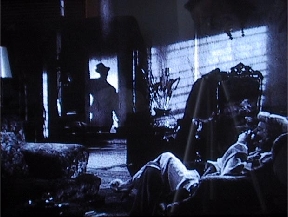
This is a still from Double Indemnity which shows a number of trademark features. The shadows cast by venetian blinds on the wall, the cigarette being smoked by Barbara Stanwyck and the curious construction of the mise en scene are all very characteristic of the style. What is even more wonderful about this particular shot however is the way the shadow of Fred McMurray’s character enters the scene before he does. The Barbara Stanwyck character is just about to shoot him with a pearl-handled revolver so this image suggests that he is already on his way to the underworld.

Noir settings are almost exclusively urban: the resulting iconography consists of images of dark night-time cities with rain-soaked streets reflecting dazzling neon lights that intrude into the picture and fracture the composition. Interiors are almost always cramped and claustrophobic: dingy hotel rooms, night clubs or even the backs of taxi cabs. The dark outside world presses in on the characters and is full of danger. Soundtracks often include jazz in the bebop style from the late 1940s or early 1950s, with its jagged melodic lines and stuttering rythms, emphasizing the psychological instability displayed by the characters and settings.

The protagonists are trapped, perhaps just by mischance, in an alienating lonely world, usually a night-time city, where they are constantly in danger for their lives. The chaotic, random violence of this world gives rise to feelings of persecution and paranoia and a sense that life is absurd, meaningless, without order or purpose, and governed by contingency rather than design.

Much has been written about the origins of Film Noir, but it does seem clear to me that, although it is essentially an American style, it owes many of its roots to European existentialism, a point further reinforced by the fact that many great movie directors of the noir period (including the great Billy Wilder, who directed Double Indemnity) were in fact European emigres.

Anyway, I digress. What I wanted to say really was that during the course of watching all these wonderful films from a bygone age it struck me how much the language and iconography of modern cosmology shares this existentialist heritage. Our new standard cosmological model is full of references to the “dark” sector (dark matter and dark energy) which dominates the energy budget of the Universe, but which not just invisible but also unfathomable. The cosmos is lit by garish starlight from small islands of luminosity embedded in this sea of darkness. Long chains of bright galaxies stretch across space like rows of streetlights whose glare fractures and disturbs the celestial dark. We cling to a precarious existence on a tiny rock that is surrounded by danger. Even the stuff from which our atoms are made is completely overshadowed by alien matter. The universe is oblivious to us and we are irrelevant to it.

But it’s not only the surface imagery of cosmology that resembles that of a noir movie. The exisentialist trend runs deep. Cosmology seems to be abandoning the idea that there is a design behind it all. The idea that there is a single explanatory principle “a theory of everything” that accounts for why our Universe is the way it is and why life is possible within it, is losing ground to the idea that there is a multiverse in which all possible laws of nature are realised; we just live in a place where life happens to be possible. I’m not at all convinced that it is a good route for science to follow, but many cosmologists seem to be accepting this kind of thing as the best we will ever do to explain the Universe.

But if the idea of a world without meaning fills you with existential angst, then don’t worry about it. At least there are plenty of good films to watch.

Nooks and Corners

Posted in Bute Park with tags , on November 30, 2008 by telescoper

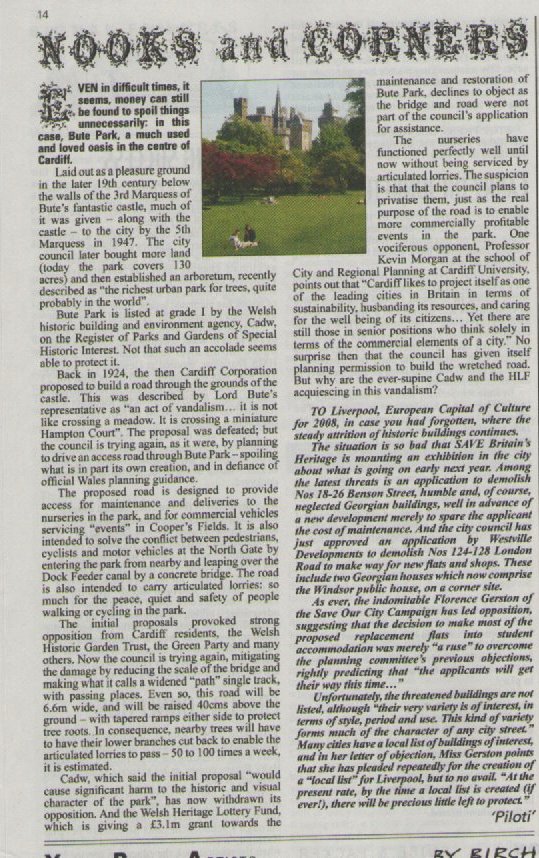
bute-park-storyAs a subscriber to the esteemed organ Private Eye, I was delighted to see that the November 28th 2008 issue carried this article about Cardiff City Council’s disgraceful plans for Bute Park, and the bewildering behaviour of the Welsh Heritage Lottery Fund in supporting the proposal to increase the traffic of articulated lorries through it.

I understand there is to be a public meeting to discuss this on Friday December 12th, but the organizers are having some difficulty finding a representative of the Council who is willing to defend their conduct. I can’t say I’m surprised, but I also hope that it is not too late to persuade the Council to abandon their ridiculous scheme.

I have complained before about precisely the attitude noted in the Eye, namely that the Council sees its Parks mainly as venues for promotional events and other commercialised ventures, whereas I think a Park is best kept as a Park so people can enjoy a bit of Mother Nature in the middle of the City.

As it happens I walked  through Bute Park this afternoon on my way back from Cardiff Bay where I had been paying the deposit and ordering wine for a forthcoming Christmas celebration in one of the restaurants down there. It wasn’t too cold (considering it is the last day of November) primarily because there was very little wind so I walked there and back from my house, doing a little shopping on the way.

The Council gardeners have been hard at work preparing the borders and plots for the winter so these look pretty bare at the moment. The brown fallen leaves blend with the green of the lawns to produce a variegated groundscape which is very beautiful. Enough colour remains amongst the trees because of the presence of evergreens of various types thoughtfully planted amongst the deciduous trees.  On a bright day like this the lack of leaves on other trees really opens up the sightlines in the park so one gets a wonderful sense of space. The landscaping isn’t all that obvious when the woods are thick with greenery, but at this time of year through the minimal foliage the gentle undulations created by Capability Brown can be clearly seen. The Park is more spartan than in the summer, though not at all less enjoyable.

I love to see how Nature marks the passage of time like this. I would hate to live somewhere where the sun shines everyday and where the seasons offer no variety. With winter coming on there’s a sense of battening down the hatches and preparing for the tough times that might lie ahead, but also a reminder that eventually the cycle will begin again in the spring.  There’s a sense of peace that comes from being attuned to this reality that is deeply therapeutic and which, in modern life, especially in cities, is an increasingly rare experience. Please, Council, don’t take this away from Cardiff!

Mumbai Memories

Posted in Biographical with tags , , , on November 29, 2008 by telescoper

Like many of you I’ve been following the events in Mumbai over the last few days with a mixture of shock and horror. It’s terrible to see the levels of cruelty and inhumanity that people can descend to. I doubt if we’ll ever really know what this murderous gang thought they were going to achieve when they set out on their killing spree on Wednesday evening. I’d be surprised if any of them could actually articulate their reasons for being involved, any more than a typical British soldier could explain, if asked, what they thought they were achieving by their presence in Iraq.

It’s a matter of great shame that we have become relatively hardened to the news of deaths abroad. Practically every day we hear of killings of occupying troops, insurgents, or non-combatants in Iraq or Afghanistan but we pay them little attention now. The death toll in Mumbai is now at least 195, but this is just a tiny fraction of the number of lives lost around the globe. What hits us hardest in the west is when we can no longer keep such events at a safe distance in our minds but when they strike on familiar territory, such as was the case in the London bombings. Only then do we see the horror close-up and personal. But we shouldn’t forget that in small towns we’ve never heard of all around the world many others are crying too, and probably for just as little reason.

I suppose it was inevitable that the events in Mumbai would send me wandering down memory lane. I have actually been there twice but both visits were long ago when the city was still called Bombay. I was supposed to go to India this summer too, but complications involved in moving house meant that I couldn’t go. However, I did once eat in the Cafe Leopold that the terrorists attacked in such cowardly fashion on Wednesday and I have waited for a train in the old Bombay Victoria station (now Chhatrapati Shivaji Terminus). We shouldn’t need to rely on such connections to shake off the numbness that we feel when hearing about atrocities in other places, but that’s what it’s like to be a complacent westerner.

My first trip to India was in early 1994 and I passed through Bombay on my way to and from Pune. My flight from London to Bombay arrived at about three o’clock in the morning and I was greeted outside the immigration area by a young man holding a sign with my name on it who had my train tickets from Bombay to Pune. The train didn’t leave until 6.30am so he asked me what I wanted to do until then. I said I thought I would just go to the station if it was open and wait there. He looked surprised, but said that, yes, the station was open all night. He then offered me a lift in his car as he was heading home and would be going roughly in that direction.

When we got to Bombay Victoria I realised why he had been surprised. I had assumed the station would be fairly empty and I might be able to sleep on a bench or something. When I walked into the concourse it was jam-packed with people sleeping all over the floor. I wandered in sheepishly, the only westerner to be seen, and started to look for what platform my train would be leaving from. Immediately I was surrounded by beggars – women with small babies, cripples, people with gruesome scabs and sores – all pushing me around and pleading for money. Then a teenage boy tried to lift my walkman from my pocket and I started to feel not just uncomfortable but scared.

Pretty soon, though, an official from the State Railways saw my predicament and came to my rescue. Delivering numerous clips around ears he speedily liberated me from my oppressors, took me to into a small kiosk situated on the platform, and offered me a cup of tea. It had far too much sugar in it, but I drank it anyway. He asked me where I was going, and I told him. He was initially suspicious, I think, because the primary place westerners tended to visit in Pune those days was the Ashram run by Bhagwan Shree Rasjneesh where his disciplines were encouraged to participate in unrestricted sexual activities. When I told my friend from the railways that I actually going to visit IUCAA, which at that time was run by the famous Professor Narlikar, he beamed with relief. I think he wasn’t unique amongst Indians who thought that Rasjneesh was a fraud and his disciples gullible idiots.

It turned out that the train I was to take to Pune was actually already in the station but was being cleaned. Since they cleaned the first class compartments first, I was allowed to get on the train early, about 4.30, and immediately nodded off. I only woke up when the train pulled out of the station and started on its journey up towards the Deccan plateau.

I enjoyed the journey enormously, partly because the train was slow enough to allow me to take in all the sights, and partly because I was sharing a compartment with a very friendly Indian couple (a professor of engineering and his wife). They had done the customary thing in such cases which is to consult the list of passenger names posted on the platform before the train left the station. When I woke up, they greeted me by name and introduced themselves. It was a refreshing change from London, where it is apparently forbidden to talk to strangers on a train.

I stayed about a month in Pune working with a colleague, Varun Sahni, on a lengthy article for Physics Reports. When that was over I had been invited to visit the Tata Institute for Fundamental Research in Bombay for a few days on my way home, so I got the train back to Victoria. Arriving on time, I left the train to be confronted by a crowd of small boys who tried to convince me that there were no taxis but that they would arrange one for me for a price of 200 rupees. That was way over the odds for a taxi so I laughed and said no thanks.

Proceeding out of the station to the taxi rank, I realised that they had been telling the truth. All the taxis in Bombay were on strike that day. I started to panic. How am I going to get to TIFR? Then I remembered that I was to have asked the taxi driver for “Navy Nagar Bus Stop”, which is right next to the guest house I was supposed to stay in. This is actually not far from the scenes of terrorist atrocities, but nearer the southern end of the Colaba peninsula, marked with an A on the map

I thought that if there’s a bus stop there must be a bus. I found a policeman and asked him where the buses went from. He gave me very clear directions and told me I needed the Number 11. I found the stop without much difficulty, but then there was a hitch. The buses themselves were red double-decker Routemaster types just like those you could find in London. Unfortunately, though, the numbers were written in Marathi script which I couldn’t read. Only when a bus went past did I see that the arabic numerals “11” were written on the back. A few minutes later I was joined at the bus stop by an Indian guy so I asked him if he could tell me the numbers of the buses as they came into view. He asked me where I was going, so I told him and it turned out he was going there too. Sorted.

On the bus I sat with my luggage around me and the front of the lower saloon facing backwards. All the locals peered at me like I was an exhibit in a museum, but most of them smiled. A couple of stops into the journey an old man got on wearing a scruffy coat. He looked rather poorly and had some sort of skin condition. He sat facing me and started scratching himself through his coat. I started to feel quite uncomfortable because this performance went on for some time. Then he started to unbutton his coat as if he was going to take it off. It was then that I realised the cause of his discomfort as a chicken poked its head out.

The bus was quite slow and the journey quite long so, when I finally got to the TIFR guest house, it was quite late. When I found the building, I was pleased to see my host, a physicist called TP Singh, in the lobby talking on the phone. He had his back towards me and was in the middle of a heated conversation, so I waited until he had finished before introducing myself. After a few minutes he put the phone down and turned around, so I offered my handshake and said hello.

He had a look of complete confusion on his face which gradually gave way to relief. Peter! He shouted. How did you get here? I got the bus, was my answer. It turned out he had found out in the afternoon (when I had already left Pune) that there would be no taxis so he had sent the TIFR car and driver to meet me at the station. I hadn’t seen the driver amongst the crowds and wasn’t expecting to be met anyway. In those days I didn’t have a mobile phone so there was no way of warning me about it. After scouring the station, the driver had returned to TIFR and reported that I was missing. When I had arrived at the guest house, my host had actually been on the phone to the local police in order to report me lost.

It was during this short visit of three days or so before flying back to London that I behaved as a tourist although I was guided around by students and staff from TIFR so I wasn’t herded around like a sheep. I visited the Gateway to India (right next to the Taj Mahal Hotel, scene of one of the recent terrorist outrages), ate at the Cafe Leopold, and took a boat to Elephanta Island.

Mumbai (as it is now) is an enormous city in which extreme wealth and abject poverty can be found in close proximity and where religious tensions are never far away. Riots are fairly commonplace and there are powerful grievances between the different social groups and claims of police corruption. The sheer scale of the place means that no casual visitor can hope to understand what the place is really like. But my visit there left me with an impression of a city full of energy and determination in which there is much kindness to be found below its rather scary surface.

Gamma Plus

Posted in The Universe and Stuff with tags , on November 26, 2008 by telescoper

I’m a bit slow to blog about this but better late than never. The topic is the satellite formerly known as GLAST (which was an acronym: Gamma-ray Large Area Space Telescope) and which is now called Fermi (which isn’t an acronym, but a late and great physicist). I’ve got nothing against the change of name but I rather enjoyed seeing GLAST in titles of papers and conference talks, particularly in combination with the complementary ground-based facility HESS (another acronym: High Energy Stereoscopic System, situated in Namibia). “Astronomy with Hess and Glast” always sounded to me it should be like Astronomy with Sturm und Drang, or something like that. Astronomy with Hess and Fermi just doesn’t sound as exciting.

Anyway, Fermi was launched in June 2008 and by August had completed a quick scan of the whole sky in gamma rays with energies from 20 MeV up to 300 GeV. The main result of this quick look is that the telescope seems to work and that most of things you would expect are actually there in the gamma-ray sky, as you can see in this picture (courtesy of NASA/Fermi):

fermi0827081

As expected, the Galactic Plane shows up quite brightly in gamma rays because of the collisions between dust particles and high-energy cosmic rays. There are also a couple of supernova remnants nearby and one nearby active galaxy 3C454.3 outside our galaxy. It’s too early to say how many other sources Fermi will identify but it’s certainly a very promising start.

Actually things are looking up elsewhere in the high-energy astrophysics world too, as reported on cosmic variance recently, with a number of tantalising indications of immense potential interest discussed there. One of the exciting possibilities is that gamma ray observations might offer the chance to detect the annihilation of dark matter particles through collisions in our own Galaxy. Such collisions could chuck out gamma rays energies relating to the (unknown) mass of the dark matter particles.

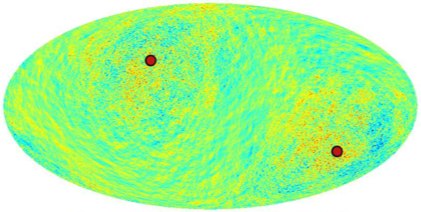
For myself, I wonder if there might be any hint that the low-level fuzz in the Fermi map might give us about the apparent lopsidedness and other anomalies in the Cosmic Microwave background?

elongated

Hmm. Watch this space

PS. I hope my remarks about the name won’t set Enrico Fermi spinning in his grave. Or perhaps only half-spinning. (Geddit?)

Popularisation or Propaganda?

Posted in Science Politics, The Universe and Stuff with tags , , , on November 25, 2008 by telescoper

I was just reading a piece by Jim Al-Khalili in today’s Guardian online science section. Jim is Professor of Physics and of Public Engagement in Science at the University of Surrey. His piece seems to have been inspired by the new appointment of Marcus du Sautoy to a similar position at Oxford University recently vacated by Richard Dawkins. His message is essentially that scientists should not only be more active in popularising science but also do more to “defend our rational, secular society against the rising tide of irrationalism”.

The legitimate interface between science and society has many levels to it. One aspect is the simple need to explain what science tells us about the world in order that people can play an informed part in our increasingly technological society. Another is that there needs to be encouragement for (especially young) people to study science seriously and to make it their career in order to maintain the supply of scientists for the future. And then there is the issue of the wider cultural implications of science, its impact on other belief-systems (such as religions) other forms of endeavour (such as art and literature) and even for government.

I think virtually all scientists would agree with the need for engagement in at least the first two of these. In fact, I’m sure most scientists would love to have the chance to explain their work to a lay audience, but not all subjects are as accessible or inspirational as, say, astronomy. Unfortunately also, not all scientists are very good at this sort of thing. Some might even be counterproductive if inflicted on the public in this way. So it seems relatively natural that some people have had more success than others, and have thus become identified as “science communicators”. Although some scientists are a bit snobby about those who write popular books and give popular talks, most of us agree that this kind of work is vital.

Vital, yes, but there are dangers. The number of scientists involved in this sort of work is probably more limited than it should be owing to the laziness of the popular media, who generally can’t be bothered to look outside London and the South-East for friendly scientists. The broadsheet newspapers employ very few qualified specialists among their staff even on the science pages so it’s a battle to get meaningful scientific content into print in the mass media. Much that does appear is slavishly regurgitated from one of the press agencies who are kept well fed by the public relations experts employed by research laboratories and other science institutes.

These factors mean that what comes out in the media can be a distorted representation of the real scientific process. Head of research groups and laboratories are engaged in the increasingly difficult business of securing enough money to continue their work in these uncertain financial times. Producing lots of glossy press releases seems to be one way of raising the profile and gaining the attention of funding bodies. Most scientists do this with care, but sometimes the results are ludicrously exaggerated or simply wrong. Some of the claims circulating around the time the Large Hadron Collider was switched on definitely fell into one or more of those categories. I realise that there’s a difficult balance to be struck between simplicity and accuracy, and that errors can result from overenthusiasm rather than anything more sinister, but even so we should tread carefully if we want the public to engage with what science really is.

Most worryingly is the perceived need to demonstrate black-and-white certainty over issues which are considerably more complicated than that. This is another situation where science popularisation becomes science propaganda. I’m not sure whether the public actually wants its scientists to make pronouncements as if they were infallible oracles, but the media definitely do. Scientists sometimes become cast in the role of priests, which is dangerous, especially when a result is later shown to be false. Then the public don’t just lose faith with one particular scientist, but with the whole of science.

Science is not about certainty. What it is a method for dealing rationally with uncertainty. It is a pragmatic system primarily intended for making testable inferences about the world using measurable, quantitative data. Scientists look their most arrogant and dogmatic when they try to push science beyond the (relatively limited) boundaries of its applicability and to ride roughshod over alternative ways of dealing with wider issues including, yes, religion.

I don’t have any religious beliefs that anyone other than me would recognize as such. I am also a scientist. But I don’t see any reason why being a scientist or not being a scientist should have any implications for my (lack of) religious faith. God (whatever that means) is, by construction, orthogonal to science. I’m not at all opposed to scientists talking about their religion or their atheism in the public domain, but I don’t see why their opinions are of any more interest than anyone else’s in these matters.

This brings us to the third of Jim’s suggestions: that more scientists should follow Richard Dawkins’ lead and be champions of atheism in the public domain. As a matter of fact, I agree with some of Dawkins’ agenda, such as his argument for the separation of church and state, although I don’t feel his heavy-handed use of the vitriol in The God Delusion achieved anything particularly positive (except for his bank balance, perhaps). But I don’t think it’s right to assume that all scientists should follow his example. Their beliefs are their business. I don’t think we will be much better off if we simply replace one set of priests with another.

So there you have my plea for scientists to accept that science will never have all the answers. There will always be “aspects of human experience that, even in an age of astonishing scientific advance, remain beyond the reach of scientific explanation”.

Can I have the Templeton Prize now please?

Beethoven and Borge

Posted in Music with tags , on November 25, 2008 by telescoper

I still don’t seem able to shake off this cursed cold that I’ve had for nearly a week. I resorted to finding some of my favourite clips on youtube to cheer myself up. Actually these are so funny I think I’m quite likely to have a relapse. If there’s anyone else out there in the blogosphere who’s feeling a bit under the weather, I thought I’d share a couple of uplifting cultural moments with you.

The first is by the brilliantly talented musician and comedian Dudley Moore, who performs this hysterically funny parody of a Beethoven Piano Sonata. Dudley Moore was best known as a comedian and actor but music was his first love, and he was a wonderful pianist who could play lovely jazz as well as classical pieces. His only fault was probably that he never really acquired a style of his own. Playing Jazz, he usually sounded like Errol Garner and on the classical side he was much disposed to affectionate piss-takes like this. I particularly love the drawn-out ending which seems to take up about half the track! I wonder what old Ludwig Von would have thought of this? I suspect he would have loved it. Don’t believe everything you hear about Germans having no sense of humour.

The second is by the Danish comedian (yes, there are such things), Victor Borge. Playing half of Liszt’s Hungarian Rhapsody. It says on Youtube that it’s No. 2 but I think it’s great.

Fine and Mellow

Posted in Jazz, Music with tags , on November 23, 2008 by telescoper

I’ve been off sick for the last few days with a nasty bug, but at least it’s given me the chance to listen to quite a lot of music. Yesterday, I was playing some of the classic recordings made in the 1930s by singer Billie Holiday and saxophonist Lester Young. I’ve had these for ages but for some reason haven’t listened to them for a while. Coming back to them after a long break just strengthened my belief that they are amongst the greatest recordings ever made in music of any kind.

Billie Holiday was born in Baltimore in 1915. After a grim and traumatic childhood she dabbled with prostitution and then ended up as a night club singer where she was spotted by talent scout John Hammond who arranged for her to make recordings with Benny Goodman‘s Orchestra in 1933. Most people don’t realise this but, by 1935, this band was a pop sensation on exactly the same scale as, say, the Beatles were to achieve three decades later.

In her early recording career, Billie wasn’t so well known so she was given relatively unpromising songs to sing. With her unique sense of phrasing, and a willingness to take outrageous liberties with both melody and rhythm, she turned out to be brilliant at turning this base metal into gold; some he was undoubtedly the best singer of a bad song there has ever been. If you ever get the chance to hear her versions of When you’re smiling or Back in your own Backyard you can marvel at how she manages to say everything about life and death using only the slenderest of lyrics.

Also featuring on both of these classic tracks was the tenor saxophonist Lester Young. Nicknamed “The President”, or “Prez” for short, he was one of the greatest of all Jazz musicians. He had a sublime gift for melodic improvisations, coupled to unrivalled sense of sheer swing as befits a mainstay of Count Basie‘s magnificently propulsive big band of the late 1930s. The sound of Lester Young at full throttle with the Basie Band riffing away behind him must have been truly magnificent to hear live and is thrilling enough on record.

Although he wasn’t at all averse to a bit of rabble rousing, and loved to see people dancing as he played, Lester Young’s solos on the Billie Holiday recordings mentioned above showed the delicate side of his nature. People often say is that the reason the two of them worked so well together musically was that they had similar sense of phrasing. I don’t agree with that at all. Billie Holiday’s vocal style sound to be more like a feminine version of Louis Armstrong’s, derived from a trumpeter’s mannerisms rather than those of a saxophonist.

Lester Young and Billie Holiday became very close friends during this period, although there is no sign that they had any form of sexual relationship. Rumours have circulated that Lester Young was gay, although I don’t think there’s any evidence to back them up. It is true that he had a rather eccentric and perhaps effeminate demeanour, but it seems that’s just the way he was. During the war, Lester Young was conscripted into the US Army and this had a dreadful effect on him personally and on his career, not least because he wasn’t allowed to play his saxophone at all. The strict discipline and macho posturing of the army affected this gentle and introverted man very badly and drove him to a nervous breakdown. He was eventually discharged from the army and, although he started playing again, his career never regained the heights it had reached in the 1930s. He had frequent bouts of ill health owing to alcoholism and drug abuse and his recordings from the late forties and fifties are of uneven quality.

Billie Holiday’s career was also in decline during the 1940s, after she became addicted to heroin, and she was imprisoned on drugs charges in 1947. Cigarettes, booze and hard drugs ravaged her voice and, although she made a number of classic records in the 1950s, her vocal style was sometimes mannered and self-conscious. I definitely prefer the earlier recordings which show her at her most original. That said, there was one song from George Gershwin‘s Porgy and Bess that invariably inspired her to an intensely moving performance, including this sensational recording made just five months before her death in 1959.

But the reason for putting this all on my blog was that playing through these old records I remembered when I used to listen to Humphrey Lyttelton‘s Jazz programme on the radio. He once admitted on the air that there was a TV recording involving Billie Holiday and Lester Young that he couldn’t watch without bursting into tears. The programme “Sounds of Jazz” was made by CBS Television in the United States in 1957 and features a vast array of great musicians, including Miles Davis and Thelonious Monk. But this excerpt is the bit that always got Humph going, and I don’t wonder why.

Lester and Billie had at one time been very close indeed, but had become estranged for some reason, and hadn’t recorded together for the best part of twenty years before this. Time had exacted its toll on both of them. Prez, in fact, was very ill during this broadcase and he looks it. Barely able to stand or hold the horn, when he plays he still manages to deliver a moving and poignant solo. The camera cuts to Billie’s reaction, full of tenderness and empathy and the emotional effect is overwhelming. So intense is that moment that you tend to forget the other magnificent players on this track (including Coleman Hawkins, the other leading saxophonist of the 1930s whose style was very different, but whom Lester Young deeply admired). As Nat Hentoff later recalled

Lester got up, and he played the purest blues I have ever heard, and [he and Holiday] were looking at each other, their eyes were sort of interlocked, and she was sort of nodding and half–smiling. It was as if they were both remembering what had been — whatever that was. And in the control room we were all crying. When the show was over, they went their separate ways.

Lester Young died in March 1959, a little over a year after this performance. In a taxi returning home from his funeral, Billie told a friend that she thought she would be the next. She died in July the same year.