Overhead and down below

Posted in Biographical on October 28, 2008 by telescoper

I’ve just been catching up on a few of the posts on cosmic variance. Of course their blog is a complete swizz because there are several contributors, which is obviously cheating. However they do manage to cover a lot of ground and provoke a lot of discussion.

One recent theme which has extended over several posts concerns John McCain’s complaints about the cost of an “overhead projector” (about $3M) at the Adler Planetarium in Chicago. Of course this is no ordinary OHP, but a wonderful “Sky Theater” for which the price tag seems actually rather modest.

Of course I could complain about the spelling of “Theater” or the refusal to use the proper plural for planetarium but it would be completely unlike me to go on about such things. Instead, I thought I’d meditate on the theme of old-fashioned proper overheard projectors.

Most people use powerpoint for lectures and conference talks these days, but it’s not long ago that we all seemed to use transparencies (“viewgraphs”) to be placed on the OHP. I was relatively late to switch to powerpoint, but got the hang of it quite quickly having decided to do so. I have, however, resisted the temptation for annoying gimmicky animations and sounds in favour of a plainer minimalist style that draws appropriate attention to the extraordinary level of my verbal eloquence. *Cough*

Powerpoint also means that I’ll never have to suffer the embarrassment I once endured at an international conference (which shall remain nameless). Giving the first talk of the morning session, I turned up with a neat stack of transparencies that I’d carefully written out in my hotel room the night before the talk.

As the audience settled down and the chairperson introduced my talk, I took the first slide and placed it carefully on the glass top of the projector. For maximum impact, I didn’t switch on the light until I was ready to speak. My first slide had just the title of my talk and little else in the way of text or pictures. When I was sure everyone was paying attention, I hit the switch and the light came on. I knew this pause would ensure everyone would be looking. I turned around to glance at the screen and check it was all in focus.

Brightly illuminated, perfectly focussed, projected to an enormous size and plain for all to see, was a single shocking and inexplicable pubic hair.

A Friend of Dorothy

Posted in Biographical with tags , , on October 26, 2008 by telescoper

In my previous post about childhood memories of Benwell, one of the stones I left unturned was the story of our next door neighbour when we lived there. I was going to skip this because I feel quite guilty still, but on the grounds that it will probably be some form of catharsis I decided to write about it now.

In the other one of The Cottages I described in the previous post there lived an old lady, a spinster whose name was Dorothy Newton. She was already living there when we moved in next door and had, in fact, lived there for as long as she could remember. She had never married and had little experience of children, at least at the start. My first encounter with her wasn’t at all auspicious. I had accidentally kicked a football into her garden and without thinking about it at all, just went in and got it. As I picked it up I saw her looking out and, scared, I ran back to my house. Technically, I was trespassing and I assumed she was angry with me.

A bit later I had the chance to talk to her in her garden and she said she hadn’t minded, but that in future I should try not to trample her roses. I got to know her slowly and eventually started visiting her quite regularly. She became my “Aunty Dorothy”, although she obviously wasn’t actually a relative. This was before I started School so I would have been less than five years old. I’m told I called her something like “Ann Dorry” at that time because I couldn’t manage her full name.

Aunty Dorothy was an invalid, having suffered a fall on a trolley bus some years previously which resulted in permanent problems with both her legs. She got around on sticks at first and then, later on, needed to use a walking frame. If our house was basic, hers was downright primitive. At some point in the past (which she always referred to as “The Flood”) her roof had suffered a big leak and large amounts of water had got in and badly damaged half of her house. Since she never had money to repair it, the right-hand side of her cottage (out of shot in the picture in the previous post) was completely unusable. As she became more infirm she couldn’t manage the stairs and lived entirely from the ground floor room whose window you can see in the first photograph on my previous post. Her kitchen (which she called the “scullery”) was really Victorian in style, complete with old-fashioned walk-in pantry. And she too had an outside loo.

Life for Aunty Dorothy had, I think, always been tough and she lived a very humble existence but she had acquired an almost unimaginable sense of determination over the years as well as the ability to take huge amounts of pleasure from the small things in life. She had numerous accidents around the house – she was very prone to falls, and sometimes these left her lying for days on end before anyone found her – but she always recovered and carried on with her routine regardless. It took her ages to do even simple things but she never gave up and never complained.

As time went on she eventually found it impossible to leave the house, except for a spot of gardening, and lived an increasingly solitary life, apart from visits from the home help (whom she didn’t like at all) and the nurse who, amongst other things, helped her take a bath once a week.

When I started school a sort of routine developed. My mum and dad both worked at that time and weren’t home when school finished around 4pm. Since I had no distance to go to get home I would have to wait outside the house for one of them to return, so instead I called on Aunty Dorothy. We would sit and have tea (usually with jam or banana sandwiches). Sometimes we would watch the children’s TV programmes in black-and-white and sometimes we would just talk, until about 6pm when I would go next door to my own house. We had tea like that most days for about five years.

In the beginning I was, by any standards, an extremely backward child. I was very slow to learn to speak, which I didn’t even start to do do until I was three. I also had various physical problems, including a condition my mum always referred to as “spacky feet” which meant I had to visit an orthopaedic clinic from time to time. I’m not sure which particular deficiency was responsible, but it took me absolutely ages to learn to ride a bicycle. I think when I started School I was immediately earmarked as a likely basket-case from an educational point of view. In those days the slow kids didn’t really get much help; they sat at the back of the class and did raffia. I wonder how often these diagnoses turned out to be self-fulfilling, but I was definitely a misft from the start.

I think my parents might have mentioned to her that they were worried about my performance in school but whether or not they did, Aunty Dorothy started to take an active interest in my education. I didn’t realise it at the time but she did this in very clever ways. She started asking me to run errands for her to the local shops (which were very close). She would always send me for a single item and ask me to make sure I got the right change. I realise now that she basically invented these jobs to help me practice my arithmetic. I’m sure that myriad of little jobs, allied to the confidence that she obviously placed in me, helped me get over my difficulties with sums to the extent that, by the time I was 10, I even looked forward to Mr Martin’s mental arithmetic tests.

Aunty Dorothy was also keen on horse-racing, which she liked to watch on the telly. When I was a little older, she would sometimes ask me to work out the odds for her. I realised only later that she knew perfectly well how to work out what her winnings would be and this, like the little trips to the shops, was just a way of getting me to work things out myself. At the time, though, I was chuffed to feel I was helping.

Later on, when the dreaded decimalisation happened in the early 1970s she asked me to help with that, although this time I don’t think she was faking it. The pound was no longer 20 shillings, each containing 12 pence, but a simple 100 “new pence”. It may seem simple now but it was a difficult transition for the older generation. The old pound notes were still legal tender for a time, but some coins and rarer notes had to be swapped for the new versions, such as the ten-bob note (10 shillings) which was replaced by the 50p coin. The old shilling coin became the new 5p and the 2 bob was 10p, but there was no longer a place for the old threepenny bit or the sixpence (tanner). Aunty Dorothy once sent me to the post office with a couple of ten bob notes and brought her back the two coins, but she didn’t like them. Somehow you feel richer with paper money.

And then there was reading. I was very behind in developing my reading skills, just like everything else really, but here again Aunty Dorothy helped me enormously. Her eyesight wasn’t great but it wasn’t as bad as she pretended it was when she asked me to read carefully selected items from the Newcastle Evening Chronicle (which now has its own website) to her. On Sundays she got the Sunday Post, a Scottish newspaper which was quite popular on Tyneside in those days. It had a kid’s supplement which was really good, and I would avidly read the cartoons, especially Oor Wullie and The Broons, and do the puzzles.

After a time I had caught up with reading in class and eventually managed to read just about every book the School had to offer, including the Diaries of Samuel Pepys which were for some reason on the shelves in Class 2 and which I was allowed to borrow. I don’t think anyone had read them before so nobody, including the teachers, knew how rude they were. I had no idea at that time that less than ten years later I would be studying at Magdalene College Cambridge, site of the Pepys Library where the orignal diaries are kept as well as the rest of Pepys’ own collection of rare books.

Aunty Dorothy and I were close for many years, during which I underwent a transition from dimwit to high-flier (or at least the closest approximation to such a thing that Pendower School had ever produced). It wasn’t just her that helped me succeed academically – I also had many good teachers at Pendower School – but she certainly played an important part.

In due course my family moved from The Cottages to an ordinary semi-detached house (with an inside toilet) in Hodgkin Park Road but I carried on going to Pendower School, which was only half a mile away, and visiting my adopted Aunt as often as I could over the next few years even though I was no longer living right next door.

I remember during the time of the Miner’s Strike in 1974 when the country switched to a three day working week for a time, sitting in Dorothy’s house with only candles to light us, listening to her stories about the wartime blackout. She also told me that the strike was a good thing because it would probably bring down the hated Conservative government of Ted Heath. She was certainly right on that count.

I also remember that she had a peculiar suspicion about thunderstorms. If there was any sign of lightning in the area, she unplugged all the electrical equipment in the house and switched off all the lights. That much I think I can understand but, for reasons I never figure out, she also insisted on putting all metal objects (such as cutlery) away into drawers or covering them with a tablecloth if there wasn’t time to do that.

In 1974 I took the entrance examination at eleven-plus for the Royal Grammar School in Jesmond and was recommended by the Governors for the award of a scholarship. This was effectively a private school but the City Council paid the fees for a limited number of pupils who did well in the entrance examination. I therefore got a free place which is just as well since there’s no way my family could have afforded the fees. The following year, the new Labour government scrapped the arrangement and the School became fully independent but the Council agreed to carry on paying the fees for those students who were already there. I had got in by the skin of my teeth.

However, the RGS was (and is) in Jesmond, which is on the other side of the city to where I was living so I had to get the bus there and back every day, a journey that took over an hour in each direction. I also had lots of homework to do every night. The frequency of my visits to Aunty Dorothy decreased. Although I had promised to keep in touch with her as best as I could, I didn’t keep my word and after a year or so I stopped visiting her altogether.

I found out in 1978 that she had died in hospital after suffering yet another fall at her home from which this time she hadn’t recovered. I never had the chance to say goodbye and had never taken the time to tell her how grateful I was for all the help she had given me over the years.
Behind the Wall

Posted in Biographical with tags , , , on October 26, 2008 by telescoper

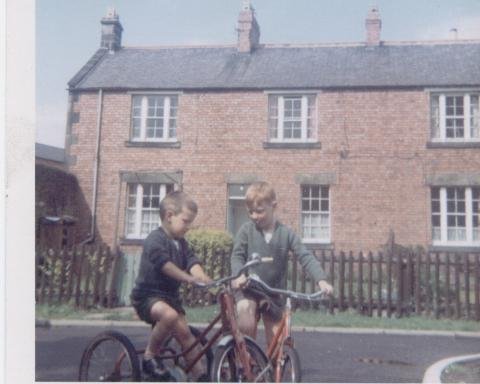
This photograph was taken in front of the little house in Benwell Village that I grew up in during the sixties. I’m on the left and my older brother Jeffrey is on the right. I don’t know when it was taken, but I was obviously just a young ‘un and it may actually have been before I started school. The house, as you can see, was quite small – basically two rooms on either side of each floor (each with one window) and with a kitchen at the back of the ground floor and a small bathroom upstairs. There was a similar house next door (of which you can see a part) and together these two were called “The Cottages”.

I wasn’t actually born in Benwell, which lies to the West of Newcastle upon Tyne, but in Walker which is to the East. However, we moved there when I was very young and all my earliest memories are from Benwell. Its name, incidentally, is derived from Hadrian’s Wall which ran from Wallsend (near to Walker) through the area covered by the modern city (which is built on the site where there has been a large town since mediaeval times), and west towards Carlisle. The whole area is littered with ruined forts, temples and mile stations and occasional pieces of the wall itself can be found between peoples’ gardens or next to modern roads; good examples include the fort at Condercum and the nearby temple which was right next to the wall itself. Benwell lies just to the south of the wall, hence its name which is a corruption of “Bynnewalle” meaning “behind the wall” and the oldest historical record of Benwell is from the 11th century, before the Norman conquest.

Our house was a strange place to grow up in primarily because of its location. Immediately behind The Cottages was Pendower School (Infants and Juniors) which I attended between the ages of 5 and 11. My trip to School in those days was about twenty yards, which made it quite difficult to think of excuses for being late. The other kids entered through the official gates on Pendower Way to the North or from Benwell Village itself to the West; I just had to turn left at the end of the garden and walk around the Cottages and I was there in the playground.

Pendower School was an austere, rather ugly,  building of Dickensian aspect but it was very well run by the Headmaster, Mr Brown, and had several very good teachers. I particularly remember Mrs Locke, Miss Stobbs and Mr Martin; the latter was a dapper fellow with a military moustache who was particularly good at drawing and painting as well as being hot on mental arithmetic, which we did every morning in class between 9 and 9.30 during my last year at Junior School. You know the sort of thing: “If it takes ten men three hours to fill a swimming pool with water using two buckets each, how long would it take two men each with one bucket?” This was Britain pre-decimalisation too, so we had to do mental arithmetic not only with pounds shillings and pence but also hundredweights, stones, pounds and ounces, gallons quarts and pints, rods poles and perches. Those were the days. Mr Brown the Headmaster didn’t take any classes but he insisted that we all did music and at assembly and during lunch he frequently played us classical music from an old gramophone. He particularly liked Purcell.

The School I attended (which had both boys and girls in it) shared its building with a school for older girls, but they were strictly separated from the youngsters, both inside and in the playground. There mustn’t have been enough space for the girls’ school so there were some outbuildings in the form of wooden huts at the edge of the playground, just to the right of The Cottages (from the viewpoint of the photograph). These were evidently for art lessons. I never went inside and was too small to look in through the windows, but they didn’t have very good drains and often the ground outside them was covered with brightly coloured mud resulting from botched attempts to dispose of paint that had ended up blocking up the pipes. The road our bikes are on in the picture was a sort of access road to allow deliveries to be made to these huts, but there were big metal gates (to the left) that were usually locked preventing access most of the time making this bit of road a good place to learn how to ride a bike, although I still hadn’t graduated from a tricycle when this picture was taken, for reasons that will become obvious later.

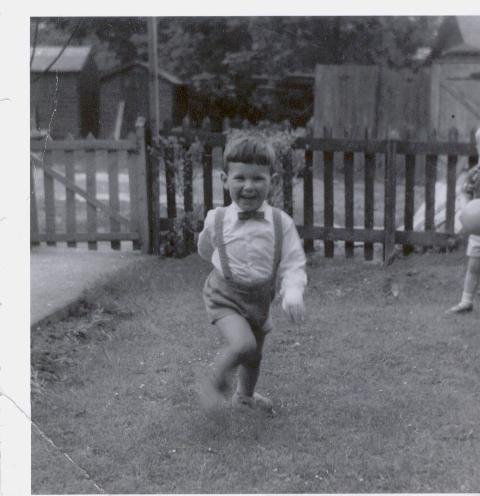
In front of The Cottages (i.e. behind the photographer’s position in the first picture) was a small wood called “The Spinney” which was enclosed on all sides by walls. In the slightly older picture to the right, which was taken from the garden looking south, you can see a little of the wood and some sheds that were later removed when the road was widened. This one was taken on my birthday, I think, but I don’t know which year it was.

Originally the two cottages were intended to house people who worked in a grand house at the south end of the Spinney which had been destroyed by fire some time before we moved in. The ruins of the house were still there for some time and they were the source of considerable fascination for me until eventually the council demolished what was left, carted the debris away and landscaped it over. That’s probably just as well as it was undoubtedly a dangerous place for a small child to be wandering about on his own.

The Spinney was probably about 100 yards square. The Cottages were in the northwest corner facing south, with Pendower School forming the rest of the northern edge, Benwell Lane to the south, where the entrance to the big house used to be, and Ferguson’s Lane as it passed through Benwell Village (past Block’s garage and the Hawthorn Inn) to the west. To the east was the former residence of the Bishop of Newcastle, another grand house called Benwell Towers, which, when I lived in Benwell, was being used a base for the Mine Rescue Unit, a specialist emergency service for the many coal mines that still operated in the area. Just a few years later all the mines were finished and Benwell Towers was flogged off to become a tacky nightclub. Since the house was supposed to have been haunted, the nightclub took the name of the ghost: The Silver Lady. This was all after we had moved away from the area.

So you will see that I lived in an unusual place when I was little: on the edge of the School playground, with my own private wood to play in, and with a haunted house only about 100 yards away!

On the far left of the original picture, which was taken facing north, you can see that there was a high wall running down the western side of the garden of our house. This carried on down the side of the house to the back where it formed the wall surrounding our back yard. There was both a door and a coalhole the size of a window in this wall, the one leading into the yard and the other to allow coal to be delivered directly from the street outside (Ferguson’s Lane) into the coalhouse, the place where it was stored. Coal provided the only heating in the house, including the hot water which was heated by a boiler behind the fires downstairs. There was no heating in the bedrooms at all and during the winter it was quite normal for there to be ice on the inside of our bedroom windows.

The backyard was also where our toilet was situated. Outside toilets (“netties”) are definitely a thing of the past but they weren’t at all unusual when and where I lived. There were only two problems with ours. One that there was no electric light so if you had to go at night it was necessary to take a paraffin lamp. The smell of paraffin always brings a memory of that back to me. I often think that if Marcel Proust had my background, A La Recherche de Temps Perdu wouldn’t have been full of that boring stuff about cakes. The other problem was the rats which frequented the area. The toilet door didn’t go all the way to the ground; there was a gap of an inch or so through which rats would sometimes poke their noses while you were on the bog, presumably attracted by the light. We kept a shovel in the loo to fetch down on the intruding rodents if they appeared. I never hit one, although I tried quite a few times. With the prospect of a rat appearing at any minute you didn’t hang around to do your business and were unlikely to need a laxative.

We had few of the comforts that people take for granted these days but my family wasn’t any worse off than any of those whose kids went to the same school as me. We always had enough food (as you can tell from the photograph), so we never thought of ourselves as being particularly poor. But it is true to say that our living conditions were pretty basic. We didn’t own the house, which I think was owned by the City Council (who also owned the Spinney), but our rent was very cheap because of the state it was in.

I go back to Newcastle from time to time, usually at Christmas. During one such visit I had the opportunity to pass through Benwell and look at where I used to live. Benwell is a grim place these days, devastated by crime and social disorder, which is depressing because I have such happy memories of the place. Even more traumatically, from a personal point of view, I realised that The Cottages, The Spinney and even Pendower School have all completely vanished.

The buildings were demolished and the little bit of woodland I used to play in ploughed up to make way for a new housing estate. The only thing that remains is a small piece of our wall, where the coalhole used to be, and behind which, forty years ago, a small boy sat, shovel in hand, hoping the rats would stay away.

News Roundup

Posted in Uncategorized with tags , on October 24, 2008 by telescoper

It’s not often that your own department gets onto the BBC News, but to do it twice in a few days with different stories has to be worth a mention!

Earlier this week was an item about the Einstein Telescope project, which has just received 3M euros in funding for design studies. Unlike familiar telescopes, this one is planned to exploit gravitational waves rather than the usual optical, radio or X-ray radiation (which are all varieties of electromagnetic waves). Gravitational radiation hasn’t actually been detected yet, but there are good reasons to believe that it will soon be measured for the first time. The next challenge will be to use gravitational waves from distant sources to study the processes that generate them, such as collisions between black holes. That’s what the new project is intended to do. In principle, gravitational waves will allow us to look much farther into the distant Universe (and therefore farther back in time) than we can do with even the largest optical or radio telescopes so this could be the dawn of a new era of observational astronomy.

But that doesn’t mean that optical telescopes will be defunct, especially when it comes to inspiring the young to take up an interest in astronomy. The other news item on the BBC this week about this department is our own new (optical) telescope which is now fully installed and will shortly to be opened. This is situated on the roof of the building that houses the School of Physics & Astronomy and it will be used primarily for undergraduate teaching, but it will also be available to be used by the general public and school visits on open nights. It should be put to particularly good use in 2009, which is the International Year of Astronomy.

It’s a small telescope by professional standards, about half a metre in diameter, but large compared with what’s available at other Universities in the UK and it promises to be a valuable addition to our already large range of astronomical facilities which is one of the reasons Cardiff is such a good place to work and study.

On the grounds that all publicity is good publicity, I was very pleased to see these things get a full airing on the local media, although I have to admit that the news that really caught my eye this week was the discovery of a headless corpse on the track at Llandaff railway station.

Network Reception

Posted in Biographical with tags on October 22, 2008 by telescoper

Tonight the Park Plaza Hotel in Cardiff played host to a wine-and-canapes reception on behalf of the Wales and West region of the RSA, an organization of which I am a Fellow, after being elected about two years ago.

The RSA is actually called the Royal Society for the Encouragement of the Arts, Manufactures and Commerce although this is frequently shortened to the Royal Society of Arts, a name that doesn’t really convey its true interdisciplinary nature. It’s London base is a splendid Georgian building in John Adam Street, just off the Strand and not far from Charing Cross, where it has been situated since 1774. Fellows have free use of this building, including its library and wi-fi connections, which I find very handy when visiting London. They do nice lunches too.

THe RSA is a venerable institution, formed in 1754, but it has evolved considerably over the years. Early on it attempted to stimulate progress by laying down challenges and offering rewards (“premiums”) for their successful completion. Probably the most famous of these was the challenge to transport live breadfruit to the West Indies taken up by Captain William Bligh with his ship the Bounty. His first attempt ended in the famous mutiny, but he survived and, showing immense skill, managed to navigate an open boat across the ocean to safety. When he got back to England he repeated the attempt, this time successfully and he duly collected the reward (or premium).

The RSA also organized Britain’s first public exhibition of contemporary art and it was such a hit that two of its members – Thomas Gainsborough and Joshua Reynolds – formed a spin-off organization in 1768 called the Royal Academy of Arts, which is now based in Burlington House Piccadilly, on the same site as the Royal Astronomical Society.

Originally the Society had a manifesto deriving from the high ideals of the 18th Century Enlightenment, chiefly to harness the energy and creativity of high achievers to improve society in general. Nowadays its aims have been altered to reflect the changes in society, but it is still involved in many and various campaigns and projects, chiefly on educational and environmental issues, and even runs its own academy, a type of school (concocted by New Labour )that is state-funded, but not controlled by a local education authority. The RSA also runs public lectures and activities from its London base as well as various regional campaigns.

Tonight’s reception was basically just to allow new Fellows to meet and to receive a few words of wisdom from the thrusting, dynamic Chief Executive Matthew Taylor. I’m afraid that part didn’t go too well. Mr Taylor went on at length about the importance of its academy to future RSA strategy without apparently realising that here in Wales there aren’t any academies at all. New Labour may have tinkered with English education, but devolution has protected the Welsh from a lot of the associated nonsense. I’m a relative newcomer to the Society, but I already have a feeling that it is a bit too London-centric for its own good (as, sadly, many things are in Britain).

Apparently when Matthew Taylor first took up his position as Chief Executive he decided to ditch the title Fellow on the grounds that it was sexist. He suggested changing the title to Member, until his staff pointed out that people probably wouldn’t want to have the letters MRSA after their name. I quite like having FRSA after mine, because I’m already FRAS. Maybe I’ll try to collect the whole set of permutations.

Anyway, after the speeches we got down to “networking”, i.e. drinking. I talked to various interesting people: a retired schoolteacher, a lady who works in the National Museum of Wales in Cardiff, and a strange man with long hair and white shoes, who I was told used to be a City Councillor in Cardiff and who was kicked out after some scandal. I thought he would probably be quite interesting to talk to, but he wasn’t very forthcoming. I think he might have thought I was a reporter, judging by the rate I was knocking back the wine.

Overall, it was quite an enjoyable evening. The wine was free and the nibbles were delicious, especially the little bread things with olive pate on them.

Powers and the Playhouse

Posted in Books, Talks and Reviews, Uncategorized with tags on October 21, 2008 by telescoper


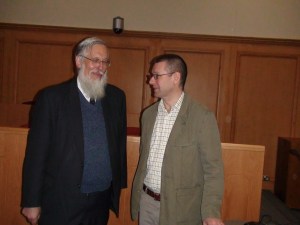
I got this picture this morning from the University of Derby. It was taken at the end of my lecture there last week. The chap on the left of the picture is Jonathan Powers, who is a former pro-vice chancellor of the University of Derby and who introduced my lecture as well as generally acting as master of ceremonies. He’s a very knowledgeable and genial fellow with a huge range of interests.

Over drinks after the talk he told me how he had recently become involved with a campaign to save the historic Derby Playhouse which was recently put into administration and is in danger of demolition if the current rescue package doesn’t work out.

I promised to put in a plug for the campaign, but forgot to do so until the photograph reminded me. You can keep in touch with the campaign and hopefully get involved by visiting their website here.

Carbon Footprints

Posted in Biographical with tags , on October 20, 2008 by telescoper

I found out this morning about an altercation during the early hours of Sunday morning in Cardiff’s city centre that resulted in a welsh rugby player having to go to hospital with facial injuries. This all happened about four o’clock in morning somewhere in the Mill Lane area of the city. Any civilised person who knows Cardiff will realize that’s generally an area to be avoided on Saturday night because of the very high density of rather seedy late-night venues and their undesirable clientele. It looks like it might have been a closing-time row but anyway it seems no serious injury was done so it will probably all be alright in the end.

Most of Britain’s cities now seem to have their weekend no-go areas as the national obsession with binge drinking and picking fights for no reason seems to have become entrenched over the last few years. Although these places are loud and unpleasant you can usually avoid trouble quite easily by showing a bit of discretion and walking away from obvious disturbances or, better still, avoiding these places altogether. If drunks want to fight each other, why not have a designated area so they can be contained? Two drunks are unlikely to inflict serious injury on each other if they are too inebriated, and the only real worry is when two gangs decide to embark on a mass brawl. That’s why there’s always a heavy police presence in such places.

I doubt if this kind of crime will attract much attention nationally, but it does remind me of the problems that developed in Nottingham (where I used to live) after the enormous increase in the number bars and clubs in the city centre about ten years ago followed by the more recent relaxation of the laws on licensing hours. Nottingham’s central area, including the Lace Market, now has over three hundred and fifty drinking establishments and at weekends these draw an estimated 100,000 people into the city on Saturdays. The consequent pandemonium never really affected me personally as I didn’t go to the pubs and clubs in that area, and had anyway been been brought up in Newcastle which has a similar reputation, but it did cause a considerable strain on the local police force and may have contributed to their difficulty in controlling Nottingham’s soaring crime figures.

On the other hand, when Nottingham acquired the nickname of the Gun Capital of Britain this definitely did have an impact close to home for me, as it clearly affected the number of student applications to the University of Nottingham. Although (as far as I know) no student was ever involved in a gun crime, there was also a rise in low-level crime including burglaries which did affect many students especially those living off-campus in the Lenton and Radcliffe areas. On most admissions days we had to contend with questions from both parents and students about crime and it was a constant struggle to counter the impression that Nottingham was a completely lawless place.

My own house was burgled a few years ago too, and several other members of staff I knew there had break-ins and other experiences with crime while I was living there. Ironically, in my case I’d just been involved in running an open day for prospective new students which had gone very well and I’d spent the evening having a few drinks in the Staff Club on the campus at University Park. I walked home to Beeston, which is near the campus, but when I got to my house I saw all the lights were on, which they weren’t when I left that morning. One of the ground floor windows had been forced open and the house was very cold, caused by the fact that the window and back door to the garden were open. Once I’d recovered from the shock I started to worry that something might have happened to Columbo, but he appeared very soon showing no signs of harm having probably slept through the whole thing.

I looked around the house and discovered that they had taken quite a lot of things, making good their escape through the garden at the back of my house thus avoiding drawing attention to themselves in the street at the front. They had taken a bit of foreign currency, a portable CD player, TV, a vacuum cleaner and various other inconsequential things. But they also took a lot of my CDs, some of which were quite obscure and difficult to replace. Although I was fully insured, so I didn’t actually lose anything much in a financial sense, I was definitely very annoyed about losing some of my favourite music. On the other hand, I wasn’t too bothered about the mess the burglars had made because my house is never very tidy anyway.

I called the police and they were at the house within a few minutes. After a cursory look around they left me a card, logged the incident and went away, telling me to try not to touch anything until the forensic officer came the next day. I called the insurers and the next morning a guy came to fix the window and door. By then I had calmed down and was just interested in getting things back to normal.

Then a SOCO (Scene-of-Crime-Officer) arrived to do some forensic tests. I had been an avid watcher of CSI: Crime Scene Investigation for some time so I was quite interested to see what sort of tests they would do.

It wasn’t anything like the TV. The lady that came sprinkled powder here and there and then announced that the intruders must have worn gloves. Then she went into the back ground floor room that led into the garden. This room had a wood laminate floor which was covered in muddy footprints.

“Oh great,” she said “I can use this new stuff!”

She rummaged in her bag and brought out some kind of graphite powder and sheets of plastic stuff like clingfilm. She poured the powder all over the floor and lifted several footprints using the sticky plastic.

“I never tried this before. I’ll let you know when I get back to the lab whether I can identify the prints.”

And off she went, leaving the powder for me to clean up. That turned out to be impossible because it was stuck deep into the grain of the wood. It was a hell of a job to clean off the fingerprint stuff too. They never show you that in the movies.

Anyway, the next day I got an excited phone call from the conscientious SOCO. She had identified the footprint. It was a size 7 Reebok trainer. Gee, I thought, there must only be a few thousand of those in Nottingham. Obviously, this discovery didn’t help much and the crime remains unsolved.

I was thinking of sending a bill for the cleaning, but decided against.

The Veggiana Monologues

Posted in Biographical, Cardiff, Maynooth with tags , on October 19, 2008 by telescoper

I’m not a vegetarian, but I do like vegetables.

A few years ago when I lived in Nottingham I decided on a plan to increase the quantity and quality of the vegetables I was eating by ordering a weekly box of from an organic supplier. The one I picked there was River Nene who provided very good stuff all year around. When I moved I had to cancel the arrangement, and I remained predominantly inorganic while I was renting a flat here. When I finally managed to buy a new house and move in, though, I looked to reestablish the regular deliveries. I was pleased to find a company called River Ford, which is kind of affiliated to River Nene, and which undertakes deliveries of organic produce in the Cardiff area. I’ve been getting a box from them regularly for a few months now, and I’m very happy with the quality.

There are several reasons why I get my vegetables this way.

First and foremost, organically grown vegetables definitely taste far nicer than the bland varieties carried by most mainstream suppliers, including both supermarkets and local greengrocers. Once you’ve tasted how carrotty a carrot should be you’ll never want to eat one of those supermarket ones that look too orange to be true and have no flavour at all.  This applies not just to carrots but to most vegetables; fresh organic ones are so much better. Although, strictly speaking, they are not vegetables, organic mushrooms are particularly good. I often get the huge flat portobello variety which are absolutely delicious and are very easy to include in all kinds of dishes.

Some supermarkets do carry organic ranges but the prices are astronomical, and they are often shipped in from all around the world. That brings me to the second point which is that all (or virtually all) the vegetables I get in my weekly box are grown locally. They’re correspondingly fresh and the environmental impact of bulk transportation is also lessened.

Third, the nature of the scheme is that all the vegetables are seasonal. I think it’s quite sad that people have largely forgotten about the passing of the seasons by virtue of the fact that you can get strawberries all year around in Sainsbury’s. I think it’s have a bit more respect for the passage of time and enjoy the correct food when it happens to be ready. You wouldn’t want to have Xmas dinner every day, so why not be prepared to wait until October to eat fresh sweetcorn?  To every thing there is a season. There’s always something yummy to eat if you’re prepared to be imaginative with your cooking.

And that’s the final point. I have a standing order for a small box of vegetables every week costing about £10. The composition varies from week to week and with the time of year. The company does email and post on its website the contents of the following week’s boxes, but I generally don’t look at it. When the box arrives, it’s usually a mixture of staples (potatoes, carrots, onions, etc) plus things that are not so familiar, and that I’ve often never cooked before.  If it hadn’t been for the veggie box, I would probably never have found out about how to cook chard, romanesco, jerusalem artichokes and celeriac. I look forward to these surprises. Not knowing exactly what’s coming forces me to cook new things, and if I don’t know how to cook them there’s always google.

Of course, the summer salads and lighter things have now finished and, with winter coming on, there will be more root vegetables. I think the heavier vegetables tend to put some people off a bit, but there’s enough variety to keep it fun. Last week’s box contained a nice swede and leeks (of course, I’m in Wales) among other things, but I’m really looking forward to cauliflower and parsnips which should be ready soon.

Each box looks like a lot of food, but I always manage to eat most of it. I have to admit that not all my culinary experiments are successful, but more often than not I am pleasantly surprised. I tried curried beetroot a few weeks ago, with more than a little trepidation. It turned out to be absolutely delicious, even if I did have to ad-lib a bit with some of the ingredients. The only drawback was an unexpectedly colourful trip to the lavatory the next morning…

Anyway, if anyone is thinking of taking the plunge I’d thoroughly recommend them. You don’t have to buy vegetables the way I do it. You can do one-off orders or you can order specific things rather than set boxes.  They do meat and poultry too, but you have to buy a relatively large amount and I don’t eat enough meat to make it worthwhile. I also have a splendid butcher around the corner from me and tend to buy enough there to satisfy my carnivorous side.

I thought I’d break my own tradition and have a peep at what Tuesday’s box has in store. Here we go:cosmos potatoes, red onions, carrots, cauliflower, bunched beetroot, sweetcorn, butternut squash, cavolo nero

Hang on a minute. Cavolo Nero? For a moment I thought it was a black horse from Italy, but  a quick google and I learn that it is Black Kale. Sounds nice. The carrots are always tasty and as I’d hoped the cauliflower is coming through now. I thought the sweetcorn might be finished, but there’s more on the way apparently. Butternut squash is quite trendy these days.

And more beetroot. Ah well. At least this time I won’t think I’m suffering from internal bleeding.

Theories of Everything

Posted in The Universe and Stuff with tags , on October 18, 2008 by telescoper

A string theorist arrives home one evening. When he goes into his house, his wife tells him that she’s hired a private detective who has been following him for the past week and she now knows he’s having an affair with another woman.

“But darling…” says the string theorist. “I can explain everything.”

Space Invader

Posted in Columbo on October 18, 2008 by telescoper
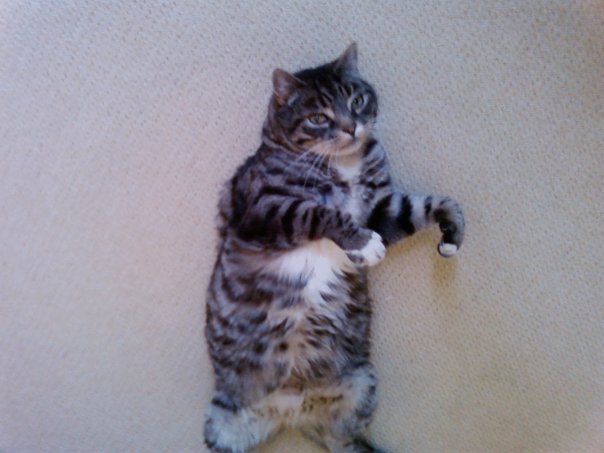
Columbo, resting before an exhausting day's sleep

Columbo, resting before an exhausting day's sleep

I think I should post a short message on behalf of Columbo to his many admirers. He’s doing well, having perked up enormously over the past few weeks. When I first moved into my new house at the end of June this year he seemed a bit down, and I couldn’t work out whether it was the dislocation of moving or the non-stop rain that carried on throughout July and August that made him a bit less ebullient than usual. It was probably a mixture. But the fine weather we have been having over the last few weeks led to him spending a lot more time outside and he’s looking and acting like he’s in fine fettle.

Another factor he had to contend with was that when we first moved in we were visited a few times by a strange black-and-white cat who seemed to upset Columbo, although as far as I know they never fought. Columbo is a heavyweight (about 7kg), but such a softy he never wins no matter how much smaller his opponent is. Anyway, after a few visits this other cat obviously decided that there wasn’t much fun to be had at my house so I haven’t seen it again all summer. I think Columbo was glad to see the back of it.

Last weekend, though, another cat turned up and sat on my shed roof. Actually, it’s not really a shed. It’s the old outside toilet that belonged to this house. It no longer has a loo in it, but it’s a sold brick building and very handy for storing things. The only problem with it is a big hole in the roof, which I have yet to get fixed. Cats are smart enough not to fall into holes like that, so this cat was quite secure in his vantage point. He was a very handsome chocolate-coloured long haired cat, and he was one of those cats who just seems to love looking. I’ve met several cats of that type over the years; you can often see them looking out of windows when you pass people’s houses. They sit motionless like small statues, just looking.

Columbo has never been a looker in that way. I think he gets bored easily so a few minutes of watching things and he generally goes to sleep. In fact after a few minutes of anything at all he usually goes to sleep.

But this cat sat on the roof, looking, and for some reason he was driving Columbo to distraction, probably because he was on Columbo’s turf, metaphorically speaking (because there is no actual turf on the toilet roof). He normally doesn’t make that much noise, but he was practically howling in irritation as he paced around the garden. He’s not nimble enough to get onto the roof himself, which is probably just as well because he would probably have come off worst. The visiting cat sat motionless and just carried on looking. It could have been a deliberate attempt to provoke. If so, it worked.

I had to go out at that point, so I left them to it. Columbo has to look after himself sometimes. But when I came back about an hour later the cat was still there on the roof and Columbo was on the lawn, sleeping. Clearly he even gets bored with being annoyed. When I went into the garden Columbo woke up and my presence seemed to scare the invader away. I haven’t seen him since, although he may well have seen me. Cats that like to look are probably looking even when you can’t see them.

Anyway, next week I’ll have to take him to the new vets and get some more medical supplies and food. I hope they’re better than the old ones. I’m just glad that he seems healthy and enjoying life, even to the extent of playing quite a lot with his toy mice from time to time and chasing leaves around the garden whenever it’s windy.

I nearly lost him a couple of years ago when his blood sugar level dived, probably because of too much insulin, and I found him flat out on the kitchen floor struggling for breath. Remembering the stuff I had read on the internet I realised he was in hypoglycemic shock, so I found the bottle of syrup I had bought especially for the purpose and got as much into him as possible before running up to the vets. He was immediately put on a drip and the vet said he was very dangerously ill, but I had done the right thing with the syrup. He stayed at the vet all day and remained unconscious and then was transferred to a veterinary hospital for the night. I really thought he would die, and was even thinking about where I might bury his remains, but the next morning he seemed to be a bit better and I took him home the following night. He gradually recovered and hasn’t had any similar episodes since.

I know he’s old now and needs a lot of looking after. I’ll be very sad when he does pass away. I dread to think how much money he’s cost me or how many things I’ve been unable to do because of his requirements. But it’s worth it. Fellow cat-lovers will understand.