The October Country

Posted in Finance, Literature with tags , on October 17, 2008 by telescoper

I don’t know why I stopped reading science fiction and fantasy stories. I don’t know exactly when either. Perhaps it was a gradual thing to do with getting older. But when I was a teenager that’s the sort of thing I read all the time. I was a big fan of Michael Moorcock and read book after book of his stories, from the swords and sorcery novellas to the amazing End of Time series, and even the trippy psychedelic 1960s adventures of Jerry Cornelius. I enjoyed Tolkien, Mervyn Peake, Asimov,  Arthur C. Clarke and many others which I usually binge-read by buying everything I could find by a given author and ploughing through them one after the other.

One of the authors I devoured in this way was Ray Bradbury, and his books are among the few that I still like to re-read from time to time. To be honest, I wasn’t all that keen on the pure science fiction books like The Martian Chronicles, but I loved his collections of macabre short stories. Perhaps it’s because I now know how difficult it is to write in that genre that my appreciation of his story-telling skill has if anything grown with time.

I was watching the news last night about the continuing tailspin in the world’s stock markets and it reminded me of one of my favourite collections of Ray Bradbury stories, The October Country. I rummaged around in the stacks of old paperbacks I still haven’t got around to putting on shelves – mainly because I haven’t got around to buying enough shelves – and finally located my copy. It’s a weirdly eclectic mixture of the whimsical and the frightening. The October Country of the title isn’t a specific place. It is many places: “a picturesque Mexican village where death is a tourist attraction; a city beneath the city where drowned lovers are silently reunited; a carnival midway where a tiny man’s most cherished fantasy can be fulfilled night after night. The October Country’s inhabitants live, dream, work, die–and sometimes live again–discovering, often too late, the high price of citizenship. Here a glass jar can hold memories and nightmares; a woman’s newborn child can plot murder; and a man’s skeleton can wage war against him. Here there is no escaping the dark stranger who lives upstairs…or the reaper who wields the world.”

What binds the separate tales together is the way Bradbury conjures up an atmosphere that is both autumnal and alien, both familiar and unnerving, like that of a long-forgotten room where dust gathers on lost artefacts of the past.

But what does this have to do with Stock Markets?

The baffling thing is that the greatest episodes of spine-chilling terror that grip the stock market from time to time also always seem to happen in October. The great Wall Street Crash of 1929 happened in October. More recently, the 1987 crash known Black Monday happened in the same month. Now, in 2008, although the credit crunch has been with us for a significant time, the most dramatic drops in share prices have also been in October.

In order to find the answer to why this is the case I went to Wikianswers and discovered somebody has already posted the question, but so far there have been no answers.

Whatever it is, something about October seems to give investors the jitters.

I blame Ray Bradbury.

East Midlands yesterday

Posted in Books, Talks and Reviews on October 16, 2008 by telescoper

I travelled to Derby yesterday to give the annual Flamsteed Lecture, named in honour of John Flamsteed who was born in Derby and was the first Astronomer Royal. I was delighted to find out that there was a full house of around 250 in the audience, including a contingent from Derby and District Astronomical Society who had a display outside the lecture hall at the University of Derby.

Curiously the lecture hall itself turned out to be the “Court Room”, a complete mock up of a court complete with witness box, dock and jury box used for training would-be lawyers. Apparently the local police sometimes use it too, for practicing the giving of the evidence. Anyway, I hope in my case it wasn’t too much of a trial for the audience.

After the lecture there was a wine and cheese reception laid on by the University of Derby and the local branch of Waterstone’s stayed open late so I could do a book signing. That seemed to go well too, although it kept me away from the wine. I didn’t keep track of how many books they sold, but every little helps!

When the festivities were over I went back to the Midland Hotel near Derby station where I crashed out as I had to get a very early train back this morning to give a postgraduate lecture on statistics. Rushing to get my slides together on the train I made quite a few mistakes – I hate powerpoint – and found myself having to correct on the fly during the lecture. I also discovered I had accidentally deleted one slide altogether. As I got increasingly flustered, the lecture degenerated into one of the worst I’ve ever done.

This sort of reflective practise, criticizing one’s performance, is supposed to be good for lecturers to do, but I think it’s probably better to prepare things more carefully in the first place, i.e. not on the train first thing in the morning while trying to contend with a hangover.

Still, at least the train wasn’t late.

The New Inflationary Universe

Posted in Finance, Science Politics on October 14, 2008 by telescoper

Among the bits of economic information released by the Office of National Statistics today is one item that academics in all disciplines wanted to hear about: the value of the Retail Prices Index (RPI) in the UK for September 2008, which turned out to be 5.0%.

The reason for the fascination with this number is that, in an unusual spasm of farsightedness, the University and College Union stipulated that the final stage of the pay deal it negotiated in 2006 would be applied in October 2008 and this would amount to 2.5% or the RPI whichever is the greater. Two years ago it seemed a very different world, and 2.5 % seemed to be much the likelier eventuality, but energy and commodity prices surged last year and the RPI now stands at double that figure. So we’re all set for a 5% pay rise this month, although probably we won’t actually get any more money until the November pay packet arrives.

It would have been even better had UCU chosen the Consumer Prices Index (CPI), which has now overtaken the RPI and stands at 5.2%. This is the governments preferred measure of inflation, which is based only on the price of consumer goods and household utilities, while the RPI includes other items such as mortgage costs and transport costs.

At least in the short-term, this seems good news for all academics in UK universities.

But even in paradise there was a serpent, and there is a significant danger that some departments’ balance sheets will suffer very badly from these extra salary costs. Many already operate on very tight margins. In the longer term there may be mergers and closures followed by redundancies. Also since the research councils’ cash allocations for the next few years are already fixed, an increase in salaries over that already accounted for will mean a corresponding reduction in the number of positions that can be funded, which is bad news for younger people looking for PDRA positions. Given that the Science and Technology Facilities Council‘s budget wasn’t very generous in the first place, causing a crisis in funding for astronomy and particle physics research the extra wage demands are likely to cause further strain.

Still, a 5% pay rise just before Xmas will be good while it lasts.

Shameless Self-promotion

Posted in Books, Talks and Reviews with tags on October 13, 2008 by telescoper

On Wednesday (15th October) I’m going to be travelling up to the East Midlands in order to deliver this year’s prestigious Flamsteed Lecture at the University of Derby. It’s very nice to be asked to give this year’s lecture, especially when there have been so many distinguished speakers in this series the past, including Sir Martin (now Lord) Rees and my thesis supervisor John Barrow. The University of Derby has done a very nice press release describing my talk to go with the nice poster, so I’ll leave it at that.

In the Club

Posted in Biographical with tags , on October 13, 2008 by telescoper

Earlier this year I was elected a member of the Royal Astronomical Society Club. This organization shouldn’t be confused with the Royal Astronomical Society (RAS) itself. I’ve been a Fellow of that for ages. The RAS Club is basically a dining club whose members are all Fellows of the Royal Astronomical Society. All you have to do to join the Royal Astronomical Society is to pay some money and sign your name in a book. To get into the RAS Club you have to be elected by the existing membership. I was elected at the January meeting this year, but this was the first time I’ve been able to dine owing to the long drawn-out affair of my move from Nottingham to Cardiff.

Curiously the RAS Club is actually older than the RAS itself, as the first dinner was held in 1820, before the RAS was actually formed. Nowadays, the RAS Club usually meets at the Athenaeum in Pall Mall, shortly after the end of the monthly “Ordinary” meetings of the RAS at Burlington House (referred to as “another place”) which happen on the second friday of each month. That is except when the RAS meeting is the annual National Astronomy Meeting (NAM) which is held at a different location each year, usually in April. On these occasions the club also meets, but at an appropriate alternative venue near the NAM location.

Although I knew several people already in the club I didn’t really know what it would be like, but my first time there turned out to be very pleasant. The food and wine were good and the conversation was extremely enjoyable. At the end of the dinner my health was drunk – as indeed was I – and I had to reply, which I did by telling the story of my encounter with the Kansas police. It seemed to go down quite well. After other speeches the dinner was declared “informal” which is just as well because by then I was as informal as a newt.

The club’s various little rituals are a bit bizarre, such as calling Burlington House (“another place”), but quaintly amusing in their own way and the proceedings are remarkably lacking in pomposity. I’m now actually looking forward to the “Naming of Names” next month.

I think the RAS Club (and even the RAS itself) is viewed with suspicion and perhaps even hostility by some astronomers, who seem to think the club is a kind of sinister secret society whose existence is intrinsically detrimental to the health of astronomy in the UK. Actually it’s just an excuse for a good nosh-up and some daft jokes, although I was initially disappointed to find out that there wasn’t after all a covert plan for world domination. Or if there is, nobody told me about it.

The other common complaint is that the club’s membership is just a bunch of old dinosaurs. Now it is true that your typical member of the RAS Club isn’t exactly in the first flush of youth, but age has its effect on all of us eventually and there is something very distasteful, if not offensive, about the widespread ageism with which some astronomers tend to regard the older generation. The recent Wakeham review of physics rightly pointed out that UK astronomy is in a very strong international position, second only to the United States. This strength hasn’t appeared overnight. It is founded just as much on the past achievements of older astronomers as it is sustained by the energy and creativity of the young.

So let’s have a bit more respect.

As for me, the age thing isn’t a great concern. I feel I’ve been on the fast track to fogeydom for some time anyway. I like to play Bridge and go to the Opera too. Although it wouldn’t be to everyone’s taste, I’m not at all ashamed to admit that I actually felt quite at home at the RAS club.

While a private dining club can have whatever image its members feel comfortable with, fogeyish or not, the image of a professional organization is much more crucial and it is important that the former doesn’t impact negatively on the latter. The “real” Royal Astronomical Society definitely has to find a way forward that is a bit more up-to-date and relevant than it is now. If the stuffy air puts off younger astronomers from joining then that can have a very bad effect on the future. Although UK astronomy is very strong, it does need to have better representation in the corridors of power. The Institute of Physics is a professional organization which can deliver much more effective campaigning on behalf of mainstream physics than the RAS is able to do for astronomy, at least at present. Part of the reason is the poor take-up of RAS fellowship by younger astronomers, no doubt at least partly because of its fogeyish image, which in turns prevents it from modernizing. The RAS understands this and is trying to recruit more younger members, but with only limited success.

It’s a difficult balancing act to weigh up the considerable political value of established tradition against the critical need to encourage innovation and change. I know some astronomers think a new professional organization is needed for UK astronomy, and that the RAS should be left to turn into a kind of museum. I think that would be a shame and that it would be better for more astronomers to abandon their antipathy, join the Society and put some effort into making it fit to face the challenges of the 21st Century.

The meaning of e

Posted in Uncategorized on October 11, 2008 by telescoper

I found Andy Lawrence‘s blog (“the e-astronomer“) on wordpress this morning. He’s been at this lark for much longer than me and seems to have generated quite a lot of discussion about various things to do with astronomy.

His pseudonym, though, got me thinking about the prevalence of the prefix “e-” these days. Of course we’ve had e-mail for a long time. I have published an e-book but, as far as I know, nobody has ever e-read it. We have e-banking and e-commerce (although these may e-disintegrate the way things are going). You can get on a plane  using an e-ticket, and the police make e-fits to help solve crimes, although apparently only those that have been committed by cartoon characters. And then there’s also e-coli which is presumably some form of electronic medical treatment, judging by its ubiquity in news stories about British hospitals.

Universities now have “e-learning”, which may or may not be correlated with “e-teaching”, research councils do “e-science” or “e-technology” (and even sometimes even “e-research”).   But I’ve always been confused about what it means in these later manifestations.

And then there is the potential confusion with older terms involving “e”, as exemplified by the term Emeritus Professor. The meaning in this particular case is clearly explained by Stephen Leacock in his book Here are my Lectures:

“I am what is called a professor emeritus – from the Latin e meaning “out”, and meritus meaning “ought to be”.

But I think this gives  a clue as to how to interpret e-science and the rest. In these uses, e is roughly a combination of the two previous examples, conveying both its electronic nature and the association with “emeritus”, i.e. very expensive in terms of resources needed, very unlikely to produce anything interesting, but superficially impressive to those who don’t know any better and therefore occasionally useful to wheel out whenever you want to convince someone to give your department money.

The phrase “e-science” illustrates this nicely, especially in terms of its expense, its apparent appeal to politicians,  and the total lack of any impact on real science. Likewise “e-learning” is electronic gimmickry that doesn’t actually have much to do with learning, and so on.

But of course this interpretation doesn’t apply in any way shape or form to the name “e-astronomer”. Andy Lawrence is a very distinguished scientist. That’s why his real working title is Egregious Professor of Astronomy.

At least I think that’s what it says.

Crash! There goes another one..

Posted in Uncategorized with tags on October 9, 2008 by telescoper

Another day, another bank failure.

Further to my post about the crisis in the Icelandic banking system, it now appears the third major private Icelandic bank, Kaupthing, has also been taken into admininistration over concerns about its liquidity (or lack of it). The UK-based online subsidiary Kaupthing Edge has, however, been taken over by ING Direct, another direct savings bank. ING claims that all the deposits it has acquired are now safe, but something tells me this crisis is far from over and I interpret “safe” as meaning “for the time being”. This is all coming very close to home, as I have savings in Kaupthing Edge.

At least I’m in a better position than someone who had savings in Icesave which was the second Icelandic bank to fail. The scary thing about this one was that the Icelandic government had given guarantees to protect depositors, but has now thrown away those guarantees leaving the UK government to step in to compensate those who have lost their savings. For once, I actually agree with Prime Minister Gordon Brown’s reaction to this. I hope Britain seizes any Icelandic assets it can to compensate the UK taxpayer. That is if Iceland actually has any assets left at all.

Iceland has also today suspended all dealings in its shares as its economy rapidly melts down.  Apparently the country now has debts totalling 12 times its Gross Domestic Product which makes it as near as dammit to being bankrupt.

Meanwhile despite massive intervention from central banks around the world, stocks and shares have continued to lurch around violently above and below a steady downward trend. All this seems totally irrational to me. And they have the nerve to award a Nobel prize to economists!

If only everything in life were as simple as the Cabibbo-Kobayashi-Maskawa theory.

Jenufa

Posted in Music, Opera with tags , on October 8, 2008 by telescoper

Another day, another opera. Today I had to duck out of the usual post-seminar drinks and food and get down to the Wales Millennium Centre in Cardiff Bay for one of only two performances in Cardiff by WNO this season of Jenufa by Leos Janacek.

You couldn’t wish for an opera more different in style and substance than Saturday’s Otello, although I suppose both operas would probably be classed as tragedies. Gone are the opulent sets and costumes and associated courtly intrigues of Otello. Instead we enter a world of drab and claustrophobic interiors within which a dark story of ordinary country folk unfolds in all its bleakness. Jenufa has a child by her lover, Steva, whom she hopes will marry her. When he refuses to do the honorable thing, Jenufa’s stepmother, Kostelnicka, drugs Jenufa and kills the baby, disposing of the body in a freezing lake. Jenufa is then persuaded to marry the dim but devoted Laca. In the final act, the baby’s body is found, Jenufa is accused and then Kostelnicka confesses her guilty act, claiming that she wanted to save Jenufa from disgrace. She goes off to be tried for the murder, while the steadfast Laca promises to stand by Jenufa come what may.

None of the characters is particularly sympathetic or even comprehensible. Laca (Peter Hoare) changes from a brutish oaf, who accidentally stabs Jenufa in the face in Act 1, to a doting husband in Act 3. Steva (Stephen Rooke) is superficially attractive but clearly a bit of a bounder. Kostelnicka (Susan Bickley) is severe, pompous and moralistic. Jenufa (Nuccia Focile) just seems a bit vacuous in Act 1 but progressively disintegrates under the stress of shame and rejection becomes increasingly morose and unpredictable as the opera goes on.

But these are not meant to be easy roles to understand. They are as inconsistent as real people, and as difficult to figure out.

On paper the plot and characterization seem very slight, but what holds it all together is Janacek’s wonderful music which seems to pull together all the rather ragged strands left dangling by the libretto. The score features lush romantic passages interspersed with snatches of folk tunes and jagged unresolved ideas that seem to mirror the fractured psychology engulfing Jenufa and Kostelnicka. Although the story is unrelentingly grim, there always seems to be something interesting going on in the music. Near the end, when Kostelnicka confesses the infanticide and accepts her punishment the music is particularly beautiful and even uplifting. However dark the deed, it seems to say, some form of redemption is always possible. How Janacek manages to conjure such a radiant burst of optimism at the end of such a dark tragedy is nothing short of miraculous.

I could listen to Janacek’s music for hours. As a matter of fact, now I think about it, that’s exactly what I did.

Icelandic Sagas

Posted in Biographical, Finance with tags , on October 7, 2008 by telescoper

I read in the news today that the Icelandic government has taken over a second of its leading banks in an attempt to stop the total collapse of its economic infrastructure. Last week it took over the country’s third largest bank, Glitnir, to prevent it collapsing as a consequence of bad debts and this week it has nationalised Landsbanki, the second largest. This particular one brings Iceland’s imminent bankruptcy closer to home as hundreds of thousands of savers in the UK have cash tied up in either Icesave or Heritable, which are divisions of Landsbanki. The only private Icelandic remaining is Kaupthing, which also has a UK operation called Kaupthing Edge. This bank claims to have minimal exposure to toxic debt, but it remains to be seen whether it can avoid a run on its deposits that will surely lead it into oblivion too. I am an interested party in this case, as I recently bought some of its fixed rate high-interest bonds. This may turn out not to be the best decision I have ever made.

Iceland’s economy seems to be a microcosm of the current world situation. A decade of incredible growth built on speculative financial operations abroad led to growth beyond the wildest dreams of such a small country. With a population of only just over 300,000 – that of a small English city – most of whom live in the capital Reykjavik, this boom generated a huge increase in living standards for its own people and created a new generation of Icelandic billionaires. Now that bubble has well and truly burst. The country as a whole is on the verge of bankruptcy, its currency has fallen through the floor, and inflation is rampant.

Iceland may have a reputation as the one of the hottest destinations for a weekend of partying, but it seems to me that it’s about to suffer a sudden and very chill winter.

I had the opportunity to visit Iceland this May in order to participate in an event called the Experiment Marathon, which is one of those artists-meet-scientists events that are either excruciatingly terrible or intensely enjoyable. Held in the Hafnarhus – Reyjkavik Art Museum – the contributions included scientists talking about science or doing experiments live in front of the audience, alongside artists talking about or demonstrating their work.

I am really not sure why I was invited to take part, although I suspect it was some form of administrative error. Most of the really crap things that happen are caused by mistakes, so why shouldn’t the good things also happen that way?

Anyway, I gave a talk about the cosmic microwave background. My “experiment” was a television set that wasn’t tuned properly producing a screenful of static. I pointed out that some (actually not that much) of the buzz was coming from the beginning of the universe. Pretty lame as a gimmick, I know, but it seemed to go down quite well with the audience and I had some nice questions and comments at the end of my 20 minutes. But I also got to meet quite a few artists and other luminaries, including Brian Eno (who celebrated his 60th birthday at the festival) and Dr Ruth. I also had breakfast in the hotel with a noted performance artist called Marina Abramovic who I’m ashamed to say I’d never heard of. I didn’t actually know who she was until much later.

Even better than this I had a sort of VIP pass which meant that I got to go to a couple of wonderfully boozy receptions, including one at the President’s house, and hang out with the in-crowd at some of Reykjavik’s nightspots, although at one of them I had to listen to some experimental music that sounded like what I imagined to be played to prisoners at Guantanomo Bay. Being so far North the nights are very long which definitely added to the enjoyment, especially since the few days I was there were blessed with lovely sunny weather. Perhaps even more importantly, I don’t remember having to pay for anything at all, drinks included. They even paid me a fee! (However, they paid it in Icelandic Krona, which I never got around to cashing, so it’s probably not worth very much by now.)

It goes without saying that I formed a very positive opinion of Reykjavik as a city full of energetic and creative people who know how to have a good time: it has its own opera house, countless restaurants and bars and several excellent museums and art galleries. But at the back of my mind I was wondering how such a small country can find the money to sustain such a level of artistic and musical activity as well as lavish personal consumption. Now at last I have the answer.

It can’t.

Nobel Sur-prize

Posted in The Universe and Stuff with tags , , on October 7, 2008 by telescoper

I was waiting for the letter from Stockholm, but it didn’t come. Maybe next year…

Anyway, this year’s Nobel Prize for Physics has been awarded to Yoichiro Nambu (half the prize) and the other half is split between
Makoto Kobayashi and Toshihide Maskawa. All three are extremely distinguished physicists and their contributions certainly deserve to be rewarded. But, in the case of Kobayashi and Maskawa, the Nobel Foundation has made a startling omission that I really can’t understand at all and which even threatens to undermine the prestige of the prize itself.

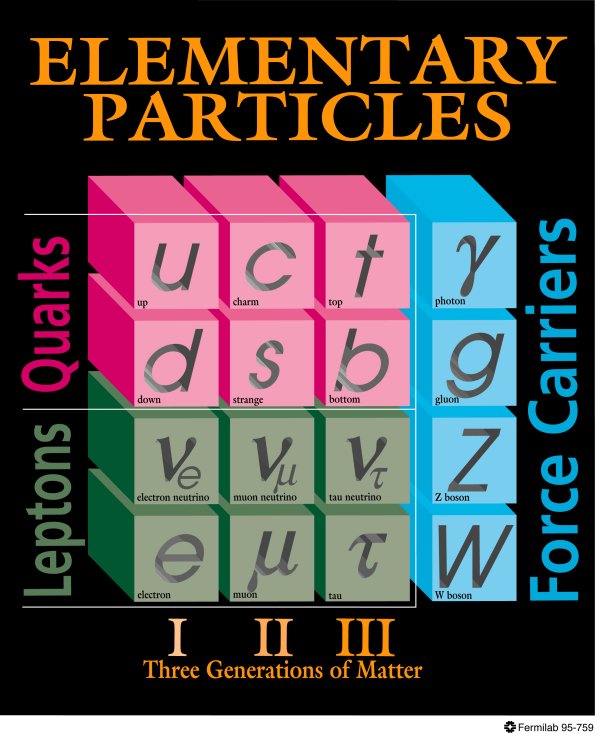
The work for which these two were given half the Nobel Prize this year relates to the broken symmetry displayed by weak interactions between quarks. We now know that there are three generations of quarks, each containing quarks of two different flavours. The first generation contains the up (u) and the down (d), the second the strange (s) and the charmed (c), and the third has the bottom (b) and the top (t). OK, so the names are daft, but physicists have never been good at names.

The world of quarks is different to penetrate becauses quarks interact via the strong force which binds them close together into hadrons which are either baryons (three quarks) or mesons (a quark and an anti-quark).

But there are other kinds of particles too, the leptons. These are also arranged in three generations but each of these families contains a charged particle and a neutrino. The first generation is an electron and a neutrino, the second a muon and its neutrino, and the third has the tau and another neutrino. One might think that the three quark generations and the three lepton generations might have some deep equivalence between them, but leptons aren’t quarks so can’t interact at all by the strong interaction. Quarks and leptons can both interact via the weak interaction (the force responsible for radioactive beta-decay).

Weak interactions between leptons conserve generation, so the total number of particles of electron type is never changed (ignoring neutrino oscillations, which have only relatively recently been discovered). It seemed natural to assume that weak interactions between quarks should do the same thing, forbidding processes that hop between generations. Unfortunately, however, this is not the case. There are weak interactions that appear to convert u and/or d quarks into c and/or s quarks, but these seem to be relatively feeble compared to interactions within a generation, which seem to happen with about the same strength for quarks as they do for leptons. This all suggests that there is some sort of symmetry lurking somewhere in there, but it’s not quite what one might have anticipated.

The explanation of this was proposed by Nicola Cabibbo who, using a model in which there are only two quark generations, developed the idea that states of pure quark flavour (“u” or “d”, say) are not really what the weak interaction “sees”. In other words, the quark flavour states are not proper eigenstates of the weak interaction. All that is needed is to imagine that the required eigenstates are a linear combination of the flavour states and, Bob’s your uncle, quark generation needn’t be conserved. This phenomenon is called Quark Mixing. What makes it simple for only two generations is that it can be described entirely by one number: the Cabibbo angle, which measures how much the quark flavour basis is misaligned with the weak interaction basis. The angle is small so the symmetry is only slightly broken.

Kobayashi and Maskawa generalized the work of Cabibbo to the case of three quark generations. That’s actually quite a substantial task as the description of mixing in this case requires not just a single number but a 3×3 matrix each of whose entries is complex. This matrix is universally called the Cabibbo-Kobayashi-Maskawa (CKM) matrix and it now crops up all over the standard model of particle physics.

And there’s the rub. Why on Earth was Cabibbo not awarded a share of this year’s prize? I was shocked and saddened to find out that he’d been passed over despite the fact that his work so obviously led the way. I can think of no reason why he was omitted. It’s outrageous. I even feel sorry for Kobayashi and Maskawa, because there is certain to be such an outcry about this gaffe that it may detract from their success.

But really…