Among the various items of Euclid Merch in the goody bag given to attendees at the annual Euclid Consortium Meeting in Rome are a nice bag, a cap, a notebook, and a mystery object:

Can anyone suggest what this item does?
(Wrong answers preferred.)
Among the various items of Euclid Merch in the goody bag given to attendees at the annual Euclid Consortium Meeting in Rome are a nice bag, a cap, a notebook, and a mystery object:
Can anyone suggest what this item does?
(Wrong answers preferred.)
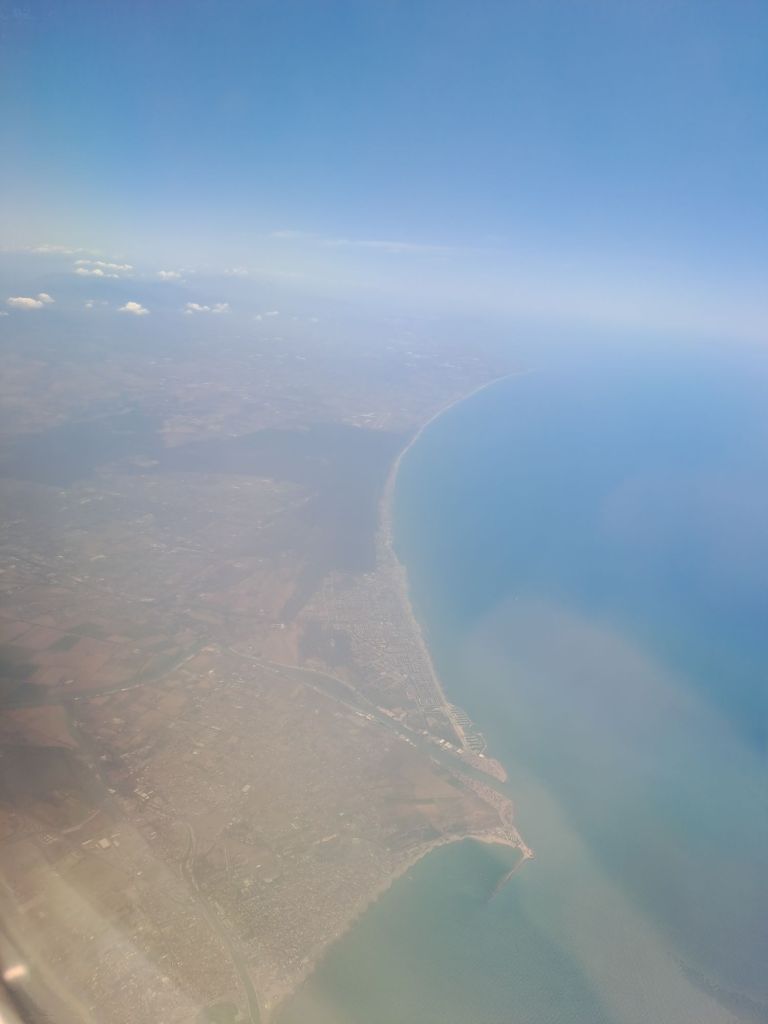
This morning, I took a short (~ 90 minute) flight from the pleasantly warm (23°C) Barcelona to the swelteringly hot (31°C) city of Rome. It’s actually forecast to be 39°C on Thursday and 40°C on Friday. Fortunately, I’m not staying that long!
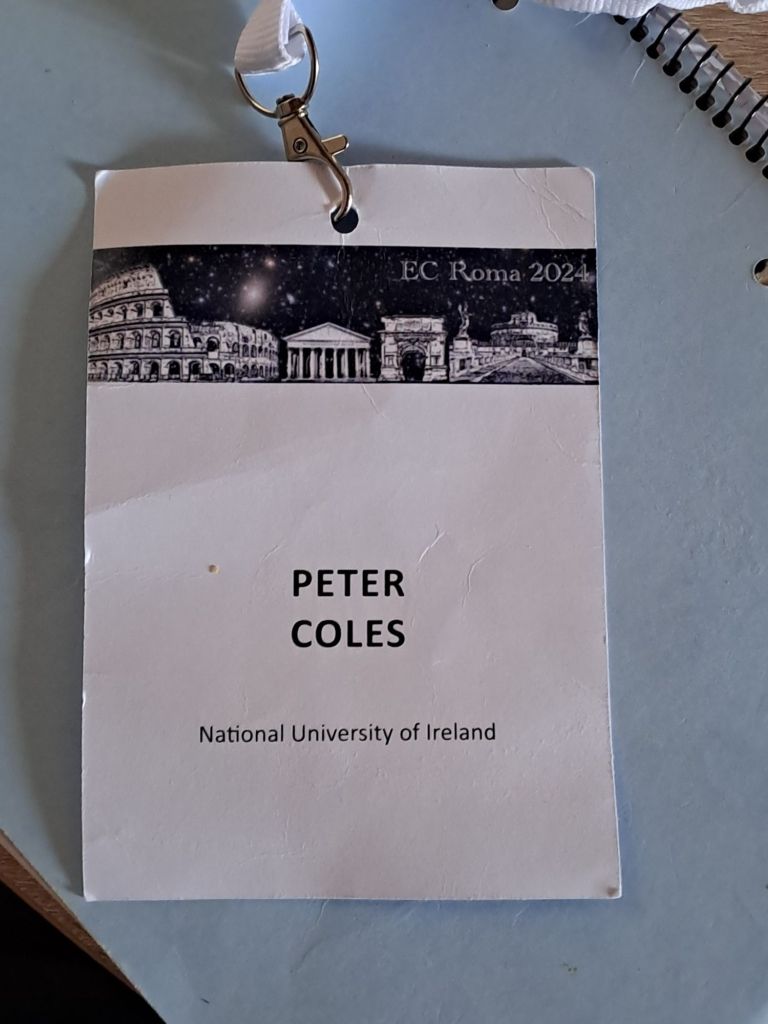
The occasion for this trip is the annual Euclid Consortium Meeting, which is being held at the Università degli Studi di Roma “La Sapienza“. The main sessions are in the splendid Aula Maxima thereof, with its imposing mural:

I’m giving a talk there in the first plenary session tomorrow…
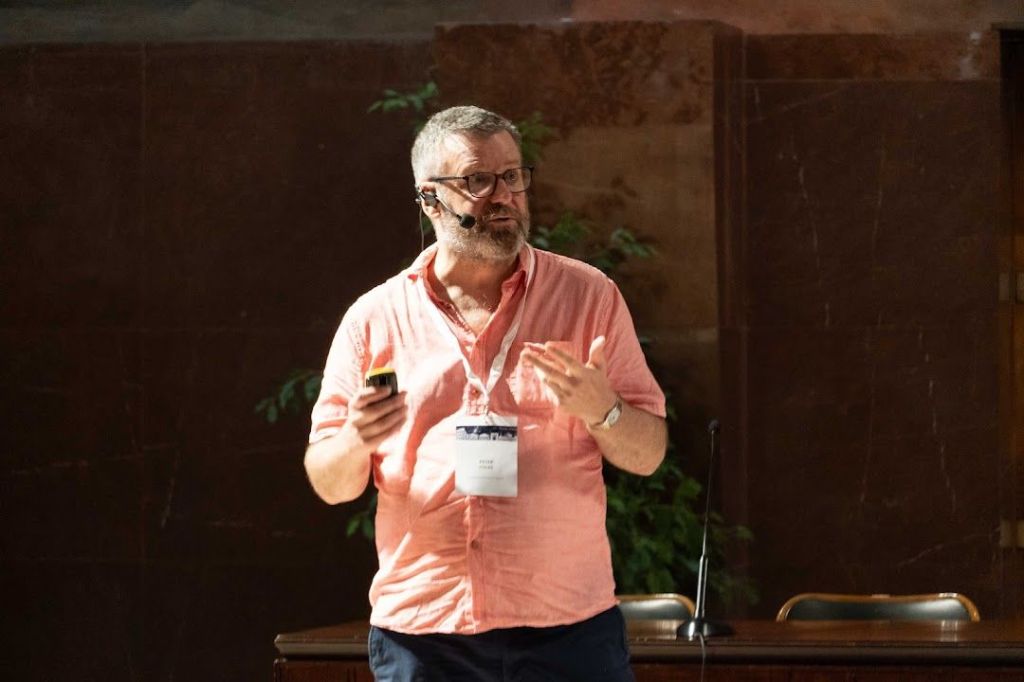
Update: here’s me giving my plenary talk:
Just to show that I’m not alone in having severe doubts about the reliability and integrity of Scopus here is an article from Retraction Watch that points out that three of the top ten philosophy journals (according to that database) are fake. Among the facts that could easily have been checked by a competent agency is this:
The same editorial board serves for three journals, with 10 members who are dead.
The article concludes:
Rankings based on Scopus frequently serve universities and funding bodies as indicators of the quality of research, including in philosophy. They play a crucial role in decisions regarding academic awards, hiring, and promotion, and thus may influence the publication strategies of researchers… Our findings show that research institutions should refrain from the automatic use of such rankings.
Quite. Any institute that has signed up to the San Francisco Declaration on Research Assessment should not be basing any decisions on Scopus anyway, but I don’t think that goes far enough. Scopus is a corrupting influence. It is high time for universities and other agencies to stop paying their subscriptions and ditch it entirely.
So it’s June 16th which means it is Bloomsday. I looked around for ways to celebrate this day in Barcelona and found that there is a Irish bar on La Rambla called Bloomsday. When I went there, though, I was disappointed to find it not only closed, but apparently abandoned:

Barcelona gets a mention – just one – in James Joyce’s Ulysses:
Noon slumbers. Kevin Egan rolls gunpowder cigarettes through fingers smeared with printer’s ink, sipping his green fairy as Patrice his white. About us gobblers fork spiced beans down their gullets. Un demi sétier! A jet of coffee steam from the burnished caldron. She serves me at his beck. Il est irlandais. Hollandais? Non fromage. Deux irlandais, nous, Irlande, vous savez ah, oui! She thought you wanted a cheese hollandais. Your postprandial, do you know that word? Postprandial. There was a fellow I knew once in Barcelona, queer fellow, used to call it his postprandial. Well: slainte!
I can confirm that there is no shortage of queer fellows here, but I’ll have to have my lunch before I can have a postprandial but slainte! to you too.
Duke Ellington’s tune The Mooche, composed in 1928, belongs to an era that spawned many other atmospheric classics such as Luis Russell’s Call of the Freaks and Don Redman’s Chant of the Weed. Fifty years later the menacing undertone of The Mooche was seized upon by saxophonist Steve Lacy and turned into an unforgettably raw version on his 1978 album Points (which I bought on vinyl when it first came out) in which he duets on soprano with Steve Potts, delivering the haunting minor-key theme with a sound like knives being sharpened.
It’s Saturday morning in Barcelona, and time to post another update relating to the Open Journal of Astrophysics. Since the last update we have published two more papers, taking the count in Volume 7 (2024) up to 47 and the total published by OJAp up to 162. We actually accepted four papers last week, but so far only two final versions have appeared on the arXiv.
The first paper of the most recent pair – published on Friday 14th June – is “Spectroscopic Confirmation of an Ultra-Massive Galaxy in a Protocluster at z ~ 4.9″ . The author list has a strong University of California flavour: Stephanie M. Urbano Stawinski (UC Irvine), M. C. Cooper (UC Irvine), Ben Forrest (UC Davis) , Adam Muzzin (York University, Canada), Danilo Marchesini (Tufts University), Gillian Wilson (UC Merced), Percy Gomez (Keck Observatories, USA), Ian McConachie (UC Riverside), Z. Cemile Marsan (York University, Canada), Marianna Annuziatella (Centro de Astrobiología CSIC-INTA, Spain) and Wenjun Chang (UC Riverside).
This paper presents an investigation of a cluster system involving a massive galaxy using Keck spectroscopy with determination of its redshift and star formation properties. The results pose a challenge for theorists. The paper is in the folder marked Astrophysics of Galaxies.
Here is a screen grab of the overlay which includes the abstract:

You can click on the image of the overlay to make it larger should you wish to do so. You can find the officially accepted version of the paper on the arXiv here.
The second paper, also published on Friday 14th June and has the title “Boil-off of red supergiants: mass loss and type II-P supernovae” by Jim Fuller (Caltech) and Daichi Tsuna (Caltech, USA and University of Tokyo, Japan). This one, which is in the folder marked Solar and Stellar Astrophysics, discusses A new model for stellar mass loss which predicts that low-mass red supergiants lose less mass than commonly assumed, while high-mass red supergiants lose more.
Here is a screen grab of the overlay which includes the abstract:

You can click on the image of the overlay to make it larger should you wish to do so. You can find the officially accepted version of the paper on the arXiv here.
That concludes this week’s update. Will we reach 50 for 20204 next week? Tune in next Saturday to find out!
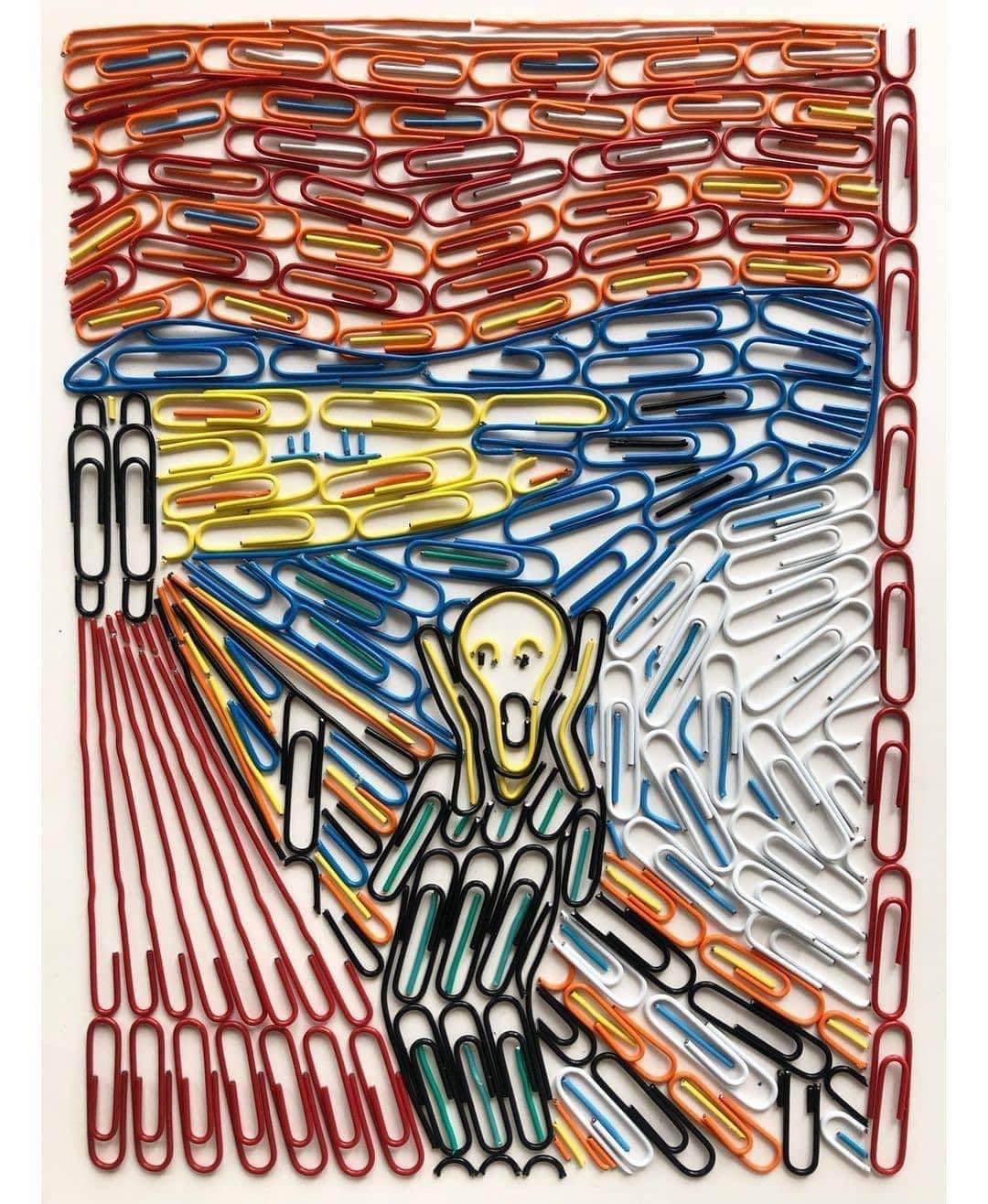
I was not inconsiderably amused by the above homage to The Scream by Edvard Munch which I see as a powerful artistic response to pointless corporate bureaucracy. It was created by Adam Hillman, an artist who specializes in making interesting designs and collages from everyday objects. You can read more about, and see more examples of, his work here.
A couple of weeks ago I posted an item about the sudden departure of Prof. Philip Nolan from his post as Director General of Science Foundation Ireland (SFI) after allegations of misconduct (including bullying). That post included these words:
As an outsider I have no idea what has been going on at SFI, so have no dirt to dish, but it must have been rather serious for Prof. Nolan to have been forced out so quickly.
Despite that clear statement I have received a number of emails from “journalists” asking for gossip. Obviously I didn’t reply to them.
Anyway, it’s not only the sudden decision that led to Prof. Nolan’s dismissal that is striking; there’s also the fact that no formal disciplinary process took place and it was accompanied by immediate termination of his access to emails, etc. Actions so extreme are usually reserved for situations in which a staff member has committed gross misconduct, but that is not the accusation here.
Anyway, just a few days after his apparent departure from SFI, Prof. Nolan went to court and obtained a temporary injunction restraining his dismissal ahead of a further hearing about the case which began on 11th June and has not yet completed. Although no longer fired, Prof. Nolan has not been allowed physically to return to work.
I have no idea how this mess will end. It does seem that there must have been a complete meltdown in SFI that will be very difficult to reverse. Perhaps the best way forward is to hasten the end of SFI and the beginning up of the new entity (Taighde Éireann– Research Ireland) supposed to be formed by the merger of SFI with the Irish Research Council.
I have no idea who is in the wrong at SFI. Perhaps both sides are. However, for the record, I will state that when my Mam died in 2019 Prof. Nolan (who was President of Maynooth University at the time) sought me out and offered his condolences in person. That was a kind gesture that I greatly appreciated at the time, and one which few University managers I have known would have made in the circumstances. Certainly not the current President of Maynooth University.
P.S. I discovered from reading this article about the Nolan Case that the Chairman of the Board of Science Foundation Ireland, Professor Peter Clinch, an economist; presumably no actual scientists were available.


 In the Dark