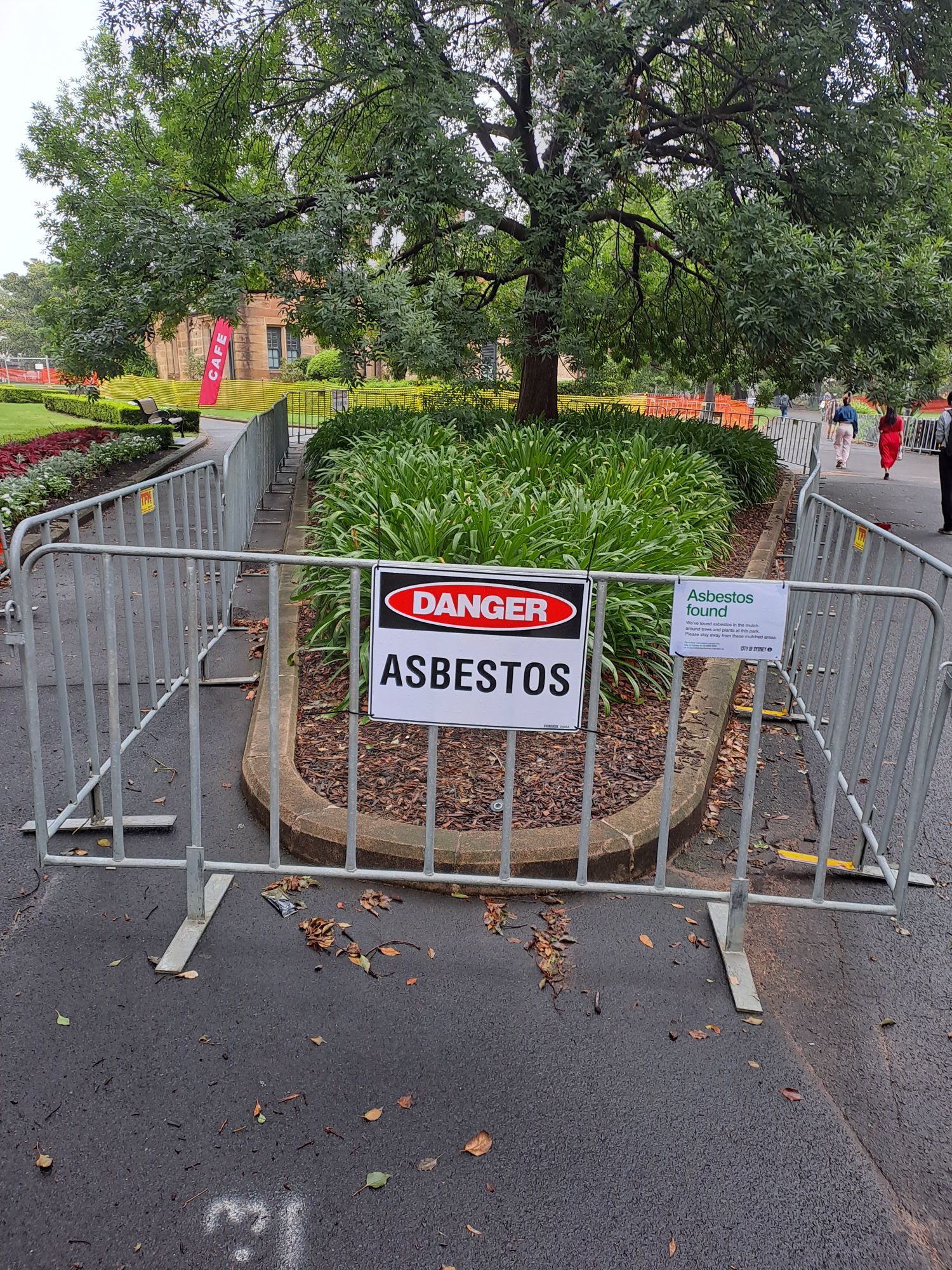
Time, I think, a bit of local news. There’s an ongoing asbestos crisis not only in Sydney but across all New South Wales. It seems that the mulch that has been used in many public parks, school grounds and even a hospital garden is contaminated with asbestos. One affected site is Victoria Park, which I walk through from my flat to the University. At least the park is still open, so you can walk on the paths and sit on the lawns, but all areas with mulch are fenced off:
The contaminated mulch at all the sites affected was supplied by the same company, Greenlife Resource Recovery. I hope they have to foot the bill for clearing it all up!
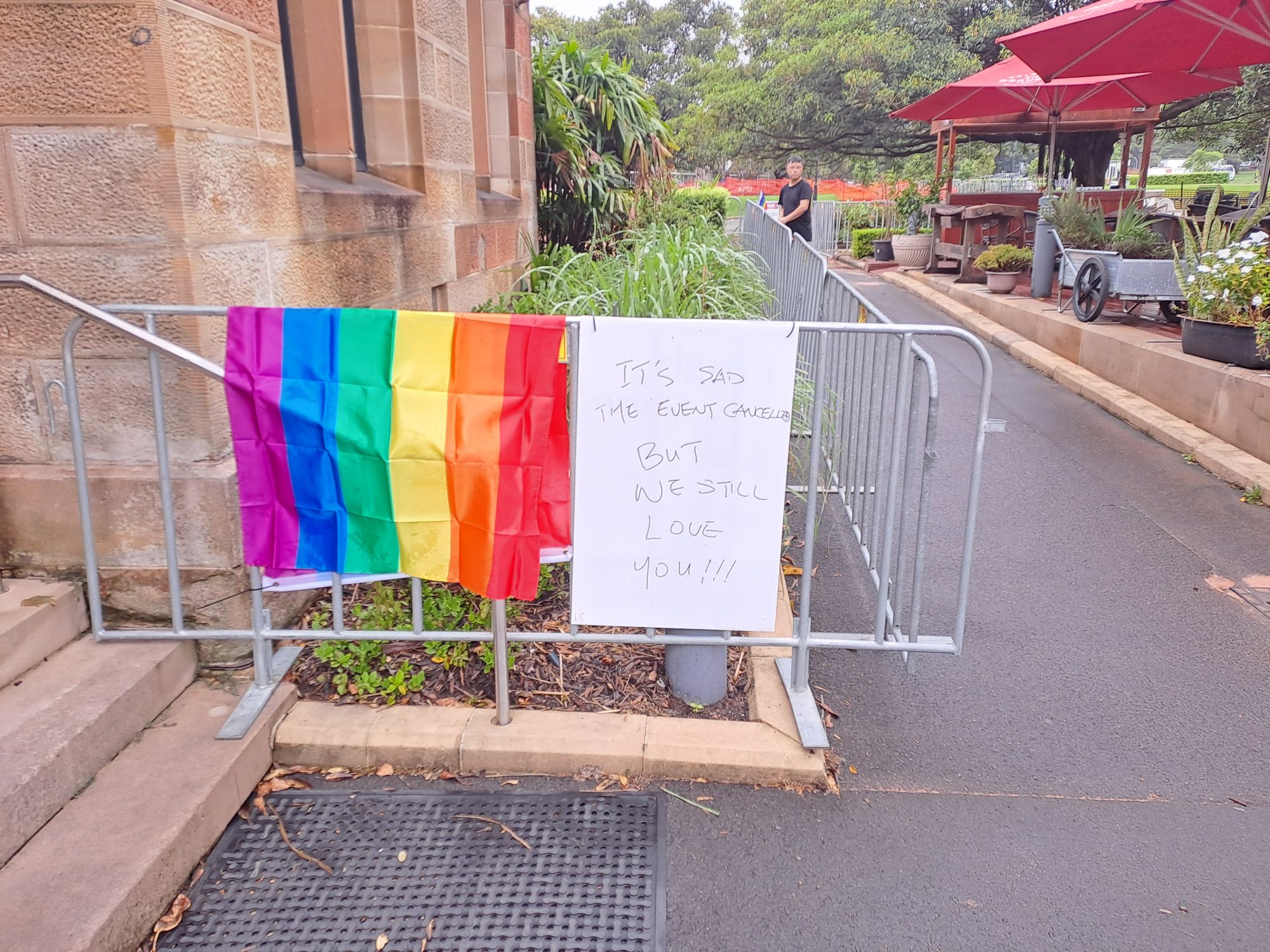
*It is, of course, a complete coincidence that this LGBT festival coincides with my stay in Sydney…
Taking a few moments over breakfast to post about life in Sydney. This morning is cooler than it has been for a while and it’s all a bit rainy. It was very warm (by my standards) earlier in the week (up to 31°C) and very humid, culminating in thunderstorms but those were some way off in the distance so didn’t affect us greatly. Since then it’s been in the mid-20s with a mixture of clouds, light rain, and sunshine. You have to be careful here, though, as it is perfectly possible to get sunburn when it’s cloudy. I’m definitely glad I brought my hat.
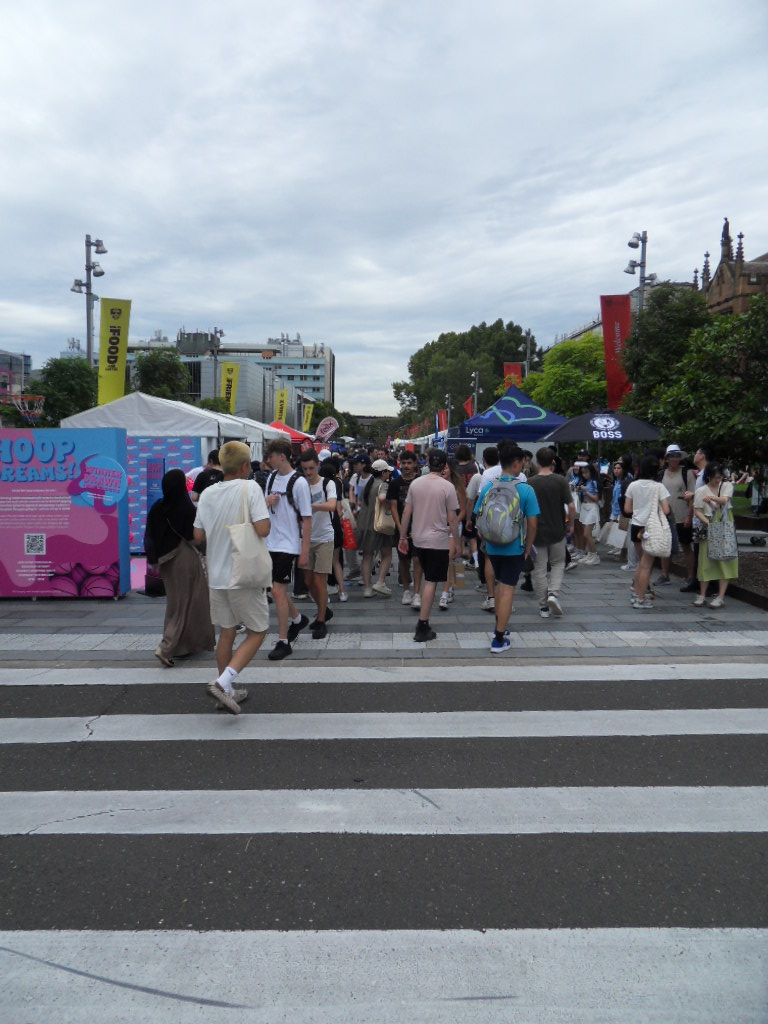
Preparing for Fresher’s FairFresher’s Fair
Other than the weather, the main thing at the University is that it’s Orientation Week, when the new students arrive. Campus has been much busier this week than it was last week, as you can see from the pictures above; I wanted to stand in the same spot for the second picture but there were too many people. Lectures start next week, for both new and returning students, so it should get even busier.
I’ve managed to book tickets for two different performances at the Opera, The Magic Flute and La Traviata. These weren’t cheap but I couldn’t resist seeing the Sydney Opera House from the inside. I’m also planning a trip to the Art Gallery of New South Wales, were there is a special exhibition of art by Wassily Kandinsky which I must see. I’m also going to travel around a bit to give a few talks in the Sydney area.
My diary is filling up, so the second half of this visit will be rather busier than the first, but it should all be interesting!
A month ago I wrote a piece about observations of an apparent “Big Ring” of absorption systems that was claimed to be inconsistent with the Cosmological Principle and hence with the standard cosmological model. At the time there was no paper describing the results, but a preprint has now appeared on arXiv. I haven’t read it carefully yet, but at a cursory reading it confirms my prior expectation that it does not contain a comparison of the observations with predictions of the standard model. I’ll say more after I’ve had a chance to digest the paper.
One of the things that irked me at the time of the announcement of this “discovery” was that there was no way to scrutinize the claims because they hadn’t been written up. Another was that the media covering the Big Ring did not appear to want to present balancing opinions.
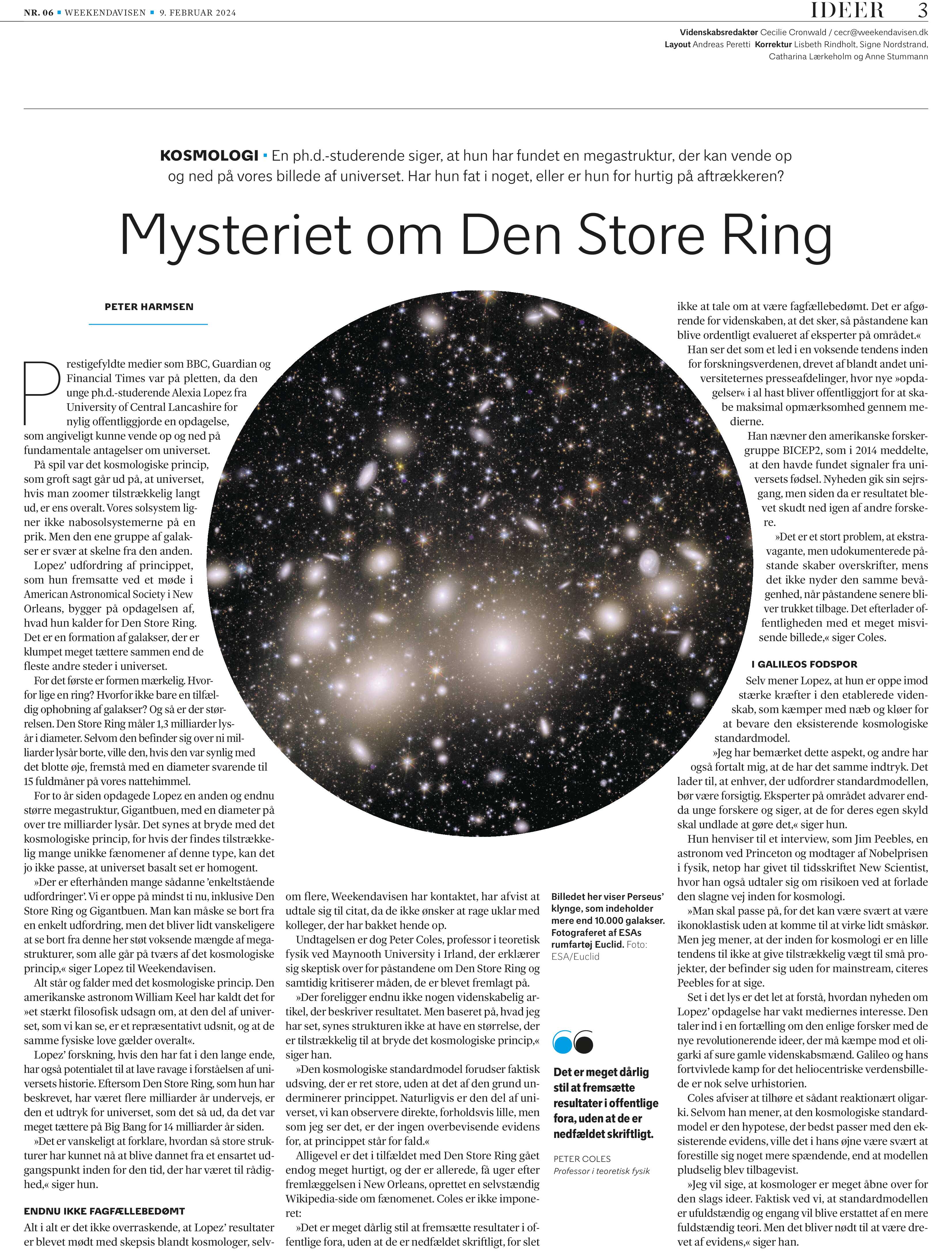
An exception was Danish journalist Peter Harmsen who writes for the weekly broadsheet Weekendavisen who asked me for an interview after seeing my sceptical blog post. The results appeared in an article that came out yesterday (13th February). It’s behind a paywall but here’s a screengrab to give you an idea (if you can read Danish):
The word “store” in Danish means “big” or “large”; it comes up quite often if you want to buy a beer in Denmark. The key quote of mine is
Det er meget dårlig stil at fremsætte resultater i offentlige fora, uden at de er nedfældet skriftligt
Weekendavisen, 13th February 2024
I actually kept a transcript of the interview which I thought it might be useful to share here in the form of questions and answers. You will find the original English version of the above quote in my response to the last question.
Fundamentally, do you think that the cosmological principle still stands or is in need of adjustment or even replacement?
The Cosmological Principle, in the form used in the standard cosmological model, requires the Universe to be sufficiently homogeneous and isotropic on large scales that its behaviour can be described by relatively simple solutions of Einstein’s equations called the Friedman equations. We know the Universe is not exactly homogenous and isotropic, and the standard model predicts actually fluctuations on rather large scales that do not violate it. Of course the part of the Universe we have actually observed directly is relatively small, but as I see it there is no compelling evidence that the Cosmological Principle is violated.
Specifically regarding the research on the so-called Big Ring, is the jury still out on whether the people behind the research are on to something, pending publication of a peer-reviewed paper, or is it your assessment, based on what has been made public so far, that it is probably not the breakthrough that it has been made out to be in some reports?
I am sceptical of the claims made about the Big Ring because there is no scientific paper describing the result. Based on what I have seen, however, just like other claims of arcs and filaments, the structure described does not seem to be on a sufficiently large scale to violate the cosmological principle. A careful comparison of the results with simulations would be required to draw more definite conclusions. I am not aware that the authors have done that.
The PhD student credited with the research is quoted in the Financial Times as making the following remark: “Lots of people are excited but, having said that, you do get this [resistant] attitude in cosmology that you don’t generally find elsewhere in science… Good science should be about pushing back and testing our fundamental assumptions but there are clearly people who want to protect the Standard Model.” What is your comment on this? Is cosmology stifled by a scientific community resistant to change?
Science is – or should be – based on evidence. In my view the weight of evidence supporting the standard model is substantial, but that does not mean that it is proven to be true; it is a working hypothesis. If anyone does come up with evidence that shows it to be wrong then that would be the most exciting thing possible. I don’t see such evidence here. There are of course many people working on alternative theories , for example involving different forms of gravitational theory. I’d say cosmologists are very open to such ideas. Indeed we know that the standard model is incomplete and will eventually be replaced by a more complete theory. That has to be driven by evidence.
You describe in your blog “an increasing tendency for university press offices to see themselves entirely as marketing agencies.” Have there been other recent examples of universities being a little too eager to sell their scientific advances to the public?
There’s quite a lot of this about, and I have to say that scientists, sadly, are often willing participants. A famous example from some years ago was the BICEP2 “discovery” concerning the cosmic microwave background, which made headlines around the world but was later shown to be false. More recently there have been many claims that very distant galaxies observed with JWST are incompatible with the standard cosmology. In that case some of the observations turned out to be incorrect and the theoretical interpretation misleading. Very high redshift galaxies would indeed be difficult to account for in the standard model, but we haven’t seen enough evidence yet.
The narrative of a young scholar proposing revolutionary new ideas despite resistance from established science seems to resonate with the public and has echoes of Galilei and Darwin. Are we, the lay public, too easy victims of such dramatic story-telling, and does it give us a wrong idea about how science actually works?
I think the public don’t really understand how science really works for a number of reasons. I think many people expect scientists to be certain about things, when really it’s about dealing with statistical evidence in as careful and rational a way as possible. Earlier you asked me about the Cosmological Principle. If you asked me if the Cosmological Principle is valid I would answer “I don’t know, but as a working hypothesis it accounts very well for the reliable data”. That sort of statement, however, does not make headlines. A significant problem is that extravagant unsubstantiated claims make headlines, but subsequent retractions don’t. This presents a very misleading picture to the public.
In your blog, you write that headline-hunting without the presence of even a pre-print is “not the sort of thing PhD supervisors should be allowing their PhD students to do.” Is it because it is harmful to science as a whole, or because there is a risk of derailing a young scientist’s career before it has even begun due to an early debacle?
My objection is more that I think it is very bad form to present in public results which have not even been written up, let alone subject to proper peer review. It’s essential for science that this happens, so that the claims can be properly evaluated by experts in the field. Bypassing this is potentially extremely damaging to the proper public understanding of this subject.
It’s a lovely sunny Saint Ash Valentine’s Wednesday Day in Australia though I’m not sure what day it is at the 2nd Lagrange Point of the Earth-Sun system. Nevertheless, as I mentioned last week, Euclid’s Wide Survey starts today; here is the official announcement of this from ESA. To mark this momentous event here is another nice video update showing the preparations that have been going on ahead of the arrival of the deluge of real data:
Among other things, you will see an appearance by Henry Joy McCracken whose namesake led the United Irishmen in the Rebellion of 1798.
… current system of ‘Gold’ Open Access is a scam, and it’s a terrible shame we have ended up having it foisted upon us. Fortunately, being forced to pay APCs of many thousands of euros to publish their papers, researchers are at last starting to realize that they are being ripped off. Recently, the entire Editorial Board of Neuroimage and its sister journal Neuroimage: Reportsresigned in protest at the `extreme’ APC levels imposed by the publisher, Elsevier. I’m sure other academics will follow this example, as it becomes more and more obvious that the current arrangements are unsustainable. Previously the profits of the big publishers were hidden in library budgets. Now they are hitting researchers and their grants directly, as authors now have to pay, and people who previously hadn’t thought much about the absurdity of it all are now realizing what a racket academic publishing really is.
Well, the new journal founded by former Editorial Board of Neuroimage and Neuroimage: Reports has now appeared. It’s called Imaging Neuroscience and its rather website can be found here.
Good news, you would think.
But no…
Imaging Neuroscience is itself a Gold Open Access journal which charges an APC of $1600 per paper. That’s about half the Elsevier were charging ($3,450) but is still far too high. It simply does not cost this much to publish papers online! (There’s a paper that gives a summary of the commercial costs of different aspects of publishing here.) The journal claims to be non-profit making so I’d love to see what they are spending this money on. It can’t be on their website, which is very rudimentary.
It seems that the neuroscientists concerned have just decided to replace Elsevier’s absurd APCs with their own absurd APCs. Oh dear. And they seemed so close to getting it…
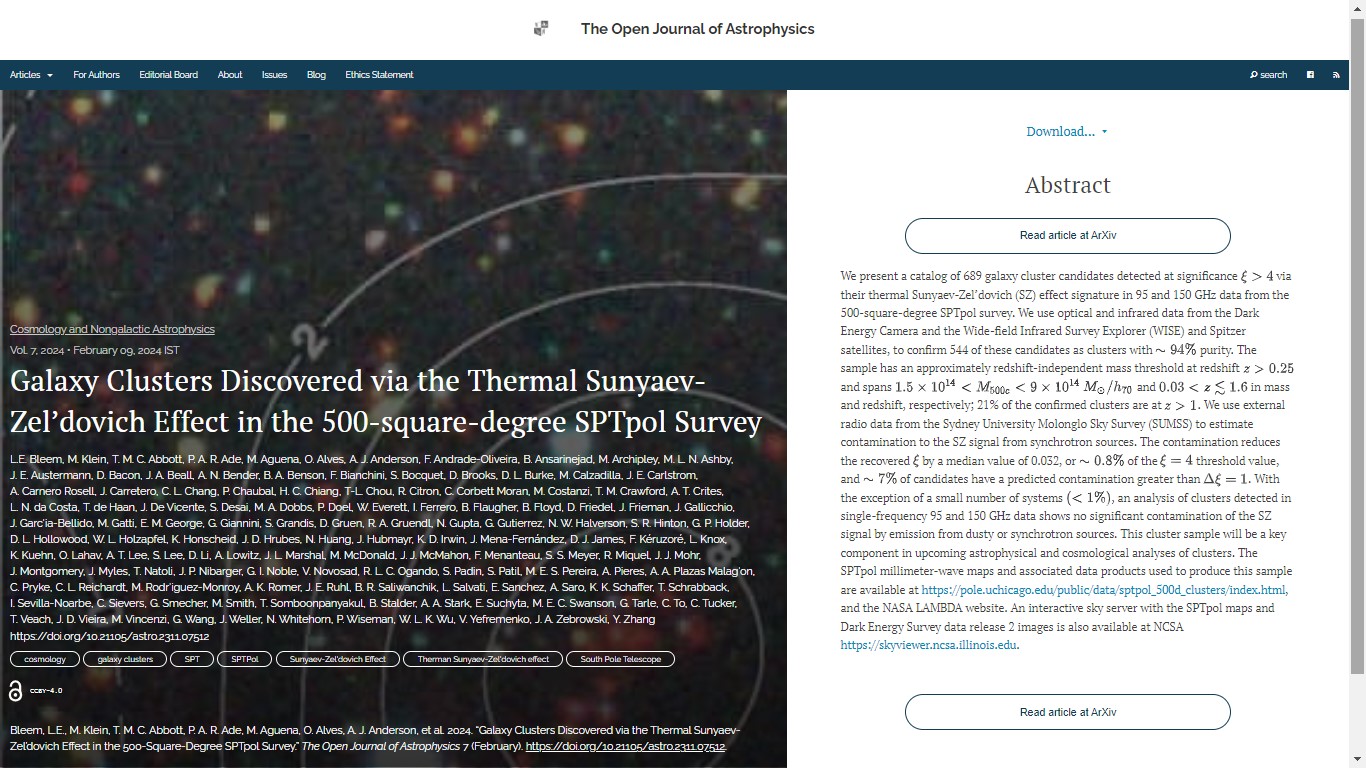
With all the excitement of my first weekend in Sydney I completely forgot to post an update from the Open Journal of Astrophysics. In fact there is only one paper to report from last week, being the 12th paper in Volume 7 (2024) and the 127th altogether. This one was published on 9th February 2024 and is the first published from Down Under.
This paper has lead author Lindsey Bleem of the Argonne National Laboratory in the USA and has 127 other authors – too many to list individually here – but you can see them on the overlay below. I see quite a few names of people I know well!
Here is the overlay of the paper containing the abstract:
You can click on the image of the overlay to make it larger should you wish to do so. You can find the officially accepted version of the paper on the arXiv here.
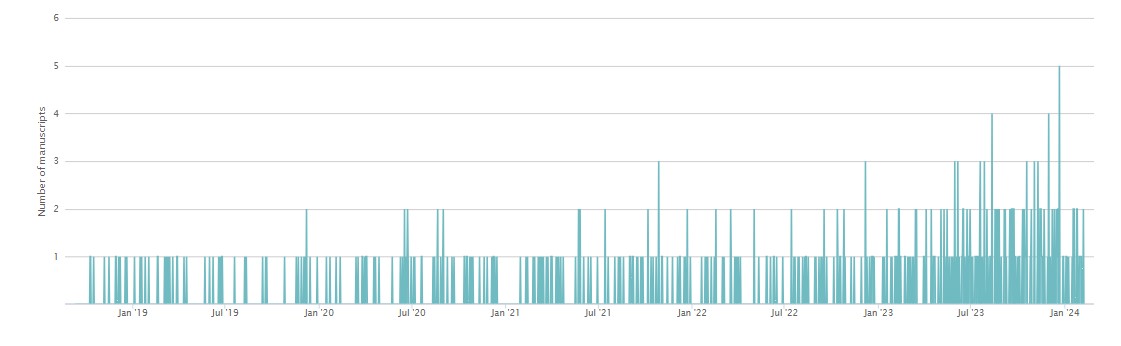
P.S. Incidentally, while I’m here I thought I’d share this little graphic I’ve generated (for other purposes) that shows how the rate of submissions to OJAp has increased over the last 5 years:
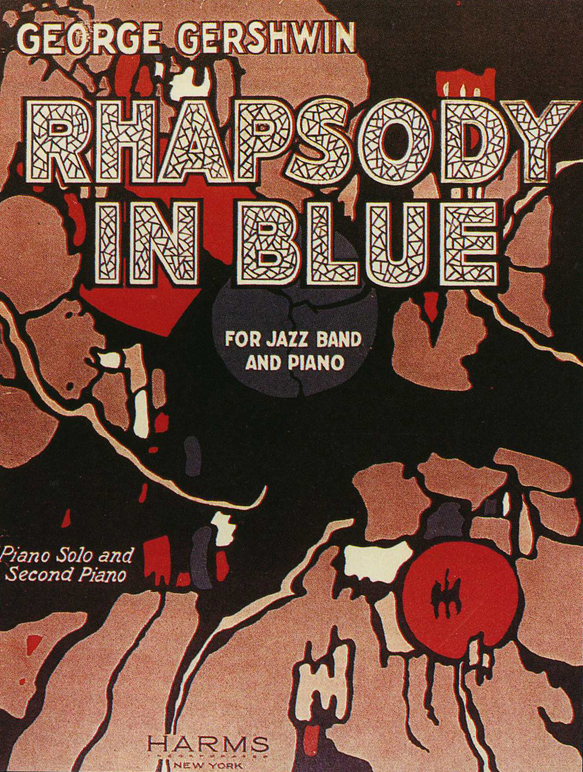
It is February 12th 2024, one hundred years to the day since the first performance of George Gershwin’s composition Rhapsody in Blue at the Aeolian Hall in New York by Paul Whiteman and his Palais Royal Orchestra with the composer himself on piano. This piece is has been a concert favourite for decades, but is usually heard in an arrangement for piano and full symphony orchestra which dates from 1942. The orchestration for that version was provided by Ferdi Grofe who had scored the original for Whiteman’s much smaller band back in 1924. Gershwin originally wrote the piece for two pianos, but didn’t know much about orchestration and had handed that task over to Grofe which the latter completed just a few days before the performance on February 12th 1924. It was not until the rehearsal with Whiteman’s band, however, that the famous opening took its now familiar shape.
The clarinet player with Paul Whiteman’s band in 1924 was a chap called Ross Gorman. It was his job to play the first few bars of Rhapsody in Blue, which had been scored for solo clarinet, consisting of a trill and then a long rising scale or arpeggio of more than two octaves. When they did the first play through Gorman didn’t play it as written but instead followed the trill with part of the scale followed by a long smeared glissando. Gorman often used smears to mimic laughing or sobbing noises, so this was a kind of trademark of his and came very naturally to him (though it is quite difficult to play a long glissando like this, especially slowly). There’s no question that it was “jazzed up” with humorous intent, but Grofe and Gershwin loved Gorman’s way of playing it, and that’s how it has been played ever since.
Rhapsody in Blue was a hit with the audience at its first performance, and has remained so with audiences around the world ever since. Sales of sheet music were good too! Critical reception was somewhat different, but those who disliked it were mostly judging it in comparison with classical music forms (e.g. a piano concerto) that it wasn’t attempting to be. I think it’s a piece to be enjoyed for its exuberance and atmosphere rather than thematic development or other more refined criteria.
There isn’t a recording of the original performance of 1924, but there is one of the same arrangement played by Paul Whiteman’s band in 1927 – complete with Ross Gorman on clarinet and George Gershwin again on piano. The difference is that it was played a bit faster for this recording than it was in concert so that it would fit on two sides of a 12″ record. Although I do think some modern performances of Rhapsody in Blue are too slow, this sounds to me rather rushed in places. The sound quality isn’t great either. Nevertheless, it’s an important piece of music history and it did sell over a million copies, so it would be remiss of me not to share it today!
Since I’m in a self-catering apartment here in Sydney, I’ve needed to scout out the local shops. It turns out the nearest supermarket to my residence is called Coles. When I was buying a few bits and bobs there I showed the name on my debit card to the person at the checkout, but they wouldn’t even give me a discount.
Coles is one of the two big supermarket chains in Australia, the other being Woolworths. I was a bit surprised by that as the UK Woolworths went down the tubes some time ago. I’ve tried both stores during my stay here and it pains me to say that I think Woolworths is the better of the two; it also has the highest market share. There’s also an Aldi near me.
One thing that surprised me about both Coles and Woolworths is that neither sells alcoholic beverages while Aldi does. It turns out that both have associated drinks businesses, Liquorland and BWS respectively, usually located right next to the supermarkets. For some reason it has been decided to keep them separate from the general stores. That might be because of licensing laws or because of purely commercial reasons. I’ve sampled a couple of wines while I’ve been here (one red and one white, both mid-price) and both were nice. Imported wines are available, but I’ll be sticking to local producers while I’m here. Of course the grape varieties are of European origin, but grown in Australia: the red I tried was a Montepulciano and the white a Riesling.
Other than that the main difference between supermarkets here and in Ireland (or the UK) is the much greater selection of Asian food and ingredients. Most groceries are of Australian origin, though, and even brands that are familiar back home (e.g. Heinz) are generally made here under licence. Anyway, I didn’t come all the way here to eat what I would eat at home, and it’s been fun sampling some of the local delicacies, such as Barramundi. I haven’t had kangaroo yet. I did try a Tim Tam but was unimpressed.
It was a bit rainy this morning so my planned Saturday walk around Sydney was a bit truncated. I made it to Sydney Harbour but didn’t go on a boat trip, which I’ll do later. I didn’t have time to visit the Botanical Gardens or the Art Gallery of New South Wales, which are nearby, but will do so later. I was planning to take more pictures with my little compact camera too, but when I took it out I realized its battery was virtually flat and I had to use my phone camera instead. The light here is very different from Ireland! Fortunately I’m here long enough that I’ll have other opportunities for exploration.
My residence in Sydney is the district called Ultimo, which is very central and close to the University of Sydney campus. There is excellent public transport from here to Circular Quay, close to both the Sydney Harbour Bridge and the Opera House, but I needed to stretch my legs so took a leisurely stroll of about an hour, my route taking me through Haymarket and Chinatown to Circular Quay. It being Chinese New Year, I took a detour to look at some of the preparations for two weeks of celebrations. I enjoyed the walk, which followed the tram line most of the way there, and it was getting rather warm in late afternoon so I returned by tram.
Anyway, after much fiddling about, I’ve managed to embed a video I put on Instagram. As you can hear, it was quite windy!
The views presented here are personal and not necessarily those of my employer (or anyone else for that matter).
Feel free to comment on any of the posts on this blog but comments may be moderated; anonymous comments and any considered by me to be vexatious and/or abusive and/or defamatory will not be accepted. I do not necessarily endorse, support, sanction, encourage, verify or agree with the opinions or statements of any information or other content in the comments on this site and do not in any way guarantee their accuracy or reliability.







 In the Dark