Archive for Albert Einstein

The 1919 Eclipse: That Was The Talk That Was…

Posted in History, The Universe and Stuff with tags , , , , , on May 29, 2019 by telescoper

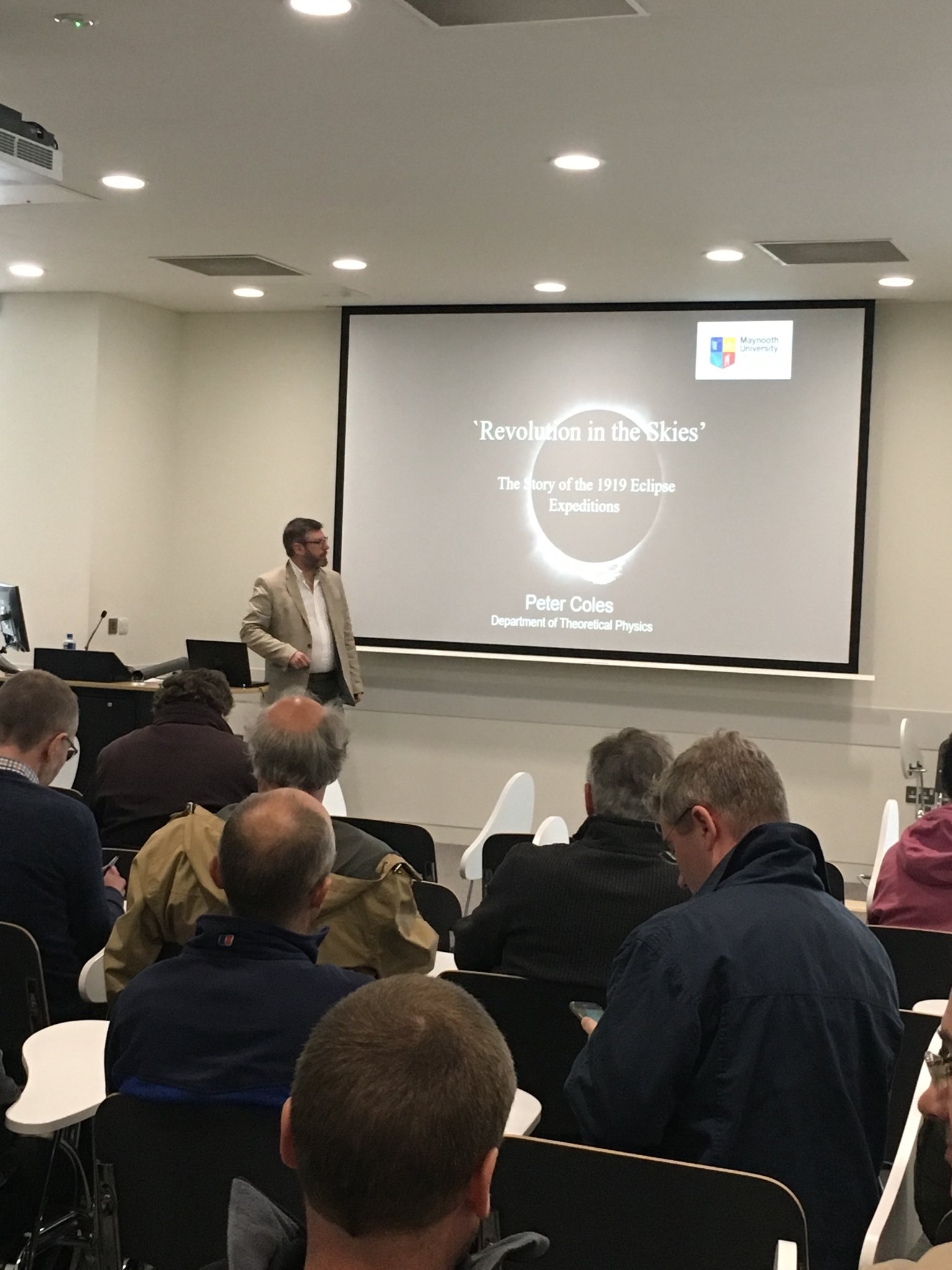
Well, I did my talk this afternoon to mark the centenary of the 1919 Eclipse Experiment that was performed on May 29th 1919. It’s a good job we changed the venue to a bigger lecture theatre than originally booked because even the new one was full! Thanks to everyone who came, and I hope you enjoyed the talk!

Anyway, here are the slides if you’d like to see them:

Here is a picture of me about to start:

Now that the centenary has passed I promise to post a bit less about this topic, although there are still a few things coming up that I might mention…

The Centenary of the 1919 Eclipse Expeditions

Posted in History, The Universe and Stuff with tags , , , , on May 29, 2019 by telescoper

Well, the big day has arrived. Today, 29th May 2019, is the centenary of the 1919 Solar Eclipse during which an experiment was carried out to test Einstein’s theory of general relativity. I’m giving a public talk this afternoon and will post the slides afterwards.

In the meantime, however, I’ll just re-post his little piece which is based on an article I wrote some years ago for Firstscience.

–0–

The Eclipse that Changed the Universe

A total eclipse of the Sun is a moment of magic: a scant few minutes when our perceptions of the whole Universe are turned on their heads. The Sun’s blinding disc is replaced by ghostly pale tentacles surrounding a black heart – an eerie experience witnessed by hundreds of millions of people throughout Europe and the Near East last August.

But one particular eclipse of the Sun, eighty years ago, challenged not only people’s emotional world. It was set to turn the science of the Universe on its head. For over two centuries, scientists had believed Sir Isaac Newton’s view of the Universe. Now his ideas had been challenged by a young German-Swiss scientist, called Albert Einstein. The showdown – Newton vs Einstein – would be the total eclipse of 29 May 1919.

Newton’s position was set out in his monumental Philosophiae Naturalis Principia Mathematica, published in 1687. The Principia – as it’s familiarly known – laid down a set of mathematical laws that described all forms of motion in the Universe. These rules applied as much to the motion of planets around the Sun as to more mundane objects like apples falling from trees.

At the heart of Newton’s concept of the Universe were his ideas about space and time. Space was inflexible, laid out in a way that had been described by the ancient Greek mathematician Euclid in his laws of geometry. To Newton, space was the immovable and unyielding stage on which bodies acted out their motions. Time was also absolute, ticking away inexorably at the same rate for everyone in the Universe.

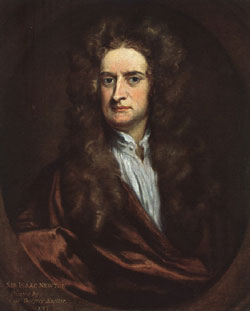
Sir Isaac Newton, painted by Sir Godfrey Kneller. Picture Credit: National Portrait Gallery,

For over 200 years, scientists saw the Cosmos through Newton’s eyes. It was a vast clockwork machine, evolving by predetermined rules through regular space, against the beat of an absolute clock. This edifice totally dominated scientific thought, until it was challenged by Albert Einstein.

In 1905, Einstein dispensed with Newton’s absolute nature of space and time. Although born in Germany, during this period of his life he was working as a patent clerk in Berne, Switzerland. He encapsulated his new ideas on motion, space and time in his special theory of relativity. But it took another ten years for Einstein to work out the full consequences of his ideas, including gravity. The general theory of relativity, first aired in 1915, was as complete a description of motion as Newton had prescribed in his Principia. But Einstein’s description of gravity required space to be curved. Whereas for Newton space was an inflexible backdrop, for Einstein it had to bend and flex near massive bodies. This warping of space, in turn, would be responsible for guiding objects such as planets along their orbits.

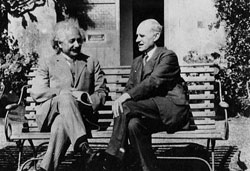
Albert Einstein (left), pictured with Arthur Stanley Eddington (right). Picture Credit: Royal Greenwich Observatory.

By the time he developed his general theory, Einstein was back in Germany, working in Berlin. But a copy of his general theory of relativity was soon smuggled through war-torn Europe to Cambridge. There it was read by Arthur Stanley Eddington, Britain’s leading astrophysicist. Eddington realised that Einstein’s theory could be tested. If space really was distorted by gravity, then light passing through it would not travel in a straight line, but would follow a curved path. The stronger the force of gravity, the more the light would be bent. The bending would be largest for light passing very close to a very massive body, such as the Sun.

Unfortunately, the most massive objects known to astronomers at the time were also very bright. This was before black holes were seriously considered, and stars provided the strongest gravitational fields known. The Sun was particularly useful, being a star right on our doorstep. But it is impossible to see how the light from faint background stars might be bent by the Sun’s gravity, because the Sun’s light is so bright it completely swamps the light from objects beyond it.

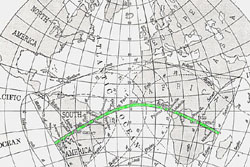
A scientific sketch of the path of totality for the 1919 eclipse. Picture Credit: Royal Greenwich Observatory.

Eddington realised the solution. Observe during a total eclipse, when the Sun’s light is blotted out for a few minutes, and you can see distant stars that appear close to the Sun in the sky. If Einstein was right, the Sun’s gravity would shift these stars to slightly different positions, compared to where they are seen in the night sky at other times of the year when the Sun far away from them. The closer the star appears to the Sun during totality, the bigger the shift would be.

Eddington began to put pressure on the British scientific establishment to organise an experiment. The Astronomer Royal of the time, Sir Frank Watson Dyson, realised that the 1919 eclipse was ideal. Not only was totality unusually long (around six minutes, compared with the two minutes we experienced in 1999) but during totality the Sun would be right in front of the Hyades, a cluster of bright stars.

But at this point the story took a twist. Eddington was a Quaker and, as such, a pacifist. In 1917, after disastrous losses during the Somme offensive, the British government introduced conscription to the armed forces. Eddington refused the draft and was threatened with imprisonment. In the end, Dyson’s intervention was crucial persuading the government to spare Eddington. His conscription was postponed under the condition that, if the war had finished by 1919, Eddington himself would lead an expedition to measure the bending of light by the Sun. The rest, as they say, is history.

The path of totality of the 1919 eclipse passed from northern Brazil, across the Atlantic Ocean to West Africa. In case of bad weather (amongst other reasons) two expeditions were organised: one to Sobral, in Brazil, and the other to the island of Principe, in the Gulf of Guinea close to the West African coast. Eddington himself went to Principe; the expedition to Sobral was led by Andrew Crommelin from the Royal Observatory at Greenwich.

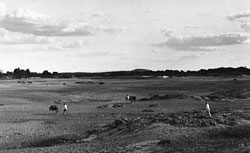
British scientists in the field at their observing site in Sobral in 1919. Picture Credit: Royal Greenwich Observatory

The expeditions did not go entirely according to plan. When the day of the eclipse (29 May) dawned on Principe, Eddington was greeted with a thunderstorm and torrential rain. By mid-afternoon the skies had partly cleared and he took some pictures through cloud.

Meanwhile, at Sobral, Crommelin had much better weather – but he had made serious errors in setting up his equipment. He focused his main telescope the night before the eclipse, but did not allow for the distortions that would take place as the temperature climbed during the day. Luckily, he had taken a backup telescope along, and this in the end provided the best results of all.

After the eclipse, Eddington himself carefully measured the positions of the stars that appeared near the Sun’s eclipsed image, on the photographic plates exposed at both Sobral and Principe. He then compared them with reference positions taken previously when the Hyades were visible in the night sky. The measurements had to be incredibly accurate, not only because the expected deflections were small. The images of the stars were also quite blurred, because of problems with the telescopes and because they were seen through the light of the Sun’s glowing atmosphere, the solar corona.

Before long the results were ready. Britain’s premier scientific body, the Royal Society, called a special meeting in London on 6 November. Dyson, as Astronomer Royal took the floor, and announced that the measurements did not support Newton’s long-accepted theory of gravity. Instead, they agreed with the predictions of Einstein’s new theory.

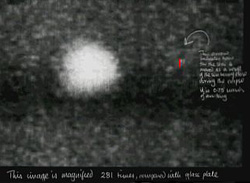
The final proof: the small red line shows how far the position of the star has been shifted by the Sun’s gravity. Each star experiences a tiny deflection, but averaged over many exposures the results definitely support Einstein’s theory. Picture Credit: Royal Greenwich Observatory.

The press reaction was extraordinary. Einstein was immediately propelled onto the front pages of the world’s media and, almost overnight, became a household name. There was more to this than purely the scientific content of his theory. After years of war, the public embraced a moment that moved mankind from the horrors of destruction to the sublimity of the human mind laying bare the secrets of the Cosmos. The two pacifists in the limelight – the British Eddington and the German-born Einstein – were particularly pleased at the reconciliation between their nations brought about by the results.

But the popular perception of the eclipse results differed quite significantly from the way they were viewed in the scientific establishment. Physicists of the day were justifiably cautious. Eddington had needed to make significant corrections to some of the measurements, for various technical reasons, and in the end decided to leave some of the Sobral data out of the calculation entirely. Many scientists were suspicious that he had cooked the books. Although the suspicion lingered for years in some quarters, in the end the results were confirmed at eclipse after eclipse with higher and higher precision.

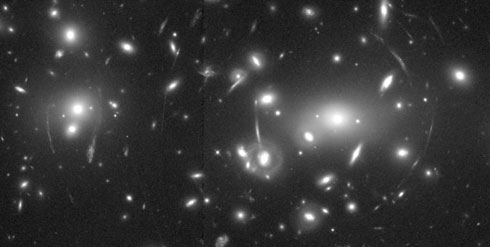
In this cosmic ‘gravitational lens,’ a huge cluster of galaxies distorts the light from more distant galaxies into a pattern of giant arcs. Picture Credit: NASA

Nowadays astronomers are so confident of Einstein’s theory that they rely on the bending of light by gravity to make telescopes almost as big as the Universe. When the conditions are right, gravity can shift an object’s position by far more than a microscopic amount. The ideal situation is when we look far out into space, and centre our view not on an individual star like the Sun, but on a cluster of hundreds of galaxies – with a total mass of perhaps 100 million million suns. The space-curvature of this immense ‘gravitational lens’ can gather the light from more remote objects, and focus them into brilliant curved arcs in the sky. From the size of the arcs, astronomers can ‘weigh’ the cluster of galaxies.

Einstein didn’t live long enough to see through a gravitational lens, but if he had he would definitely have approved….
Statistical Analysis of the 1919 Eclipse Measurements

Posted in Bad Statistics, The Universe and Stuff with tags , , , , on May 27, 2019 by telescoper

So the centenary of the famous 1919 Eclipse measurements is only a couple of days away and to mark it I have a piece on RTÉ Brainstorm published today in advance of my public lecture on Wednesday.

I thought I’d complement the more popular piece by posting a very short summary of how the measurements were analyzed for those who want a bit more technical detail.

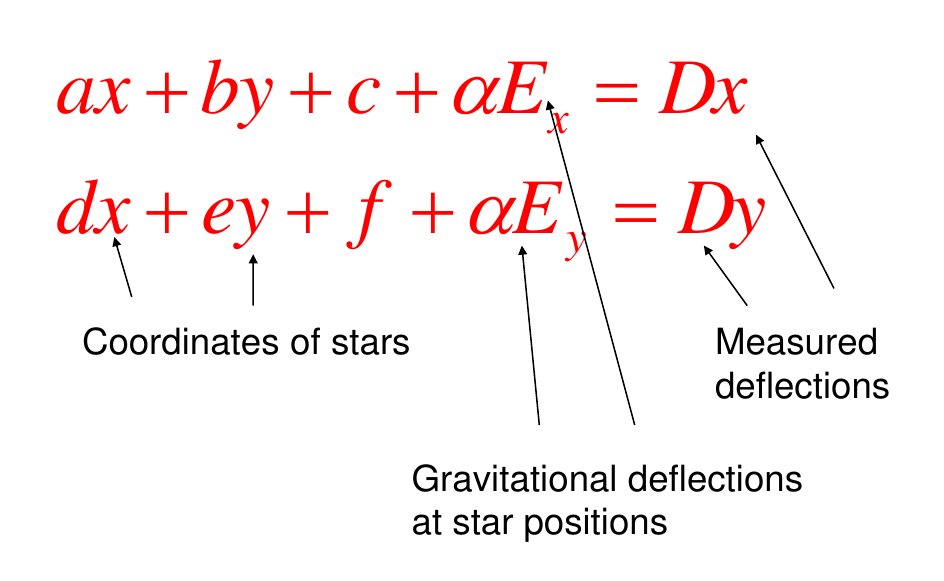
The idea is simple. Take a photograph during a solar eclipse during which some stars are visible in the sky close enough to the Sun to be deflected by its gravity. Take a similar photograph of the same stars at night at some other time when the Sun is elsewhere. Compare the positions of the stars on the two photographs and the star positions should have shifted slightly on the eclipse plates compared to the comparison plate. This gravitational shift should be radially outwards from the centre of the Sun.

One can measure the coordinates of the stars in two directions: Right Ascension (x) and Declination (y) and the corresponding (small) difference between the positions in each direction are Dx and Dy on the right hand side of the equations above.

In the absence of any other effects these deflections should be equal to the deflection in each component calculated using Einstein’s theory or Newtonian value. This is represented by the two terms Ex(x,y) and Ey(x,y) which give the calculated components of the deflection in both x and y directions scaled by a parameter α which is the object of interest – α should be precisely a factor two larger in Einstein’s theory than in the `Newtonian’ calculation.

The problem is that there are several other things that can cause differences between positions of stars on the photographic plate, especially if you remember that the eclipse photographs have to be taken out in the field rather than at an observatory.  First of all there might be an offset in the coordinates measured on the two plates: this is represented by the terms c and f in the equations above. Second there might be a slightly different magnification on the two photographs caused by different optical performance when the two plates were exposed. These would result in a uniform scaling in x and y which is distinguishable from the gravitational deflection because it is not radially outwards from the centre of the Sun. This scale factor is represented by the terms a and e. Third, and finally, the plates might be oriented slightly differently, mixing up x and y as represented by the cross-terms b and d.

Before one can determine a value for α from a set of measured deflections one must estimate and remove the other terms represented by the parameters a-f. There are seven unknowns (including α) so one needs at least seven measurements to get the necessary astrometric solution.

The approach Eddington wanted to use to solve this problem involved setting up simultaneous equations for these parameters and eliminating variables to yield values for α for each plate. Repeating this over many allows one to beat down the measurement errors by averaging and return a final overall value for α. The 1919 eclipse was particularly suitable for this experiment because (a) there were many bright stars positioned close to the Sun on the sky during totality and (b) the duration of totality was rather long – around 7 minutes – allowing many exposures to be taken.

This was indeed the approach he did use to analyze the data from the Sobral plates, but tor the plates taken at Principe during poor weather he didn’t have enough star positions to do this: he therefore used estimates of the scale parameters (a and e) taken entirely from the comparison plates. This is by no means ideal, though he didn’t really have any choice.

If you ask me a conceptually better approach would be the Bayesian one: set up priors on the seven parameters then marginalize over a-f  to leave a posterior distribution on α. This task is left as an exercise to the reader.


Revolution in the Skies: The Experiment that made Einstein Famous

Posted in History, The Universe and Stuff with tags , , on May 14, 2019 by telescoper

At the risk of being a complete bore about the 1919 Eclipse Expeditions, here is a plug for a public talk I am giving in Maynooth on 29 May 2019, the centenary of the event itself.

Here is the blurb:

Albert Einstein is the undisputed genius whose insights have revolutionised the way we think about the Universe. He is also a cultural icon whose fame extends far beyond the realm of theoretical physics.

Einstein’s transition to global stardom can be dated precisely to 29th May 1919, the date of a total solar eclipse at which the first measurements were made of the bending of light by the Sun’s gravity that tested Einstein’s then new general theory of relativity. The announcement of the results created an unprecedented media sensation: news of Einstein and his revolutionary theory made front-page news around the world.

To mark the centenary of this historic event, Peter Coles will describe the historical and scientific background to an experiment that changed the world, and explain why it was such an important event both for Einstein the physicist and Einstein the celebrity.

The event will be on the North Campus of Maynooth University. It is free, but please register at the Eventbrite site here if you want to attend so we can get an idea of numbers. If, for some reason, you can’t get to Maynooth, we are planning to do a live feed of the talk too, so please watch this blog for more details.

Lights all askew in the Heavens – the 1919 Eclipse Expeditions

Posted in History, Talks and Reviews, The Universe and Stuff with tags , , , , , on April 23, 2019 by telescoper

I completely forgot to upload the slides from my talk at the Open Meeting of the Royal Astronomical Society on April 12 2019 so here they are now!

Just a reminder that the centenary of the famous 1919 Eclipse Expeditions is on 29 May 2019.

Nature Piece Plug

Posted in History, The Universe and Stuff with tags , , on April 17, 2019 by telescoper

Just a quick post to advertise that a short piece what I wrote is now published online on the journal Nature. It will appear in the print edition published tomorrow.

I think the title is fairly self-explanatory – it’s basically a triple book review, but with some additional scientific background thrown in.

Should you wish to do so, you can download a PDF version of the article here.

There’s a SharedIt link too.

The Mystery Object Revealed

Posted in History, The Universe and Stuff with tags , , , , , on April 12, 2019 by telescoper

As I revealed this afternoon in my talk at the Royal Astronomical Society, yesterday’s mystery object..

..is in fact the 4-inch object (geddit?) glass that was manufactured by Howard Grubb in Dublin and taken to Sobral in Brazil in 1919 to be used in a famous experiment to measure the bending of light by the Sun during a total eclipse.

Here is a picture of the observing setup in Sobral:

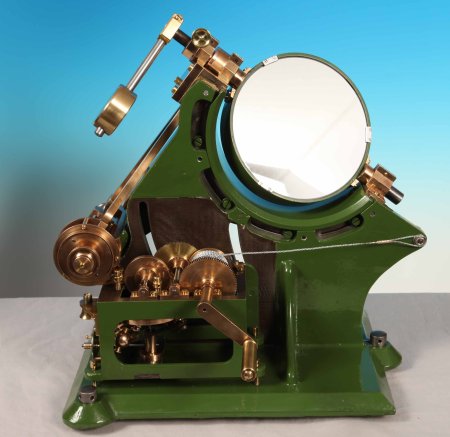
The 4-inch lens is mounted in the square tube on the right. The eclipse was observed using a coelostat (a steerable mirror) that reflected light into the telescopes. Here is a photograph of the coelostat:

The object glass and coelostat are usually on display at Dunsink Observatory but these are currently en route to Brazil for the commemorations of the centenary of the historic expedition.

Photo Credits to Tom Ray of DIAS…

One Hundred Years of the Cosmological Constant

Posted in History, The Universe and Stuff with tags , , , , , , on February 8, 2017 by telescoper

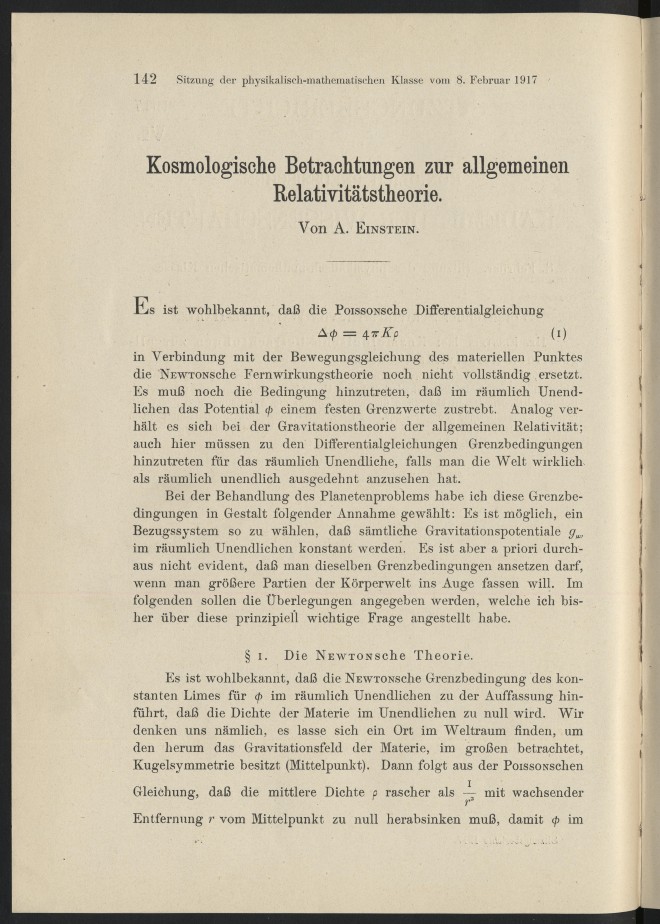
It was exactly one hundred years ago today – on 8th February 1917 – that a paper was published in which Albert Einstein explored the cosmological consequences of his general theory of relativity, in the course of which he introduced the concept of the cosmological constant.

For the record the full reference to the paper is: Kosmologische Betrachtungen zur allgemeinen Relativitätstheorie and it was published in the Sitzungsberichte der Königlich Preußischen Akademie der Wissenschaften. You can find the full text of the paper here. There’s also a nice recent discussion of it by Cormac O’Raifeartaigh  and others on the arXiv here.

Here is the first page:

cosmo

It’s well worth looking at this paper – even if your German is as rudimentary as mine – because the argument Einstein constructs is rather different from what you might imagine (or at least that’s what I thought when I first read it). As you see, it begins with a discussion of a modification of Poisson’s equation for gravity.

As is well known, Einstein introduced the cosmological constant in order to construct a static model of the Universe. The 1917 paper pre-dates the work of Friedman (1923) and Lemaître (1927) that established much of the language and formalism used to describe cosmological models nowadays, so I thought it might be interesting just to recapitulate the idea using modern notation. Actually, in honour of the impending centenary I did this briefly in my lecture on Physics of the Early Universe yesterday.

To simplify matters I’ll just consider a “dust” model, in which pressure can be neglected. In this case, the essential equations governing a cosmological model satisfying the Cosmological Principle are:

\ddot{a} = -\frac{4\pi G \rho a }{3} +\frac{\Lambda a}{3}

and

\dot{a}^2= \frac{8\pi G \rho a^2}{3} +\frac{\Lambda a^2}{3} - kc^2.

In these equations a(t) is the cosmic scale factor (which measures the relative size of the Universe) and dots are derivatives with respect to cosmological proper time, t. The density of matter is \rho>0 and the cosmological constant is \Lambda. The quantity k is the curvature of the spatial sections of the model, i.e. the surfaces on which t is constant.

Now our task is to find a solution of these equations with a(t)= A, say, constant for all time, i.e. that \dot{a}=0 and \ddot{a}=0 for all time.

The first thing to notice is that if \Lambda=0 then this is impossible. One can solve the second equation to make the LHS zero at a particular time by matching the density term to the curvature term, but that only makes a universe that is instantaneously static. The second derivative is non-zero in this case so the system inevitably evolves away from the situation in which $\dot{a}=0$.

With the cosmological constant term included, it is a different story. First make \ddot{a}=0  in the first equation, which means that

\Lambda=4\pi G \rho.

Now we can make \dot{a}=0 in the second equation by setting

\Lambda a^2 = 4\pi G \rho a^2 = kc^2

This gives a static universe model, usually called the Einstein universe. Notice that the curvature must be positive, so this a universe of finite spatial extent but with infinite duration.

This idea formed the basis of Einstein’s own cosmological thinking until the early 1930s when observations began to make it clear that the universe was not static at all, but expanding. In that light it seems that adding the cosmological constant wasn’t really justified, and it is often said that Einstein regard its introduction as his “biggest blunder”.

I have two responses to that. One is that general relativity, when combined with the cosmological principle, but without the cosmological constant, requires the universe to be dynamical rather than static. If anything, therefore, you could argue that Einstein’s biggest blunder was to have failed to predict the expansion of the Universe!

The other response is that, far from it being an ad hoc modification of his theory, there are actually sound mathematical reasons for allowing the cosmological constant term. Although Einstein’s original motivation for considering this possibility may have been misguided, he was justified in introducing it. He was right if, perhaps, for the wrong reasons. Nowadays observational evidence suggests that the expansion of the universe may be accelerating. The first equation above tells you that this is only possible if \Lambda\neq 0.

Finally, I’ll just mention another thing in the light of the Einstein (1917) paper. It is clear that Einstein thought of the cosmological as a modification of the left hand side of the field equations of general relativity, i.e. the part that expresses the effect of gravity through the curvature of space-time. Nowadays we tend to think of it instead as a peculiar form of energy (called dark energy) that has negative pressure. This sits on the right hand side of the field equations instead of the left so is not so much a modification of the law of gravity as an exotic form of energy. You can see the details in an older post here.

Charles Ives & Albert Einstein: Parallel Lives

Posted in Music, The Universe and Stuff with tags , , , on October 20, 2015 by telescoper

I just noticed that today is the birthday of the great American modernist composer Charles Ives, who was born 141 years ago on this day. Some time ago I read The Life of Charles Ives by Stuart Feder, it’s a very interesting and informative biography of one of the strangest but most fascinating composers in the history of classical music so I thought I’d rehash an old piece I wrote about him to celebrate his birthday.

Charles Ives was by any standards a daring musical innovator. Some of his compositions involve atonal structures and some involve different parts of the orchestra playing in different time signatures. He also wrote strange and wonderful piano pieces, including some which involved re-tuning the piano to obtain scales involving quarter-tones. Among this maelstrom of modern ideas he also liked to add quotations from folk songs and old hymns which gives his work a paradoxically nostalgic tinge.

His pieces are often extremely diffficult to play (so I’m told) and sometimes not that easy to listen to, but while he’s often perplexing he can also be exhilarating and very moving. Other composers might play off two musical ideas against each other, but Ives would smash them together and to hell with the dissonance. I think the wholeheartedness of his eccentricity is wonderful, but I know that some people think he was just a nut.. You’ll have to make your own mind up on that.

My favourite quote of his can be found scrawled on a hand-written score which he sent to his copyist:

Please don’t try to make things nice! All the wrong notes are right. Just copy as I have – I want it that way.

But the point of adding this post to my blog was that in the course of reading the biography, it struck me that there is a strange parallel between the life of this controversial and not-too-well known composer and that of Albert Einstein who is certainly better known, especially to people reading what purports to be a physics blog.

For one thing their lifespans coincide pretty closely. Charles Ives was born in 1874 and died in 1954; Albert Einstein lived from 1879 to 1955. Of course the former was born in America and the latter in Germany. One inhabited the world of music and the other science; Ives, in fact, made his living in the insurance business and only composed in his spare time while Einstein spent most of his career in academia, after a brief period working in a patent office. Not everything Ives wrote was published professionally and he also rewrote things extensively, so it is difficult to establish exact dates for things, especially for a non-expert like me. In any case I don’t want to push things too far and try to argue that some spooky zeitgeist acted at a distance to summon the ideas from each of them in his own sphere. I just think it is curious to observe how similar their world lines were, at least in some respects.

We all know that Einstein’s “year of miracles” was 1905, during which he published classic papers on special relativity, Brownian motion and the photoelectric effect. What was arguably Ives’ greatest composition, The Unanswered Question, was completed in 1906 (although it was revised later). This piece is subtitled “A Cosmic Landscape” and it’s a sort of meditation on the philosophical problem of existence: the muted strings (which are often positioned offstage in concert performances) symbolize silence while the solo trumpet evokes the individual struggling to find meaning within the void. Here’s a fine recording of this work, featuring the New York Philharmonic conducted by Leonard Bernstein:

The Unanswered Question is probably Ives’ greatest masterpiece, but it wasn’t the only work he composed in 1906. A companion piece called Central Park in the Dark also dates from that year and they are sometimes performed together as a kind of diptych which offers interesting contrasts. While the former is static and rather abstract, the latter is dynamic and programmatic (in that it includes realistic evocations of night-time sounds).

Einstein’s next great triumph was his General Theory of Relativity in 1915, an extension of the special theory to include gravity and accelerated motion, which which came only after years of hard work learning the required difficult mathematics. Ives too was hard at work for the next decade which resulted in other high points, although they didn’t make him a household name like Einstein. The Fourth Symphony is an extraordinary work which even the best orchestras find extremely difficult to perform. Even better in my view is Three Places in New England (completed in 1914) , which contains my own favourite bit of Ives. The last movement, The Housatonic at Stockbridge is very typical of his unique approach, with a beautifully paraphrased hymn tune floating over the top of complex meandering string figures until the piece ends in a tumultuous crescendo.

After this period, both Einstein and Ives carried on working in their respective domains, and even with similar preoccupations. Einstein was in search of a unified field theory that could unite gravity with the other forces of nature, although the approach led him away from the mainstream of conventional physics research and his later years he became an increasingly marginal figure.

By about 1920 Ives had written five full symphonies (four numbered ones and one called the Holidays Symphony) but his ambition beyond these was perhaps just as grandiose as Einstein’s: to create a so-called “Universe Symphony” which he described (in typically bewildering fashion) as

A striving to present – to contemplate in tones rather than in music as such, that is – not exactly within the general term or meaning as it is so understood – to paint the creation, the mysterious beginnings of all things, known through God to man, to trace with tonal imprints the vastness, the spiritual eternities, from the great unknown to the great unknown.

I guess such an ambitious project – to create an entirely new language of “tones” that could give expression to timeless eternity, a kind of musical theory of everything – was doomed to failure. Although Ives was an experienced symphonic composer he couldn’t find a way to realise his vision. Only fragments of the Universe Symphony remain (although various attempts have been made by others to complete it).

In fact, the end of Ives’ creative career was much more sudden and final than Einstein who, although he never again reached the heights he had scaled in 1915 – who could? – remained a productive and respected scientist until his death. Ives had a somewhat melancholic disposition and from time to time suffered from depression. By 1918 he already felt that his creative flame was faltering, but by 1926 the spark was extinguished completely. His wife, appropriately named Harmony, remembered the precise day when this happened at their townhouse in New York:

He came downstairs one day with tears in his eyes, and said he couldn’t seem to compose anymore – nothing went well, nothing sounded right.

Although Charles Ives lived almost another thirty years he never composed another piece of music after that day in 1926. I find that unbearably sad, but at least a lot of his work is available and now fairly widely played. Alongside the pieces I have mentioned, there are literally hundreds of songs, some of which are exceptionally beautiful, and dozens of smaller works including piano and violin sonatas.

Although they both lived in the same part of America for many years, I don’t think Charles Ives and Albert Einstein ever met. I wonder what they would have made of each other if they had?

If you believe in the multiverse, of course, then there is a part of it in which they do meet. Einstein was an enthusiastic violinist so there will even be a parallel world in which Einstein is playing the Ives’ Violin Sonata on Youtube…


Astronomy Look-alikes, No. 96

Posted in Astronomy Lookalikes with tags , on October 7, 2015 by telescoper

Heavens above!

It has been drawn to my attention that there is a remarkable similarity in visual appearance between planetary astronomer Albert Einstein and the creator of the theory of general relativity Jean-Pierre Bibring. I wonder if, by any chance, they might be related?


Bibring