It’s Saturday again so it’s time for another update of activity at the Open Journal of Astrophysics. Since the last update we have published a further seven papers, bringing the number in Volume 9 (2026) to 136 and the total so far published by OJAp up to 584.
I will continue to include the posts made on our Mastodon account (on Fediscience); these announcements also show the DOI for each paper.
The first paper to report this week, published on Monday 29th June, is “Analysis and implications of the spatio-spectral morphology of the Fermi Bubbles” by Ami Tank (Indian Institute of Technology) and Roland Crocker & Mark R. Krumholz (Australian National University). Published in the folder High-Energy Astrophysical Phenomena, this paper presents an analysis of the gamma-ray structures of Fermi Bubbles in the Milky Way using a decade of data. The research suggests either hadronic or leptonic processes can explain the data.
The overlay for this paper is here
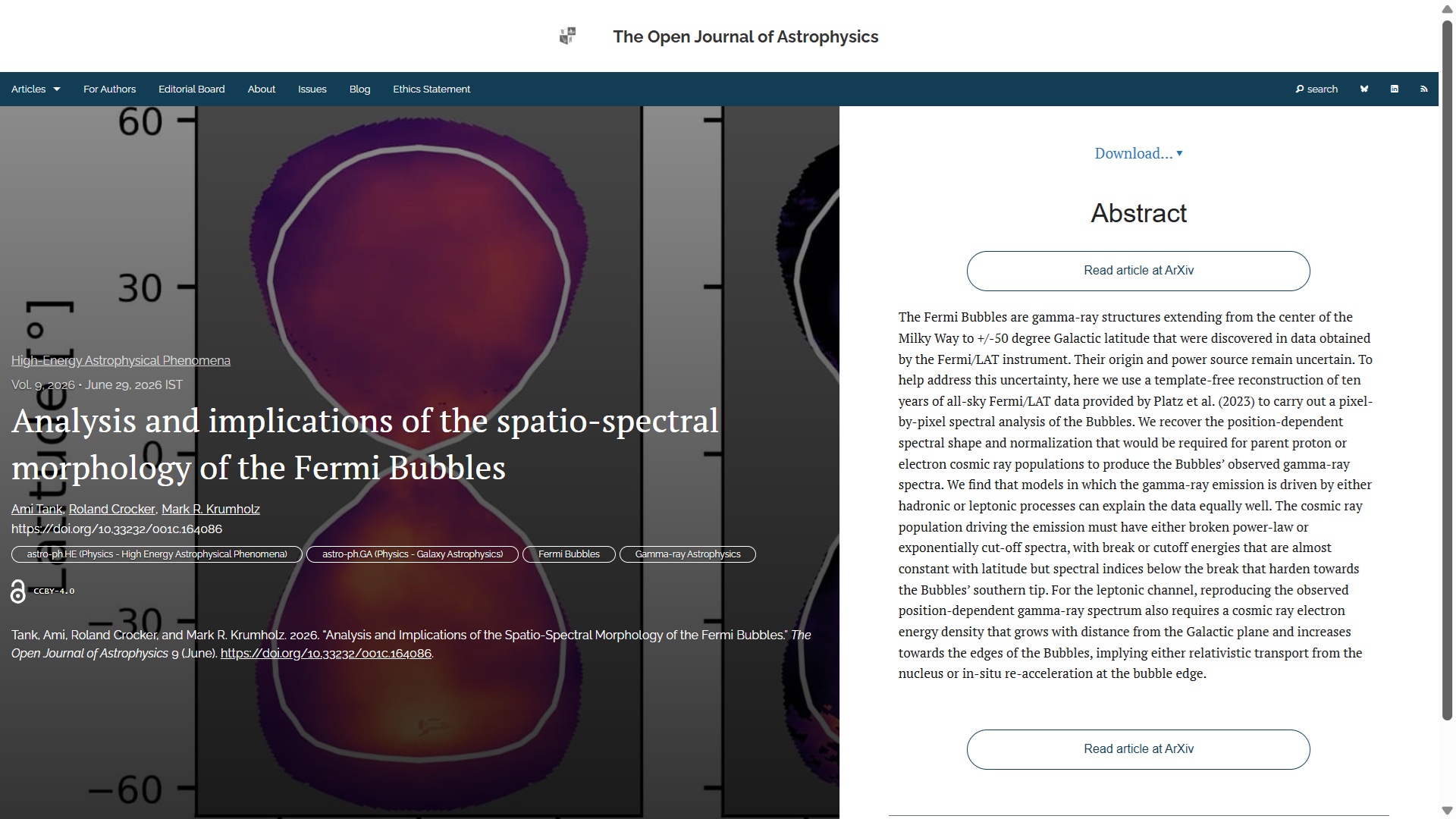
You can find the officially accepted version on arXiv here and the announcement on Fediverse here:

The second paper for this week, also published on Monday 29th June, but in the folder Cosmology and Nongalactic Astrophysics, is “A first measurement of baryonic feedback with Fast Radio Bursts” by Robert Reischke (Universität Bonn, Germany) and Steffen Hagstotz (Ludwig-Maximilians Universität München, Germany). This paper argues that Fast Radio Bursts (FRBs) provide a new method to trace baryon distribution and feedback in the cosmos, offering insights into matter distribution and rejecting no-feedback scenarios with high confidence.
The overlay looks like this:
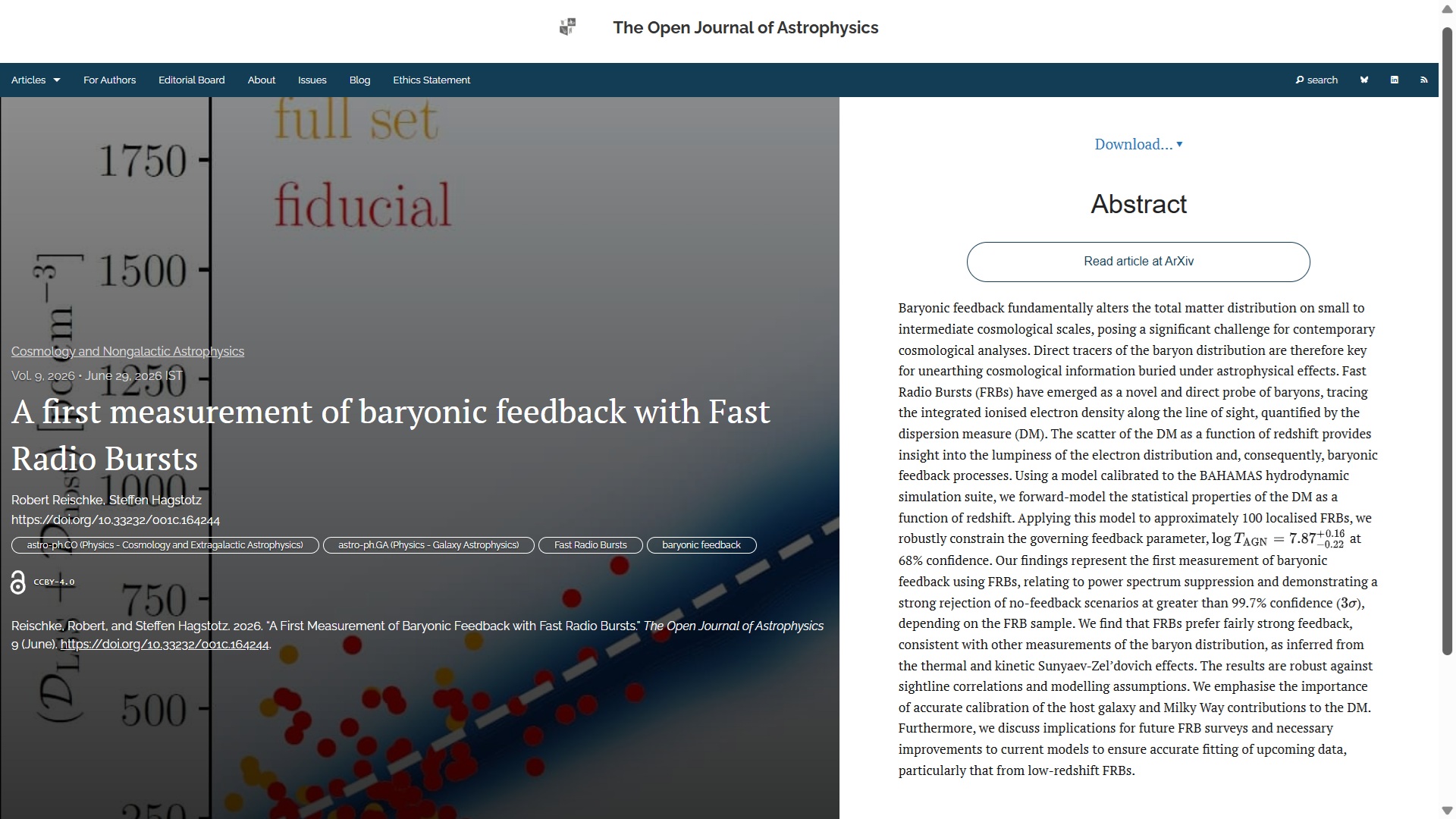
The official version of the paper can be found on arXiv here and the Fediverse announcement here:
The third paper of the week, published on Tuesday 30th June in the folder High-Energy Astrophysical Phenomena, is “Idealized Global Models of Accretion Disks with Strong Toroidal Magnetic Fields” by Minghao Guo & Eliot Quataert (Princeton U., USA), Jonathan Squire (U. Otago, NZ), Philip F. Hopkins (Caltech, USA) and James M. Stone (Princeton). This study uses global magnetohydrodynamic simulations to explore the behavior of idealized accretion disks with strong toroidal magnetic fields, finding that these systems maintain a moderately strong mean azimuthal field.
The overlay for this one is here:
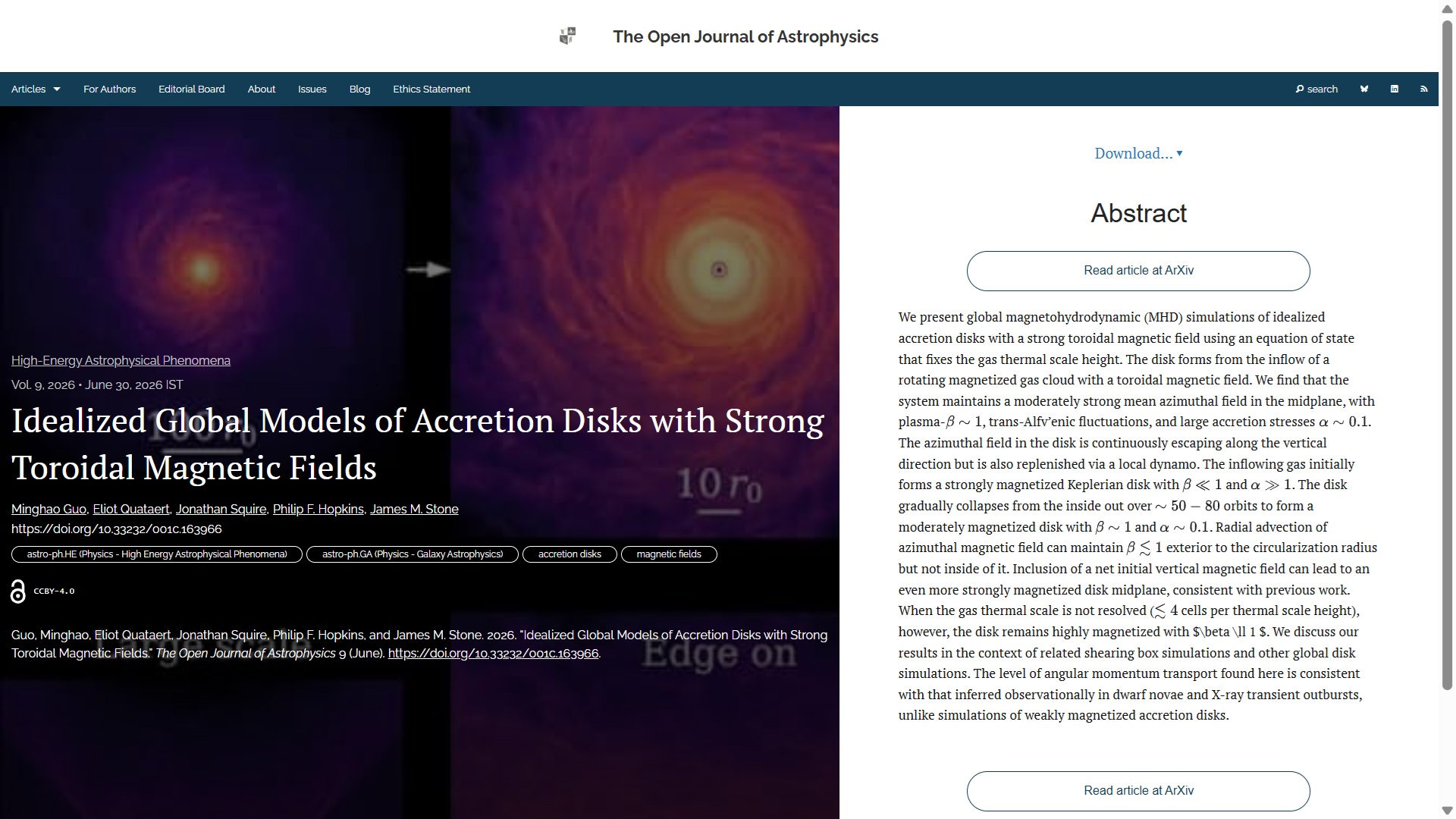
The final, accepted version can be found on arXiv here and the Mastodon announcement is here:
The fourth paper of the week, published on Tuesday 30th June in the folder High-Energy Astrophysical Phenomena, is “On the effective spin-mass ratio relation of binary black hole mergers that evolved in isolation” by Sambaran Banerjee (Helmholtz-Instituts für Strahlen und Kernphysik, Germany) and Aleksandra Olejak (MPA Garching, Germany). This study explores mechanisms of binary black hole mergers and finds that certain spin and mass ratio trends can be naturally explained by isolated binary evolution. The overlay for this one is here:
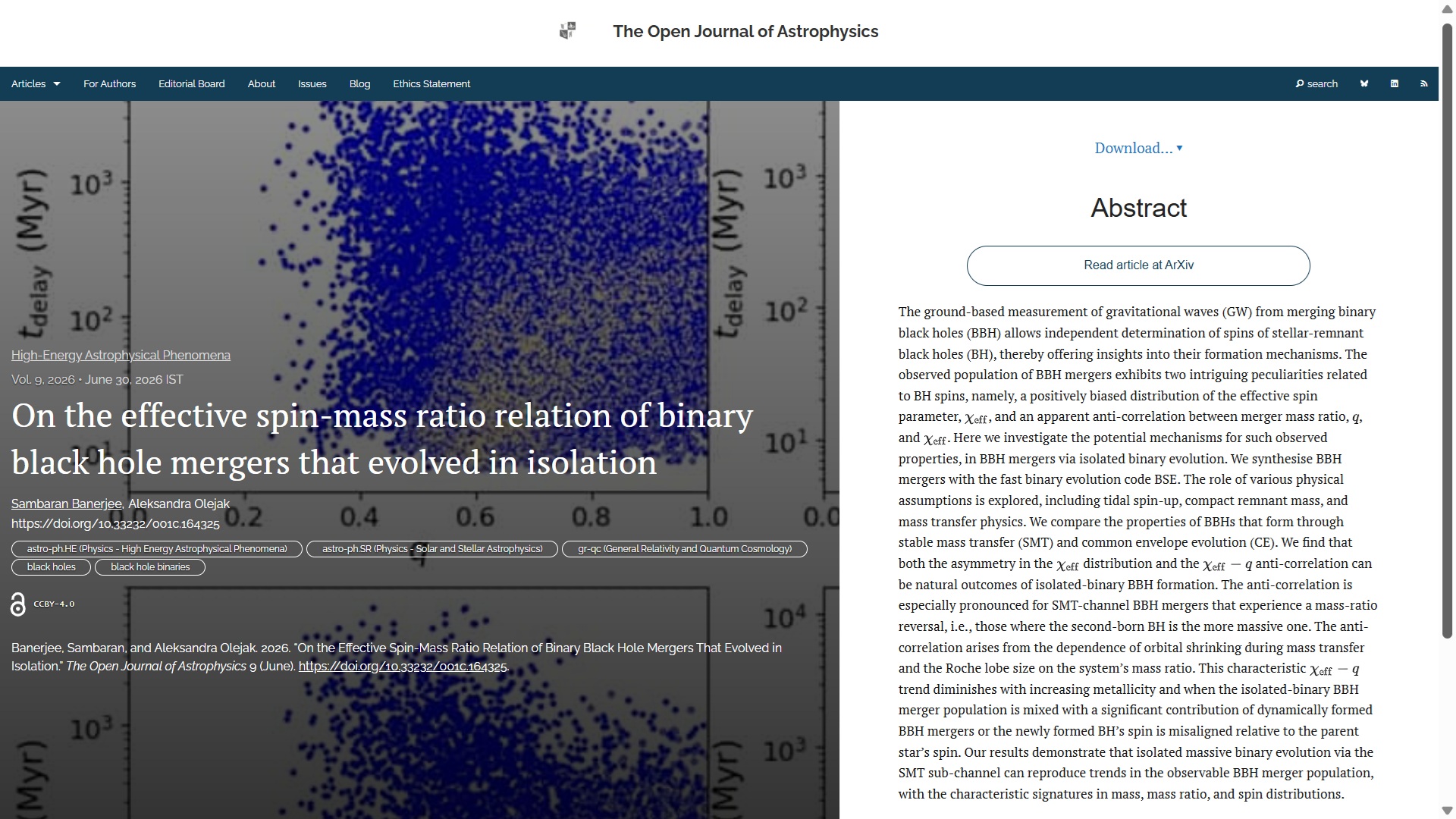
You can read the final version of this one on arXiv here and the Mastodon announcement is here:
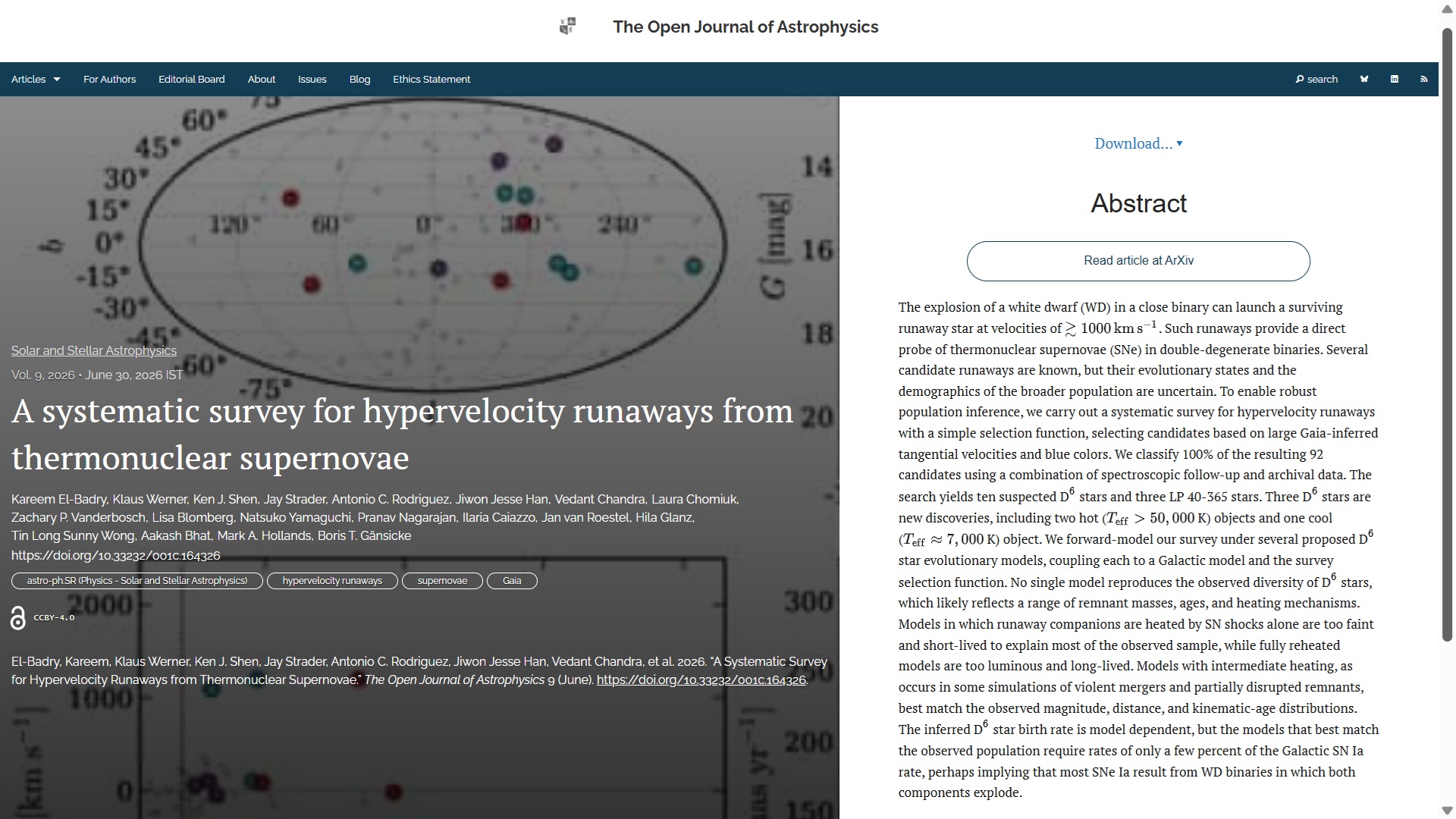
The fifth paper of the week, also published on Tuesday 30th June but in the folder Solar and Stellar Astrophysics is “A systematic survey for hypervelocity runaways from thermonuclear supernovae” by Kareem El-Badry (Caltech, USA), and 18 others based in the USA, Germany, Austria and the UK. This paper presents a systematic survey of hypervelocity runaways, resulting from white dwarf explosions in binary systems. The findings suggest a diversity of remnant masses, ages, and heating mechanisms, challenging theoretical models.
The overlay for this one is here:
You can read the final version of this one on arXiv here and the Mastodon announcement is here:
The sixth and penultimate paper of this week is “Boris and Exponential Integrators in the Theory of Particles Interacting with Magnetic Turbulence” by Andreas Shalchi (U. Manitoba, Canada). This was published on Wednesday 1st July, in the folder Solar and Stellar Astrophysics (it is posted in the plasma physics section of aXiv but cross-listed in solar and stellar astrophysics). The study compares the Rodrigues and Boris integrators in test-particle simulations of charged particles interacting with magnetic fields, finding both methods yield similar results.
The overlay for this one is here:
You can find the final accepted version on arXiv here and the Mastodon announcement is here:
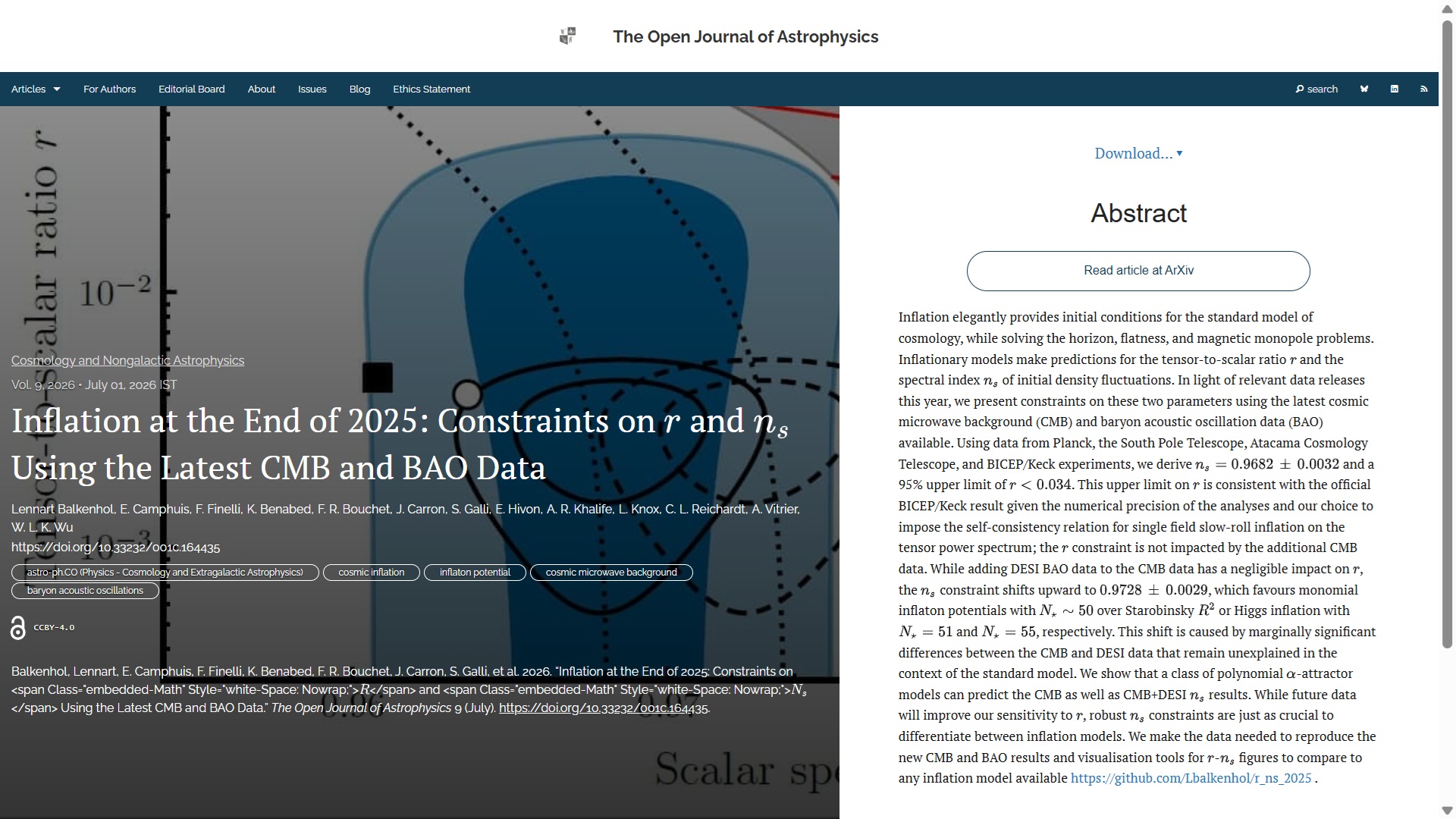
The seventh and final paper for this week is “Inflation at the End of 2025: Constraints on $r$ and $n_S$ using the Latest CMB and BAO Data” by Lennart Balkenhol (Institut d’Astrophysique de Paris, France) and 12 others based in France, Italy, Switzerland, UK, USA and Australia. This was also published on Wednesday 1st July, in the folder Cosmology and Nongalactic Astrophysics. This study presents constraints on parameters of inflationary models in cosmology, using the latest cosmic microwave background and baryon acoustic oscillation data. The findings help differentiate between inflation models.
The overlay for this one is here:
You can find the final accepted version of this one on arXiv here and the Mastodon announcement is here:
And that concludes this week’s update. We’re starting to catch up on the backlog generated in June. At just past the halfway point of the year, which is where we are, we’re on 136 papers, which suggests a total around 272 for the year.


