It’s time for another Saturday update of activity at the Open Journal of Astrophysics. Since the last update we have published a further six papers, bringing the number in Volume 9 (2026) to 275 and the total so far published by OJAp up to 723.
I continue to include the posts made on our Mastodon account (on Fediscience); these announcements also contain a clickable form of the DOI for each paper. Our Mastodon account has regular updates and other announcements from OJAp too, including posts from the OJAp blog.
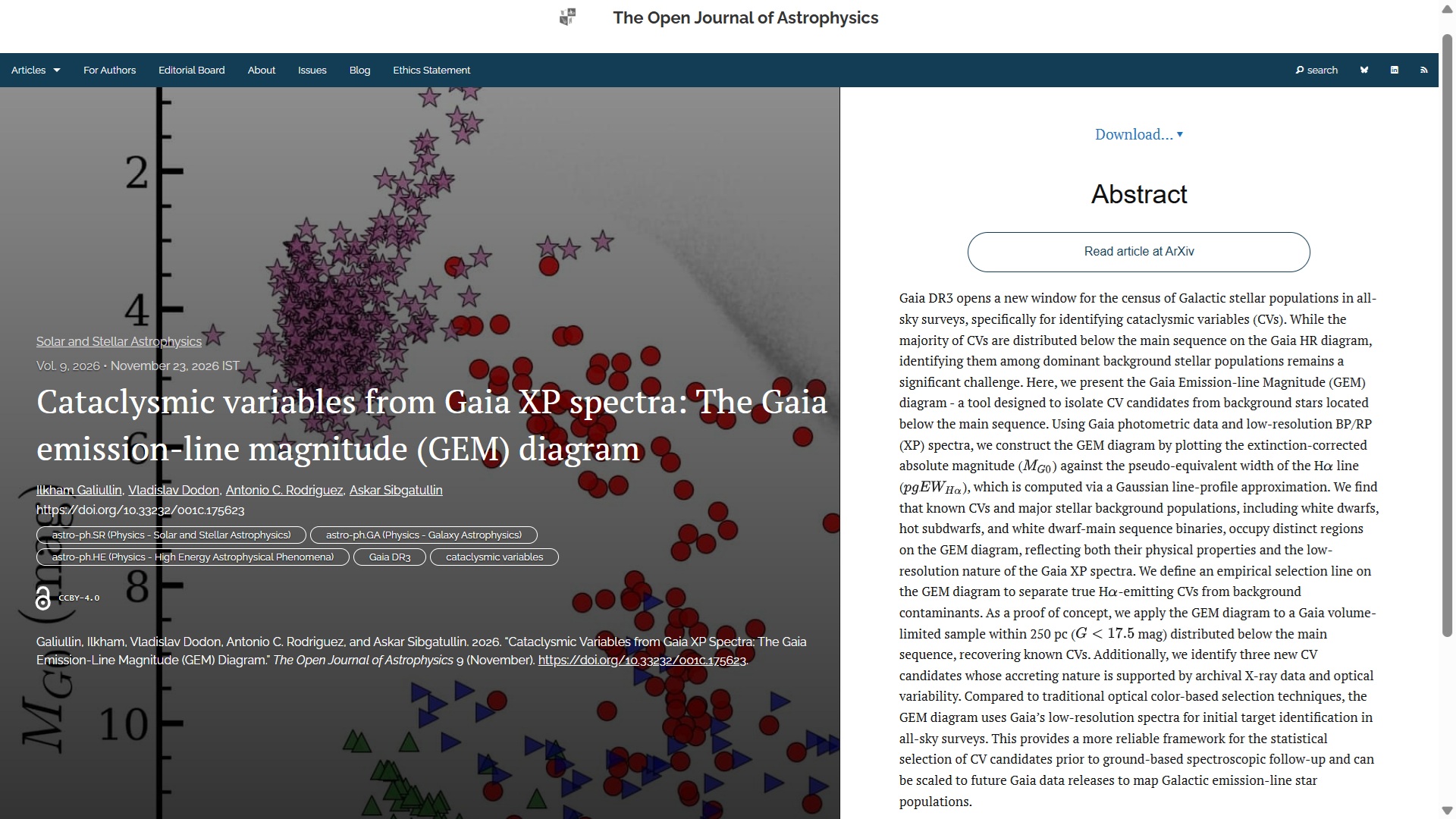
The first paper this week was published on Monday 23rd November in the folder Solar and Stellar Astrophysics. The title is “Cataclysmic variables from Gaia XP spectra: The Gaia emission-line magnitude (GEM) diagram” by Ilkham Galiullin (Kazan Federal U., Russia), Vladislav Dodon (Kazan Federal U.), Antonio C. Rodriguez (Harvard-Smithsonian CfA, USA) and Askar Sibgatullin (Kazan Federal U.). The Gaia Emission-line Magnitude diagram uses Gaia photometry and low-resolution spectra to distinguish cataclysmic variables from stellar contaminants, recovering known systems and identifying three new candidates.
The overlay for this one is here:
You can find the officially accepted version on arXiv here and the announcement on Fediverse here:

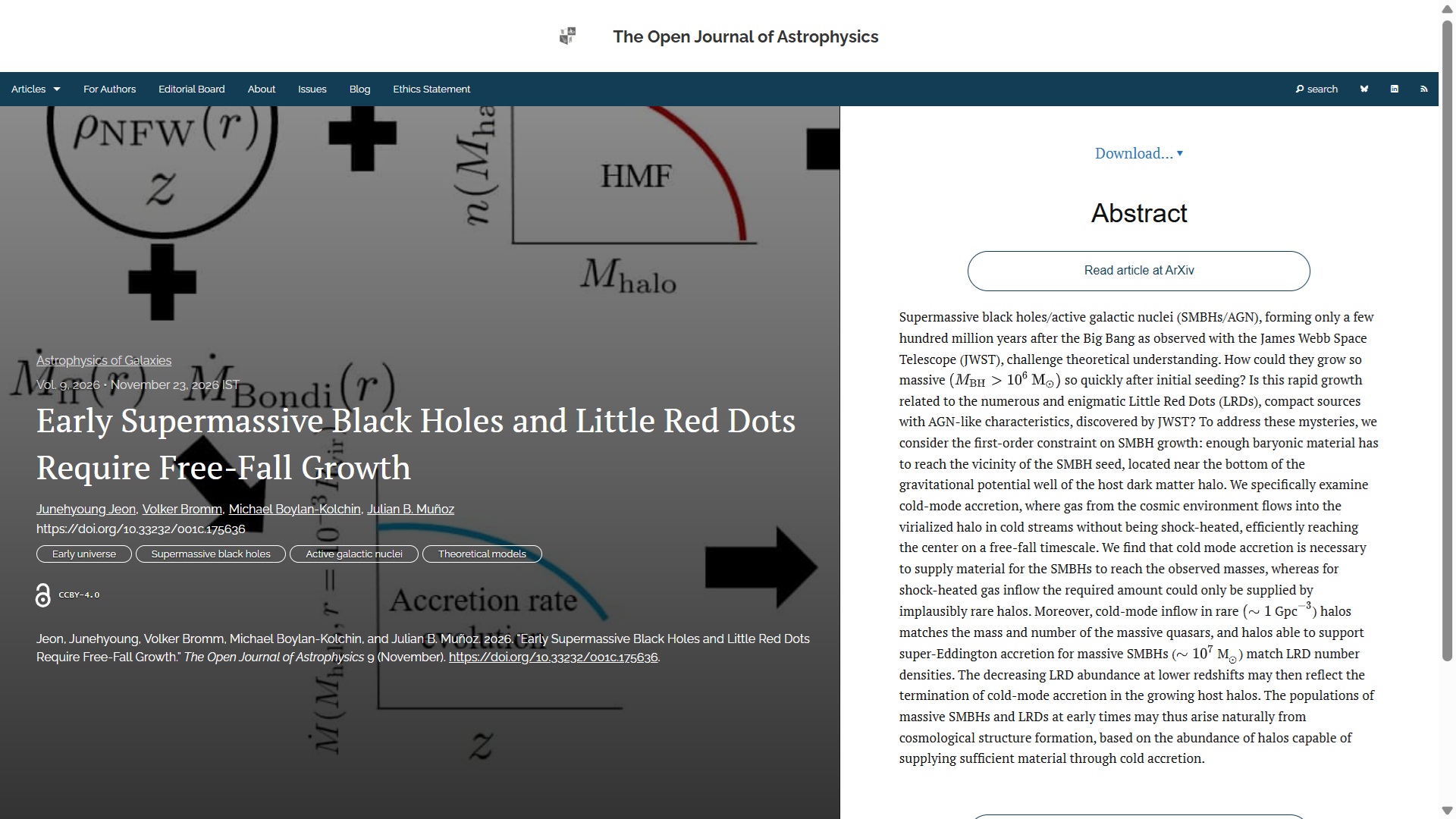
The second paper for this week, also published on Monday 23rd November but in the folder Astrophysics of Galaxies is “Early Supermassive Black Holes and Little Red Dots Require Free-Fall Growth” by Junehyoung Jeon, Volker Bromm, Michael Boylan-Kolchin and Julian B. Muñoz (U. Texas Austin, USA). Cold gas streams may fuel rapid early black-hole growth, explaining the abundance of massive quasars and Little Red Dots; declining cold accretion could account for fewer LRDs at later times.
The overlay looks like this:
The official version of the paper can be found on arXiv here and the Fediverse announcement here:
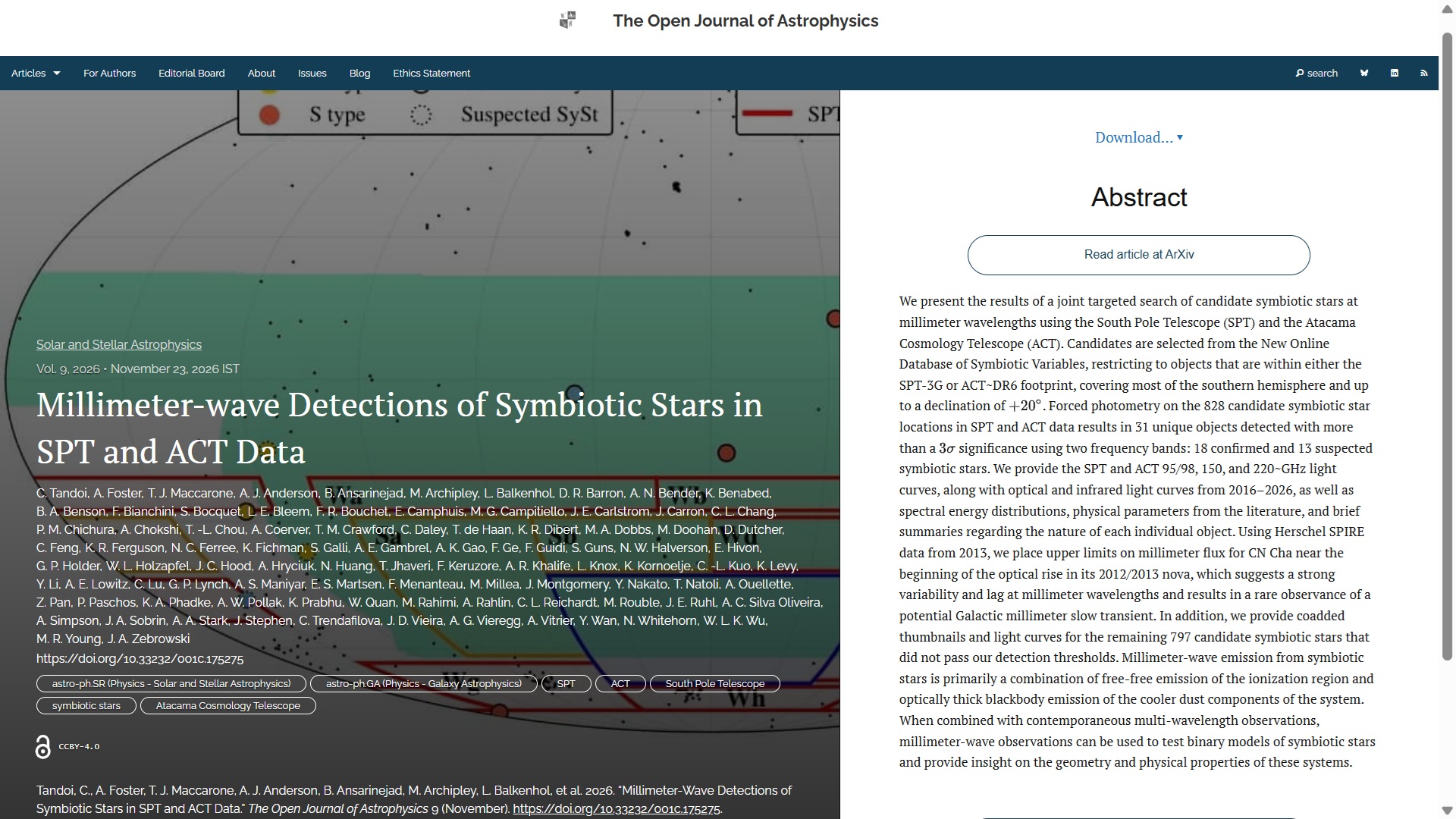
The third paper of the week, also published on Monday 23rd November, in the folder Solar and Stellar Astrophysics, is “Millimeter-wave Detections of Symbiotic Stars in SPT and ACT Data” by C. Tandoi (University of Illinois Urbana-Champaign, USA) and 91 others from around the world. This paper describes a targeted SPT and ACT survey detected millimeter emission from 31 symbiotic-star candidates, providing multiwavelength light curves and data that can probe their physical properties and binary models.
The overlay for this is here:
The accepted version of this one can be found on the arXiv here and the Mastodon announcement here:
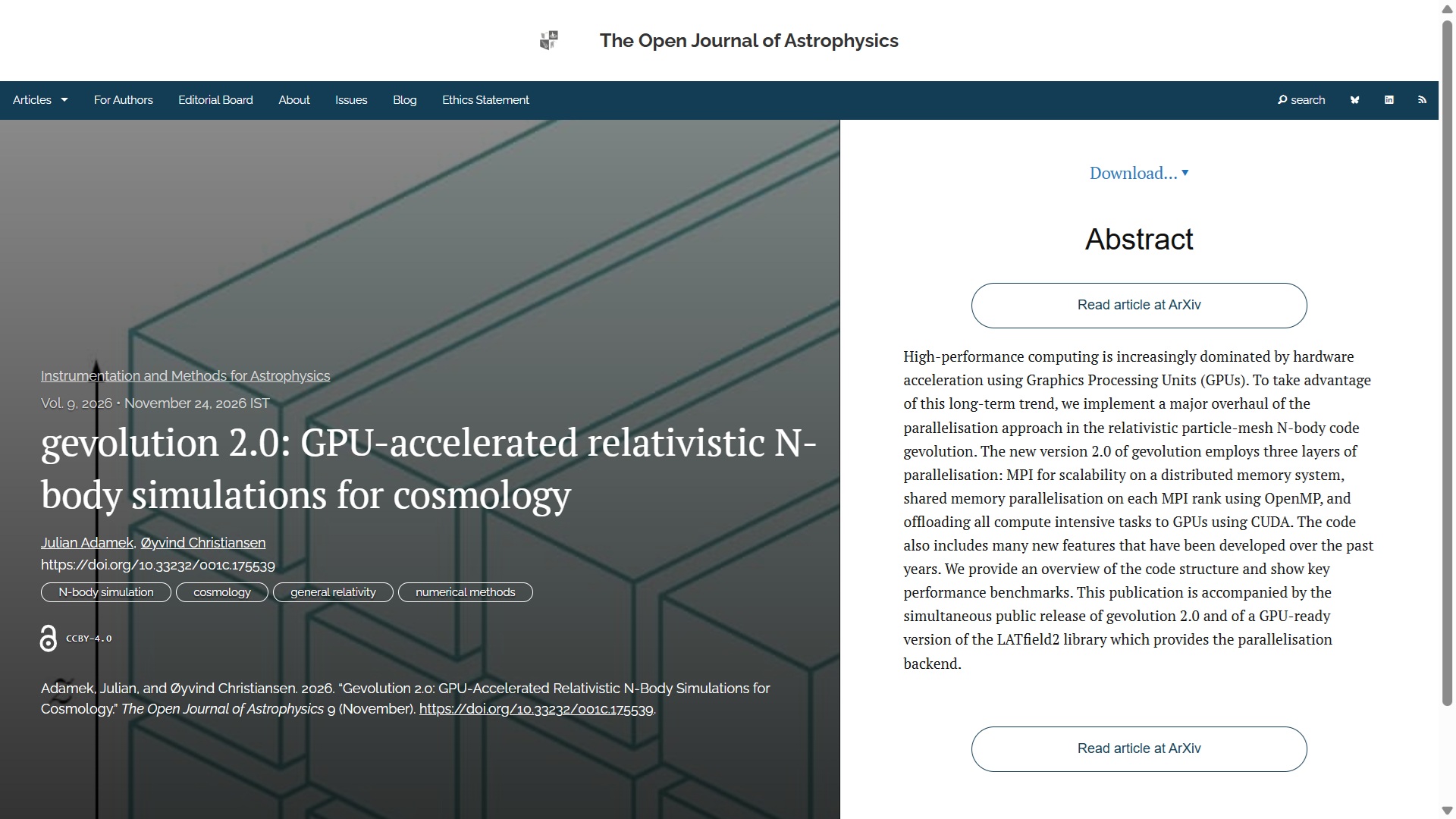
Our fourth paper of the week is “gevolution 2.0: GPU-accelerated relativistic N-body simulations for cosmology” by Julian Adamek (ETH Zürich, Switzerland) and Øyvind Christiansen (Institute of Physics of the Czech Academy of Sciences. Czechia). This was published on Tuesday November 24th in the folder Instrumentation and Methods for Astrophysics (which includes numerical techniques). The code gevolution 2.0 combines MPI, OpenMP, and CUDA to accelerate relativistic particle-mesh simulations, introduces new features, and reports performance benchmarks alongside public releases of the code and GPU-ready LATfield2.
The overlay for this paper is here:
The officially accepted version can be found on arXiv here and the Mastodon announcement is here:
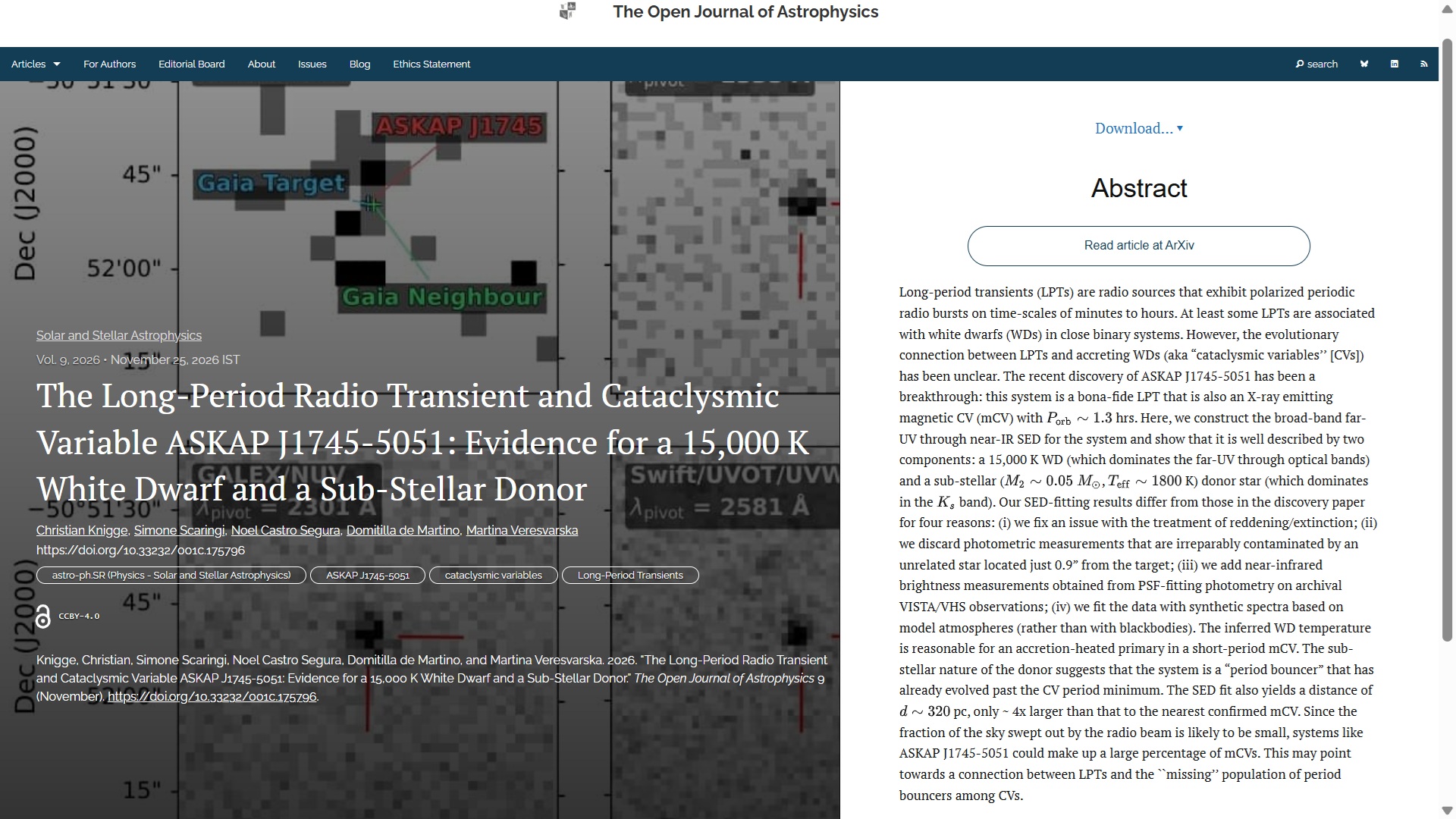
And the fifth paper of this week is “The Long-Period Radio Transient and Cataclysmic Variable ASKAP J1745-5051: Evidence for a 15,000 K White Dwarf and a Sub-Stellar Donor” by Christian Knigge (U. Southampton, UK), Simone Scaringi (U. Durham, UK), Noel Castro Segura (U. Warwick, UK), Domitilla de Martino (Capodimonte Astron. Obs., Italy) and Martina Veresvarska (Institute of Space Sciences, Barcelona, Spain). This was published on Wednesday November 25th November in the folder Solar and Stellar Astrophysics. The article describes how SED modeling of the long-period radio transient ASKAP J1745-5051 identifies a 15,000 K white dwarf and a substellar donor, suggesting an evolved, post-period-minimum cataclysmic variable.
The overlay for this one is here:
The officially accepted version of this paper can be found on arXiv here and the Mastodon announcement is here:
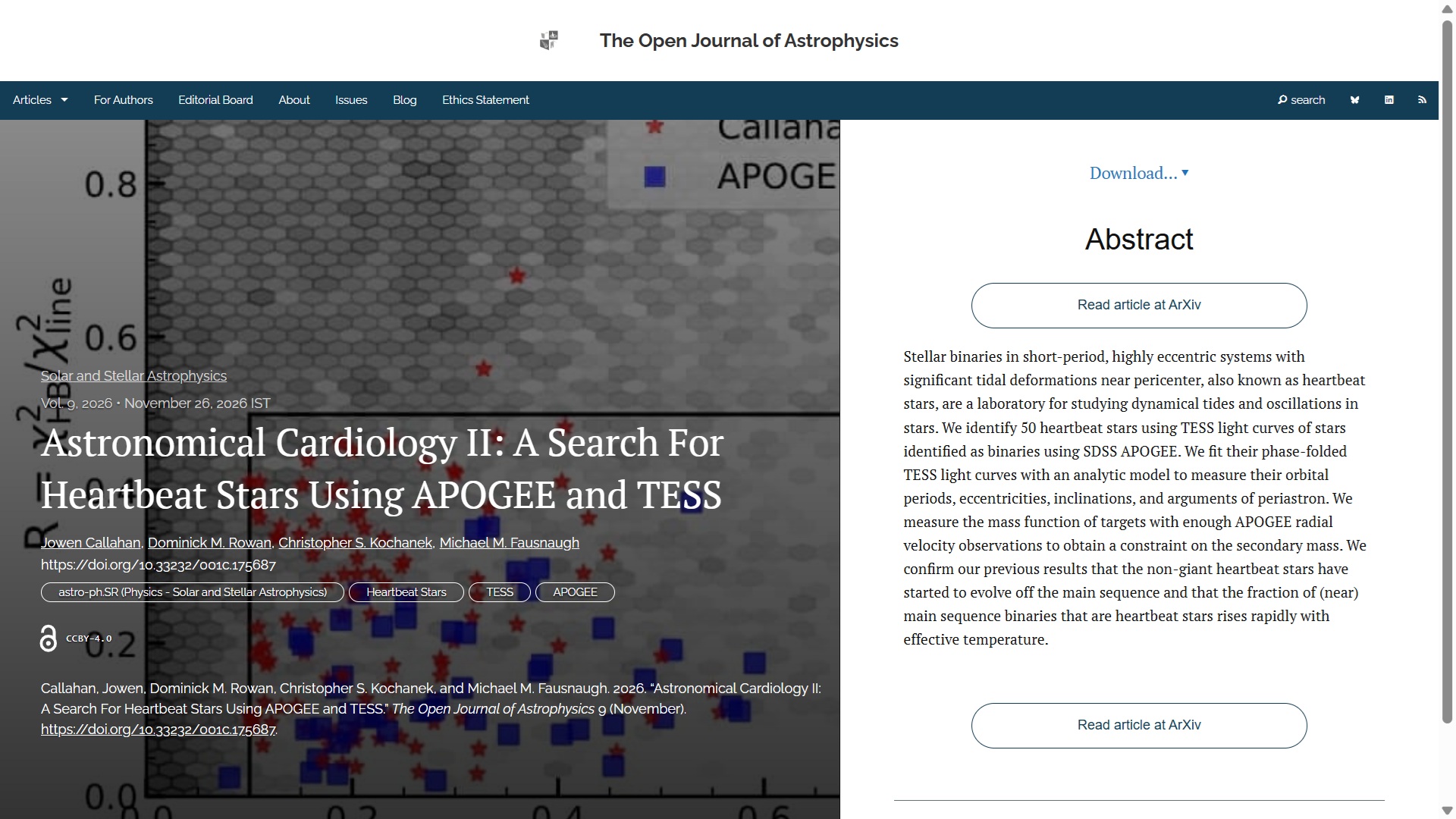
The sixth and final paper for this week is “Astronomical Cardiology II: A Search For Heartbeat Stars Using APOGEE and TESS” by Jowen Callahan (Ohio State U., USA), Dominick M. Rowan & Christopher S. Kochanek (UC Berkeley, USA) and Michael M. Fausnaugh (Texas Tech. U., USA). This was published on Thursday 26th November in the folder Solar and Stellar Astrophysics. Using TESS and APOGEE data, the researchers identify and characterize 50 heartbeat stars, finding that non-giant systems are evolving off the main sequence and hotter binaries are more often heartbeat stars.
The overlay for this one is here:
You can find the officially-accepted version of this one on arXiv here and this is the fediverse announcment:
And that concludes this week’s update. It’s worth mentioning that Thursday 26th November was Thanksgiving in the USA so there was no arXiv update that day so no announcements on Friday. Any papers submitted before Thursday will probably be announced on Monday 30th November. I’ll also remark that four out of this week’s six publications are in Solar and Stellar Astrophysics, continuing the very welcome trend of increasing interest in that part of the astrophysics community.


