Archive for astrometry

Weekly Update from the Open Journal of Astrophysics – 24/05/205

Posted in OJAp Papers, Open Access, The Universe and Stuff with tags , , , , , , , , , , , , , , , , , on May 24, 2025 by telescoper

It’s  time once again for the regular Saturday update of papers published during the past week at the Open Journal of Astrophysics. Since the last update we have published three new papers, which brings the number in Volume 8 (2025) up to 62 and the total so far published by OJAp up to 297.

In chronological order of publication, the three papers published this week, with their overlays, are as follows. You can click on the images of the overlays to make them larger should you wish to do so.

The first paper to report is: “Jet-shaped filamentary ejecta in common envelope evolution” by Ron Schreier, Shlomi Hillel and Noam Soker (Technion, Haifa, Israel). This paper, which was published on Monday May 19th 2025 in the folder High-Energy Astrophysical Processes, presents three-dimensional hydrodynamical simulations of common envelope evolution of a neutron star inside the envelope of a rotating red supergiant with Rayleigh-Taylor instabilities forming filamentary ejecta.

The overlay is here:

You can find the officially accepted version on arXiv here.

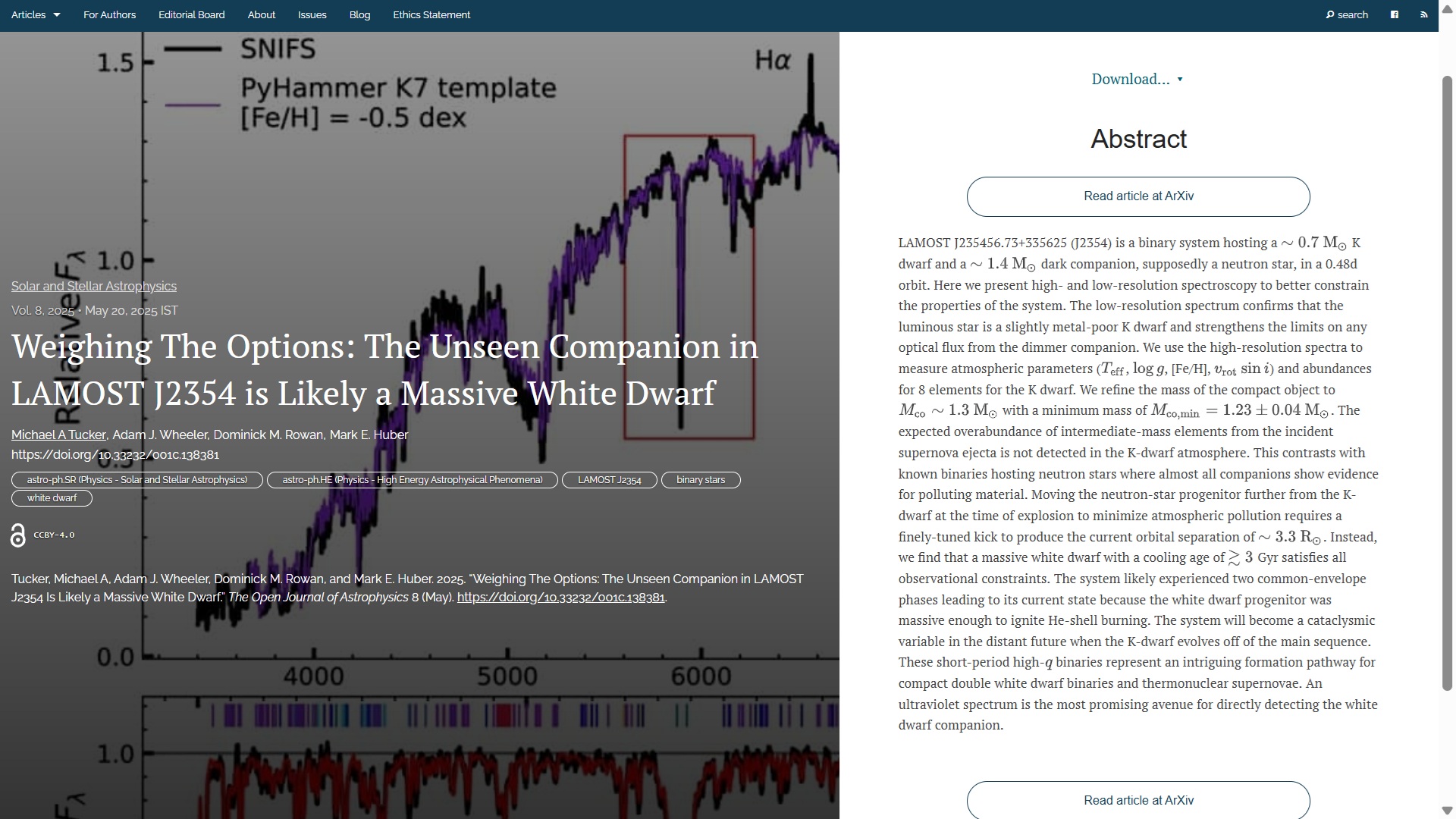
Second one up is “Weighing The Options: The Unseen Companion in LAMOST J2354 is Likely a Massive White Dwarf” by M. A. Tucker, A. J. Wheeler & D. M. Rowan (Ohio State University, USA) and M. E. Huber (U. Hawaii, USA). This paper was published on Tuesday 20th May 2025 in the folder for Solar and Stellar Astrophysics. It discusses a spectroscopic study of the binary system LAMOST J235456.73+335625 (J2354) with a discussion of the implications for the nature of the dark component.

The overlay is here:
 

You can find the officially-accepted version of the paper on arXiv here.

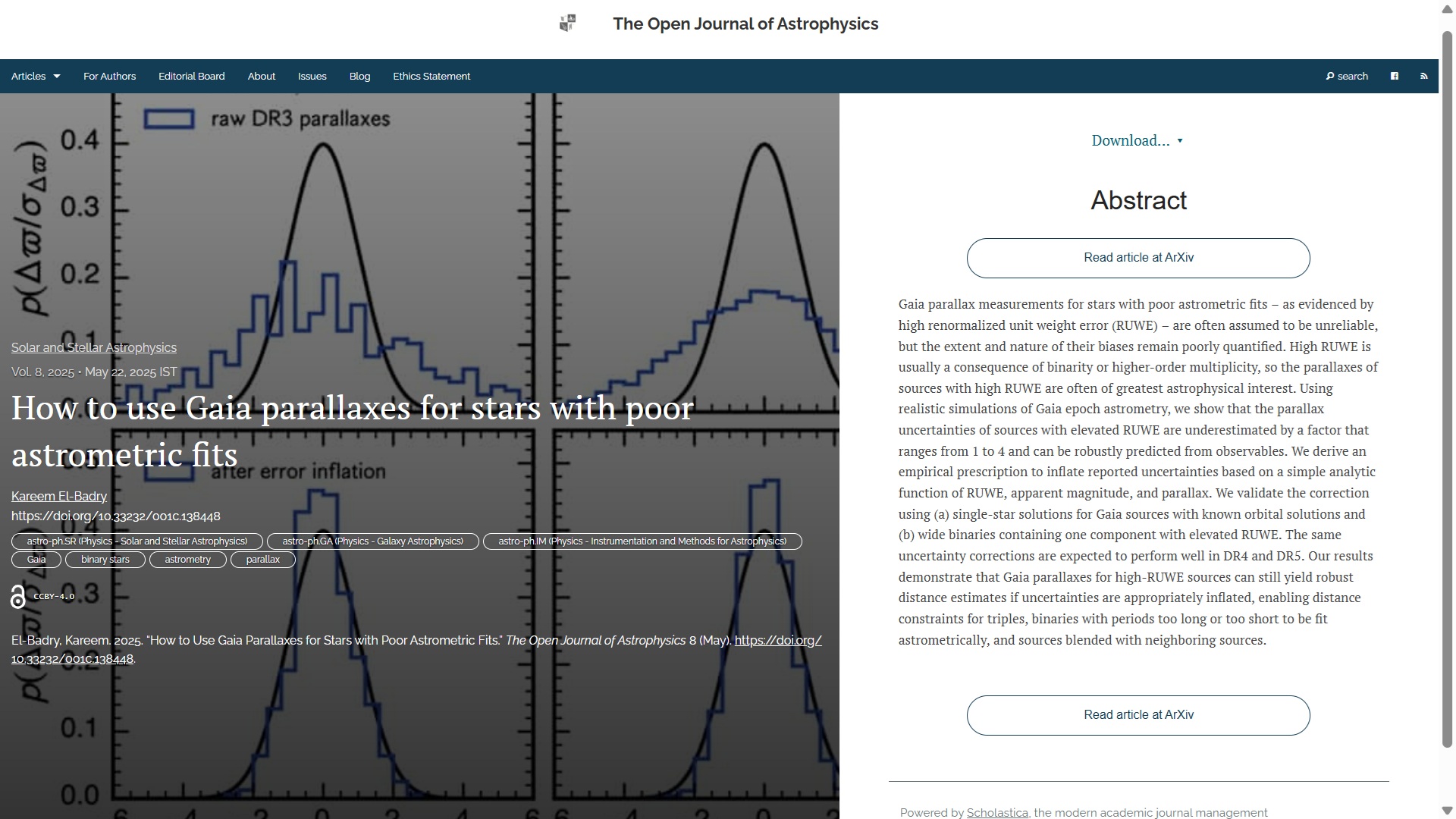
The third and last paper of the week, published on Thursday May 22nd 2025, also in the folder Solar and Stellar Astrophysics, is “How to use Gaia parallaxes for stars with poor astrometric fits” by Kareem El-Badry (Caltech, USA).  This paper presents a method for extracting reasonable estimates of stellar parallaxes from Gaia data when the overall astrometric solution is unreliable due to errors and noise

Here is the overlay:
You can find the officially accepted version of this paper on arXiv here.

That’s all the papers for this week. Looking at the publishing workflow, I expect we will pass the 300 mark next week. We’ll see when I post the next update next Saturday.
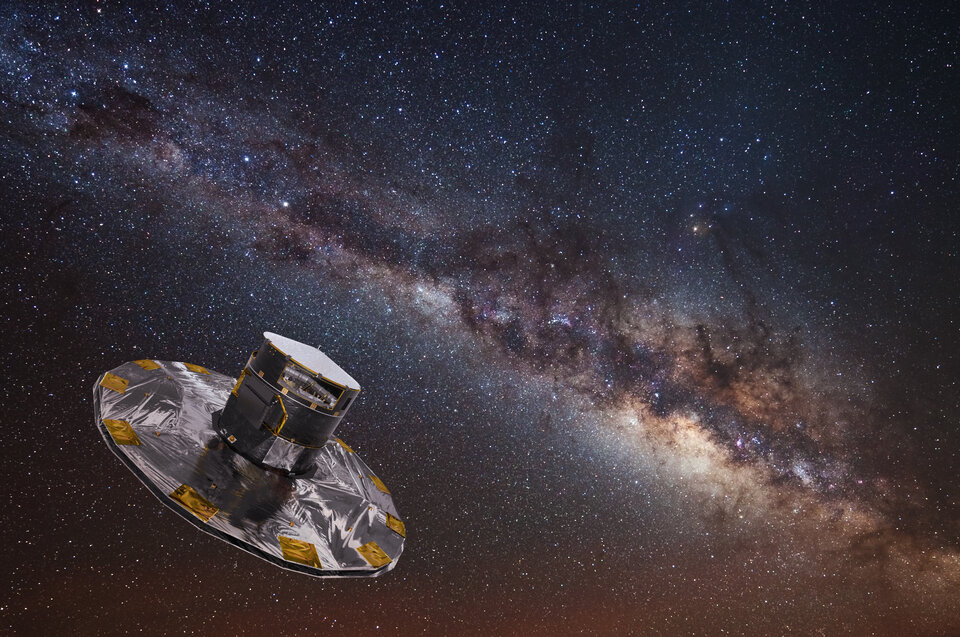
 

Farewell to Gaia

Posted in The Universe and Stuff with tags , , , , on January 15, 2025 by telescoper
Artist impression of ESA’s Gaia satellite observing the Milky Way. The background image of the sky is compiled from data from more than 1.8 billion stars. Spacecraft: ESA/ATG medialab; Milky Way: ESA/Gaia/DPAC. Acknowledgement: A. Moitinho

Today (15th January 2025) marks the end of an era. The European Space Agency’s Gaia spacecraft stops taking data today as it is running out of the gas propellant needed to keep it scanning the sky. The spacecraft was launched on 19 December 2013 so has been operating for just over 11 years.

For those of you not in the know, Gaia is a global space astrometry mission, whose mission was to make the largest, most precise three-dimensional map of our Galaxy by surveying more than a billion stars. Gaia was to monitor each of its target stars about 70 times over a five-year period. Alongside this core mission, it has also discovered hundreds of thousands of new celestial objects, such as extra-solar planets and brown dwarfs, and observed hundreds of thousands of asteroids within our own Solar System.

Gaia is creating an extraordinarily precise three-dimensional map of more than a thousand million stars throughout our Galaxy (The Milky Way) and beyond, mapping their motion, luminosity, temperature and chemical composition as well as any changes in such properties. This huge stellar census will provide the data needed to tackle an enormous range of important problems related to the origin, structure and evolutionary history of our Galaxy. Gaia does this by repeatedly measuring the positions of all objects down to an apparent magnitude of 20. A billion stars is about 1% of the entire stellar population of the Milky Way.

For the brighter objects, i.e. those brighter than magnitude 15, Gaia  measures their positions to an accuracy of 24 microarcseconds, comparable to measuring the diameter of a human hair at a distance of 1000 km. Distances of relatively nearby stars are measured to an accuracy of 0.001%. Even stars near the Galactic Centre, some 30,000 light-years away, have their distances measured to within an accuracy of 20%.

The huge quantity of high-precision data Gaia has produced constitutes a tremendously influential resource for astronomical research. The fourth data release from Gaia, DR4, is in the pipeline for completion soon but the final data release (DR5) will take some years to appear, so this is by no means the last we will hear from Gaia, but the end of observations does close a significant chapter. Its legacy will be immense.

Four New Publications at the Open Journal of Astrophysics

Posted in OJAp Papers, Open Access, The Universe and Stuff with tags , , , , , , , , , , , , , , , , on November 9, 2024 by telescoper

Once again it’s time for a quick update of activity at the Open Journal of Astrophysics. Since the last update a week ago we have published  four papers, which takes the count in Volume 7 (2024) up to 102 and the total published altogether by OJAp up to 217.   This means not only that we have reached a century for the year but also that so far in 2024 we have published more than double the number of papers that we published in all of 2023. I blogged about the significance of the figure 217 here.

In chronological order, the four papers published this week, with their overlays, are as follows. You can click on the images of the overlays to make them larger should you wish to do so.

First one up is “A generative model for Gaia astrometric orbit catalogs: selection functions for binary stars, giant planets, and compact object companions” by Kareem El-Badry (Caltech, USA), Casey Lam (Carnegie Observatories), Berry Holl & Jean-Louis Halbwachs (U. Geneva), Hans-Walter Rix (MPA Heidelberg, Germany), Tsevi Mazeh (Tel Aviv, Israel) and Sahar Shahaf (Weizmann Institute of Science, Israel). This one is in the folder Solar and Stellar Astrophysics. The paper presents a forward method for estimating the selection function (i.e. the probability of a system with a given set of parameters being included in a catalog). It was published on November 4th 2024.

Here is a screen grab of the overlay, which includes the abstract:


You can find the officially accepted version of the paper on the arXiv here.

The second paper to announce, published on 5th November 2024. is “Primordial magnetogenesis in a bouncing model with dark energy” by Marcus V. Bomfim (Rio de Janeiro, Brazil), Emmanuel Frion (Western U. Canada), Nelson Pinto-Neto (Espírito Santo, Brazil), and Sandro D. P. Vitenti (Paraná, Brazil). This paper, in the section on Cosmology and NonGalactic Astrophysics, presents a discussion of the possible generation of magnetic fields on cosmological scales by in a model involving a scalar field coupled to electromagnetism

You can see the overlay here:


The accepted version of this paper can be found on the arXiv here.

The third paper, published on 6th November 2024 in the folder marked Astrophysics of Galaxies, is called  “Evidence for large scale compressible turbulence in the ISM of CSWA13, a star-Forming Lensed Galaxy at z = 1.87 with outflowing wind” by Itzhak Goldman (Tel Aviv, Israel). It presents a statistical analysis of the spatial distribution and kinematics of nebular gas with discussion of the nature of the turbulence present.

Here is the overlay


The final version accepted on arXiv is here.

Last in this batch is “Star formation in the high-extinction Planck cold clump PGCC G120.69+2.66” by Anlaug Amanda Djupvik (Aarhus, Denmark), João L. Yun (Lisbon, Portugal), and Fernando Comerón (ESO, Garching, Germany). It was published on 7th November 2024 in the folder marked Astrophysics of Galaxies. The paper uses imaging and spectroscopy  information to identify sites of star formation in a molecular cloud. This is the overlay:

You can find the official accepted version on the arXiv here.

That’s all for now. I will post another update in a week.

Gaia’s Second Data Release!

Posted in The Universe and Stuff with tags , , , on April 26, 2018 by telescoper

It seems like only yesterday that I was blogging excitedly about the first release of data (DR1) from the European Space Agency’s Gaia Mission. In fact it was way back in 2016! Anyway, yesterday came another glut of Gaia goodness in the form of the second release of data, known to its friends as DR2.

In case you weren’t aware, Gaia is an ambitious space mission to chart a three-dimensional map of our Galaxy, the Milky Way, in the process revealing the composition, formation and evolution of the Galaxy. Gaia will provide unprecedented positional and radial velocity measurements with the accuracy needed to produce a stereoscopic and kinematic census of about one billion stars in our Galaxy and throughout the Local Group. This amounts to about 1 per cent of the Galactic stellar population.

You can find links to all the DR2 science papers here, a guide to how to use the data here, and of course a link to the full Gaia Archive here.

Here’s a (brief!) list of the contents of DR2:

  • The five-parameter astrometric solution – positions on the sky (α, δ), parallaxes, and proper motions – for more than 1.3 billion (109) sources, with a limiting magnitude of G = 21 and a bright limit of G ≈ 3. Parallax uncertainties are in the range of up to 0.04 milliarcsecond for sources at G < 15, around 0.1 mas for sources with G=17 and at the faint end, the uncertainty is of the order of 0.7 mas at G = 20. The corresponding uncertainties in the respective proper motion components are up to 0.06 mas yr-1 (for G < 15 mag), 0.2 mas yr-1 (for G = 17 mag) and 1.2 mas yr-1 (for G = 20 mag). The Gaia DR2 parallaxes and proper motions are based only on Gaia data; they do no longer depend on the Tycho-2 Catalogue.
  • Median radial velocities (i.e. the median value over the epochs) for more than 7.2 million stars with a mean G magnitude between about 4 and 13 and an effective temperature (Teff) in the range of about 3550 to 6900 K. This leads to a full six-parameter solution: positions and motions on the sky with parallaxes and radial velocities, all combined with mean G magnitudes. The overall precision of the radial velocities at the bright end is in the order of 200-300 m s-1 while at the faint end the overall precision is approximately 1.2 km s-1 for a Teff of 4750 K and about 2.5 km s-1 for a Teff of 6500 K.
  • An additional set of more than 361 million sources for which a two-parameter solution is available: the positions on the sky (α, δ) combined with the mean G magnitude. These sources have a positional uncertainty at G=20 of about 2 mas, at J2015.5.
    G magnitudes for more than 1.69 billion sources, with precisions varying from around 1 milli-mag at the bright (G<13) end to around 20 milli-mag at G=20. Please be aware that the photometric system for the G band in Gaia DR2 is different from the photometric system as used in Gaia DR1.
  • GBP and GRP magnitudes for more than 1.38 billion sources, with precisions varying from a few milli-mag at the bright (G<13) end to around 200 milli-mag at G=20.
  • Full passband definitions for G, BP and RP. These passbands are now available for download.
  • Epoch astrometry for 14,099 known solar system objects based on more than 1.5 million CCD observations. 96% of the along-scan (AL) residuals are in the range -5 to 5 mas, and 52% of the AL residuals are in the range of -1 to 1 mas. The transit observations are part of Gaia DR2 and have also been delivered to the Minor Planet Center (MPC).
  • Subject to limitations (see below) the effective temperatures Teff for more than 161 million sources brighter than 17th magnitude with effective temperatures in the range 3000 to 10,000 K. For a subset of about 87 million sources also the line-of-sight extinction AG and reddening E(BP-RP) are given and for a part of this subset (around 76 million sources) the luminosity and radius are available as well.
  • Classifications for more than 550,000 variable sources consisting of Cepheids, RR Lyrae, Mira and Semi-Regular Candidates as well as High-Amplitude Delta Scuti, BY Draconis candidates, SX Phoenicis Candidates and short time scale phenomena.
  • Planned cross-matches between Gaia DR2 sources on the one hand and Hipparcos-2, Tycho-2, 2MASS PSC, SDSS DR9, Pan-STARRS1, GSC2.3, PPM-XL, AllWISE, and URAT-1 data on the other hand.

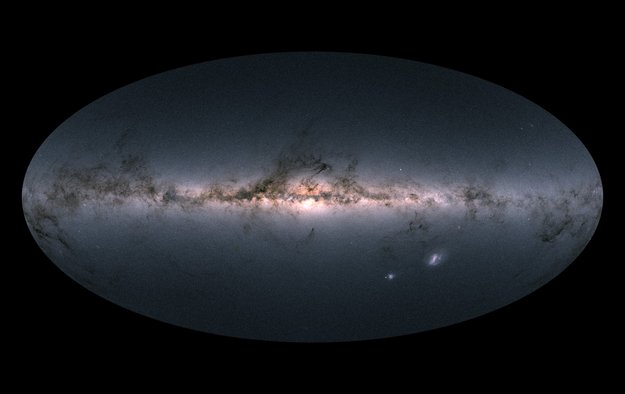
There’s much more to Gaia than pictures, but here’s a map of the stars in our galaxy to give you an idea:

I remember first hearing about Gaia about 17 years ago when I was on a PPARC advisory panel and was immediately amazed  by the ambition of its objectives. As I mentioned above, Gaia is a global space astrometry mission, which will make the largest, most precise three-dimensional map of our Galaxy by surveying more than a billion stars. In some sense Gaia is the descendant of the Hipparcos mission launched in 1989, but it’s very much more than that. Gaia monitors each of its target stars about 70 times over a five-year period. It is expected to discover hundreds of thousands of new celestial objects, such as extra-solar planets and brown dwarfs, and observe hundreds of thousands of asteroids within our own Solar System. The mission is also expected to yield a wide variety of other benefits, including new tests of the  General Theory of Relativity.

For the brighter objects, i.e. those brighter than magnitude 15, Gaia  measures their positions to an accuracy of 24 microarcseconds, comparable to measuring the diameter of a human hair at a distance of 1000 km. Distances of relatively nearby stars are measured to an accuracy of 0.001%. Even stars near the Galactic Centre, some 30,000 light-years away, have their distances measured to within an accuracy of 20%.

It’s an astonishing mission that will leave an unbelievably rich legacy not only for the astronomers working on the front-line operations of Gaia but for generations to come.

Gaia’s First Data Release!

Posted in The Universe and Stuff with tags , , , on September 14, 2016 by telescoper

It seems like only yesterday that I was blogging excitedly about the imminent launch of the European Space Agency’s Gaia Mission. In fact it was almost three years ago – 1000 days to be precise – and today the world of astronomy is a-flutter with excitement because we’ve just seen the first release of data from the mission. You can find an overview with links to all the yummy data here. I can’t resist pointing out the adoption of a rigorously Bayesian method for dealing with partial or incomplete data when a full astrometric solution is not possible due to insufficient observations. If you want to go straight to the data archive you go here or you could try one of the other data centres listed here. It’s great that all this data is being made freely available, but this is only the first set of data. It’s just a hint of what the mission overall will achieve.

If you would prefer some less technical background to the mission have a look here.

Here’s a summary (courtesy of ESA) of what Gaia has achieved so far:

cstyyenwgaa7fa

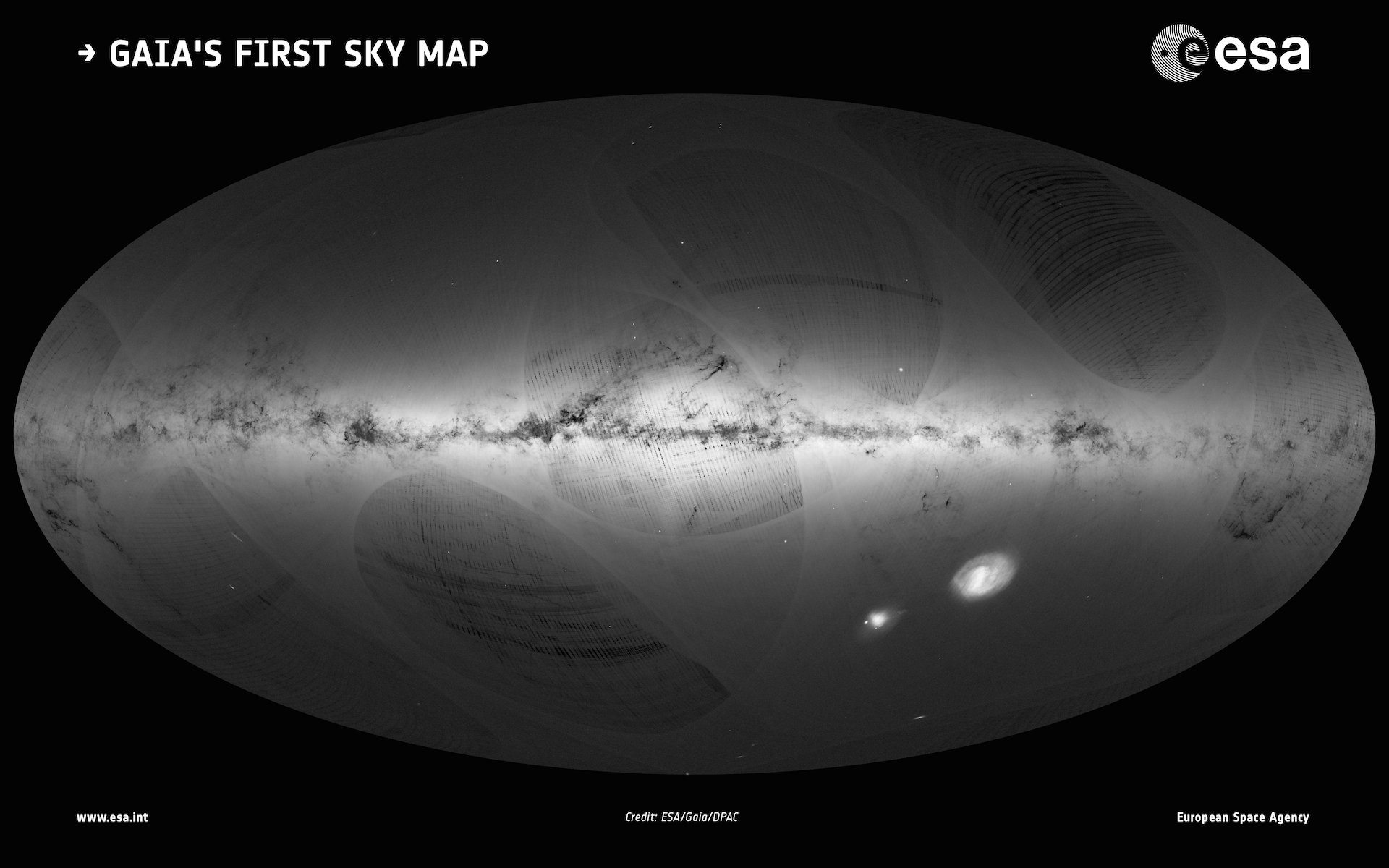
There’s much more to Gaia than pictures, but here’s the first map of the sky  it produced:

cstpe32weaeiwmw

I remember first hearing about Gaia about 15 years ago when I was on a PPARC advisory panel and was immediately amazed  by the ambition of its objectives. As I mentioned above, Gaia is a global space astrometry mission, which will make the largest, most precise three-dimensional map of our Galaxy by surveying more than a billion stars; DR1 is really just a taster as the measurements will become more complete and more accurate as the mission continues.

In some sense Gaia is the descendant of the Hipparcos mission launched in 1989, but it’s very much more than that. Gaia monitors each of its target stars about 70 times over a five-year period. It is expected to discover hundreds of thousands of new celestial objects, such as extra-solar planets and brown dwarfs, and observe hundreds of thousands of asteroids within our own Solar System. The mission is also expected to yield a wide variety of other benefits, including new tests of the  General Theory of Relativity.

Gaia will created an extraordinarily precise three-dimensional map of more than a thousand million stars throughout our Galaxy (The Milky Way) and beyond, mapping their motion, luminosity, temperature and chemical composition as well as any changes in such properties. This huge stellar census will provide the data needed to tackle an enormous range of important problems related to the origin, structure and evolutionary history of our Galaxy. Gaia will do all this by repeatedly measuring the positions of all objects down to an apparent magnitude of 20. A billion stars is about 1% of the entire stellar population of the Milky Way.

For the brighter objects, i.e. those brighter than magnitude 15, Gaia  measures their positions to an accuracy of 24 microarcseconds, comparable to measuring the diameter of a human hair at a distance of 1000 km. Distances of relatively nearby stars are measured to an accuracy of 0.001%. Even stars near the Galactic Centre, some 30,000 light-years away, have their distances measured to within an accuracy of 20%.

It’s an astonishing mission that will leave an unbelievably rich legacy not only for the astronomers working on the front-line operations of Gaia but for generations to come.


Countdown to GAIA

Posted in The Universe and Stuff with tags , , , on December 18, 2013 by telescoper

Just a quick post to point out that tomorrow morning at 9.12am GMT will see the launch of the European Space Agency’s Gaia mission.  You can watch the launch live here from about 8.50 GMT. I’ll be in a meeting at 9am tomorrow morning, so I’m probably going to miss it.

Gaia arrives on the Launchpad at Kourou, French Guyana, on 13th December

Gaia arrives on the Launchpad at Kourou, French Guyana, on 13th December

I remember first hearing about Gaia about 15 years ago when I was on a PPARC advisory panel and was simultaneously amazed  by the ambition of its objectives and sceptical that it would ever get off the ground. Now its almost ready to go, so fingers crossed for a successful launch tomorrow.

Coincidentally, Gaia is among the various telescopes and observatories featured in the STFC Roadshow we put on  viewfor an Astronomy Master Class we have been putting on for local schools over the last couple of days here at the University of Sussex:

IMG-20131218-00248

Gaia is a global space astrometry mission, which will make the largest, most precise three-dimensional map of our Galaxy by surveying more than a thousand million stars. In some sense it is the descendant of the Hipparcos mission launched in 1989, but it’s very much more than that. Gaia will monitor each of its target stars about 70 times over a five-year period. It is expected to discover hundreds of thousands of new celestial objects, such as extra-solar planets and brown dwarfs, and observe hundreds of thousands of asteroids within our own Solar System. The mission is also expected to yield a wide variety of other benefits, including new tests of the  General Theory of Relativity.

Gaia will create an extraordinarily precise three-dimensional map of more than a thousand million stars throughout our Galaxy (The Milky Way) and beyond, mapping their motion, luminosity, temperature and chemical composition as well as any changes in such properties. This huge stellar census will provide the data needed to tackle an enormous range of important problems related to the origin, structure and evolutionary history of our Galaxy. Gaia will do all this by repeatedly measuring the positions of all objects down to an apparent magnitude of 20. A thousand million stars is about 1% of the entire stellar population of the Milky Way.

For the brighter objects, i.e. those brighter than magnitude 15, Gaia will measure their positions to an accuracy of 24 microarcseconds, comparable to measuring the diameter of a human hair at a distance of 1000 km. Distances of relatively nearby stars will be measured to an accuracy of 0.001%. Even stars near the Galactic Centre, some 30 000 light-years away, will have their distances measured to within an accuracy of 20%.

It’s an astonishing mission that will leave an unbelievably rich legacy not only for the astronomers working on the front-line operations of Gaia but for generations to come. I have a feeling that there might be  a few sleepless nights tonight waiting for the launch, but I suppose astronomers should be used to that!

UPDATE: 19/12/2013 Success! Launch went smoothly, separation of the Gaia spacecraft achieved. Now we have to wait for a month or so for it to get to L2, settle itself down, and then start doing science. The first data release isn’t due for 22 months…Bon Voyage!