Anyways, while I’m thinking STFC stuff let me put my community service hat on and remind astronomers that the Astronomy Advisory Panel (yes, there is one) is consulting, and the deadline for folks to fill in the consultation questionnaire is tomorrow (Wednesday 5th September 2012). Please upload your input forthwith.
As a prompt, you might like to have a look at this figure that shows the breakdown of STFC expenditure generally, and specifically within the astronomy programme.
Do these pie charts provide you with food for thought?
Since the new series of Doctor Who is to start this evening on BBC1, I thought I’d mark the occasion by posting this old blog item again:
–0–
As a Professor of Astrophysics I am often asked “Why on Earth did you take up such a crazy subject?”
I guess many astronomers, physicists and other scientists have to answer this sort of question. For many of them there is probably a romantic reason, such as seeing the rings of Saturn or the majesty of the Milky Way on a dark night. Others will probably have been inspired by TV documentary series such as The Sky at Night, Carl Sagan’s Cosmos or even Horizon which, believe it or not, actually used to be quite good but which is nowadays uniformly dire. Or it could have been something a bit more mundane but no less stimulating such as a very good science teacher at school.
When I’m asked this question I’d love to be able to put my hand on my heart and give an answer of that sort but the truth is really quite a long way from those possibilities. The thing that probably did more than anything else to get me interested in science was a Science Fiction TV series or rather not exactly the series but the opening titles.
The first episode of Doctor Who was broadcast in the year of my birth, so I don’t remember it at all, but I do remember the astonishing effect the credits had on my imagination when I saw later episodes as a small child. Here is the opening title sequence as it appeared in the very first series featuring William Hartnell as the first Doctor.
To a younger audience it probably all seems quite tame, but I think there’s a haunting, unearthly beauty to the shapes conjured up by Bernard Lodge. Having virtually no budget for graphics, he experimented in a darkened studio with an old-fashioned TV camera and a piece of black card with Doctor Who written on it in white. He created the spooky kaleidoscopic patterns you see by simply pointing the camera so it could see into its own monitor, thus producing a sort of electronic hall of mirrors.
What is so fascinating to me is how a relatively simple underlying concept could produce a rich assortment of patterns, particularly how they seem to take on an almost organic aspect as they merge and transform. I’ve continued to be struck by the idea that complexity could be produced by relatively simple natural laws which is one of the essential features of astrophysics and cosmology. As a practical demonstration of the universality of physics this sequence takes some beating.
As well as these strange and wonderful images, the titles also featured a pioneering piece of electronic music. Officially the composer was Ron Grainer, but he wasn’t very interested in the commission and simply scribbled the theme down and left it to the BBC to turn it into something useable. In stepped the wonderful Delia Derbyshire, unsung heroine of the BBC Radiophonic Workshop who, with only the crudest electronic equipment available, turned it into a little masterpiece. Ethereal yet propulsive, the original theme from Doctor Who is definitely one of my absolute favourite pieces of music and I’m glad to see that Delia Derbyshire is now receiving the acclaim she deserves from serious music critics.
It’s ironic that I’ve now moved to Cardiff where new programmes of Doctor Who and its spin-off, the anagrammatic Torchwood, are made. One of the great things about the early episodes of Doctor Who was that the technology simply didn’t exist to do very good special effects. The scripts were consequently very careful to let the viewers’ imagination do all the work. That’s what made it so good. I’m pleased that the more recent incarnations of this show also don’t go overboard on the visuals. Perhaps thats a conscious attempt to appeal to people who saw the old ones as well as those too young to have done so. It’s just a pity the modern opening title music is so bad…
Anyway, I still love Doctor Who after all these years. It must sound daft to say that it inspired me to take up astrophysics, but it’s truer than any other explanation I can think of. Of course the career path is slightly different from a Timelord, but only slightly.
At any rate I think The Doctor is overdue for promotion. How about Professor Who?
Regular readers of this blog (Sid and Doris Bonkers) may recall that a few weeks ago I posted an item in which I suggested setting up The Open Journal of Astrophysics. The motivation behind this was to demonstrate that it is possible to run an academic journal which is freely available to anyone who wants to read it, as well as at minimal cost to authors. Basically, I want to show that it is possible to “cut out the middle man” in the process of publishing scientific research and that by doing it ourselves we can actually do it better.
I have been unwell for much of the summer, so haven’t been able to carry this project on as much as I would have liked, and I also received many messages offering help and advice that I have been unable to reply to individually. But I can assure you that I haven’t forgotten about the idea, nor have I quietly withdrawn the financial backing I suggested in my earlier post. Indeed, my interest in, and excitement, about this project has grown significantly over the summer as new possibilities have been suggested and my resentment about how the academic publishing industry hijacked the Finch Report has deepened.
In fact, quite a lot of effort has already been put in by people elsewhere thinking about how to set this journal up in the best way to make maximal use of digital technology to produce something radically different from the stale formats offered by existing journals. I hope to be able to report back soon with more details of how it will work, when we propose to launch the site, and even what its name will be, Open Journal of Astrophysics being just a working title. I think it’s far better to wait until we have a full prototype going before going further.
In the meantime, however, I have a request to make. The Open Journal of Astrophysics will need an Editorial Board with expertise across all astrophysics, so they can select referees and deal with the associated correspondence. The success of this venture will largely depend on establishing trust with the research community and one way of doing that will be by having eminent individuals on the Editorial Board. I will be contacting privately various scientists who have already offered their assistance in this, but if any senior astronomers and/or astrophysicists out there are interested in playing a part please contact me. I can’t offer much in the way of remuneration, but I think this is an opportunity to get involved in a venture that in the long run will benefit the astronomical community immensely.
Oh, and please feel free pass this on to folks you think might be interested even if you yourself are not!
A few days ago an article appeared on the BBC website that discussed the enduring appeal of Sherlock Holmes and related this to the processes involved in solving puzzles. That piece makes a number of points I’ve made before, so I thought I’d update and recycle my previous post on that theme. The main reason for doing so is that it gives me yet another chance to pay homage to the brilliant Jeremy Brett who, in my opinion, is unsurpassed in the role of Sherlock Holmes. It also allows me to return to a philosophical theme I visited earlier this week.
One of the things that fascinates me about detective stories (of which I am an avid reader) is how often they use the word “deduction” to describe the logical methods involved in solving a crime. As a matter of fact, what Holmes generally uses is not really deduction at all, but inference (a process which is predominantly inductive).
In deductive reasoning, one tries to tease out the logical consequences of a premise; the resulting conclusions are, generally speaking, more specific than the premise. “If these are the general rules, what are the consequences for this particular situation?” is the kind of question one can answer using deduction.
The kind of reasoning of reasoning Holmes employs, however, is essentially opposite to this. The question being answered is of the form: “From a particular set of observations, what can we infer about the more general circumstances that relating to them?”.
And for a dramatic illustration of the process of inference, you can see it acted out by the great Jeremy Brett in the first four minutes or so of this clip from the classic Granada TV adaptation of The Hound of the Baskervilles:
I think it’s pretty clear in this case that what’s going on here is a process of inference (i.e. inductive rather than deductive reasoning). It’s also pretty clear, at least to me, that Jeremy Brett’s acting in that scene is utterly superb.
I’m probably labouring the distinction between induction and deduction, but the main purpose doing so is that a great deal of science is fundamentally inferential and, as a consequence, it entails dealing with inferences (or guesses or conjectures) that are inherently uncertain as to their application to real facts. Dealing with these uncertain aspects requires a more general kind of logic than the simple Boolean form employed in deductive reasoning. This side of the scientific method is sadly neglected in most approaches to science education.
In physics, the attitude is usually to establish the rules (“the laws of physics”) as axioms (though perhaps giving some experimental justification). Students are then taught to solve problems which generally involve working out particular consequences of these laws. This is all deductive. I’ve got nothing against this as it is what a great deal of theoretical research in physics is actually like, it forms an essential part of the training of an physicist.
However, one of the aims of physics – especially fundamental physics – is to try to establish what the laws of nature actually are from observations of particular outcomes. It would be simplistic to say that this was entirely inductive in character. Sometimes deduction plays an important role in scientific discoveries. For example, Albert Einstein deduced his Special Theory of Relativity from a postulate that the speed of light was constant for all observers in uniform relative motion. However, the motivation for this entire chain of reasoning arose from previous studies of eletromagnetism which involved a complicated interplay between experiment and theory that eventually led to Maxwell’s equations. Deduction and induction are both involved at some level in a kind of dialectical relationship.
The synthesis of the two approaches requires an evaluation of the evidence the data provides concerning the different theories. This evidence is rarely conclusive, so a wider range of logical possibilities than “true” or “false” needs to be accommodated. Fortunately, there is a quantitative and logically rigorous way of doing this. It is called Bayesian probability. In this way of reasoning, the probability (a number between 0 and 1 attached to a hypothesis, model, or anything that can be described as a logical proposition of some sort) represents the extent to which a given set of data supports the given hypothesis. The calculus of probabilities only reduces to Boolean algebra when the probabilities of all hypothesese involved are either unity (certainly true) or zero (certainly false). In between “true” and “false” there are varying degrees of “uncertain” represented by a number between 0 and 1, i.e. the probability.
Overlooking the importance of inductive reasoning has led to numerous pathological developments that have hindered the growth of science. One example is the widespread and remarkably naive devotion that many scientists have towards the philosophy of the anti-inductivist Karl Popper; his doctrine of falsifiability has led to an unhealthy neglect of an essential fact of probabilistic reasoning, namely that data can make theories more probable. More generally, the rise of the empiricist philosophical tradition that stems from David Hume (another anti-inductivist) spawned the frequentist conception of probability, with its regrettable legacy of confusion and irrationality.
In fact Sherlock Holmes himself explicitly recognizes the importance of inference and rejects the one-sided doctrine of falsification. Here he is in The Adventure of the Cardboard Box (the emphasis is mine):
Let me run over the principal steps. We approached the case, you remember, with an absolutely blank mind, which is always an advantage. We had formed no theories. We were simply there to observe and to draw inferences from our observations. What did we see first? A very placid and respectable lady, who seemed quite innocent of any secret, and a portrait which showed me that she had two younger sisters. It instantly flashed across my mind that the box might have been meant for one of these. I set the idea aside as one which could be disproved or confirmed at our leisure.
My own field of cosmology provides the largest-scale illustration of this process in action. Theorists make postulates about the contents of the Universe and the laws that describe it and try to calculate what measurable consequences their ideas might have. Observers make measurements as best they can, but these are inevitably restricted in number and accuracy by technical considerations. Over the years, theoretical cosmologists deductively explored the possible ways Einstein’s General Theory of Relativity could be applied to the cosmos at large. Eventually a family of theoretical models was constructed, each of which could, in principle, describe a universe with the same basic properties as ours. But determining which, if any, of these models applied to the real thing required more detailed data. For example, observations of the properties of individual galaxies led to the inferred presence of cosmologically important quantities of dark matter. Inference also played a key role in establishing the existence of dark energy as a major part of the overall energy budget of the Universe. The result is now that we have now arrived at a standard model of cosmology which accounts pretty well for most relevant data.
Nothing is certain, of course, and this model may well turn out to be flawed in important ways. All the best detective stories have twists in which the favoured theory turns out to be wrong. But although the puzzle isn’t exactly solved, we’ve got good reasons for thinking we’re nearer to at least some of the answers than we were 20 years ago.
It being A-level results day, I thought I’d try a little experiment and use this blog to broadcast an unofficial announcement that, owing to additional government funding for high-achieving subjects, the School of Physics and Astronomy at Cardiff University is able to offer extra places on all undergraduate courses starting this September for suitably qualified students.
An institutional review of intake numbers by HEFCW (Higher Education Funding Council for Wales) resulted in the award of extra funded places for undergraduate entry in 2012. Of particular benefit are those STEM (science, technology, engineering and mathematics) subjects seen as strategically important by the UK government. Therefore, the School of Physics and Astronomy is pleased to announce acceptance of late UCAS applications from those candidates expected to achieve our entrance requirements.
Those current applicants who have already applied through the standard UCAS procedure and who have been offered places need not be concerned as these new places are IN ADDITION to those we were expecting to fill.
Applications can be made through Clearing on UCAS after discussions with the Admissions Team.
Course codes (for information)
BSc Physics (F300) and BSc Astrophysics (F511)
MPhys Physics (F303) and MPhys Astrophysics (F510)
BSc Physics with professional placement (F302)
BSc Theoretical and Computational Physics (F340)
BSc Physics with Medical Physics (F350)
Course enquiries can be made to Dr Carole Tucker, Undergraduate Admissions Tutor, via email to Physics-ug@cardiff.ac.uk or call the admissions teams on 029 2087 4144 / 6457.
I woke up this morning as usual to the 7am news on BBC Radio 3, which included an item about how Education Secretary Michael Gove is planning to scrap the current system of GCSE Examinations and replace them with something more like the old GCE O-levels, which oldies like me took way back in the mists of time.
There is a particular angle to this in Wales, because Michael Gove doesn’t have responsibility for education here. That falls to the devolved Welsh Government, and in particular to Leighton Andrews. He’s made it quite clear on Twitter that he has no intention to take Wales back to O-levels. Most UK media sources – predominantly based in London – seem to have forgotten that Gove speaks for England, not for the whole United Kingdom.
This is not the central issue, however. The question is whether GCSEs are, as Michael Gove claims, “so bad that they’re beyond repair”. Politicians, teachers and educationalists are basically saying that students are doing better; others are saying that the exams are easier. It’s a shouting match that has been going for years and which achieves very little. I can’t add much to it either, because I’m too old to have done GCSEs – they hadn’t been invented then. I did O-levels.
It does, however, give me the excuse to show you the O-level physics paper I took way back in 1979. I’ve actually posted this before, but it seems topical to put it up again:
You might want to compare this with a recent example of an Edexcel GCSE (Multiple-choice) Physics paper, about which I have also posted previously.
I think most of the questions in the GCSE paper are much easier than the O-level paper above. Worse, there are many that are so sloppily put together that they don’t make any sense at all. Take Question 1:
I suppose the answer is meant to be C, but since it doesn’t say that A is the orbit of a planet, as far as I’m concerned it might just as well be D. Are we meant to eliminate D simply because it doesn’t have another orbit going through it?
On the other hand, the orbit of a moon around the Sun is in fact similar to the orbit of its planet around the Sun, since the orbital speed and radius of the moon around its planet are smaller than those of the planet around the Sun. At a push, therefore you could argue that A is the closest choice to a moon’s orbit around the Sun. The real thing would be something close to a circle with a 4-week wobble variation superposed.
You might say I’m being pedantic, but the whole point of exam questions is that they shouldn’t be open to ambiguities like this, at least if they’re science exams. I can imagine bright and knowledgeable students getting thoroughly confused by this question, and many of the others on the paper.
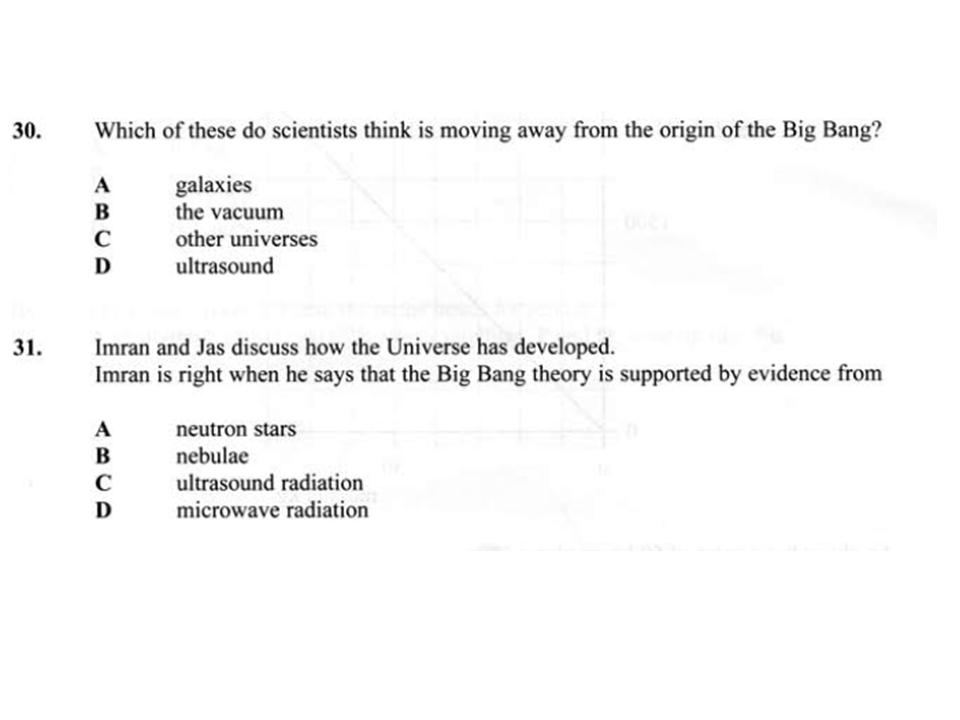
Here’s a couple more, from the “Advanced” section:
The answer to Q30 is, presumably, A. But do any scientists really think that galaxies are “moving away from the origin of the Big Bang”? I’m worried that this implies that the Big Bang was located at a specific point. Is that what they’re teaching?
Bearing in mind that only one answer is supposed to be right, the answer to Q31 is presumably D. But is there really no evidence from “nebulae” that supports the Big Bang theory? The expansion of the Universe was discovered by observing things Hubble called “nebulae”..
I’m all in favour of school students being introduced to fundamental things such as cosmology and particle physics, but my deep worry is that this is being done at the expense of learning any real physics at all and is in any case done in a garbled and nonsensical way.
Lest I be accused of an astronomy-related bias, anyone care to try finding a correct answer to this question?
The more of this kind of stuff I see, the more admiration I have for the students coming to study physics and astronomy at University. How they managed to learn anything at all given the dire state of science education represented by this paper is really quite remarkable.
Ultimately, however, the issue is not whether we have GCSEs or O-level examinations. There’s already far too much emphasis in the education system on assessment instead of learning. That runs all the way through schools and into the university system. The excessive time we spend examining students reduces what we can teach them and turns the students’ learning experience into something resembling a treadmill. I agree that we need better examinations than we have now, but we also need fewer. And we need to stop being obsessed by them.
Had I the heavens’ embroidered cloths,
Enwrought with golden and silver light,
The blue and the dim and the dark cloths
Of night and light and the half light,
I would spread the cloths under your feet:
But I, being poor, have only my dreams;
I have spread my dreams under your feet;
Tread softly because you tread on my dreams.
I woke up this morning to hear an item about astronomy on the 7 o’clock news on BBC Radio 3. That doesn’t happen very often so I thought I’d follow it up with a short post before I head off to work.
The news item I heard followed up an announcement yesterday that the governing Council of the European Southern Observatory (ESO) had approved the European Extremely Large Telescope (E-ELT) programme – which is to produce what will be the world’s largest ground-based optical telescope. Extremely Large is putting in mildly, of course. Its main mirror will be a colossal 39 metres in diameter (with a collecting area of almost a thousand square metres) and will have to made in bits with a sophisticated adaptive optics system to ensure that it can counter the effects of the Earth’s atmosphere and the limitations of its own structure to reach a phenomenal angular resolution of 0.001 arc seconds.
For more details on the telescope, see the official website here or the wikipedia article here, where you can also read more about the science to be done with E-ELT.
This telescope has been in planning for many years, of course. In fact, it began as an even more ambitious concept, a 100-metre diameter monster which I used to call the FLT. Over the years, however, for a mixture of technical and financial reasons, this was progressively de-scoped.
Yesterday’s announcement doesn’t mean that work will start immediately on building the E-ELT. That won’t happen until sufficient funding is secured and in the case of some countries, governmental approval obtained. Recent decisions by the UK Science and Technology Facilities Council to close down telescopes in Hawaii clearly anticipated the need to make some headroom in future budgets to enable this to happen. The best-case scenario is probably for E-ELT to take a decade or so to complete.
Of course the concentration of funding in ever and ever larger international facilities – such as E-ELT and the Square Kilometre Array – does create tensions within the UK astronomical community. Many scientists do excellent work with relatively small facilities, including those about to be closed down to make room for E-ELT. In the near future, the only ground-based optical facilities to which UK astronomers will have access will be operated by the European Southern Observatory. With fewer but larger (and more expensive) facilities operated by international agencies carrying out projects run by vast consortia, observational astronomy is definitely going the way of particle physics…
The problem comes when the Next Big Thing is too big to be built. We might have already seen X-ray astronomy bubble burst in this way. To quote my learned friend Andy Lawrence:
Fundamentally, the problem is that X-ray astronomy has hit the funding wall. Everything gets inexorably bigger and more ambitious. Eventually its all or nothing… so when the answer is nothing … ah.
What will come after the Large Hadron Collider, or the E-ELT? Is Big Science about to get too big?
I can never resist a terrible pun, so thought this would be an especially good day to post this video from NASA’s Solar Dynamics Observatory, showing views of last week’s Transit of Venus taken at several different wavelengths..
The views presented here are personal and not necessarily those of my employer (or anyone else for that matter).
Feel free to comment on any of the posts on this blog but comments may be moderated; anonymous comments and any considered by me to be vexatious and/or abusive and/or defamatory will not be accepted. I do not necessarily endorse, support, sanction, encourage, verify or agree with the opinions or statements of any information or other content in the comments on this site and do not in any way guarantee their accuracy or reliability.




 In the Dark