Archive for astronomy

Most Exciting Venus Transit Pictures Ever!

Posted in The Universe and Stuff with tags , , on June 6, 2012 by telescoper

Before

After

The Song of the Happy Shepherd

Posted in Poetry with tags , , , on June 5, 2012 by telescoper

A blog post yesterday by Andy Lawrence put the word Arcady into my head, and thus reminded me of this poem by William Butler Yeats, known to his friends as W.B. I’ve actually quoted a bit of this poem before, but now seem to have excuse to post the whole thing; I’ve highlighted the section that reveals Yeats’ opinion of observational astronomers…

The woods of Arcady are dead,
And over is their antique joy;
Of old the world on dreaming fed;
Grey Truth is now her painted toy;
Yet still she turns her restless head:
But O, sick children of the world,
Of all the many changing things
In dreary dancing past us whirled,
To the cracked tune that Chronos sings,
Words alone are certain good.
Where are now the warring kings,
Word be-mockers? – By the Rood,
Where are now the warring kings?
An idle word is now their glory,
By the stammering schoolboy said,
Reading some entangled story:
The kings of the old time are dead;
The wandering earth herself may be
Only a sudden flaming word,
In clanging space a moment heard,
Troubling the endless reverie.
Then nowise worship dusty deeds,
Nor seek, for this is also sooth,
To hunger fiercely after truth,
Lest all thy toiling only breeds
New dreams, new dreams; there is no truth
Saving in thine own heart. Seek, then,
No learning from the starry men,
Who follow with the optic glass
The whirling ways of stars that pass –
Seek, then, for this is also sooth,
No word of theirs – the cold star-bane
Has cloven and rent their hearts in twain,
And dead is all their human truth.
Go gather by the humming sea
Some twisted, echo-harbouring shell.
And to its lips thy story tell,
And they thy comforters will be.
Rewording in melodious guile
Thy fretful words a little while,
Till they shall singing fade in ruth
And die a pearly brotherhood;
For words alone are certain good:
Sing, then, for this is also sooth.
I must be gone: there is a grave
Where daffodil and lily wave,
And I would please the hapless faun,
Buried under the sleepy ground,
With mirthful songs before the dawn.
His shouting days with mirth were crowned;
And still I dream he treads the lawn,
Walking ghostly in the dew,
Pierced by my glad singing through,
My songs of old earth’s dreamy youth:
But ah! she dreams not now; dream thou!
For fair are poppies on the brow:
Dream, dream, for this is also sooth.

Astronomy Jobs at Cardiff!

Posted in The Universe and Stuff with tags , , , , , on June 1, 2012 by telescoper

Just a quick post to advertise a couple of job opportunities in the School of Physics & Astronomy at Cardiff University. For further details you can look at the official website, but here is an outline:

Two Faculty Positions in Astrophysics

Observational and theoretical studies of star-formation and/or extrasolar planetary systems.

The School of Physics and Astronomy at Cardiff University has immediate vacancies for two permanent faculty appointments in Astrophysics.  We are seeking experts in observational and theoretical studies of star-formation and/or extra-solar planetary systems to conduct world-class research and research-led teaching at undergraduate and postgraduate level.  The appointments will be at any level from Lecturer to Professor depending on the experience of the candidate; we expect at least one of the appointments to be at a junior level.

Physics and Astronomy at Cardiff University has undergone substantial expansion in the past few years and has very strong research groups in gravitational-wave physics, astronomical instrumentation, extragalactic astronomy and cosmology, star-formation and condensed matter physics.  There are presently 18 academic staff involved in astrophysics and relativity, with 15 post-doctoral researchers and 22 PhD students.

The appointment will be made at a level commensurate with experience.

The advertisement is also available on the AAS Jobs Register, or will be when they get their act together and put it online. The AAS website is just one of a number that have been recently improved, with the result that they’re much less efficient than they were before.

Anyway, I’m just passing on the advertisement so please don’t send me your CVs! If you’d like to apply please do so using the official Cardiff University jobs page, which also has a lot of general information about the City and the University.

P.S. There have been quite a few job vacancies in astronomy around the UK recently – Edinburgh, Surrey, Liverpool, Exeter etc. I wonder why that is, and where the money is coming from?

SKA Site Duel ends in Dual Site for SKA

Posted in Science Politics, The Universe and Stuff with tags , , , , , on May 26, 2012 by telescoper

I wasn’t going to post about this but then I realised nobody seemed to have used the obvious headline so thought I might as well knock out a quickie.

Yesterday, after much to-ing and fro-ing an announcement was finally made  concerning the site of the Square Kilometre Array.  The two contenders for the honour of hosting this superb project were South Africa and Australasia (both Australia and New Zealand get a bit, actually).

So who won?

Well, formally the decision was to split the project between both. At first sight this looks like a political compromise, but wiser heads than me disagree and say that this an excellent outcome on science grounds. I’d be interested to hear  opinions on that, in fact.

In any case, a quick skim through the STFC announcement makes it clear that South Africa actually gets the lion’s share of the actual dishes, which will be operated alongside the  Meerkat facility, and will do what I think is the more exciting science.  Having been to Cape Town just recently I know how much the SKA project means for astronomy in South Africa so I’m delighted for them that the outcome is so positive.

It does, however, remain to be seen what the implications of this decision are for the overall cost and scientific value-for-money, but for the time being the thing I’m most pleased about is that a decision has been reached.  I think the SKA project is by far the most exciting ground-based astronomy project around, and it will be very exciting to watch it grow.

Those earthly godfathers of Heaven’s lights

Posted in Literature, Poetry, The Universe and Stuff with tags , , on May 2, 2012 by telescoper

What was it that Ernest Rutherford said about science and stamp-collecting? It seems Shakespeare had much the same idea!

Study is like the heaven’s glorious sun,
That will not be deep-search’d with saucy looks;
Small have continual plodders ever won,
Save base authority from others’ books.
These earthly godfathers of heaven’s lights
That give a name to every fixed star,
Have no more profit of their shining nights
Than those that walk and wot not what they are.

from Love’s Labour’s Lost (Act I, Scene I) by William Shakespeare.

P.S. “wot” in the last line is an archaic form of  the verb “wit”, meaning “to know”; cf “I wot not what I ought to have braught” from A Midsummer Night’s Dream.

Going Virial

Posted in The Universe and Stuff with tags , , , on April 16, 2012 by telescoper

Here’s something a bit different. I was talking the other day with some folks here about the use of the Virial Theorem to measure masses of galaxy clusters. In case you’ve forgotten,  an important consequence of the virial theorem is that the average potential energy of an isolated system in gravitational equilibrium is equal to minus twice the average kinetic energy, i.e.

\langle \Phi \rangle = -2 \langle T \rangle

Being mathematicians they wanted to  have a precise definition of when this theorem holds, i.e. what it means for a system to be in virial equilibrium. I have to admit I was a bit stumped.

The problem is that the proof of the theorem (which you can find on the wikipedia page) involves assuming that the time-average of a scalar quantity (the virial), derived from the positions and momenta of the particles in the system, is zero. That’s fine, but the average is taken over an infinite time and most cosmic objects we apply it too are rather younger than the age of the Universe. So how accurately does it apply to, e.g., galaxy clusters? How large are the fluctuations about the mean?

Another problem is that clusters aren’t really isolated either. According to prevailing wisdom clusters sit at the intersections of filaments and sheets of dark matter from which matter continually accretes onto them, increasing their mass.

Clusters also contain a sizeable amount of substructure. Does this cast further doubt on how well actual clusters are described by the virial theorem?

I’ve heard a number of lectures and seminars about virial mass estimates of clusters but never have I heard a precise, testable definition of when it is expected to apply and how large the deviations from it are in realistic situations. I’ve taught courses in which the theorem is applied to a variety of situations, but I never looked too deeply into its foundations – which is, of course, very sloppy of me.  I tried asking a few people, and posted a question of Twitter, but didn’t get a really convincing response. Naturally, therefore, I decided to try it out on the readership of this blog….

So, please, would anyone out there please give me a precise  testable definition of what is meant by a “virialised system”  and explain how how well the virial theorem is supposed to apply to real clusters? Pointers to convincing discussions in the literature would be welcome!


Dyson on Eddington

Posted in Books, Talks and Reviews, The Universe and Stuff with tags , , , , , , on April 10, 2012 by telescoper

I’m grateful to George Ellis for sending me a link to a book review written by Freeman Dyson that appeared in a recent  edition of the New York Review of Books. I was particularly interested to read the following excerpt about Arthur Stanley Eddington. I have been intrigued by Eddington since I wrote a book about his famous expeditions (to Principe and Sobral) in 1919 to measure the bending of light by the Sun as a test of Einstein’s general theory of relativity; I blogged about this on its ninetieth anniversary, by the way, in case anyone wants to read any more about it.

Although I read quite a lot about Eddington, not only during the course of researching the book but also afterwards, as there are many things about his character that fascinate me. He died long before I was born, of course, but whenever I meet someone who knew him I ask what they make of him. Not altogether surprisingly, opinions differ rather widely from one person to another as his character seems to have been extremely contradictory. He doesn’t seem to have been very good at small talk, but was nevertheless a much sought-after dining companion. He was a man of great moral integrity, but at times treated his colleagues (notably Chandrasekhar) rather shamefully. He was a brilliant astrophysicist, but got himself hooked on his peculiar Fundamental Theory which was a dead end. He remains an enigma.

Anyway, this is what Dyson has to say about him:

Eddington was a great astronomer, one of the last of the giants who were equally gifted as observers and as theorists. His great moment as an observer came in 1919 when he led the British expedition to the island of Principe off the coast of West Africa to measure the deflection of starlight passing close to the sun during a total eclipse. The purpose of the measurement was to test Einstein’s theory of General Relativity. The measurement showed clearly that Einstein was right and Newton wrong. Einstein and Eddington both became immediately famous. One year later, Eddington published a book, Space, Time and Gravitation, that explained Einstein’s ideas to English-speaking readers. It begins with a quote from Milton’s Paradise Lost:

Perhaps to move
His laughter at their quaint opinions wide
Hereafter, when they come to model heaven
And calculate the stars: how they will wield
The mighty frame: how build, unbuild, contrive
To save appearances.

Milton had visited Galileo at his home in Florence when Galileo was under house arrest. Milton wrote poetry in Italian as well as English. He spoke Galileo’s language, and used Galileo as an example in his campaign for freedom of the press in England. Milton had witnessed with Galileo the birth struggle of classical physics, as Eddington witnessed with Einstein the birth struggle of relativity three hundred years later. Eddington’s book puts relativity into its proper setting as an episode in the history of Western thought. The book is marvelously clear and readable, and is probably responsible for the fact that Einstein was better understood and more admired in Britain and America than in Germany.

As a student at Cambridge University I listened to Eddington’s lectures on General Relativity. They were as brilliant as his books. He divided his exposition into two parts, and warned the students scrupulously when he switched from one part to the other. The first part was the orthodox mathematical theory invented by Einstein and verified by Eddington’s observations. The second part was a strange concoction that he called “Fundamental Theory,” attempting to explain all the mysteries of particle physics and cosmology with a new set of ideas. “Fundamental Theory” was a mixture of mathematical and verbal arguments. The consequences of the theory were guessed rather than calculated. The theory had no firm basis either in physics or mathematics.

Eddington said plainly, whenever he burst into his fundamental theory with a wild rampage of speculations, “This is not generally accepted and you don’t have to believe it.” I was unable to decide who were more to be pitied, the bewildered students who were worried about passing the next exam or the elderly speaker who knew that he was a voice crying in the wilderness. Two facts were clear. First, Eddington was talking nonsense. Second, in spite of the nonsense, he was still a great man. For the small class of students, it was a privilege to come faithfully to his lectures and to share his pain. Two years later he was dead.

Last Week of Term

Posted in Biographical, Education, The Universe and Stuff with tags , , , , , on March 26, 2012 by telescoper

So the glorious weather continues. Unfortunately, unlike most UK universities, we’re not finished for Easter yet; at Cardiff University we only get three weeks for the Easter recess instead of the four that colleagues over the border seem to enjoy.

One of the consequences of this is that the annual National Astronomy Meeting (NAM) often falls in Cardiff term time. This year NAM is taking place in the fine city of Manchester (which, for those of you unfamiliar with British geography, is in the Midlands). Many colleagues in the School of Physics & Astronomy are attending NAM, and most of my research group are either there already or travelling up today. I particularly wish Jo and Ian well when they give their talks; one of the excellent things about NAM is the opportunity it offers for younger researchers to talk about their work to a large audience. Nerve-wracking, no doubt, but invaluable experience.

I’m not going to NAM this year because I have too much to do back here at the ranch, including filling in a few lectures for staff who are away.  I’m always reluctant to cancel lectures during term-time, but in the current spell of good weather I doubt if any students would complain too much! I did a cosmology lecture this morning – only the second I’ve done here – and it the room was uncomfortably stuffy. A few of the students failed to fall asleep, however, so I regard that as a major success.

It’s strange how often good weather coincides with times of great stress for students. I recall that most of my undergraduate examinations took place in glorious sunshine, which seemed to have been laid on by some malevolent being to make us suffer. This week our students have project reports and presentations to worry about and other coursework to finish before term ends, as well as revision for the exams that take place in May; being couped up inside is no fun on days like this and I’m sure they’d prefer it to be raining outside so as not to distract them from the tasks in hand…

It’s so quiet around here today that it occurred to me now would be a good time to stage a Coup d’Etat. Come to thank of it, there’s a Staff Meeting  been called on Wednesday which may well amount to something pretty similar…

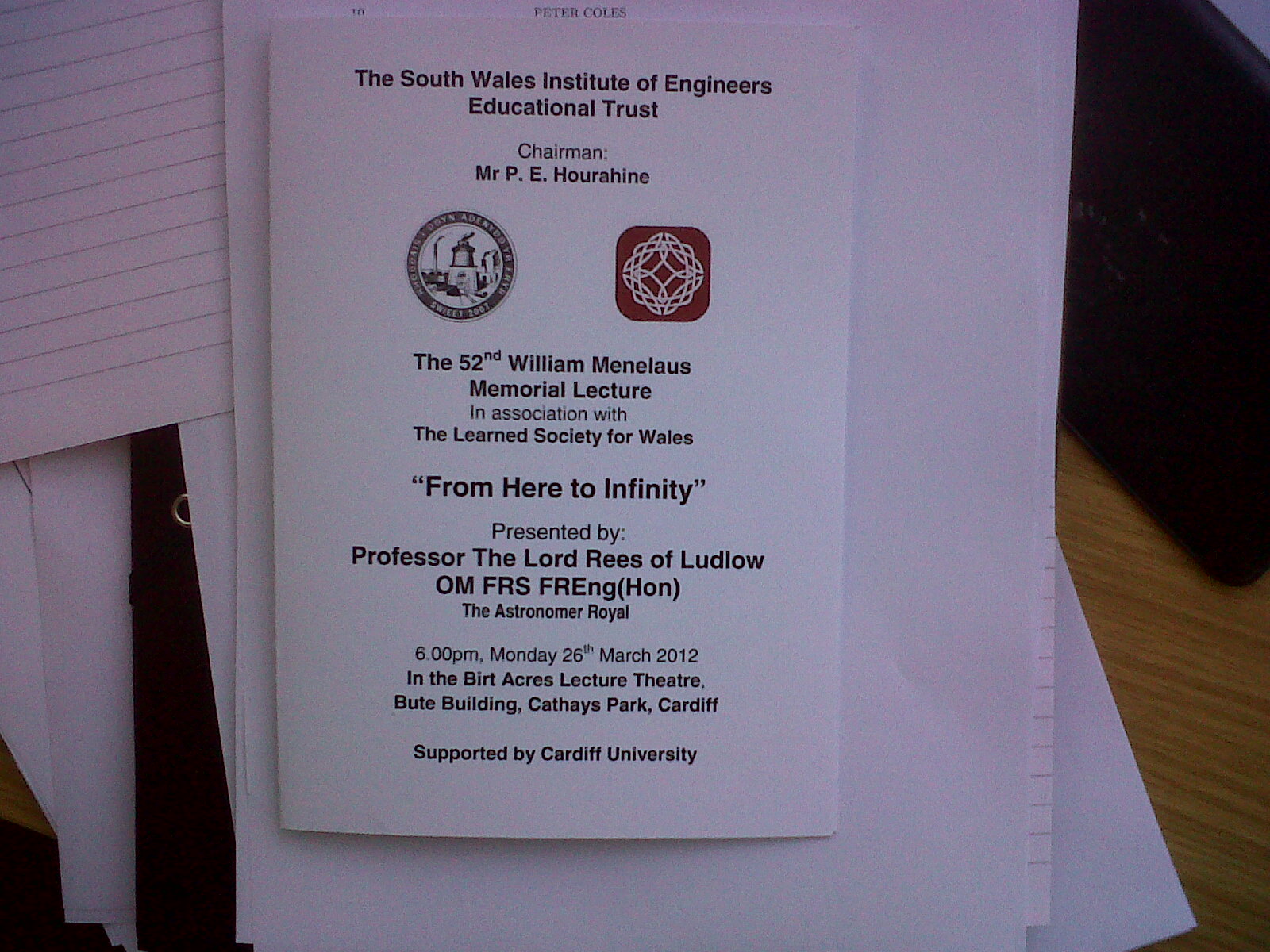
Anyway, those of us around today have a nice event this evening to look forward to, a lecture by Lord Rees followed by a nice dinner in Aberdare Hall. Here’s the invitation:

You’ll see that this is organized “in association with The Learned Society for Wales“, which I only just learned about when I saw it on the invitation!

Anyway, the prospect of a slap-up dinner persuaded me to just have a sandwich for lunch. Now that’s eaten methinks I’ll get back to work!

UPDATE: It was indeed a very interesting and entertaining lecture by Lord Rees; here he is, in action, watched by Prof. Disney…

VISTA on Video

Posted in The Universe and Stuff with tags , , , , , on March 23, 2012 by telescoper

A chance tweet brought to my attention this video that fits well with a news story that’s been doing the rounds for a few days.   This concerns a very deep and wide survey called UltraVISTA, that has been made using the VISTA telescope at the European Southern Observatory’s Paranal Observatory in Chile. You can find the full press release from ESO that started the media interest here, where some lovely images can also be found.

VISTA is the world’s largest infra-red survey telescope, and is unusual among telescopes for having only one instrument on it, an Infra-red camera.  Technically, therefore,  it should really be called ISTA; owing to cost constraints the Visible camera that was initially proposed to accompany the Infra-red one and supply the V in its acronym,  was never built. Anyway, VISTA was designed explicitly to do survey work involving very distant and faint objects; its forte is to allow very deep images to be made with a very wide field of view, as demonstrated on the video…

Since I’m using the handle “telescoper” on this blog, I suppose I really should post about telescopes a bit more often than I do but I hope this will do for now!

Terra Nova

Posted in Art, History, The Universe and Stuff with tags , , , , , , , on February 3, 2012 by telescoper

We’re currently enduring a spell of cold weather here in Cardiff, although I think it might be rather milder here then elsewhere in the UK. My garden thermometer showed a mere -5 C when I looked at it at 7.15 this morning. The other day we had a meeting of half-a-dozen people in one of our large teaching rooms and it was absolutely freezing. I don’t know what was wrong with the heating. Yesterday I actually did a lecture in the same room, but with 80-odd “warm bodies” (or “students” as they are sometimes known) in there, it was bearable.

The cold here of course is nothing compared with that endured by Captain Scott‘s ill-fated expedition to the South Pole, but I mention it here for a number of reasons. First, the centenary of the death of Scott and his companions is coming up next month; the tragedy unfolded in March 1912. There’s actually a very special concert coming up next week, featuring Vaughan Williams’ wonderful music written for the classic film Scott of the Antarctic (which, incidentally, you can actually watch in full on Youtube). I’m definitely going along, and will probably review the performance next week, but quite a number of my colleagues are also going, for reasons which will become obvious..

The concert is special because of the very strong connections between the Scott Expedition and the City of Cardiff. Much of the financial support needed to fund the trek to the South Pole was raised from Cardiff businessmen and Scott’s ship, the Terra Nova, actually set sail from Cardiff (in June 1910) on its journey, first to New Zealand and thence to Antarctica.

Incidentally, an article in this morning’s Western Mail relates to a historic painting of the departure of the Terra Nova which is about to be auctioned:

Cardiff Bay has certainly changed a great deal since 1910, but quite a lot is recognizable, especially the Pierhead Building, which can be seen to the right. The actual docks, the locations of which are revealed by the lines of masts of tall ships, are now mainly filled in. But there is at least one other reminder of this occasion to be found at Cardiff Bay, a large waterfront bar itself called Terra Nova

There’s also a deep connection with the South Pole, and the Antarctic generally, for many members of the Astronomy Instrumentation Group here in the School of Physics & Astronomy at Cardiff University, quite a few of whom have actually been to the South Pole in connection with various experiments, including Quad,  Boomerang and BLAST, because of the unique observing conditions there.