Archive for astronomy

Don’t call me FRAS

Posted in Biographical, Open Access with tags , , , , on March 22, 2024 by telescoper

Some time ago I mentioned on this blog that I was resigning my Fellowship of the Institute of Physics as a consequence of the IOP’s blatant dishonesty over its publication policy. In a subsequent post giving further details of my fundamental disagreements with IOP Publishing’s profiteering, I stated that

I will decide in the next few days whether or not to resign also from the Royal Astronomical Society for the same reason.

After giving the matter a lot of thought, I have indeed now decided to resign my Fellowship of the Royal Astronomical Society, of which I have been a Fellow since 1990. The main reason for this decision is that I feel it would be inconsistent to remain FRAS after resigning as FInstP when I have the same problem with both institutions, i.e. the way they fund themselves through exploitative publishing practices.

Here is the email I sent to the Royal Astronomical Society earlier today.

Dear Membership Officer,

After much deliberation about the new policy of the Royal Astronomical Society to charge exorbitant fees for publishing in its journals (especially Monthly Notices of the Royal Astronomical Society), I have decided that I cannot in good conscience remain a member of a society that funds itself this way. I therefore resign my Fellowship of the Royal Astronomical Society with immediate effect. Kindly remove me from your membership list. I have cancelled the Direct Debit relating to my subscription.

Regards,

Peter Coles

Other, subsidiary, reasons for resignation include the expense, and the fact that Astronomy & Geophysics, the house magazine of the RAS, one of the few direct benefits of membership, even if it doesn’t have a crossword, only ever arrives in Ireland 6-8 weeks late (if it arrives at all). In any case, since I now live in Ireland, it is much more appropriate for me to participate in the activities of the Astronomical Society of Ireland than the Royal Astronomical Society, which is a UK institution.

As I am no longer a Fellow of the Royal Astronomical Society, I am no longer eligible to remain a member of the RAS Dining Club, of which I have been a member for 15 years, so I have resigned from that too. It has been in any case difficult and expensive for me to attend the dinners since I moved to Ireland. No more dinners at the Athenaeum for me!
The Euclid Survey(s)

Posted in Euclid, The Universe and Stuff with tags , , , , , , , , , on February 27, 2024 by telescoper

Since it’s been a couple of weeks since Euclid commenced its routine survey operations, I thought I would share this little video from the European Space Agency that shows how the surveying will proceed over the next six years with explanatory text adapted from here:

This animation shows the location of the fields on the sky that will be covered by Euclid’s wide (blue) and deep (yellow) surveys. The sky is shown in the Galactic coordinate system, with the bright horizontal band corresponding to the plane of our Milky Way.

The wide survey will cover more than one third of the sky as shown in blue. Other regions are avoided because they are dominated by Milky Way stars and interstellar matter, or by diffuse dust in the Solar System – the so-called zodiacal light. The wide survey is complemented by a deep survey, taking about 10% of the total observing time and repeatedly observing just three patches of the sky called the Euclid Deep Fields, highlighted in yellow.

The Euclid Deep Field North – towards the top left – has an area of 20 square degrees and is located very close to the Northern Ecliptic Pole. The proximity to the ecliptic pole ensures maximum coverage throughout the year; the exact position was chosen to obtain maximum overlap with one of the deep fields surveyed by NASA’s Spitzer Space Telescope.

The Euclid Deep Field Fornax – in the lower right of the image – spans 10 square degrees and is located in the southern constellation Fornax, the furnace. It encompasses the much smaller Chandra Deep Field South, a 0.11 square degree region of the sky that has been extensively surveyed in the past couple of decades with the Chandra and XMM-Newton X-ray observatories, as well as the Hubble Space Telescope and major ground-based telescopes.

The third and largest of the fields is the Euclid Deep Field South – between the Large Magellanic Cloud and the Euclid Deep Field Fornax. It covers 20 square degrees in the southern constellation of Horologium, the pendulum clock. This field has not been covered to date by any deep sky survey and so has a huge potential for new, exciting discoveries. It has been planned to be observed from the ground by the Vera C. Rubin Observatory.

P.S. According to my latest calculations, I shall have retired by the time the Wide survey is completed.

PHANGS for the galaxies…

Posted in The Universe and Stuff with tags , , , , , , , on January 31, 2024 by telescoper

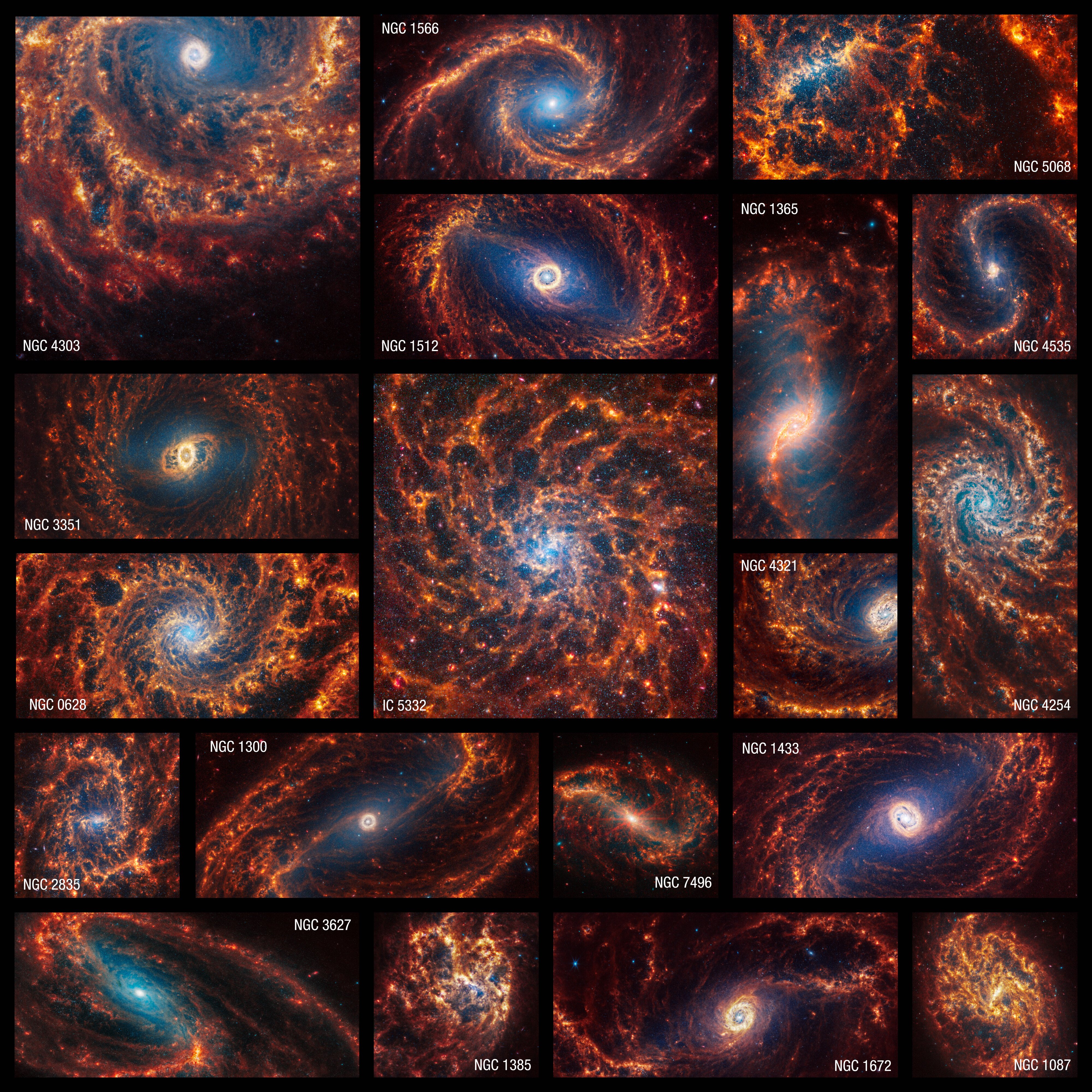
I couldn’t resist sharing this wonderful set of images from JWST courtesy of the PHANGS* team showing exquisite details of 19 face-on spiral galaxies as seen in the infra-red:

More information about the remarkable structures seen in these images, as well as higher resolution versions of the images themselves, can be found on the European Space Agency website here.

*For those of you not in the know, PHANGS stands for Particularly Horrible Acronym Not Generated Sensibly Physics at High Angular resolution in Nearby GalaxieS.

Celestial Echoes: The Night Sky in Irish Folklore

Posted in History, Irish Language, The Universe and Stuff with tags , , , , on August 29, 2023 by telescoper
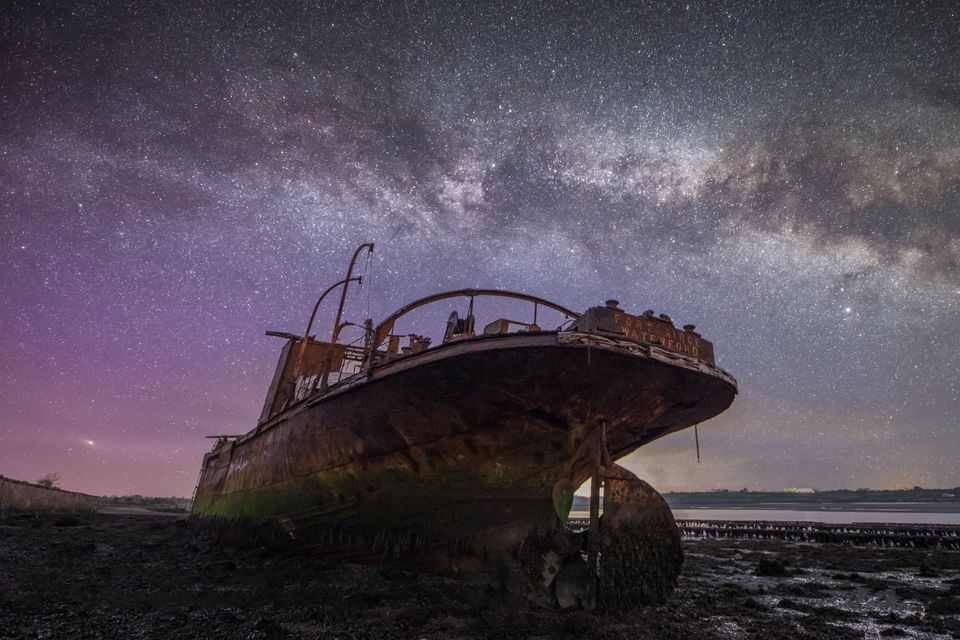
The Milky Way over a shipwreck in Co Wexford, photographed by Adrian Hendroff, winner of this year’s Reach for the Skies photography competition.

I mentioned last week that I attended a public lecture by journalist Seán Mac an tSíthigh called Celestial Echoes: the Night Sky in Irish folklore. The talk was largely about some of the names given to celestial objects and the stories attached to those names. Much of the material was drawn from an extensive National Folklore Collection held at University College, Dublin. Unfortunately, however, the index to this collection is not very good at names for stars and constellations. In some cases it isn’t obvious what those names that are recorded actually refer to and in some cases the words themselves are obscure. The lecturer stressed that many of these words would have been known by the parents or grandparents of people in the audience, but have since been lost. There’s an article here that makes a similar point in a wider context. One prominent source of folklore, for example, is the traditional style of mackerel fishing, done at night so that the phosphorescence produced by the fish could be seen, which basically no longer exists so the folk names of stars and constellations used by the fishermen for navigation have been forgotten. Some other names have obviously been influenced by the Greco-Roman constellation names, etc.

I didn’t take many notes during this very enjoyable talk, but I did jot down a few words and phrases that I thought I’d pass on here. Given that my knowledge of modern Irish is very limited and many of the words used are dialect or archaic words that you won’t find in dictionaries, I’ll restrict myself to just a few of the things that caught my ear. Many of these are very similar in Scots Gaelic. Apologies in advance for misspellings, mistranslations or other forms of incompetence!

Before we start let me just mention that the Irish word for “star” is réalta (plural réaltai), which can also mean “a light”. There is also a diminutive, réiltín. Astronomy is réalteolaíocht and astrophysics is réaltfhisic. I’ve always liked the way astrophysics looks like “real physics”!

  • The Milky Way is usually Bealach na Bó Finne (the Way of the White/Fair Cow). The legend that goes with this name is of a cow that produces an endless supply of milk. The Milky Way can also have the more literal name Claí Mór na Réaltaí (the Great Wall of Stars); in Irish mór means “big or great” and must be cognate with the Welsh mawr. Another folk name is An Láir Bhán (the White Mare).
  • Orion is An Bodach which can mean a man, specifically an old man, or a ghost.
  • Betelgeuse is An Spor Dearg (the Red Spur); Rigel is An Spor Liath (the Grey Spur).
  • The Orion Nebula is An Sparán (the purse, pouch); cf. Scots sporran.
  • In modern Irish, the Pleaides is An Tréidín (the Little Flock or Herd) but there are a variety of other terms including Buaile an Bhodaigh (the ghost’s milking place) and Na Cearrbhaigh (the Gamblers, because they look like people playing cards..).
  • The constellation of Leo is An Corrán (the Hook, Sickle).
  • Polaris is An Réalta Thuaidh (the North Star) but also Réalta Eolais (guiding star)
  • Sirius is An Réalta Mhadra (the Dog Star).
  • Ursa Minor is An Dragbhoth (the Fiery House).
  • Ursa Major is An Mathghamhain Mór (the Great Bear); a more modern alternative word for “bear” is mathúin. The Plough is An Camchéachta
  • The Aurora Borealis can be Soilse na Speire Thuaidh (lights of the Northern sky) or na Gealáin Thuaidh or na Saighneáin.
  • A Comet is réalta (an) eireabaill, (star with a tail) réalta mhongach (long-haired or maned star) or réalta (na) scuaibe (star with a brush). There is an (extremely exaggerated) account of a comet in the famous book (and mainstay of the Irish language leaving certificate) by Peig Sayers; given the timing it may have been Halley’s Comet near its 1910 perihelion.

That’s enough for now. I have a few more, but they’ll have to wait…

Astronomical Observatories on Indigenous Land

Posted in Euclid, Politics, The Universe and Stuff with tags , , , , , , , , on July 15, 2023 by telescoper

I’ve been meaning to post about for some time about the use of telescopes all around the world that reside in observatories on lands previously and/or presently occupied by indigenous peoples. The creation of these astronomical facilities has been accompanied by neglect (and sometimes violent displacement) of tribal communities native to the land on which they now stand. Though we exploit native lands for science, the astronomical community makes little reference to the people who are directly impacted by the advancement of astronomy through colonialism of this sort.

I know I’m not alone in thinking that, at the very least as a community we should do much more to acknowledge our use of astronomical facilities built on land that in many cases was basically “stolen” by colonial settlers. There was a talk about this issue at the recent Euclid Consortium Meeting in Copenhagen, and it came up at the National Astronomy Meeting in Cardiff in the context of the broad issue of the decolonization of astronomy.

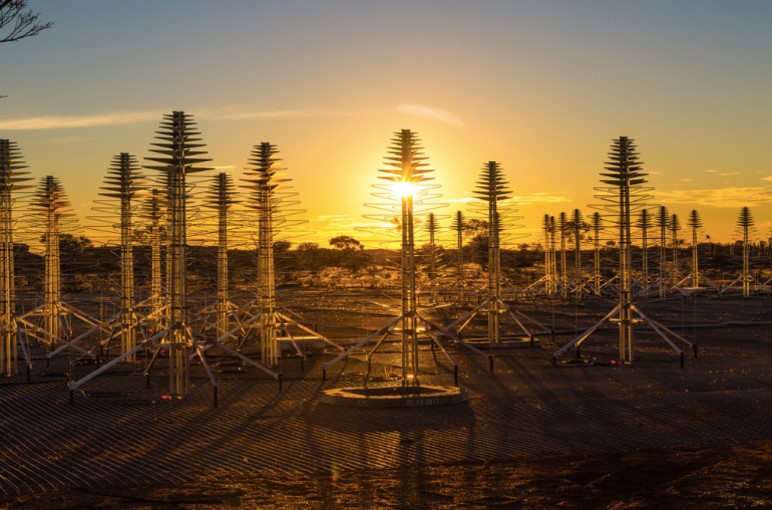
Anyway, just for a start I have included here a small gallery of images of modern astronomical observatories of various kinds, with captions giving the names not of the observatory, but of the indigenous peoples upon whose land it is built:

There are many more than these, but hopefully you get the point. The question is: what to do about it?

Back to Maynooth

Posted in Biographical, Cardiff, GAA, Maynooth with tags , , , on July 8, 2023 by telescoper

I made it back to Maynooth from Cardiff last night after a relatively uneventful journey, although sitting next to a hen party on a RyanAir flight en route to Dublin wasn’t exactly the most peaceful experience and I was quite tired when I got home.

Among the many things that have changed over the last few years is how much quieter Cardiff Airport is. When I arrived there at about 6pm yesterday there were only two flights on the departure screen. One of them (a KLM flight to Amsterdam) was then cancelled, so all the intending passengers had to leave the departure lounge and collect their checked luggage. My flight was on time, however, and was very full.

In a previous pre-pandemic existence I spent half my time in Cardiff and half in Maynooth so had to cross the Irish Sea twice a week. The airline I used in those days, FlyBe, went bust just before the pandemic. RyanAir has taken the Cardiff-Dublin route, deploying a Boeing which is much bigger than the Embraer used by FlyBe, but there is only one flight a day. The other routes previously operated by FlyBe from Cardiff (e.g. to Edinburgh) no longer exist. Bristol is relatively easy to get to from Cardiff so I suppose people go that way nowadays if they have to fly.

A consequence of the small number of flights from Cardiff Airport is that the shuttle bus to Cardiff City Centre no longer runs. That was the method I used to get to and from the airport in my previous existence when I had to cross the Irish Sea twice a week. That no longer being available, I travelled to the airport by train and bus transfer. It’s a lot less convenient than the old bus, and a bit more expensive, but went off without any hitches.

Anyway, it’s nice to be home. I plan to spend the day chilling and watching the hurling semi-final between Limerick and Galway. UPDATE: Defending Champions Limerick beat Galway by 2-24 to 1-18 and thus get to the final yet again. The other semi-final, between Clare and Kilkenny, is tomorrow.

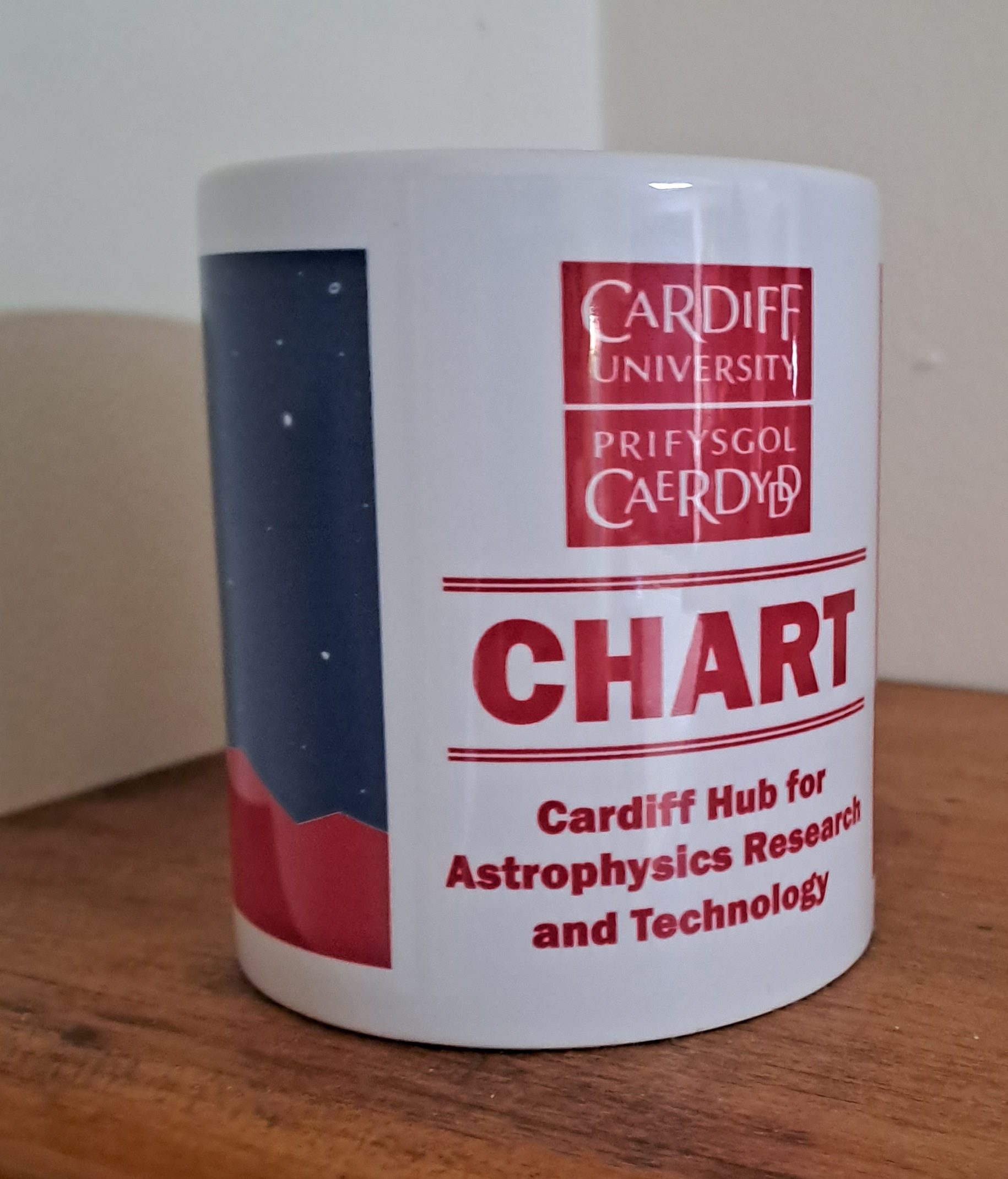
P.S. I forgot to mention that the good folk of Cardiff gave me a mug advertising CHART – Cardiff Hub for Astrophysics Research and Technology – which is new since my day.

James Webb: the wrong name for a Space Telescope

Posted in History, LGBTQ+, The Universe and Stuff with tags , , , on July 13, 2022 by telescoper

Following yesterday’s excitement about the new images from the James Webb Space Telescope I thought I’d share this video documentary that explains why the choice of name for this facility is highly inappropriate and should be changed. This is a matter I’ve blogged about previously, in fact, but the video is new.

R.I.P. David Hughes (1941-2022)

Posted in The Universe and Stuff with tags , , on June 9, 2022 by telescoper
David W Hughes (1941-2022)

I am once again very sorry to have to pass on some sad news. Astronomer David Hughes (formerly of Sheffield University) passed away suddenly on Monday 6th June at the age of 80.

Born in Nottinghamshire, David did his first degree at Birmingham University and his DPhil in Oxford. He moved to Sheffield in 1965 and worked there until he retired in 2007.

David was an expert on the Solar System, especially its minor bodies, such as asteroids and comets; the Mars-crossing asteroid 4205 David Hughes is named in honour of his many achievements. He was also very knowledgeable about the history of astronomy and the threat to Earth from meteors and other impact phenomena. An ebullient public speaker, he was much in demand as a guest on TV programmes, as well as giving lectures on cruise ships and talks to amateur astronomical societies and lay audiences. Through these activities he did a huge amount for the popularization of astronomy especially in the UK.

I send my condolences to his family, friends and colleagues both in Sheffield and around the world.

R.I.P. David W Hughes (1941-2022)

Distant Things!

Posted in The Universe and Stuff with tags , , , on April 1, 2022 by telescoper

I’m a bit late passing this on but there was a great deal of excitement this week at the news that the Hubble Space Telescope (HST) has made an astonishing discovery about the early Universe as illustrated by the above picture published in Nature. As well as an individual star (?) observed at redshift 6.2, so distant that its light set out when the Universe was just 8% of its current age, the image also reveals the presence in the early Universe of large geometric shapes (such as rectangles) as well as a remarkable giant arrow. The presence of these features at such high redshift is completely inconsistent with the standard theory of structure formation.

JWST: Nice Telescope, Shame about the Name…

Posted in LGBTQ+, Science Politics, The Universe and Stuff with tags , , , , , , , on October 17, 2021 by telescoper
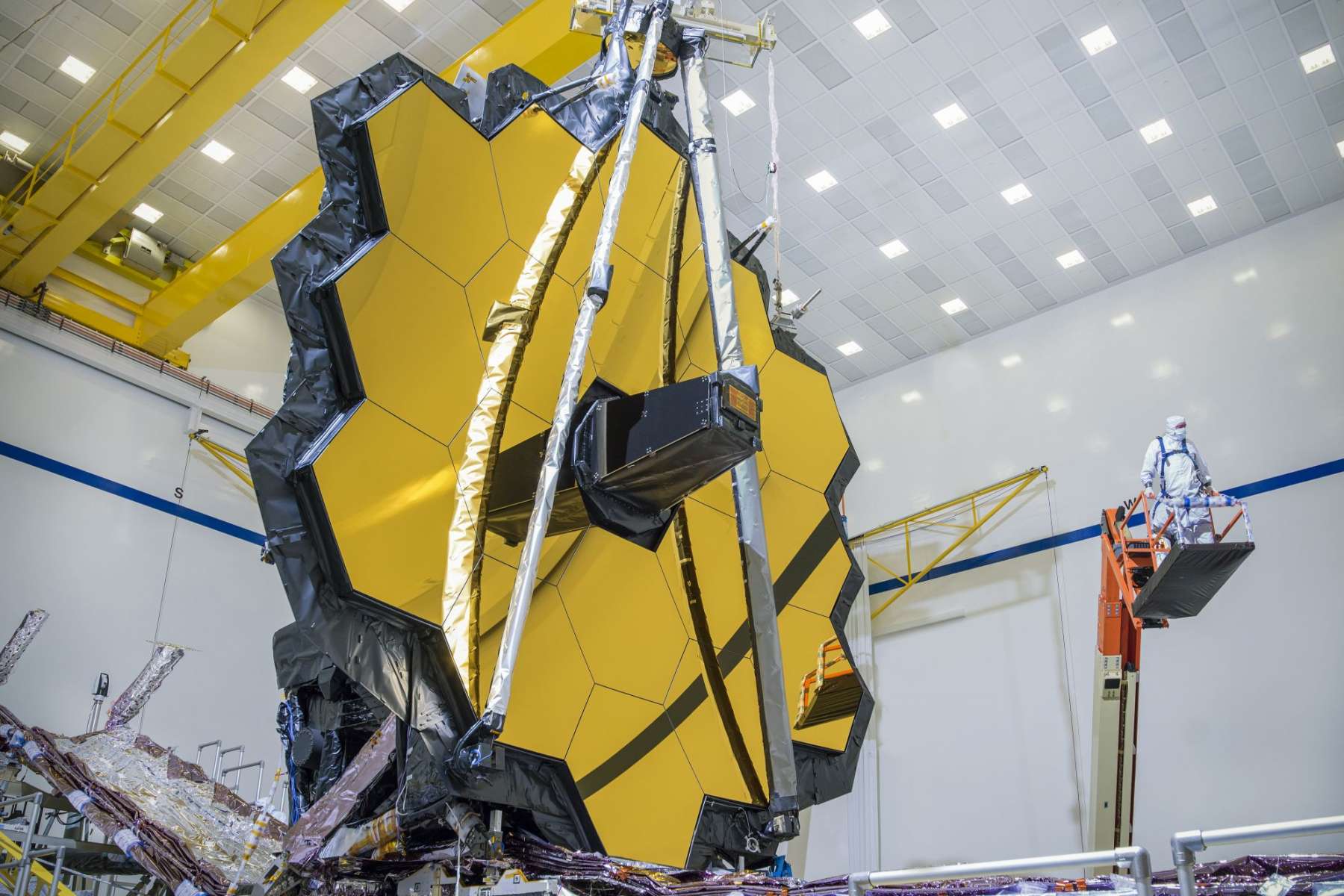
The JWST deployable mirror undergoing tests

I heard last week that the ship carrying the James Webb Space Telescope (JWST) arrived safely in French Guiana and is now being prepared for launch on an Ariane-5 rocket at the European Space Agency’s facility at Kourou. Since the telescope cost approximately $10 billion there was some nervousness it might have been hijacked by pirates on the way.

I’m old enough to remember JWST when it was called the Next Generation Space Telescope NGST); it was frequently discussed at various advisory panels I was on about 20 years ago. Although the basic concept hasn’t changed much – it was planned to be the successor to the Hubble Space Telescope working in the infrared and with a deployable mirror – at that time it was going to have an even bigger mirror than the 6.5m it ended up with, was going to be launched in or around 2010, and was to have a budget of around $600 million. About a decade ago cost overruns, NASA budget problems, and technical hitches led to suggestions that it should be cancelled. It turned out however that it was indeed too big too fail. Now it is set for launch in December total cost greater than ten times the original estimate.

I know many people involved in the JWST project itself or waiting to use it to make observations, and I’ll be crossing my fingers on launch day and for the period until its remarkable folding mirror is deployed about a fortnight later. I hope it goes well, and look forward to the celebrations when it does.

There is a big problem with JWST however and that is its name, which was changed in 2002 from the Next Generation Space Telescope to the James Webb Space Telescope after James E. Webb, a civil servant who was NASA’s chief administrator from 1961 to 1968.

It’s not uncommon for scientific space missions like this to be named after people once the proposal has moved off the drawing board and into serious planning. That happened with the European Space Agency’s Planck and Herschel to give two examples. In any case Next General Space Telescope was clearly never anything but a working title. Yet naming this important mission after a Government official always seemed a strange decision to me. Then news emerged that James Webb had enthusiastically cooperated in a McCarthyite purge of LGBT+ people working in government institutions, part of a wider moral panic referred to by historians as the Lavender Scare. There have been high-profile protests (see, e.g., here) and a petition that received over a thousand signatures, but NASA has ruled out any change of name.

The main reason NASA give is that they found no evidence that Webb himself was personally involved in discrimination or persecution. I find that very unconvincing. He was in charge, so had responsibility for what went on in his organization. If he didn’t know then why didn’t he know? Oh, and by the way, he didn’t have anything to do with infrared astronomy either…

It’s a shame that this fantastic telescope should have its image so tarnished by the adoption of an inappropriate name. The name is a symbol of a time when homophobic discrimination was even more prevalent than it is now, and as such will be a constant reminder to us that NASA seems not to care about the many LGBT+ people working for them directly or as members of the wider astronomical community.

P.S. As an alternative name I suggest the Lavender Scare Space Telescope (LSST)…