Archive for astronomy

Life, the Universe and the Partial Eclipse..

Posted in Astrohype, The Universe and Stuff with tags , , on March 19, 2015 by telescoper

As you will no doubt be aware, tomorrow there will be a Partial Eclipse of the Sun visible from the United Kingdom. Here’s a handy guide, courtesy of the Met Office, to the time and maximum fraction of the Sun’s disk that will be obscured.

Eclipse

Unfortunately the weather forecast for Brighton isn’t marvellous so it’s possible that the main event will be obscured by cloud and all we experience is that an already dark and gloomy morning gets even darker and gloomier.

However, in the event that the weather forecast turns out to be inaccurate, which is far from unheard of, please make sure you follow the official Royal Astronomical Society guidelines to make sure you observe it safely.

And while I’m at it, here is a video of a nice lecture by Ian Ridpath explaining all about Solar and Lunar Eclipses.

As a spectacle a partial solar eclipse is pretty exciting – as long as it’s not cloudy – but even a full view of one can’t really be compared with the awesome event that is a total eclipse. I’m lucky enough to have observed one and I can tell you it was truly awe-inspiring.

If you think about it, though, it’s rather odd that such a thing is possible at all. In a total eclipse, the Moon passes between the Earth and the Sun in such a way that it exactly covers the Solar disk. In order for this to happen the apparent angular size of the Moon (as seen from Earth) has to be almost exactly the same as that of the Sun (as seen from Earth). This involves a strange coincidence: the Moon is small (about 1740 km in radius) but very close to the Earth in astronomical terms (about 400,000 km away). The Sun, on the other hand, is both enormously large (radius 700,000 km) and enormously distant (approx. 150,000,000 km). The ratio of radius to distance from Earth of these objects is almost identical at the point of a a total eclipse, so the apparent disk of the Moon almost exactly fits over that of the Sun. Why is this so?

The simple answer is that it is just a coincidence. There seems no particular physical reason why the geometry of the Earth-Moon-Sun system should have turned out this way. Moreover, the system is not static. The tides raised by the Moon on the Earth lead to frictional heating and a loss of orbital energy. The Moon’s orbit is therefore moving slowly outwards from the Earth. I’m not going to tell you exactly how quickly this happens, as it is one of the questions I set my students in the module Astrophysical Concepts I’ll be starting in a few weeks, but eventually the Earth-Moon distance will be too large for total eclipses of the Sun by the Moon to be possible on Earth, although partial and annular eclipses may still be possible.

It seems therefore that we just happen to be living at the right place at the right time to see total eclipses. Perhaps there are other inhabited moonless planets whose inhabitants will never see one. Future inhabitants of Earth will have to content themselves with watching eclipse clips on Youtube.

Things may be more complicated than this though. I’ve heard it argued that the existence of a moon reasonably close to the Earth may have helped the evolution of terrestrial life. The argument – as far as I understand it – is that life presumably began in the oceans, then amphibious forms evolved in tidal margins of some sort wherein conditions favoured both aquatic and land-dwelling creatures. Only then did life fully emerge from the seas and begin to live on land. If it is the case that the existence of significant tides is necessary for life to complete the transition from oceans to solid ground, then maybe the Moon played a key role in the evolution of dinosaurs, mammals, and even ourselves.

I’m not sure I’m convinced of this argument because, although the Moon is the dominant source of the Earth’s tides, it is not overwhelmingly so. The effect of the Sun is also considerable, only a factor of three smaller than the Moon. So maybe the Sun could have done the job on its own. I don’t know.

That’s not really the point of this post, however. What I wanted to comment on is that astronomers generally don’t question the interpretation of the occurence of total eclipses as simply a coincidence. Eclipses just are. There are no doubt many other planets where they aren’t. We’re special in that we live somewhere where something apparently unlikely happens. But this isn’t important because eclipses aren’t really all that significant in cosmic terms, other than that the law of physics allow them.

On the other hand astronomers (and many other people) do make a big deal of the fact that life exists in the Universe. Given what we know about fundamental physics and biology – which admittedly isn’t very much – this also seems unlikely. Perhaps there are many other worlds without life, so the Earth is special once again. Others argue that the existence of life is so unlikely that special provision must have been made to make it possible.

Before I find myself falling into the black hole marked “Anthropic Principle” let me just say that I don’t see the existence of life (including human life) as being of any greater significance than that of a total eclipse. Both phenomena are (subjectively) interesting to humans, both are contingent on particular circumstances, and both will no doubt cease to occur at some point in perhaps not-too-distant the future. Neither tells us much about the true nature of the Universe.

Perhaps we should just face up to the fact that we’re just not very significant….

Stargazing Live on Sussex University Campus – Tonight!

Posted in The Universe and Stuff with tags , , , , on March 18, 2015 by telescoper

Just a quick post to advertise the fact that the BBC Television series Stargazing Live will be broadcast in the evenings this week from Wednesday 18th to Friday 20th March, 2015. The programme is hosted by Professor Brian Cox and Dara O Briain and will be beamed to you (or at least to those of you who have television sets) from Jodrell Bank, which is near Manchester (in the Midlands).

Closer to home, at least for those of you whose home is closer to mine than it is to Jodrell Bank, the Department of Physics & Astronomy at the University of Sussex will be running a series of astronomical activities (including planetarium shows, observing sessions and lectures) for all ages to coincide with the programme tonight (i.e. Wednesday 18th March). This also takes place within One World Week at the University of Sussex, which gives it added interest for both staff and students. There’s nothing like astronomy to make you aware of our shared existence on this little planet…

There are two sessions this evening. One is from 6pm to 7.30pm and the other from 8pm to 9.30pm. You can find full details of both sessions here, but here’s a taster of the menu for the earlier session:

stargazing

It’s lovely and sunny on Sussex University campus as I write this, and the forecast is good for this evening too. Might we be able to get a glimpse of the Aurorae that lit up the skies over Britain last night? I can’t promise that, but there’s a chance! Sadly the forecast for Friday’s partial solar eclipse is not so good, but we live in hope.

Anyway, wherever you are and whatever you do this evening, here’s wishing you Happy Stargazing!

Yes, science produces too many PhDs

Posted in Science Politics with tags , , , , , on February 19, 2015 by telescoper

I came across a blog post this morning entitled Does Science Produce Too Many PhDs? I think the answer is an obvious “yes” but I’ll use the question as an excuse to rehash an argument I have presented before, which is that most analyses of the problems facing yearly career researchers in science are looking at the issue from the wrong end. I think the crisis is essentially caused by the overproduction of PhDs in this field. To understand the magnitude of the problem, consider the following.

Assume that the number of permanent academic positions in a given field (e.g. astronomy) remains constant over time. If that is the case, each retirement (or other form of departure) from a permanent position will be replaced by one, presumably junior, scientist.

This means that over an academic career, on average, each academic will produce just one PhD who will get a permanent job in academia. This of course doesn’t count students coming in from abroad, or those getting faculty positions abroad, but in the case of the UK these are probably relatively small corrections.

Under the present supply of PhD studentships an academic can expect to get a PhD student at least once every three years or so. At a minimum, therefore, over a 30 year career one can expect to have ten PhD students. A great many supervisors have more PhD students than this, but this just makes the odds worse. The expectation is that only one of these will get a permanent job in the UK. The others (nine out of ten, according to my conservative estimate) above must either leave the field or the country to find permanent employment.

The arithmetic of this situation is a simple fact of life, but I’m not sure how many prospective PhD students are aware of it. There is still a reasonable chance of getting a first postdoctoral position, but thereafter the odds are stacked against them.

The upshot of this is we have a field of understandably disgruntled young people with PhDs but no realistic prospect of ever earning a settled living working in the field they have prepared for. This problem has worsened considerably in recent  years as the number of postdoctoral positions has almost halved since 2006. New PhDs have to battle it out with existing postdoctoral researchers for the meagre supply of suitable jobs. It’s a terrible situation.

Now the powers that be – in this case the Science and Technology Facilities Council – have consistently argued that the excess PhDs go out into the wider world and contribute to the economy with the skills they have learned. That may be true in a few cases. However, my argument is that the PhD is not the right way to do this because it is ridiculously inefficient.

What we should have is a system wherein we produce more and better trained Masters level students  and fewer PhDs. This is the system that exists throughout most of Europe, in fact, and the UK is actually committed to adopt it through the Bologna process.  Not that this commitment seems to mean anything, as precisely nothing has been done to harmonize UK higher education with the 3+2+3 Bachelors+Masters+Doctorate system Bologna advocates.

The training provided in a proper two-year Masters programme will improve the skills pool for the world outside academia, and also better prepare the minority of students who go on to take a PhD. The quality of the  PhD will also improve, as only the very best and most highly motivated researchers will take that path. This used to be what happened, of course, but I don’t think it is any longer the case.

The main problem with this suggestion is that it requires big changes to the way both research and teaching are funded. The research councils turned away from funding Masters training many years ago, so I doubt if they can be persuaded to to a U-turn now. Moreover, the Research Excellence Framework provides a strong incentive for departments to produce as many PhDs as they possibly can, as these are included in an algorithmic way as part of the score for “Research Environment”. The more PhDs a department produces, the higher it will climb in the league tables. One of my targets in my current position is to double the number of PhDs produced by my School over the period 2013-18. What happens to the people concerned seems not to be a matter worthy of consideration. They’re only “outputs”…

Social Physics & Astronomy

Posted in The Universe and Stuff with tags , , , , , , on January 25, 2015 by telescoper

When I give popular talks about Cosmology,  I sometimes look for appropriate analogies or metaphors in television programmes about forensic science, such as CSI: Crime Scene Investigation which I watch quite regularly (to the disdain of many of my colleagues and friends). Cosmology is methodologically similar to forensic science because it is generally necessary in both these fields to proceed by observation and inference, rather than experiment and deduction: cosmologists have only one Universe;  forensic scientists have only one scene of the crime. They can collect trace evidence, look for fingerprints, establish or falsify alibis, and so on. But they can’t do what a laboratory physicist or chemist would typically try to do: perform a series of similar experimental crimes under slightly different physical conditions. What we have to do in cosmology is the same as what detectives do when pursuing an investigation: make inferences and deductions within the framework of a hypothesis that we continually subject to empirical test. This process carries on until reasonable doubt is exhausted, if that ever happens.

Of course there is much more pressure on detectives to prove guilt than there is on cosmologists to establish the truth about our Cosmos. That’s just as well, because there is still a very great deal we do not know about how the Universe works.I have a feeling that I’ve stretched this analogy to breaking point but at least it provides some kind of excuse for writing about an interesting historical connection between astronomy and forensic science by way of the social sciences.

The gentleman shown in the picture on the left is Lambert Adolphe Jacques Quételet, a Belgian astronomer who lived from 1796 to 1874. His principal research interest was in the field of celestial mechanics. He was also an expert in statistics. In Quételet’s  time it was by no means unusual for astronomers to well-versed in statistics, but he  was exceptionally distinguished in that field. Indeed, Quételet has been called “the father of modern statistics”. and, amongst other things he was responsible for organizing the first ever international conference on statistics in Paris in 1853.

His fame as a statistician owed less to its applications to astronomy, however, than the fact that in 1835 he had written a very influential book which, in English, was titled A Treatise on Man but whose somewhat more verbose original French title included the phrase physique sociale (“social physics”). I don’t think modern social scientists would see much of a connection between what they do and what we do in the physical sciences. Indeed the philosopher Auguste Comte was annoyed that Quételet appropriated the phrase “social physics” because he did not approve of the quantitative statistical-based  approach that it had come to represent. For that reason Comte  ditched the term from his own work and invented the modern subject of  sociology…

Quételet had been struck not only by the regular motions performed by the planets across the sky, but also by the existence of strong patterns in social phenomena, such as suicides and crime. If statistics was essential for understanding the former, should it not be deployed in the study of the latter? Quételet’s first book was an attempt to apply statistical methods to the development of man’s physical and intellectual faculties. His follow-up book Anthropometry, or the Measurement of Different Faculties in Man (1871) carried these ideas further, at the expense of a much clumsier title.

This foray into “social physics” was controversial at the time, for good reason. It also made Quételet extremely famous in his lifetime and his influence became widespread. For example, Francis Galton wrote about the deep impact Quételet had on a person who went on to become extremely famous:

Her statistics were more than a study, they were indeed her religion. For her Quételet was the hero as scientist, and the presentation copy of his “Social Physics” is annotated on every page. Florence Nightingale believed – and in all the actions of her life acted on that belief – that the administrator could only be successful if he were guided by statistical knowledge. The legislator – to say nothing of the politician – too often failed for want of this knowledge. Nay, she went further; she held that the universe – including human communities – was evolving in accordance with a divine plan; that it was man’s business to endeavour to understand this plan and guide his actions in sympathy with it. But to understand God’s thoughts, she held we must study statistics, for these are the measure of His purpose. Thus the study of statistics was for her a religious duty.

The person  in question was of course  Florence Nightingale. Not many people know that she was an adept statistician who was an early advocate of the use of pie charts to represent data graphically; she apparently found them useful when dealing with dim-witted army officers and dimmer-witted politicians.

The type of thinking described in the quote  also spawned a number of highly unsavoury developments in pseudoscience, such as the eugenics movement (in which Galton himself was involved), and some of the vile activities related to it that were carried out in Nazi Germany. But an idea is not responsible for the people who believe in it, and Quételet’s work did lead to many good things, such as the beginnings of forensic science.

A young medical student by the name of Louis-Adolphe Bertillon was excited by the whole idea of “social physics”, to the extent that he found himself imprisoned for his dangerous ideas during the revolution of 1848, along with one of his Professors, Achile Guillard, who later invented the subject of demography, the study of racial groups and regional populations. When they were both released, Bertillon became a close confidante of Guillard and eventually married his daughter Zoé. Their second son, Adolphe Bertillon, turned out to be a prodigy.

Young Adolphe was so inspired by Quételet’s work, which had no doubt been introduced to him by his father, that he hit upon a novel way to solve crimes. He would create a database of measured physical characteristics of convicted criminals. He chose 11 basic measurements, including length and width of head, right ear, forearm, middle and ring fingers, left foot, height, length of trunk, and so on. On their own none of these individual characteristics could be probative, but it ought to be possible to use a large number of different measurements to establish identity with a very high probability. Indeed, after two years’ study, Bertillon reckoned that the chances of two individuals having all 11 measurements in common were about four million to one. He further improved the system by adding photographs, in portrait and from the side, and a note of any special marks, like scars or moles.

Bertillonage, as this system became known, was rather cumbersome but proved highly successful in a number of high-profile criminal cases in Paris. By 1892, Bertillon was exceedingly famous but nowadays the word bertillonage only appears in places like the Observer’s Azed crossword.

The main reason why Bertillon’s fame subsided and his system fell into disuse was the development of an alternative and much simpler method of criminal identification: fingerprints. The first systematic use of fingerprints on a large scale was implemented in India in 1858 in an attempt to stamp out electoral fraud.

The name of the British civil servant who had the idea of using fingerprinting in this way was Sir William James Herschel (1833-1917), the eldest child of Sir John Herschel, the astronomer, and thus the grandson of Sir William Herschel, the discoverer of Uranus. Another interesting connection between astronomy and forensic science.


Andromeda in High Resolution

Posted in The Universe and Stuff with tags , , , , , , on January 20, 2015 by telescoper

This afternoon I gave three hours of lectures on the trot, so I’m now feeling more than a little knackered. Before I head home for an early night, though, I thought I’d share this amazing video produced by the Panchromatic Hubble Andromeda Survey (or PHAT, for short), which is a Hubble Space Telescope (HST) Multi-cycle program to map roughly a third of the star-forming disk of the Andromeda Nebula (M31), using 6 filters covering from the ultraviolet through the near infrared. With HST’s resolution and sensitivity, the disk of M31 is resolved into more than 100 million stars. The combination of scale and detail is simply jaw-dropping. Hat’s off to the PHAT team!

Mathematics, Astronomy and the National Secular Society

Posted in Biographical, History, Politics with tags , , , , on January 17, 2015 by telescoper

I imagine that a  great many people have been thinking hard recently about democracy, free speech and religious belief in the wake of the Charlie Hebdo murders in Paris. There’s also been a great deal of stuff in the print media covering these issues. I just want to mention one thing that I have decided to do, namely to join the National Secular Society an organization that campaigns against religious privilege.

Let me reproduce a statement from their webpage here:

The National Secular Society works towards a society in which all citizens, regardless of religious belief, or lack of religious belief, can live together fairly and cohesively. We campaign for a secular democracy with a separation of religion and state, where everyone’s Human Rights are respected equally.

We work in the UK and Europe to challenge the disproportionate influence of religion on governments and in public life. We provide a secular voice in the media, defending freedom and equality as a counterbalance to the powerful religious lobby and some of the more destructive religious impulses that can threaten human rights worldwide.

The National Secular Society is a non-party-political organisation with members from across the social and political spectrum. Our Honorary Associates include MPs and peers, as well as leading figures from politics, journalism, law and the arts.

The NSS is a democratic and independent non-profit organisation which receives no funding from government or other public bodies. Our campaigning is wholly supported by our members and supporters, people like you who share our belief in the urgent need to keep religion and politics separate.

One of the National Secular Society’s very active current campaings is against the egregious Local Government (Religious etc Observances) Bill, which includes a provision that would require local councillors to attend sessions that involve prayers. This bill is wholly unacceptable to me, as it is perfectly possible for councillors of a religious persuasion to pray whenever they like, either before during or after a meeting, without requiring non-believers to be present.

I respect the right of others to whatever religious belief they choose and would not interrupt or disrupt an act of religious observance, but imposing such actions on others is simply unacceptable. I don’t think religious services should be imposed in schools and colleges, and I don’t see why this is any different.

Anyway, the general point is that I firmly believe that the only way we will ever develop a society that allows people of all cultures and beliefs to live in peace with each other and in atmosphere of mutual respect is to remove any reference to religion from our political and legal establishment. It’s a ridiculous anachronism that Bishops of the Church of England sit in the House of Lords, for example.

You’ll all no doubt be glad to know that I’m not going to “preach” about this at length here, although I may from time to time post on matters related to the National Secular Society (NSS), though hopefully in such a way as it doesn’t get confused with that other NSS the National Student Survey. I will however include a little story as a kind of postscript.

When I tweeted about the National Secular Society recently a friend of mine pointed out a curious connection between it, astronomy, and my former employer, Cardiff University. The first ever Professor of Mathematics and Astronomy at the University College of South Wales and Monmouthsire (which eventually became Cardiff University) was a distinguished chap by the name of Henry William Lloyd Tanner, who was appointed to his position in 1883. In November 1883 there was a vigorous campaign by religious types to have him removed because of his connections with the National Secular Society (which was founded way back in 1866); you can read about it here. The campagign did not succeed, and H.W. Lloyd Tanner remained in post until 1909.

We have at least made some progress since 1883, in that nowadays a Professor would not be threatened with the sack on the basis of his religious beliefs or lack of them, but there’s a long way to go before our nation is a truly secular society.

STFC Consolidated Grants Review

Posted in Finance, Science Politics with tags , , , , , , , , on October 28, 2014 by telescoper

It’s been quite a while since I last put my community service hat on while writing a blog post, but here’s an opportunity. Last week the Science and Technology Facilities Council (STFC) published a Review of the Implementation of Consolidated Grants, which can be found in its entirety here (PDF). I encourage all concerned to read it.

Once upon a time I served on the Astronomy Grants Panel whose job it was to make recommendations on funding for Astronomy through the Consolidated Grant Scheme, though this review covers the implementation across the entire STFC remit, including Nuclear Physics, Particle Physics (Theory), Particle Physics (Experiment) and Astronomy (which includes solar-terrestrial physics and space science). It’s quite interesting to see differences in how the scheme has been implemented across these various disciplines, but I’ll just include here a couple of comments on the Astronomy side of things.

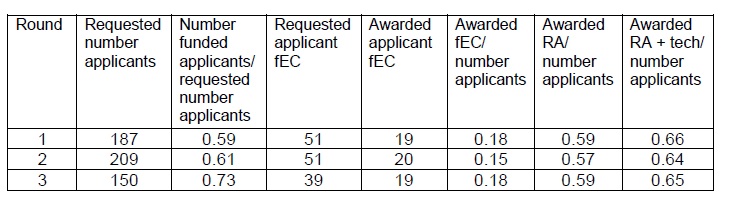
First, here is a table showing the number of academic staff for whom support was requested over the three years for which the consolidated grant system has been in existence (2011, 2012 and 2013 for rounds 1, 2 and 3 respectively).  You can see that the overall success rate was slightly better in round 3, possibly due to applicants learning more about the process over the cycle, but otherwise the outcomes seem reasonably consistent:

STFC_Con1

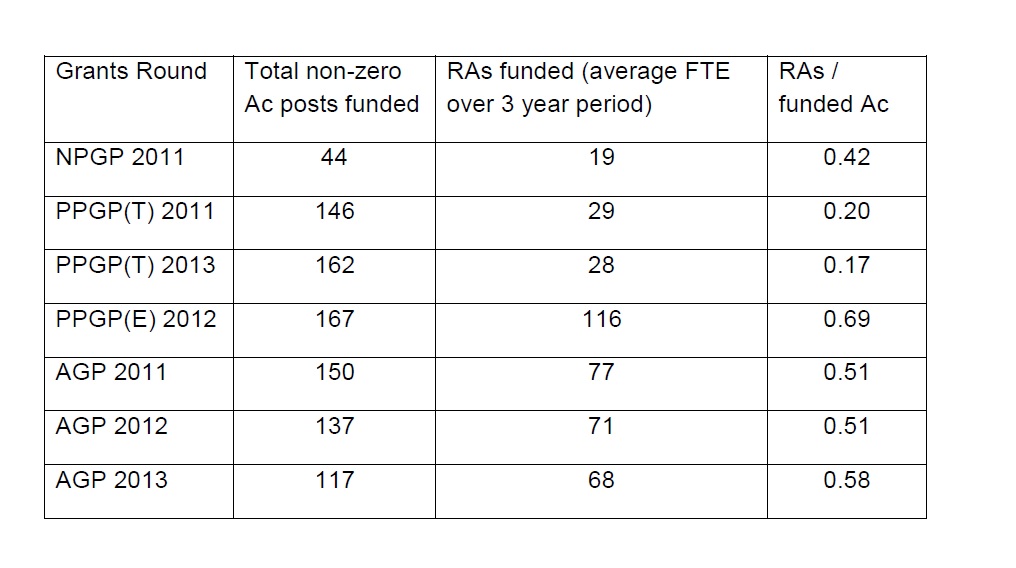
The last three rows of this table  on the other hand show quite clearly the impact of the “flat cash” settlement for STFC science funding on Postdoctoral Research Assistant (PDRA) support:
STFC_Con

Constant cash means ongoing cuts in real terms; there were 11.6% fewer Astronomy PDRAs supported in 2013 than in 2011. Job prospects for the next generation of astronomers continue to dwindle…

Any other comments, either on these tables or on the report as a whole, are welcome through the comments box.


It’s Official, it’s PLATO!

Posted in Science Politics, The Universe and Stuff with tags , , , , on February 19, 2014 by telescoper

Just a quick post to pass on the news that the European Space Agency has officially selected the third M-Class mission to form part of its Cosmic Vision Programme (which covers the period 2015-2025). The lucky winner is PLATO (PLAnetary Transits and  Oscillations of stars) and it will detect extra-solar planets by monitoring relatively nearby stars, searching for tiny, regular dips in brightness as planets transit in front of them. It will also study astroseismological activity, enabling a precise characterisation of the host star of each planet discovered, including its mass, radius and age.

plato_satelliteIt is expected that PLATO will find and analyse thousands of  such exoplanetary systems in this way, with an emphasis on discovering and characterizing Earth-sized planets and super-Earths in the habitable zone of their parent star. PLATO will be launched on a Soyuz rocket from Europe’s Spaceport in Kourou by 2024 for an initial six-year mission. It will operate from the Second Lagrange Point, or L2 for short. It’s an intriguing design consisting of 34 small telescopes (left).

PLATO joins Solar Orbiter and Euclid, which were chosen in 2011 as ESA’s first two M-class missions. Solar Orbiter will be launched in 2017 to study the Sun and solar wind from a distance of less than 50 million km, while Euclid, to be launched in 2020, will focus on dark energy, dark matter and the structure of the Universe.

The decision to select PLATO wasn’t exactly a surprise as it was singled out as the leading candidate by an expert panel last month, but there was nevertheless some nervousness among certain senior astronomers at the Royal Astronomical Society on Friday in advance of the formal decision. I suspect they’ll all be out celebrating tonight!

Hot News! Supernova in M82

Posted in The Universe and Stuff with tags , , , , , on January 22, 2014 by telescoper

Very exciting news today – a supernova has gone off in Messier 82. In fact, according to this sequence of images from Japan it actually started to brighten about a week ago:

psn-m82

Being arranged in Japanese fashion, you have to read these from top to bottom but starting at the right, so the supernova can be seen to be steadily brightening, i.e. decreasing in magnitude from 17.0 to 11.9. That means it’s now visible with binoculars and will have been seen already by many amateur astronomers. The exciting question this time is whether we’ll get any neutrinos from it!

UPDATE: I’m told that, close as it is, M82 is probably too far to detect neutrinos. Boo.

This is the nearest supernova since 1987a which was observed in, er, 1987. This is the nearest Type Ia supernova for a very long time (possibly 1937), so it’s of considerable interest for the use of such objects in cosmology. There have been other close ones since the nearest one I can remember, 1987a, which was observed in, er, 1987 but all have been Type II.

UPDATE: Thanks for the people who pointed out my error which I’ve left in to show that I don’t know much about supernovae so you shouldn’t phone me up to ask.

An Astronomical Teaser

Posted in Cute Problems, The Universe and Stuff with tags , , , , on January 1, 2014 by telescoper

For those of you who feel up to a little brain-teaser after last night’s revels, try this little problem which involves the use of everybody’s favourite type of astronomical measurement, the magnitude system. Answers through the comment box please!

A binary star at a distance of 100 pc has such a small separation between its component stars that it is unresolved by a telescope. If the apparent visual magnitude of the combined image of the system is 10.5, and one star is known to have an absolute visual magnitude of 9.0, what is the absolute visual magnitude of the other star?