Archive for Astrophysics

Western Sydney

Posted in Biographical, Open Access with tags , , , , , , on February 26, 2024 by telescoper

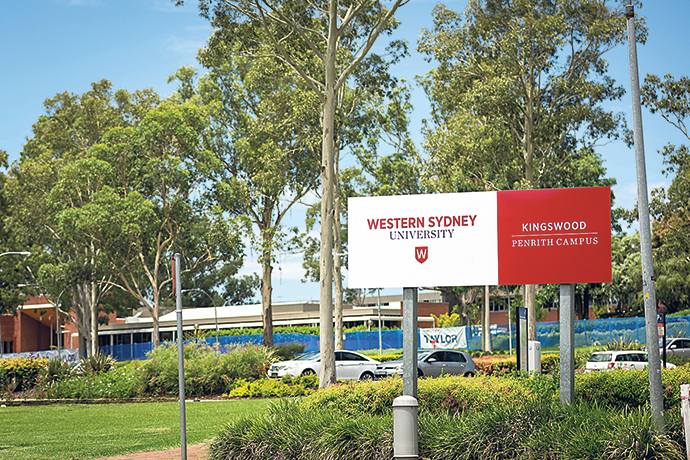
Today I made a journey by train to Kingswood, a suburb of Sydney which is the location of one of the campuses of Western Sydney University (WSU). The journey of about 50 km takes about an hour on the stopping train (T1) from Sydney Central Station. I was intrigued that the final destination for the train I got was Emu Plains; I had visions of vast herds of Emus gathered there, but I had to get off the stop before the terminus so never saw them. There’s about a 20-minute walk to the campus from Kingswood Station. It was quite warm so I was grateful when one of my hosts offered me a lift back to Kingswood Station at the end of my visit.

The reason for my visit was set another seminar about Open Access Publishing in Astrophysics. Here are the slides:

Although I’ve given a talk based on more-or-less the same slides recently, it always comes out slightly different. There was a bigger audience than I expected in the room, supplemented by even more on Zoom. The topic of Open Access Publishing does seem to be pretty hot these days in Australia and there was quite a lively discussion. I have a feeling we might have a manuscript or two submitted from WSU before too long.

Kingswood is a far less affluent area than where I am staying in Ultimo, and WSU is an institution that’s very different from the University of Sydney itself, but it was good to see another side of the city, geographically as well as socially. Thank you to everyone who attended and, especially, to Luke Barnes for inviting me and for lunch and coffee!

On the train back into Sydney I noticed that trains going in the opposite direction where crammed full, with (mostly) teenage girls heading to Olympic Park for a Taylor Swift concert. My train, heading into Sydney was fairly empty by contrast and the journey back pleasant enough.

The Centre for Astrophysics and Space Science at Maynooth (CASM)

Posted in Maynooth, The Universe and Stuff with tags , , on September 5, 2023 by telescoper

As part of effort to bring about closer interactions between members of the Departments of Theoretical Physics and Experimental Physics at MaynoothUniversity, we have formed a Centre for Astrophysics and Space Science which now has its own web pages.

The members of CASM have been meeting regularly together for coffee on Tuesdays for over a year, during which time more people have joined the Centre.

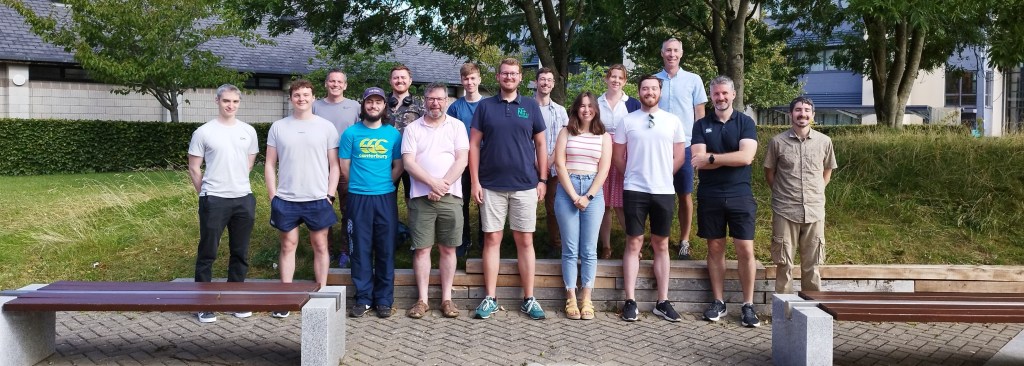
Today being a nice day we decided to make a team photograph showing staff, postgrads, and postdocs split roughly evenly between the two Departments. There’s also an undergraduate who has been working with us through the summer and helped to set up the web pages.

The People of CASM

Not everyone was able to be there this morning, but it’s lovely to see the group as big as this. I think it will be even bigger when I get back from my sabbatical next year…

Astronomy Plot of the Week

Posted in The Universe and Stuff with tags , , on April 19, 2023 by telescoper

Pictures made by observational astronomers, like the one I featured a couple of days ago, often feature on various sites as “Astronomy Pic of the Week” or such. I’ve often thought that this disadvantages astrophysicists of the more theoretical sort and wondered why don’t we do same with graphical illustrations of other kinds. On that basis, I offer this (found here) as my inaugural Astrophysics Plot of the Week:

Its explanatory power is matched by its simplicity and elegance.

Essays and (Computational) Physics

Posted in Biographical, Education, Maynooth with tags , , , , , on March 14, 2023 by telescoper

There have been more news stories about ChatGPT and assessment in universities going around. There’s one here from The Journal and another here from The Conversation to give just two examples.

I wrote about this myself a couple of months ago in a post that included this:

I have to admit that I’ve never really understood the obsession in some parts of academia with “the student Essay” as a form of assessment. I agree that writing skills are extremely important but they’re not the only skills it is important for students to acquire during the course of a degree. Of course I’m biased because I work in Theoretical Physics, an area in which student essays play a negligible role in assessment. Our students do have to write project reports, etc, but writing about something you yourself have done seems to me to be different from writing about what other people have done. While forms of assessment in science subjects have evolved considerably over the last 50 years, other domains still seem to concentrate almost exclusively on “The Essay”.

Whatever you think about the intrinsic value of The Essay (or lack thereof) it is clear that if it is not done in isolation (and under supervision) it is extremely vulnerable to cheating.

A few people have retorted that communication skills are very important in higher education. I agree with that wholeheartedly, but it seems to me that (a) there are other ways of communicating than via formal essays and (b) there are, should be, more to academic study than  writing about things.

That said, I do think we could be doing more in some disciplines, including my own, to cultivate communication skills in general and writing skills in particular. In Theoretical Physics we certainly don’t do this as much as we should. I do have a project report in my 3rd Year computational physics module, but that is a relatively short document and the report itself counts only one-third of the marks (and the project is only 40% of the module mark).

These thoughts somehow reminded me of this. You can click on it to make it bigger if it’s difficult to read. It was the first paper (called colloquially Paper Zero) of my finals examination at the University of Cambridge way back in 1985, getting on for 40 years ago:

wpid-wp-1425648226410.jpeg

As you can probably infer from the little circle around number 4, I decided to write an Essay about topic 4. I’ve always been interested in detective stories so this was an easy choice for me, but I have absolutely no idea what I wrote about for three hours. Nor do I recall actually ever getting a mark for the essay, so I never really knew whether it really counted for anything. I do remember, however, that I had another 3-hour examination in the afternoon of the same day, two three-hour examinations the following day, and would have had two the day after that had I not elected to do a theory project which let me off one paper at the end and for which I got a good mark.

Anyway, to get back to the essay paper, we certainly don’t set essay examinations like that here in the the Department of Theoretical Physics at Maynooth University and I suspect they no longer do so in the Department of Physics at Cambridge either. At the time I didn’t really see the point of making students write such things under examination conditions but then we didn’t have ChatGPT way back then. No doubt it could generate a reasonable essay on any of the topics given.

I am skeptical about whether any of my 3rd year computational physicists would use ChatGPT to write their reports, but they might. But ChatGPT can write Python code too. Am I worried about that? Not greatly. I’ve asked it to write scripts for the various class exercises I’ve set so far and the code it has produced has usually failed. It will get better though….

Astrophysics & Cosmology Masterclass Next Week!

Posted in Maynooth, The Universe and Stuff with tags , , , , on November 11, 2022 by telescoper

As next week is Science Week I thought I’d remind readers that as part of the festivities we are hosting a virtual  Masterclass in Astrophysics & Cosmology in Maynoothon Wednesday 16th November 2022  .

You may remember that we have presented such events twice before. Last year’s event was a particularly big success, with over a hundred schools joining in, with probably over a thousand young people listening and asking questions.

Like last year’s event this year’s will be a half-day virtual event via Zoom. It’s meant for school students in their 5th or 6th year of the Irish system. There might be a few of them or their teachers who see this blog so I thought I’d share the news here. You can find more information, including instructions on how to book a place, here.

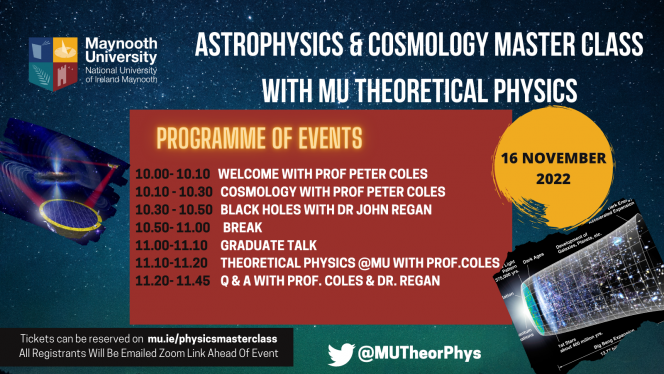
Here is the flyer for the event:

I’ll be talking about cosmology early on, and John Regan will talk about black holes later on. After the coffee break one of our students will talk about why they wanted to study astrophysics. Then I’ll say something about our degree programmes for those students who might be interested in studying astrophysics and/or cosmology as part of a science course. We’ll finish with questions either about the science or the studying!

Here is a more detailed programme:

Astrophysics & Cosmology Masterclass at Maynooth

Posted in Education, Maynooth, The Universe and Stuff with tags , , , on October 24, 2022 by telescoper

Regular readers of the blog – both of them – may remember that we have twice previously presented a Masterclass in Astrophysics & Cosmology in Maynooth. Well, owing to popular demand, we’ve decided to do a re-run of the event on Wednesday 16th November 2022 during this year’s Science Week. Last year’s event was a big success, with over a hundred schools joining in, with probably over a thousand young people listening and asking questions.

Like last year’s event this year’s will be a half-day virtual event via Zoom. It’s meant for school students in their 5th or 6th year of the Irish system. There might be a few of them or their teachers who see this blog so I thought I’d share the news here. You can find more information, including instructions on how to book a place, here.

Here is the flyer for the event:

I’ll be talking about cosmology early on, and John Regan will talk about black holes later on. After the coffee break one of our students will talk about why they wanted to study astrophysics. Then I’ll say something about our degree programmes for those students who might be interested in studying astrophysics and/or cosmology as part of a science course. We’ll finish with questions either about the science or the studying!

Here is a more detailed programme:

Fortunately this year I don’t need to dash away at noon to do a lecture!

Final Reminder – Professorial Position in Observational Astrophysics or Cosmology at Maynooth!

Posted in Maynooth, The Universe and Stuff with tags , , , , on July 1, 2022 by telescoper

With just a few days to go to the deadline (3rd July), I thought I would take the opportunity to remind readers that Maynooth University has a Chair (i.e. Full Professor) position in Astrophysics or Cosmology under the Strategic Academic Leadership Initiative (SALI). I blogged about this scheme here and announced this Chair position originally here.

You can find the full announcement of the competition for all the SALI positions here; you can apply for the position at Maynooth here. The position is now also advertised on the AAS Jobs Register here.

As I said, the deadline for applications is 3rd July 2022, and the provisional start date is January 2023 (although this is flexible). As well as a good salary (starting at €124,683 at current rates, rising by annual increments to €157,611) the position comes with membership of the Irish public service pension scheme, a defined benefit scheme (comparable to the older version of the UK’s USS which has now been scrapped).

The key rationale for these SALI positions is clear from the statement from Simon Harris, the Minister responsible for Third Level education in Ireland:

“Championing equality and diversity is one of the key goals of my department. The Senior Academic Leadership Initiative (SALI) is an important initiative aimed at advancing gender equality and the representation of women at the highest levels in our higher education institutions.

We have a particular problem with gender balance among the staff in Physics in Maynooth, especially in Theoretical Physics where all the permanent staff are male, and the lack of role models has a clear effect on our ability to encourage more female students to study with us.

The wider strategic case for this Chair revolves around broader developments in the area of astrophysics and cosmology at Maynooth. Currently there are two groups active in research in these areas, one in the Department of Experimental Physics (which is largely focussed on astronomical instrumentation) and the other, in the Department of Theoretical Physics, which is theoretical and computational. We want to promote closer collaboration between these research strands. The idea with the new position is that the holder will nucleate and lead a new research programme in the area between these existing groups as well as getting involved in outreach and public engagement.

It is intended that the position to appeal not only to people undertaking observational programmes using ground-based facilities (e.g. those provided by ESO, which Ireland recently joined), or those exploiting data from space-based experiments, as well as people working on multi-messenger astrophysics, gravitational waves, and so on.

Exciting as this position is in itself, it is part of wider developments and we are expecting to advertise further job opportunities in physics and astronomy very soon! I’d be happy to be contacted by any eligible person wishing to discuss this position (or indeed the general situation in Maynooth) on an informal basis.

Professorial Position in Observational Astrophysics or Cosmology at Maynooth!

Posted in Maynooth, The Universe and Stuff with tags , , , , on May 30, 2022 by telescoper

With about a month to go to the deadline, I thought I would take the opportunity to remind readers that Maynooth University has a Chair (i.e. Full Professor) position in Astrophysics or Cosmology under the Strategic Academic Leadership Initiative (SALI). I blogged about this scheme here and announced this Chair position originally here.

You can find the full announcement of the competition for all the SALI positions here; you can apply for the position at Maynooth here. The position is now also advertised on the AAS Jobs Register here.

The deadline for applications is in July 2022, and the provisional start date is January 2023 (although this is flexible). As well as a good salary (starting at €124,683 at current rates, rising by annual increments to €157,611) the position comes with membership of the Irish public service pension scheme, a defined benefit scheme (comparable to the older version of the UK’s USS which has now been scrapped).

The key rationale for these SALI positions is clear from the statement from Simon Harris, the Minister responsible for Third Level education in Ireland:

“Championing equality and diversity is one of the key goals of my department. The Senior Academic Leadership Initiative (SALI) is an important initiative aimed at advancing gender equality and the representation of women at the highest levels in our higher education institutions.

We have a particular problem with gender balance among the staff in Physics in Maynooth, especially in Theoretical Physics where all the permanent staff are male, and the lack of role models has a clear effect on our ability to encourage more female students to study with us.

The wider strategic case for this Chair revolves around broader developments in the area of astrophysics and cosmology at Maynooth. Currently there are two groups active in research in these areas, one in the Department of Experimental Physics (which is largely focussed on astronomical instrumentation) and the other, in the Department of Theoretical Physics, which is theoretical and computational. We want to promote closer collaboration between these research strands. The idea with the new position is that the holder will nucleate and lead a new research programme in the area between these existing groups as well as getting involved in outreach and public engagement.

It is intended that the position to appeal not only to people undertaking observational programmes using ground-based facilities (e.g. those provided by ESO, which Ireland recently joined), or those exploiting data from space-based experiments, as well as people working on multi-messenger astrophysics, gravitational waves, and so on.

Exciting as this position is in itself, it is part of wider developments and we are expecting to advertise further job opportunities in physics and astronomy very soon! I’d be happy to be contacted by any eligible person wishing to discuss this position (or indeed the general situation in Maynooth) on an informal basis.

New Professorial Position in Astrophysics or Cosmology at Maynooth!

Posted in Maynooth, The Universe and Stuff with tags , , , , on March 31, 2022 by telescoper

You may recall that back in November 2021 we received word that Maynooth University had been awarded one of ten new senior professorial positions under the Strategic Academic Leadership Initiative (SALI). I blogged about this scheme here. The position we have been awarded is a Chair (Full Professorship) in Observational Astrophysics or Cosmology; you can find Maynooth University’s official response to the original announcement here.

The wheels have turned fairly slowly since the announcement but today at last the applications opened for the new Chairs, including the one in Maynooth. You can find the full announcement of the competition for all the positions here; you can apply for the position at Maynooth here. I think the advertisement will appear on a number of the standard job platforms (such as the Times Higher) too, although this is all being managed centrally. The deadline is in July 2022, and the provisional start date is January 2023 (although this is flexible).

Update: you can find an advertisement for the position on the Times Higher website here. A more complete advertisement can be found here.

The key rationale for these SALI positions is clear from the statement from Simon Harris, the Minister responsible for Third Level education in Ireland:

“Championing equality and diversity is one of the key goals of my department. The Senior Academic Leadership Initiative (SALI) is an important initiative aimed at advancing gender equality and the representation of women at the highest levels in our higher education institutions.

We have a particular problem with gender balance among the staff in Physics in Maynooth, especially in Theoretical Physics where all the permanent staff are male, and the lack of role models has a clear effect on our ability to encourage more female students to study with us.

The wider strategic case for this Chair revolves around broader developments in the area of astrophysics and cosmology at Maynooth. Currently there are two groups active in research in these areas, one in the Department of Experimental Physics (which is largely focussed on astronomical instrumentation) and the other, in the Department of Theoretical Physics, which is theoretical and computational. We want to promote closer collaboration between these research strands. The idea with the new position is that the holder will nucleate and lead a new research programme in the area between these existing groups as well as getting involved in outreach and public engagement.

It is intended that the position to appeal not only to people undertaking observational programmes using ground-based facilities (e.g. those provided by ESO, which Ireland recently joined), or those exploiting data from space-based experiments, as well as people working on multi-messenger astrophysics, gravitational waves, and so on.

Exciting as this position is in itself, it is part of wider developments and we are expecting to advertise further job opportunities in physics and astronomy very soon! I’d be happy to be contacted by any eligible person wishing to discuss this position (or indeed the general situation in Maynooth) on an informal basis.

P. S. For those of you reading this from outside Ireland the job includes a public service pension, a defined benefit scheme way better than the UK’s USS.

Great News for Astrophysics & Cosmology at Maynooth!

Posted in Education, Maynooth, Science Politics, The Universe and Stuff with tags , , , on November 29, 2021 by telescoper

I couldn’t resist a quick post in reaction to the announcement by the Irish Government of ten new senior professorial positions under the Strategic Academic Leadership Initiative (SALI). I blogged about this scheme here. Among the positions just announced is a new Chair in Observational Astrophysics or Cosmology at Maynooth University. You can find Maynooth University’s official response to the announcement here.

The pandemic has played havoc with my sense of the passage of time so I had to check my documents folder to see when we completed the application. It turns out to have been January this year; the deadline was 29th January 2021. It has taken much longer than expected to for the outcome of this, the second, round to emerge but I suppose it’s better late than never!

The key rationale for these SALI positions is clear from the statement from Simon Harris, the Minister responsible for Third Level education in Ireland:

“Championing equality and diversity is one of the key goals of my department. The Senior Academic Leadership Initiative (SALI) is an important initiative aimed at advancing gender equality and the representation of women at the highest levels in our higher education institutions.

We have a particular problem with gender balance among the staff in Physics in Maynooth, especially un Theoretical Physics where all the permanent staff are male, and the lack of role models has a clear effect on our ability to encourage more female students to study with us.

The wider strategic case for this Chair revolves around broader developments in the area of astrophysics and cosmology at Maynooth. Currently there are two groups active in research in these areas, one in the Department of Experimental Physics (which is largely focussed on astronomical instrumentation) and the other, in the Department of Theoretical Physics, which is theoretical and computational. We want to promote closer collaboration between these research strands. The idea with the new position is that the holder will nucleate and lead a new research programme in the area between these existing groups as well as getting involved in outreach and public engagement.

The next step will be to launch a recruitment campaign, and more details will be available when the position is formally advertised. Let me just say for now that we intend the position to appeal not only to people who have their own observational programmes (e.g. using facilities provided by ESO, which Ireland recently joined) but also working on data from space missions, multi-messenger astrophysics, gravitational waves, and so on.