Archive for black hole

That Exciting New Black Hole Picture!

Posted in Uncategorized with tags , , , , on March 27, 2024 by telescoper

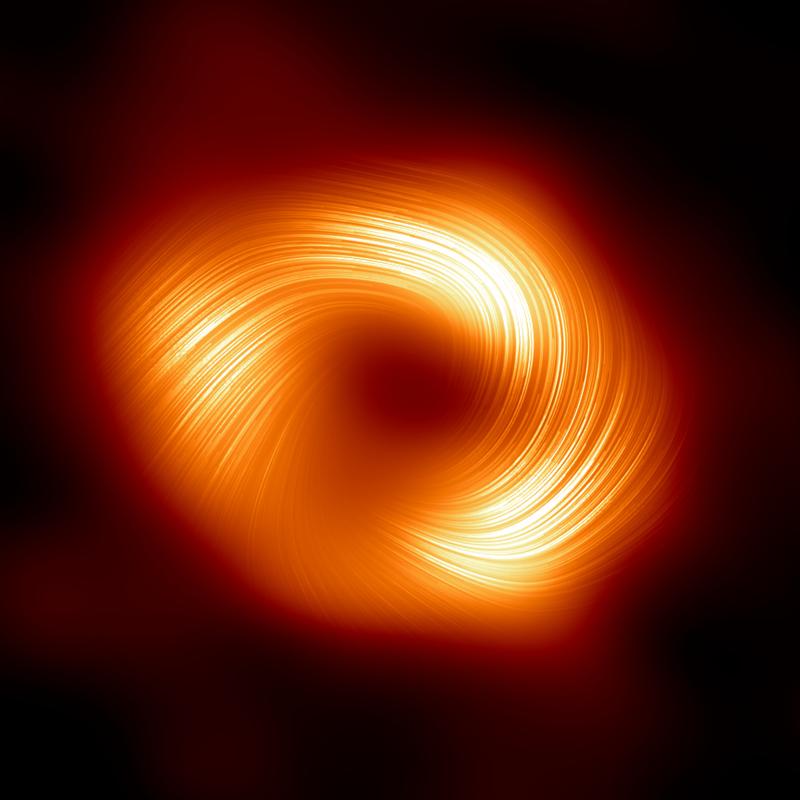
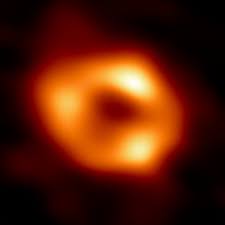
At a press conference earlier today, scientists from the Event Horizon Telescope revealed an exciting new picture of the environs of Sgr A* the black hole at the centre of the Milky Way that shows structures associated with a powerful magnetic field:

You can see immediately the enormous advantage of using a paintbrush (left) rather than a crayon (right) to make such images. For more details, see the press release here or the two papers about this work, here and here.

Newsflash: another Neutron Star – Black Hole merger?

Posted in The Universe and Stuff with tags , , , , , on May 18, 2023 by telescoper
Fanciful “artist’s impression” of a Neutron Star – Black Hole merger (from last time).

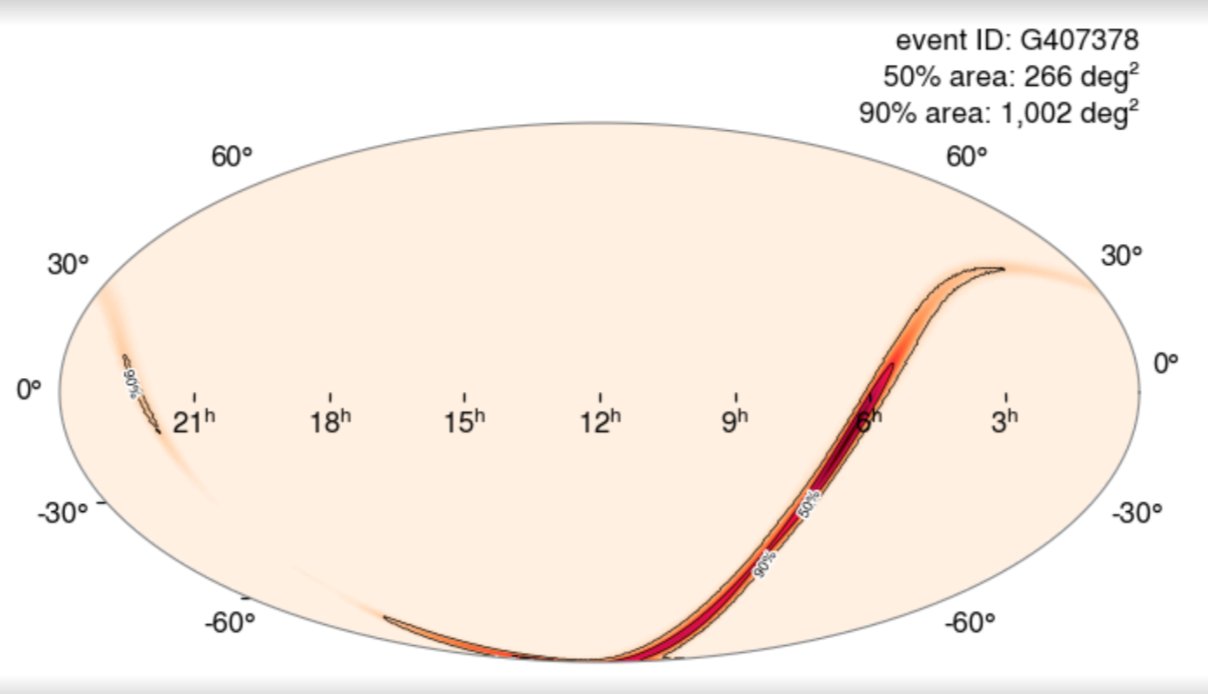
It seems that the engineering data ahead of the imminent observing run from the newly refurbished LIGO gravitational wave observatory has just triggered an alert for astronomers to look for an electromagnetic counterpart. The code number for this candidate event is S230518h. If confirmed this could very well be another Neutron-Star – Black Hole merger event. The search area is rather large, with the 90% probability region being about 1002 square degrees on the sky:

For more details, see here.

I’m reminded about the excitement surrounding the first Neutron Star merger way back in 2017. In fact, rumours started to spread via this blog as people outside the LIGO/transient source community used a comments thread here to share information of where telescopes were looking. Those were the days. Was that really 6 years ago?

Our own Galactic Black Hole

Posted in The Universe and Stuff with tags , , , , on May 12, 2022 by telescoper

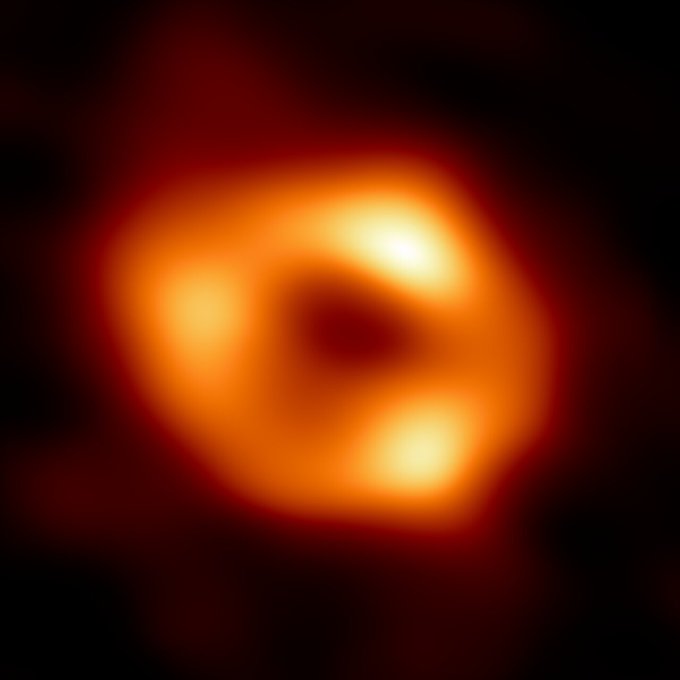
As I mentioned a while ago the Event Horizon Telescope team held a press conference this afternoon and to nobody’s surprise they used it announce an image of the (shadow of the event horizon around the) black hole at the centre of the Milky Way.

Here it is:

You can read the full press release here.

You may recall a great deal of excitement about three years ago concerning the imaging of the “shadow” of the event horizon of the black hole in the centre of the galaxy M87. The question I was asked most frequently back then is that there’s a much closer black hole in the centre of our own Galaxy, the Milky Way, so why wasn’t that imaged first?

It it true is that the black hole in the centre of M87 is ~103 times further away from us than the black hole in the centre of the Milky Way – known to its friends as Sagittarius A* or SgrA* for short – but is also ~103 times more massive, so its Schwarzschild radius is ~103 times larger. In terms of angular resolution, therefore, the observational challenge of imaging the event horizon is similar in the two cases. However, in the the case of the Milky Way’s black hole the timescales involved are much shorter than in M87 and there is a greater level of obscuration along the line of sight. That’s why it took longer to produce the image.

It’s a very difficult observation of course and I’m not sure of the significance of the “lumps” you can see, but the dark region in the centre is what the image is really about and that seems to be exactly the predicted size. The resolution is about 20 microarcseconds. Congratulations to the Event Horizon Telescope team!

If you’re interested in learning more about how this image was made I recommend this short video:

Astronomical Heads Up

Posted in The Universe and Stuff with tags , , , , on May 3, 2022 by telescoper

You may recall a great deal of excitement about three years ago concerning the imaging of the “shadow” of the event horizon of the black hole in the centre of the galaxy M87. There was so much interest in this measurement that you could hardly move without seeing this picture somewhere or other:

The question I was asked most frequently back then is that there’s a much closer black hole in the centre of our own Galaxy, the Milky Way, so why wasn’t that imaged first? The answer is that the black hole in the centre of M87 is about 1000 times further away from us than the black hole in the centre of the Milky Way – known to its friends as Sagittarius A* or SgrA* for short – but is also about 1000 times more massive, so its Schwarzschild radius is 1000 times larger. In terms of angular resolution, therfore, the observational challenge of imaging the event horizon is similar in the two cases.

I mention this because the Event Horizon Telescope team who made the above image are holding a press conference next week at ESO on “groundbreaking Milky Way results from the Event Horizon Telescope Collaboration”.

I wonder what these “groundbreaking results” might be?

What kind of thing is GW190814?

Posted in The Universe and Stuff with tags , , , , , , , on June 24, 2020 by telescoper

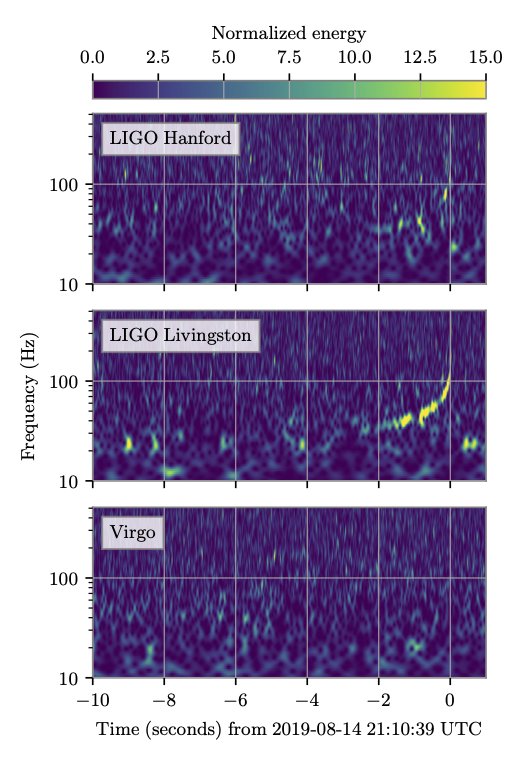
There’s been a lot of interest in the past day or two over an event that occurred in the LIGO detectors last August, entitled GW190814. A paper has appeared declaring this to be “the observation of a compact binary coalescence involving a 22.2–24.3 M  black hole and a compact object with a mass of 2.50–2.67 M “. That would be interesting of course because the smaller object is smaller than the black holes involved in previous detections and its mass suggests the possibility that it may be a neutron star, although no electromagnetic counterpart has yet been detected.  It’s a mystery.

I was quite excited when I saw the announcement about this yesterday but my enthusiasm was dampened a bit when I saw the data from the two LIGO detectors at Hanford and Livingston in the USA and the Virgo detector in Italy.

Visually, the Livingston detection seems reasonably firm, but the paper notes that there were thunderstorms in the area at the time of  GW190814 which affected the low-frequency data. There doesn’t look like anything at all but noise in the Virgo channel. The Hanford data may show something but, according to the paper, the detector was “not in nominal observing mode at the time of GW190814” so the data from this detector require special treatment. What you see in the Hanford channel looks rather similar to the two (presumably noise) features seen to the left in the Livingston plot.

I know that – not for the first time – I’m probably going to incur the wrath of my colleagues in the gravitational waves community but I have to sound a note of caution. Before asking whether the event involves a black hole or a neutron star you have to be convinced that the event is an event at all.  Fortunately, at least some of the data relating to this have been released and will no doubt be subjected to independent scrutiny.

Now I’m going to retreat into my bunker and hide from the inevitable comments…

Results from the Event Horizon Telescope

Posted in Astrohype, The Universe and Stuff with tags , , on April 10, 2019 by telescoper

Following yesterday’s little teaser, let me point out that there is a press conference taking place today (at 2pm Irish Summer Time, that’s 3pm Brussels) to announce a new result from the Event Horizon Telescope. The announcement will be streamed live here.

Sadly, I’m teaching at the time of the press conference so I won’t be able to watch, but that doesn’t mean that you shouldn’t!

I’ll post pictures and comments when I get back. Watch this space. Or you could watch this video..

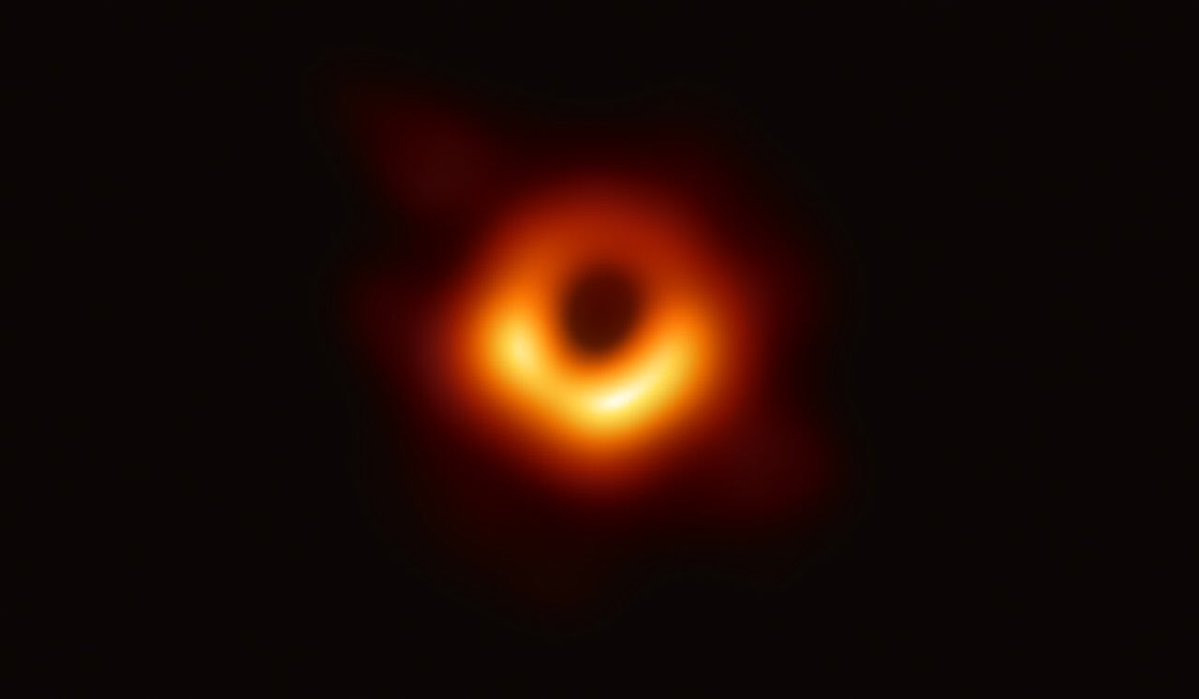
UPDATE: Well, there we are. Here is the image of the `shadow’ of the event horizon around the black hole in M87:

The image is about 42 micro arcseconds across. I guess to people brought up on science fiction movies with fancy special effects the image is probably a little underwhelming, but it really is an excellent achievement to get that resolution. Above all, it’s a great example of scientific cooperation – 8 different telescopes all round the world. The sizeable European involvement received a substantial injection of funding from the European Union too!

Other parameters are here:

The accompanying EU press release is here. Further information can be found here. The six publications relating to this result can be found here:

Gravitational Redshift around the Black Hole at the Centre of the Milky Way

Posted in The Universe and Stuff with tags , , , , , , on July 26, 2018 by telescoper

I’ve just been catching up on the arXiv, and found this very exciting paper by the GRAVITY collaboration (see herefor background on the relevant instrumentation). The abstract of the new paper reads:

The highly elliptical, 16-year-period orbit of the star S2 around the massive black hole candidate Sgr A* is a sensitive probe of the gravitational field in the Galactic centre. Near pericentre at 120 AU, ~1400 Schwarzschild radii, the star has an orbital speed of ~7650 km/s, such that the first-order effects of Special and General Relativity have now become detectable with current capabilities. Over the past 26 years, we have monitored the radial velocity and motion on the sky of S2, mainly with the SINFONI and NACO adaptive optics instruments on the ESO Very Large Telescope, and since 2016 and leading up to the pericentre approach in May 2018, with the four-telescope interferometric beam-combiner instrument GRAVITY. From data up to and including pericentre, we robustly detect the combined gravitational redshift and relativistic transverse Doppler effect for S2 of z ~ 200 km/s / c with different statistical analysis methods. When parameterising the post-Newtonian contribution from these effects by a factor f, with f = 0 and f = 1 corresponding to the Newtonian and general relativistic limits, respectively, we find from posterior fitting with different weighting schemes f = 0.90 +/- 0.09 (stat) +\- 0.15 (sys). The S2 data are inconsistent with pure Newtonian dynamics.

Note the sentence beginning `Over the past 26 years…’!. Anyway, this remarkable study seems to have demonstrated that, although the star S2 has a perihelion over a thousand times the Schwarzschild radius of the central black hole, the extremely accurate measurements demonstrate departures from Newtonian gravity.

The European Southern Observatory has called a press conference at 14.00 CEST (13.00 in Ireland and UK) today to discuss this result.

Newsflash: another LIGO detection!

Posted in The Universe and Stuff with tags , , , on June 1, 2017 by telescoper

I’ve just heard the news that  LIGO has just announced the detection of another gravitational-wave signal, which has been given the identifier GW170104; it was detected on 4th January 2017.

The event was the merger of a black-hole binary system a redshift z=0.2, which is a proper distance of about 800 Mpc in the standard cosmological model, the most distant event yet detected. There are also tantalising hints that at least one of the black holes had spin opposite the orbital angular momentum, which implies it may have originated in a globular cluster. For more details please see the refereed paper.

If you’d rather just look at the plot here is the evidence for the event, in the form of coincident signals at the two components of LIGO:

 
LIGO

I reckon there’s a good chance of seeing members of the Cardiff University Gravitational Physics group celebrating in the pub later this evening!

It’s also a reasonable inference given the rate of detection of these events so far that we’re going to see many more in the very near future!

Formation of black holes in the dark [HEAP]

Posted in The Universe and Stuff with tags , on September 28, 2016 by telescoper

Given the title of my website I could hardly resist reblogging this arXiver post. I’m not an expert on Black Hole (BH) formation, so would be interested to hear opinions on how plausible is this idea that massive BHs might form via implosion rather than following a Supernova explosion.

arxiver's avatararXiver

http://arxiv.org/abs/1609.08411

A binary black hole (BBH) with components of 30-40 solar masses as the source of gravitational waves GW150914 can be formed from a relatively isolated binary of massive stars if both BHs are formed by implosion, namely, by complete or almost complete collapse of massive stars with no energetic SNe accompanied by a sudden mass loss that would significantly reduce the mass of the compact objects, and in most cases unbind the binary system. BBHs can also be formed by dynamical interactions in globular clusters, if the BHs are formed with no energetic SNe that would kick the BHs out from the cluster before BBH formation. Besides, if BHs of ~10 solar masses as in the source GW151226 are formed by implosion, the formation of BBHs would be prolific, and their fusion would make an important contribution to a stochastic gravitational wave background. Theoretical models set mass ranges for…

View original post 183 more words

Making Massive Black Hole Binaries Merge

Posted in The Universe and Stuff with tags , , , , , on February 16, 2016 by telescoper

Many fascinating questions remain unanswered by last week’s detection of gravitational waves produced by a coalescing binary black hole system (GW150914) by LIGO. One of these is whether the fact that the similarity of the component masses (29 and 36 times the mass of the Sun respectively) is significant.

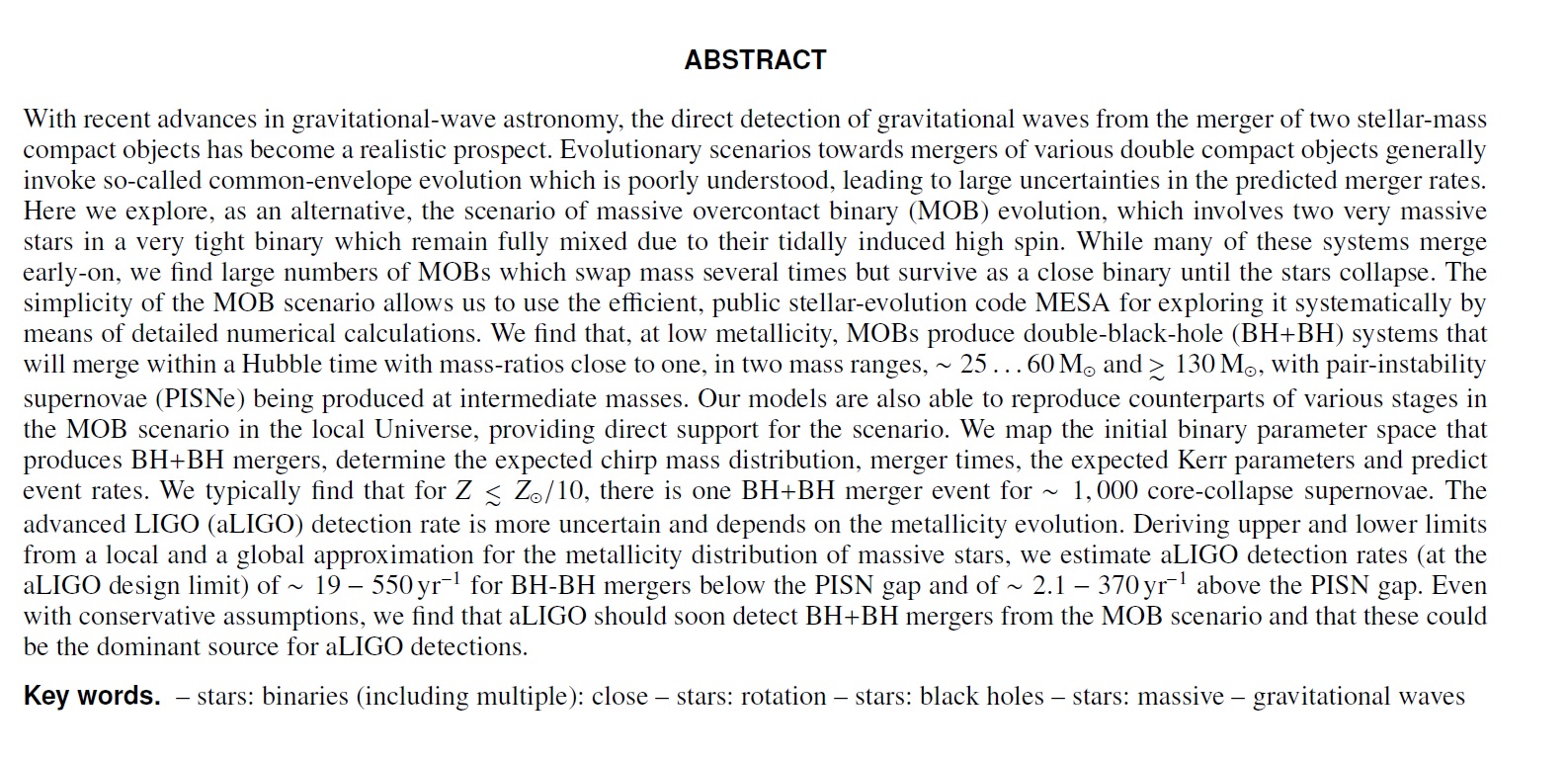
An interesting paper appeared on the arXiv last week by Marchant et al. that touches on this. Here is the abstract (you can click on it to make it larger):
BinaryBH


Although there is some technical jargon, the point is relatively clear. It appears that very masssive, very low metallicity binary stars can evolve into black hole binary systems via supernova explosions without disrupting their orbit. The term ‘low metallicity’ characteristises stars that form from primordial material (i.e. basically hydrogen and helium) early in the cycle of stellar evolution. Such material has very different opacity properties from material with significant quantities of heavier elements in it, which alters the dynamical evolution considerably.

(Remember that to an astrophysicist, chemistry is extremely simple. Hydrogen and helium make up most of the atomic matter in the Universe; all the rest is called “metals” including carbon, nitrogen, and oxygen…. )

Anyway, this theoretical paper is relevant because the mass ratios produced by this mechanism are expected to be of order unity, as is the case of GW150914.  One observation doesn’t prove much, but it’s definitely Quite Interesting…

Incidentally, it has been reported that another gravitational wave source may have been detected by LIGO, in October last year. This isn’t as clean a signal as the first, so it will require further analysis before a definitive result is claimed, but it too seems to be a black hole binary system with a mass ratio of order unity…

You wait forty years for a gravitational wave signal from a binary black hole merger and then two come along in quick succession…