Archive for Charlie Parker

Bird 100: Ah Leu Cha

Posted in Jazz with tags , , , on August 29, 2020 by telescoper

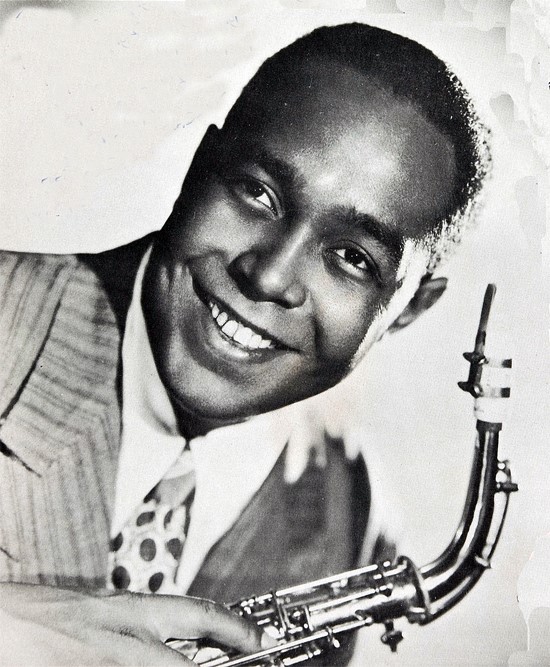
Second post today to mark the centenary of the great alto saxophonist Charlie Parker (“Bird”), undoubtedly one of the most influential musicians of the twentieth century. Together with trumpeter Dizzy Gillespie, Bird effectively created a revolution in Jazz after the end of World War II in the form of a new style called bebop.

Sadly, as with many Jazz legends, Charlie Parker died young as a result of chronic alcoholism and, especially in his case, drug addiction. He became hooked on heroin when he was a teenager and when he couldn’t get heroin he used anything else he could. The result was a body ravaged by abuse and a career frequently interrupted by illness. When he died, at the age of 35, the doctor who signed his death certificate estimated his age as “about 60”.

I remember, as a teenager, finding a Charlie Parker LP in a second-hand record shop and buying it for 50p. When I got home I put it straight on the record player and couldn’t believe my ears when I heard the staggering virtuosity of his playing. I just didn’t realise the alto sax could be played the way he played it. I’ve been a devout Charlie Parker fan ever since, although most of recorded output is quite difficult to get your hands on. In fact, the first record I bought as an LP has never been released on CD, which I think is a scandal.

Many people I know can’t really stand any Jazz that’s stylistically dated after about 1940. I have never really understood this attitude. To my mind the two tracks I’ve picked here, recorded in 1948, sound as fresh and exciting to me now as they did when I first heard them 30 years ago. They also seem to me firmly rooted in a wonderful tradition of music-making that reaches back to Louis Armstrong and King Oliver and forward to the likes of John Coltrane, Eric Dolphy and Ornette Coleman. Anyway, I’m not going to preach. I love this music and it’s up to you whether you agree or not.

Parker’s ideas didn’t just remain within jazz, and bebop had a huge cultural influence on post-war America. It never became as popular as pre-war Jazz, but had a devoted following on both sides of the Atlantic and breathed new creative life into a form that was in danger of becoming stale and commercialized.

The piece is called Ah Leu Cha and – as far as I’m aware – it is the only tune Bird ever wrote that involves any kind of counterpoint (provided by a very young Miles Davis on trumpet).

Bird 100: Anthropology

Posted in Jazz with tags , , , , , , on August 29, 2020 by telescoper

Today marks the 100th anniversary of the birth of the great Charlie Parker, who was known to his friends as “Bird”. I’ve posted more than a few examples of Charlie Parker’s music over the years so I thought I’d celebrate the centenary with a bit of a flood.

I thought I’d start with this clip (inevitably without video I’m afraid) is in fact taken from the first ever Charlie Parker LP I bought when I was about 15 and which I still have. I bought it on impulse, not really knowing who Charlie Parker was, was this record that turned me onto his music and I’ve never turned off.

No information is provided on Youtube, but referring to the sleeve note reveals that the track was recorded from a radio broadcast live from Birdland in New York City on March 31st 1951 using a primitive disc recording machine by an amateur recording buff called Boris Rose. The sound quality isn’t great, but he deserves much greater recognition for capturing this and so many other classic performances and preserving them for posterity.

The personnels consist of Charlie Parker (alto saxophone), Dizzy Gillespie (trumpet), Bud Powell (piano), Tommy Potter (bass) and Roy Haynes (drums).

Here’s what the sleevenote (written by Gary Giddens) says about this track:

“Anthropology is an “I Got Rhythm” variation which originally appeared, in a slightly different form, as “Thriving on a Riff” on Parker’s first session as leader. The tempo is insanely fast; the performance is stunning. Bird has plenty of ideas in his first chorus, but he builds the second and third around a succession of quotations: “Tenderly”, “High Society”, “Temptation.” Gillespie’s second chorus is especially fine – only Fats Navarro had comparable control among the trumpeters who worked with Bird. His blazing high notes tend to set his lyrical phrases in bold relief. Bud, the ultimate bop pianist (and much more), jumps in for two note-gobbling choruses: no quotes, though, it’s all Powell. The four bar exchanges that follow demonstrate Hayne’s precision.

Spot on, but words aren’t really enough to describe this scintillating music, so listen!

Bird of Paradise – In Memoriam Charlie Parker

Posted in Jazz with tags , , on March 12, 2018 by telescoper

Today is the 63rd anniversary of the death, in 1955 aged just 34, of the great saxophonist and composer Charlie Parker, also known as `Bird’.  I know a lot of people don’t really `get’ Bird’s way of playing, but for me he created some of the most beautiful and exciting sounds not only in jazz, but in any musical genre. Here, to mark his memory, is a piece called Bird of Paradise (a thinly disguised version of the Jerome Kern standard All The Things You Are) recorded in 1947 for the Dial label with a quintet that included a young (21 year-old) Miles Davis on trumpet. Miles Davis was still finding his way musically at the time of the Dial sessions, but Bird had already established himself as a powerful creative force and his solo on this number is absolutely exquisite.

Anachronic Anthropology

Posted in Jazz with tags , , , , on February 7, 2017 by telescoper

I’m struggling a bit with a heavy cold (or at least I hope that’s what it is) and I had a two-hour lecture earlier today so I’m going to go home and crash out. To keep my readers (Sid and Doris Bonkers) amused, I decided to repost this piece which I’ve actually posted before almost eight years ago. It’s an oddity, but quite an interesting one I think.

The Anachronic Jazz Band is, I think, now defunct but they were from Paris originally. The style they played in could probably be described as like the New York style of the late 1920s, with definite touches of Bix Beiderbecke. On the other hand, the tunes they played all came from the bebop era of modern jazz, such as this one which is the Charlie Parker classic Anthropology. 

You might think that an uncompromising bebop number like this would pose unsurmountable challenges for a traditional jazz outfit, but I think they pull it off rather well. I think though that they were probably helped by the fact that this tune, like many modern jazz compositions, is actually based on a chord progression belonging to a much more familiar tune. In this case the harmonies actually derive from George Gershwin’s standard I Got Rhythm….

Anyway, perhaps the efforts of this fine little band go some way to showing that there’s more continuity between traditional and modern jazz than one might suppose…


The Young Charlie Parker plays Cherokee

Posted in Jazz with tags , , , , on December 22, 2016 by telescoper

I came across this rare treasure on Youtube and couldn’t resist sharing it here. It features a very young Charlie Parker, with the relatively unknown Efferge Ware on guitar and Little Phil Phillips on drums, playing the jazz standard Cherokee. This track was recorded in 1941 (when he was only 21 years old) in Bird’s home town of Kansas City. There is a gap in Charlie Parker’s discography between 1942 and 1944, which was when the American Musicians Union called a strike which led to a ban on all commercial recordings. When the ban game to an end Charlie Parker’s recordings with Dizzy Gillespie, Max Roach, Bud Powell and others unleashed the new harmonic language of bebop on the general public from New York City where it had been incubating during the strike. Parker’s style had evolved greatly in the intervening two years which no doubt made his playing sound all the more revolutionary when the ban was lifted. Although this version of Cherokee is to some extent a pre-bebop recording, you can hear the originality and beauty of Bird’s improvisation (complete with cheeky quotation from the “Popeye” theme) and it’s clear where he was heading.

The sophisticated and complex chord sequence of Cherokee (with its trademark ii-7–V7–I progressions) made it a firm favourite with bop musicians who tended to play it even faster than this earlier version.
In 1945, during what was arguably the first ever bebop recording session, Charlie Parker and Dizzy Gillespie decided to play a variation of Cherokee using the same chords but a different head. During the first take the musicians absent-mindedly played the theme from Cherokee at which point there was a cry of anguish from the control room uttered by a producer, who obviously had hoped that if they stayed off the actual tune he wouldn’t have to pay composer’s royalties. They started again, made another take, called it Ko-Ko, and it became one of the classics.

The 1941 version is valuable from a historical perspective but you don’t have to be interested in that to enjoy the wonderful fluidity and invention of Bird’s playing. Happy Christmas!

Friday Music Quiz: The Yardbird Suite

Posted in History, Jazz with tags , , on September 30, 2016 by telescoper

Not much time to write today so I thought I’d put up a bit of music to end the week. This is a classic from 1946, featuring Charlie Parker leading a band that included a very young Miles Davis. The Yardbird Suite an original composition by Parker, and has become a jazz standard, but he never copyrighted the tune so never earned any royalties from it.

Now, here’s a little question to tease you with. Can anyone spot the connection between this tune and a notable event that occurred today, 30th September 2016?

Answers through the comments box please!


Dizzy Atmosphere

Posted in Jazz with tags , , , on July 6, 2016 by telescoper

Whenever I’m in dire need of inspiration – which happens a lot these days – I usually turn to music. I found this not long ago and decided to share it here because it’s not just inspirational, but awe-inspiring. I don’t have any information about the date or location of this  recording of Dizzy Atmosphere – except that it’s obviously live, and that it features the composer Dizzy Gillespie on trumpet after a great solo by the great Charlie Parker on alto saxophone. Bird is absolutely on fire in this performance!  In case you’re interested this is yet another bebop standard that’s built on rhythm changes though it is in an unusual key (A♭) for such pieces. Anyway, never mind about that, just listen to Bird flying through this!


The Top 10 Jazz Artists

Posted in Jazz with tags , , , , , on December 8, 2015 by telescoper

Back from a short break I thought I’d mention that BBC Radio 3 recently announced the results of a poll for the top Jazz artist of all time. The result was:

  1. Miles Davis
  2. Louis Armstrong
  3. Duke Ellington
  4. John Coltrane
  5. Ella Fitzgerald
  6. Charlie Parker
  7. Billie Holiday
  8. Thelonious Monk (8=)
  9. Bill Evans (8=)
  10. Oscar Peterson

Although my ordering would have been a little different, I was quite surprised that the top 10 corresponded so closely with my own selection. In fact 8 of the above list would have made it into mine: Miles Davis; Louis Armstrong; John Coltrane; Charlie Parker; Billie Holiday; Thelonious Monk; and Bill Evans.

The only differences were that (a) I couldn’t possibly have had Billie Holiday without having Lester Young and (b) I simply had to have Ornette Coleman in there. To accommodate Messrs Young and Coleman I would have displaced Ella Fitzgerald and Oscar Peterson. The latter are great artists, of course, but I wouldn’t say either influenced the development of Jazz as much as the others I mentioned, and that’s one of the criteria I applied.

miles-davis

No surprise that Miles Davis (above) came top. He changed musical direction so many times that he should actually count as four or five different musicians. It’s no coincidence that Miles Davis, John Coltrane and Bill Evans all appeared on Kind of Blue, which is arguably the greatest jazz record of all time. I don’t think any serious Jazz enthusiast could have left out Charlie Parker or Thelonious Monk either. And of course, Louis Armstrong just had to be there too. It’s hard to imagine what Jazz would have been without Satchmo. The same goes for the great Duke Ellington.

Anyway, it’s all a matter of personal choice. There are dozens of great jazz artists who didn’t make it into the top ten. Among my near misses were Coleman Hawkins, Sidney Bechet, Eric Dolphy and Dizzy Gillespie.

Who else would you have picked?


Bloomdido – In Memoriam Charlie Parker

Posted in Jazz with tags , , , , , , on March 12, 2015 by telescoper

bird

Today marks the 60th anniversary of the death of the great saxophonist Charlie Parker (“Bird”) on 12th March 1955. I’ve written quite a few posts relating to Charlie Parker over the years but today has provided a good excuse to spend my lunchtime writing another one, this time featuring one of my favourite tracks from one of my favourite albums. First released in 1952 but in fact recorded in two separate sessions in 1949 and 1950, the album Bird and Diz was actually the last studio album made under the joint leadership of Charlie Parker and Dizzy Gillespie, the two main architects of the bebop revolution; the track I’ve picked has the added advantage of featuring another great musical genius on piano, Thelonious Monk.

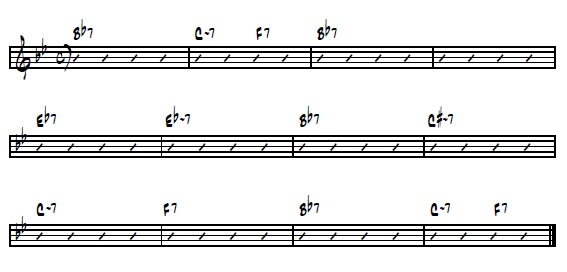
The Charlie Parker composition Bloomdido is yet another of his variations on the blues, though this one is a bit less intricate than some of the others he wrote. Here are the chords for Bloomdido:

Bloomdido

You can see that the progression is based around the standard three chords of a blues in B♭. The foundation is a  “tonic” chord (T) based on the root note of whatever key it’s played in, in this case B♭. This sometimes a basic triad consisting of the first, third and five notes of a major scale starting on that note or, as in this example,  including the dominant 7th so it’s B♭7. The next chord is the subdominant chord  (S), shifting things up by a perfect fourth relative to the tonic, in this case an E♭7 and then finally we have the dominant (D) which brings us up by a fifth from the original root note, in this case F7.

The basic blues sequence in B♭ would be four bars of B♭7 (T), two of E♭7 (S), back to B♭7 (T) for two, then the characteristic bluesy cadence returning to two bars of  B♭7 (T) via one bar each of F7 (D) and E♭7 (S). The sequence for Bloomdido has a few alterations, including a characteristic turnaround at the end instead of the tonic, but is otherwise fairly recognizable. I guess the first part of the title  is a play on the blues origin too, though I wonder if the second part suggests that some of the alterations are inspired by the A-section of the  Juan Tizol standard Perdido?

Some people tell me they find Charlie Parker’s music “too technical” and that somehow if music “needs to be explained” it’s not good music. I don’t understand that attitude at all. I find this music so fascinating and exciting to listen to that I want to try to dig a little bit into it and find out what’s going underneath the surface. It’s particularly striking what a difference a few substitutions and passing chords can make to the overall harmonic “feel” of a piece like this compared to a standard blues sequence, for example. But you don’t need to study the chords to appreciate the sheer beauty of the music that Charlie Parker built on these harmonic foundations; his solo on this track, as on so many others he recorded in his short life,  is just sublime even if you don’t realise how hard it is to play! I guess it all depends whether your way of enjoying a thing is to sit back and let it wash over you, or for it to inspire you to find out more. Many of the physicists I know are deeply interested in music. Perhaps that’s because they’re the sort of people who don’t just think “wow that’s beautiful”, they tend to think “wow that’s beautiful – how does it work?”.

Charlie Parker and Albert Einstein died in the same year, just over a month apart, the former in March 1955 and the latter in April. They were two very different geniuses but it’s as difficult to imagine physics without  Einstein as jazz without Bird.

The Giant Steps of Buddy DeFranco

Posted in Jazz with tags , , , , , , on January 11, 2015 by telescoper

Christmas Eve saw the passing of another great Jazz artist, the clarinettist Buddy DeFranco , at the grand old age of 91. Not surprisingly, glowing tributes to him have appeared in all the mainstream media as well as in specialist jazz sources as he was an absolutely superb musician as well as a distinctive stylist. Alongside countless other measures of his greatness and popularity, he won no less than twenty Downbeat Magazine Awards and nine Metronome Magazine Awards as the number one jazz clarinettist in the world.

It’s an interesting facet of jazz history that the clarinet, a mainstay of jazz styles from the New Orleans roots through to the Swing Era, fell into disfavour in the post-war era with the advent of bebop when it was largely eclipsed by the saxophone. Very few musicians persisted with the clarinet into the era of modern jazz, but Buddy DeFranco was one who did. That’s not to say that he disliked swing music though. In fact he began his career playing with big bands of that era, such as those led by Gene Krupa and Tommy Dorsey. One of the most famous bands of that era, the Glenn Miller Orchestra, formed in 1935 and saw its greatest popularity during the Second World War. It was disbanded in 1944 on the death of its leader, but it started again in 1956 and, although it has had a number of changes of personnel, it is still going strong. So strong that there’s a minimum two year waiting list if you want to book the Glenn Miller Orchestra for a gig! With the 70th anniversary of the end of World War Two coming up this year, I’ve no doubt that there’ll be a great deal of nostalgia evoked by renditions of Moonlight Serenade..

The distinctive sound of the original Glenn Miller Orchestra largely derived from the unusual arrangement of its reed section: usually four saxophones playing in harmony, topped by a high clarinet lead. Many jazz fans found that blend a bit too honeyed compared with the likes of, e.g., the Count Basie Orchestra but there’s no question that it gave the band an immediately recognisable sound. Despite his predilection for more modern jazz idioms, especially bebop, Buddy DeFranco obviously very much liked the idea of a big band with a clarinet playing such a prominent part and, in fact, he was the leader and musical director of the revived Glenn Miller Orchestra from 1966 until 1974, and also guested with them on a number of occasions after that.

Anyway, Buddy DeFranco was one of the most technically accomplished clarinettists in all of jazz. Very few have ever been able to match his control, particularly in the upper register. But what I admired most about him was his willingness to take on material not usually associated with his instrument. Here’s a great example, of him playing the John Coltrane classic Giant Steps together with Terry Gibbs on vibraphone. When I saw the relatively low quality reproduction of the film I assumed the sound quality would be similarly poor, but some superb remastering work has been done and this sounds terrific.

Rest In Peace, Buddy DeFranco (1923-2014).