Archive for circumstellar disks

Weekly Update from the Open Journal of Astrophysics – 16/08/2025

Posted in OJAp Papers, Open Access, The Universe and Stuff with tags , , , , , , , , , , , , on August 16, 2025 by telescoper

It’s time once again for the usual update of papers published at the Open Journal of Astrophysics which I do every Saturday. Since the last update we have published two new papers, which brings the number in Volume 8 (2025) up to 116, and the total so far published by OJAp up to 351. The summer lull we always expected is now upon us, so this will be a shorter post than we have had of late.

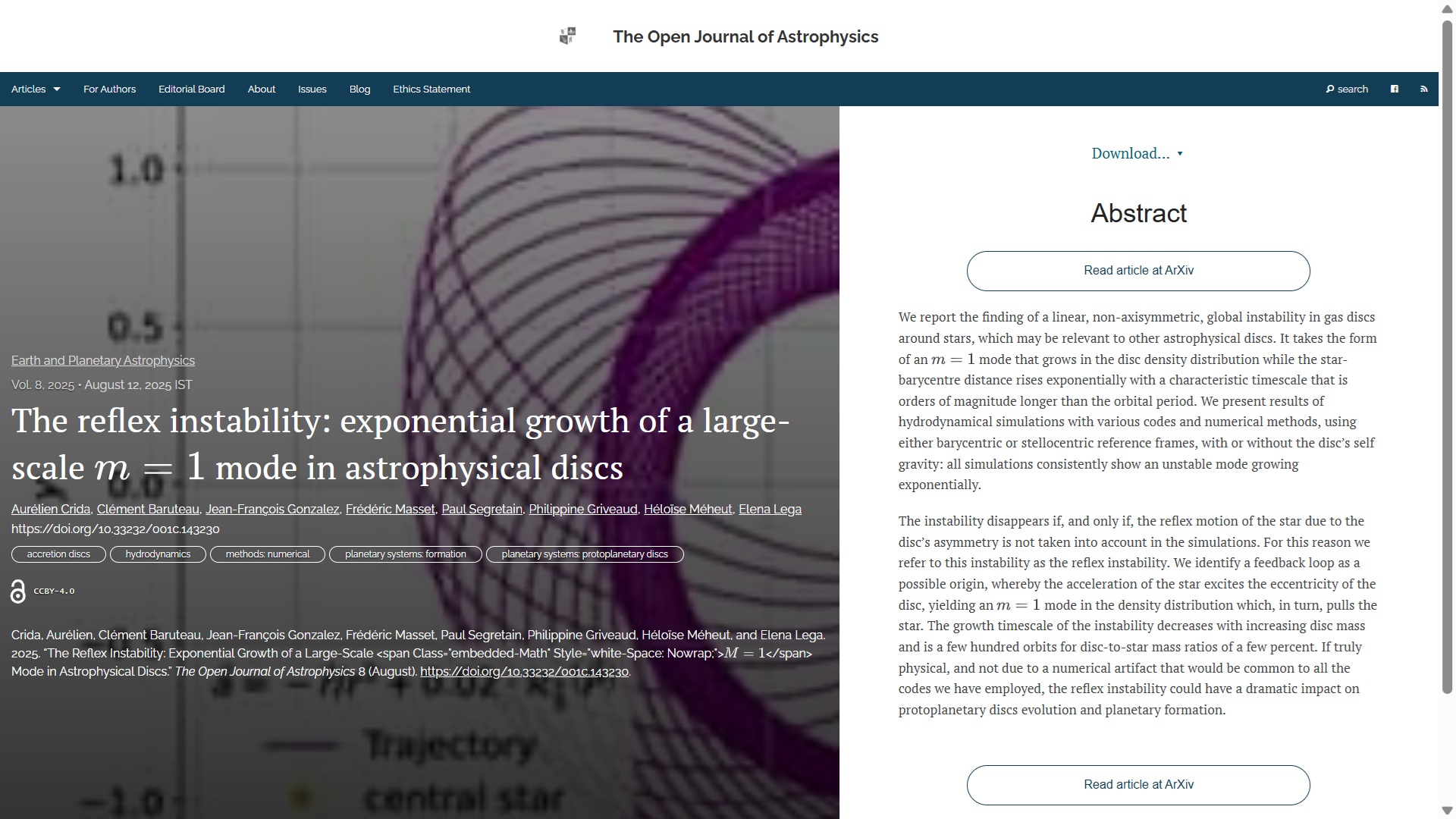
The first paper to report this week is “The reflex instability: exponential growth of a large-scale mode in astrophysical discs” by Aurélien Crida (Université Côte d’Azur, France), Clément Baruteau (Université de Toulouse, France), Jean-François Gonzalez (Universite Claude Bernard Lyon 1, France), Frédéric Masset (Universidad Nacional Autonoma de México) and Paul Segretain, Philippine Griveaud, Héloïse Méheut & Elena Lega (Université Côte d’Azur).  This paper was published on Tuesday August 12th 2025 in the folder marked “Earth and Planetary Astrophysics“. It discusses a exponentially-growing instability in gas discs around stars caused by the motion of the central star in response to the disc.

The overlay – which you can make larger by clicking on it – is here:
You can find the officially accepted version on arXiv here.

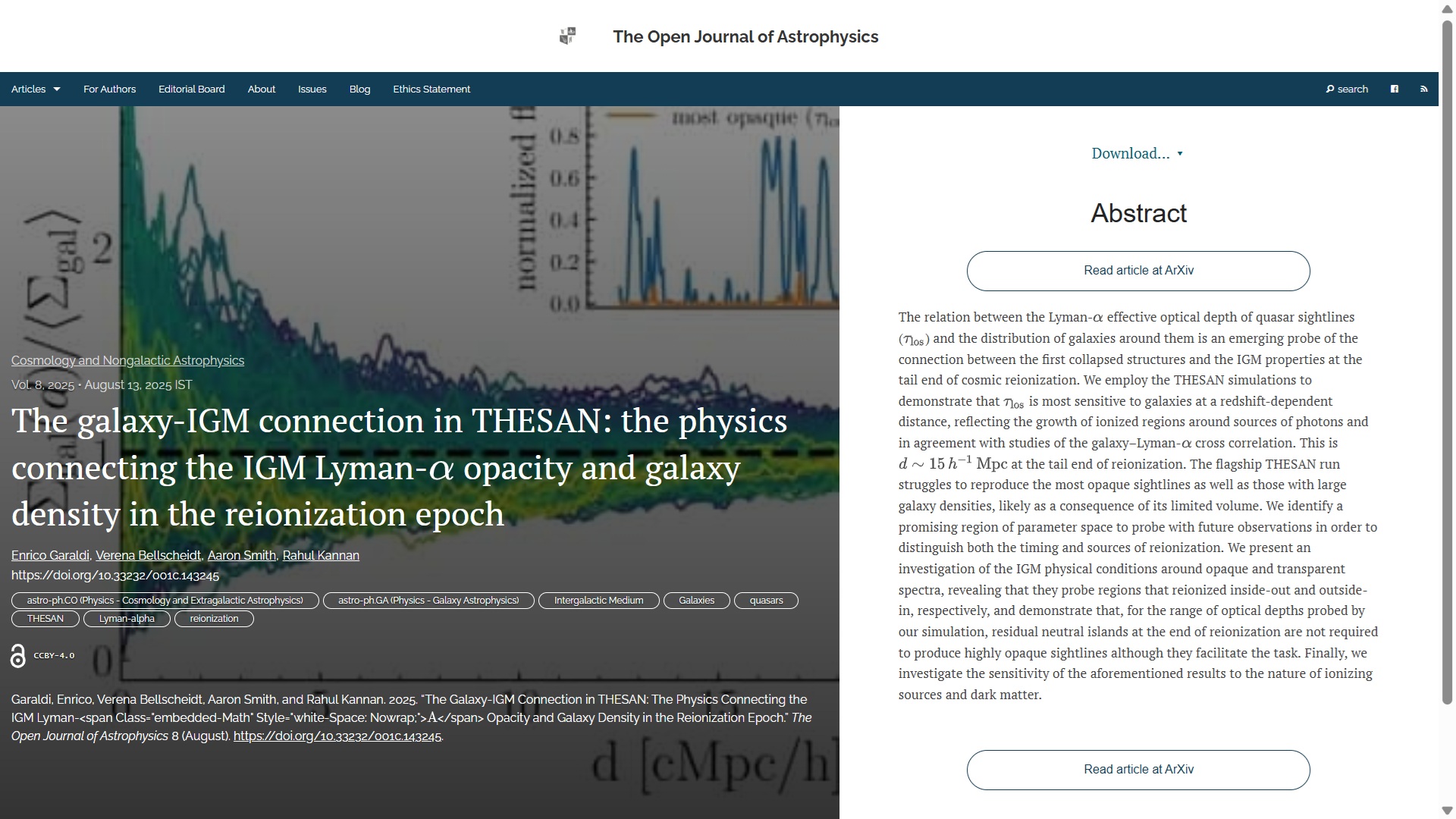
The other paper this week, published in the folder Cosmology and Nongalactic Astrophysics, is “The galaxy-IGM connection in THESAN: the physics connecting the IGM Lyman-alpha opacity and galaxy density in the reionization epoch” by Enrico Garaldi (University of Tokyo, Japan), Verena Bellscheidt (Technical University of Munich, Germany), Aaron Smith (York University, Canada) and Rahul Kannan (University of Texas at Dallas, USA).  It presents a study of the relation between the Lyman-alpha effective optical depth of quasar sightlines and the distribution of galaxiesas as a probe of ionized regions around sources of photons. It was published on Wednesday August 13th 2025.

The overlay is here:
 

You can find the officially accepted version of the paper on arXiv here.

That concludes the papers for this week. I’ll do another update next weekend, though I expect things will remain relatively quiet until September.
Weekly Update from the Open Journal of Astrophysics – 02/08/2025

Posted in OJAp Papers, Open Access, The Universe and Stuff with tags , , , , , , , , , , , , , , , , , , , , , , , , , , , , on August 2, 2025 by telescoper

It’s Saturday morning again, and it’s the start of a new month, so it’s time for an update of papers published at the Open Journal of Astrophysics. Since the last update we have published five new papers, which brings the number in Volume 8 (2025) up to 110, and the total so far published by OJAp up to 345. I expect we’ll the total number we published last year (120) sometime this month. I predict that by the end of this year we will have published around 180 papers in Volume 8 and around 400 altogether.

The papers published this week, with their overlays, are as follows. You can click on the images of the overlays to make them larger should you wish to do so.

The first paper to report is “The matter with(in) CPL” by Leonardo Giani (U. Queensland, Australia), Rodrigo Von Marttens (Universidade Federal da Bahia, Brazil) and Oliver Fabio Piattella (Universita degli Studi dell’Insubria, Italy). This was published on Monday 29th July 2025 in the folder Cosmology and Nongalactic Astrophysics. This article presents a new parameterization of the standard model and its implications for the interpretation of cosmological observations.

The overlay is here:


The officially-accepted version can be found on arXiv here.

The second paper of the week, published on Tuesday 30th July in the folder Instrumentation and Methods for Astrophysics, is “An automated method for finding the most distant quasars” by Lena Lenz, Daniel Mortlock, Boris Leistedt & Rhys Barnett (Imperial College London, UK) and Paul C. Hewett (U. Cambridge, UK)”.  This paper presents an automated, reproduceable and objective high-redshift quasar selection pipeline, tested on simulations and real data from the Sloan Digital Sky Survey (SDSS) and UKIRT Infrared Deep Sky Survey (UKIDSS). The overlay is here:


You can find the officially accepted version of the paper on arXiv here.

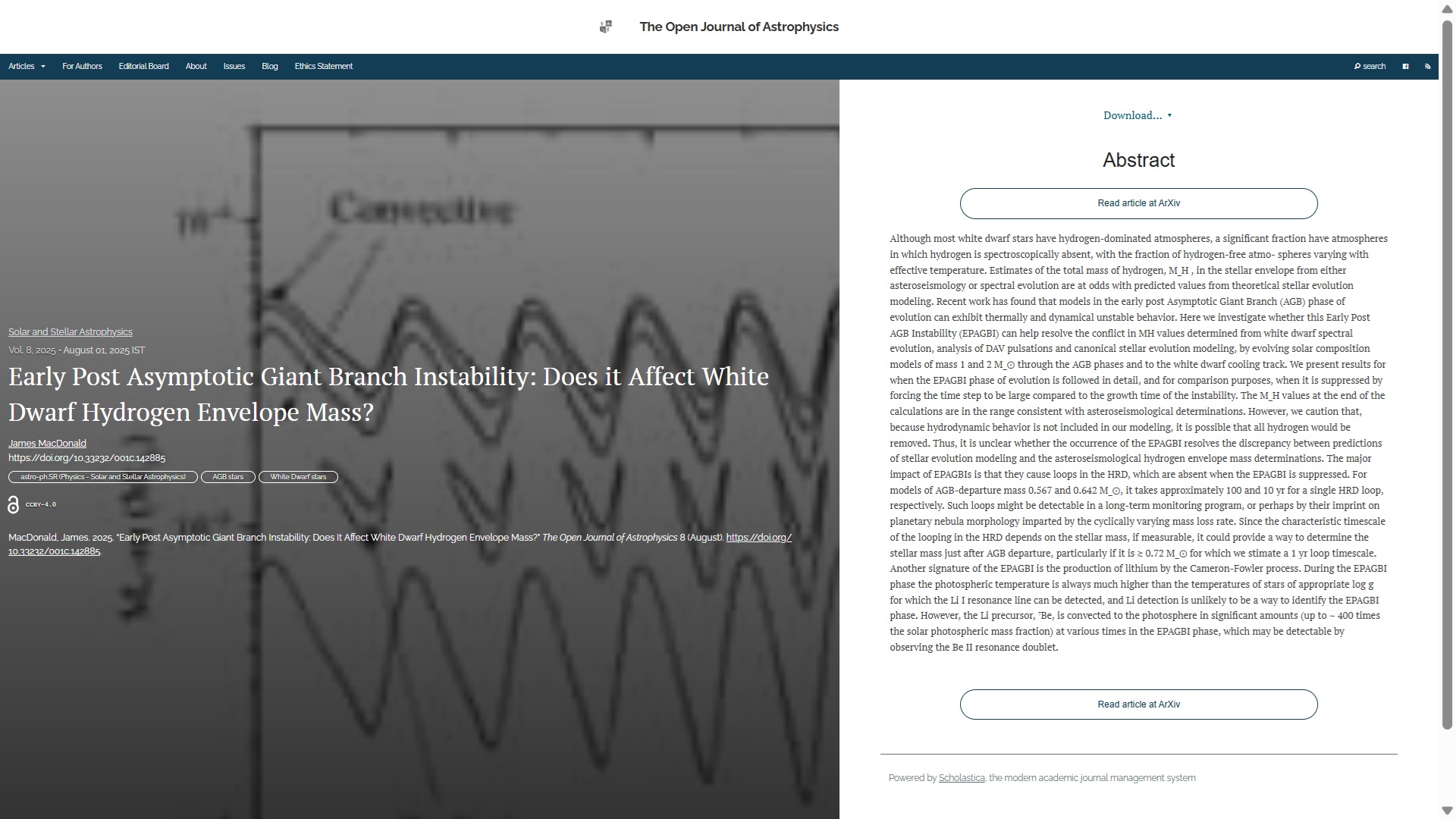
The third paper of the week is “Early Post Asymptotic Giant Branch Instability: Does it Affect White Dwarf Hydrogen Envelope Mass?” by James MacDonald (University of Delaware, USA). This one was published on Friday 1st Auguest (i.e. yesterday) in the folder Solar and Stellar Astrophysics. It is an investigation into whether Early Post AGB Instability (EPAGBI) can affect determinations of the total abundance of hydrogen in white dwarf stars.

The overlay is here:

The final version is on arXiv here.


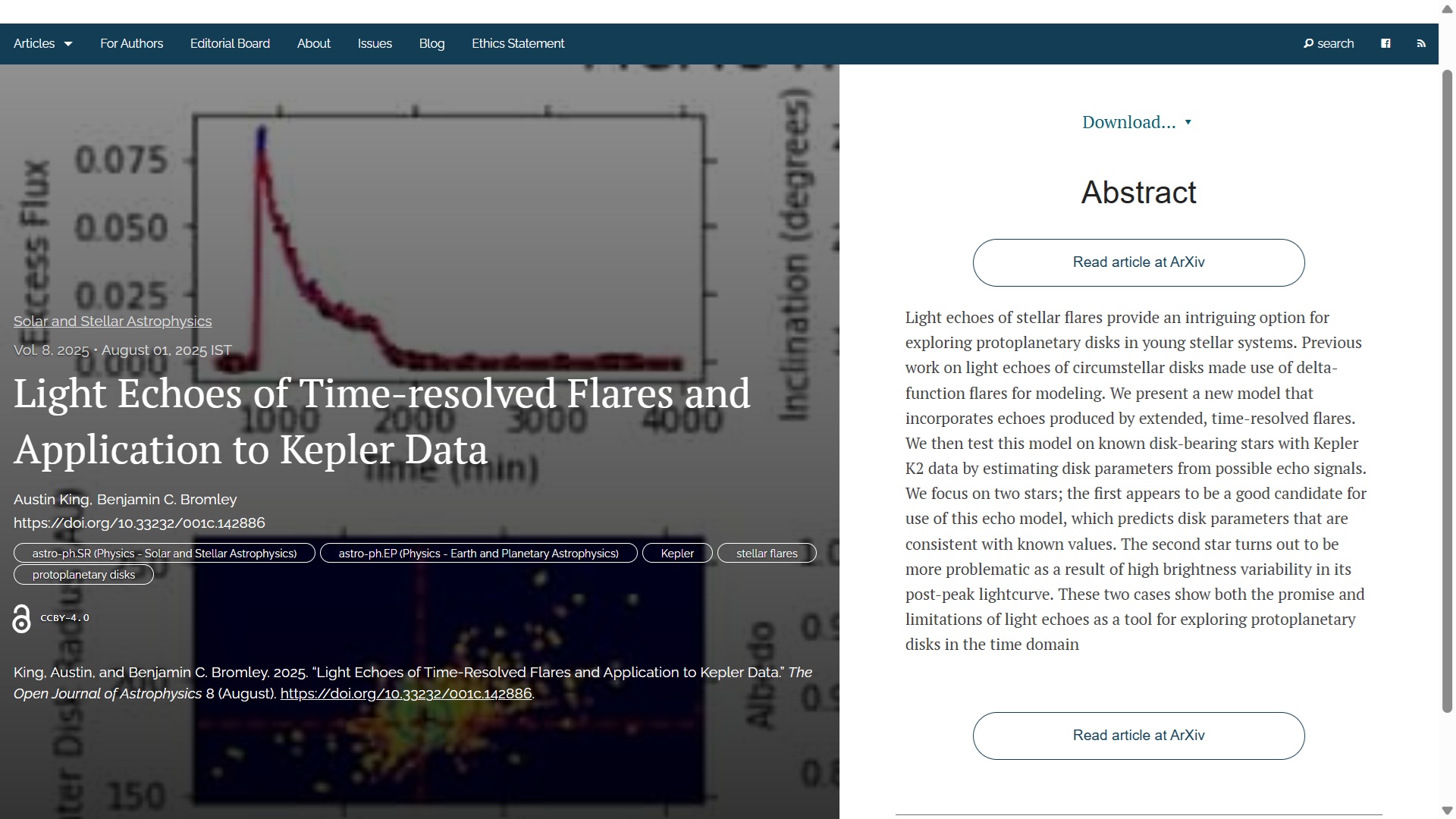
The fourth paper of the week, also published on Friday 1st August, is “Light Echoes of Time-resolved Flares and Application to Kepler Data” by Austin King and Benjamin C. Bromley (University of Utah, USA).  This describes a new model for circumstellar disks that incorporates echoes produced by extended, time-resolved flares. It is published in the folder Solar and Stellar Astrophysics. Here is the overlay:

You can find the officially-accepted version on arXiv here.


The fifth and final article published this week, also published on Friday 1st August,  is “Wide Binaries from Gaia DR3 : testing GR vs MOND with realistic triple modelling” by Charalambos Pittordis, Will Sutherland and Paul Shepherd (Queen Mary, University of London, UK). This presents a test for modified gravity from a sample of wide-binary stars from Gaia DR3, finding that (unmodified) Newtonian gravity provides a better fit to the data. It is in the folder Astrophysics of Galaxies.

The overlay is here:


You can find the officially-accepted version on arXiv here.

And that’s all the papers for this week. I’ll do another update next Saturday.