Archive for Cosmic Microwave Background

COBE and after…

Posted in Biographical, The Universe and Stuff with tags , , , on April 24, 2012 by telescoper

An item on the BBC website yesterday reminds me that it is twenty years since the announcement, in April 1992, of the discovery of temperature variations across the sky in the cosmic microwave background radiation by the Cosmic Background Explorer (COBE). Was it really so long ago?

At the time the announcement was made as I actually in the USA. In fact,  I was at the University of Kansas for about a month working on this paper with Adrian Melott and Sergei Shandarin, which eventually came out early in 1993. I remember it very well because we started the project, did all the calculations and wrote up the paper within the short time I was there. Oh what it is to be a postdoc, having only research to think about and none of the other distractions that come with more senior positions.

Anyway, the COBE announcement hit the news while I was there and it got a lot of press coverage. I even did a TV interview myself, for a local cable news channel. Nor surprisingly, they were pretty clueless about the physics of the cosmic microwave background; what had drawn them to the story was George Smoot’s comment that seeing the pattern of fluctuations was “like seeing the face of God”. They were disappointed when I answered their questions about God with “I don’t know, I’m an atheist”.

The Face of God?

I didn’t know at the time that the way the announcement of the COBE discovery was handled had caused such ructions. Apparently George Smoot let his enthusiasm get the better of him, broke ranks with the rest of the COBE team, and did his own press conference which led to accusations that he was trying to steal the limelight and a big falling-out between Smoot and other members of the team, especially John Mather. It’s unfortunate that this cast a shadow over what was undoubtedly one of the most important science discoveries of the twentieth century. Without COBE there would have been no WMAP and no Planck, and our understanding of the early Universe and the formation of galaxies and large-scale structure would still be in the dark ages.

As a lowly postdoc at the time, living a hand-to-mouth existence on short-term contracts, I didn’t realise that I would still be working in cosmology twenty years later, let alone become a Professor.  Nor could I have predicted how much cosmology would change over the next two decades. Most of all, though, I never even imagined that I’d find myself travelling to Stockholm as a guest of the Nobel Foundation to attend the ceremony and banquet at which the 2006 Nobel Prize for Physics was awarded to George Smoot and John Mather for the COBE discovery. It was a wonderful one-in-a-lifetime experience, made all the nicer because Smoot and Mather seemed to have made peace at last.

Where were you when the COBE results came out?

Big Bang Acoustics

Posted in The Universe and Stuff with tags , , , , , , on March 12, 2012 by telescoper

It’s National Science and Engineering Week this week and as part of the programme of events in Cardiff we have an open evening at the School of Physics & Astronomy tonight. This will comprise a series of public talks followed by an observing session using the School’s Observatory. I’m actually giving a (short) talk myself, which means it will be a long day, so I’m going to save time by recycling the following from an old blog post on the subject of my talk.

As you probably know the Big Bang theory involves the assumption that the entire Universe – not only the matter and energy but also space-time itself – had its origins in a single event a finite time in the past and it has been expanding ever since. The earliest mathematical models of what we now call the  Big Bang were derived independently by Alexander Friedman and George Lemaître in the 1920s. The term “Big Bang” was later coined by Fred Hoyle as a derogatory description of an idea he couldn’t stomach, but the phrase caught on. Strictly speaking, though, the Big Bang was a misnomer.

Friedman and Lemaître had made mathematical models of universes that obeyed the Cosmological Principle, i.e. in which the matter was distributed in a completely uniform manner throughout space. Sound consists of oscillating fluctuations in the pressure and density of the medium through which it travels. These are longitudinal “acoustic” waves that involve successive compressions and rarefactions of matter, in other words departures from the purely homogeneous state required by the Cosmological Principle. The Friedman-Lemaitre models contained no sound waves so they did not really describe a Big Bang at all, let alone how loud it was.

However, as I have blogged about before, newer versions of the Big Bang theory do contain a mechanism for generating sound waves in the early Universe and, even more importantly, these waves have now been detected and their properties measured.

The above image shows the variations in temperature of the cosmic microwave background as charted by the Wilkinson Microwave Anisotropy Probe about a decade years ago. The average temperature of the sky is about 2.73 K but there are variations across the sky that have an rms value of about 0.08 milliKelvin. This corresponds to a fractional variation of a few parts in a hundred thousand relative to the mean temperature. It doesn’t sound like much, but this is evidence for the existence of primordial acoustic waves and therefore of a Big Bang with a genuine “Bang” to it.

A full description of what causes these temperature fluctuations would be very complicated but, roughly speaking, the variation in temperature you see in the CMB corresponds directly to variations in density and pressure arising from sound waves.

So how loud was it?

The waves we are dealing with have wavelengths up to about 200,000 light years and the human ear can only actually hear sound waves with wavelengths up to about 17 metres. In any case the Universe was far too hot and dense for there to have been anyone around listening to the cacophony at the time. In some sense, therefore, it wouldn’t have been loud at all because our ears can’t have heard anything.

Setting aside these rather pedantic objections – I’m never one to allow dull realism to get in the way of a good story- we can get a reasonable value for the loudness in terms of the familiar language of decibels. This defines the level of sound (L) logarithmically in terms of the rms pressure level of the sound wave Prms relative to some reference pressure level Pref

L=20 log10[Prms/Pref]

(the 20 appears because of the fact that the energy carried goes as the square of the amplitude of the wave; in terms of energy there would be a factor 10).

There is no absolute scale for loudness because this expression involves the specification of the reference pressure. We have to set this level by analogy with everyday experience. For sound waves in air this is taken to be about 20 microPascals, or about 2×10⁻¹⁰ times the ambient atmospheric air pressure which is about 100,000 Pa.  This reference is chosen because the limit of audibility for most people corresponds to pressure variations of this order and these consequently have L=0 dB. It seems reasonable to set the reference pressure of the early Universe to be about the same fraction of the ambient pressure then, i.e.

Pref~2×10⁻¹⁰ Pamb

The physics of how primordial variations in pressure translate into observed fluctuations in the CMB temperature is quite complicated, and the actual sound of the Big Bang contains a mixture of wavelengths with slightly different amplitudes so it all gets a bit messy if you want to do it exactly, but it’s quite easy to get a rough estimate. We simply take the rms pressure variation to be the same fraction of ambient pressure as the averaged temperature variation are compared to the average CMB temperature,  i.e.

Prms~ a few ×10-5Pamb

If we do this, scaling both pressures in logarithm in the equation in proportion to the ambient pressure, the ambient pressure cancels out in the ratio, which turns out to be a few times 10-5

With our definition of the decibel level we find that waves corresponding to variations of one part in a hundred thousand of the reference level  give roughly L=100dB while part in ten thousand gives about L=120dB. The sound of the Big Bang therefore peaks at levels just a bit less than  120 dB. As you can see in the Figure to the left, this is close to the threshold of pain,  but it’s perhaps not as loud as you might have guessed in response to the initial question. Many rock concerts are actually louder than the Big Bang, so I suspect any metalheads in the audience will be distinctly unimpressed.

A useful yardstick is the amplitude  at which the fluctuations in pressure are comparable to the mean pressure. This would give a factor of about 1010 in the logarithm and is pretty much the limit that sound waves can propagate without distortion. These would have L≈190 dB. It is estimated that the 1883 Krakatoa eruption produced a sound level of about 180 dB at a range of 100 miles. By comparison the Big Bang was little more than a whimper.

PS. If you would like to read more about the actual sound of the Big Bang, have a look at John Cramer’s webpages. You can also download simulations of the actual sound. If you listen to them you will hear that it’s more of  a “Roar” than a “Bang” because the sound waves don’t actually originate at a single well-defined event but are excited incoherently all over the Universe.

PPS. If you would like to hear a series of increasingly sophisticated computer simulations showing how our idea of the sounds accompanying the start of the Universe has evolved over the past few years, please take a look at the following video. It’s amazing how crude the 1995 version seems, compared with that describing the new era of precision cosmology.

A Potted Prehistory of Cosmology

Posted in History, The Universe and Stuff with tags , , , , , , , , , , , , , , , , , , , , , on January 26, 2012 by telescoper

A few years ago I was asked to provide a short description of the history of cosmology, from the dawn of civilisation up to the establishment of the Big Bang model, in less than 1200 words. This is what I came up with. Who and what have I left out that you would have included?

–0–

 Is the Universe infinite? What is it made of? Has it been around forever?  Will it all come to an end? Since prehistoric times, humans have sought to build some kind of conceptual framework for answering questions such as these. The first such theories were myths. But however naïve or meaningless they may seem to us now, these speculations demonstrate the importance that we as a species have always attached to thinking about life, the Universe and everything.

Cosmology began to emerge as a recognisable scientific discipline with the Greeks, notably Thales (625-547 BC) and Anaximander (610-540 BC). The word itself is derived from the Greek “cosmos”, meaning the world as an ordered system or whole. In Greek, the opposite of “cosmos” is “chaos”. The Pythagoreans of the 6th century BC regarded numbers and geometry as the basis of all natural things. The advent of mathematical reasoning, and the idea that one can learn about the physical world using logic and reason marked the beginning of the scientific era. Plato (427-348 BC) expounded a complete account of the creation of the Universe, in which a divine Demiurge creates, in the physical world, imperfect representations of the structures of pure being that exist only in the world of ideas. The physical world is subject to change, whereas the world of ideas is eternal and immutable. Aristotle (384-322 BC), a pupil of Plato, built on these ideas to present a picture of the world in which the distant stars and planets execute perfect circular motions, circles being a manifestation of “divine” geometry. Aristotle’s Universe is a sphere centred on the Earth. The part of this sphere that extends as far as the Moon is the domain of change, the imperfect reality of Plato, but beyond this the heavenly bodies execute their idealised circular motions. This view of the Universe was to dominate western European thought throughout the Middle Ages, but its perfect circular motions did not match the growing quantities of astronomical data being gathered by the Greeks from the astronomical archives made by the Babylonians and Egyptians. Although Aristotle had emphasised the possibility of learning about the Universe by observation as well as pure thought, it was not until Ptolemy’s Almagest, compiled in the 2nd Century AD, that a complete mathematical model for the Universe was assembled that agreed with all the data available.

Much of the knowledge acquired by the Greeks was lost to Christian culture during the dark ages, but it survived in the Islamic world. As a result, cosmological thinking during the Middle Ages of Europe was rather backward. Thomas Aquinas (1225-74) seized on Aristotle’s ideas, which were available in Latin translation at the time while the Almagest was not, to forge a synthesis of pagan cosmology with Christian theology which was to dominated Western thought until the 16th and 17th centuries.

The dismantling of the Aristotelian world view is usually credited to Nicolaus Copernicus (1473-1543).  Ptolemy’s Almagest  was a complete theory, but it involved applying a different mathematical formula for the motion of each planet and therefore did not really represent an overall unifying system. In a sense, it described the phenomena of heavenly motion but did not explain them. Copernicus wanted to derive a single universal theory that treated everything on the same footing. He achieved this only partially, but did succeed in displacing the Earth from the centre of the scheme of things. It was not until Johannes Kepler (1571-1630) that a completely successful demolition of the Aristotelian system was achieved. Driven by the need to explain the highly accurate observations of planetary motion made by Tycho Brahe (1546-1601), Kepler replaced Aristotle’s divine circular orbits with more mundane ellipses.

The next great development on the road to modern cosmological thinking was the arrival on the scene of Isaac Newton (1642-1727). Newton was able to show, in his monumental Principia (1687), that the elliptical motions devised by Kepler were the natural outcome of a universal law of gravitation. Newton therefore re-established a kind of Platonic level on reality, the idealised world of universal laws of motion. The Universe, in Newton’s picture, behaves as a giant machine, enacting the regular motions demanded by the divine Creator and both time and space are absolute manifestations of an internal and omnipresent God.

Newton’s ideas dominated scientific thinking until the beginning of the 20th century, but by the 19th century the cosmic machine had developed imperfections. The mechanistic world-view had emerged alongside the first stirrings of technology. During the subsequent Industrial Revolution scientists had become preoccupied with the theory of engines and heat. These laws of thermodynamics had shown that no engine could work perfectly forever without running down. In this time there arose a widespread belief in the “Heat Death of the Universe”, the idea that the cosmos as a whole would eventually fizzle out just as a bouncing ball gradually dissipates its energy and comes to rest.

Another spanner was thrown into the works of Newton’s cosmic engine by Heinrich Olbers (1758-1840), who formulated in 1826 a paradox that still bears his name, although it was discussed by many before him, including Kepler. Olbers’ Paradox emerges from considering why the night sky is dark. In an infinite and unchanging Universe, every line of sight from an observer should hit a star, in much the same way as a line of sight through an infinite forest will eventually hit a tree. The consequence of this is that the night sky should be as bright as a typical star. The observed darkness at night is sufficient to prove the Universe cannot both infinite and eternal.

Whether the Universe is infinite or not, the part of it accessible to rational explanation has steadily increased. For Aristotle, the Moon’s orbit (a mere 400,000 km) marked a fundamental barrier, to Copernicus and Kepler the limit was the edge of the Solar System (billions of kilometres away). In the 18th and 19th centuries, it was being suggested that the Milky Way (a structure now known to be at least a billion times larger than the Solar System) to be was the entire Universe. Now it is known, thanks largely to Edwin Hubble (1889-1953), that the Milky Way is only one among hundreds of billions of similar galaxies.

The modern era of cosmology began in the early years of the 20th century, with a complete re-write of the laws of Nature. Albert Einstein (1879-1955) introduced the principle of relativity in 1905 and thus demolished Newton’s conception of space and time. Later, his general theory of relativity, also supplanted Newton’s law of universal gravitation. The first great works on relativistic cosmology by Alexander Friedmann (1888-1925), George Lemaître (1894-1966) and Wilhem de Sitter (1872-1934) formulated a new and complex language for the mathematical description of the Universe.

But while these conceptual developments paved the way, the final steps towards the modern era were taken by observers, not theorists. In 1929, Edwin Hubble, who had only recently shown that the Universe contained many galaxies like the Milky way, published the observations that led to the realisation that our Universe is expanding. That left the field open for two rival theories, one (“The Steady State”, with no beginning and no end)  in which matter is continuously created to fill in the gaps caused by the cosmic expansion and the other in which the whole shebang was created, in one go, in a primordial fireball we now call the Big Bang.

Eventually, in 1965, Arno Penzias and Robert  Wilson discovered the cosmic microwave background radiation, proof (or as near to proof as you’re likely to see) that our Universe began in a  Big Bang…

Planck Exclusive!

Posted in The Universe and Stuff with tags , , , , on January 25, 2012 by telescoper

I forgot to mention on this blog some important news about the Planck mission which many people here in the School of Physics & Astronomy at Cardiff University are heavily involved in.

Here is the official announcement from The Planck Science Team home page:

The High Frequency Instrument (HFI) on ESA’s Planck mission has completed its survey of the remnant light from the Big Bang. The sensor ran out of coolant on January 14 2012 as expected, ending its ability to detect this faint energy. Planck was launched in May 2009, and the minimum requirement for success was for the spacecraft to complete two whole surveys of the sky. In the end, Planck worked perfectly for 30 months, about twice the span originally required, and completed five full-sky surveys with both instruments. Able to work at slightly higher temperatures than HFI, the Low Frequency Instrument (LFI) will continue surveying the sky for a large part of 2012, providing even more data to improve the Planck final results.

For more details, see here. Basically, the HFI instrument consists of bolometers contained in a cryogenic system to keep them cool and thus suppress thermal noise in order to enable them to detect the very weak signals coming from the cosmic microwave background radiation. The helium required to maintain the low temperature is gradually lost as Planck operates, and has now run out. The HFI bolometers consequently warmed up, which makes them useless for cosmological work, so the instrument has been switched off. I’m sure you all understand how uncomfortable it is when your bolometers get too hot…

You can find a host of public information about Planck here but the scientific work is under strict embargo until early next year. However, as a Telescoper exclusive I am able to offer you a sneak preview of the top secret Planck data well in advance of official release. If you want to see what Planck scientists have been looking at for the last couple of years, just click here.

Hints of Bubbles in the Background?

Posted in Astrohype, Cosmic Anomalies, The Universe and Stuff with tags , , , on August 4, 2011 by telescoper

Looking around for a hot cosmological topic for a brief diversionary post, I came across a news item on the BBC website entitled ‘Multiverse theory suggested by microwave background‘. I’ll refer you to the item itself for a general description of the study and to the actual paper (by Feeney et al.), which has been accepted for publication in Physical Review D, for technical details.

I will, however, flagrantly steal Auntie Beeb’s nice picture which shows the location on the sky of a number of allegedly anomalous features; they being the coloured blobs that look like Smarties in the bottom right. The greyed out bits of the map are areas of the sky masked out to avoid contamination from our own Galaxy or various other foreground sources.

One possible explanation of the Smarties from Outer Space is furnished by a variant of the theory known as chaotic inflation in which the universe comprises a collection of mini-universes  which nucleate and expand rather like bubbles in a glass of champagne. Assuming this “multiverse” picture is correct – a very big “if”, in my opinion –  it is just possible that two bubbles might collide just after nucleation leaving a sort of dent in space that we see in the microwave background.

It’s a speculative idea, of course, but there’s nothing wrong with such things. Everything starts off with speculation, really. I’ve actually read the paper, and I think it’s an excellent piece of work.  I can’t resist commenting, however, that there’s a considerable gap between the conclusions of the study and the title of the BBC article, either the present `Multiverse  theory suggested by microwave background’ or the original one `Study hints at bubble universes’.

My point is that the authors  concede that they do not find any statistically significant evidence for the bubble collision interpretation, i.e. this is essentially  a null result. I’m not sure how “study fails to find evidence for..” turned into “study hints at…”.

Nonetheless, it’s an interesting paper and there’s certainly a possibility that better, cleaner and less noisy data  may find evidence where WMAP couldn’t. Yet another reason to look forward to future data from Planck!

Astronomy Look-alikes, No. 59

Posted in Astronomy Lookalikes with tags , , , , , on July 13, 2011 by telescoper

It’s not widely known that the painstaking detective work done by Penzias and Wilson in confirming the extraterrestrial
origin of the excess noise that they measured, and eventually understood to be evidence of the cosmic microwave background radiation, was actually the original inspiration for the 1970s British television police drama, The Sweeney.

False Convergence and the Bandwagon Effect

Posted in The Universe and Stuff with tags , , , , , , on July 3, 2011 by telescoper

In idle moments, such as can be found during sunny sunday summer afternoons in the garden, it’s  interesting to reminisce about things you worked on in the past. Sometimes such trips down memory lane turn up some quite interesting lessons for the present, especially when you look back at old papers which were published when the prevailing paradigms were different. In this spirit I was lazily looking through some old manuscripts on an ancient laptop I bought in 1993. I thought it was bust, but it turns out to be perfectly functional; they clearly made things to last in those days! I found a paper by Plionis et al. which I co-wrote in 1992; the abstract is here

We have reanalyzed the QDOT survey in order to investigate the convergence properties of the estimated dipole and the consequent reliability of the derived value of \Omega^{0.6}/b. We find that there is no compelling evidence that the QDOT dipole has converged within the limits of reliable determination and completeness. The value of  \Omega_0 derived by Rowan-Robinson et al. (1990) should therefore be considered only as an upper limit. We find strong evidence that the shell between 140 and 160/h Mpc does contribute significantly to the total dipole anisotropy, and therefore to the motion of the Local Group with respect to the cosmic microwave background. This shell contains the Shapley concentration, but we argue that this concentration itself cannot explain all the gravitational acceleration produced by it; there must exist a coherent anisotropy which includes this structure, but extends greatly beyond it. With the QDOT data alone, we cannot determine precisely the magnitude of any such anisotropy.

(I’ve added a link to the Rowan-Robinson et al. paper for reference). This was  a time long before the establishment of the current standard model of cosmology (“ΛCDM”) and in those days the favoured theoretical paradigm was a flat universe, but one without a cosmological constant but with a critical density of matter, corresponding to a value of the density parameter \Omega_0 =1.

In the late eighties and early nineties, a large number of observational papers emerged claiming to provide evidence for the (then) standard model, the Rowan-Robinson et al. paper being just one. The idea behind this analysis is very neat. When we observe the cosmic microwave background we find it has a significant variation in temperature across the sky on a scale of 180°, i.e. it has a strong dipole component

There is also some contamination from Galactic emission in the middle, but you can see the dipole in the above map from COBE. The interpretation of this is that the Earth is not at rest. The  temperature variation causes by our motion with respect to a frame in which the cosmic microwave background (CMB) would be isotropic (i.e. be the same temperature everywhere on the sky) is just \Delta T/T \sim v/c. However, the Earth moves around the Sun. The Sun orbits the center of the Milky Way Galaxy. The Milky Way Galaxy orbits in the Local Group of Galaxies. The Local Group falls toward the Virgo Cluster of Galaxies. We know these velocities pretty well, but they don’t account for the size of the observed dipole anisotropy. The extra bit must be due the gravitational pull of larger scale structures.

If one can map the distribution of galaxies over the whole sky, as was first done with the QDOT galaxy redshift survey, then one can compare the dipole expected from the distribution of galaxies with that measured using the CMB. We can only count the galaxies – we don’t know how much mass is associated with each one but if we find that the CMB and the galaxy dipole line up in direction we can estimate the total amount of mass needed to give the right magnitude. I refer you to the papers for details.

Rowan-Robinson et al. argued that the QDOT galaxy dipole reaches convergence with the CMB dipole (i.e. they line up with one another) within a relatively small volume – small by cosmological standards, I mean, i.e. 100 Mpc or so- which means that  there has to be quite a lot of mass in that small volume to generate the relatively large velocity indicated by the CMB dipole. Hence the result is taken to indicate a high density universe.

In our paper we questioned whether convergence had actually been reached within the QDOT sample. This is crucial because if there is significant structure beyond the scale encompassed by the survey a lower overall density of matter may be indicated. We looked at a deeper survey (of galaxy clusters) and found evidence of a large-scale structure (up to 200 Mpc) that was lined up with the smaller scale anisotropy found by the earlier paper. Our best estimate was \Omega_0\sim 0.3, with a  large uncertainty. Now, 20 years later, we have a  different standard cosmology which does indeed have \Omega_0 \simeq 0.3. We were right.

Now I’m not saying that there was anything actually wrong with the Rowan-Robinson et al. paper – the uncertainties in their analysis are clearly stated, in the body of the paper as well as in the abstract. However, that result was widely touted as evidence for a high-density universe which was an incorrect interpretation. Many other papers published at the time involved similar misinterpretations. It’s good to have a standard model, but it can lead to a publication bandwagon – papers that agree with the paradigm get published easily, while those that challenge it (and are consequently much more interesting) struggle to make it past referees. The accumulated weight of evidence in cosmology is much stronger now than it was in 1990, of course, so the standard model is a more robust entity than the corresponding version of twenty years ago. Nevertheless, there’s still a danger that by treating ΛCDM as if it were the absolute truth, we might be closing our eyes to precisely those clues that will lead us to an even better understanding.  The perils of false convergence  are real even now.

As a grumpy postscript, let me just add that Plionis et al. has attracted a meagre 18 citations whereas Rowan-Robinson et al. has 178. Being right doesn’t always get you cited.

The Laws of Extremely Improbable Things

Posted in Bad Statistics, The Universe and Stuff with tags , , , , , , , , on June 9, 2011 by telescoper

After a couple of boozy nights in Copenhagen during the workshop which has just finished, I thought I’d take things easy this evening and make use of the free internet connection in my hotel to post a short item about something I talked about at the workshop here.

Actually I’ve been meaning to mention a nice bit of statistical theory called Extreme Value Theory on here for some time, because not so many people seem to be aware of it, but somehow I never got around to writing about it. People generally assume that statistical analysis of data revolves around “typical” quantities, such as averages or root-mean-square fluctuations (i.e. “standard” deviations). Sometimes, however, it’s not the typical points that are interesting, but those that appear to be drawn from the extreme tails of a probability distribution. This is particularly the case in planning for floods and other natural disasters, but this field also finds a number of interesting applications in astrophysics and cosmology. What should be the mass of the most massive cluster in my galaxy survey? How bright the brightest galaxy? How hot the hottest hotspot in the distribution of temperature fluctuations on the cosmic microwave background sky? And how cold the coldest? Sometimes just one anomalous event can be enormously useful in testing a theory.

I’m not going to go into the theory in any great depth here. Instead I’ll just give you a simple idea of how things work. First imagine you have a set of n observations labelled X_i. Assume that these are independent and identically distributed with a distribution function F(x), i.e.

\Pr(X_i\leq x)=F(x)

Now suppose you locate the largest value in the sample, X_{\rm max}. What is the distribution of this value? The answer is not F(x), but it is quite easy to work out because the probability that the largest value is less than or equal to, say, z is just the probability that each one is less than or equal to that value, i.e.

F_{\rm max}(z) = \Pr \left(X_{\rm max}\leq z\right)= \Pr \left(X_1\leq z, X_2\leq z\ldots, X_n\leq z\right)

Because the variables are independent and identically distributed, this means that

F_{\rm max} (z) = \left[ F(z) \right]^n

The probability density function associated with this is then just

f_{\rm max}(z) = n f(z) \left[ F(z) \right]^{n-1}

In a situation in which F(x) is known and in which the other assumptions apply, then this simple result offers the best way to proceed in analysing extreme values.

The mathematical interest in extreme values however derives from a paper in 1928 by Fisher \& Tippett which paved the way towards a general theory of extreme value distributions. I don’t want to go too much into details about that, but I will give a flavour by mentioning a historically important, perhaps surprising, and in any case rather illuminating example.

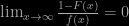
It turns out that for any distribution F(x) of exponential type, which means that

\lim_{x\rightarrow\infty} \frac{1-F(x)}{f(x)} = 0

then there is a stable asymptotic distribution of extreme values, as n \rightarrow \infty which is independent of the underlying distribution, F(x), and which has the form

G(z) = \exp \left(-\exp \left( -\frac{(z-a_n)}{b_n} \right)\right)

where a_n and b_n are location and scale parameters; this is called the Gumbel distribution. It’s not often you come across functions of the form e^{-e^{-y}}!

This result, and others, has established a robust and powerful framework for modelling extreme events. One of course has to be particularly careful if the variables involved are not independent (e.g. part of correlated sequences) or if there are not identically distributed (e.g. if the distribution is changing with time). One also has to be aware of the possibility that an extreme data point may simply be some sort of glitch (e.g. a cosmic ray hit on a pixel, to give an astronomical example). It should also be mentioned that the asymptotic theory is what it says on the tin – asymptotic. Some distributions of exponential type converge extremely slowly to the asymptotic form. A notable example is the Gaussian, which converges at the pathetically slow rate of \sqrt{\ln(n)}! This is why I advocate using the exact distribution resulting from a fully specified model whenever this is possible.
The pitfalls are dangerous and have no doubt led to numerous misapplications of this theory, but, done properly, it’s an approach that has enormous potential.

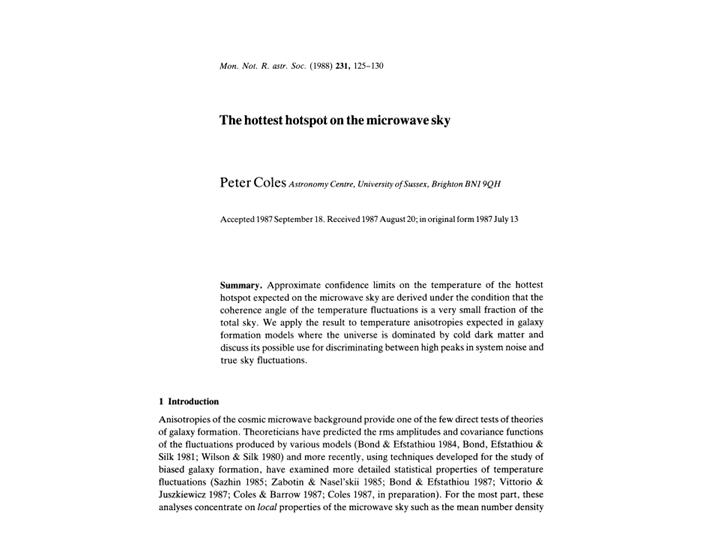
I’ve been interested in this branch of statistical theory for a long time, since I was introduced to it while I was a graduate student by a classic paper written by my supervisor. In fact I myself contributed to the classic old literature on this topic myself, with a paper on extreme temperature fluctuations in the cosmic microwave background way back in 1988..

Of course there weren’t any CMB maps back in 1988, and if I had thought more about it at the time I should have realised that since this was all done using Gaussian statistics, there was a 50% chance that the most interesting feature would actually be a negative rather than positive fluctuation. It turns out that twenty-odd years on, people are actually discussing an anomalous cold spot in the data from WMAP, proving that Murphy’s law applies to extreme events…

Echo of Creation – the Trailer

Posted in Education, The Universe and Stuff with tags , , , on May 27, 2011 by telescoper

Each day I find myself pressed for time and unable to think of anything to post, something seems to come along to rescue me. I found this on Twitter this morning and couldn’t resist sharing it, partly because it’s a cute video in its own right, and partly because it gives me the chance to advertise the event that it trails. Here’s the film …

..and it advertises a forthcoming event at the Cheltenham Science Festival, featuring the excellent Andrew Pontzen who is based at the Institute of Astronomy in Cambridge. Andrew is not only a whizzkid cosmology theorist but also an excellent public speaker, so do go and see his lecture if you can. Here’s the blurb:

Billions of years after the birth of the Universe, scientists realised they could tune into an echo of creation itself using nothing more sophisticated than a de-tuned television set. Andrew Pontzen explains the cosmos’ ‘background noise’ with hula hoops, beach balls and amazing telescopic pictures. But hold onto your hats: all is not as it seems with space and time…

Sounds fascinating! The talk is on Saturday 11th June 2011, 10am at the Town Hall in Cheltenham. You can book tickets here.

Can the CMB Alone Provide Evidence for Dark Energy? (via astrobites)

Posted in The Universe and Stuff with tags , , , on May 22, 2011 by telescoper

While I’m in reblogging mood I’ll try to send some traffic the way of this post, which is somewhat related to Friday’s one about the Wigglezeddy survey (or whatever it’s called)…

Can the CMB Alone Provide Evidence for Dark Energy? Paper Title: The Atacama Cosmology Telescope: Evidence for Dark Energy from the CMB Alone Authors: Blake D. Sherwin et al. 1st Author’s Affiliation: Dept. of Physics, Princeton University Introduction Continuing with Monday’s theme of cosmology, today’s astrobite features an ApJ Letter that describes new evidence for dark energy.  In the past decade a number of cosmological tests have been developed that show a need for a cosmological constant th … Read More

via astrobites