Archive for cosmic shear

Three New Publications at the Open Journal of Astrophysics

Posted in OJAp Papers, The Universe and Stuff with tags , , , , , , , , , on November 12, 2023 by telescoper

It’s been a busy week generally, and specifically at the  Open Journal of Astrophysics. In fact, this week we have published three papers, which I didn’t have time to post here at the time we published them but now present to you. These take the count in Volume 6 (2023) up to 44 and the total published by OJAp up to 109. With many more in the pipeline we’re still on for 50 by the end of the year.

In chronological order, the three papers published this week, with their overlays, are as follows. You can click on the images of the overlays to make them larger should you wish to do so. All three of these papers are in the folder Cosmology and Nongalactic Astrophysics.

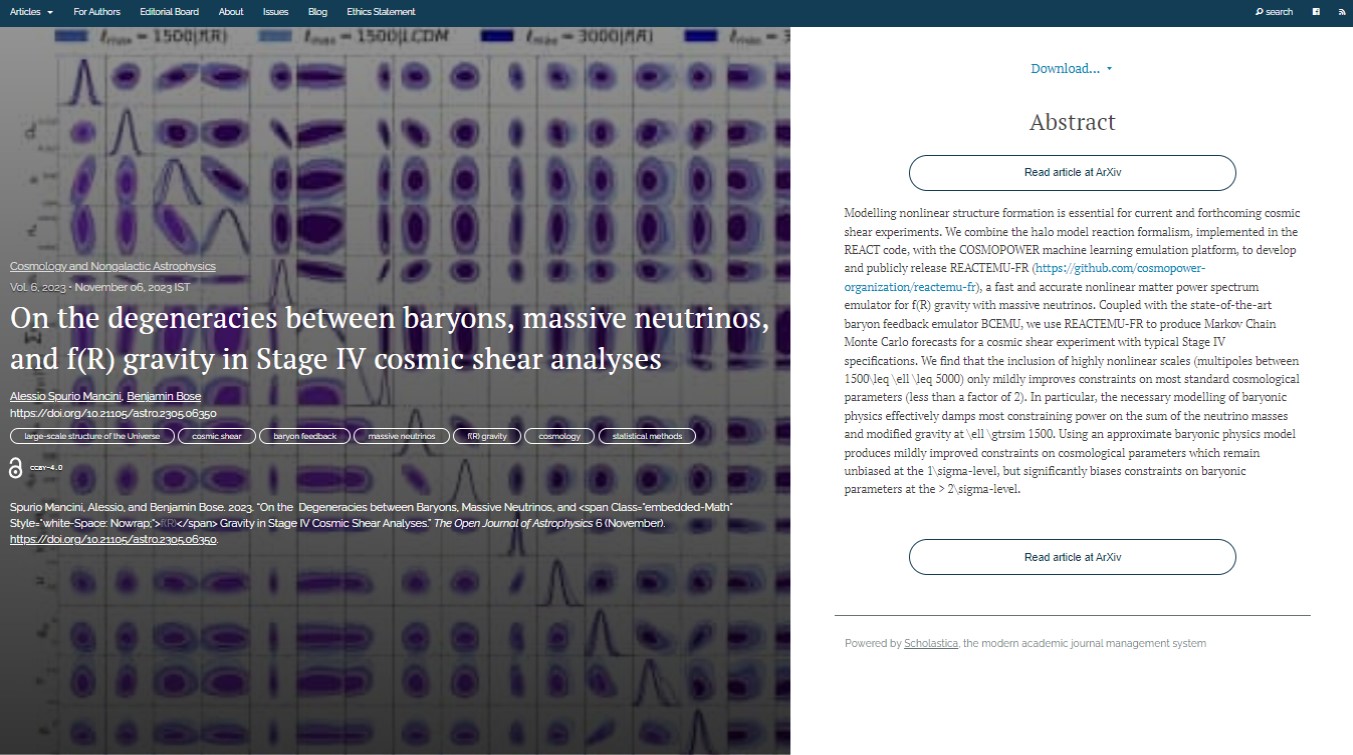
First one up is “On the degeneracies between baryons, massive neutrinos and f(R) gravity in Stage IV cosmic shear analyses” by Alessio Spurio Mancini (Mullard Space Sciences Laboratory, University College London, UK) and Benjamin Bose (Royal Observatory Edinburgh, UK). This presents a fast nonlinear matter power spectrum emulator for f(R) gravity with massive neutrinos, coupled with a baryon feedback emulator forecasts for a cosmic shear experiment with typical Stage IV specifications. This paper was published on 6th November 2023.

Here is a screen grab of the overlay, which includes the abstract:

You can find the officially accepted version of the paper on the arXiv here.

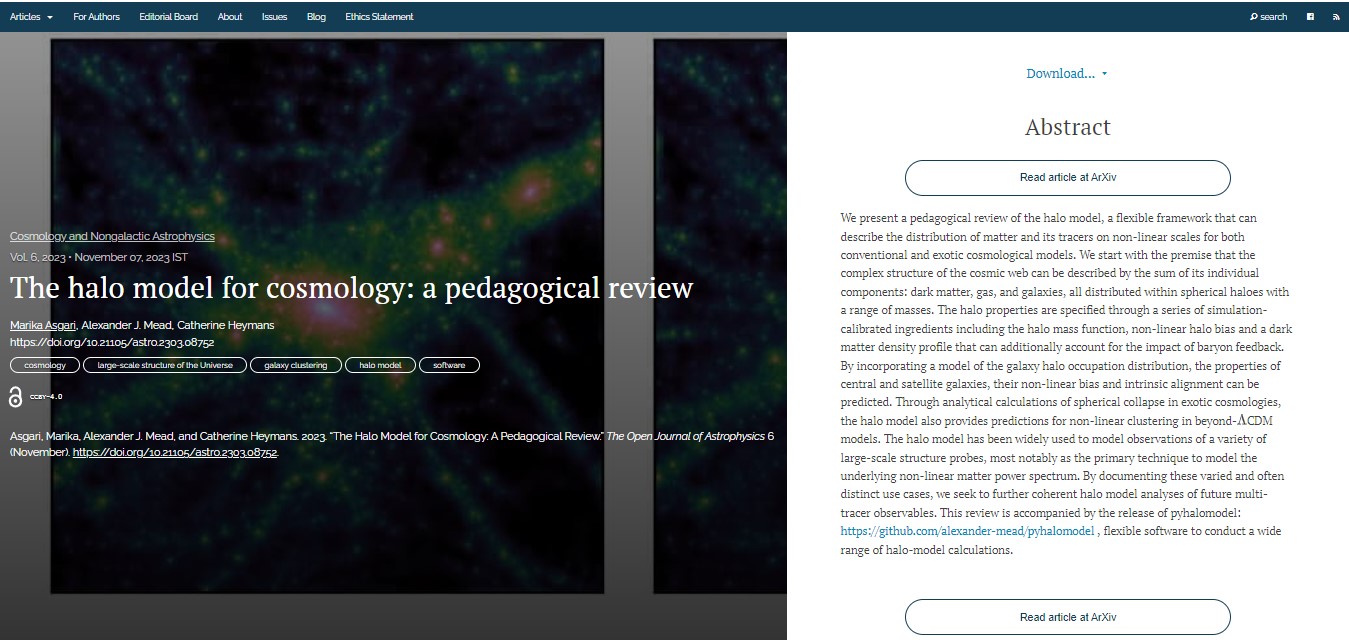
The second paper to announce is “” by Marika Asgari (Hull, UK), Alexander Mead (Bochum, Germany) and Catherine Heymans (Edinburgh, UK).  This presents a thorough discussion of the popular halo model for cosmological structure with applications, accompanied by the release of a software suite called pyhalomodel (which you can download here). The paper was also published on 7th November 2023 and you can see the overlay here:


The accepted version of this paper can be found on the arXiv here.

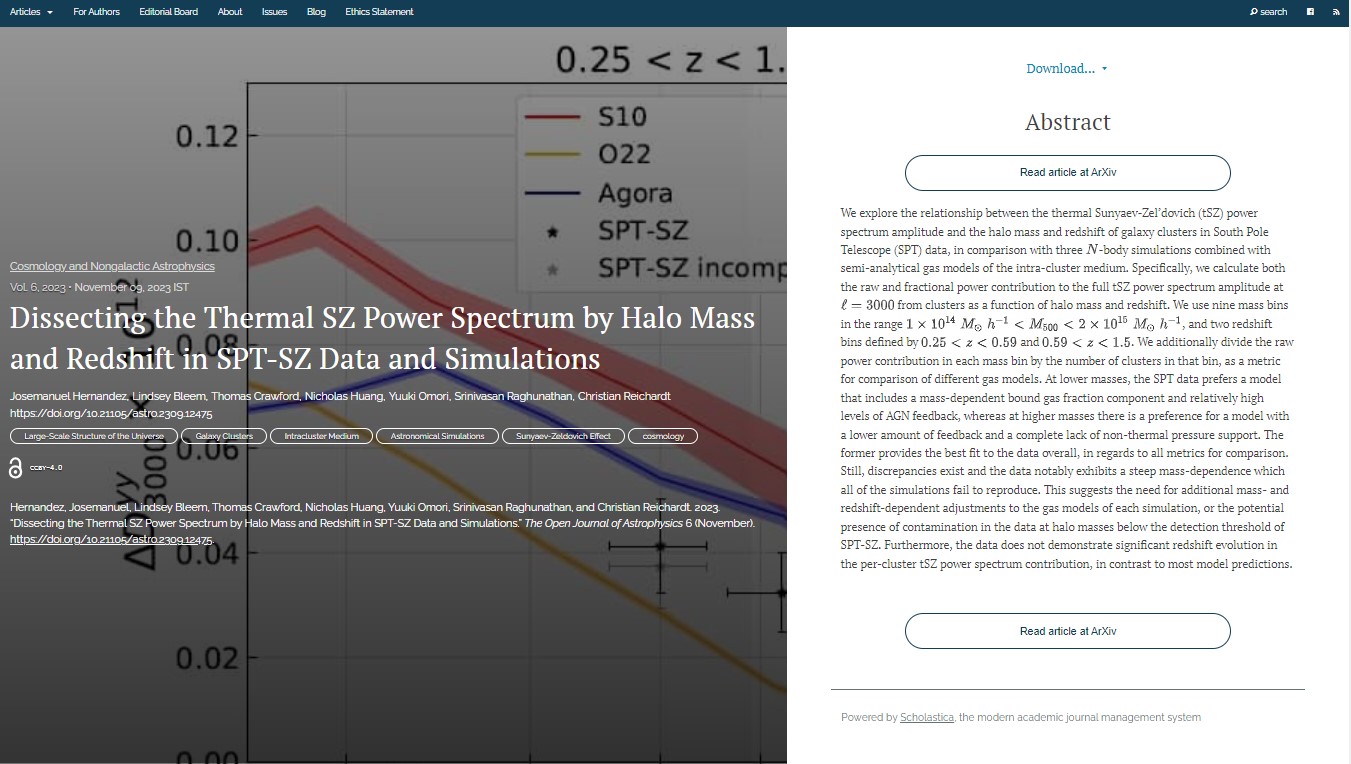
The last paper of this batch is  entitled “Dissecting the Thermal SZ Power Spectrum by Halo Mass and Redshift in SPT-SZ Data and Simulations” and the authors are: by Josemanuel Hernandez (Chicago), Lindsey Bleem (Chicago) , Thomas Crawford (Chicago), Nicholas Huang (Berkeley), Yuuki Omori (Chicago), Srinivasan Raghunathan (NCSA, Urbana) & Christian Reichardt (Melbourne). This paper, a study of the mass and redshift dependence of the thermal Sunyaev-Zeldovich effect in South Pole Telescope data and a comparison thereof with theoretical calculations, was published on 9th November 2023.

Here is the overlay:


You can find the full text for this one on the arXiv here.

New Publication at the Open Journal of Astrophysics

Posted in OJAp Papers, Open Access, The Universe and Stuff with tags , , , , , on October 22, 2023 by telescoper

It’s Sunday but I’ll be a bit busy next week so I’m taking the opportunity today to announce yet another new paper at the Open Journal of Astrophysics. This one was published on Friday 20th October.

The latest paper is the 41st  so far in Volume 6 (2023) and the 106th in all. It is a product of the Dark Energy Survey team and the Kilo-Degree Survey Collaboration, which amounts to about 160 authors altogether. The corresponding author for this article was the Astronomer Royal for Scotland Professor Catherine Heymans, no less.

The primary classification for this paper is Cosmology and NonGalactic Astrophysics and its title is “DES Y3 + KiDS-1000: Consistent cosmology combining cosmic shear surveys”. The article presents a joint analysis of the Dark Energy Survey Year 3 data and the Kilo-Degree Survey data, with a discussion of the implications for cosmological parameters. The key figure – a very important one – is this:

If you want to know more about the result and why it is so important you could read the paper. It is, however, rather long: 40 pages including 21 figures and 15 tables. Do not despair, though, because here is a video explaining the work in the series of Cosmology Talks presented by Shaun Hotchkiss:

Anyway, here is the overlay of the paper containing the abstract:

You can click on the image of the overlay to make it larger should you wish to do so. You can find the officially accepted version of the paper on the arXiv here.

Two New Publications at the Open Journal of Astrophysics

Posted in Open Access, The Universe and Stuff with tags , , , , , , on May 29, 2022 by telescoper

Last week was rather busy. Amongst other things I managed to complete the publication process for two more papers in the Open Journal of Astrophysics (one on Tuesday and one on Thursday) although there was a small delay in registering the metadata so I didn’t fully announce them until yesterday. I’ve only just managed to find time today to advertise them here. These two are the sixth and seventh papers in Volume 5 (2022) and the 54th and 55th in all respectively. Both the new papers are in the folder marked Cosmology and Nongalactic Astrophysics.

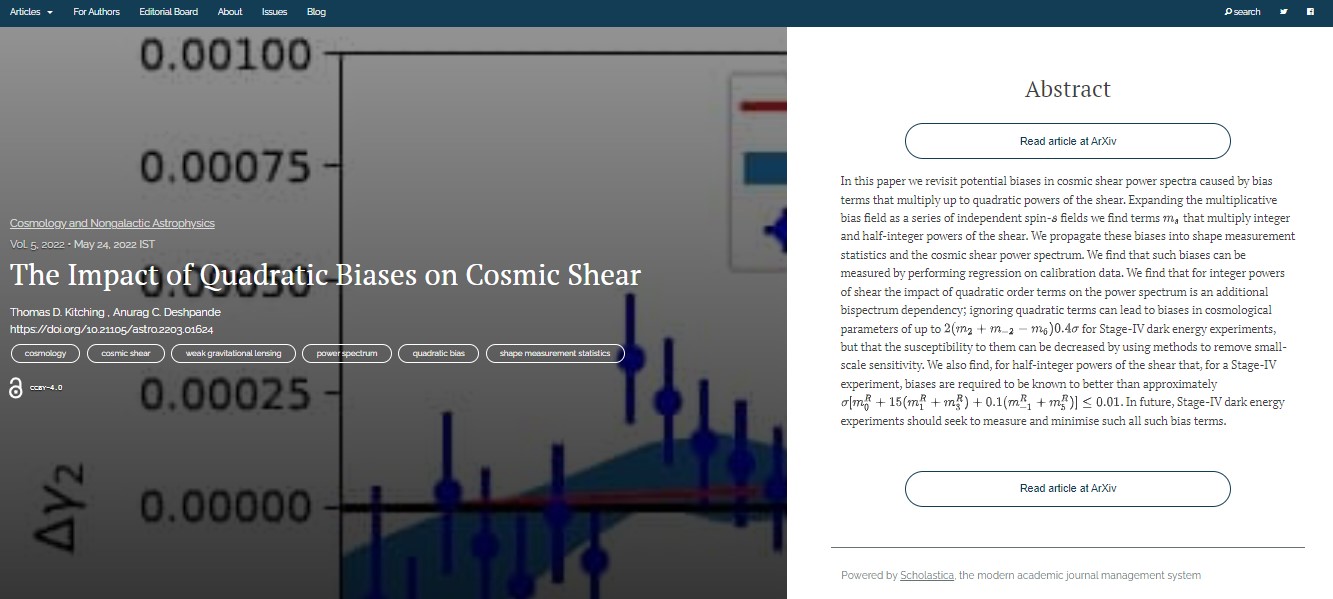
The first of these two new publications is entitled “The Impact of Quadratic Biases on Cosmic Shear” and is written by Tom Kitching and Anurag Deshpande of the Mullard Space Science Laboratory in Surrey (UK).

Here is a screen grab of the overlay which includes the abstract:

You can click on the image to make it larger should you wish to do so. You can find the arXiv version of this paper directly here.

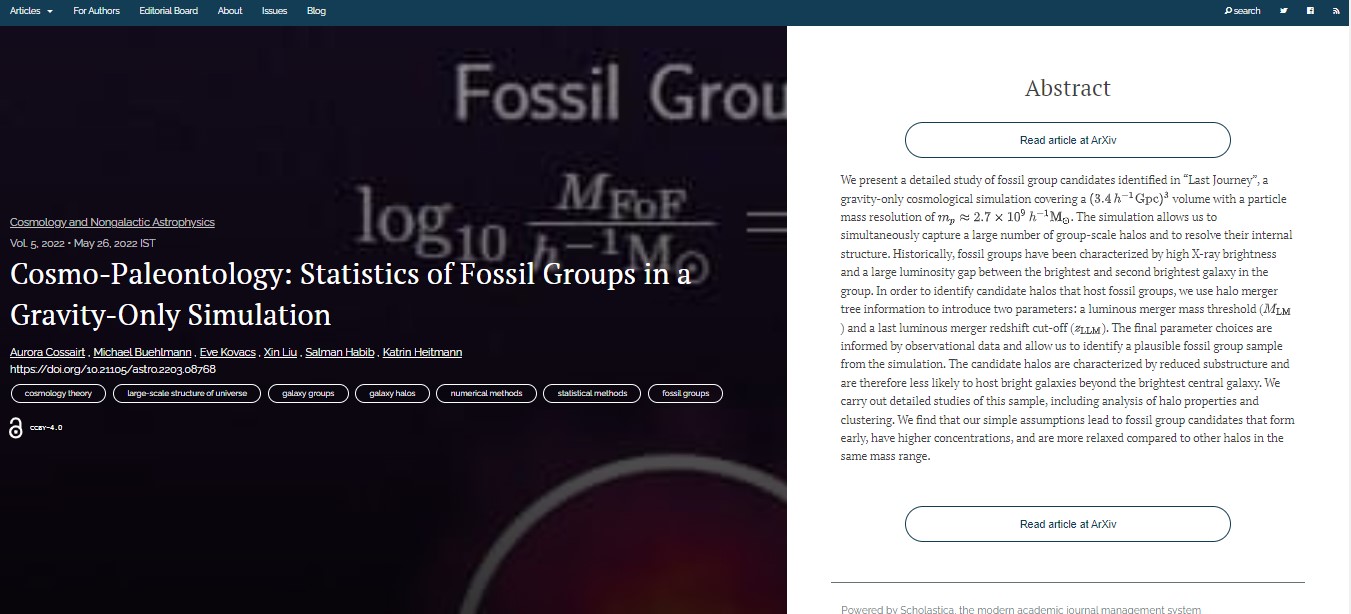
The second new publication is entitled “Cosmo-Paleontology: Statistics of Fossil Groups in a Gravity-Only Simulation” and is written by Aurora Coissairt, Michael Buehlmann, Eve Kovacs, Xin Liu, Salman Habib and Katrin Heitmann all from the Argonne National Laboratory which is just outside Chicago in the USA.

Here is the overlay of that paper which includes the abstract:

Once again You can click on the image to make it larger should you wish to do so. You can find the arXiv version of the paper here.

We have quite a few more papers in the pipeline so expect to be announcing more quite soon, probably early next month.

New Publication at the Open Journal of Astrophysics

Posted in OJAp Papers, Open Access, The Universe and Stuff with tags , , , , , , on December 17, 2021 by telescoper

It’s nice to be able to announce another publication in the Open Journal of Astrophysics before the Christmas break. This one was published yesterday, actually, but I didn’t get time to post about it until just now. It is the 17th paper in Volume 4 (2021) and the 48th in all.

The latest publication is entitled Mapping Spatially Varying Additive Biases in Cosmic Shear Data and is written by Tom Kitching and Anurag Deshpande of the Mullard Space Science Laboratory (UCL) and Peter Taylor of the Jet Propulsion Laboratory (Caltech).

Here is a screen grab of the overlay which includes the abstract:

You can click on the image to make it larger should you wish to do so. You can find the arXiv version of the paper here. This is another one for the Cosmology and Nongalactic Astrophysics folder, which is the most popular category so far on the Open Journal of Astrophysics site.

P. S. Let me apologise for any inconvenience caused by a recent temporary outage on our Scholastica platform overnight between 16th & 17th December (US time). Normal service has now been restored.

More from the Dark Energy Survey

Posted in Astrohype, The Universe and Stuff with tags , , , , , , on May 28, 2021 by telescoper

To much media interest the Dark Energy Survey team yesterday released 11 new papers based on the analysis of their 3-year data. You can find the papers together with short descriptions here. There’s even a little video about the Dark Energy Survey here:

The official press release summarizes the results as follows:

Scientists measured that the way matter is distributed throughout the universe is consistent with predictions in the standard cosmological model, the best current model of the universe.

This contrasts a bit with the BBC’s version:

The results are a surprise because they show that it is slightly smoother and more spread out than the current best theories predict.

The observation appears to stray from Einstein’s theory of general relativity – posing a conundrum for researchers.

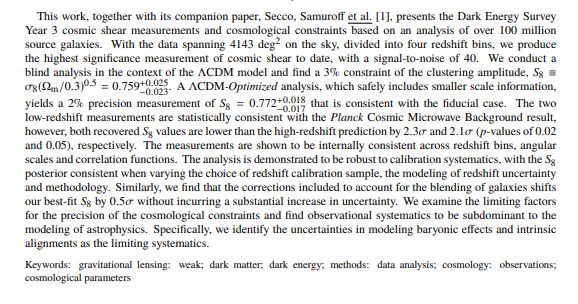
The reason for this appears to be that the BBC story focusses on the weak lensing paper (found here; I’ll add a link to the arXiv version if and when it appears there). The abstract is here:

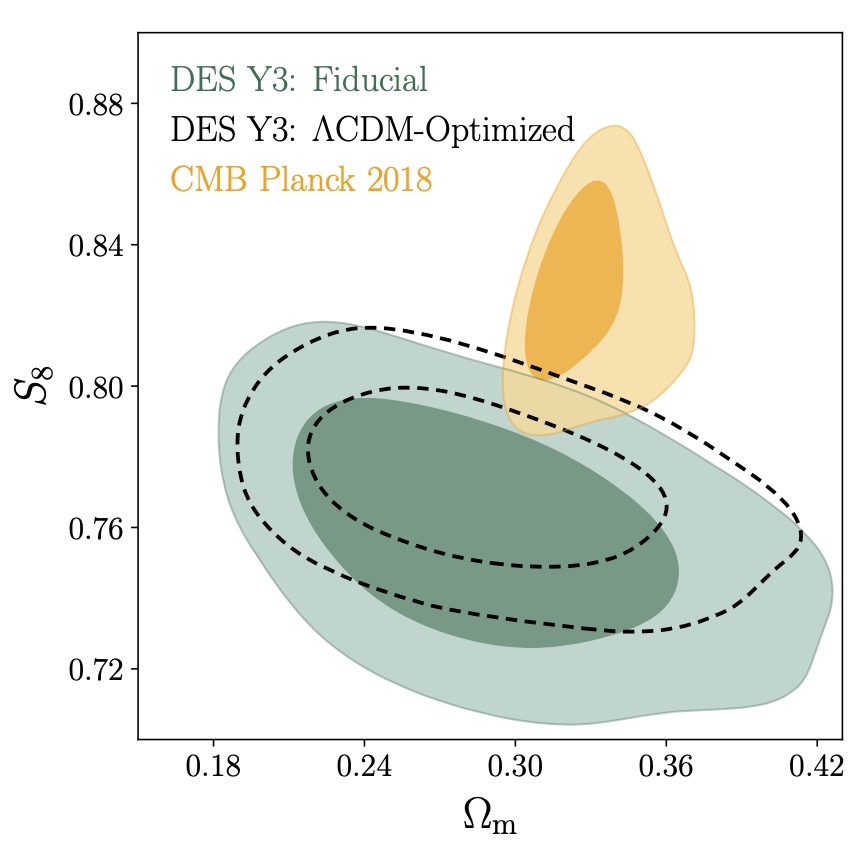
The parameter S8 is a (slightly) rescaled version of the more familiar parameter σ8  – which quantifies the matter-density fluctuations on a scale of 8 h-1 Mpc – as defined in the abstract; cosmic shear is particularly sensitive to this parameter.

The key figure showing the alleged “tension” with Planck is here:

The companion paper referred to in the above abstract (found here has an abstract that concludes with the words (my emphasis).

We find a 2.3σ difference between our S8 result and that of Planck (2018), indicating no statistically significant tension, and additionally find our results to be in qualitative agreement with current weak lensing surveys (KiDS-1000 and HSC).

So, although certain people have decided to hype up a statistically insignificant l discrepancy, everything basically fits the standard model…

New Publication at the Open Journal of Astrophysics

Posted in OJAp Papers, Open Access, The Universe and Stuff with tags , , , , , , , on December 15, 2020 by telescoper

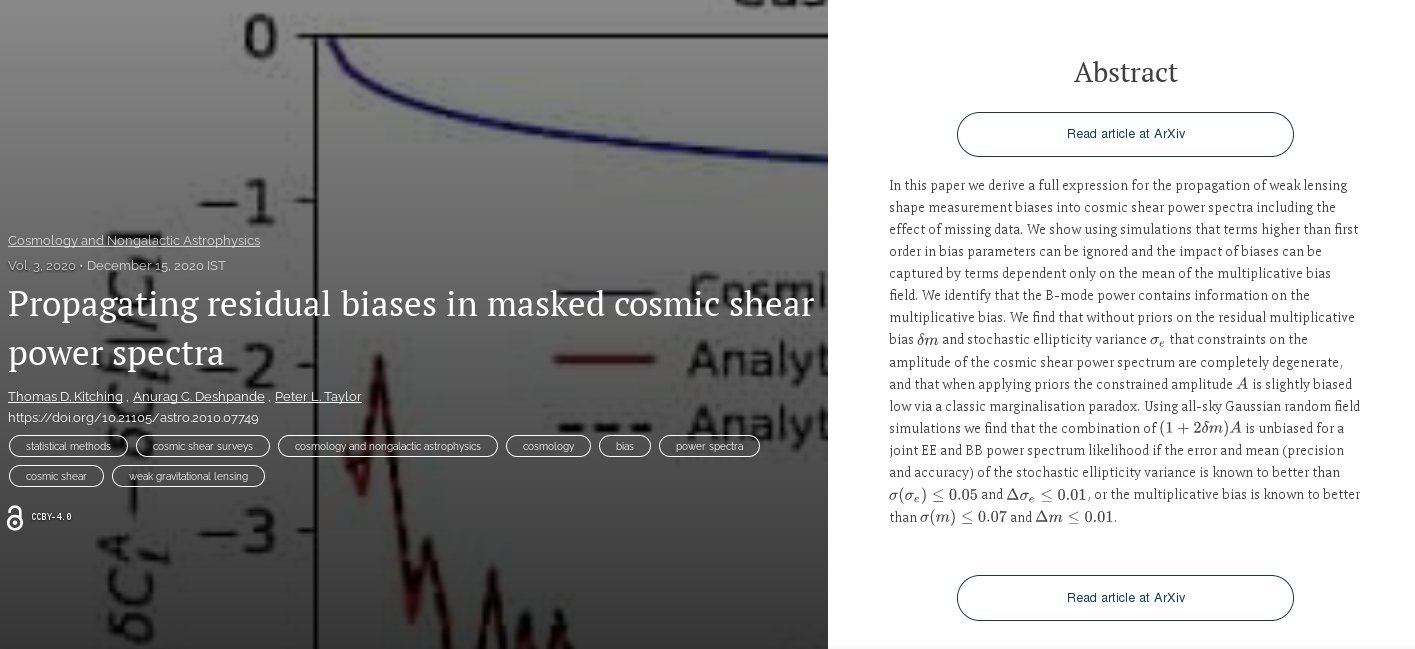
The Christmas rush is definitely upon us and papers are queuing up to be published in the Open Journal of Astrophysics. The latest publication is by Tom Kitching and Anurag Deshpande of MSSL (University College London) and Peter Taylor of JPL (Caltech). It is entitled Propagating residual biases in masked cosmic shear power spectra. This is another one for the folder marked Cosmology and Nongalactic Astrophysics.

Here is a screen grab of the overlay:

You can click on the image to make it larger should you wish to do so. You can find the arXiv version of the paper here.

When I last posted about a new OJA paper I mentioned that it seemed to be taking authors longer than usual to make revisions. There are signs now that some authors are trying to get papers off their desk before the Christmas break so we may have two or three more to publish before the year is out.

P.S. Last week I received an offer from a commercial organization to buy the Open Journal of Astrophysics. I replied politely that it is not for sale.

New Publication at the Open Journal of Astrophysics!

Posted in OJAp Papers, Open Access, The Universe and Stuff with tags , , , , , , on June 25, 2020 by telescoper

Proving further the point that the The Open Journal of Astrophysics is definitely fully open we have published yet another paper. This one was actually published yesterday, which means that we had two in two days..

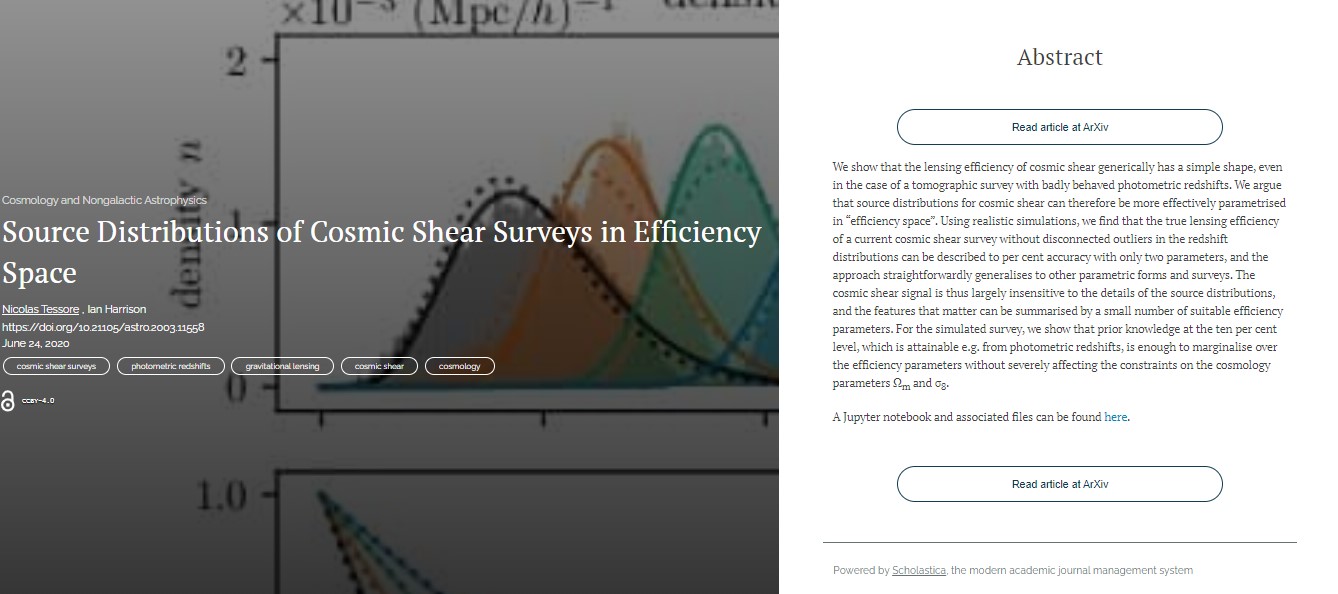
This one is in the Cosmology and Nongalactic Astrophysics section and is entitled Source Distributions of Cosmic Shear Surveys in Efficiency Space. The authors are Nicolas Tessore and Ian Harrison, both from the University of Manchester. The paper is concerned with the extraction of cosmological information from cosmic shear surveys.

Here is a screen grab of the overlay:

You can find the arXiv version of the paper here.

New Publication at the Open Journal of Astrophysics!

Posted in OJAp Papers, Uncategorized with tags , , , , , , , on July 19, 2019 by telescoper

I was a bit busy yesterday doing a number of things, including publishing a new paper at The Open Journal of Astrophysics, but I didn’t get time to write a post about it until now. Anyway, here is how the new paper looks on the site:

The authors are Tom Kitching, Paniez Paykari and Mark Cropper of the Mullard Space Sciences Laboratory (of University College London) and Henk Hoekstra of Leiden Observatory.

You can find the accepted version on the arXiv here. This version was accepted after modifications requested by the referee and editor. Because this is an overlay journal the authors have to submit the accepted version to the arXiv (which we then check against the copy submitted to us) before publishing. We actually have a bunch of papers that we have accepted but are awaiting the appearance of the final version on the arXiv so we can validate it.

Anyway, this is another one for the `Cosmology and Nongalactic Astrophysics’ folder. We would be happy to get more submissions from other areas of astrophysics. Hint! Hint!

P.S. Just a reminder that we now have an Open Journal of Astrophysics Facebook page where you can follow updates from the Journal should you wish..

Subaru and Cosmic Shear

Posted in The Universe and Stuff with tags , , , , , , on February 15, 2019 by telescoper

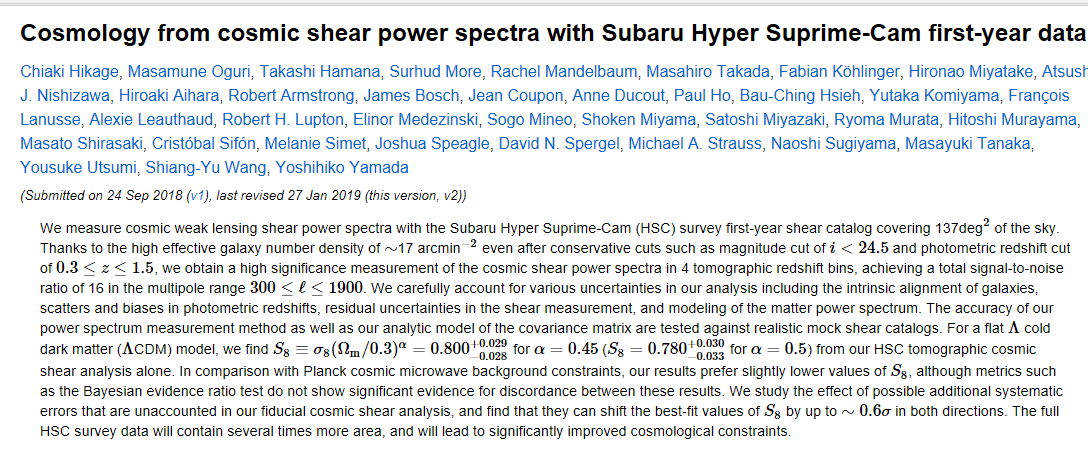
Up with the lark this morning I suddenly remembered I was going to do a post about a paper which actually appeared on the arXiv some time ago. Apart from the fact that it’s a very nice piece of work, the first author is Chiaki Hikage who worked with me as a postdoc about a decade ago. This paper is extremely careful and thorough, which is typical of Chiaki’s work. Its abstract is here:

The work described uses the Hyper-Suprime-Cam Subaru Telescope to probe how the large-scale structure of the Universe has evolved by looking at the statistical effect of gravitational lensing – specifically cosmic shear – as a function of redshift (which relates to look-back time). The use of redshift binning as demonstrated in this paper is often called tomography. Gravitational lensing is sensitive to all the gravitating material along the line of sight to the observer so probes dark, as well as luminous, matter.

Here’s a related graphic:

The article that reminded me of this paper is entitled New Map of Dark Matter Spanning 10 Million Galaxies Hints at a Flaw in Our Physics. Well, no it doesn’t really. Read the abstract, where you will find a clear statement that these results `do not show significant evidence for discordance’. Just a glance at the figures in the paper will convince you that is the case. Of course, that’s not to say that the full survey (which will be very much bigger; the current paper is based on just 11% of the full data set) may not reveal such discrepancies, just that analysis does not. Sadly this is yet another example of misleadingly exaggerated science reporting. There’s a lot of it about.

Incidentally, the parameter S8 is a (slightly) rescaled version of the more familiar parameter σ8  – which quantifies the matter-density fluctuations on a scale of 8 h-1 Mpc – as defined in the abstract; cosmic shear is particularly sensitive to this parameter.

Anyway, if this is what can be done with just 11%, the full survey should be a doozy!