Archive for cosmography

Weekly Update from the Open Journal of Astrophysics – 29/11/2025

Posted in OJAp Papers, Open Access, The Universe and Stuff with tags , , , , , , , , , , , , , , , , , , , , on November 29, 2025 by telescoper

It’s Saturday again, so it’s time for the usual update of the week’s new papers at the Open Journal of Astrophysics. Publishing this week was interrupted by the Thanksgiving holiday in the United States, which meant there were no arXiv announcements yesterday. Nevertheless, since the last update we have published another four papers, which brings the number in Volume 8 (2025) up to 184, and the total so far published by OJAp up to 419.

The first paper this week is “A theoretical prediction for the dipole in nearby distances using cosmography” by Hayley J. Macpherson (U. Chicago, USA) and Asta Heinesen (Niels Bohr Institute, Denmark). This was published on Monday 24th November 2025 in the folder Cosmology and Nongalactic Astrophysics. It presents a method to predict the dipole in luminosity distances that arises due to nearby inhomogeneities to leading-order correction to the standard isotropic distance-redshift law. Incidentally, I wrote about a talk by one of the authors here.

The overlay is here:
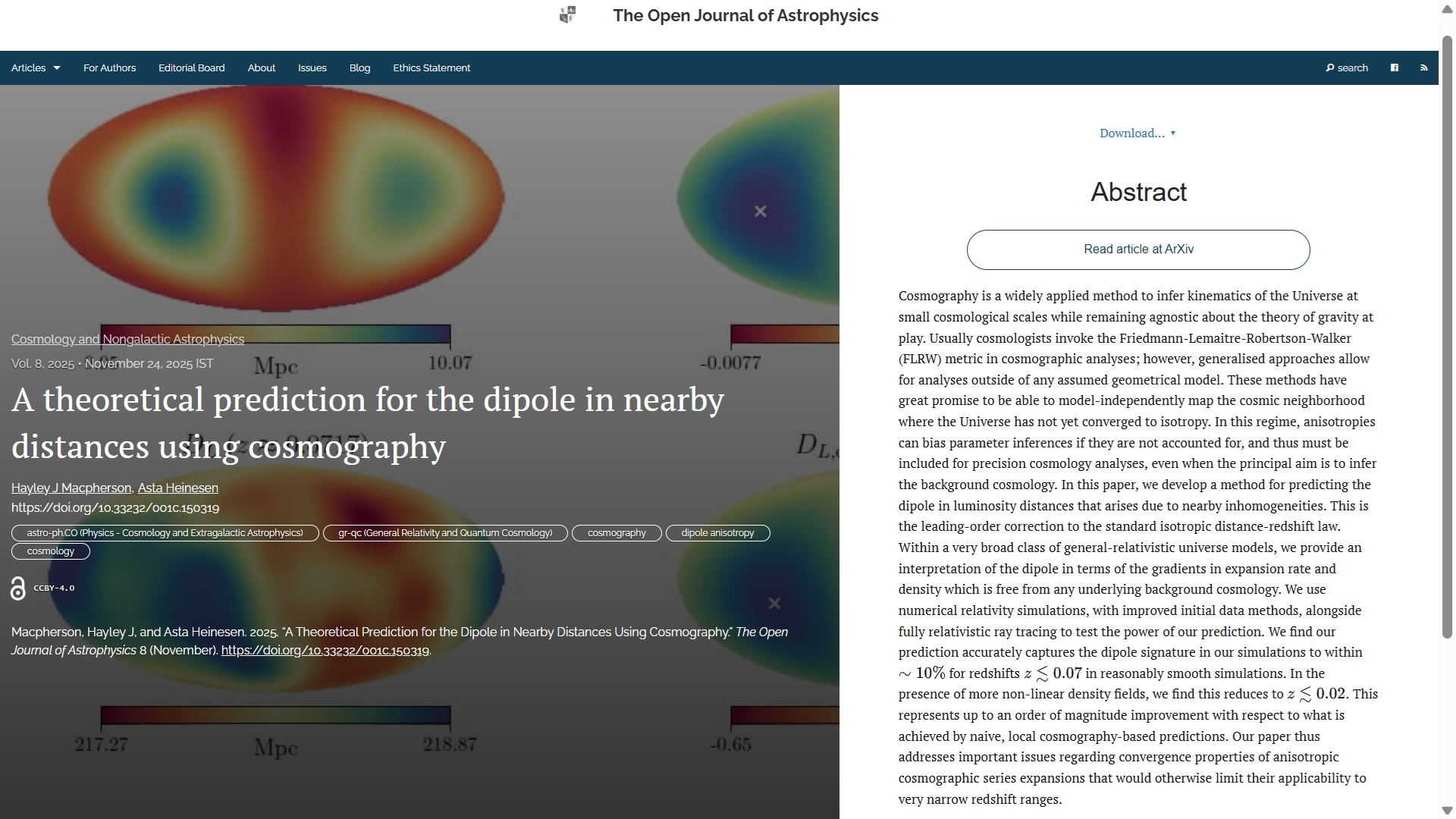
 

You can find the officially accepted version on arXiv here and the Fediverse announcement is here:

Open Journal of Astrophysics

New Publication at the Open Journal of Astrophysics: "A theoretical prediction for the dipole in nearby distances using cosmography" by Hayley J Macpherson (U. Chicago, USA) and Asta Heinesen (Niels Bohr Institute, Denmark)

doi.org/10.33232/001c.150319

November 24, 2025, 8:25 am 2 boosts 1 favorites


The second paper of the week is “A Targeted Gamma-Ray Search of Five Prominent Galaxy Merger Systems with 17 years of Fermi-LAT Data” by Siddhant Manna and Shantanu Desai (IIT Hyderabad Kandi, India). This one was published on Tuesday November 25th 2025 in the folder marked High-Energy Astrophysical Phenomena. It describes a search for gamma-ray emission in Fermi-LAT data from five merging galaxy systems with marginal detections for two of them

The overlay is here:
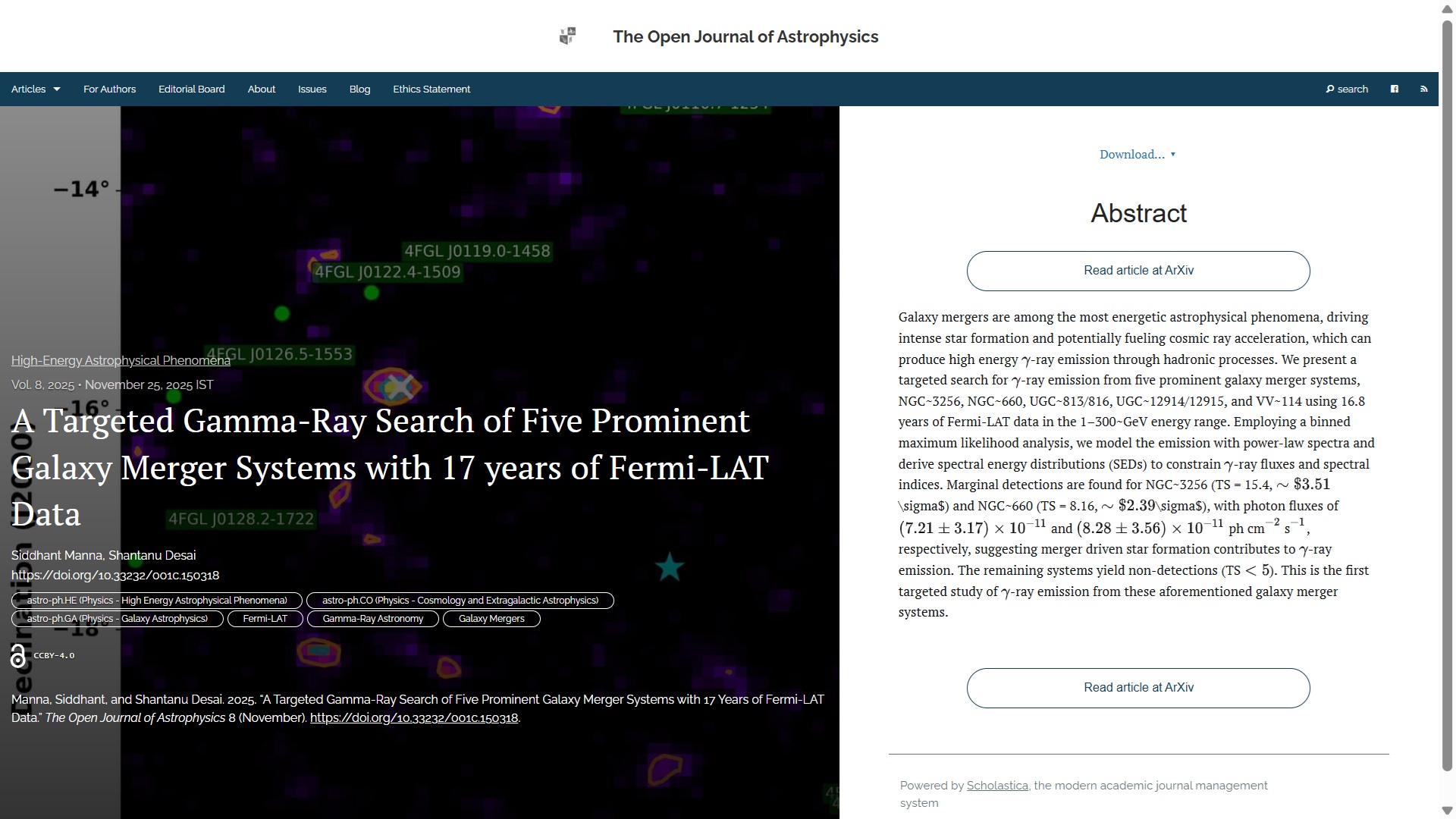
 

You can find the official version of this one on arXiv here. The federated announcement on Mastodon is here:


Next one up is “Metallicity fluctuation statistics in the interstellar medium and young stars – II. Elemental cross-correlations and the structure of chemical abundance space” by Mark R. Krumholz (ANU, Australia), Yuan-Sen Ting (Ohio State U., USA), Zefeng Li (Durham U., UK), Chuhan Zhang (ANU), Jennifer Mead (Columbia U., USA) and Melissa K. Ness (ANU). This was published in the folder Astrophysics of Galaxies on Wednesday November 26th. It presents an extended stochastically-forced diffusion model for the chemical evolution of galaxies, making quantitative predictions for the degree of correlation in abundance patterns in both gas and young stars.

The overlay is here:
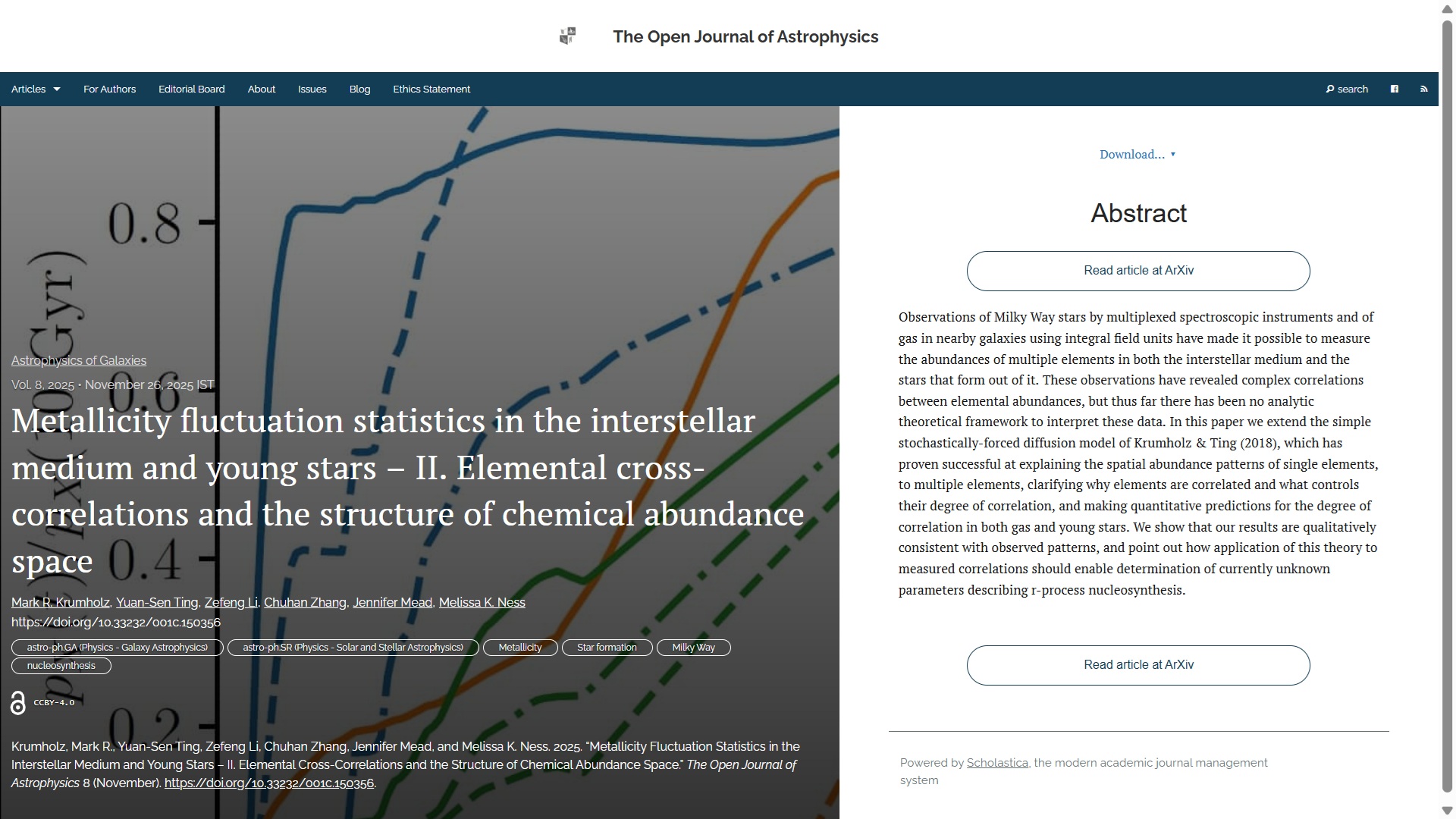
 

You can find the official accepted version on arXiv here. The fediverse announcement is here:

Open Journal of Astrophysics

New Publication at the Open Journal of Astrophysics: "Metallicity fluctuation statistics in the interstellar medium and young stars – II. Elemental cross-correlations and the structure of chemical abundance space" by Mark R. Krumholz (ANU, Australia), Yuan-Sen Ting (Ohio State U., USA), Zefeng Li (Durham U., UK), Chuhan Zhang (ANU), Jennifer Mead (Columbia U., USA) and Melissa K. Ness (ANU)

doi.org/10.33232/001c.150356

November 26, 2025, 8:34 am 1 boosts 1 favorites

The fourth and final paper of the week is “Simulating realistic Lyman-alpha emitting galaxies including the effect of radiative transfer” by Hasti Khoraminezhad & Shun Saito (Missouri Institute of Science & Technology, USA), Max Gronke (U. Heidelberg, Germany) and Chris Byrohl (MPA Garching, Germany). An empirical model for Lyman-alpha emitters (LAEs) which provides predictions for the halo occupation distributions and relationship between luminosity and halo mass, including the distribution of satellite LAEs. It was published on Thursday November 27th 2025 in the folder Astrophysics of Galaxies.

The overlay is here:
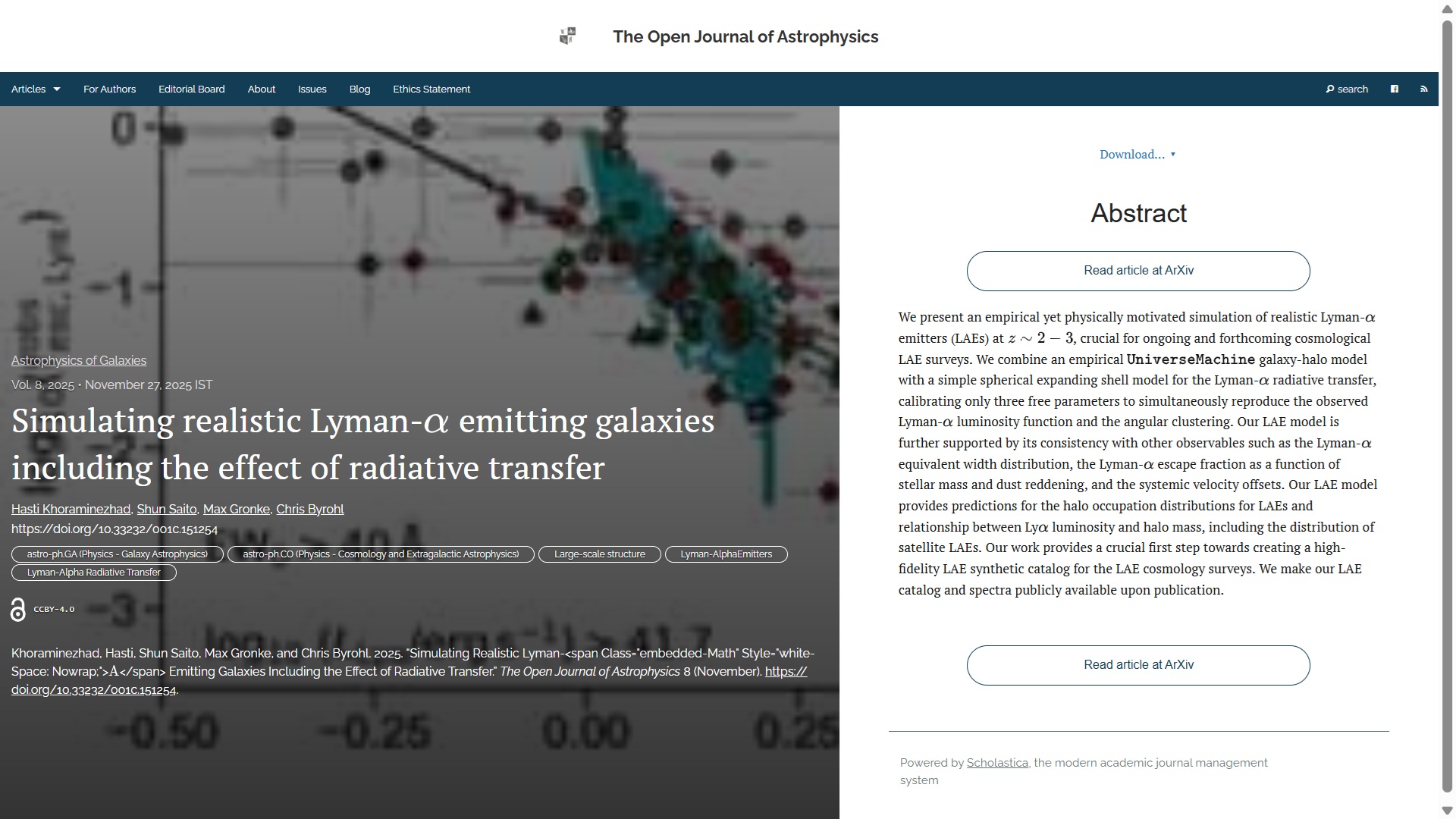
You can find the official published version on arXiv here. The Fediverse announcement follows:

Open Journal of Astrophysics

New Publication at the Open Journal of Astrophysics: "Simulating realistic Lyman-alpha emitting galaxies including the effect of radiative transfer" by Hasti Khoraminezhad & Shun Saito (Missouri Institute of Science & Technology, USA), Max Gronke (U. Heidelberg, Germany) and Chris Byrohl (MPA Garching, Germany)

doi.org/10.33232/001c.151254

November 27, 2025, 9:20 am 1 boosts 1 favorites

And that concludes the update for this week. I will do another next Saturday.
On Cosmography (and going Mainstream)

Posted in Maynooth, The Universe and Stuff with tags , , , , on October 19, 2025 by telescoper

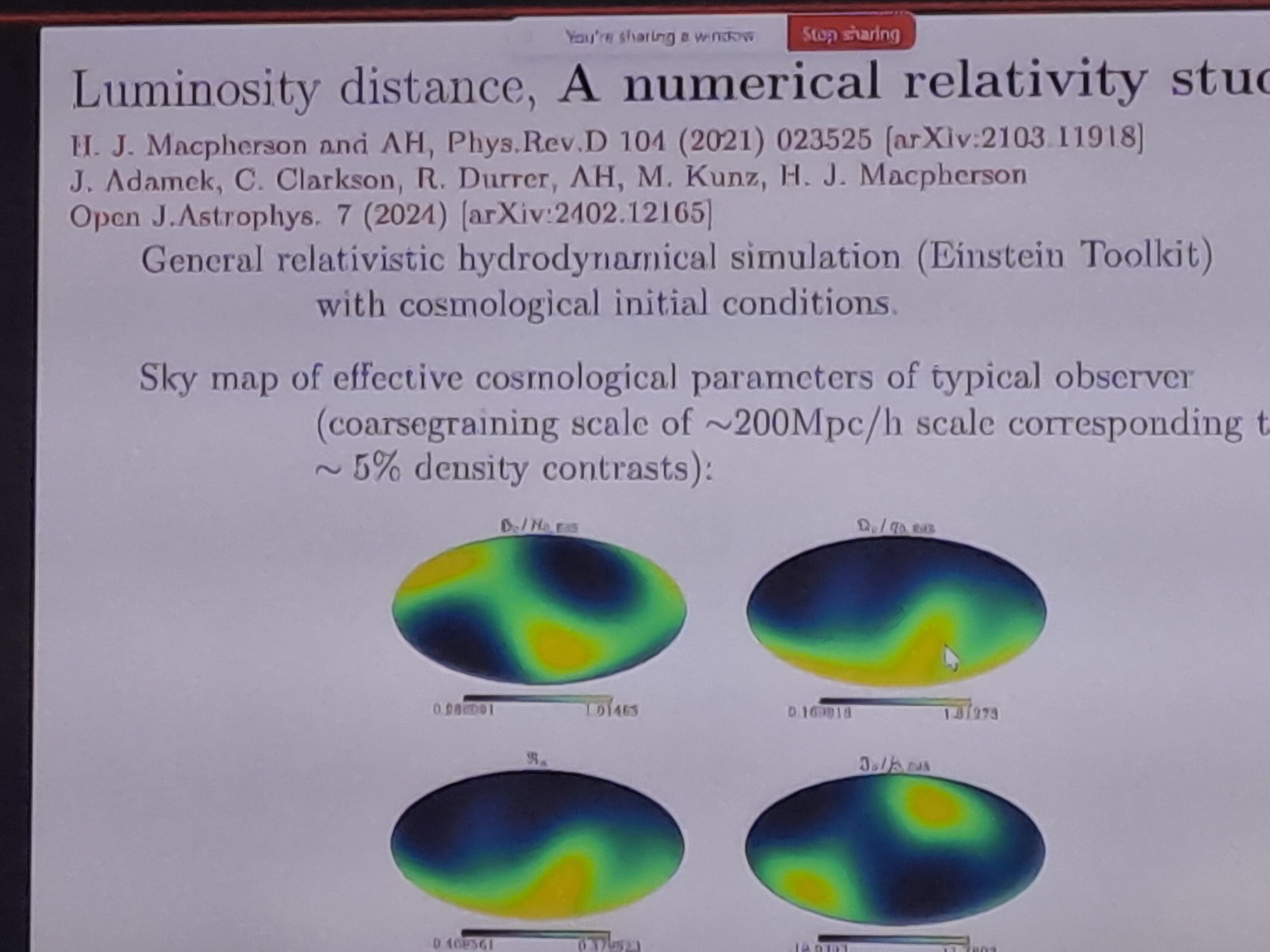
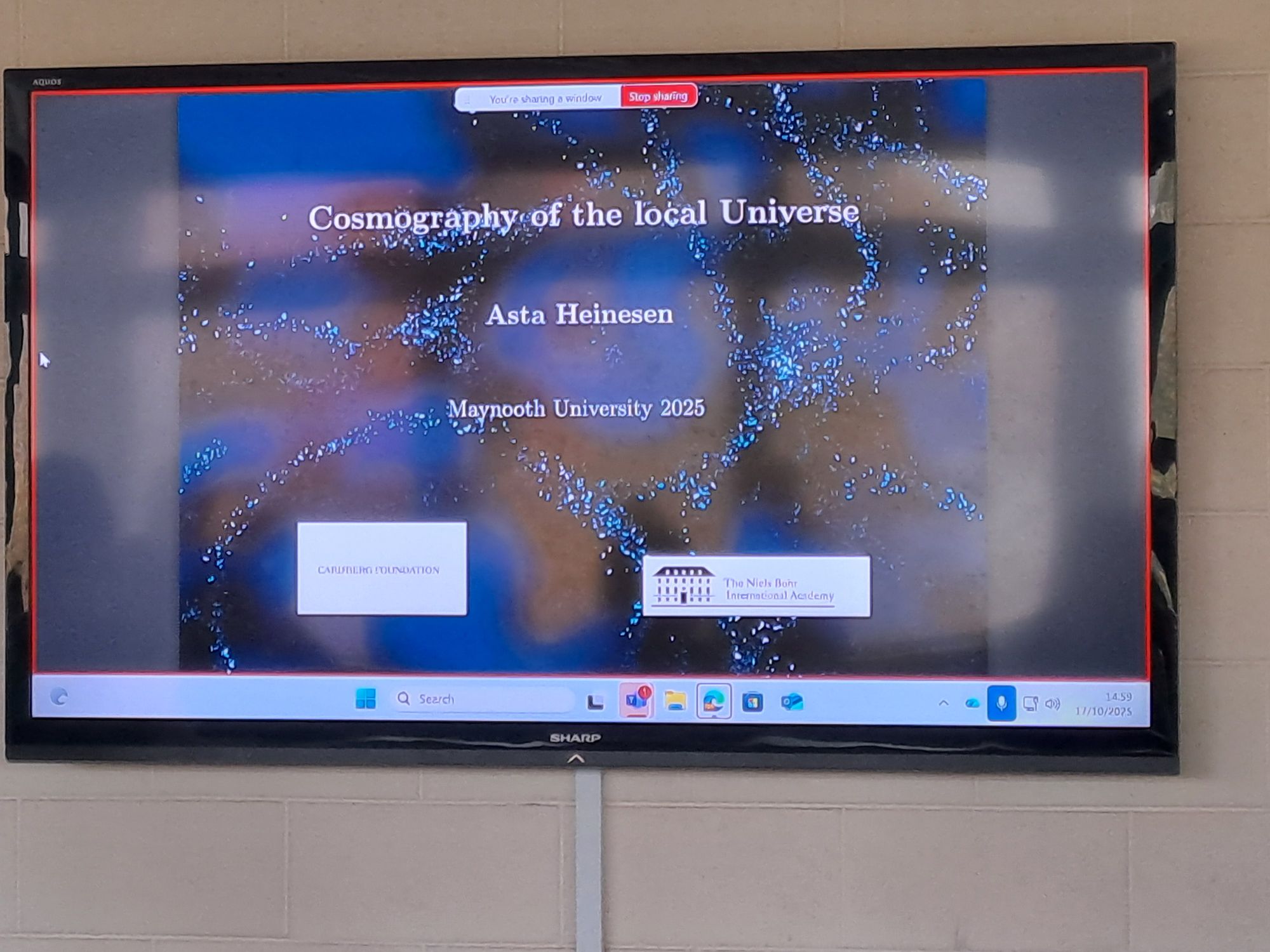
On Friday I attended a colloquium in the Physics Department at Maynooth University by Asta Heinesen of the Niels Bohr Institute in Copenhagen. The talk had the title of Cosmography of the local Universe, as shown on the first slide:

Asta talked about a very interesting programme of work that takes a different approach from most of modern cosmology in that it avoids making the prior assumption of global homogeneity and isotropy embodied by the Friedmann–Lemaître–Robertson–Walker metric. In particular, instead of assuming the isotropic expansion of the Universe, it tries to determine its properties directly using only such measurements as luminosity distances and redshifts. This method is not entirely model-independent because it does assume Lorentz invariance and the conditions required for the Etherington Reciprocity Theorem to hold, but it does not assume any particular form of the metric, so can be applied on scales where the distribution of matter is inhomogeneous and isotropic, e.g. in our local neighbourhood.

To apply this “metric-free” idea one has to construct as general as possible description of the kinematic properties of the underlying matter flow, allowing the global expansion to be anisotropic, and for there to be both rotation and shear. Obviously one would need a large number of measurements to extract anything like a full description of the matter flow, so generally one is restricted to deriving the low-order multipoles (monopole. dipole and quadrupole) as well as the observer’s velocity with respect to the large-scale matter flow.

I found Asta Heinesen’s seminar very stimulating in itself, but it was also nice to see that one of the papers on which it was based is published in the Open Journal of Astrophysics:

When I checked it, I found it was published on my birthday! Here is the overlay:

I announced it on this blog here.

I freely admit that I feel quite proud to have played a small part in helping to get such interesting work published. I’m seeing more and more papers referenced like this, actually. I was reminded of the recent announcement of this year’s list of MacArthur Fellows. among them Kareem El-Badry who has published quite a few papers with the Open Journal of Astrophysics. His biography on the MacArthur Foundation page includes this:

He has published articles in Monthly Notices of the Royal Astronomical SocietyThe Astrophysical Journal, and The Open Journal of Astrophysics, among other leading scientific journals.

I’m pleased to see us listed with the established names. I mention this just in case there are still people out there who think it might damage their career if they publish with a non-mainstream journal. We are mainstream now…

Three New Publications at the Open Journal of Astrophysics

Posted in OJAp Papers, Open Access, The Universe and Stuff with tags , , , , , , , , , , , , , , , , , on June 8, 2024 by telescoper

Time for another roundup of business at the  Open Journal of Astrophysics. This time I have three papers to announce, which brings the total we have published so far this year (Vol. 7) to 45 and the total published by OJAp to 160. We’re still on track to publish around 100 papers this year or more, compared to last year’s 50.

First one up, published on 3rd June 2024, is “Log-Normal Waiting Time Widths Characterize Dynamics” by Jonathan Katz of Washington University (St Louis, Missouri, USA). This paper presents a discussion of the connection between waiting time distributions and dynamics for aperiodic astrophysical systems, with emphasis on log-normal distributions.  This paper is in the folder marked High-Energy Astrophysical Phenomena.

Here is a screen grab of the overlay, which includes the abstract:


You can read the paper directly on arXiv here.

The second paper to present is “An Empirical Model For Intrinsic Alignments: Insights From Cosmological Simulations” by Nicholas Van Alfen (Northeastern University, Boston, USA), Duncan Campbell (Carnegie Mellon University, Pittsburgh, USA), Jonathan Blazek (Northeastern University), C. Danielle Leonard (Newcastle University, UK), Francois Lanusse (Université Paris-Saclay, France), Andrew Hearin (Argonne National Laboratory, USA), Rachel Mandelbaum (Carnegie Mellon University) and The LSST Dark Energy Science Collaboration.  This paper presents an extension of the halo model (specifically the Halo Occupation Distribution, HOD) to include intrinsic alignment effects for the study of weak gravitational lensing. This paper is in the folder marked Cosmology and Nongalactic Astrophysics. It was published on Tuesday June 4th 2024.

The overlay looks like this:


You can read this paper directly on the arXiv here.

Last, but by no means least, comes  “Towards Cosmography of the Local Universe”  which proposes the multipoles of the distance-redshift relation as new cosmological observables that have a direct physical interpretation in terms of kinematical quantities of the underlying matter flow. This was also published on 4th June. The authors are Julian Adamek (IfA Zurich, Switzerland), Chris Clarkson (Queen Mary, London, UK), Ruth Durrer (Geneva, Switzerland), Asta Heinesen (U. Lyon, France & NBI Copenhagen, Denmark), Martin Kunz (Geneva), and Hayley J. Macpherson (Chicago, USA).

Here is a screengrab of the overlay:


To read the accepted version of this on the arXiv please go here. This paper is also in the folder marked Cosmology and Nongalactic Astrophysics.
That’s it for this week. I aim to post another update next weekend.


The Local Universe

Posted in The Universe and Stuff with tags , , , , on July 2, 2013 by telescoper

I just stumbled across this on Amanda Bauer’s blog  and thought I’d post it here because it’s so nice. The film is by Hélène Courtois, Daniel Pomarède, R. Brent Tully, Yehuda Hoffman, and Denis Courtois and it describes the Cosmography – like geography, only more cosmic – of the Local Universe. I’m not sure there’s a consensus among cosmologists about what exactly “local” means, but I’d say it probably means out to a few hundred Megaparsecs from the observer (say up to about a billion light years) or, alternatively, with redshifts much less than unity.  That may not sound very nearby at all, but even on such scales the look-back time is sufficiently short that the effect of cosmic evolution and/or the expansion of the Universe is negligible, so when we look at objects at such distances we’re seeing them as they are “now” rather than as they were in the past, which is the case when we study extremely distant objects.