It’s Saturday again so it’s time for another update of activity at the Open Journal of Astrophysics. Since the last update we have published a further three papers, bringing the number in Volume 9 (2026) to 126 and the total so far published by OJAp up to 574.
I will continue to include the posts made on our Mastodon account (on Fediscience); these announcements also show the DOI for each paper.
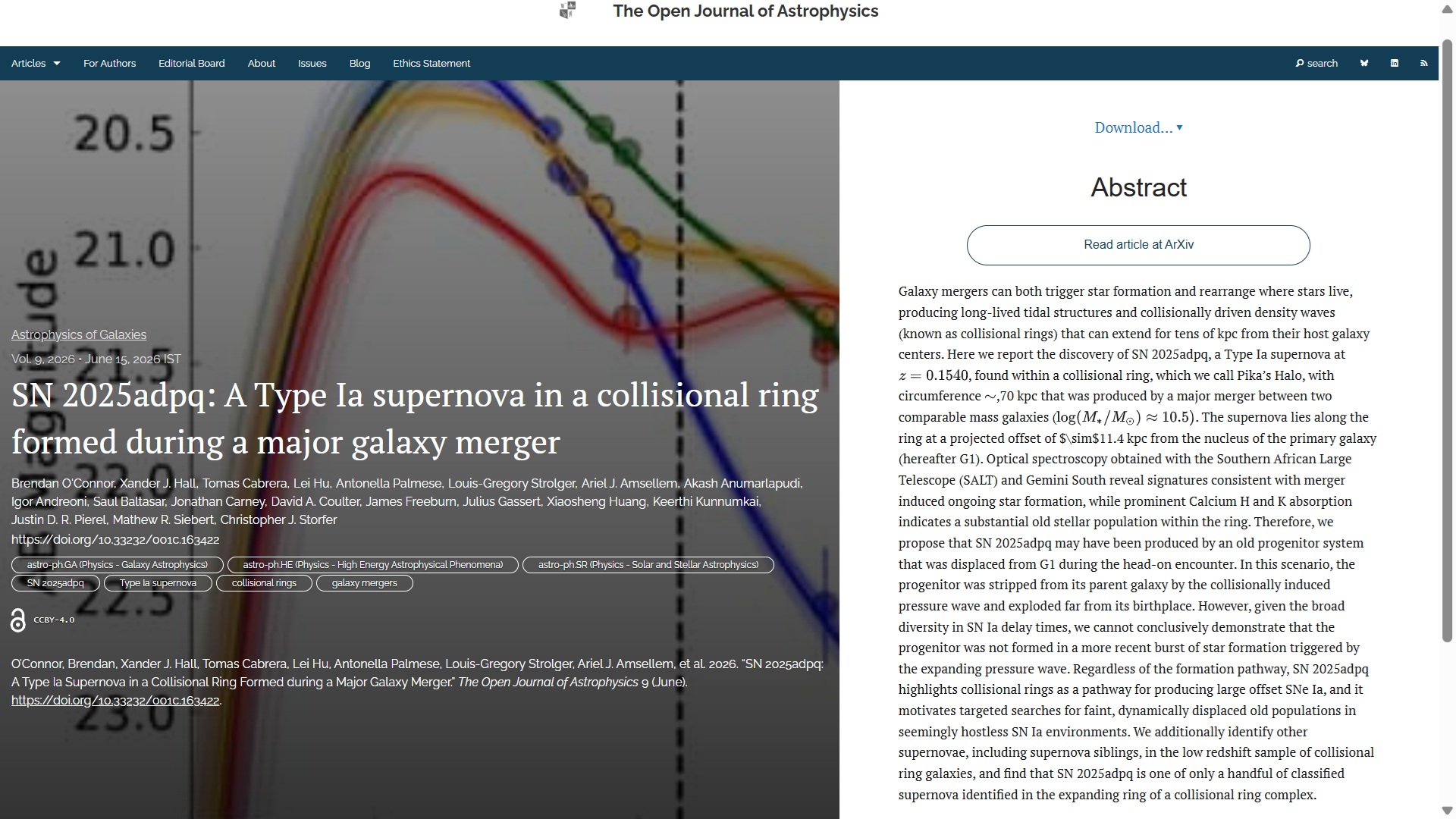
The first paper to report this week, published on Monday 15th June, is “SN 2025adpq: A Type Ia supernova in a collisional ring formed during a major galaxy merger” by Brendan O’Connor (Carnegie Mellon University, USA) and 18 others based in the USA, Germany and Australia. The study reports the discovery of a Type Ia supernova, SN 2025adpq, within a collisional ring formed by a major galaxy merger., offset from the nucleus of the primary galaxy. It is published in the folder Astrophysics of Galaxies.
The overlay for this paper is here
You can find the officially accepted version on arXiv here and the announcement on Fediverse here:
New Publication at the Open Journal of Astrophysics: "SN 2025adpq: A Type Ia supernova in a collisional ring formed during a major galaxy merger" by Brendan O'Connor (Carnegie Mellon University, USA) and 18 others based in the USA, Germany and Australia
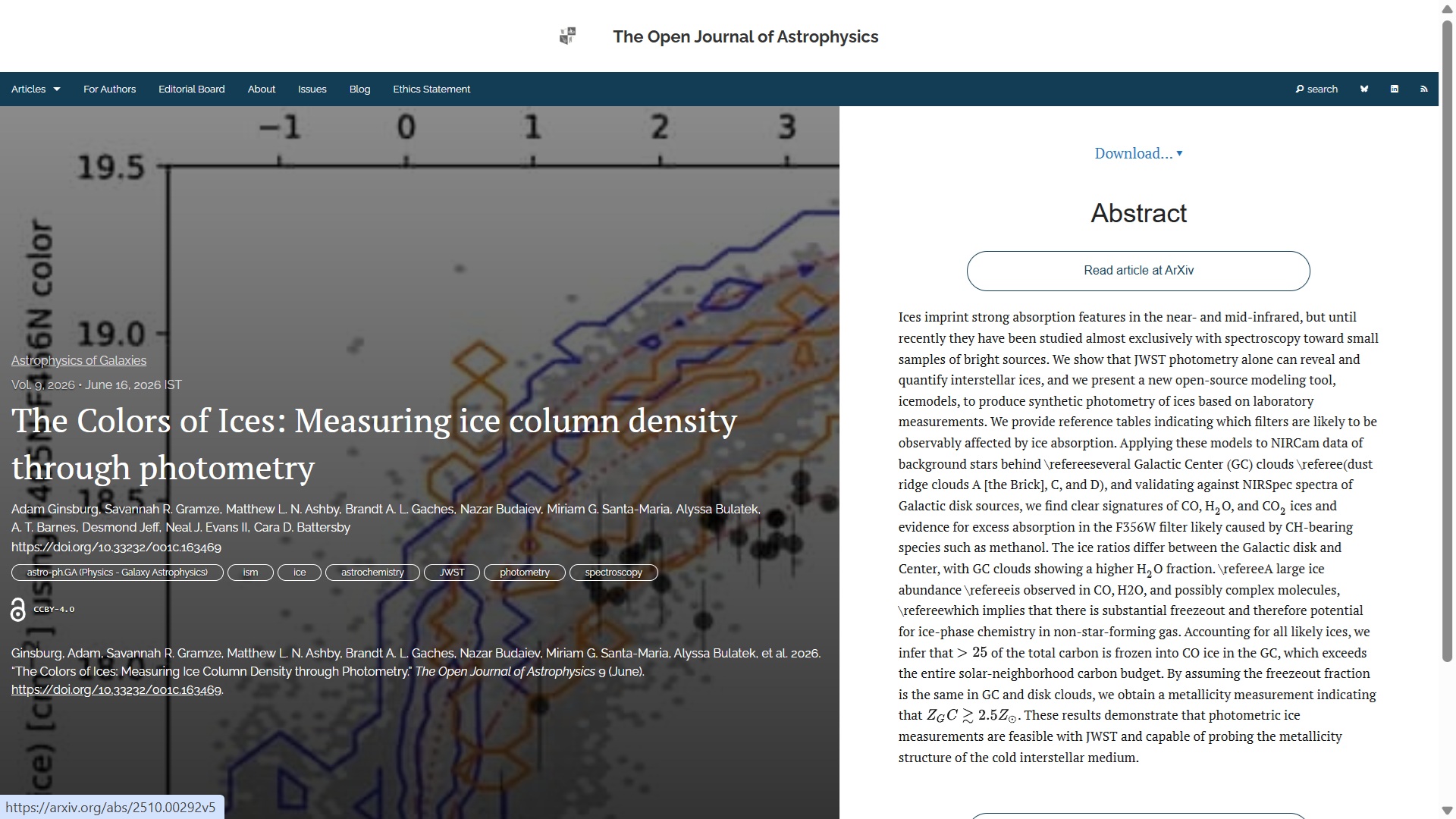
The second paper for this week, published on Tuesday June 16th in the folder Astrophysics of Galaxies is “The Colors of Ices: Measuring ice column density through photometry” by Adam Ginsburg (U. Florida, USA) and ten others based in the USA, Germany and Spain. This study demonstrates that JWST photometry can identify and quantify interstellar ices, using new open-source models, interstellar ices, finding significant abundance in non-star-forming gas, suggesting many avenues for further research.
The overlay looks like this:
The official version of the paper can be found on arXiv here and the Fediverse announcement here:
New Publication at the Open Journal of Astrophysics: "The Colors of Ices: Measuring ice column density through photometry" by Adam Ginsburg (U. Florida, USA) and ten others based in the USA, Germany and Spain
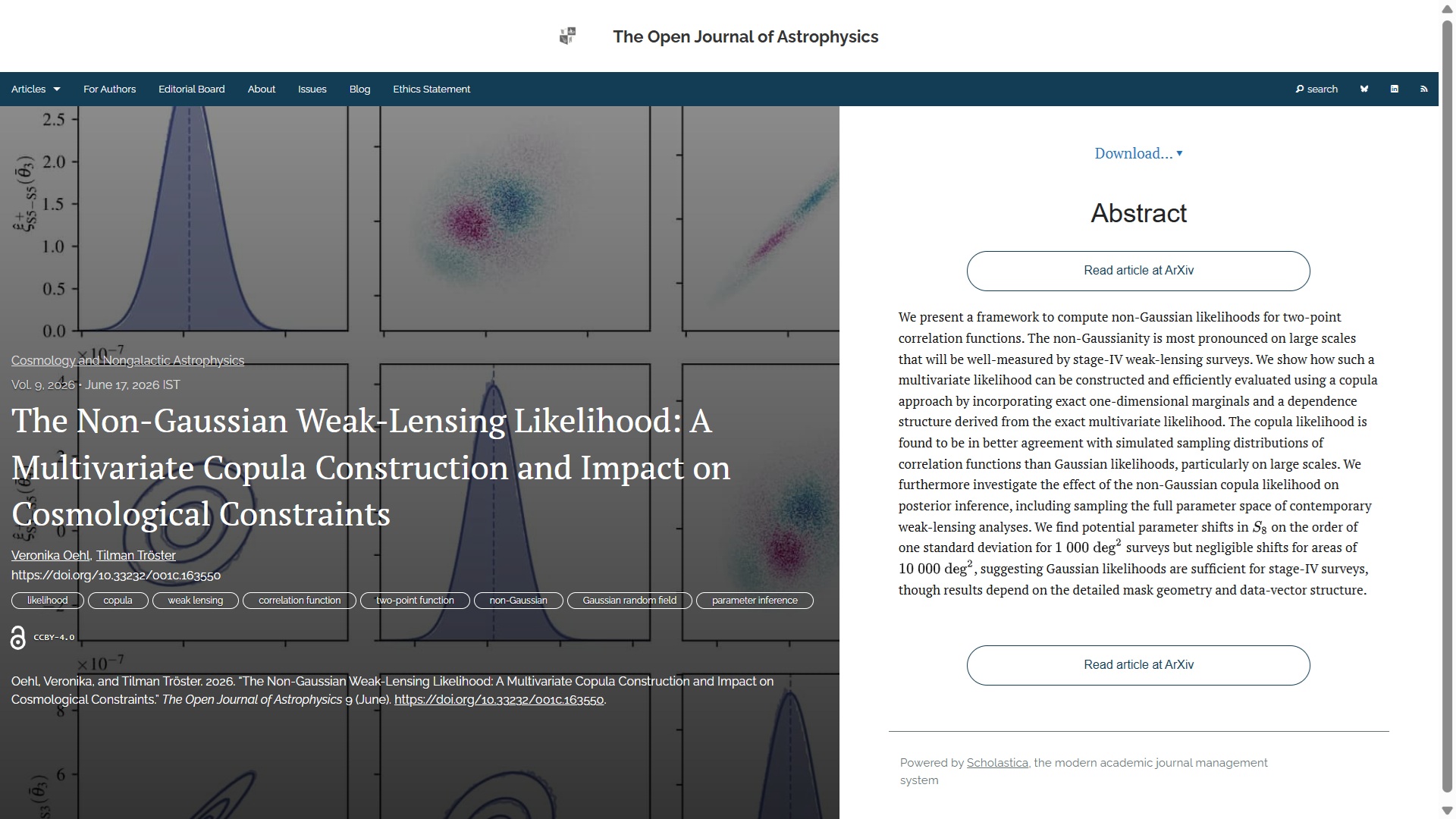
New Publication at the Open Journal of Astrophysics: "The Non-Gaussian Weak-Lensing Likelihood: A Multivariate Copula Construction and Impact on Cosmological Constraints" by Veronika Oehl and Tilman Tröster (ETH Zurich, Switzerland)
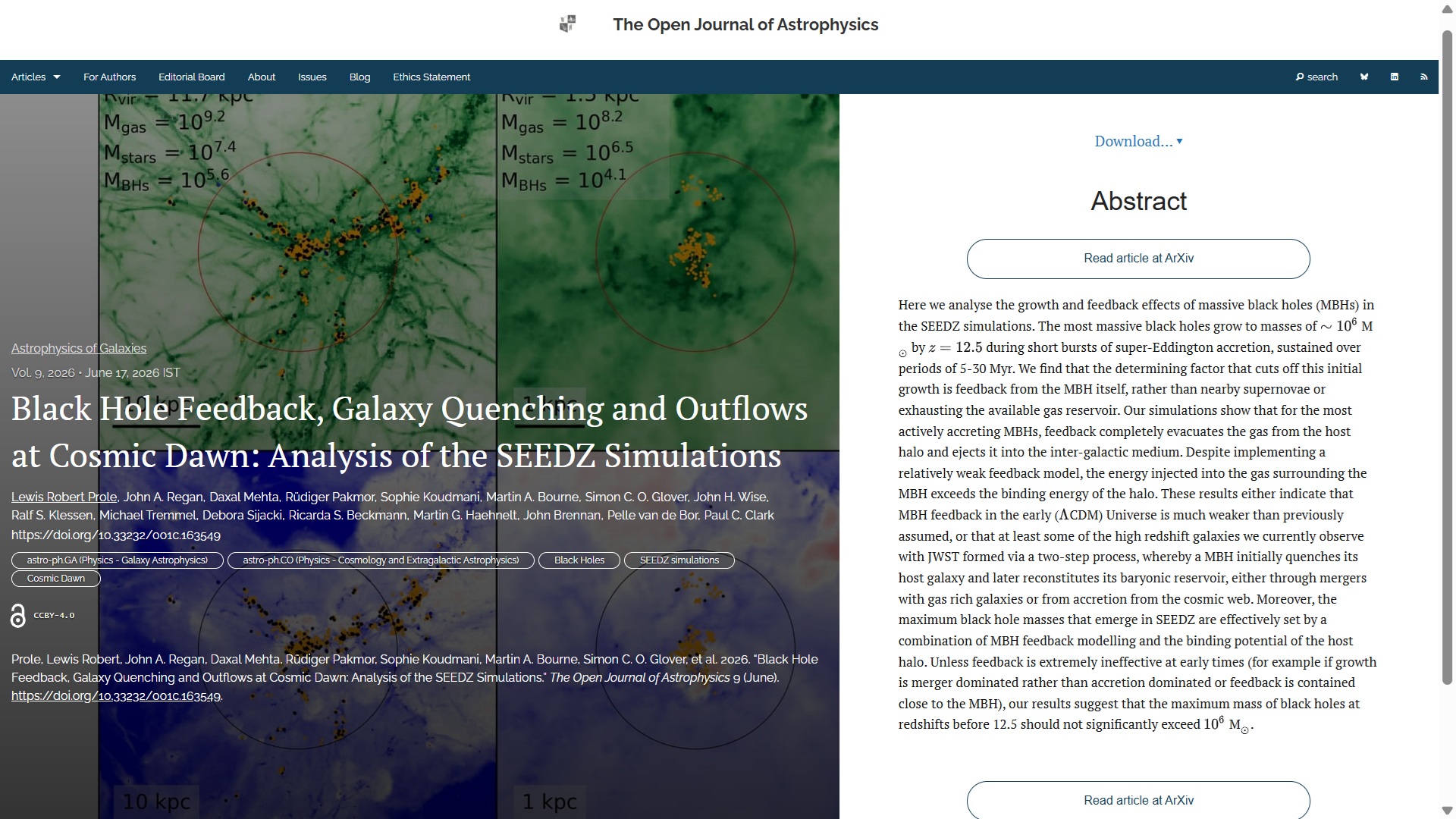
The fourth and final paper of the week, also ublished on Wednesday 17th June but in the folder Astrophysics of Galaxies, is “Black Hole Feedback, Galaxy Quenching and Outflows at Cosmic Dawn: Analysis of the SEEDZ Simulations” by Lewis R. Prole (Maynooth University, Ireland) and 15 others based in Ireland, Germany, USA and UK. The study analyzes the growth and feedback effects of massive black holes in SEEDZ simulations, suggesting that black hole feedback, not nearby supernovae or gas exhaustion, limits initial growth.
The overlay is here:
The final, accepted version can be found on arXiv here and the Mastodon announcement is here:
New Publication at the Open Journal of Astrophysics: "Black Hole Feedback, Galaxy Quenching and Outflows at Cosmic Dawn: Analysis of the SEEDZ Simulations" by Lewis R. Prole (Maynooth University, Ireland) and 15 others based in Ireland, Germany, USA and UK.
And that concludes this week’s update. It has been a slow week on the publishing front, but the main reason is that we have a big backlog of papers accepted but waiting for the authors to put their final versions on arXiv and we can’t do anything about that! I’ll do another update next Saturday.
It’s Saturday again so it’s time for another update of activity at the Open Journal of Astrophysics. Since the last update we have published a further three papers, bringing the number in Volume 9 (2026) to 122 and the total so far published by OJAp up to 570.
I will continue to include the posts made on our Mastodon account (on Fediscience); these announcements also show the DOI for each paper.
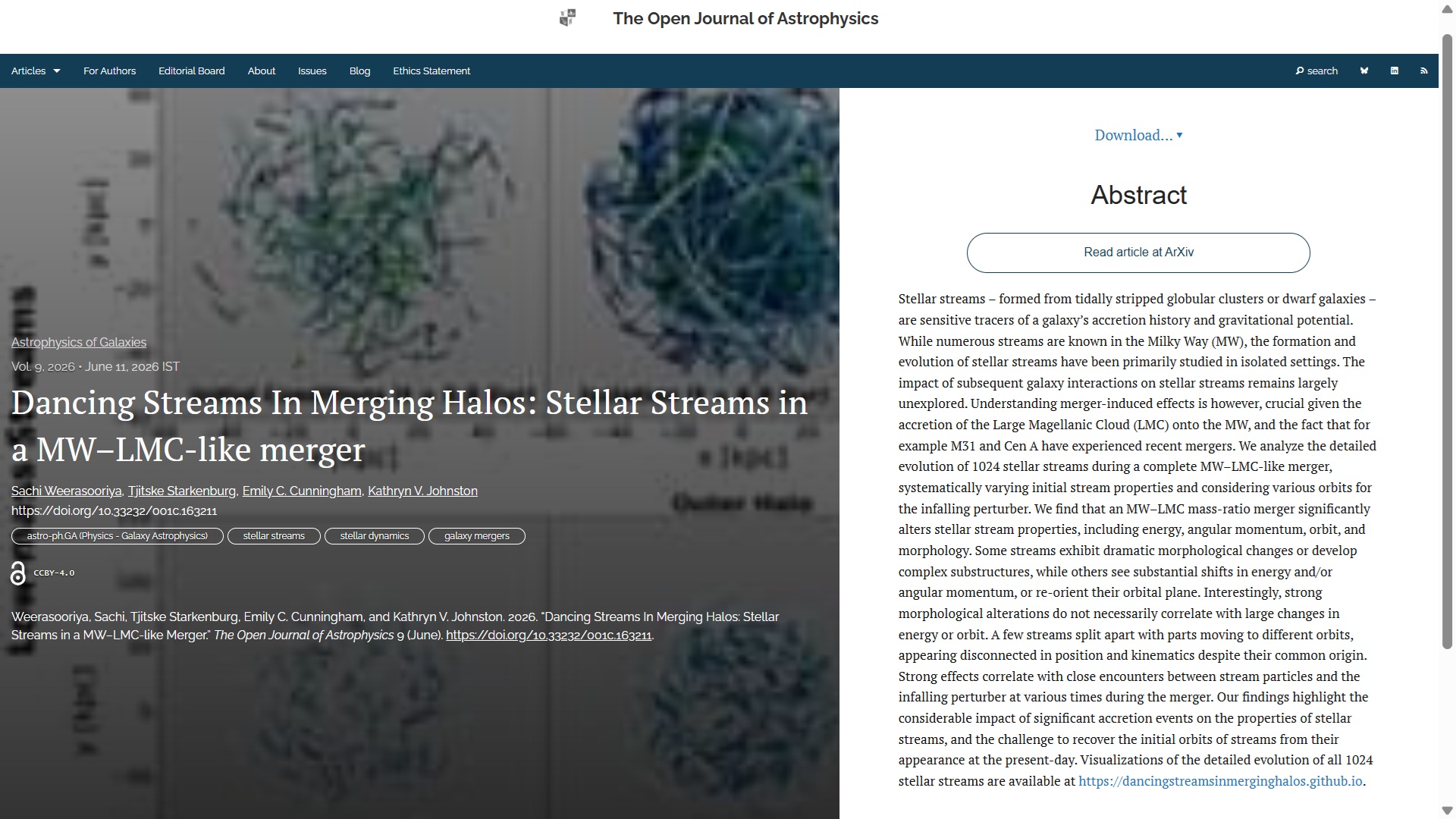
The first paper to report this week, published on Thursday 11th June, is “Dancing Streams In Merging Halos: Stellar Streams in a MW–LMC-like merger” by (all based in the USA): Sachi Weerasooriya (Carnegie Observatories), Tjitske Starkenburg (Northwestern U.), Emily C. Cunningham (Columbia U.) & Kathryn V. Johnston (Flatiron Institute). This article explores how galaxy mergers, like the Milky Way-Large Magellanic Cloud merger, significantly alter the properties and structures of stellar streams, challenging the recovery of their initial orbits. It is in the folder marked Astrophysics of Galaxies.
The overlay for this paper is here
You can find the officially accepted version on arXiv here and the announcement on Fediverse here:
New Publication at the Open Journal of Astrophysics: "Dancing Streams In Merging Halos: Stellar Streams in a MW–LMC-like merger" by (all based in the USA): Sachi Weerasooriya (Carnegie Observatories), Tjitske Starkenburg (Northwestern U.), Emily C. Cunningham (Columbia U.) & Kathryn V. Johnston (Flatiron Institute).
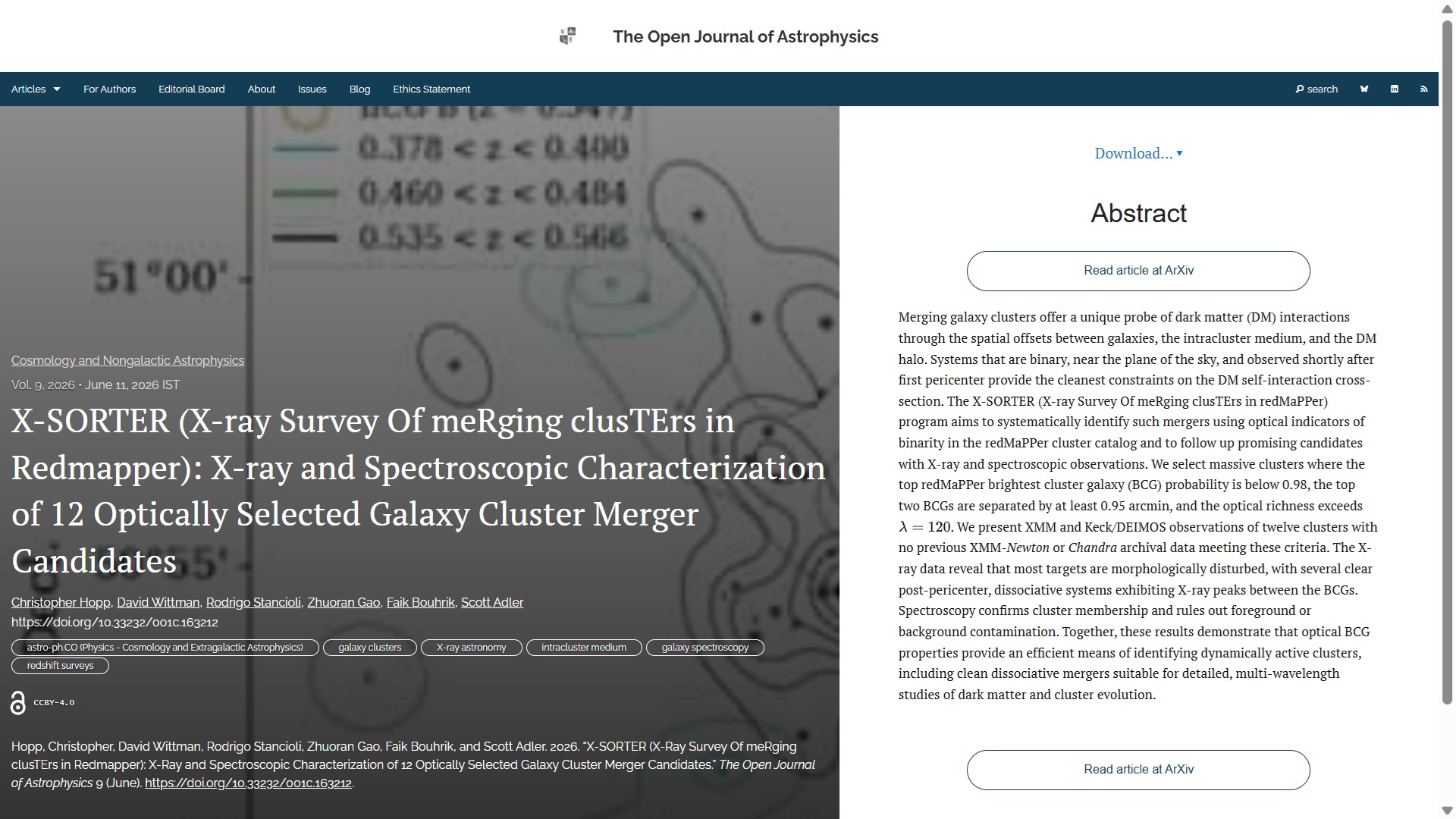
New Publication at the Open Journal of Astrophysics: "X-SORTER (X-ray Survey Of meRging clusTErs in Redmapper): X-ray and Spectroscopic Characterization of 12 Optically Selected Galaxy Cluster Merger Candidates" by Christopher Hopp, David Wittman, Rodrigo Stancioli, Zhuoran Gao & Faik Bouhrik (UC Davis) and Scott Adler (Rochester), all based in the USA.
The third and final paper of the week, published on Friday 12th June in the folder Earth and Planetary Astrophysics, is “JCMT Constraints on the Early-Time HCN and CO Emission and HCN Temporal Evolution of 3I/ATLAS” by Jason T. Hinkle (U. Illinois, USA) and 6 others based in the USA and Chile. This article presents observations of the third Interstellar Object, 3I/ATLAS, providing early sub-mm constraints on its activity. The findings suggest a steeper production rate slope than typical Solar System comets.
The overlay for this one is here:
The final, accepted version can be found on arXiv here and the Mastodon announcement is here:
New Publication at the Open Journal of Astrophysics: "JCMT Constraints on the Early-Time HCN and CO Emission and HCN Temporal Evolution of 3I/ATLAS" by Jason T. Hinkle (U. Illinois, USA) and 6 others based in the USA and Chile.
And that concludes this week’s update. It has been a slow week on the publishing front, but the main reason is that we have a big backlog of papers accepted but waiting for the authors to put their final versions on arXiv and we can’t do anything about that! I’ll do another update next Saturday.
Here we are, on schedule, with another update of activity at the Open Journal of Astrophysics. Since the last update we have published a further seven papers, bringing the number in Volume 9 (2026) to 94 and the total so far published by OJAp up to 542. I checked the corresponding update for last year (on 3rd May 2025), and we’ve had an increase from 54 to 94 in papers published (about 74%) between the first four months of 2025 and the first four months of 2026.
I will continue to include the posts made on our Mastodon account (on Fediscience) to encourage you to visit it. Mastodon is a really excellent service, and a more than adequate replacement for X/Twitter (which nobody should be using); these announcements also show the DOI for each paper.
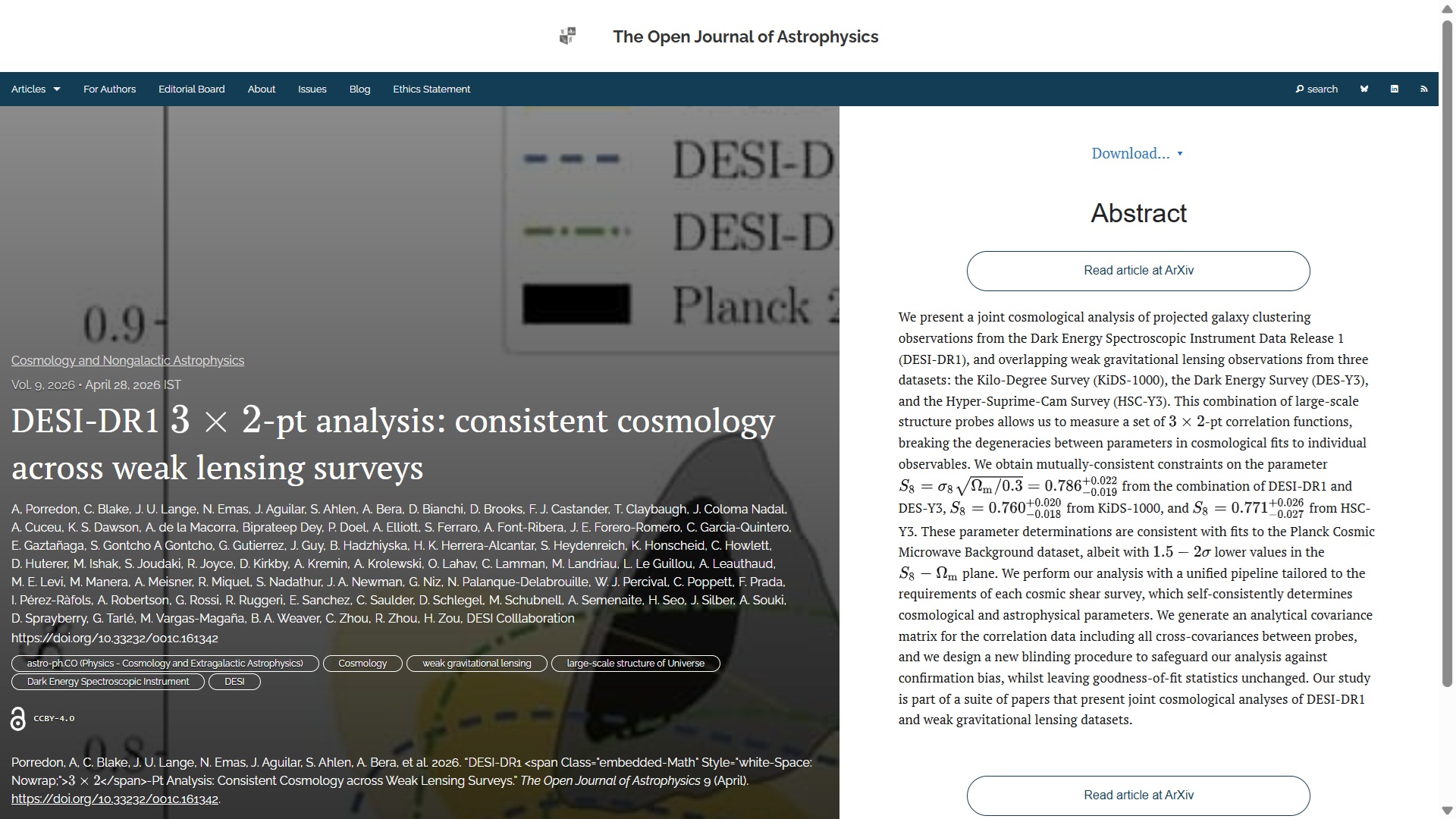
The first paper to report this week is “DESI-DR1 3 × 2-pt analysis: consistent cosmology across weak lensing surveys” by Anna Porredon (CIEMAT, Madrid, Spain) and 72 others (DESI Colllaboration). This paper was published on Tuesday 28th April in the folder Cosmology and Nongalactic Astrophysics. This paper presents a joint cosmological analysis of galaxy clustering and gravitational lensing observations, providing consistent constraints on cosmological parameters. The analysis also introduces a new blinding procedure to prevent confirmation bias. See this post for news of an important DESI milestone.
The overlay for this paper is here
You can find the officially accepted version on arXiv here and the announcement on Fediverse here:
New Publication at the Open Journal of Astrophysics: "DESI-DR1 3 × 2-pt analysis: consistent cosmology across weak lensing surveys" by Anna Porredon (CIEMAT, Madrid, Spain) and 72 others (DESI Colllaboration)
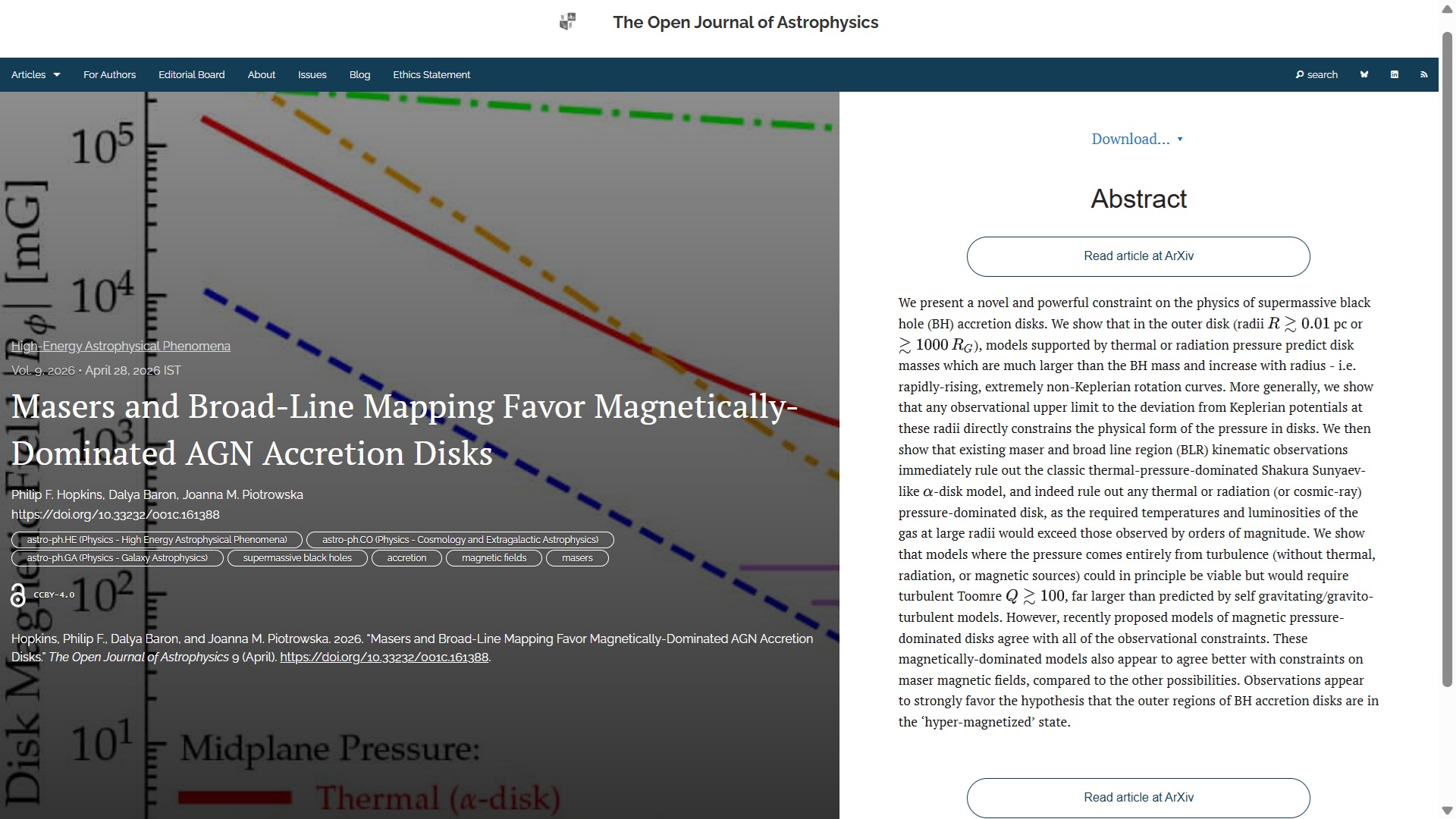
The second paper for this week, also published on Tuesday 28th April but in the folder High-Energy Astrophysical Phenomena is “Masers and Broad-Line Mapping Favor Magnetically-Dominated AGN Accretion Disks” by Philip F. Hopkins (Caltech, USA), Dalya Baron (Stanford U., USA) and Joanna M. Piotrowska (Caltech). This one presents a new constraint on supermassive black hole accretion disks physics, suggesting that outer regions are likely in a ‘hyper-magnetized’ state, as thermal or radiation pressure models appear inconsistent.
The overlay for this one is here:
The official version of the paper can be found on arXiv here and the Fediverse announcement here:
New Publication at the Open Journal of Astrophysics: "Masers and Broad-Line Mapping Favor Magnetically-Dominated AGN Accretion Disks" by Philip F. Hopkins (Caltech, USA), Dalya Baron (Stanford U., USA) and Joanna M. Piotrowska (Caltech)
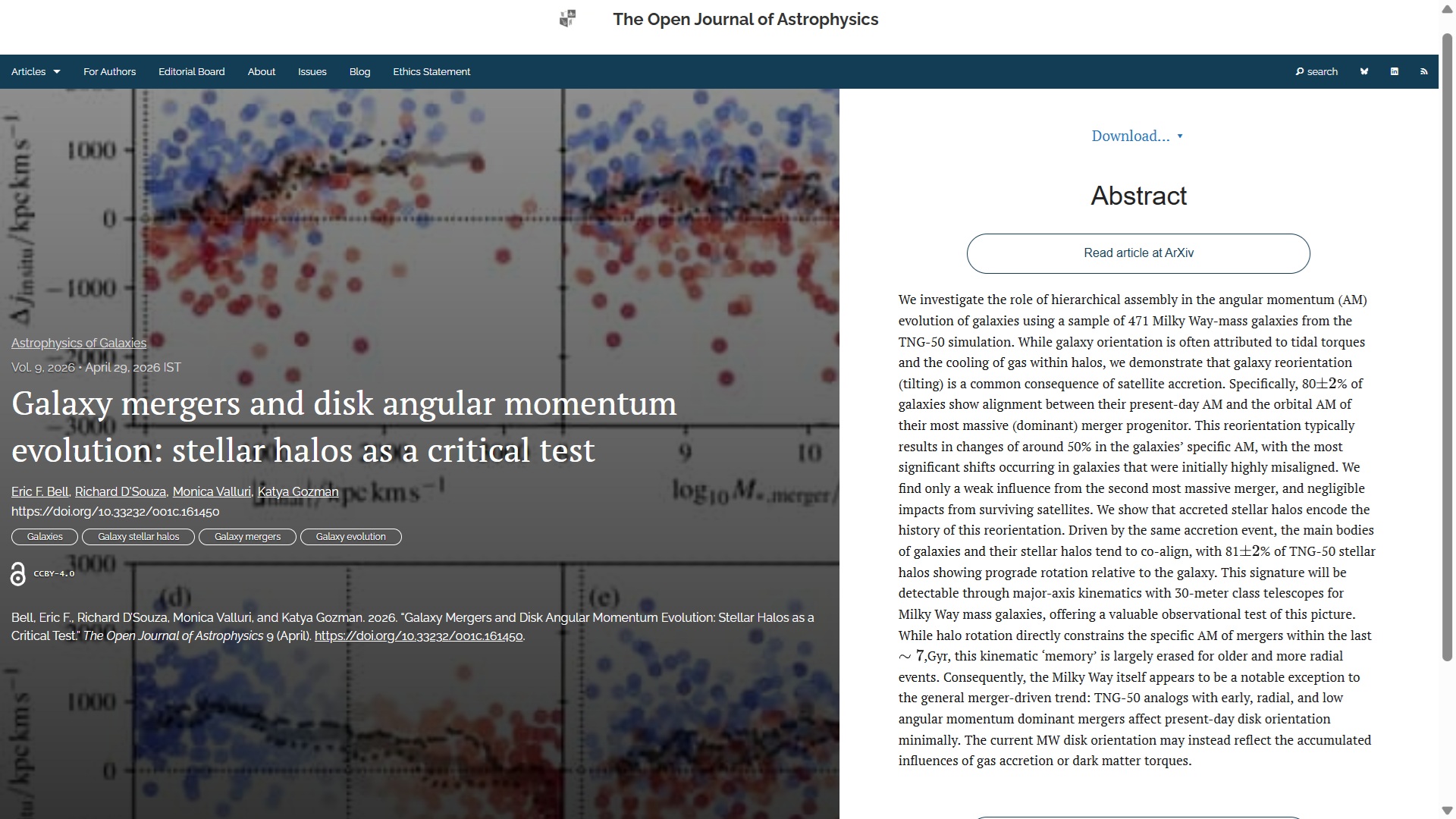
Next one up, the third paper of the week, is “Galaxy mergers and disk angular momentum evolution: stellar halos as a critical test” by Eric F. Bell (U. Michigan, Ann Arbor, USA), Richard D’Souza (Vatican Observatory), Monica Valluri & Katya Gozman (U. Michigan). This was published on Wednesday 29th April in the folder Astrophysics of Galaxies. The paper argues that satellite accretion impacts the angular momentum evolution of galaxies, often causing significant reorientation. This process is detectable in Milky Way-mass galaxies so the idea is testable observationally.
The overlay for this one is here:
The final, accepted version can be found on arXiv here and the Mastodon announcement is here:
New Publication at the Open Journal of Astrophysics: "Galaxy mergers and disk angular momentum evolution: stellar halos as a critical test" by Eric F. Bell (U. Michigan, Ann Arbor, USA), Richard D'Souza (Vatican Observatory), Monica Valluri & Katya Gozman (U. Michigan)
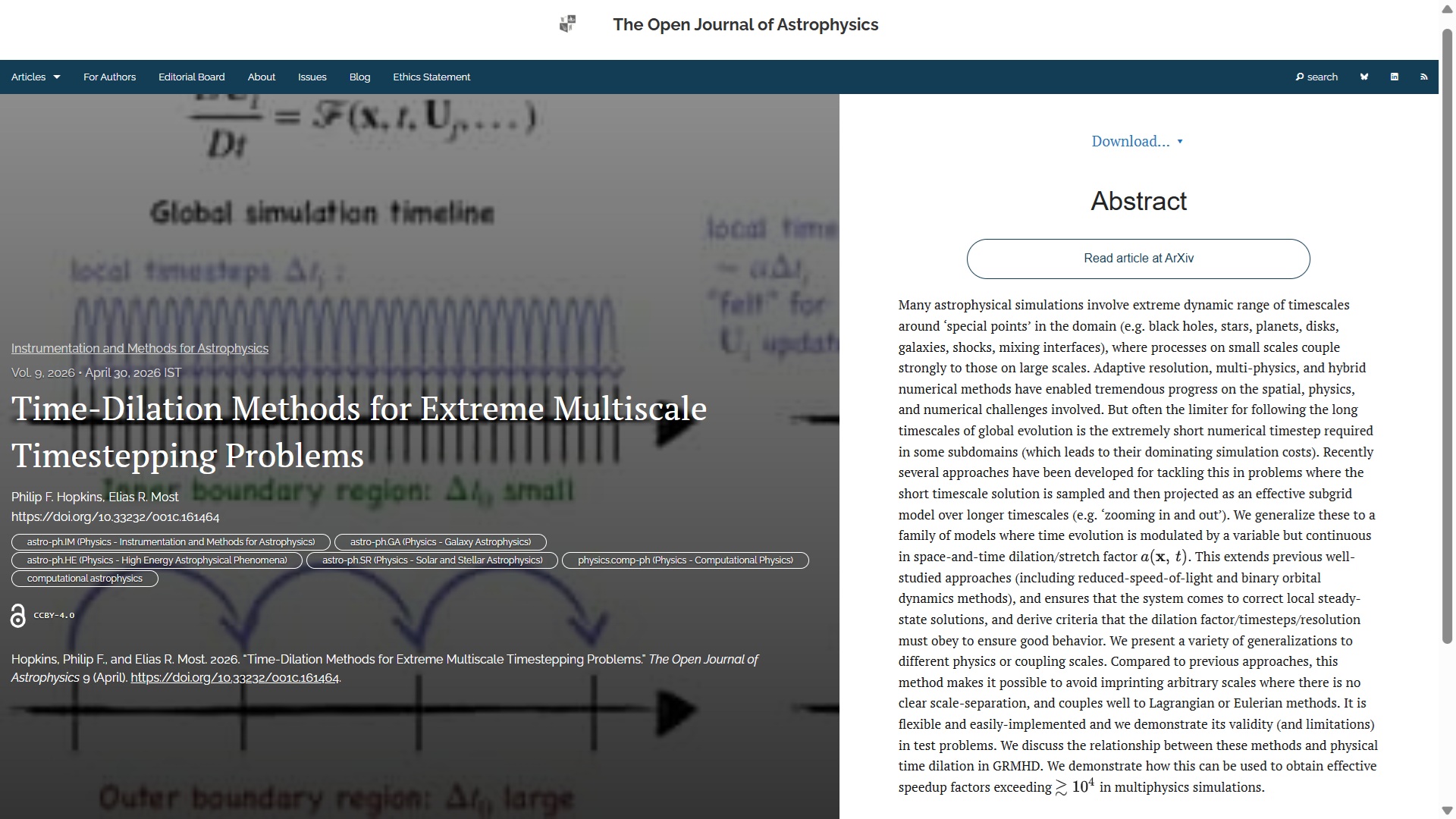
The fourth paper this week, published on Thursday April 30th, is “Time-Dilation Methods for Extreme Multiscale Timestepping Problems” by Philip F. Hopkins and Elias R. Most (Caltech, USA). This paper is in the folder Instrumentation and Methods for Astrophysics: it presents a new method for astrophysical simulations that modulates time evolution with a variable dilation/stretch factor, improving efficiency and accuracy in modeling processes across different scales.
The overlay is here:
The finally accepted version of this paper can be found here and the Mastodon announcement follows:
New Publication at the Open Journal of Astrophysics: "Time-Dilation Methods for Extreme Multiscale Timestepping Problems" by Philip F. Hopkins and Elias R. Most (Caltech, USA)
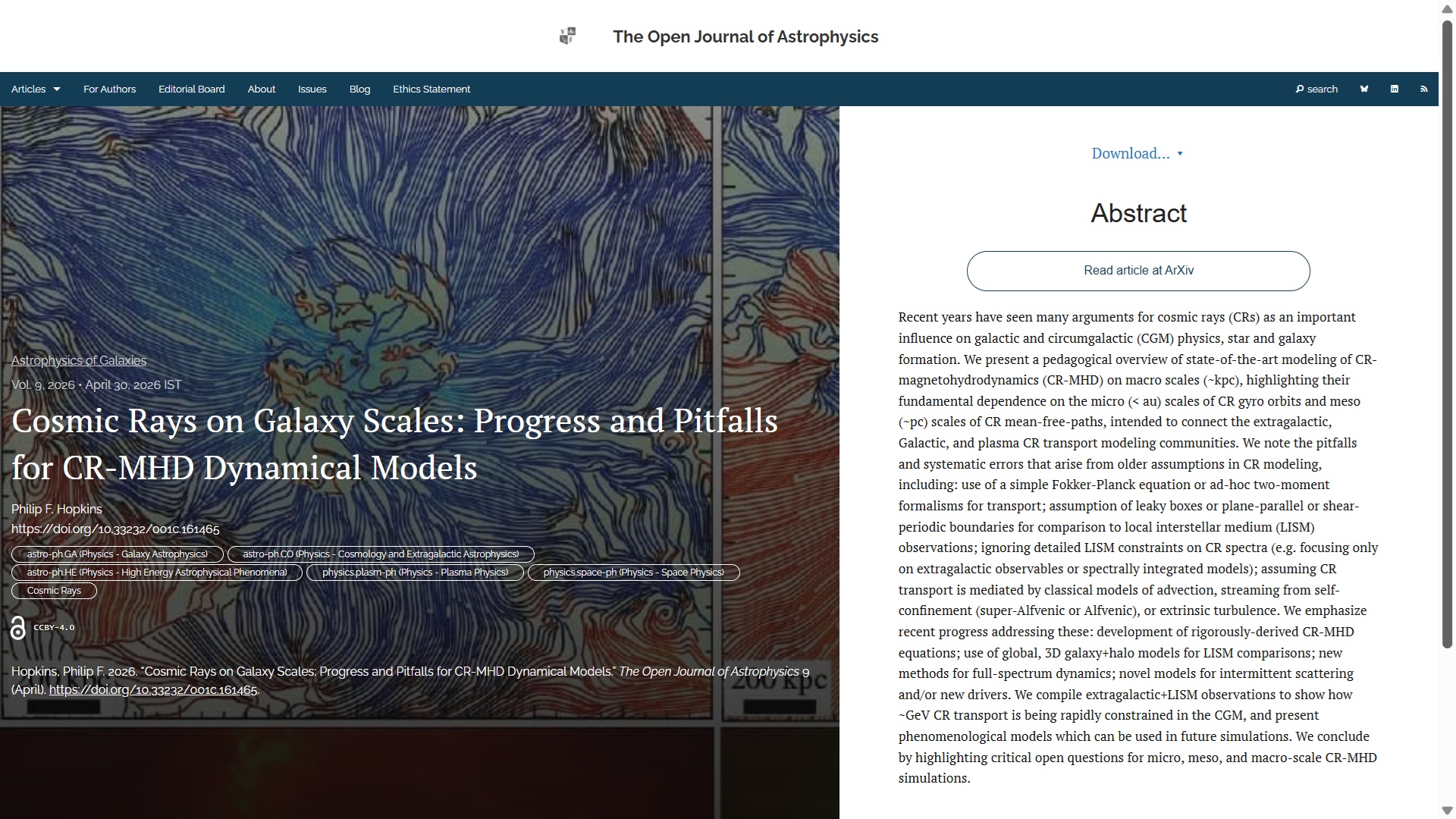
The fifth article of this week was also published on Thursday 30th April, but in the folder Astrophysics of Galaxies. The title is “Cosmic Rays on Galaxy Scales: Progress and Pitfalls for CR-MHD Dynamical Models” and the author is Philip F. Hopkins (Caltech, USA) who has three papers featured this week. The paper presents an overview of cosmic ray (CR) modeling, highlighting its influence on galactic physics and star formation. It addresses previous modeling errors and presents new methods for full-spectrum dynamics.
The overlay is here:
You can find the authorized version of this paper on arXiv here and the Fediverse announcement is here:
New Publication at the Open Journal of Astrophysics: "Cosmic Rays on Galaxy Scales: Progress and Pitfalls for CR-MHD Dynamical Models" by Philip F. Hopkins (Caltech, USA)
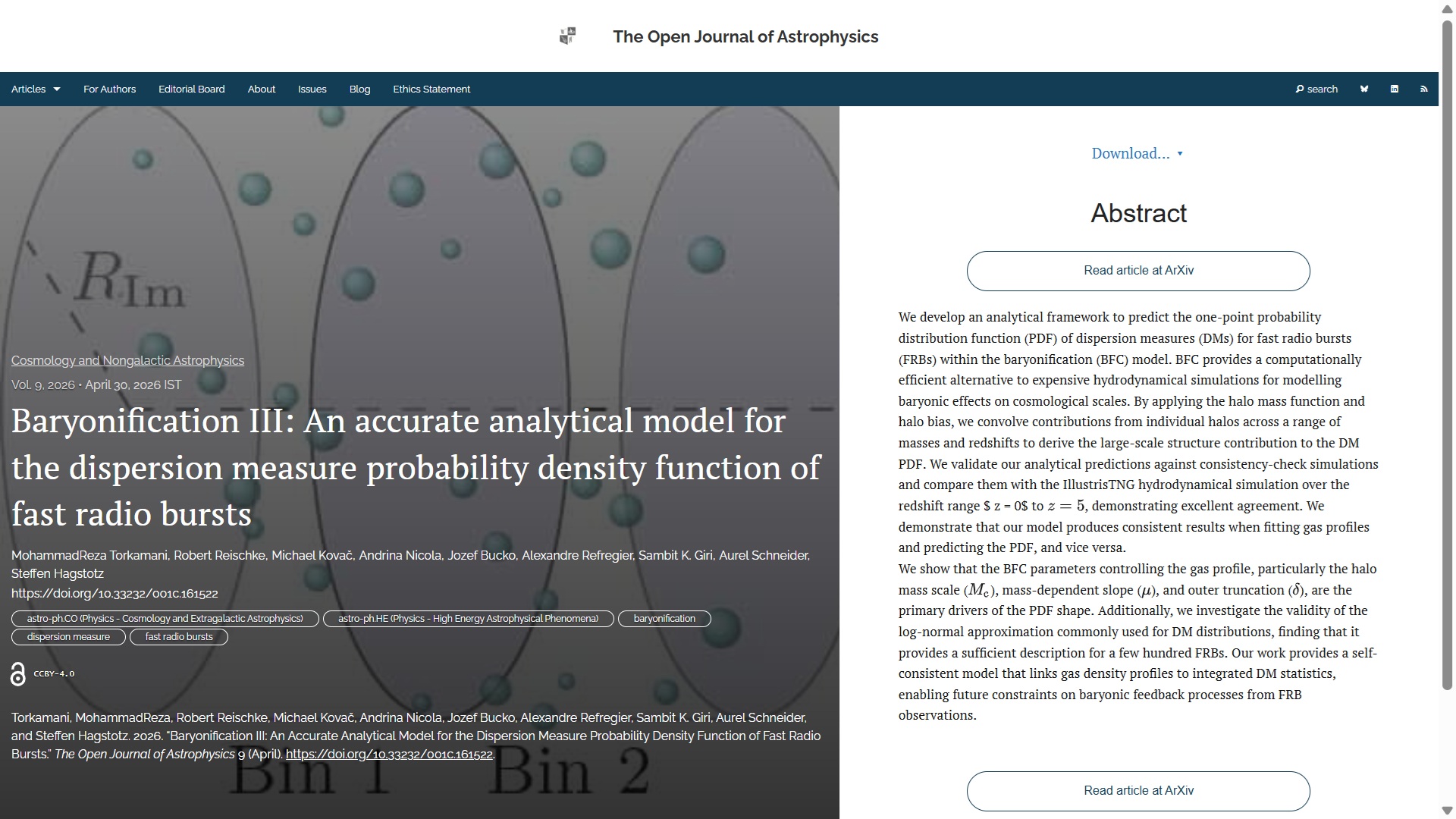
New Publication at the Open Journal of Astrophysics: "Baryonification III: An accurate analytical model for the dispersion measure probability density function of fast radio bursts" by MohammadReza Torkamani (Universität Bonn, Germany) and 8 others based in Germany, Switzerland, UK and Sweden
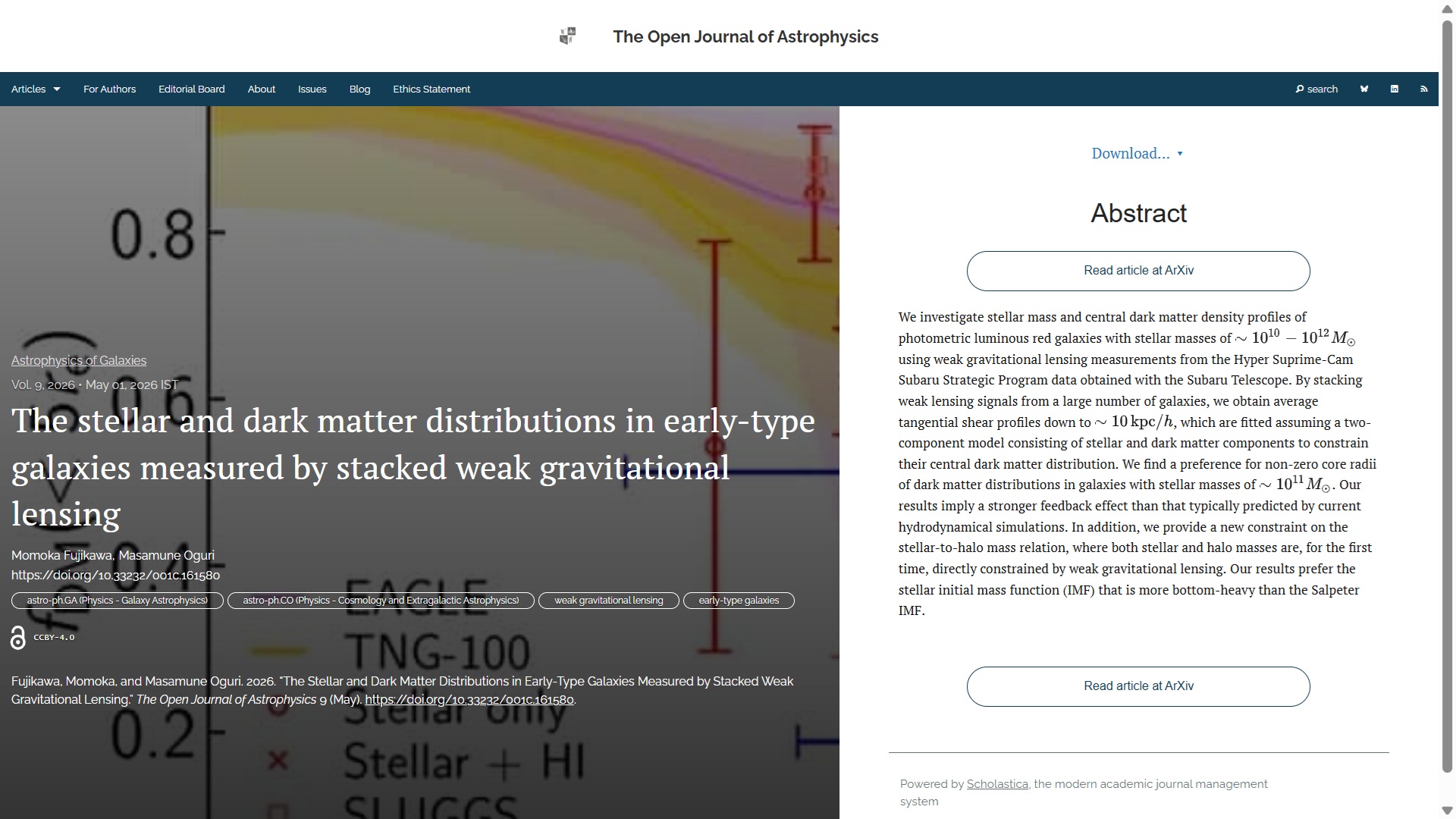
New Publication at the Open Journal of Astrophysics: "The stellar and dark matter distributions in early-type galaxies measured by stacked weak gravitational lensing" by Momoka Fujikawa & Masamune Oguri (Chiba University, Japan)
So here we are again, on a Saturday morning, with another update of activity at the Open Journal of Astrophysics. Since the last update we have published a further five papers, bringing the number in Volume 9 (2026) to 87 and the total so far published by OJAp up to 535.
I will continue to include the posts made on our Mastodon account (on Fediscience) to encourage you to visit it. Mastodon is a really excellent service, and a more than adequate replacement for X/Twitter (which nobody should be using); these announcements also show the DOI for each paper.
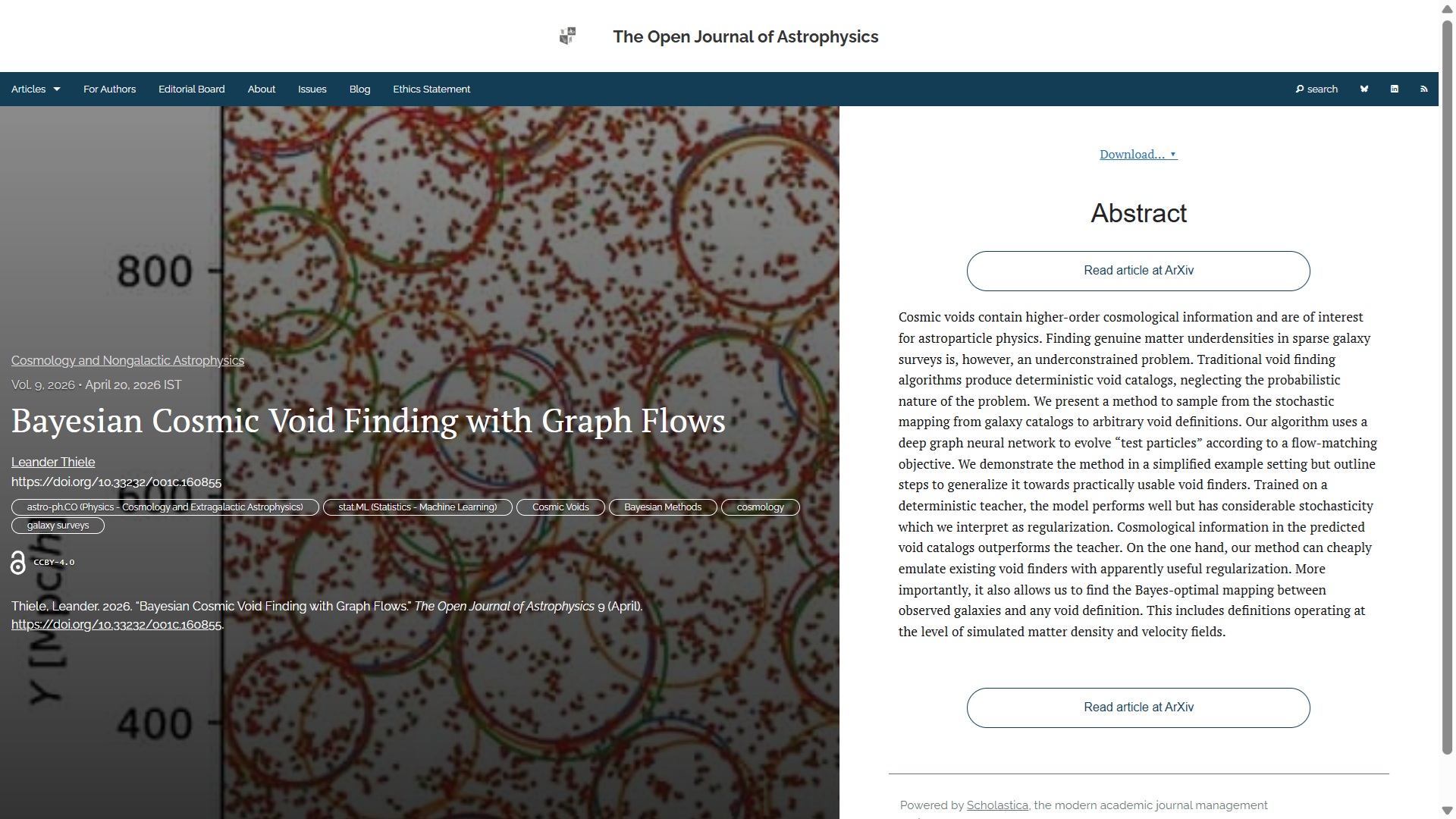
The first paper to report this week is “Bayesian Cosmic Void Finding with Graph Flows” by Leander Thiele (U. Tokyo, Japan). This was published on Monday 20th April in the folder Cosmology and Nongalactic Astrophysics. The paper presents a method using a deep graph neural network to identify cosmic voids in sparse galaxy surveys, improving upon traditional deterministic algorithms by considering the problem’s probabilistic nature. The overlay is here:
You can find the officially accepted version on arXiv here and the announcement on Fediverse here:
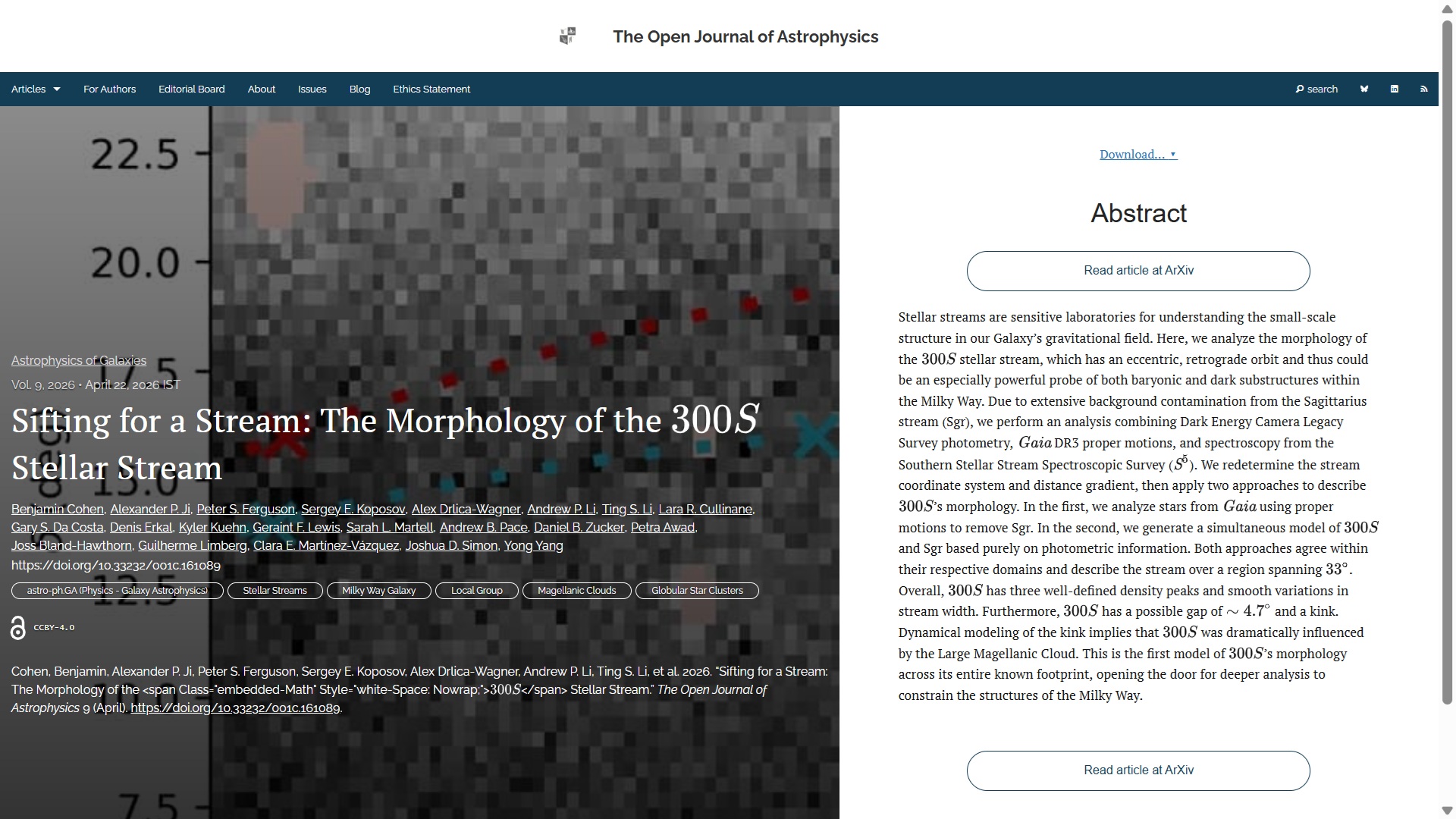
The second paper for this week, published on Wednesday 22nd April in the folder Astrophysics of Galaxies, is “Sifting for a Stream: The Morphology of the 300S Stellar Stream” by Benjamin Cohen (U. Chicago, USA) and 20 others distributed around the world. This study analyzes the morphology of the $300S$ stellar stream, revealing three density peaks, a possible gap, and a kink, suggesting significant influence from the Large Magellanic Cloud on its structure.
The overlay for this one is here:
The official version of the paper can be found on arXiv here and the Fediverse announcement here:
New Publication at the Open Journal of Astrophysics: "Sifting for a Stream: The Morphology of the 300S Stellar Stream" by Benjamin Cohen (U. Chicago, USA) and 20 others distributed around the world.
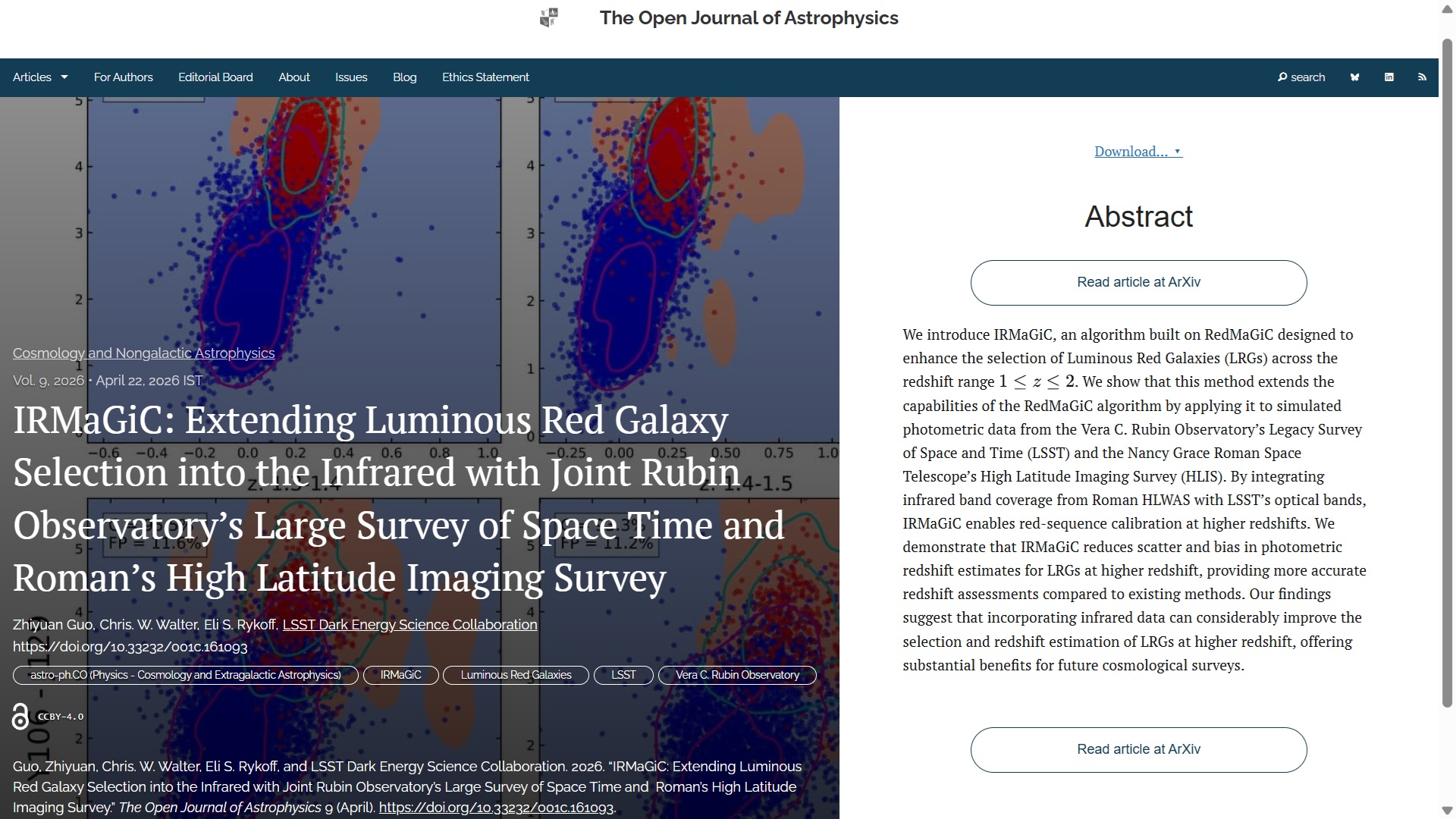
New Publication at the Open Journal of Astrophysics: "IRMaGiC: Extending Luminous Red Galaxy Selection into the Infrared with Joint Rubin Observatory’s Large Survey of Space Time and Roman’s High Latitude Imaging Survey" by Zhiyuan Guo & Chris. W. Walter (Duke U., USA) and Eli S. Rykoff (Stanford U., USA) on behalf of the LSST Dark Energy Science Collaboration
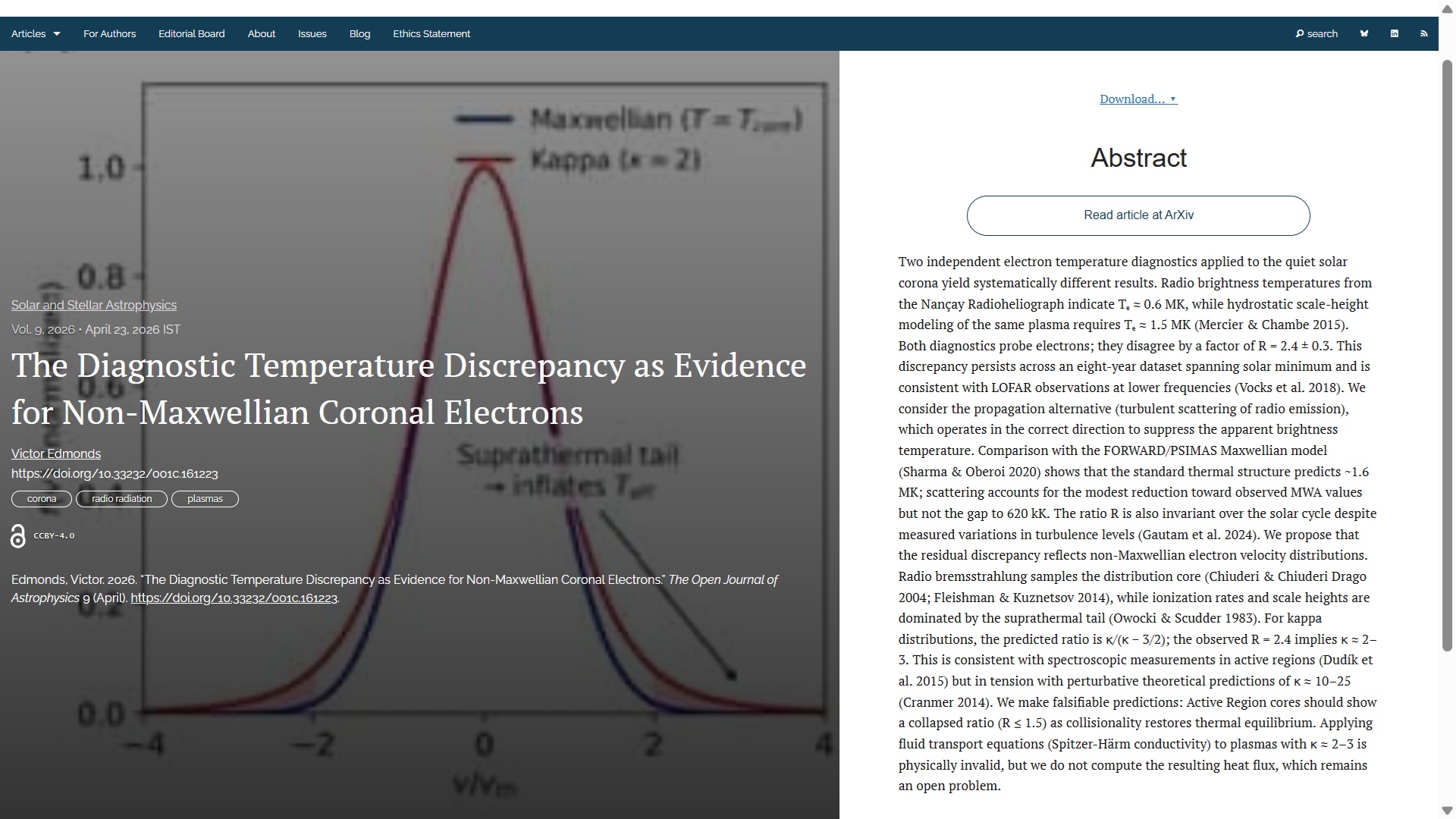
New Publication at the Open Journal of Astrophysics: "The Diagnostic Temperature Discrepancy as Evidence for Non-Maxwellian Coronal Electrons" by Victor Edmonds (Final Stop Consulting, USA)
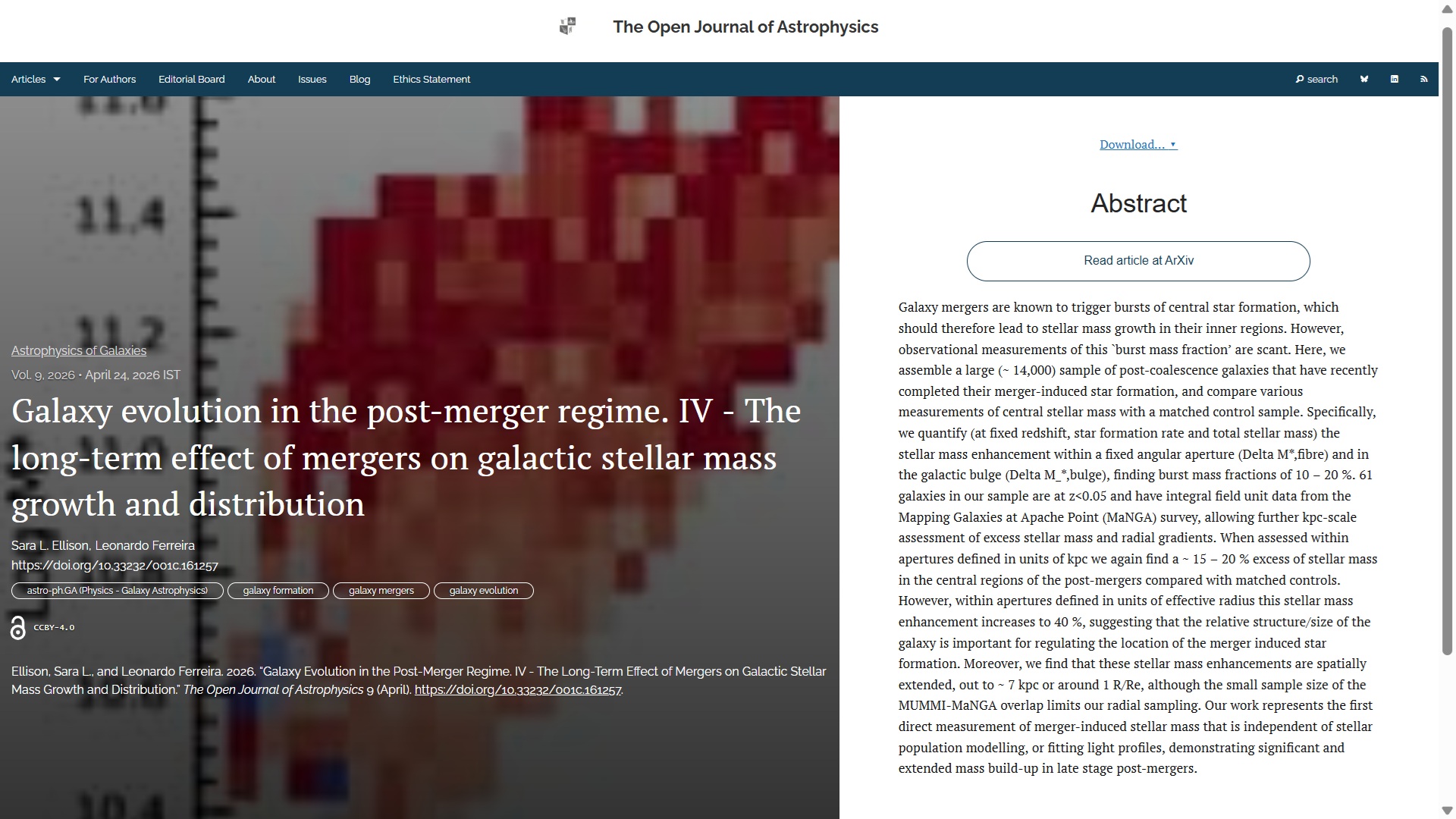
The fifth and final paper for this week was published on Friday 24th April in the folder Astrophysics of Galaxies. The title is “Galaxy evolution in the post-merger regime. IV – The long-term effect of mergers on galactic stellar mass growth and distribution” by Sara L. Ellison (U. Victoria, Canada) and Leonardo Ferreira (Universidade Federal do Rio Grande, Brazil). This study uses a large sample of post-merger galaxies to demonstrate that galaxy mergers trigger significant and extended stellar mass growth in their central regions, independent of stellar population modelling.
The overlay is here:
You can find the authorized version of this paper on arXiv here and the Fediverse announcement is here:
New Publication at the Open Journal of Astrophysics: "Galaxy evolution in the post-merger regime. IV – The long-term effect of mergers on galactic stellar mass growth and distribution" by Sara L. Ellison (U. Victoria, Canada) and Leonardo Ferreira (Universidade Federal do Rio Grande, Brazil)
New Publication at the Open Journal of Astrophysics: "Galaxy evolution in the post-merger regime. IV – The long-term effect of mergers on galactic stellar mass growth and distribution" by Sara L. Ellison (U. Victoria, Canada) and Leonardo Ferreira (Universidade Federal do Rio Grande, Brazil)
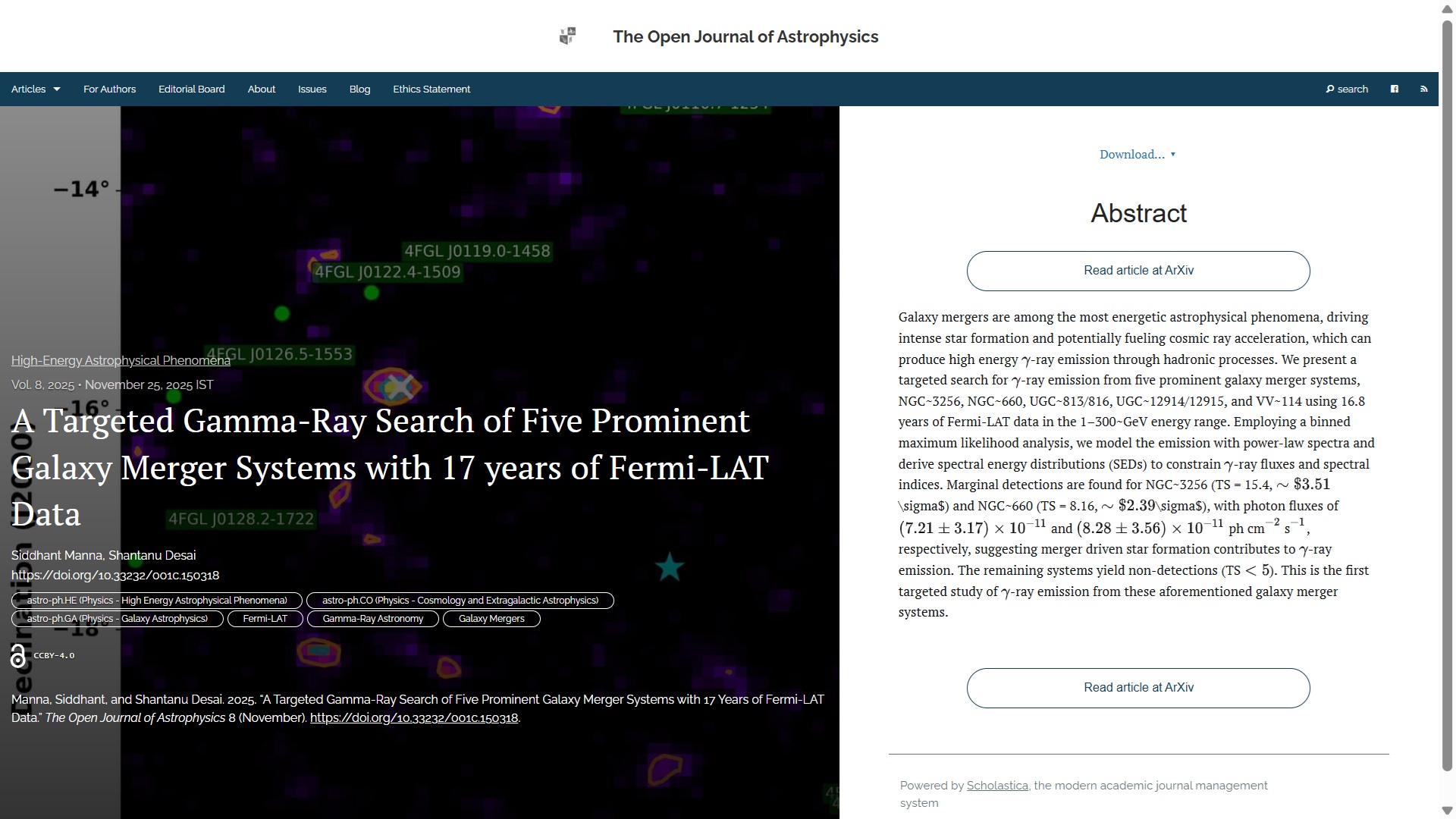
It’s Saturday again, so it’s time for the usual update of the week’s new papers at the Open Journal of Astrophysics. Publishing this week was interrupted by the Thanksgiving holiday in the United States, which meant there were no arXiv announcements yesterday. Nevertheless, since the last update we have published another four papers, which brings the number in Volume 8 (2025) up to 184, and the total so far published by OJAp up to 419.
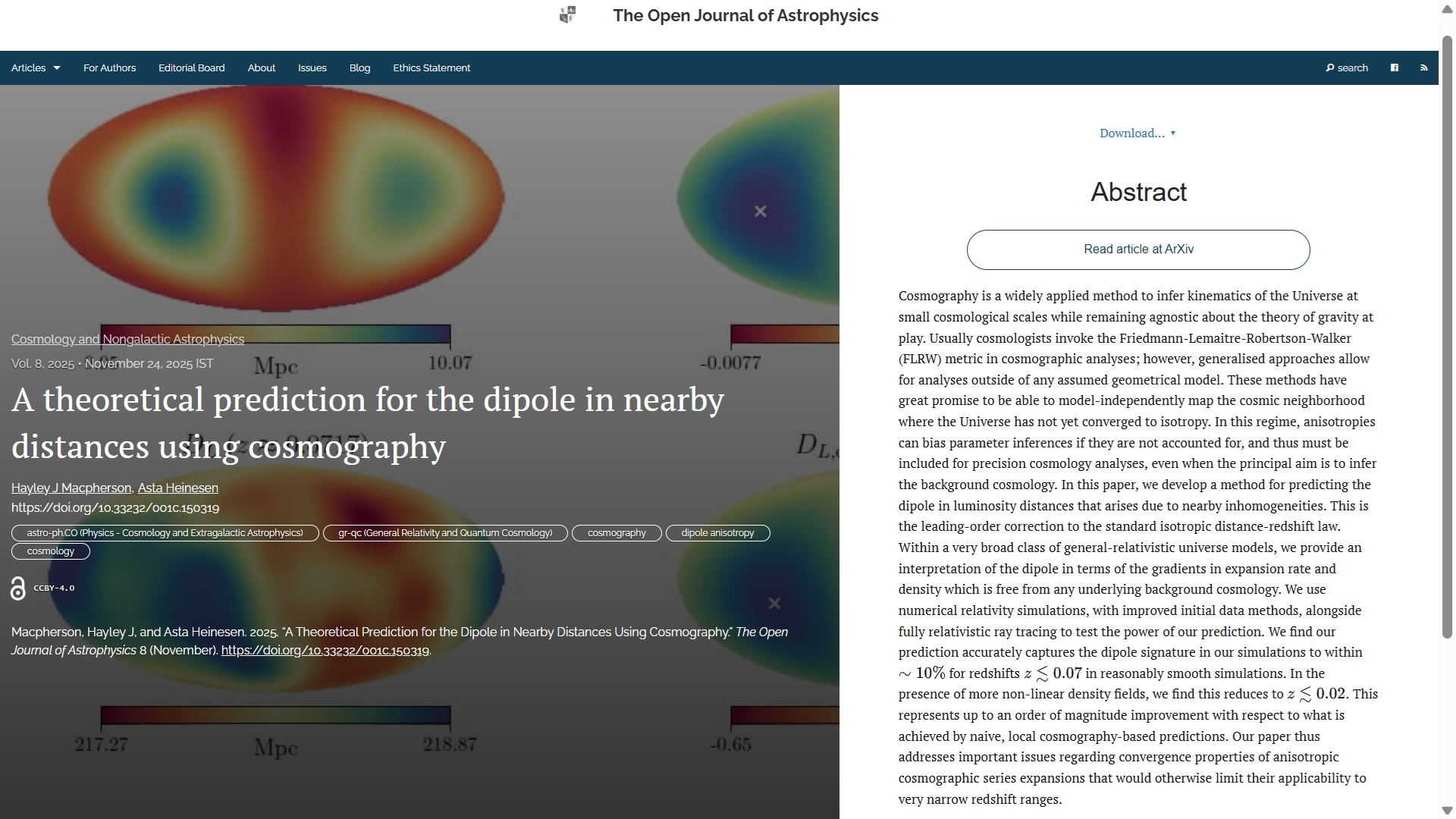
The first paper this week is “A theoretical prediction for the dipole in nearby distances using cosmography” by Hayley J. Macpherson (U. Chicago, USA) and Asta Heinesen (Niels Bohr Institute, Denmark). This was published on Monday 24th November 2025 in the folder Cosmology and Nongalactic Astrophysics. It presents a method to predict the dipole in luminosity distances that arises due to nearby inhomogeneities to leading-order correction to the standard isotropic distance-redshift law. Incidentally, I wrote about a talk by one of the authors here.
The overlay is here:
You can find the officially accepted version on arXiv here and the Fediverse announcement is here:
New Publication at the Open Journal of Astrophysics: "A theoretical prediction for the dipole in nearby distances using cosmography" by Hayley J Macpherson (U. Chicago, USA) and Asta Heinesen (Niels Bohr Institute, Denmark)
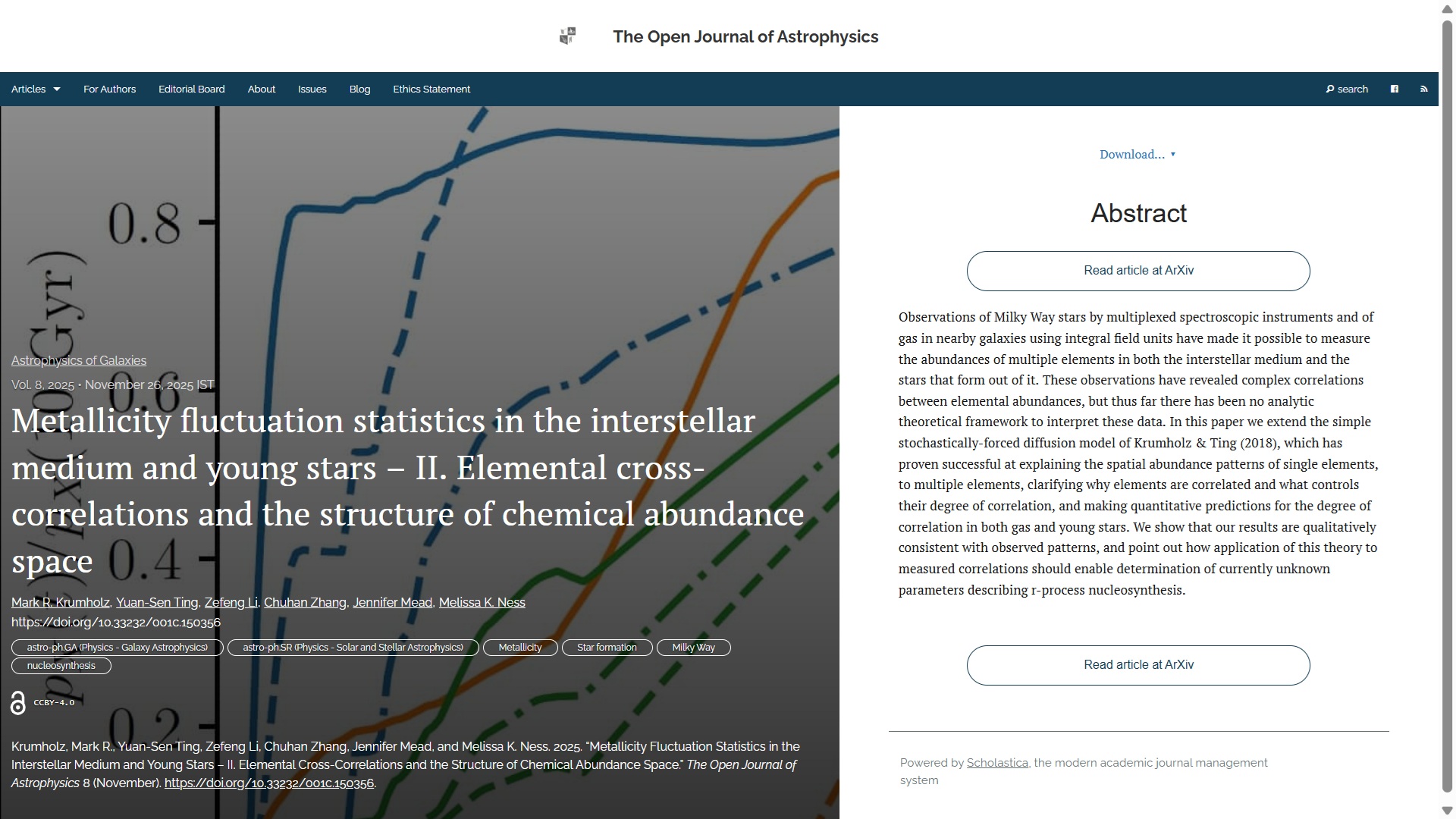
New Publication at the Open Journal of Astrophysics: "Metallicity fluctuation statistics in the interstellar medium and young stars – II. Elemental cross-correlations and the structure of chemical abundance space" by Mark R. Krumholz (ANU, Australia), Yuan-Sen Ting (Ohio State U., USA), Zefeng Li (Durham U., UK), Chuhan Zhang (ANU), Jennifer Mead (Columbia U., USA) and Melissa K. Ness (ANU)
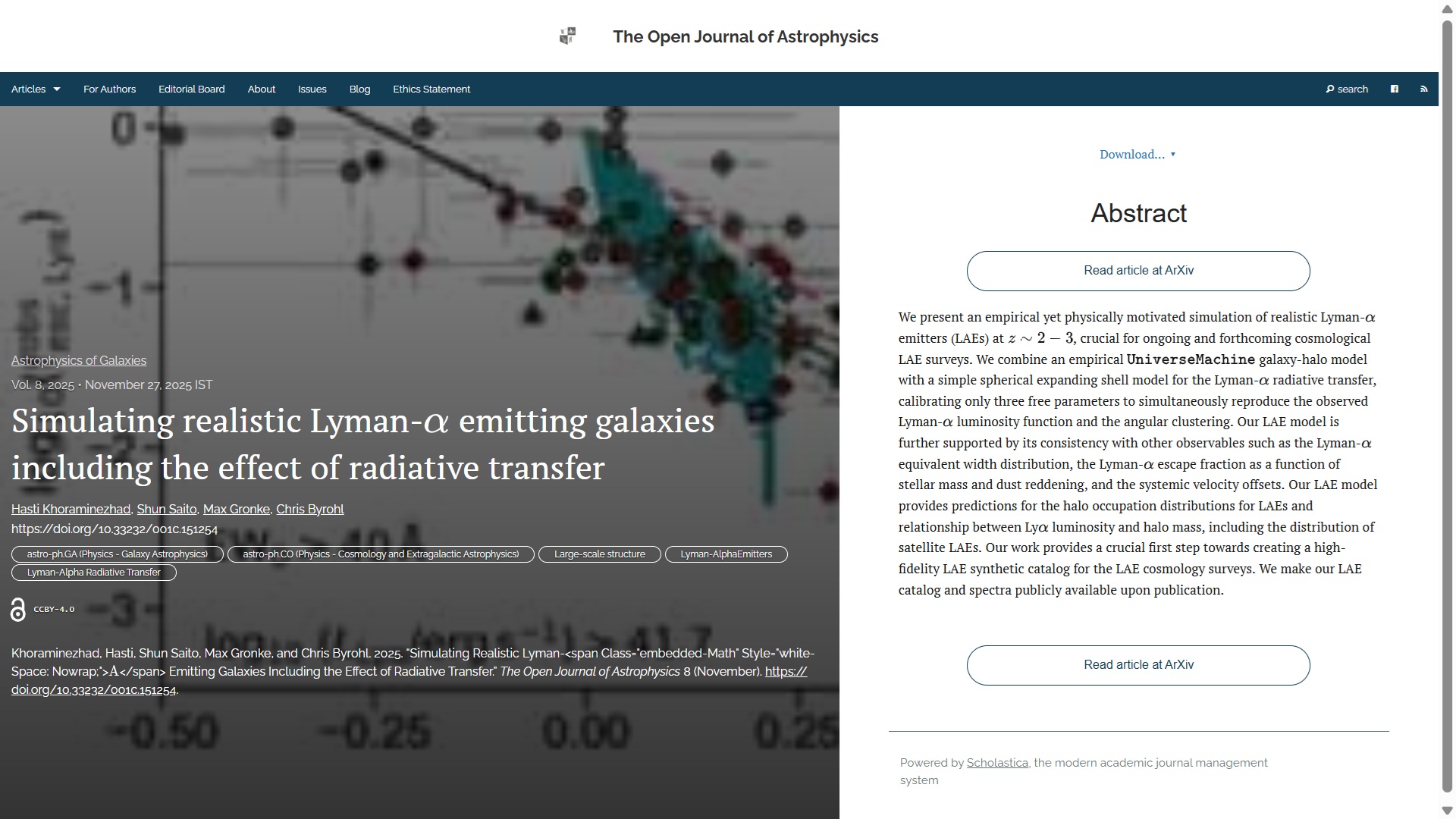
The fourth and final paper of the week is “Simulating realistic Lyman-alpha emitting galaxies including the effect of radiative transfer” by Hasti Khoraminezhad & Shun Saito (Missouri Institute of Science & Technology, USA), Max Gronke (U. Heidelberg, Germany) and Chris Byrohl (MPA Garching, Germany). An empirical model for Lyman-alpha emitters (LAEs) which provides predictions for the halo occupation distributions and relationship between luminosity and halo mass, including the distribution of satellite LAEs. It was published on Thursday November 27th 2025 in the folder Astrophysics of Galaxies.
The overlay is here:
You can find the official published version on arXiv here. The Fediverse announcement follows:
New Publication at the Open Journal of Astrophysics: "Simulating realistic Lyman-alpha emitting galaxies including the effect of radiative transfer" by Hasti Khoraminezhad & Shun Saito (Missouri Institute of Science & Technology, USA), Max Gronke (U. Heidelberg, Germany) and Chris Byrohl (MPA Garching, Germany)
It’s Saturday morning, so once again it’s time for an update from the Open Journal of Astrophysics. Since the last update we have published one new paper, which brings the number in Volume 8 (2025) up to 12 and the total so far published by OJAp up to 247.
“Galaxy evolution in the post-merger regime. III – The triggering of active galactic nuclei peaks immediately after coalescence” was written by Sara Ellison, Leonardo Ferreira, Robert Bickley & Tess Grindlay (U. Victoria, Canada), Samir Salim (Indiana U., USA), Shoshannah Byrne-Mamahit (Victoria), Shobita Satyapal (George Mason U., USA), David R. Patton (Trent U., Canada) and Jillian M. Scudder (Oberlin College, USA). It was published on 4th February 2025 and is in the folder marked Astrophysics of Galaxies. The paper describes an investigation into the timescale of triggering of AGN activity after galaxy mergers and concluding that most occurs immediately after coalescence.
You can find the officially accepted version of this paper on arXiv here.
That’s all for this week. I’ll have more updates next Saturday.
Once again, it’s time for a quick update of activity at the Open Journal of Astrophysics. This week we have published another batch of four papers which takes the count in Volume 7 (2024) up to 77 and the total published altogether by OJAp up to 192. Things are picking up again after the summer lull, and we’re moving towards a double century. If we keep up a steady average of four per week we’ll be at 200 per year.
In chronological order, the four papers published this week, with their overlays, are as follows. You can click on the images of the overlays to make them larger should you wish to do so.
Here is a screen grab of the overlay, which includes the abstract:
You can find the officially accepted version of the paper on the arXiv here.
The second paper to announce, also published on 9th September 2024, is “mochi_class: Modelling Optimisation to Compute Horndeski In class” by Matteo Cataneo (Universität Bonn, Germany) and Emilio Bellini (SISSA, Trieste, Italy). This article presents a cosmological Einstein-Boltzmann solver adapted to work with Horndeski gravity, together with validation tests. It is in the folder Cosmology and NonGalactic Astrophysics.
You can see the overlay here:
The accepted version of this paper can be found on the arXiv here.
The third paper, published on 11th September 2024 in the folder marked High-Energy Astrophysical Phenomena, is by Jonathan Katz of Washington University, St Louis, USA. The title is “The Sources of Fast Radio Bursts” and it presents a discussion of the possible physical origin of Fast Radio Bursts, arguing that they fall into two distinct groups.
Last in this batch, but by no means least, is “RMS asymmetry: a robust metric of galaxy shapes in images with varied depth and resolution” by Elizaveta Sazonova (U. Waterloo, Canada) with 15 other authors spread around the world (in Canada, USA, Australia, Italy, Chile, UK, Poland, Mexico, Germany, and Spain). This paper presents a method of quantifying distortion of galaxy images connected with mergers or other instabilities. It is in the folder marked Astrophysics of Galaxies and was published on September 12th 2024 with this overlay:
You can find the official accepted version on the arXiv here.
That’s all for now. I will post another update in a week.
The views presented here are personal and not necessarily those of my employer (or anyone else for that matter).
Feel free to comment on any of the posts on this blog but comments may be moderated; anonymous comments and any considered by me to be vexatious and/or abusive and/or defamatory will not be accepted. I do not necessarily endorse, support, sanction, encourage, verify or agree with the opinions or statements of any information or other content in the comments on this site and do not in any way guarantee their accuracy or reliability.