Some weeks ago I posted an item about recent results that have emerged from the DESI (Dark Energy Spectroscopic Instrument) Collaboration. I have been a bit busy since then but I just saw that there is one of those Cosmology Talks about these results which I thought I would pass on. The contributors are Arnaud de Mattia, Hector Gil-Marín and Pauline Zarrouk and they are talking about the analsysis they have done using the “full shape” of the galaxy power spectrum. It’s quite a long video, but very illuminating.
Archive for Cosmology Talks
Cosmology Talks: Recent DESI Power Spectrum Results
Posted in The Universe and Stuff with tags Cosmology, Cosmology Talks, Dark Energy, Dark Energy Spectroscopic Instrument, DESI, Physics on December 12, 2024 by telescoperDark Matter from Primordial Black Holes?
Posted in The Universe and Stuff with tags arXiv:2402.14069, arXiv:2402.17823, Cosmology, Cosmology Talks, dark matter, PBH, Physics, primordial black holes, Science, Universe on September 27, 2024 by telescoperWe live in a cyclic universe of a sort because every few years somebody tries to resurrect the idea that dark matter is somehow related to primordial black holes, i.e. black holes formed in the very early stages of the history of the Universe so that they have masses much smaller than black holes formed more recently by the collapse of stars or the merger of other black holes. If it forms very early the mass of a PBH could in principle be very small, much less than a star or a planet. The problem with very small black holes is that they evaporate very quickly via Hawking Radiation so would not survive the 14 billion years or so needed to still be in existence today and able to be dark matter.
An idea that was used in the past to circumvent this issue was that something might stop Hawking Radiation proceeding to reduce the mass of a PBH to zero, leaving a relic of finite mass usually taken to be the Planck mass. The suggestion has returned in different (but still speculative) guise recently, fueling a number of media articles of varying degrees of comprehensibility, e.g. here. The technical papers on which these articles are based can be found here and here.
Fortunately, there is now one of those excellent Cosmology Talks explaining the latest idea of how Hawking Radiation might break down and what the consequences are for Primordial Black Holes as a form of Dark Matter.
Cosmology Talks: Cosmological Constraints from BAO
Posted in The Universe and Stuff, YouTube with tags astronomy, Cosmology, Cosmology Talks, Dark Energy, Dark Energy Spectroscopic Instrument, DESI, Physics, Science, Shaun Hotchkiss, Universe on April 5, 2024 by telescoperHere’s another video in the Cosmology Talks series curated by Shaun Hotchkiss. This one very timely after yesterday’s announcement. Here is the description on the YouTube page:
The Dark Energy Spectroscopic Instrument (DESI) has produced cosmological constraints! And it is living up to its name. Two researchers from DESI, Seshadri Nadathur and Andreu Font-Ribera, tell us about DESI’s measurements of the Baryon Acoustic Oscillations (BAO) released today. These results use one full year of DESI data and are the first cosmological constraints from the telescope that have been released. Mostly, it is what you might expect: tighter constraints. However, in the realm of the equation of state of dark energy, they find, even with BAO alone, that there is a hint of evidence for evolving dark energy. When they combine their data with CMB and Supernovae, who both also find small hints of evolving dark energy on their own, the evidence for dark energy not being a cosmological constant jumps as high as 3.9σ with one combination of the datasets. It seems there still is “concordance cosmology”, it’s just not ΛCDM for these datasets. The fact that all three probes are tentatively favouring this is intriguing, as it makes it unlikely to be due to systematic errors in one measurement pipeline.
My own take is that the results are very interesting but I think we need to know a lot more about possible systematics before jumping to conclusions about time-varying dark energy. Am I getting conservative in my old age? These results from DESI do of course further underline the motivation for Euclid (another Stage IV survey), which may have an even better capability to identify departures from the standard model.
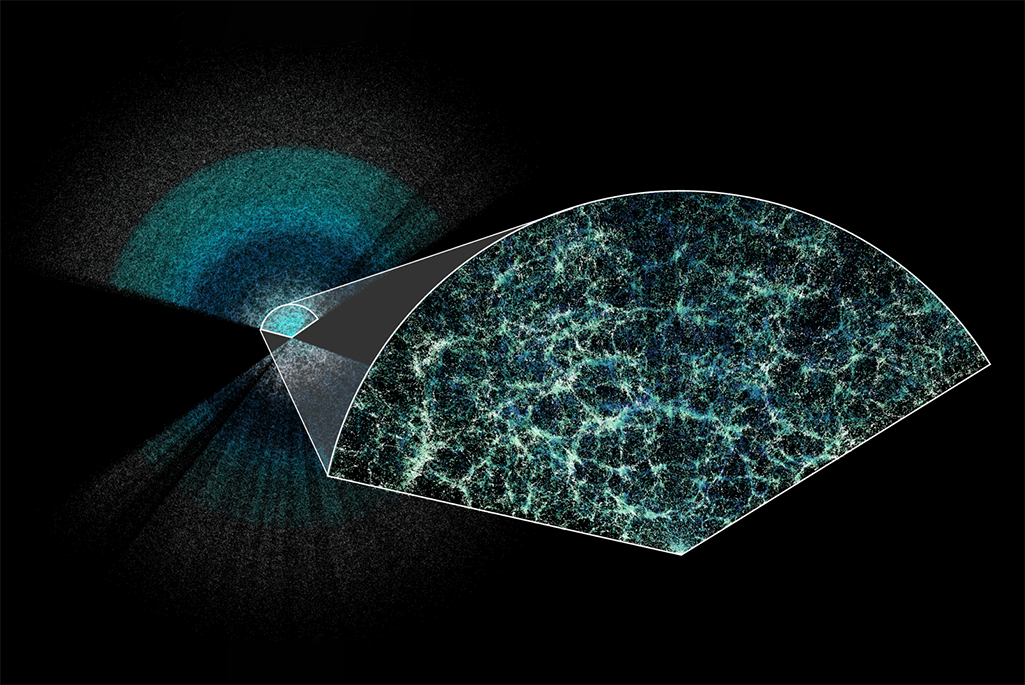
P.S. Here’s a nice graphic showing the cosmic web showing revealed by the DESI survey:
Cosmology Talks – To Infinity and Beyond (Probably)
Posted in mathematics, The Universe and Stuff with tags Alex Vilenkin, arXiv:2308.12229, Cosmology, Cosmology Talks, David Hilbert, George Ellis, Infinity, Kolmogorov, multiverse, philosophy, Physics, probability, Science, Sylvia Wedmackers on March 20, 2024 by telescoperHere’s an interestingly different talk in the series of Cosmology Talks curated by Shaun Hotchkiss. The speaker, Sylvia Wenmackers, is a philosopher of science. According to the blurb on Youtube:
Her focus is probability and she has worked on a few theories that aim to extend and modify the standard axioms of probability in order to tackle paradoxes related to infinite spaces. In particular there is a paradox of the “infinite fair lottery” where within standard probability it seems impossible to write down a “fair” probability function on the integers. If you give the integers any non-zero probability, the total probability of all integers is unbounded, so the function is not normalisable. If you give the integers zero probability, the total probability of all integers is also zero. No other option seems viable for a fair distribution. This paradox arises in a number of places within cosmology, especially in the context of eternal inflation and a possible multiverse of big bangs bubbling off. If every bubble is to be treated fairly, and there will ultimately be an unbounded number of them, how do we assign probability? The proposed solutions involve hyper-real numbers, such as infinitesimals and infinities with different relative sizes, (reflecting how quickly things converge or diverge respectively). The multiverse has other problems, and other areas of cosmology where this issue arises also have their own problems (e.g. the initial conditions of inflation); however this could very well be part of the way towards fixing the cosmological multiverse.
The paper referred to in the presentation can be found here. There is a lot to digest in this thought-provoking talk, from the starting point on Kolmogorov’s axioms to the application to the multiverse, but this video gives me an excuse to repeat my thoughts on infinities in cosmology.
Most of us – whether scientists or not – have an uncomfortable time coping with the concept of infinity. Physicists have had a particularly difficult relationship with the notion of boundlessness, as various kinds of pesky infinities keep cropping up in calculations. In most cases this this symptomatic of deficiencies in the theoretical foundations of the subject. Think of the ‘ultraviolet catastrophe‘ of classical statistical mechanics, in which the electromagnetic radiation produced by a black body at a finite temperature is calculated to be infinitely intense at infinitely short wavelengths; this signalled the failure of classical statistical mechanics and ushered in the era of quantum mechanics about a hundred years ago. Quantum field theories have other forms of pathological behaviour, with mathematical components of the theory tending to run out of control to infinity unless they are healed using the technique of renormalization. The general theory of relativity predicts that singularities in which physical properties become infinite occur in the centre of black holes and in the Big Bang that kicked our Universe into existence. But even these are regarded as indications that we are missing a piece of the puzzle, rather than implying that somehow infinity is a part of nature itself.
The exception to this rule is the field of cosmology. Somehow it seems natural at least to consider the possibility that our cosmos might be infinite, either in extent or duration, or both, or perhaps even be a multiverse comprising an infinite collection of sub-universes. If the Universe is defined as everything that exists, why should it necessarily be finite? Why should there be some underlying principle that restricts it to a size our human brains can cope with?
On the other hand, there are cosmologists who won’t allow infinity into their view of the Universe. A prominent example is George Ellis, a strong critic of the multiverse idea in particular, who frequently quotes David Hilbert
The final result then is: nowhere is the infinite realized; it is neither present in nature nor admissible as a foundation in our rational thinking—a remarkable harmony between being and thought
But to every Hilbert there’s an equal and opposite Leibniz
I am so in favor of the actual infinite that instead of admitting that Nature abhors it, as is commonly said, I hold that Nature makes frequent use of it everywhere, in order to show more effectively the perfections of its Author.
You see that it’s an argument with quite a long pedigree!
Many years ago I attended a lecture by Alex Vilenkin, entitled The Principle of Mediocrity. This was a talk based on some ideas from his book Many Worlds in One: The Search for Other Universes, in which he discusses some of the consequences of the so-called eternal inflation scenario, which leads to a variation of the multiverse idea in which the universe comprises an infinite collection of causally-disconnected “bubbles” with different laws of low-energy physics applying in each. Indeed, in Vilenkin’s vision, all possible configurations of all possible things are realised somewhere in this ensemble of mini-universes.
One of the features of this scenario is that it brings the anthropic principle into play as a potential “explanation” for the apparent fine-tuning of our Universe that enables life to be sustained within it. We can only live in a domain wherein the laws of physics are compatible with life so it should be no surprise that’s what we find. There is an infinity of dead universes, but we don’t live there.
I’m not going to go on about the anthropic principle here, although it’s a subject that’s quite fun to write or, better still, give a talk about, especially if you enjoy winding people up! What I did want to say mention, though, is that Vilenkin correctly pointed out that three ingredients are needed to make this work:
- An infinite ensemble of realizations
- A discretizer
- A randomizer
Item 2 involves some sort of principle that ensures that the number of possible states of the system we’re talking about is not infinite. A very simple example from quantum physics might be the two spin states of an electron, up (↑) or down(↓). No “in-between” states are allowed, according to our tried-and-tested theories of quantum physics, so the state space is discrete. In the more general context required for cosmology, the states are the allowed “laws of physics” ( i.e. possible false vacuum configurations). The space of possible states is very much larger here, of course, and the theory that makes it discrete much less secure. In string theory, the number of false vacua is estimated at 10500. That’s certainly a very big number, but it’s not infinite so will do the job needed.
Item 3 requires a process that realizes every possible configuration across the ensemble in a “random” fashion. The word “random” is a bit problematic for me because I don’t really know what it’s supposed to mean. It’s a word that far too many scientists are content to hide behind, in my opinion. In this context, however, “random” really means that the assigning of states to elements in the ensemble must be ergodic, meaning that it must visit the entire state space with some probability. This is the kind of process that’s needed if an infinite collection of monkeys is indeed to type the (large but finite) complete works of shakespeare. It’s not enough that there be an infinite number and that the works of shakespeare be finite. The process of typing must also be ergodic.
Now it’s by no means obvious that monkeys would type ergodically. If, for example, they always hit two adjoining keys at the same time then the process would not be ergodic. Likewise it is by no means clear to me that the process of realizing the ensemble is ergodic. In fact I’m not even sure that there’s any process at all that “realizes” the string landscape. There’s a long and dangerous road from the (hypothetical) ensembles that exist even in standard quantum field theory to an actually existing “random” collection of observed things…
More generally, the mere fact that a mathematical solution of an equation can be derived does not mean that that equation describes anything that actually exists in nature. In this respect I agree with Alfred North Whitehead:
There is no more common error than to assume that, because prolonged and accurate mathematical calculations have been made, the application of the result to some fact of nature is absolutely certain.
It’s a quote I think some string theorists might benefit from reading!
Items 1, 2 and 3 are all needed to ensure that each particular configuration of the system is actually realized in nature. If we had an infinite number of realizations but with either infinite number of possible configurations or a non-ergodic selection mechanism then there’s no guarantee each possibility would actually happen. The success of this explanation consequently rests on quite stringent assumptions.
I’m a sceptic about this whole scheme for many reasons. First, I’m uncomfortable with infinity – that’s what you get for working with George Ellis, I guess. Second, and more importantly, I don’t understand string theory and am in any case unsure of the ontological status of the string landscape. Finally, although a large number of prominent cosmologists have waved their hands with commendable vigour, I have never seen anything even approaching a rigorous proof that eternal inflation does lead to realized infinity of false vacua. If such a thing exists, I’d really like to hear about it!
Cosmology Talks: Intrinsic Alignments – A Guide for All Cosmologists
Posted in OJAp Papers, The Universe and Stuff, YouTube with tags Claire Lamman, Cosmology Talks, Elisa Legnani, intrinsic alignments, Jingjing Shi, Niko Šarčević, Shaun Hotchkiss, Susan Pyne, Tassia Ferreira, weak gravitational lensing on February 24, 2024 by telescoperI was just thinking this afternoon that I haven’t posted recently any of the Cosmology Talks curated by Shaun Hotchkiss, then I looked and found that I had the perfect excuse for doing so. This particular talk is actually about one of the two new OJAp papers I announced in my previous post, i.e. “The IA Guide: A Breakdown of Intrinsic Alignment Formalisms” and the authors are: Claire Lamman (Harvard, USA); Eleni Tsaprazi (Stockholm, Sweden); Jingjing Shi (Tokyo, Japan); Nikolina Niko Šarčević (Newcastle, UK); Susan Pyne (UCL, UK); Elisa Legnani (Barcelona, Spain); and Tassia Ferreira (Oxford, UK).
Here is Shaun’s description of the video:
Claire Lamman, Jingjing Shi, Niko Šarčević, Susan Pyne, Elisa Legnani and Tassia Ferreira tell us about the intrinsic alignments guide they wrote (along with Eleni Tsaprazi, who couldn’t make the video recording).
They wanted to write something that wasn’t quite a review, but also wasn’t quite a set of lecture notes. Instead they aimed for what might be best framed as a “cheat sheet” for intrinsic alignments. Everything you need to know about the topic, compressed into one article. However, there’s still a lot about the topic, so the compression is still 33 pages and 10 figures big.
To construct the guide they broke the topic of intrinsic alignments into sub-fields and then asked questions like “what are the key equations for this sub-field?”, “what are the different notations people use?”, “what might be confusing to a newcomer?” They then wrote the guide to answer those questions, even including subsections with quick definitions of each common term, and short lists of common alternative notations.
And here is the video!
Cosmology Talks: Keir Rogers on Ultralight Dark Matter and the S₈ tension
Posted in The Universe and Stuff with tags arXiv:2301.08361, Cosmology Talks, Keir Rogers, ULDM, Ultra-Light Dark Matter on March 6, 2023 by telescoperIt’s been far too long since I last shared another one of those interesting cosmology talks on the Youtube channel curated by Shaun Hotchkiss. This channel features technical talks rather than popular expositions so it won’t be everyone’s cup of tea but for those seriously interested in cosmology at a research level find them seriously informative.
In this one, Keir Rogers talks about Ultra-Light Dark Matter (ULDM; for a detailed review of this idea, see here). To summarize the argument, it seems that ULDM consisting of a single particle can’t be responsible for all the dark matter, but this doesn’t mean it can’t exist. Keir Rogers discusses how much of the dark matter could be of ULDM form.
Another issue discussed here relates to the parameter S8 quantifies the matter-density fluctuations on a scale of 8 h-1 Mpc. There is a Cosmology Talk discussing the state of play with this parameter here. The structure-suppressing properties of ULDM could also have implications for the S8 tension, i.e. maybe a small sub-component of ULDM is what is causing the apparently low S8 in local measurements?
The paper describing this work can be found on the arXiv here and here is the video:
Cosmology Talks: James Alvey on Big Bang Nucleosynthesis in 2021
Posted in The Universe and Stuff with tags Big Bang Nucleosynthesis, Cosmology, Cosmology Talks, James Alvey, nucleosynthesis, Shaun Hotchkiss on October 15, 2021 by telescoperIt’s been a while since I last shared another one of those interesting cosmology talks on the Youtube channel curated by Shaun Hotchkiss. This channel features technical talks rather than popular expositions so it won’t be everyone’s cup of tea but for those seriously interested in cosmology at a research level they should prove interesting. I found this one particular interesting as it is a field that I lost track of quite a long time ago and it was great to see what has been going on!
Here James Alvey gives a pedagofical overview of the general state of the field of Big Bang Nucleosynthesis (BBN) in 2021, including the basic physics that goes into BBN calculations through each of the relevant epochs (neutrino decoupling, the deuterium bottleneck, etc). He gives particular emphasis to the recent LUNA measurements of the D + p →γ + 3He reaction (or deuterium + proton goes to photon and 3-Helium). This was previously the source of greatest uncertainty in predicting the final deuterium abundance of BBN. He ends by talking about the implications of the LUNA measurements on possible new physics beyond the standard model, in particular possible thermal relics.
There is a Nature paper about the LUNA results here and two other papers on this topic by James can be found here and here.
Cosmology Talks: Volker Springel on GADGET-4
Posted in The Universe and Stuff with tags arXiv:2010.03567, Cosmology, Cosmology Talks, galaxy formation, large-scale structure of the Universe, N-body calculations, Shaun Hotchkiss, Volker Springel on May 18, 2021 by telescoperIt’s time I shared another one of those interesting cosmology talks on the Youtube channel curated by Shaun Hotchkiss. This channel features technical talks rather than popular expositions so it won’t be everyone’s cup of tea but for those seriously interested in cosmology at a research level they should prove interesting.
In this talk from a couple of months ago Volker Springel discusses Gadget-4 which is a parallel computational code that combines cosmological N-body and SPH code and is intended for simulations of cosmic structure formation and calculations relevant for galaxy evolution and galactic dynamics.
The predecessor of GADGET-2 is probably the most used computational code in cosmology; this talk discusses what new ideas are implemented in GADGET-4 to improve on the earlier version and what new features it has. Volker also explains what happened to GADGET-3!
The paper describing Gadget-4 can be found here.
Cosmology Talks about the Open Journal of Astrophysics
Posted in Open Access, The Universe and Stuff with tags Cosmology Talks, Shaun Hotchkiss, The Open Journal of Astrophysics on May 3, 2021 by telescoperI have from time to time posted videos from the series of Cosmology Talks curated by Shaun Hotchkiss. These are usually technical talks at the level you might expect for a cosmology seminar, but this time it’s something different. Shaun asked me if I’d like to give a talk about the Open Journal of Astrophysics, so one night last week we recorded this. We ended up chatting about quite a lot of things so it turned out longer than most of the videos in the series, but it’s not a technical talk so I hope you’ll find it bearable!
Cosmology Talks: Dan Thomas on the first model-independent cosmological simulations of modified gravity
Posted in The Universe and Stuff with tags arXiv:2004.13051, arXiv:2103.05051, Cosmology, Cosmology Talks, Dan Thomas, modified gravity, Poisson's equation, Shaun Hotchkiss on April 7, 2021 by telescoperIt’s time I shared another one of those interesting cosmology talks on the Youtube channel curated by Shaun Hotchkiss. This channel features technical talks rather than popular expositions so it won’t be everyone’s cup of tea but for those seriously interested in cosmology at a research level they should prove interesting. This one was published just yesterday.
In the talk Dan Thomas discusses his recent work first creating a framework for describing modified gravity (i.e. extensions of general relativity) in a model-independent way on non-linear scales and then running N-body simulations in that framework. The framework involves finding a correspondence between large scale linear theory where everything is under control and small scale non-linear post-Newtonian dynamics. After a lot of care and rigour it boils down to a modified Poisson equation – on both large and small scales (in a particular gauge). The full generality of the modification to the Poisson equation allows, essentially, for a time and space dependent value for Newton’s constant. For most modified gravity models, the first level of deviation from general relativity can be parametrised in this way. This approach allows the method to use to constrain modified gravity using observations without needing to run a new simulation for every step of a Monte Carlo parameter fit.
P. S. A couple of papers to go with this talk can be found here and here.

 In the Dark