Archive for Cosmology

Three Minutes of Cosmology

Posted in The Universe and Stuff with tags , , on October 29, 2014 by telescoper

Not much time today to do anything except help one of my former PhD students become a Youtube sensation by sharing this video of Ian Harrison. Ian did his doctorate with me in Cardiff but now works in the Midlands, at the University of Manchester. Here he is talking about part of his PhD work for just three minutes without repetition, hesitation, deviation, or repetition:


Why Cosmology Isn’t Boring

Posted in Brighton, The Universe and Stuff with tags , , , on October 23, 2014 by telescoper

As promised yesterday, here’s a copy of the slides I used for my talk to the ~150 participants of the collaboration meeting of the Dark Energy Survey that’s going on here this week at Sussex. The title is a reaction to a statement I heard that recent developments in cosmology, especially from Planck, have established that we live in a “Maximally Boring Universe”. I the talk I tried to explain why I don’t think the standard cosmology is at all boring. In fact, I think it’s only now that we can start to ask the really interesting questions.

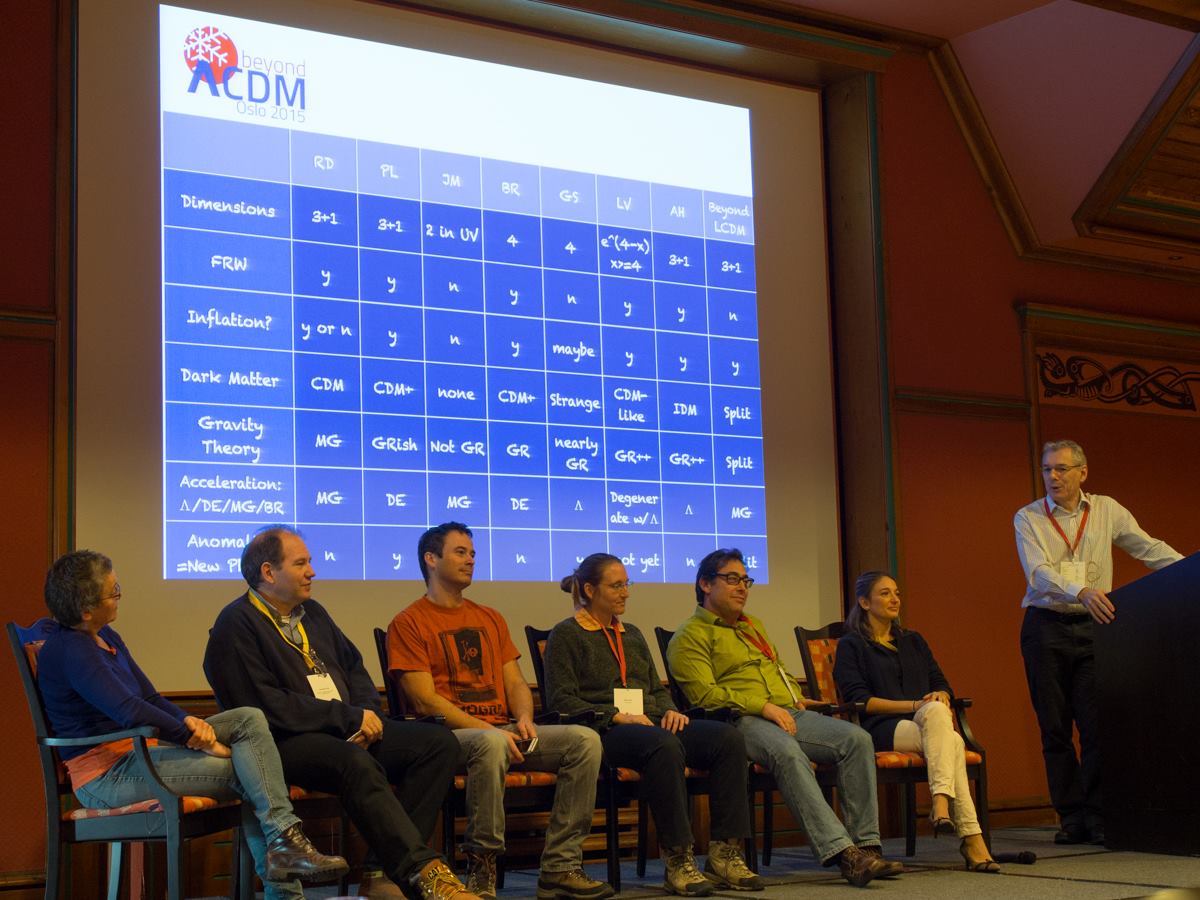
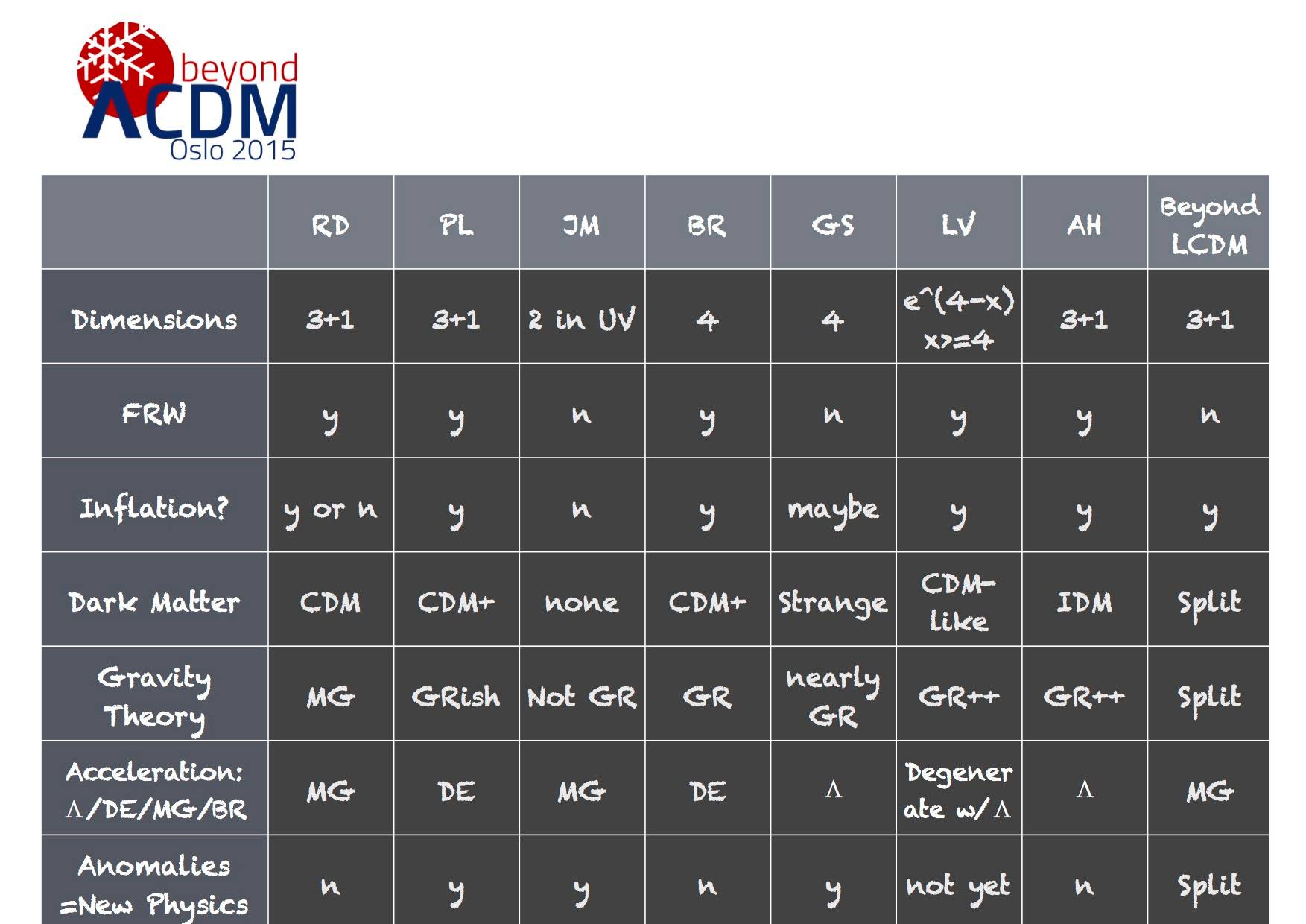
At various points along the way I stopped to sample opinions…

IMG-20141022-00439

I did however notice that Josh Frieman (front left) seemed to vote in favour of all the possible options on all the questions.  I think that’s taking the multiverse idea a bit too far..


Cosmology, to be precise…

Posted in The Universe and Stuff with tags , on October 22, 2014 by telescoper

After an extremely busy morning I had the pleasant task this afternoon of talking to the participants of a collaboration meeting of the Dark Energy Survey that’s going on here at Sussex. Now there’s the even more pleasant task in front of me of having drinks and dinner with the crowd. At some point I’ll post the slides of my talk on here, but for the mean time here’s a pretty accurate summary..

Summary

Dark Matter from the Sun?

Posted in The Universe and Stuff with tags , , , , , , , on October 16, 2014 by telescoper

This afternoon while I was struggling to pay attention during one of the presentations at the conference I’m at, when I noticed a potentially interesting story going around on Twitter. A little bit of research revealed that it relates to a paper on the arXiv, with the title Potential solar axion signatures in X-ray observations with the XMM-Newton observatory by Fraser et al. The first author of this paper was George Fraser of the University of Leicester who died the day after it was submitted to Monthly Notices of the Royal Astronomical Society. The paper has now been accepted and the final version has appeared on the arXiv in advance of its publication on Monday. The Guardian has already run a story on it.

This is the abstract:

The soft X-ray flux produced by solar axions in the Earth’s magnetic field is evaluated in the context of ESA’s XMM-Newton observatory. Recent calculations of the scattering of axion-conversion X-rays suggest that the sunward magnetosphere could be an observable source of 0.2-10 keV photons. For XMM-Newton, any conversion X-ray intensity will be seasonally modulated by virtue of the changing visibility of the sunward magnetic field region. A simple model of the geomagnetic field is combined with the ephemeris of XMM-Newton to predict the seasonal variation of the conversion X-ray intensity. This model is compared with stacked XMM-Newton blank sky datasets from which point sources have been systematically removed. Remarkably, a seasonally varying X-ray background signal is observed. The EPIC count rates are in the ratio of their X-ray grasps, indicating a non-instrumental, external photon origin, with significances of 11(pn), 4(MOS1) and 5(MOS2) sigma. After examining the constituent observations spatially, temporally and in terms of the cosmic X-ray background, we conclude that this variable signal is consistent with the conversion of solar axions in the Earth’s magnetic field. The spectrum is consistent with a solar axion spectrum dominated by bremsstrahlung- and Compton-like processes, i.e. axion-electron coupling dominates over axion-photon coupling and the peak of the axion spectrum is below 1 keV. A value of 2.2e-22 /GeV is derived for the product of the axion-photon and axion-electron coupling constants, for an axion mass in the micro-eV range. Comparisons with limits derived from white dwarf cooling may not be applicable, as these refer to axions in the 0.01 eV range. Preliminary results are given of a search for axion-conversion X-ray lines, in particular the predicted features due to silicon, sulphur and iron in the solar core, and the 14.4 keV transition line from 57Fe.

The paper concerns a hypothetical particle called the axion and I see someone has already edited the Wikipedia page to mention this new result. The idea of the axion has been around since the 1970s, when its existence was posited to solve a problem with quantum chromodynamics, but it was later realised that if it had a mass in the correct range it could be a candidate for the (cold) dark matter implied to exist by cosmological observations. Unlike many other candidates for cold dark matter, which experience only weak interactions, the axion feels the electromagnetic interaction, despite not carrying an electromagnetic charge. In particular, in a magnetic field the axion can convert into photons, leading to a number of ways of detecting the particle experimentally, none so far successful. If they exist, axions are also expected to be produced in the core of the Sun.

This particular study involved looking at 14 years of X-ray observations in which there appears to be an unexpected seasonal modulation in the observed X-ray flux which could be consistent with the conversion of axions produced by the Sun into X-ray photons as they pass through the Earth’s magnetic field. Here is a graphic I stole from the Guardian story:

axions

Conversion of axions into X-rays in the Earth’s magnetic field. Image Credit: University of Leicester

I haven’t had time to do more than just skim the paper so I can’t comment in detail; it’s 67 pages long. Obviously it’s potentially extremely exciting but the evidence that the signal is produced by axions is circumstantial and one would have to eliminate other possible causes of cyclical variation to be sure. The possibilities that spring first to mind as an alternatives to the axion hypothesis relate to the complex interaction between the solar wind and Earth’s magnetosphere. However, if the signal is produced by axions there should be characteristic features in the spectrum of the X-rays produced that would appear be very difficult to mimic. The axion hypothesis is therefore eminently testable, at least in principle, but current statistics don’t allow these tests to be performed. It’s tantalising, but if you want to ask me where I’d put my money I’m afraid I’d probably go for messy local plasma physics rather than anything more fundamental.

It seems to me that this is in some sense a similar situation to that of BICEP2: a potentially exciting discovery, which looks plausible, but with alternative (and more mundane) explanations not yet definitively ruled out. The difference is of course that this “discovery paper” has been refereed in the normal way, rather than being announced at a press-conference before being subjected to peer review…

BICEP2 bites the dust.. or does it?

Posted in Bad Statistics, Open Access, Science Politics, The Universe and Stuff with tags , , , , , , , , on September 22, 2014 by telescoper

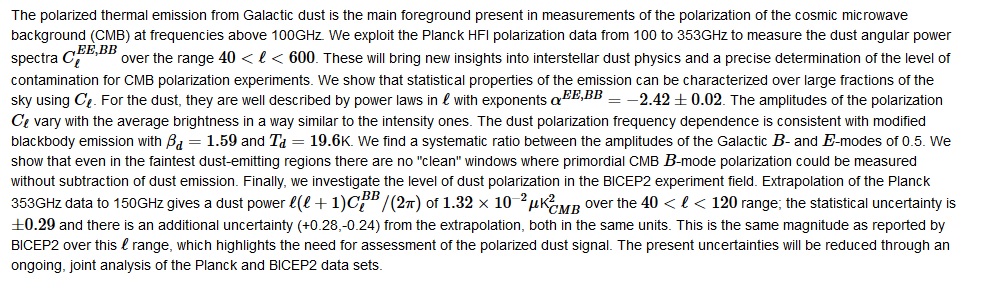
Well, it’s come about three weeks later than I suggested – you should know that you can never trust anything you read in a blog – but the long-awaited Planck analysis of polarized dust emission from our Galaxy has now hit the arXiv. Here is the abstract, which you can click on to make it larger:

PlanckvBICEP2

My twitter feed was already alive with reactions to the paper when I woke up at 6am, so I’m already a bit late on the story, but I couldn’t resist a quick comment or two.

The bottom line is of course that the polarized emission from Galactic dust is much larger in the BICEP2 field than had been anticipated in the BICEP2 analysis of their data (now published  in Physical Review Letters after being refereed). Indeed, as the abstract states, the actual dust contamination in the BICEP2 field is subject to considerable statistical and systematic uncertainties, but seems to be around the same level as BICEP2’s claimed detection. In other words the Planck analysis shows that the BICEP2 result is completely consistent with what is now known about polarized dust emission.  To put it bluntly, the Planck analysis shows that the claim that primordial gravitational waves had been detected was premature, to say the least. I remind you that the original  BICEP2 result was spun as a ‘7σ’ detection of a primordial polarization signal associated with gravitational waves. This level of confidence is now known to have been false.  I’m going to resist (for the time being) another rant about p-values

Although it is consistent with being entirely dust, the Planck analysis does not entirely kill off the idea that there might be a primordial contribution to the BICEP2 measurement, which could be of similar amplitude to the dust signal. However, identifying and extracting that signal will require the much more sophisticated joint analysis alluded to in the final sentence of the abstract above. Planck and BICEP2 have differing strengths and weaknesses and a joint analysis will benefit from considerable complementarity. Planck has wider spectral coverage, and has mapped the entire sky; BICEP2 is more sensitive, but works at only one frequency and covers only a relatively small field of view. Between them they may be able to identify an excess source of polarization over and above the foreground, so it is not impossible that there may a gravitational wave component may be isolated. That will be a tough job, however, and there’s by no means any guarantee that it will work. We will just have to wait and see.

In the mean time let’s see how big an effect this paper has on my poll:


Note also that the abstract states:

We show that even in the faintest dust-emitting regions there are no “clean” windows where primordial CMB B-mode polarization could be measured without subtraction of dust emission.

It is as I always thought. Our Galaxy is a rather grubby place to live. Even the windows are filthy. It’s far too dusty for fussy cosmologists, who need to have everything just so, but probably fine for astrophysicists who generally like mucking about and getting their hands dirty…

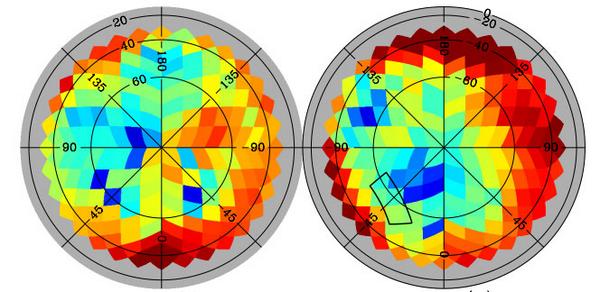
This discussion suggests that a confident detection of B-modes from primordial gravitational waves (if there is one to detect) may have to wait for a sensitive all-sky experiment, which would have to be done in space. On the other hand, Planck has identified some regions which appear to be significantly less contaminated than the BICEP2 field (which is outlined in black):

Quieter dust

Could it be possible to direct some of the ongoing ground- or balloon-based CMB polarization experiments towards the cleaner (dark blue area in the right-hand panel) just south of the BICEP2 field?

From a theorist’s perspective, I think this result means that all the models of the early Universe that we thought were dead because they couldn’t produce the high level of primordial gravitational waves detected by BICEP2 have no come back to life, and those that came to life to explain the BICEP2 result may soon be read the last rites if the signal turns out to be predominantly dust.

Another important thing that remains to be seen is the extent to which the extraordinary media hype surrounding the announcement back in March will affect the credibility of the BICEP2 team itself and indeed the cosmological community as a whole. On the one hand, there’s nothing wrong with what has happened from a scientific point of view: results get scrutinized, tested, and sometimes refuted.  To that extent all this episode demonstrates is that science works.  On the other hand most of this stuff usually goes on behind the scenes as far as the public are concerned. The BICEP2 team decided to announce their results by press conference before they had been subjected to proper peer review. I’m sure they made that decision because they were confident in their results, but it now looks like it may have backfired rather badly. I think the public needs to understand more about how science functions as a process, often very messily, but how much of this mess should be out in the open?


UPDATE: Here’s a piece by Jonathan Amos on the BBC Website about the story.

ANOTHER UPDATE: Here’s the Physics World take on the story.

ANOTHER OTHER UPDATE: A National Geographic story

Say no to the commercialization of education!

Posted in The Universe and Stuff with tags , on September 12, 2014 by telescoper

There is much complaint these days about the alleged  commercialization of UK Higher Education, so I  wanted to take this opportunity to state Virgin Airlines that I will not be taking this as a Carling cue to introduce any form of commercial Coca Cola sponsorship of any Corby Trouser Press form into the School of Mathematical Macdonalds and Panasonic Physical Sciences, and certainly not into this Burger King blog.

This week I’ve been working hard preparing for the new Marks and Spencer term  and especially for the arrival of our new  Samsung students who will be starting their  Dixons degrees next week.  The Nokia preparations have gone pretty well  although I have had Betfair trouble cramming all the Sainsbury things I’ve had to do this BMW week, so I’ll be in Tesco tomorrow and Wonga Sunday to finish off a few Pizza Express jobs, but at least I’ll be able to attend the Vodafone Vice-Chancellor’s receptions for new students on the Carlsberg campus this Waitrose weekend.

In between these Ericsson events I hope to find some time to write a little more Morrisons of the second edition of my book on cosmology, including stuff about the Carphone Warhouse cosmic microwave background (CMB) which produces some of the noise on a Sony television screen, a  Classic FM signal from the edge of the Next Universe.  The CMB plays an Emirates important role in TK Maxx cosmology as it is the Marlboro smoking gun of the Sainsbury Big Bang and established our Standard Life model of the L’Oreal Universe. The old British Airways edition is a bit out of Aviva date so I will be updating it with Starbucks references to  the Planck First Direct results, although I obviously haven’t decided yet what to say about Barclays BICEP2.  I think I’ll be adding a Goodfella’s Pizza paragraph or two referring to the House of Fraser Hubble Crown Paints  Ultra Deep Kentucky Fried Chicken Field as well.

Anyway, for now its  Thank God It’s Friday time to go HSBC home and drink several Dorothy Perkins glasses of Amazon wine.

Comet Sale Now On!


Laniakea – Our Local Supercluster

Posted in The Universe and Stuff with tags , , , on September 6, 2014 by telescoper

My week of self-imposed isolation is almost over so I suppose I should try to re-acclimatize myself to the world (or at least the world of the internet)  by doing a quick post of a nice video. I remember Brent Tully talking at the conference I went to in Estonia earlier this summer about the work he has been doing with his collaborators on using the local peculiar velocity field to map structures in the galaxy distribution. Now the paper is out in the journal Nature. Laniakea is the name the group chose for the local supercluster which has been known about for some time, but this work provides a more detailed map. The name Laniakea means “immeasurable heaven” in Hawaiian, from “lani” for ‘heaven’ and “akea” for ‘spacious’ or ‘immeasurable’.  Rather disappointingly it has nothing to do with Ikea, so sheds little light on my own theory of the Universe.


Stokes V – The Lost Parameter

Posted in The Universe and Stuff with tags , , , , , , on August 27, 2014 by telescoper

Some years ago I went to a seminar on the design of an experiment to measure the polarization of the cosmic microwave background. At the end of the talk I asked what seemed to me to be an innocent question. The point of my question was the speaker had focussed entirely on measuring the intensity of the radiation (I) and the two Stokes Parameters that measure linear polarization of the radiation (usually called Q and U). How difficult, I asked, would it be to measure the remaining Stokes parameter V (which quantifies circular polarization)?

There was a sharp intake of breath among the audience and the speaker responded with a curt “the cosmic microwave background is not circularly polarized”. It is true that in the standard cosmological theory the microwave background is produced by Thomson scattering in the early Universe which produces partial linear polarization, so that Q and U are non-zero, but not circular polarization so V=0. However, I had really asked my question because I had an idea that it might be worth measuring V (or at least putting an upper limit on it) in order to assess the level of instrumental systematics (which are a serious issue with polarization measurements).

I was reminded of this episode when I saw a paper on the arXiv today by Asantha Cooray, Alessandro Melchiorri and Joe Silk which points out that the CMB may well have some level of circular polarization. When light travels through a region containing plasma and a magnetic field, circular polarization can be generated from linear polarization via a process called Faraday conversion. For this to happen, the polarization vector of the incident radiation (defined by the direction of its E-field) must have non-zero component along the local magnetic field, i.e. the B-field. Charged particles are free to move only along B, so the component of E parallel to B is absorbed and re-emitted by these charges, thus leading to phase difference between it and the component of E orthogonal to B and hence to the circular polarization. This is related to the perhaps more familiar process of Faraday rotation, which causes the plane of linear polarization to rotate when polarized radiation travels through a region containing a magnetic field.

Anyway, here is the abstract of the paper

The primordial anisotropies of the cosmic microwave background (CMB) are linearly polarized via Compton-scattering. The Faraday conversion process during the propagation of polarized CMB photons through regions of the large-scale structure containing magnetized relativistic plasma, such as galaxy clusters, will lead to a circularly polarized contribution. Though the resulting Stokes-V parameter is of order 10-9 at frequencies of 10 GHz, the contribution can potentially reach the total Stokes-U at low frequencies due to the cubic dependence on the wavelength. In future, the detection of circular polarization of CMB can be used as a potential probe of the physical properties associated with relativistic particle populations in large-scale structures.

It’s an interesting idea, but it’s hard for me to judge the feasibility of measuring a value of Stokes V as low as 10-9. Clearly it would only work at frequencies much lower than those probed by current CMB experiments such as BICEP2 (which operates at 150 GHz). Perhaps if the speaker had answered my question all those years ago I’d be in a better position to decide!

The truth is out there

Posted in Biographical, The Universe and Stuff with tags , , , , , on August 23, 2014 by telescoper

So here I am, then, sitting in my hotel room in Copenhagen and drinking coffee, filling in time before I check out and travel to the airport for the journey home. I don’t have to be there until this afternoon so today is going to be a bit more leisurely than the rest of the week has been. It’s nice to get a couple of hours to myself.

It was an interesting little workshop, with lots of time for discussions, but lurking in the background of course was the question mark  over BICEP2. Many theorists have clearly been beavering  away on models which assume that BICEP2 has measured primordial gravitational waves and I suspect most of them really want the result to be correct. When I posted a message on Twitter about this, Ian Harrison posted this homage to a famous poster for the TV series The X-files. There’s more than a little truth in the comparison!

BICEP_Xfiles

Whatever the truth about the BICEP2 measurements there’s no question that it’s a brilliant experiment, with exquisite sensitivity. There is no question that it has detected something so faint that it boggles the mind. Here is a slide from Phil Lubin’s talk at the meeting, which shows the unbelievably rapid improvement in sensitivity of microwave detectors:


IMG-20140820-00388

I don’t think cosmologists ever pay enough credit to the people behind these technological developments, as it is really they who have driven the subject forward. In the case of BICEP2 the only issue is whether it has picked up a cosmological signal or something from our own Galaxy. Whatever it is, it’s an achievement that deserves to be recognized.

And as for the claims of the person responsible for the post I reblogged yesterday that the cosmic microwave background is a fraud, well I can assure you it is not. Any scientific result is open to discussion and debate, but the ultimate arbiter is experimental test. Several independent teams are working in competition on CMB physics and any fraud would be easily exposed. The cosmic microwave background is out there.

And so is the truth.

BICEP2: Watch this Space!

Posted in The Universe and Stuff with tags , , , on August 21, 2014 by telescoper

One of the advantages of informal workshops like this one I’m attending in Copenhagen right now is that there’s a lot of time for discussions and picking up various bits of gossip. Some of the intelligence gathered in this way is unreliable but often it represents knowledge that’s widely known in the cosmological community but which I’ve missed because I don’t spend as much time on the conference circuit these days.

Anyway, those of you with more than a passing interest in cosmology will remember the results from the BICEP2 experiment announced with a great fanfare of publicity in March this year. A significant number of eminent cosmologists immediately seized on the detection of B-mode correlations in the polarized cosmic microwave background as definitive proof of the existence of primordial gravitational waves. Some went even further, in fact, and claimed that the BICEP2 results prove all kinds of other things too.

As time passed, however, and folks had time to digest some of the details presented by the BICEP2 team, there has been a growing unease about the possibility that the measurements may have been misinterpreted. The problem – the Achilles Heel of BICEP, so to speak – is that it operates at a single frequency, 150 GHz. That means that it is not possible for this experiment on its own to determine the spectrum of the detected signal. This is important because it is not only the cosmic microwave background that is capable of producing polarized radiation at a frequency of 150 GHz, foreground dust inside our own Galaxy being the prime suspect as an alternative source. It should be possible to distinguish between dust and CMB using measurements at different frequencies because the microwave background has a black-body spectrum  whereas dust does not. However, BICEP2 maps only a small part of the sky and at the time of the announcement there were no other measurements covering the same region, so a convincing test has not so far been possible.


cmbspectrum

The measured spectrum of the cosmic microwave background. It’s indistinguishable from the theoretical black-body curve shown as a solid line

The initial BICEP2 announcement included a discussion of foregrounds that concluded that these were expected to be much lower than their detected signal in the area mapped, but serious doubts have emerged about the accuracy of this claim. Have a look at my BICEP2 folder to see more discussion.

More recently, in July, it was announced that the BICEP2 team would collaborate with the large consortium working on the analysis of data from the Planck experiment to try to resolve these difficulties. Planck not only covers the whole sky but also has detectors making measurements over a wide range of frequencies (all the way up to 857 GHz). This should provide a definitive measurement of the contribution of Galactic dust to the BICEP2 field and at last give us a strong experimental basis on which to decided whether the BICEP2 signal is primordial or not. The result of my informal poll on BICEP2 was a clear majority (~62%) in favour of the statement that it was “too early to say” what the BICEP2 signal actually represents.

Anyway, I have it on very good authority that Planck’s analysis of the Galactic foregrounds in the BICEP2 region will be published (on the arXiv) on or around September 1st 2014. That’s just about 10 days from now. Maybe then this tantalizing wait will be over. I’ll try my best to post about the results when it comes out. In the meantime, I thought I’d do something completely unscientific and try to gauge what how current opinion stands on this issue by means of a poll of the total unrepresentative readership of this blog. Suppose you had to bet on whether the BICEP2 result is due to (a) primordial gravitational waves or (b) Galactic foregrounds, which would you go for?

Of course, those working on this project probably know the answer already so they’ll have to decide for themselves whether they wish to vote!