Archive for Cosmology

Power versus Pattern

Posted in Bad Statistics, The Universe and Stuff with tags , , , , , on June 15, 2012 by telescoper

One of the challenges we cosmologists face is how to quantify the patterns we see in galaxy redshift surveys. In the relatively recent past the small size of the available data sets meant that only relatively crude descriptors could be used; anything sophisticated would be rendered useless by noise. For that reason, statistical analysis of galaxy clustering tended to be limited to the measurement of autocorrelation functions, usually constructed in Fourier space in the form of power spectra; you can find a nice review here.

Because it is so robust and contains a great deal of important information, the power spectrum has become ubiquitous in cosmology. But I think it’s important to realise its limitations.

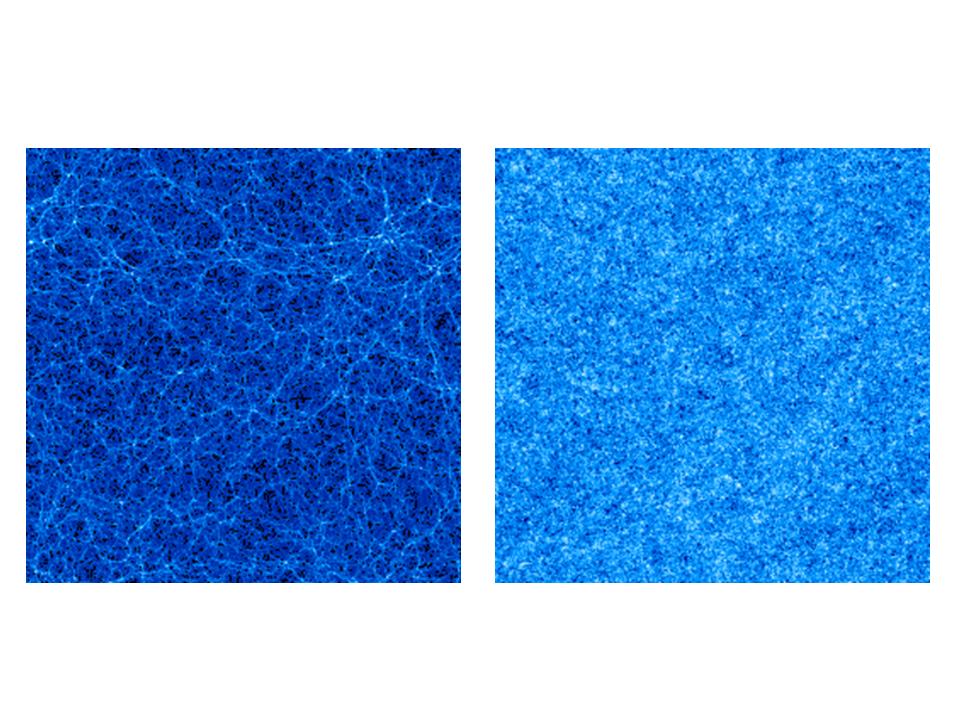
Take a look at these two N-body computer simulations of large-scale structure:

The one on the left is a proper simulation of the “cosmic web” which is at least qualitatively realistic, in that in contains filaments, clusters and voids pretty much like what is observed in galaxy surveys.

To make the picture on the right I first  took the Fourier transform of the original  simulation. This approach follows the best advice I ever got from my thesis supervisor: “if you can’t think of anything else to do, try Fourier-transforming everything.”

Anyway each Fourier mode is complex and can therefore be characterized by an amplitude and a phase (the modulus and argument of the complex quantity). What I did next was to randomly reshuffle all the phases while leaving the amplitudes alone. I then performed the inverse Fourier transform to construct the image shown on the right.

What this procedure does is to produce a new image which has exactly the same power spectrum as the first. You might be surprised by how little the pattern on the right resembles that on the left, given that they share this property; the distribution on the right is much fuzzier. In fact, the sharply delineated features  are produced by mode-mode correlations and are therefore not well described by the power spectrum, which involves only the amplitude of each separate mode.

If you’re confused by this, consider the Fourier transforms of (a) white noise and (b) a Dirac delta-function. Both produce flat power-spectra, but they look very different in real space because in (b) all the Fourier modes are correlated in such away that they are in phase at the one location where the pattern is not zero; everywhere else they interfere destructively. In (a) the phases are distributed randomly.

The moral of this is that there is much more to the pattern of galaxy clustering than meets the power spectrum…

My Even Newer Theory of the Universe

Posted in The Universe and Stuff with tags , , on June 13, 2012 by telescoper

I have decided this evening to unveil my new cosmological theory.

My previous work  was based on the idea that the Universe was obtained from the Swedish furniture and home accessory emporium IKEA. This “Easy Self Assembly” hypothesis dispenses with the need for creation from nothing, and also accounts naturally for the observed geometry of space (it came in a flat pack).

My subsequent study of this scenario has focussed on properties of the Universe that can’t be explained in the earlier version of the theory, specifically  the cosmic microwave background. However, making my supper just now I suddenly hit upon the answer to that particular puzzle. Clearly, wanting to achieve the best results possible, on his/her way back from IKEA the Divine Creator stopped off at Marks and Spencer …

Big Bang: Who’s the Daddy?

Posted in History, The Universe and Stuff with tags , , , , on June 8, 2012 by telescoper

Time, I think, for a frivolous Friday poll.

I stumbled across a post on the Physics World Blog concerning a radio broadcast about Georges Lemaître.

Here’s a description of said programme:

Few theories could claim to have a more fundamental status than Big Bang Theory. This is now humanity’s best attempt at explaining how we got here: A Theory of Everything. This much is widely known and Big Bang Theory is now one of the most recognisable scientific brands in the world. What’s less well known is that the man who first proposed the theory was not only an accomplished physicist, he was also a Catholic priest. Father Georges Lemaître wore his clerical collar while teaching physics, and not at Oxford, Cambridge or MIT but at the Catholic University of Leuven in Belgium. It was this unassuming Catholic priest in an academic backwater who has changed the way we look at the origins of the universe. His story also challenges the assumption that science and religion are always in conflict. William Crawley introduces us to the “Father” of the Big Bang.

The question is whether the word “Father” in the last sentence should be taken as anything more than a play on the title he’d be given as a Catholic priest?

Lemaître’s work was highly original and it undoubtedly played an important role in the development of the Big Bang theory, especially in Western Europe and in the United States. However, a far stronger claim to the title of progenitor of this theory belongs to Alexander Alexandrovich Friedman, who obtained the cosmological solutions of Einstein’s general theory of relativity, on which the Big Bang model is based, independently of and shortly before Lemaître did. Unfortunately the Russian Friedman died in 1925 and it was many years before his work became widely known in the West. At least in my book, he’s the real “father” of the Big Bang, but I’m well aware that this is the source of a great deal of argument at cosmology conferences, which makes it an apt topic for a quick poll:

P.S. I prefer to spell Friedman with one “n” rather than two. His name in his own language is Алекса́ндр Алекса́ндрович Фри́дман and the spelling “Friedmann” only arose because of later translations into German.

The World as a Beach

Posted in Biographical, The Universe and Stuff with tags , , , , , , on April 10, 2012 by telescoper

Well, as some of you will have noticed, I’ve been offline over the long weekend. There’s no internet connection – not one that I could get to work, anyway – at the residence I’m staying in and I couldn’t be bothered to traipse all the way up the hill to the department in the pouring rain to connect from my office. Hence the first gap in my postings this year. I don’t suppose anyone minds that much. Anyway, here are a few pictures and random thoughts from the weekend.

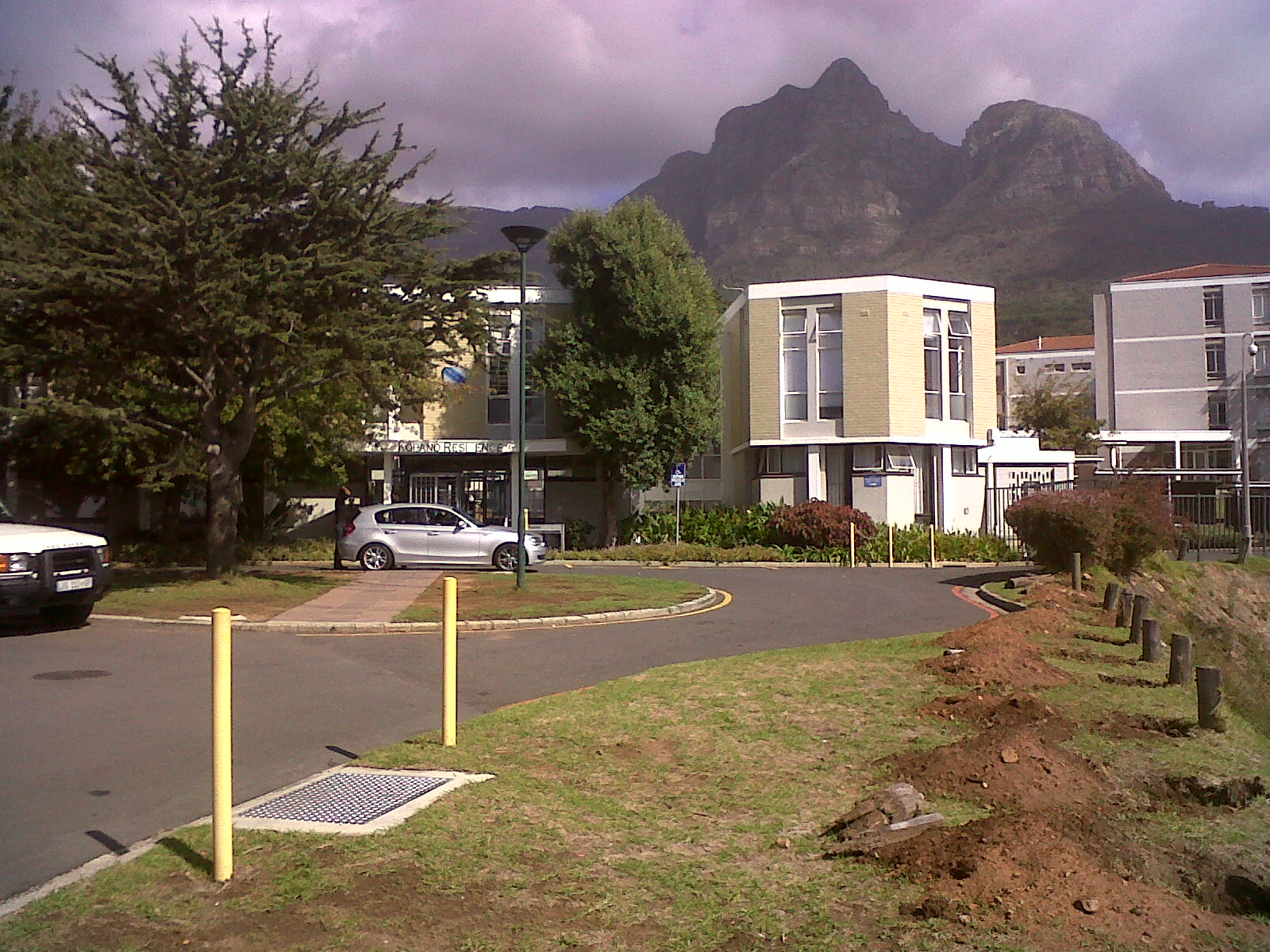
Here’s a picture of the residence, by the way. It’s called Kopano, although when I previously stayed it was called Driekoppen. The old name was a relic of the days of slavery – three slaves were tortured and executedin public  after rebelling against the terrible conditions they were held in. Their heads were displayed on pikes nearby, hence the name which means “Three Heads”. This was in 1724. I’m not surprised that the end of apartheid brought a change in the name, although keeping it as it was would have served as a reminder of South Africa’s terrible past. One shouldn’t  become obsessed by events that took place such a long time ago, but neither should one forget them.

Good Friday was a very Good Friday indeed, starting with a lovely breakfast and a walk on the beach in Muizenberg. Apparently this is something of a surfer’s paradise but, as I said, I didn’t have an internet connection so couldn’t join in. Also, they have sharks here. I mean big ones. Great White ones, as  a matter of fact. None showed up while I was there, though, and in any case I was only paddling along the shoreline. It may not be obvious from the picture, but it was pretty hot. Almost 30 degrees.

 I was watching a chap surfing while we walked along and it reminded me of the post I did a while ago about teaching analogies. Standing on a beach looking out towards the horizon is a bit like doing cosmology. Off in the far distance everything looks smooth; the waves on the surface are much lower in amplitude than the depth of the sea out there, so everything evolves linearly and is quite easy to understand. That’s like looking back in time at the early Universe imprinted on the cosmic microwave background. Nearer to the shore, however, the waves become non-linear because their height is comparable to, or larger than, the depth of the water. These waves evolve in a non-linear way producing, breaking on the beach to produce foam and spray, just as the primordial waves collapse to form galaxies and the foam of large-scale structure when their self-gravity becomes sufficiently strong.

That’s enough of that, I think.

Unfortunately, the weather changed for the worse over the rest of the Easter weekend and torrential rain kept me from doing much on Saturday or Sunday. The finishing section of the  Two Oceans Marathon, which ended on the UCT campus on Saturday, was like a quagmire. As you can see from the picture, I reached the line well in front of the pack. About two days in front, actually. I took this as they were building the stands and hospitality tents a few days before the race.

Anyway, the good side of the bad weather was that I got quite a lot of work done, catching up on things I have let slip for far too long. I also exhausted the reading material I brough with me, so will have to find a good bookshop in the next day or two. Well, that’s about enough for now. I hope to continue regular dispatches from now on until I return to Blighty  next week.

The Long Weekend

Posted in Books, Talks and Reviews, The Universe and Stuff with tags , , , , , on April 5, 2012 by telescoper

It’s getting even warmer in Cape Town as we approach the Easter vacation. The few clouds to be found in the sky over the last couple of days have now disappeared and even the mountain behind the campus has lost its white fluffy hat:

It’s going to be a busy weekend in these parts over the forthcoming weekend. As in the UK, tomorrow (Good Friday) is a national holiday and there will be a 5K fun run around the campus. The temporary stands and marquees you can see in the picture are associated with that. On Saturday there’s a really big event finishing there too – the Two Oceans Marathon – which will finish on the University of Cape Town campus. At the moment it’s 30 degrees, but the forecast is to cool down a bit over the holiday weekend. Good news for the runners, but not I suspect for everyone who’s disappearing off for a weekend at the beach!

Anyway, I did my talk this morning which seemed to go down reasonably well. It was followed by a nice talk by Roberto Trotta from Imperial College in a morning that turned out to be devoted to statistical cosmology. I didn’t get the chance to coordinate with Roberto, but suspected he would focus on in the ins and outs of Bayesian methods (which turned out to be right), so I paved the way with a general talk about the enormous statistical challenges cosmology will face in the era after Planck. The main point I wanted to make – to an audience which mainly comprised theoretical folk  – was that we’ve really been lucky so far in that the nature of the concordance cosmology has enabled us to get away with using relatively simple statistical tools, i.e. the power spectrum.This is because the primordial fluctuations from which galaxies and large-scale structure grew are assumed to be the simplest possible statistical form, i.e. Gaussian.  Searching for physics beyond the standard model, e.g. searching for the  non-Gaussianities which might be key to understanding the physics of the very early stages of the evolution of the Universe,  will be more difficult  by an enormous factor and will require much more sophisticated tools than we’ve needed so far.

Anyway, that’s for the future. Cosmological results from Planck won’t be freely available until next year at the earliest, so I think I can still afford to take the long weekend off  without endangering the “Post-Planck Era” too much!

News from the BOSS

Posted in The Universe and Stuff with tags , , , on April 1, 2012 by telescoper

No April Fool’s from me today I’m afraid!

New results from the Baryon Oscillation Spectroscopic Survey (known to its friends as BOSS) were one of the highlights of the National Astronomy Meeting last week (which I wasn’t at) and they’ve received quite a lot of press attention over the past few days. Rather than repeat what’s been said I thought I’d reblog this lengthy piece, which gives a lot of detail and is also written by an insider!

Rita's avatarwe are all in the gutter

I wrote the following post yesterday, but I fell asleep before I could do anything with it. It’s about the first set of results from the Baryon Oscillation Spectroscopic Survey (BOSS), part of Sloan Digital Sky Survey-III project, which we announced to the science community and to the press yesterday. How this whole project was picked up by the press in a way I hadn’t anticipated is the matter for another post. What really matters is the science, and the science – if you don’t mind my exceedingly biased opinion – is just excellent.

============================

I’m now making my way back home from this year’s National Astronomy Meeting (NAM) 2012 in Manchester. I love NAM. It’s always a chance to see old friends and listen to good science, to catch up on gossip and long-promised pints. This year, I did almost none of these things. The reason is that one…

View original post 2,265 more words

Research Opportunities in the Philosophy of Cosmology

Posted in The Universe and Stuff with tags , , , , , , on March 16, 2012 by telescoper

I got an email this morning telling me about the following interesting opportunities for research fellowships. They are in quite an unusual area – the philosophy of cosmology – and one I’m quite interested in myself so I thought it might ahieve wider circulation if I posted the advertisement on here.

–0–

Applications are invited for two postdoctoral fellowships in the area of philosophy of cosmology, one to be held at Cambridge University and one to be held at Oxford University, starting 1 Jan 2013 to run until 31 Aug 2014. The two positions have similar job-descriptions and the deadline for applications is the same: 18 April 2012.

For more details, see here, for the Cambridge fellowship and  here for the Oxford fellowship.

Applicants are encouraged to apply for both positions. The Oxford group is led by Joe Silk, Simon Saunders and David Wallace, and that at Cambridge by John Barrow and Jeremy Butterfield.

These appointments are part of the initiative ‘establishing the philosophy of cosmology’, involving a consortium of universities in the UK and USA, funded by the John Templeton Foundation. Its aim is to identify, define and explore new foundational questions in cosmology. Key questions already identified concern:

  • The issue of measure, including potential uses of anthropic reasoning
  • Space-time structure, both at very large and very small scales
  • The cosmological constant problem
  • Entropy, time and complexity, in understanding the various arrows of time
  • Symmetries and invariants, and the nature of the description of the universe as a whole

Applicants with philosophical interests in cosmology outside these areas will also be considered.

For more background on the initiative, see here and the project website (still under construction).

Big Bang Acoustics

Posted in The Universe and Stuff with tags , , , , , , on March 12, 2012 by telescoper

It’s National Science and Engineering Week this week and as part of the programme of events in Cardiff we have an open evening at the School of Physics & Astronomy tonight. This will comprise a series of public talks followed by an observing session using the School’s Observatory. I’m actually giving a (short) talk myself, which means it will be a long day, so I’m going to save time by recycling the following from an old blog post on the subject of my talk.

As you probably know the Big Bang theory involves the assumption that the entire Universe – not only the matter and energy but also space-time itself – had its origins in a single event a finite time in the past and it has been expanding ever since. The earliest mathematical models of what we now call the  Big Bang were derived independently by Alexander Friedman and George Lemaître in the 1920s. The term “Big Bang” was later coined by Fred Hoyle as a derogatory description of an idea he couldn’t stomach, but the phrase caught on. Strictly speaking, though, the Big Bang was a misnomer.

Friedman and Lemaître had made mathematical models of universes that obeyed the Cosmological Principle, i.e. in which the matter was distributed in a completely uniform manner throughout space. Sound consists of oscillating fluctuations in the pressure and density of the medium through which it travels. These are longitudinal “acoustic” waves that involve successive compressions and rarefactions of matter, in other words departures from the purely homogeneous state required by the Cosmological Principle. The Friedman-Lemaitre models contained no sound waves so they did not really describe a Big Bang at all, let alone how loud it was.

However, as I have blogged about before, newer versions of the Big Bang theory do contain a mechanism for generating sound waves in the early Universe and, even more importantly, these waves have now been detected and their properties measured.

The above image shows the variations in temperature of the cosmic microwave background as charted by the Wilkinson Microwave Anisotropy Probe about a decade years ago. The average temperature of the sky is about 2.73 K but there are variations across the sky that have an rms value of about 0.08 milliKelvin. This corresponds to a fractional variation of a few parts in a hundred thousand relative to the mean temperature. It doesn’t sound like much, but this is evidence for the existence of primordial acoustic waves and therefore of a Big Bang with a genuine “Bang” to it.

A full description of what causes these temperature fluctuations would be very complicated but, roughly speaking, the variation in temperature you see in the CMB corresponds directly to variations in density and pressure arising from sound waves.

So how loud was it?

The waves we are dealing with have wavelengths up to about 200,000 light years and the human ear can only actually hear sound waves with wavelengths up to about 17 metres. In any case the Universe was far too hot and dense for there to have been anyone around listening to the cacophony at the time. In some sense, therefore, it wouldn’t have been loud at all because our ears can’t have heard anything.

Setting aside these rather pedantic objections – I’m never one to allow dull realism to get in the way of a good story- we can get a reasonable value for the loudness in terms of the familiar language of decibels. This defines the level of sound (L) logarithmically in terms of the rms pressure level of the sound wave Prms relative to some reference pressure level Pref

L=20 log10[Prms/Pref]

(the 20 appears because of the fact that the energy carried goes as the square of the amplitude of the wave; in terms of energy there would be a factor 10).

There is no absolute scale for loudness because this expression involves the specification of the reference pressure. We have to set this level by analogy with everyday experience. For sound waves in air this is taken to be about 20 microPascals, or about 2×10⁻¹⁰ times the ambient atmospheric air pressure which is about 100,000 Pa.  This reference is chosen because the limit of audibility for most people corresponds to pressure variations of this order and these consequently have L=0 dB. It seems reasonable to set the reference pressure of the early Universe to be about the same fraction of the ambient pressure then, i.e.

Pref~2×10⁻¹⁰ Pamb

The physics of how primordial variations in pressure translate into observed fluctuations in the CMB temperature is quite complicated, and the actual sound of the Big Bang contains a mixture of wavelengths with slightly different amplitudes so it all gets a bit messy if you want to do it exactly, but it’s quite easy to get a rough estimate. We simply take the rms pressure variation to be the same fraction of ambient pressure as the averaged temperature variation are compared to the average CMB temperature,  i.e.

Prms~ a few ×10-5Pamb

If we do this, scaling both pressures in logarithm in the equation in proportion to the ambient pressure, the ambient pressure cancels out in the ratio, which turns out to be a few times 10-5

With our definition of the decibel level we find that waves corresponding to variations of one part in a hundred thousand of the reference level  give roughly L=100dB while part in ten thousand gives about L=120dB. The sound of the Big Bang therefore peaks at levels just a bit less than  120 dB. As you can see in the Figure to the left, this is close to the threshold of pain,  but it’s perhaps not as loud as you might have guessed in response to the initial question. Many rock concerts are actually louder than the Big Bang, so I suspect any metalheads in the audience will be distinctly unimpressed.

A useful yardstick is the amplitude  at which the fluctuations in pressure are comparable to the mean pressure. This would give a factor of about 1010 in the logarithm and is pretty much the limit that sound waves can propagate without distortion. These would have L≈190 dB. It is estimated that the 1883 Krakatoa eruption produced a sound level of about 180 dB at a range of 100 miles. By comparison the Big Bang was little more than a whimper.

PS. If you would like to read more about the actual sound of the Big Bang, have a look at John Cramer’s webpages. You can also download simulations of the actual sound. If you listen to them you will hear that it’s more of  a “Roar” than a “Bang” because the sound waves don’t actually originate at a single well-defined event but are excited incoherently all over the Universe.

PPS. If you would like to hear a series of increasingly sophisticated computer simulations showing how our idea of the sounds accompanying the start of the Universe has evolved over the past few years, please take a look at the following video. It’s amazing how crude the 1995 version seems, compared with that describing the new era of precision cosmology.

A Piece on a Paradox

Posted in The Universe and Stuff with tags , , , , , , , , , on March 7, 2012 by telescoper

Not long ago I posted a short piece about the history of cosmology which got some interesting comments, so I thought I’d try again with a little article I wrote a while ago on the subject of Olbers’ Paradox. This is discussed in almost every astronomy or cosmology textbook, but the resolution isn’t always made as clear as it might be. The wikipedia page on this topic is unusually poor by the standards of wikipedia, and appears to have suffered a severe attack of the fractals.

I’d be interested in any comments on the following attempt.

One of the most basic astronomical observations one can make, without even requiring a telescope, is that the night sky is dark. This fact is so familiar to us that we don’t imagine that it is difficult to explain, or that anything important can be deduced from it. But quite the reverse is true. The observed darkness of the sky at night was regarded for centuries by many outstanding intellects as a paradox that defied explanation: the so-called Olbers’ Paradox.

The starting point from which this paradox is developed is the assumption that the Universe is static, infinite, homogeneous, and Euclidean. Prior to twentieth century developments in observation (Hubble’s Law) and theory  (Cosmological Models based on General Relativity), all these assumptions would have appeared quite reasonable to most scientists. In such a Universe, the intensity of light received by an observer from a source falls off as the inverse square of the distance between the two. Consequently, more distant stars or galaxies appear fainter than nearby ones. A star infinitely far away would appear infinitely faint, which suggests that Olbers’ Paradox is avoided by the fact that distant stars (or galaxies) are simply too faint to be seen. But one has to be more careful than this.

Imagine, for simplicity, that all stars shine with the same brightness. Now divide the Universe into a series of narrow concentric spherical shells, in the manner of an onion. The light from each source within a shell of radius r  falls off as r^{-2}, but the number of sources increases in the same manner. Each shell therefore produces the same amount of light at the observer, regardless of the value of r.  Adding up the total light received from all the shells, therefore, produces an infinite answer.

In mathematical form, this is

I = \int_{0}^{\infty} I(r) n dV =  \int_{0}^{\infty} \frac{L}{4\pi r^2} 4\pi r^{2} n dr \rightarrow \infty

where L is the luminosity of a source, n is the number density of sources and I(r) is the intensity of radiation received from a source at distance r.

In fact the answer is not going to be infinite in practice because nearby stars will block out some of the light from stars behind them. But in any case the sky should be as bright as the surface of a star like the Sun, as each line of sight will eventually end on a star. This is emphatically not what is observed.

It might help to think of this in another way, by imagining yourself in a very large forest. You may be able to see some way through the gaps in the nearby trees, but if the forest is infinite every possible line of sight will end with a tree.

As is the case with many other famous names, this puzzle was not actually first discussed by Olbers. His discussion was published relatively recently, in 1826. In fact, Thomas Digges struggled with this problem as early as 1576. At that time, however, the mathematical technique of adding up the light from an infinite set of narrow shells, which relies on the differential calculus, was not known. Digges therefore simply concluded that distant sources must just be too faint to be seen and did not worry about the problem of the number of sources. Johannes Kepler was also interested in this problem, and in 1610 he suggested that the Universe must be finite in spatial extent. Edmund Halley (of cometary fame) also addressed the  issue about a century later, in 1720, but did not make significant progress. The first discussion which would nowadays be regarded as a  correct formulation of the problem was published in 1744, by Loys de Chéseaux. Unfortunately, his resolution was not correct either: he imagined that intervening space somehow absorbed the energy carried by light on its path from source to observer. Olbers himself came to a similar conclusion in the piece that forever associated his name with this cosmological conundrum.

Later students of this puzzle included Lord Kelvin, who speculated that the extra light may be absorbed by dust. This is no solution to the problem either because, while dust may initially simply absorb optical light, it would soon heat up and re-radiate the energy at infra-red wavelengths. There would still be a problem with the total amount of electromagnetic radiation reaching an observer. To be fair to Kelvin, however, at the time of his writing it was not known that heat and light were both forms of the same kind of energy and it was not obvious that they could be transformed into each other in this way.

To show how widely Olbers’ paradox was known in the nineteenth Century, it is worth also mentioning that Friedrich Engels, Manchester factory owner and co-author with Karl Marx of the Communist Manifesto also considered it in his book The Dialectics of Nature. In this discussion he singles out Kelvin for particular criticism, mainly for the reason that Kelvin was a member of the aristocracy.

In fact, probably the first inklings of a correct resolution of the Olbers’ Paradox were contained not in a dry scientific paper, but in a prose poem entitled Eureka published in 1848 by Edgar Allan Poe. Poe’s astonishingly prescient argument is based on the realization that light travels with a finite speed. This in itself was not a new idea, as it was certainly known to Newton almost two centuries earlier. But Poe did understand its relevance to Olbers’ Paradox.  Light just arriving from distant sources must have set out a very long time ago; in order to receive light from them now, therefore, they had to be burning in the distant past. If the Universe has only lasted for a finite time then one can’t add shells out to infinite distances, but only as far as the distance given by the speed of light multiplied by the age of the Universe. In the days before scientific cosmology, many believed that the Universe had to be very young: the biblical account of the creation made it only a few thousand years old, so the problem was definitely avoided.

Of course, we are now familiar with the ideas that the Universe is expanding (and that light is consequently redshifted), that it may not be infinite, and that space may not be Euclidean. All these factors have to be taken into account when one calculates the brightness of the sky in different cosmological models. But the fundamental reason why the paradox is not a paradox does boil down to the finite lifetime, not necessarily of the Universe, but of the individual structures that can produce light. According to the theory Special Relativity, mass and energy are equivalent. If the density of matter is finite, so therefore is the amount of energy it can produce by nuclear reactions. Any object that burns matter to produce light can therefore only burn for a finite time before it fizzles out.

Imagine that the Universe really is infinite. For all the light from all the sources to arrive at an observer at the same time (i.e now) they would have to have been switched on at different times – those furthest away sending their light towards us long before those nearby had switched on. To make this work we would have to be in the centre of a carefully orchestrated series of luminous shells switching on an off in sequence in such a way that their light all reached us at the same time. This would not only put us  in a very special place in the Universe but also require the whole complicated scheme to be contrived to make our past light cone behave in this peculiar way.

With the advent of the Big Bang theory, cosmologists got used to the idea that all of matter was created at a finite time in the past anyway, so  Olber’s Paradox receives a decisive knockout blow, but it was already on the ropes long before the Big Bang came on the scene.

As a final remark, it is worth mentioning that although Olbers’ Paradox no longer stands as a paradox, the ideas behind it still form the basis of important cosmological tests. The brightness of the night sky may no longer be feared infinite, but there is still expected to be a measurable glow of background light produced by distant sources too faint to be seen individually. In principle,  in a given cosmological model and for given assumptions about how structure formation proceeded, one can calculate the integrated flux of light from all the sources that can be observed at the present time, taking into account the effects of redshift, spatial geometry and the formation history of sources. Once this is done, one can compare predicted light levels with observational limits on the background glow in certain wavebands which are now quite strict .
Planck Time

Posted in The Universe and Stuff with tags , , , , , , on February 13, 2012 by telescoper

Only time for a quickie today, as I have a busy afternoon in store at a meeting in the Graduate College (zzz…). Today there has been a press conference in Bologna about latest results from the ESA experiment, Planck. Here’s a picture taken at the press conference by roving reporter astrophysicist Mike Peel.

I gave a talk in that room once, actually, although there weren’t any press people there on that occasion.

Although it will be some time still before the full cosmological results from Planck are released to the public (and researchers outside the Planck Consortium), the press conference covered a number of new and interesting discoveries, particularly about our own Galaxy. You can read about them at the  ESA Planck website here and on the UK Planck site (hosted at Cardiff University) here.

Among the results are beautiful maps of microwave emission from cold molecular gas (e.g.  carbon monoxide) from sources inside the Milky Way:

Planck wasn’t specifically designed to detect CO emission, but it’s part of the “foreground” radiation that must be understood and modelled on the way to extracting cosmological information from the results.

Another exciting item is the Galactic Haze that emanates from the central regions of the Milky Way, which you can see in this picture poking out from behind the “mask” that is used to blank out emission from the Galactic Plane (i.e. the disk of our Galaxy).

The origin of this haze, which appears to be consistent with synchrotron radiation but with quite a hard spectrum, is not known and is the topic of much discussion in the astrophysics community.

For more information, see the main Planck site or, with more technical details, here.