Archive for Covid-19

Matters of Chance

Posted in Biographical, Covid-19, Maynooth with tags , , , on May 5, 2020 by telescoper

Quite a few times on this blog I have acknowledged the tremendous amount of luck I have had all the way through my career, not least that the opportunity which led to my current position in Maynooth came up when exactly when it did.

I was reminded of these theme the other day when someone circulated this excerpt from a book by Max Weber, which reflects on my own experiences.

I remember a conversation I had with Lev Kofman – a far more significant scientist than me – during which he called me a “fucking lucky bastard”. For a moment I thought he was being abusive but then, with a smile, he added “Welcome to (the)* Club”.

Another factor that has undoubtedly played a role in my own career as well as good fortune has been privilege, defined not only in terms of race and social class but also educational and institutional background. Those of us who have benefitted from this are often blind to its influence, preferring to think we achieve things purely on merit.

Nowadays all this talk about luck has taken a new twist. During the Coronavirus crisis my workload and stress levels have gone through the roof. Whenever I feel a bit overwhelmed I tend to reflect on the fact that I’m lucky to still have a job with a steady income at this time when so many have lost theirs.

How much longer this good fortune will last, I don’t know. There are dark rumours circulating about pay cuts, course closures and redundancies having to take place in the financial aftermath of Covid-19. I almost opted for early retirement a couple of years ago. Perhaps soon I’ll have no choice.

*Lev, being Russian, never really got the hang of articles; the definite article in parentheses is my addition.

The Riddle of the Leaving Certificate

Posted in Covid-19, Education, Maynooth with tags , , , on May 3, 2020 by telescoper

I’ve been studying the ‘Roadmap‘ outlining the gradual relaxation of Covid-19 restrictions that, all being well. will begin on May 18th. There are five phases of this process, each lasting three weeks. At any point the process can be stopped or reversed if the data suggest things are going wrong.

It’s quite consistent with how I imagined it might work when I wrote about it a couple of weeks ago:

As a physicist I see the change being rather like an adiabatic process, carried out in quasi-static fashion, in a series of reversible steps…

Some measure of social distancing will remain even after the completion of all five phases, and will probably stay in place until a vaccine for Covid-19 is available.

I first noted this in Phase 1:

Which suggests that some staff may be allowed onto campus. At my University (Maynooth), however, teaching will have finished by May 8th. By May 18th the exam period will have started but it is not obvious that the above can be interpreted as allowing staff into their offices to mark examinations and project assessments. Speaking for myself I would find that useful. I suppose we will find out fairly soon what it means.

On the whole the Roadmap seems to me quite reasonable. It is rather broadbrush in character, which is understandable, though that does mean many details need to be worked out. There is however one very surprising omission which leads to a serious contradiction and is causing considerable confusion.

According to the Roadmap, Irish schools will not reopen until Phase Five, which commences on August 10th, just in time for the start of the 2020/2021 academic year.

On the other hand it has already been announced that the School Leaving Certificate examinations (which start in June in a normal year) would commence on July 29th. Moreover the Education Minister has previously indicated that these examinations would only happen after two weeks of classroom teaching for students who have been having only remote teaching during the Lockdown.

If schools are not to reopen until August 10th then it is not possible for the Leaving Certificate to start on July 29th. Even if the classroom teaching bit is scrapped there won’t be anywhere for students to sit the examinations!

There’s no mention of the Leaving Certificate in the Roadmap which suggests that the Government hasn’t thought it through yet. It seems to me virtually certain that a u-turn is coming up and the Leaving Certificate is going to be cancelled after all. Students will probably welcome this outcome but I’m not sure what it would mean for this year’s University admissions!

On the other hand I am informed by a reliable source that the Government is adamant that the Leaving Certificate will go ahead on 29th July as planned. The question is how?

The 5km Limit

Posted in Biographical, Covid-19, Maynooth with tags , , , on May 2, 2020 by telescoper

Since the Covid-19 restrictions were imposed over a month ago I’ve been confined to within a 2km radius of my home.

Yesterday, however, the Taioseach Leo Varadkar announced that is being relaxed to a 5km limit. Eager to see what thrilling new horizons would unfold as a result of this announcement I checked on a phone app and found this:

Great. So now I can visit a little bit of Leixlip, a little bit of Celbridge, or an even smaller bit of Kilcock.

I can barely contain my excitement.

Mayday!

Posted in Biographical, Covid-19, Maynooth with tags , , on May 1, 2020 by telescoper

Today, 1st May, Beltane (Bealtaine in Irish) is an old Celtic festival that marks the mid-point between the Spring Equinox and the Summer Solstice. It’s one of the so-called Cross-Quarter Days that lie exactly halfway between the equinoxes and solstices. These ancient festivals have been moved so that they take place earlier in the modern calendar than the astronomical events that represent their origin: the halfway point between the Spring Equinox and Summer Solstice is actually next week…

Anyway, let me offer a hearty ‘Lá Bealtaine sona daoibh‘!

Today is also the day that the Irish Government decides whether to extend the restrictions arising from the Covid-19 outbreak due to end on May 5th (May 4th is a Bank Holiday). All the signs are that they will and indeed that they should.

We are told that the decision will be based on five measures.

The ‘criteria’ being quoted are:

  1. the progress of the disease;
  2. healthcare capacity & resilience;
  3. testing & contact tracing capacity;
  4. ability to shield & care for at-risk groups;
  5. the risk of secondary morbidity & mortality due to the restrictions themselves.

These aren’t really criteria of course as they don’t set a standard by which performance will be measured. My own amateurish attempts to keep track of the data show that while new cases are falling slowly (the value of the R-number is in the range 0.5-0.8) the rate of deaths remains roughly constant:

If you look at the world data on Covid-19 you will see that it’s a global phenomenon that the timescale for the spread to decrease is much longer than that for the initial increase. That means that loosening control too early will simply precipitate another rapid spread which in turn will require another lengthy lockdown.

The rate of hospital and ICU admissions is not falling significantly either. This may be because over the past weeks an increasing number of infections have occurred in care homes among elderly patients who are much more vulnerable to serious illness than the general population.

I can’t see any evidence from this that would support an argument for starting to end the lockdown anytime soon, and that’s before considering the other points. Testing, for example, is definitely not yet up to speed.

When it first started I told my colleagues that it wouldn’t start to unwind until June and I’m sticking with that.

It’s worrying though that there are signs that some individuals are taking it upon themselves to relax the restrictions. There is definitely more traffic (both vehicular and pedestrian) than there was a few weeks ago here in Maynooth. The question arises that if the lockdown is extended will it just become less effective as more people flout it? I think if it is going to be extended the Gardaí will have to get much tougher.

Although I’m very worried by the prospect of things dragging on I do at least get the impression that the Irish Government is doing its best not only to deal with Covid-19 but also to be honest about the situation, to the extent of owning up to its failures. The situation is very different on the other side of the Irish Sea, where the daily UK Government briefings are transparent only in their abject dishonesty.

UPDATE: to nobody’s great surprise the current restrictions will stay in place until 18th May, after which there will be a phased relaxation. For more details see here.

The Bandana Face Mask

Posted in Covid-19, Education with tags , , , on April 22, 2020 by telescoper

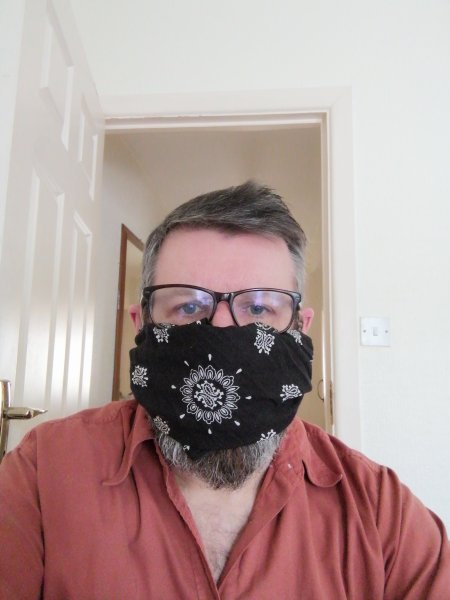
There is quite a controversy these days about whether or not to wear a face mask in public to help prevent the spread of Covid-19. The way you should think of this is not to protect yourself but to protect others from being infected by you. On the other hand there is a shortage of proper medical face masks which no sensible person would want to exacerbate.

Yesterday I saw this little video on YouTube that shows how to make a mask from a bandana and two elastic bands:

The instructions are so simple that I even managed to make one myself, though it’s not as neat as the one in the video.

The thing about all the folding is that it puts several layers in between your nose/mouth and the outside world. It’s important to use quite large elastic bands too, otherwise it will pull on your ears.

It’s quite comfortable so from now on I think I will wear one whenever it seems appropriate. The only disadvantage I’ve found so far is that it results in the audio quality on my video lectures being somewhat degraded…

Death in the UK

Posted in Covid-19, Politics with tags , , on April 22, 2020 by telescoper

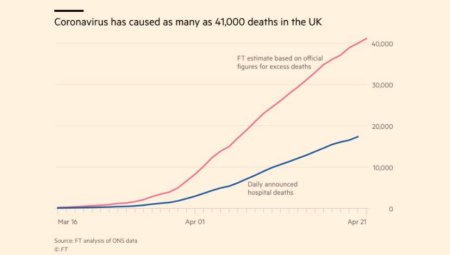
I couldn’t resist the temptation to do a short post drawing attention to an article in the Financial Times that points out that, based on an analysis of data from the Office of National Statistics, the number of Covid-19 related deaths in the UK is probably around 41,000 which is more than twice the official figure. Unusually for the FT the article is not behind a paywall so I recommend you read it.

Here you can see a couple of figures from the FT piece:

There are three main reasons why the official figures are misleading, namely that Covid-19 deaths reported each day by the UK authorities exclude:

Your reminder that the Covid-19 deaths reported each day by the UK authorities exclude:

  1. those who died of Covid-19 without ever being tested;
  2. those who died of Covid-19 who were tested but whose result was a false negative;
  3. those who died of Covid-19 outside hospitals whether they were tested or not.

Whenever I have pointed this out on Twitter (which I have done several times) I have attracted comments to the effect of “So what? Every country does the same” which is untrue. Several other countries (both large and small), including Ireland, include deaths outside hospital. Not all countries have such a shambolic policy on testing either, so not all countries leave people to die alone in their own homes without being tested. And, above all, not all countries have a Government consisting entirely of people whose incompetence is surpassed only by their dishonesty.

I’m not saying that it’s easy to communicate reliable data during a rapidly evolving pandemic. The Irish authorities are struggling to keep their figures accurate and up to date. The result is that the information available to the public is sometimes a bit confusing.

For example, a couple of days ago there was a significant upward spike in the reported deaths (red curve, about a factor two increase):

Whether this is an artefact of counting having been delayed over the weekend or a real increase, I don’t know. In any case the deaths reported each day did not necessarily occur in the previous 24 hours and may have been several days earlier. This makes the plot difficult to interpret

What I am saying is that the UK government could easily be more honest about the Covid-19 situation in the UK if it wanted to. Given that the shambles is of its own creation, and that lying is a way of life for its Ministers, it has no incentive to do anything other than obfuscate.

Exceptional Moods?

Posted in Biographical, Mental Health with tags , , on April 20, 2020 by telescoper

The other day I came across the following excerpt from The War Of The Worlds by H. G. Wells:

Perhaps I am a man of exceptional moods. I do not know how far my experience is common. At times I suffer from the strangest sense of detachment from myself and the world about me; I seem to watch it all from the outside, from somewhere inconceivably remote, out of time, out of space, out of the stress and tragedy of it all.

This passage struck me very forcefully because it captures what it feels like to experience depersonalisation disorder. I wrote about my own experiences of this about three years ago.

In my own case the depersonalisation was, I think, a side-effect of medication I took to deal with an anxiety condition that has plagued me off and on for many years.

In recent weeks I have often felt strangely detached in the same way as before, but I haven’t been on medication for nearly three years now so that’s not the cause this time.

Perhaps it is just the social distancing and the general stress caused by the Covid-19 outbreak that is causing it?

If so there is probably quite a number of people out there feeling the same way.do maybe these moods aren’t really exceptional?

R.I.P. Henry Grimes (1935-2020)

Posted in Jazz with tags , , , , , on April 19, 2020 by telescoper

The Coronavirus continues to cut a swathe through a generation of great Jazz musicians. The latest sad news is of the passing of bass player Henry Grimes at the age of 84.

Henry Grimes was very active in the 50s and 60s, playing with such luminaries as Sonny Rollins and Thelonious Monk, and appearing on some classic recordings, but he dropped out of the music scene as a performer for roughly thirty years from about 1970 during which time he was virtually destitute. He returned to music around 2002 after a Jazz fan tracked him down and bought him a double bass to play – he had sold his instrument decades earlier – and remained active until his death.

When I heard last night of the death of Henry Grimes the first thing that popped into my mind was this sequence from the movie Jazz On A Summer’s Day. You can see shot of the young Henry Grimes right at the beginning in this clip of the Thelonious Monk trio playing Blue Monk at the Newport JJazz Festival in 1958; Roy Haynes was the drummer.

Rest in peace, Henry Grimes (1935-2020)

Covid-19: the next steps

Posted in Biographical, Covid-19, Education, Maynooth with tags , on April 16, 2020 by telescoper

The Irish Government’s information booklet about Covid-19

Although we are currently in what is meant to be the Easter holiday the new normal continues in the form of a plethora video conferences and email exchanges punctuated by the occasional bit of rest and relaxation. We’ve even got a virtual seminar tomorrow and a virtual Open Day on Saturday 25th April to add to the fun.

One of the things making life stressful for academics these days is uncertainty about the future. Will the current lockdown actually end on May 5th? Will our plans for remote examinations work out OK? Will the Leaving Certificate actually go ahead this summer? When will the next academic year begin?

None of these issues is on the same scale as those confronting health workers and others on the front line fighting this pandemic, but that doesn’t mean they aren’t causing anxiety.

My own view is that we need to concentrate as far as possible on the next step and not get carried away by the ifs and buts about what comes after. There are too many imponderables on the horizon, so just focus on what you can control. We have three more weeks teaching here at Maynooth before the end of the Semester so let’s do that as well as we can. After that there is the exam period so let’s try to get through that with as few glitches as possible. We’ll just have to cross other bridges when we come to them.

For myself, I am sceptical that there will be any reduction of the current restrictions on May 5th and if there is, it will be slight at first. As the Taoiseach Leo Varadkar said today relaxation of the lockdown will take places gradually over a number of months. As a physicist I see the change being rather like an adiabatic process, carried out in quasi-static fashion in a series of reversible steps…

Testing Times

Posted in Biographical, Covid-19 with tags , , on April 12, 2020 by telescoper

Today is April 12th which means, astonishingly, that it’s just one month since Ireland went into the first stage of its current lockdown. I say “astonishingly” because it seems much longer ago than that!

I know I’m not the only person who is finding it difficult these days to keep track of the passage of time. The lack of a regular routine seems to be the reason. The solution, I imagine, is to try to impose a timetable on yourself rather than have it imposed upon you by someone else. I’ve only been partially successful in that, probably because I lack the necessary self-discipline. Still, somewhat to my surprise, I am not having any significant problems sleeping.

Anyway talking about testing times, I wanted to make a quick comment on the Covid-19 situation in Ireland. I’ve been keeping track of the statistics on my page here, which I shall continue to update as things develop. The latest plot is as follows.

The last two points in the orange curve show a bit of a spike. That is because they include the results from a batch of about 6000 swabs sent for testing to Germany. These should be apportioned to earlier dates but lacking the information needed to do this in a sensible way I’ve just plotted them when the results were received (Friday and Saturday). This also means that the slight inflection in the blue curve is not real, but it doesn’t change the general picture significantly.

This is a manifestation of a major difficulty that the authorities in Ireland are facing, which is the capacity to do coronavirus testing in sufficient numbers and sufficiently rapidly to enable contact tracing in real time which is needed to further control the spread of this disease. At present only around two thousand tests per day are being done, which is inadequate.

Although the recent upward blip is an artefact, the fact remains that there is no evidence that the number of new cases is reducing sufficiently quickly for the relaxation of the rules to be considered feasible. There is a real danger that if the number of new cases does not stop falling soon, the number of patients needing intensive care will exceed the resources available.

Anyway, I reckon things will stay as they are until June at the earliest, so we’ll just have to get used to it!